
Forklifts Market Size, Growth & Trends by 2034
Coverage: by Type (Warehouse Type and Counterbalance Type); Class (Class I, Class II, Class III, Class IV, Class V and Class VI); Engine Power (IC Engine Power and Electric Engine Power); Tonnage (Less than 5 ton, 5-10 ton, 11-36 ton and Above 36 ton); and Application (Warehouse, Logistics, Automotive, Manufacturing and Food Industry), and Geography (North America, Europe, Asia Pacific, and South and Central America)
- Status : Data Released
- Report Code : TIPTE100000630
- Category : Manufacturing and Construction
- No. of Pages : 150
- Available Report Formats :


- Last update date : July 28, 2026


2025 Market Size
US$ 79.81 Bn
Base year value
2034 Forecast
US$ 244.42 Bn
Projected by 2034
CAGR 2026-2034
13.24 %
Growth rate
Addressable Market
US$ 1,407.50 Bn
(2026-2034)
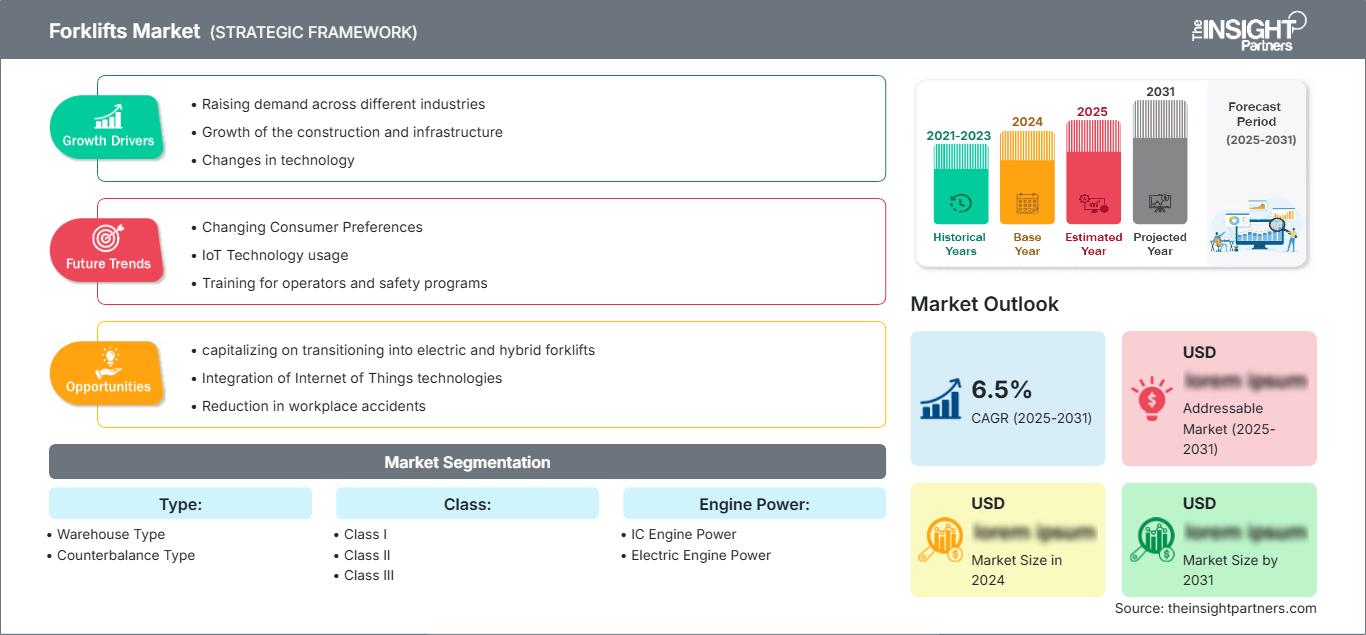
The forklifts market size stood at US$ 79.81 Billion in 2025 and is forecasted to expand to US$ 244.42 Billion by 2034, posting a CAGR of 13.24% from 2026–2034. Growth is due to automation of warehouses, electric powertrains of fleets, and higher throughput demands in manufacturing industries, retail, ports, construction material, and third-party logistics. Transition from labor-intensive manual handling to intelligent trucks is causing extended replacements intervals and higher average sale prices.
North America will see replacement demand continue to drive the growth in forklifts market size, with regional CAGR projected to be 11.8% – 12.6% up to 2034. The market growth will be aided by the number of e-commerce fulfillment facilities per unit of territory, warehouse investments related to reshoring and the stricter indoor emissions regulations favoring electric trucks. Heavy utilization in food distribution centers, cold storages and automotive factories also pushes fleet owners to implement lithium-ion charging, telematics and operator assistance systems.
Forklifts Market Assessment and Insights
- North America accounted for 24–27% forklifts market share in 2025 and is projected to grow at 11.8–12.6% CAGR between 2026–2034, supported by warehouse automation, retail distribution renewal, and electric fleet conversion.
- US represented 78–82% of North America in 2025 and is expected to expand at 11.9–12.7% CAGR between 2026–2034.
- Europe held 20–23% share in 2025 and is projected to advance at 10.8–11.6% CAGR between 2026–2034, led by Germany, France, the UK, Italy, and Spain.
- Asia Pacific captured 42–46% share in 2025 and is forecast to grow at 14.1–15.2% CAGR between 2026–2034, led by China, Japan, South Korea, India, and Australia.
- Largest Segment Counterbalance Type held 58–62% market share in 2025, with 12.4–13.1% CAGR between 2026–2034, reflecting broad outdoor and manufacturing use.
- High Growth Segment Electric Engine Power held 63–67% market share in 2025, with 14.5–15.4% CAGR between 2026–2034, driven by clean indoor operations.
- Key companies analyzed in detail: Toyota Industries Corporation, KION Group AG, Hyster-Yale Materials Handling, Inc., Jungheinrich AG, Mitsubishi Logisnext Co., Ltd., Crown Equipment Corporation, Clark Material Handling Company, Anhui Heli Co., Ltd., Hangcha Group Co., Ltd., Komatsu Ltd.
Source: The Insight Partners' analysis based on proprietary research, government publications, company annual reports, investor presentations, industry databases, and expert interviews.
Equipment innovation is shifting the balance of the forklift industry away from mechanically differentiating products to digital, battery-powered solutions that incorporate sensors, access controls, and fleet analysis systems. In terms of production trends, Asian producers are ramping up lithium-ion vehicles, while more traditional North American, Japanese, and European brands are focused on reliability, dealership support, and automation capabilities. Forklift purchases will therefore increasingly be based on factors including availability, flexibility of charging, maintenance costs, operator safety, and software compatibility in addition to capacity.
Over the forecast period, growth in sales is expected to be driven by India, Southeast Asia, the Gulf region, Mexico, and Eastern Europe due to supply chain diversification and the expansion of storage facilities. Regulatory forces will continue this trend in light of reduced indoor emissions and noise pollution at ports, factories, and distribution centers. The capital expenditures of buyers will favor electric counterbalance trucks, Class III warehouse products, navigation automation, and business models based on fleet rental rather than ownership.
Forklifts Market Report Scope
| Report Attribute | Details |
|---|---|
| Market size in 2025 | US$ 79.81 Billion |
| Market Size by 2034 | US$ 244.42 Billion |
| Global CAGR (2026 - 2034) | 13.24% |
| Historical Data | 2021-2024 |
| Forecast period | 2026-2034 |
Forklifts Market Analysis
The forklifts market growth will be driven by increased distribution centers, heavier pallet loads, and improved efficiency from the dock-to-stock process. Warehouses are embracing narrow aisles, tall racks, and multi-SKUs picking that will increase demand for Class I, II, and III lift trucks. The industry is also upgrading its lift truck fleet to ensure safety and continuous production in the automobile, food, chemical, and building materials industries.
This includes the value chain from steel fabrication, mast assembly, batteries, chargers, hydraulics, control electronics, software, dealers, rentals, and after-sale maintenance companies. Batteries have now become strategically important due to their ability to cut charging time and allow opportunity charging of lithium-ion batteries. Supply chain dynamics are still sensitive to availability of electronics, tariffs, and steel prices; localization also ensures OEMs get shorter lead times for high volume warehouse and counterbalance trucks.
The forklifts market analysis highlights an environment of competition characterized by factors such as scale, service density, battery systems, and automation partnerships. Toyota Industries Corporation, KION Group AG, Jungheinrich AG, and Mitsubishi Logisnext Co., Ltd. maintain broad portfolios while Anhui Heli Co., Ltd. and Hangcha Group Co., Ltd. are growing their international presence with cost-efficient electric forklifts and shortened product refresh cycles.
Current investments are focused on lithium-ion batteries, autonomous-ready control systems, and fleet management software which can then be sold. Hyster-Yale Materials Handling, Inc., Crown Equipment Corporation, Clark Material Handling Company, and Komatsu Ltd. are working on enhancing the offering from dealerships for tough applications. Positioning is increasingly dependent on lifetime cost evidence, financing options, availability of parts, and supporting mixed fleets at multiple locations.
● REPORT CUSTOMIZATION
Tailor This Report To Align With Your Specific Business Requirements
This report can be customized to align precisely with your business objectives, scope, and target markets. Customization options include tailored segmentation, geography, competitive analysis, and strategic insights to support informed decision-making.
Customize This Report →WHAT YOU CAN ADJUST
- ● Segmentations
- ● Geography
- ● Competitive Analysis
- ● Language Preferences
Forklifts Market: Strategic Insights
Regional Insights
North America forklifts market
The share of North America in the revenue generation in 2025 was between 24-27%, and it will grow with a CAGR of 11.8-12.6% between 2026-2034. The market shares of the forklifts are driven by massive fulfillment systems, cold chain investments, and higher labor cost resulting in quick cycle times.
Fleet electrification is gaining momentum due to the air quality regulations, corporate sustainability targets, and fewer maintenance requirements favoring batteries as the platform. The region also enjoys good dealership and rental system which enables customers to try out lithium ion forklifts, automation for pallet movement, and telematics.
U.S. Forklifts Market
The U.S. accounted for 78-82% of the North American demand in 2025 and is forecast to grow at a 11.9-12.7% CAGR during 2025-2034. Demand is driven by high throughput e-commerce facilities, foodservice distribution centers, automotive parts logistics, and construction material handling within growing metropolitan logistics corridors.
Presence in the region is extensive, with key manufacturers including Toyota Industries Corporation, Crown Equipment Corporation, Hyster-Yale Materials Handling, Inc., and Clark Material Handling Company servicing nationwide dealer networks. The applications have moved from basic pallet handling solutions to productivity programs incorporating operator training, telematics, lithium-ion charging, and predictive maintenance scheduling.
Europe Forklifts Market
Europe had market share of 20–23% in 2025 and is expected to grow at CAGR of 10.8–11.6%. Europe was led by Germany due to high automotive, machinery, chemical, and intralogistics operations in Germany, while KION Group AG and Jungheinrich AG provide technological dominance in electric warehouse trucks and automation ready fleets.
United Kingdom had support from the grocery distribution centers, parcels fulfillment centers, and port handling, while France gets support from food and pharmaceuticals logistics. Italy and Spain have been witnessing steady demand in manufacturing industries, wine and food processing, and building materials logistics, along with regulations for emissions promoting electric vehicles.
APAC Forklifts Market
Share of APAC region is estimated at 42-46%, while CAGR growth in this region is expected to be 14.1-15.2%. This is due to the presence of China's massive production, Japan's highly automated processes, South Korea's electronics supply chain, India's warehouse construction and Australia's mining logistics.
Increasing policy support for low-emission industrial equipment and modern factories stimulates electric forklift demand. Local OEMs are gaining their export competitiveness with help of lithium-ion technology, compact warehouse equipment and value forklifts in the counterbalance segment attractive for Southeast Asia logistics and industrial parks.
Middle East & Africa Forklifts Market
The Middle East & Africa segment is expected to grow at a rate of 12.2–13.0% CAGR, with Saudi Arabia leading investments within the region. Growing need for counterbalance trucks, yard support, and material handling equipment is due to UAE logistics centers, South African industrial & retail logistics, and other projects within the region.
Procurement drivers include energy & construction, port and free zone warehouse handling requirements. In general, buyers prefer robust IC engine variants in difficult outdoor conditions, although electric models are becoming more attractive in indoor storage, food logistics, and airports.
Segmentation Analysis
Type
The type segment is expected to grow at 12.8–13.6% CAGR during 2026–2034 as buyers balance warehouse maneuverability with rugged counterbalance performance. The forklifts market scope across this segment includes high-density indoor storage, loading docks, ports, construction yards, and manufacturing lines. Counterbalance trucks remain essential for heavier loads, while warehouse models gain relevance in e-commerce and grocery distribution.
- Warehouse Type equipment supports narrow aisles, pallet picking, and indoor movement where turning radius, lift height, and battery life define productivity. Demand is strongest in fulfilment, cold storage, retail, and parcel operations.
- Counterbalance Type forklifts are broadly used across manufacturing, ports, yards, and construction supply chains because they handle varied load profiles. Their strategic importance remains high where outdoor movement and heavier pallets dominate.
Class
The class segment is projected to expand at 13.0–13.8% CAGR during 2026–2034, reflecting diversified fleet requirements across indoor, outdoor, and specialized handling environments. Class I, II, and III units benefit from electrification and warehouse automation, while Class IV and V remain relevant in rugged industrial applications. Class VI equipment addresses towing and utility movement in large campuses.
- Class I electric rider trucks serve indoor and mixed-use facilities that need clean operation with high lifting capability. They are central to fleet modernization in manufacturing and distribution centers.
- Class II narrow-aisle trucks support high-rack warehousing where space utilization is critical. Their demand rises as operators add dense storage without expanding building footprints.
- Class III pallet trucks and stackers dominate routine warehouse movement, retail backrooms, and loading zones. Their strategic value lies in frequent, short-distance pallet handling at lower acquisition cost.
- Class IV cushion-tire IC trucks suit indoor hard-surface operations requiring robust load movement. They remain important in factories, paper, packaging, and building materials facilities.
- Class V pneumatic-tire trucks operate in outdoor yards, lumber, construction, and ports. Their demand is tied to durability, traction, and heavier-duty material movement.
- Class VI tow tractors support airports, industrial campuses, and line-feeding operations. Their role is strategic where repetitive trailer movement improves labor productivity and traffic flow.
Engine Power
The engine power segment is anticipated to grow at 13.4–14.2% CAGR during 2026–2034 as fleets shift toward electric platforms while retaining IC engines for heavy-duty outdoor cycles. Electric equipment is favored in indoor logistics for lower noise, reduced maintenance, and emissions compliance. IC models continue to serve construction, lumber, ports, and remote sites where refueling speed and continuous power matter.
- IC Engine Power remains relevant for outdoor, high-load, and long-shift operations where diesel, LPG, or gasoline refueling supports uninterrupted productivity. Strategic demand persists in construction and heavy industrial yards.
- Electric Engine Power leads modernization programs because lithium-ion charging, lower service needs, and cleaner indoor operation improve total cost of ownership. Demand is strongest in warehouses, food logistics, and retail fulfilment.
Tonnage
The tonnage segment is forecast to grow at 12.7–13.5% CAGR during 2026–2034 as equipment selection aligns with pallet weight, aisle design, yard condition, and lift height. Less than 5 ton trucks dominate standard warehouse and retail flows. Higher-capacity models serve steel, ports, machinery, timber, and construction materials where safety margins and structural durability outweigh compact design.
- Less than 5 ton trucks address most warehousing, grocery, consumer goods, and light manufacturing tasks. Demand is broad because these units combine maneuverability, affordability, and compatibility with electric powertrains.
- 5-1 ton equipment serves heavier pallets, industrial supplies, and mixed indoor-outdoor operations. Strategic demand comes from customers needing more stability and lifting capacity without moving into specialty heavy trucks.
- 11-36 ton forklifts are used in ports, steel, precast concrete, energy equipment, and large machinery handling. Buyers prioritize safety systems, structural strength, visibility, and dependable service availability.
- Above 36 ton units support extreme material handling in shipyards, heavy manufacturing, mining support, and container-related applications. Demand is specialized, project-linked, and highly dependent on engineering support.
Opportunity Snapshot
| Segment Name | Revenue Contribution | Trend Tag | Adoption Stage |
| Warehouse Type | High | Dense Storage | Scaling |
| Counterbalance Type | High | Fleet Renewal | Mature |
| Class I | High | Electric Ride | Scaling |
| Class II | Medium | Narrow Aisle | Scaling |
| Class III | High | Pallet Flow | Mature |
| Class IV | Medium | Indoor IC | Mature |
| Class V | Medium | Outdoor Lift | Mature |
| Class VI | Low | Yard Tow | Emerging |
| IC Engine Power | Medium | Heavy Duty | Mature |
| Electric Engine Power | High | Li-ion Shift | Scaling |
| Less than 5 ton | High | Light Loads | Mature |
| 5-1 ton | Medium | Mid Capacity | Scaling |
| 11-36 ton | Medium | Port Handling | Scaling |
| Above 36 ton | Low | Heavy Lift | Emerging |
Forklifts Market Growth Drivers and Impact Analysis
Warehouse Automation and Labor Productivity Pressure
The design of warehouses is changing based on increased picking rates, reduced delivery times, and reduced number of skilled operators. In such circumstances, forklifts, pallet jacks, reach trucks, and tow tractors have become vital for optimizing throughput rather than just material movement. Evidence of this can be found in increased demands for telematics solutions, operator assistance solutions, and fleet management software. As logistics companies continue consolidating their regional fulfillment network operations, each facility needs equipment that will facilitate high-density storage and safe traffic flow.
Electrification and Indoor Emission Compliance
Procurement of battery-powered products is becoming increasingly important as indoor working environments become stricter about air quality and reduce the use of combustion equipment in confined spaces. With lithium-ion technology, opportunity charging, lower maintenance needs, and greater suitability for shift work is possible. In the food, pharmaceutical, retail, and refrigerated applications markets, clean operation reduces the need for ventilation and makes workers feel more comfortable. The commercial result is an expanded addressable market for counterbalance trucks and Class III forklifts. OEMs with the ability to bundle batteries, chargers, service, data analysis, and even finance into one complete truck fleet solution can capitalize on this recurring revenue opportunity.
Industrial Reshoring and Infrastructure-Led Handling Demand
With increased manufacturing localization, port development, logistics parks, and infrastructure initiatives, there is a growing demand for machines that are able to safely transport components, pallets, steel, cement, wood, and manufactured goods. The reshoring trend in North America and Europe is driving manufacturing demand, whereas Asia and the Middle East will gain from industrial corridors and export-oriented facilities. This factor extends the application area of equipment beyond e-commerce and boosts demand in counterbalance and high tonnage trucks and IC engine machines. It also motivates customers to consider dealer proximity, service, and operator training.
Forklifts Market Future Trends
Autonomous-Ready Fleet Platforms
The forklifts market trends will increasingly center on autonomous-ready designs that can be manually operated today and upgraded later with navigation, sensors, and warehouse-management integration. This pathway reduces adoption risk for customers that are not ready for full automation but want future compatibility. OEMs are likely to standardize digital controllers, safety scanners, and data interfaces across broader model families. As labor availability remains uneven, semi-autonomous pallet movement, trailer loading support, and automated line feeding will become practical first steps before fully driverless fleets scale across complex facilities.
Energy Ecosystems Around Charging and Batteries
Battery strategy will evolve from equipment selection into a site-level energy planning issue. Large warehouses will compare charging windows, peak electricity tariffs, charger placement, and backup power requirements before selecting fleet configurations. Lithium-ion will remain the main upgrade path, while hydrogen fuel cells may fit high-intensity sites that require fast refueling and continuous shifts. Suppliers that advise on chargers, software, grid impact, and battery health will gain influence because the economics of electric fleets depend on energy management as much as vehicle performance.
Forklifts Market Opportunities
Fleet-as-a-Service for Multi-Site Operators
The strongest commercial opportunity lies in converting equipment sales into managed fleet programs for retailers, manufacturers, and logistics providers operating multiple sites. The forklifts market forecasts point to rising demand for predictable costs, uptime guarantees, and standardized safety reporting. OEMs and dealers can bundle trucks, batteries, chargers, telematics, operator training, maintenance, and replacement planning under long-term contracts. This approach reduces customer capital burden and creates recurring revenue for suppliers. It also improves fleet visibility, enabling right-sizing across sites and lowering idle equipment ownership.
Emerging Market Electric Conversion Packages
Emerging markets offer a practical opportunity for suppliers that can package electric trucks with financing, charging infrastructure, and local service training. Many buyers in India, Southeast Asia, the Middle East, and Africa remain cautious because upfront prices and electricity readiness vary by site. Vendors that provide modular chargers, battery leasing, and maintenance education can accelerate adoption without forcing customers into oversized systems. The opportunity is especially attractive in food logistics, retail distribution, airports, and industrial parks where indoor emissions, noise, and productivity pressures are becoming more important.
Recent Developments
- January 2025: Toyota Material Handling — launched Integrated Mid & Large Electric Pneumatic Forklifts and refreshed Core Electric Forklift models for North America, expanding electric options with lithium-ion capability and 8,000 to 17,500 pound capacities for demanding outdoor and mixed-use applications
- May 2026: Toyota Industries Corporation announced that it has signed a share transfer agreement today with IHI Corporation (hereinafter "IHI") to acquire 80% of the issued shares of IHI Logistics & Machinery Corporation (hereinafter "IHI Logistics & Machinery"), a consolidated subsidiary of IHI engaging in its logistics systems business.
- November 2025: Mitsubishi Logisnext Americas has introduced the Jungheinrich EFG C20Q-C40Q, a new electric forklift engineered for narrow-aisle warehouse operations, combining advanced technology with enhanced power, maneuverability, and operator comfort. The model is designed to improve productivity and efficiency in demanding material handling environments.
Frequently Asked Questions

- Comprehensive Market Sizing and Forecast Analysis
- Detailed Segmentation Analysis
- In-Depth Market Dynamics Assessment
- Regional and Country-Level Insights
- Competitive Landscape and Company Benchmarking
- Strategic Business Intelligence
Recent Reports
Testimonials

The Insight Partners provided valuable market intelligence that supported our global go-to-market strategy. Their team was professional, responsive, and attentive to our feedback, providing thoughtful analysis and helpful methodological clarifications throughout the project.
Junmo Kim Chief Financial Officer (CFO), Enertech Co., Ltd.
The Insight Partners' SCADA System Market report is comprehensive, with valuable insights on current trends and future forecasts. The team was highly professional, responsive, and supportive throughout. We are very satisfied and highly recommend their services.
RAN KEDEM Partner, Reali Technologies LTDs
I requested a report on a very specific software market and the team produced the report in a few days. The information was very relevant and well presented. I then requested some changes and additions to the report. The team was again very responsive and I got the final report in less than a week.
JEAN-HERVE JENN Chairman, Future Analytica
We worked with The Insight Partners for an important market study and forecast. They gave us clear insights into opportunities and risks, which helped shape our plans. Their research was easy to use and based on solid data. It helped us make smart, confident decisions. We highly recommend them.
PIYUSH NAGPAL Sr. Vice President, High Beam Global
The Insight Partners delivered insightful, well-structured market research with strong domain expertise. Their team was professional and responsive throughout. The user-friendly website made accessing industry reports seamless. We highly recommend them for reliable, high-quality research services
YUKIHIKO ADACHI CEO, Deep Blue, LLC.
This is the first time I have purchased a market report from The Insight Partners.While I was unsure at first, I visited their web site and felt more comfortable to take the risk and purchase a market report.I am completely satisfied with the quality of the report and customer service. I had several questions and comments with the initial report, but after a couple of dialogs over email with their analyst I believe I have a report that I can use as input to our strategic planning process.Thank you so much for taking the extra time and making this a positive experience.I will definitely recommend your service to others and you will be my first call when we need further market data.
JOHN SUZUKI President and Chief Executive Officer, Board Director, BK Technologies
I wish to appreciate your support and the professionalism you displayed in the course of attending to my request for information regarding to infectious disease IVD market in Nigeria. I appreciate your patience, your guidance, and the fact that you were willing to offer a discount, which eventually made it possible for us to close a deal. I look forward to engaging The Insight Partners in the future, all thanks to the impression you have created in me as a result of this first encounter.
DR CHIJIOKE ONYIA MANAGING DIRECTOR, PineCrest Healthcare Ltd.Reason to Buy
- Informed Decision-Making
- Understanding Market Dynamics
- Competitive Analysis
- Identifying Emerging Markets
- Customer Insights
- Market Forecasts
- Risk Mitigation
- Boosting Operational Efficiency
- Strategic Planning
- Investment Justification
- Tracking Industry Innovations
- Aligning with Regulatory Trends





 Get Free Sample for