
Gas Generator Set Market Growth, Share & Trends by 2034
Coverage: By Fuel Type (Natural Gas, Biogas, Others); Power Rating (Below 100 KVA, 100-350 KVA, 350-1000 KVA, Above 1000 KVA.); End-User (Residential, Industrial, Commercial, Power and Energy, Others.) , and Geography (North America, Europe, Asia Pacific, and South and Central America)
- Status : Data Released
- Report Code : TIPRE00027605
- Category : Energy and Power
- No. of Pages : 150
- Available Report Formats :


- Last update date : November 18, 2026


2025 Market Size
US$ 8.08 Bn
Base year value
2034 Forecast
US$ 12.65 Bn
Projected by 2034
CAGR 2026-2034
5.11 %
Growth rate
Addressable Market
US$ 94.07 Bn
(2026-2034)
The Gas Generator Set Market was valued at US$ 8.08 billion in 2025 and is projected to reach US$ 12.65 billion by 2034, registering a CAGR of 5.11% during 2026–2034. Growth is supported by rising requirements for dependable distributed power, increasing electricity demand from data centers and industrial facilities, expansion of gas-based generation, and the use of flexible generation assets to complement variable renewable power.
North America remains a mature demand center, supported by extensive natural gas infrastructure, distributed generation requirements, and increasing electricity demand from data centers and industrial loads. The Gas Generator Set Market size is projected to expand at a modeled CAGR of ~4% through 2034 as gas generator sets are increasingly deployed for backup, prime power, microgrids, and grid-support applications.
Gas Generator Set Market Assessment and Insights
Regional Outlook
- North America: ~30% of the global market in 2025 | ~4% CAGR through 2034. Market position: North America represents a leading regional market, supported by extensive gas availability, established generator infrastructure, data-center expansion, industrial electrification, and demand for reliable onsite generation during periods of grid constraint.
- US: ~72% of North American market revenue in 2025 | ~4% CAGR through 2034. Market position: The US dominates North American demand, supported by natural gas availability, data-center power requirements, industrial facilities, and growing investment in dedicated onsite generation and microgrids for high-reliability applications.
- Europe: ~24% of the global market in 2025 | ~4% CAGR through 2034. Market position: Europe is a mature market where gas generator sets support balancing, distributed generation, industrial resilience, and replacement requirements. Germany is the leading country in Europe, followed by substantial demand from the UK, France, Italy, and Spain.
- Asia Pacific: ~32% of the global market in 2025 | ~7% CAGR through 2034. Market position: Asia Pacific is the fastest-growing region, supported by industrialization, expanding electricity demand, data-center investment, distributed generation, and infrastructure development. China is the leading country in Asia Pacific, with India and other markets adding growth momentum.
Segment Outlook
- Industrial: ~42% Share in 2025 | ~6% CAGR through 2034. Market position: Industrial users lead demand because continuous operations require dependable electricity, voltage stability, and backup capacity. Manufacturing, processing, mining, and other energy-intensive facilities increasingly combine generator sets with onsite power systems.
- Biogas: ~16% Share in 2025 | ~8% CAGR through 2034. Market position: Biogas is the high-growth fuel segment as waste-to-energy projects, agricultural digesters, wastewater facilities, and circular-energy programs create opportunities for generation from locally available renewable gas resources.
Competitive Coverage
Caterpillar Inc., GE Vernova Inc., Cummins Inc., Himoinsa S.L., Rolls-Royce Power Systems AG, Generac Power Systems, Inc., Wärtsilä Corporation, Siemens AG, ABB Ltd., Dresser-Rand
Methodology
The Insight Partners follows Data Collection & Secondary Research, Primary Research, Data Analysis, and Data Triangulation & Final Review to validate market estimates and insights.
Source: The Insight Partners' analysis based on proprietary research, government publications, company annual reports, investor presentations, industry databases, and expert interviews.
Gas Generator Set Market evolution is influenced by advancements in gas engine efficiency, controls, emissions, remote monitoring, and integration into modular power systems. The generator set is increasingly becoming part of the overall distributed energy solution and not just a combination of an engine and alternator. Natural gas is useful when there is access to the piped network, whereas biogas can enable local generation at sites such as water treatment, agricultural, and waste-processing plants. At the equipment level, advancements are being made in load response, synchronization, and maintenance planning.
The forward Gas Generator Set Market outlook is increasingly shaped by rising electricity demand, infrastructure modernization, and the need for flexible power generation alongside renewable energy sources. The new centers of demand include certain regions of Asia Pacific, the Middle East, and developing industrial hubs where a reliable power supply remains an essential factor for investment. The regulatory focus on emissions also means investments will be made in engines and fuels that are efficient and in renewable gas applications.
Gas Generator Set Market Report Scope
| Report Attribute | Details |
|---|---|
| Market size in 2025 | US$ 8.08 Billion |
| Market Size by 2034 | US$ 12.65 Billion |
| Global CAGR (2026 - 2034) | 5.11% |
| Historical Data | 2021-2024 |
| Forecast period | 2026-2034 |
Gas Generator Set Market Analysis
Demand is now closely tied to the need for reliable generators in critical applications and to increased activity requiring large amounts of electrical energy. Data centers, factories, commercial buildings, health centers, and remote industry sites need reliable power sources when there are shortages or interruptions in the supply from the grid. The Gas Generator Set Market growth mechanism also benefits from gas infrastructure availability, fuel flexibility, and the ability to deploy generation close to electricity loads. Across the ecosystem, engine manufacturers, alternator suppliers, control-system providers, distributors, EPC contractors, fuel suppliers, and maintenance providers contribute to project delivery and lifecycle economics.
The supply chain depends on engine manufacturing capabilities, components, emissions standards, fuel system design, and the regional service network. Large-scale projects now more often require the integration of switchgear, synchronization, controls, cooling, and monitoring systems rather than just generator systems. Established suppliers with a service network can meet uptime requirements and maintenance contracts, while regional suppliers use customization and cost as competitive advantages. The growing use of generator sets in data centers and microgrids is another reason for suppliers to focus on modularity and installation.
The competitive environment comprises internationally operating, application-oriented engine and power system producers, as well as generator producers with specific application areas. Cat Inc. utilizes integrated power solutions and comprehensive distribution systems to compete, whereas Cummins Inc. utilizes both engine and generator systems. GE Vernova Inc. operates with gas power technology, while Wärtsilä Corporation uses flexible engines for generation. Rolls-Royce Power Systems AG, Generac Power Systems, Inc., Siemens AG, ABB Ltd., Himoinsa S.L., and Dresser-Rand Inc. are other entities involved.
Investment focus is shifting more towards reliability of use, efficiency of gas engines, digitalization of monitoring, and flexible production. Cat Inc. and Cummins Inc. have specific exposure to the increasing needs of data centers and distributed generation, whereas Wärtsilä Corporation focuses its engine technologies on the integration of renewable energy and grid flexibility. Thus, strategic differentiation is no longer based merely on generator performance but rather on lifecycle performance, emissions control, service availability, and the capability of generator sets to integrate with batteries, renewable power generation, and grid operations.
● REPORT CUSTOMIZATION
Tailor This Report To Align With Your Specific Business Requirements
This report can be customized to align precisely with your business objectives, scope, and target markets. Customization options include tailored segmentation, geography, competitive analysis, and strategic insights to support informed decision-making.
Customize This Report →WHAT YOU CAN ADJUST
- ● Segmentations
- ● Geography
- ● Competitive Analysis
- ● Language Preferences
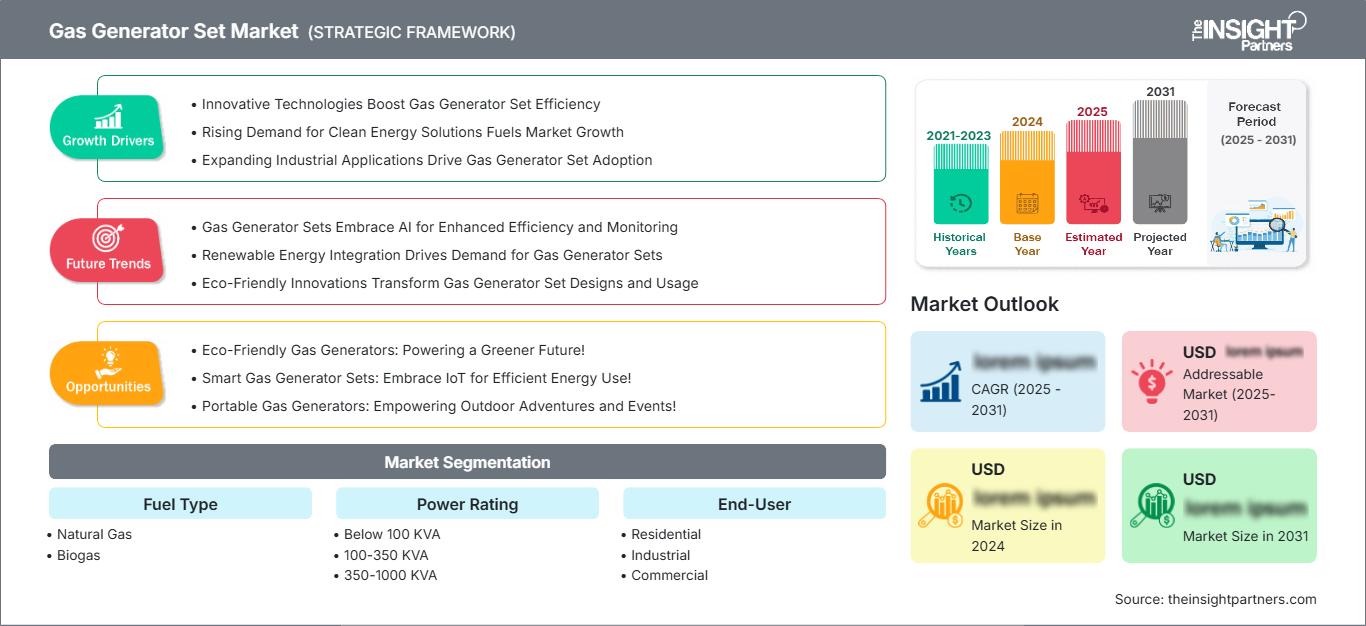
Gas Generator Set Market: Strategic Insights
Regional Insights
North America Gas Generator Set Market
North America represents ~30% of the global Gas Generator Set Market in 2025 and is projected to expand at ~4% CAGR through 2034. The region benefits from mature natural gas infrastructure, extensive generator distribution networks, and established industrial and commercial applications. The US accounts for most regional demand, while Canada contributes through industrial, remote, commercial, and resource-sector requirements. Natural gas remains an important electricity fuel in the region, although renewable generation and storage are increasingly affecting dispatch patterns.
Demand is also being reshaped by data centers and other electricity-intensive facilities that require resilient power architectures. In the US, natural gas represented about 41% of utility-scale electricity generation in 2025, while natural-gas-fired capacity represented about 40% of utility-scale generation capacity. These conditions support continued relevance for gas-based distributed power, particularly where grid expansion cannot keep pace with load growth.
U.S. Gas Generator Set Market
The US represents ~72% of North American Gas Generator Set Market revenue in 2025 and is expected to grow at ~4% CAGR through 2034. Its position is supported by abundant domestic natural gas production, extensive pipeline infrastructure, and a large installed base of distributed and standby power equipment. Electricity demand is rising across commercial and industrial applications, with data centers becoming an increasingly important source of incremental load. US electricity generation reached a record level in 2025, with demand growth particularly evident in commercial and industrial activities.
Caterpillar Inc., Cummins Inc., Generac Power Systems, Inc., and other suppliers have strong exposure to US generator demand. Applications range from standby systems for commercial buildings to prime-power microgrids supporting data centers and industrial facilities. Natural gas consumption in the electric power sector has increased substantially over the longer term, even though 2025 experienced price-driven changes in gas-fired generation.
Europe Gas Generator Set Market
Europe accounts for ~24% of the global market in 2025 and is forecast to grow at ~4% CAGR through 2034. The region has a mature installed base and strong engineering capabilities, but demand is being reshaped by energy-security priorities, renewable integration, emissions requirements, and the need for flexible electricity generation. Germany is the leading country in Europe, supported by its industrial base and large installed power infrastructure. The UK, France, Italy, and Spain each contribute through different combinations of industrial, commercial, distributed-power, and grid-balancing applications.
Germany has strong demand from manufacturing and energy-intensive facilities, while the UK places greater emphasis on flexible capacity and resilience within an increasingly renewable electricity system. France combines industrial and commercial requirements with a comparatively low-carbon power system, creating a more selective Gas Generator Set Market for gas-based equipment. Italy and Spain offer opportunities in commercial infrastructure, distributed generation, industrial applications, and systems supporting variable renewable output. European demand is therefore increasingly focused on efficiency, emissions performance, flexibility, and integration rather than simple capacity additions.
The region's gas-generation dynamics remain sensitive to weather, electricity demand, renewable output, and fuel prices. The IEA reported that European Union gas use increased in 2025, while gas-based electricity generation rose strongly as electricity demand increased and wind and hydropower output weakened. This environment supports continued demand for flexible gas engines where they can provide reliability and balancing value without displacing economically competitive renewable generation.
APAC Gas Generator Set Market
Asia Pacific accounts for ~32% of the global Gas Generator Set Market in 2025 and is the fastest-growing region, with an estimated ~7% CAGR through 2034. China is the leading country in Asia Pacific, supported by manufacturing capacity, infrastructure investment, and expanding electricity requirements. India is another major growth center, while Japan and South Korea maintain demand for resilient and efficient distributed generation. Australia is increasingly relevant for flexible generation that complements renewable electricity.
Industrial expansion, data-center development, infrastructure modernization, and power-system reliability requirements support generator-set demand. At the same time, rapid renewable deployment is changing the role of gas engines from conventional generation toward flexible backup and balancing capacity. The IEA reported that Asian gas-demand growth moderated in 2025, while China continued to record gas-demand growth and India experienced lower gas use in power generation amid strong renewable expansion.
Middle East & Africa Gas Generator Set Market
Middle East and Africa demand is supported by energy-intensive industries, infrastructure development, remote power requirements, and the need to improve electricity reliability. The region is expected to grow at ~6% CAGR through 2034. Saudi Arabia is the leading country in the Middle East and Africa Gas Generator Set Market, supported by large-scale infrastructure and industrial investment, while the UAE represents an important commercial and infrastructure application center. South Africa contributes demand from industrial, commercial, and backup-power applications.
Gas generator sets are particularly relevant where dependable electricity is required alongside expanding grids or where projects operate in remote locations. In the Middle East, fuel availability and oil-to-gas switching support gas-based power applications. The IEA reported stronger Middle Eastern gas demand in 2025, driven partly by increased gas use in power generation, particularly in Saudi Arabia.
Segmentation Analysis
Fuel Type
Fuel type is strategically important because fuel availability, emissions requirements, operating cost, and site infrastructure directly affect generator-set selection. Natural gas remains the principal commercial foundation of the category, while renewable-gas applications are gaining attention where localized feedstocks are available. The Gas Generator Set Market scope increasingly includes solutions designed for cleaner fuel pathways, flexible operation, and integration with distributed-energy systems. Fuel-selection decisions are particularly important for industrial and commercial buyers evaluating long-term operating economics and regulatory exposure. ~8% CAGR is modeled for Biogas through 2034.
- Natural Gas: Natural gas remains the dominant fuel pathway because established pipeline infrastructure, mature engine technology, and broad commercial availability support dependable operation across stationary applications. It is particularly relevant for continuous, prime, and standby generation.
- Biogas: Biogas supports localized generation where organic waste, wastewater, agricultural residues, or landfill resources can provide a dependable fuel stream. Its strategic value is strongest in circular-energy projects seeking onsite electricity production.
Power Rating
Power rating determines equipment architecture, project economics, physical footprint, and the type of electricity load that can be served. Gas Generator Set Market Demand is increasingly polarized between compact systems for commercial and distributed applications and high-capacity systems for industrial, data-center, and utility-support requirements. Buyers evaluate not only nominal output but also load profile, redundancy, runtime, synchronization, installation constraints, and serviceability. Power-rating selection therefore remains a central procurement consideration across both new installations and replacement projects.
- Below 100 KVA: This category serves smaller facilities and distributed applications where compact equipment, installation flexibility, and dependable standby electricity are more important than very high continuous output. It is relevant to smaller commercial and residential sites.
- 100-350 KVA: These systems address medium-scale commercial and institutional loads requiring dependable backup or supplementary power. Their modular configuration can support phased capacity additions and applications with moderate electrical demand.
- 350-1000 KVA: This category is relevant to larger commercial properties, industrial facilities, infrastructure projects, and mission-critical sites. Buyers typically emphasize synchronization, operating efficiency, service support, and sustained performance.
- Above 1000 KVA: High-capacity systems support large industrial facilities, data centers, utility-related projects, and substantial microgrids. Their deployment requires detailed engineering around fuel supply, cooling, controls, emissions, and grid interaction.
End-User
End-user demand reflects the reliability requirements, operating profiles, and electricity intensity of different customer groups. Industrial applications represent the largest center of Gas Generator Set Market demand because production interruptions can create significant operational losses and many facilities require stable electricity beyond grid availability. Commercial and power-sector applications are also important, while residential systems address resilience and localized electricity needs. The category is increasingly influenced by the deployment of microgrids and onsite generation for critical loads.
- Residential: Residential adoption is associated with backup-power requirements, grid reliability concerns, and locations where dependable electricity is essential. Gas availability and installation infrastructure strongly influence feasibility and system selection.
- Industrial: Industrial facilities use generator sets to protect production continuity, maintain critical processes, and support operations where grid capacity is constrained. Manufacturing, mining, processing, and resource-sector sites are significant application environments.
- Commercial: Commercial users prioritize continuity for offices, retail properties, hospitality, healthcare, and other facilities where outages can interrupt services or affect customer operations. Equipment is often integrated with building electrical systems.
- Power and Energy: Power and energy users deploy gas generator sets for distributed generation, flexible capacity, microgrids, and system support. These applications require sophisticated controls, synchronization, and operational flexibility.
Opportunity Snapshot
| End Users | Revenue Contribution | Trend Tag | Adoption Stage |
|---|---|---|---|
| Residential | Low | Grid Resilience | Scaling |
| Industrial | High | Process Continuity | Mature |
| Commercial | Medium | Critical Loads | Scaling |
| Power and Energy | High | Flexible Generation | Scaling |
Gas Generator Set Market Growth Drivers and Impact Analysis
Rising Electricity Demand from Data Centers and Critical Infrastructure
The rapid expansion of data centers and other high-availability facilities is strengthening demand for dependable onsite power. Such installations must have electricity generation systems that can operate even if there is an interruption, limitation, or delay in grid power supply due to infrastructure development delays. The installation of gas generator sets would allow for scalability of electricity generation and the use of microgrids that include batteries and renewable energy sources. Caterpillar Inc. has placed orders for the installation of gas generator sets and hyperscale computing infrastructure. The Gas Generator Set Market impact extends beyond generator sales because projects also create demand for switchgear, controls, synchronization systems, fuel infrastructure, installation, commissioning, and lifecycle service.
Need for Flexible Generation as Renewable Penetration Increases
Higher renewable penetration creates operational requirements for generation assets that can respond to changing system conditions. The performance of solar and wind energy generation systems is weather-dependent and time-of-day dependent; thus, there is a need for flexible power generation systems that are quick-startable and can vary load within microgrid operations. Gas engine power generation may be the solution when the fuel distribution system is in place, and the battery storage system cannot provide long-term resiliency. The recent developments by Wärtsilä Corporation indicate a shift towards engines that are meant to work alongside renewables.
Expansion of Distributed Power for Grid-Constrained Applications
Grid connection delays and transmission limitations are increasing the importance of on-site generation for selected industrial and commercial projects. Installation of gas generator sets may take place adjacent to the load point and may be sized according to project needs, thereby minimizing dependence on existing grid infrastructure at that time. This is especially true in scenarios where there is rapid growth of industries and industrial clusters, data centers, remote areas, and large commercial installations. There is therefore an evolution towards purchasing integrated energy solutions that encompass generation, controls, energy storage, and grid integration. Suppliers who can deliver the solution have the potential to capture more value.
Gas Generator Set Market Future Trends
Hybrid Gas Generation and Digital Energy Management
A major future Gas Generator Set Market trend is the integration of gas generator sets with battery energy storage, renewable generation, advanced controls, and digital monitoring. Instead of running generators continuously, future installations are expected to balance multiple pieces of equipment based on the load and other considerations, such as fuel costs, grid conditions, and emissions regulations. Digital control systems will help optimize power generation dispatch, synchronize multiple power plants, detect maintenance needs, and enable faster responses to load changes. Such technology will make it easier to use gas-fired generation for electricity production facilities that have uneven electricity consumption.
Higher-Efficiency Engines Designed for Multiple Fuel Pathways
Future engine platforms are expected to place greater emphasis on fuel flexibility and compatibility with evolving energy systems. Natural gas will remain important, but biogas and other lower-carbon gaseous fuels can broaden the application of the Gas Generator Set Market where suitable infrastructure is in place. In addition, manufacturers are concerned with energy efficiency, combustion control, emissions control, and flexibility in response to potential changes in fuel composition. For instance, the development of the next generation of engines at the Wärtsilä Corporation is a good example, with the manufacturer mentioning future capability to work with sustainable fuels along with renewable balancing. This may help in avoiding technological obsolescence of power plant equipment.
Gas Generator Set Market Opportunities
Dedicated Power Solutions for Hyperscale Computing
The expansion of artificial intelligence and high-performance computing creates a significant commercial opportunity for dedicated gas-based generation. Hyperscale projects require large amounts of reliable electricity and may face constraints in securing timely grid connections. Generator systems may thus be utilized as temporary or long-term on-site generation in a larger microgrid system. A collaboration by Caterpillar Inc. involving the deployment of 2 GW of natural gas generator sets for a hyperscale data center facility illustrates the scale such projects can achieve. Suppliers can pursue opportunities in the Gas Generator Set Market through integrated packages that combine generator sets, switchgear, controls, storage interfaces, emissions systems, and lifecycle services.
Localized Biogas Generation at Waste and Industrial Facilities
Biogas offers an opportunity to expand gas-generation applications beyond conventional pipeline fuel markets. Wastewater treatment plants, agricultural operations, landfills, food-processing facilities, and other sites can convert locally available organic material into electricity. This will help reduce dependence on external electricity sources and add value to waste streams. Commercial opportunities range from engines, gas treatment, electric components, controls, to maintenance services. Predictable feedstocks and high on-site electricity production requirements make such projects even more promising, as they enable better utilization of the energy produced. Companies providing biogas technologies along with effective generators may tackle both problems at once.
Frequently Asked Questions

- Comprehensive Market Sizing and Forecast Analysis
- Detailed Segmentation Analysis
- In-Depth Market Dynamics Assessment
- Regional and Country-Level Insights
- Competitive Landscape and Company Benchmarking
- Strategic Business Intelligence
Recent Reports
Testimonials

The Insight Partners provided valuable market intelligence that supported our global go-to-market strategy. Their team was professional, responsive, and attentive to our feedback, providing thoughtful analysis and helpful methodological clarifications throughout the project.
Junmo Kim Chief Financial Officer (CFO), Enertech Co., Ltd.
The Insight Partners' SCADA System Market report is comprehensive, with valuable insights on current trends and future forecasts. The team was highly professional, responsive, and supportive throughout. We are very satisfied and highly recommend their services.
RAN KEDEM Partner, Reali Technologies LTDs
I requested a report on a very specific software market and the team produced the report in a few days. The information was very relevant and well presented. I then requested some changes and additions to the report. The team was again very responsive and I got the final report in less than a week.
JEAN-HERVE JENN Chairman, Future Analytica
We worked with The Insight Partners for an important market study and forecast. They gave us clear insights into opportunities and risks, which helped shape our plans. Their research was easy to use and based on solid data. It helped us make smart, confident decisions. We highly recommend them.
PIYUSH NAGPAL Sr. Vice President, High Beam Global
The Insight Partners delivered insightful, well-structured market research with strong domain expertise. Their team was professional and responsive throughout. The user-friendly website made accessing industry reports seamless. We highly recommend them for reliable, high-quality research services
YUKIHIKO ADACHI CEO, Deep Blue, LLC.
This is the first time I have purchased a market report from The Insight Partners.While I was unsure at first, I visited their web site and felt more comfortable to take the risk and purchase a market report.I am completely satisfied with the quality of the report and customer service. I had several questions and comments with the initial report, but after a couple of dialogs over email with their analyst I believe I have a report that I can use as input to our strategic planning process.Thank you so much for taking the extra time and making this a positive experience.I will definitely recommend your service to others and you will be my first call when we need further market data.
JOHN SUZUKI President and Chief Executive Officer, Board Director, BK Technologies
I wish to appreciate your support and the professionalism you displayed in the course of attending to my request for information regarding to infectious disease IVD market in Nigeria. I appreciate your patience, your guidance, and the fact that you were willing to offer a discount, which eventually made it possible for us to close a deal. I look forward to engaging The Insight Partners in the future, all thanks to the impression you have created in me as a result of this first encounter.
DR CHIJIOKE ONYIA MANAGING DIRECTOR, PineCrest Healthcare Ltd.Reason to Buy
- Informed Decision-Making
- Understanding Market Dynamics
- Competitive Analysis
- Identifying Emerging Markets
- Customer Insights
- Market Forecasts
- Risk Mitigation
- Boosting Operational Efficiency
- Strategic Planning
- Investment Justification
- Tracking Industry Innovations
- Aligning with Regulatory Trends





 Get Free Sample for