
Gas Scrubber Market Share, Growth & Forecast by 2034
Coverage: By Product Type (Ejector Venturi Gas Scrubbers, Vent Gas Scrubber Systems, Packed Tower Gas Scrubbers, Others); End-Use (Manufacturing Industry, Power Industry, Marine Industry) , and Geography (North America, Europe, Asia Pacific, and South and Central America)
- Status : Data Released
- Report Code : TIPRE00020651
- Category : Manufacturing and Construction
- No. of Pages : 150
- Available Report Formats :


- Last update date : July 28, 2026


2025 Market Size
US$ 19.50 Bn
Base year value
2034 Forecast
US$ 28.72 Bn
Projected by 2034
CAGR 2026-2034
4.40 %
Growth rate
Addressable Market
US$ 219.01 Bn
(2026-2034)
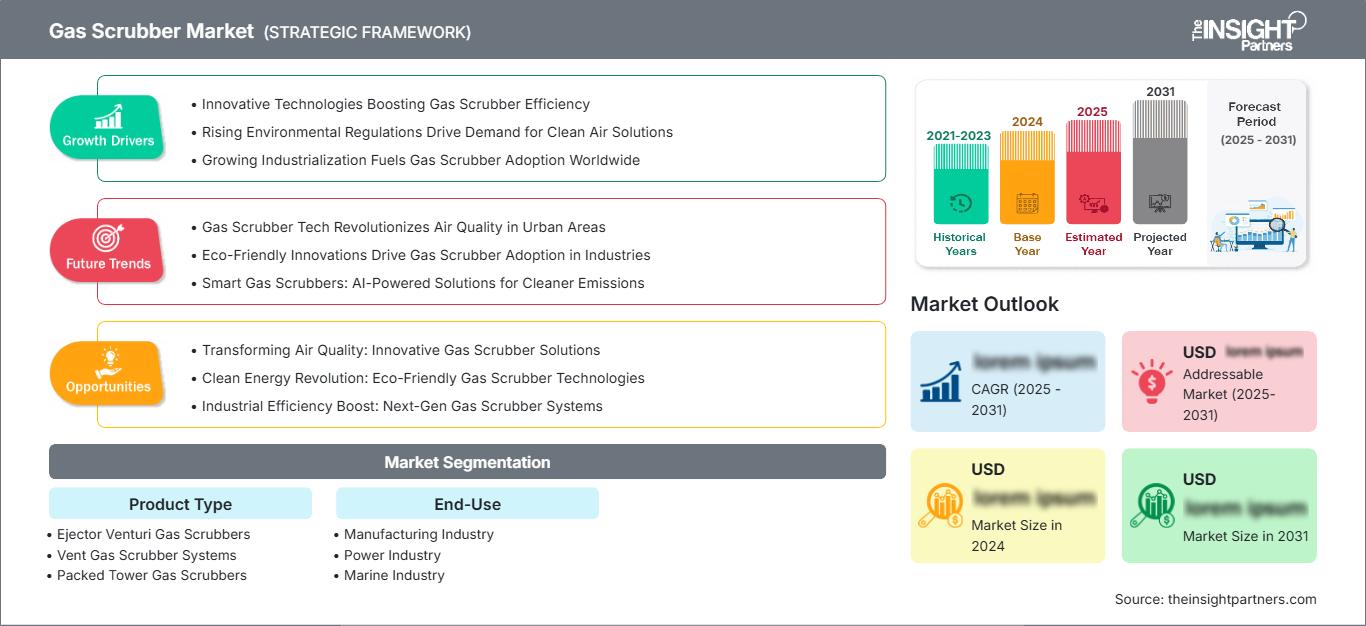
The gas scrubber market size is evaluated at US$ 19.50 Billion in 2025 and is estimated to grow to US$ 28.72 Billion by 2034, with a growth rate of 4.40%. These growth projections are a result of the constant spending on compliance activities in industrial air pollution control, marine exhaust gas treatment, refinery emissions, and power plant retrofits focused on removal of sulfur oxides, nitrogen oxides, acid gas, and particulate matter.
The North American region continues to be a significant market region, with the growth in the gas scrubber market driven by improvements in refineries, utility emission controls, and chemical manufacturing plants. It is expected that the region will have a 4.1–4.6% CAGR up to 2034, owing to stringent permit processes, replacement of installed base, and adoption of packed tower and vent gas scrubbers.
Gas Scrubber Market Assessment and Insights
- North America held 30–32% share in 2025 and is projected to grow at a CAGR of 4.1–4.6% during 2026–2034, driven by refinery, power, and chemical plant emission-control upgrades.
- US accounted for 78–82% of North America in 2025 and is expected to grow at a CAGR of 4.0–4.5% during 2026–2034.
- Europe represented 24–26% share in 2025 and is expected to grow at a CAGR of 3.7–4.2% during 2026–2034, led by Germany, the UK, France, Italy, and Spain.
- Asia Pacific captured 33–35% share in 2025 and is forecast to grow at a CAGR of 4.8–5.4% during 2026–2034, led by China, Japan, India, and South Korea.
- Largest Segment Manufacturing Industry held 44–47% market share in 2025, with a CAGR of 4.2–4.7% during 2026–2034, supported by chemical, metal, and process manufacturing demand.
- High Growth Segment Marine Industry accounted for 14–17% market share in 2025, with a CAGR of 5.2–5.9% during 2026–2034, supported by sulfur compliance and hybrid scrubber adoption.
- Key companies analyzed in detail: Babcock & Wilcox Enterprises, Inc., Mitsubishi Power Ltd., Hamon, BALCKE-DÜRR GmbH, Ducon Technologies Inc., CECO Environmental Corp., Thermax Limited, Wärtsilä Corporation, Fuji Electric Co., Ltd., ANDRITZ AG, DuPont Clean Technologies, GEA Group AG.
Source: The Insight Partners' analysis based on proprietary research, government publications, company annual reports, investor presentations, industry databases, and expert interviews.
The technological development of gas scrubbers has evolved from handling a single pollutant to integrated solutions that include absorption, mist elimination, material that does not corrode, automatic dosing, and electronic monitoring. In terms of production, technology has been evolving towards localization of production, modularity of towers and ducts and minimizing downtime at retrofit projects. Packed towers are used for processes where continuous operation is required, whereas ejector venturi is important when the gas contains particles and needs high-energy contact.
Over the forecast period, demand is going to be driven by the development of new industrial zones, compliance-related projects for ports, and upgrading brownfield plants. The regulatory push will be most noticeable in those areas that increase standards for sulfur, acid gas, and particulate matter. Investment is likely to go into high-efficiency and low pressure drop scrubbers which minimize the costs of running them while meeting the environmental standards.
Gas Scrubber Market Report Scope
| Report Attribute | Details |
|---|---|
| Market size in 2025 | US$ 19.50 Billion |
| Market Size by 2034 | US$ 28.72 Billion |
| Global CAGR (2026 - 2034) | 4.40% |
| Historical Data | 2021-2024 |
| Forecast period | 2026-2034 |
Gas Scrubber Market Analysis
Gas scrubber market growth path demand is determined by stricter air quality regulations, higher industrial production and processing of difficult gas mixes at refineries, manufacturing facilities, power plants, and ships. The buyers have started evaluating removal efficiency, water usage, pressure drop, reagent usage and accessibility before making purchases. As a result, the competition has moved from simple equipment supply towards system provision and performance warranty.
The ecosystem consists of technology licensees, tower producers, packing manufacturers, fan and pump manufacturers, instrumentation suppliers, EPC contractors, and plant operators. The supply situation is still dependent on alloy steel, FRP, pumps and automation parts. The vendors with regional capabilities in fabrication and service could decrease delivery times, especially for retrofits that require outages.
Positioning in the gas scrubber market analysis is based more on application expertise than scale. Babcock & Wilcox Enterprises, Inc. and Mitsubishi Power Ltd. are positioned well for retrofits of power plants and heavy industry, whereas CECO Environmental Corp., Ducon Technologies Inc., GEA Group AG and Thermax Limited can boast a strong position in all industrial gas cleaning applications. Wärtsilä Corporation is still relevant in the marine exhaust gas cleaning business.
Investments in the industry tend towards modular systems, multi-pollutant solutions, and service by the numbers. ANDRITZ AG, Fuji Electric Co., Ltd., DuPont Clean Technologies, BALCKE-DÜRR GmbH and Hamon have an advantage where process expertise and engineered solutions matter. Competitive differentiation is increasingly dependent on total installed cost, guaranteed uptime, emissions verification, and international customer service capabilities.
● REPORT CUSTOMIZATION
Tailor This Report To Align With Your Specific Business Requirements
This report can be customized to align precisely with your business objectives, scope, and target markets. Customization options include tailored segmentation, geography, competitive analysis, and strategic insights to support informed decision-making.
Customize This Report →WHAT YOU CAN ADJUST
- ● Segmentations
- ● Geography
- ● Competitive Analysis
- ● Language Preferences
Gas Scrubber Market: Strategic Insights
Regional Insights
North America gas scrubber market
North America held 30–32% share in 2025 and is projected to grow at a CAGR of 4.1–4.6% during 2026–2034. Demand is anchored in refinery fluid catalytic cracking units, chemical processing plants, waste-to-energy facilities, and utility boilers. The gas scrubber market share in this region is supported by strong compliance enforcement and continued replacement of aging wet scrubbing assets.
Structural motivators involve the minimization of sulfur dioxide, hazardous air pollutants, and decarbonization efforts within industry that continue to need pollution controls at the local level. Lower-water, more corrosion resistant, and digitized systems are being favored by operators. There will be strong demand for retrofit because many plants prefer upgrades of this sort over redesign of the whole process.
U.S. Gas Scrubber Market
The US represented 78-82% of North America in 2025 and was projected to record a CAGR of 4.0-4.5% between 2026-2034. The demand is focused on Gulf Coast refineries, petrochemical complexes, power plants with coal and biomass fueling, metal industries, and semiconductors related specialty manufacturers. Company presence is strong with domestic and foreign suppliers of complex engineering solutions.
Current application development includes wet gas scrubbers for sulfur treatment in refineries, packed columns for chemical scrubbing, and vent scrubbers for tank farms and emergency scenarios. The market will see improvements thanks to permitting issues, litigation management, and sustainability goals on plant level. The replacement projects are growing with customers updating control systems, fans, pumps, and mist eliminators without increasing footprint.
Europe Gas Scrubber Market
Europe constituted 24-26% of market share in 2025, and is expected to register CAGR growth of 3.7-4.2% over 2026-2034. Germany continues to be the dominant country driven by requirements of chemicals, power equipment, metals, and waste processing. The UK market is driven by refinery overhauls, port emission regulations, and energy transition projects in industries necessitating efficient flue gas treatment.
France, Italy, and Spain provide stable demand from applications like cement, marine, waste-to-energy, and process manufacturing upgradations. Europe focuses on life-cycle emissions, water management, and documentation. EU Industrial Emissions Directive revision is prompting more reviews of existing abatement systems, favoring engineered solutions over commodity offerings. Harmonization of standards and local servicing network advantages the cross-border suppliers.
APAC Gas Scrubber Market
In 2025, APAC's share was 33-35%, which is projected to expand further with a CAGR of 4.8-5.4% in 2026-2034, making it the fastest-growing regional market segment. China dominates the region because of its chemicals sector, coal-fired power generation, metals sector, and manufacturing industry, whereas Japan and South Korea provide impetus for their high-end industries and marine applications.
Refining projects, mining, utilities and environmental approvals drive growth in India and Australia. Key policies consist of urban air quality, sulfur reduction, and improved permitting process in industries. The suppliers with efficient application engineering and cost-effective fabrication have an advantage since customers demand compliance without increasing down-time and operational cost.
Middle East & Africa Gas Scrubber Market
MEA is estimated to grow at a CAGR of 4.0-4.6% from 2026 to 2034. Saudi Arabia is the dominant market for this region driven by refineries, petrochemical facilities, power plants associated with water desalination, and development of industrial cities.
Uptake in the rest of MEA is sporadic but growing wherever there are applications for energy projects, fertilizer production plants, and mineral processing plants which need localized pollution control solutions. System procurement is always driven by a preference for robust systems that can withstand tough environmental conditions. Availability of water and reagents, along with corrosion control, become very significant in technology selection.
Segmentation Analysis
Product Type
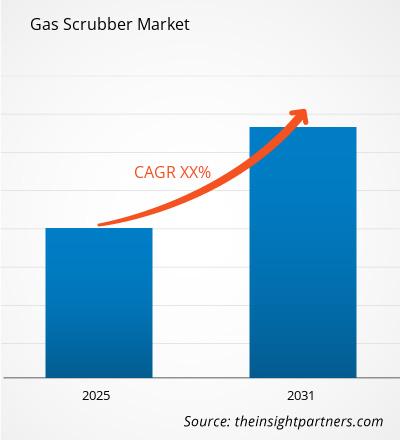
Product Type is expected to record a CAGR of 4.3–4.8% during 2026–2034. The gas scrubber market scope across product types is shaped by gas composition, particulate loading, removal efficiency, pressure drop tolerance, and installation constraints. Packed tower systems remain preferred for continuous absorption duties, while ejector venturi designs serve high-intensity contact needs. Vent gas scrubber systems support safety-led and intermittent emission capture.
- Ejector Venturi Gas Scrubbers: Demand is strongest in processes with particulate-rich or reactive gas streams, where high-velocity contact improves capture performance and supports compact installation in constrained industrial layouts.
- Vent Gas Scrubber Systems: These systems are strategically important for storage tanks, relief vents, and intermittent releases, helping operators manage compliance risks without installing oversized continuous-duty equipment.
- Packed Tower Gas Scrubbers: Packed towers hold a strong position in chemical absorption and acid gas removal because they provide stable contact efficiency, scalable capacity, and predictable performance in continuous operations.
End-Use
End-Use is expected to record a CAGR of 4.4–5.0% during 2026–2034. Adoption varies by compliance exposure, uptime requirements, and emission stream complexity. Manufacturing remains the largest demand base because chemical, metal, food processing, and specialty material facilities require localized emission controls. Power applications are retrofit-driven, while marine adoption is shaped by fuel economics, emission control areas, and port discharge restrictions.
- Manufacturing Industry: This segment leads demand as process industries need reliable acid gas, odor, and particulate control to meet permits, protect workers, and maintain production continuity.
- Power Industry: Power plants use scrubbers to manage sulfur dioxide, acid gases, and particulate matter, especially in coal, biomass, waste-to-energy, and industrial captive power applications.
- Marine Industry: Marine adoption is driven by sulfur regulations, high-sulfur fuel economics, and demand for hybrid systems that can adapt to open-sea and restricted-port operations.
Opportunity Snapshot
| Segment Name | Revenue Contribution (High/Medium/Low) | Trend Tag (MAX 2 words, specific) | Adoption Stage (Emerging/Scaling/Mature) |
| Manufacturing Industry | High | Plant Retrofit | Mature |
| Power Industry | Medium | Boiler Upgrade | Scaling |
| Marine Industry | Medium | Hybrid EGCS | Scaling |
Gas Scrubber Market Growth Drivers and Impact Analysis
Tighter Industrial Emission Compliance
Operators of industrial facilities are coming under increased scrutiny with regard to sulfur dioxide, nitrogen oxides, hydrochloric acid, volatile compounds, and particulate emissions. This is causing greater emphasis on removal systems that show their performance capabilities during permitting conditions. The economic impact of this is felt most by refineries, chemical plants, metals producers, and processors of waste. For them, a breach of regulations means that their production processes have to stop or face problems in capacity approvals. For the customer, it means buying scrubbers not as optional pollution equipment but as a risk-control facility.
Increased difficulty in meeting environmental regulations is prompting industries to invest in sophisticated gas cleaning equipment that is more efficient and reliable in operation. There are investments in automation of monitoring processes, online emission tracking, and control systems to comply with the regulations and optimize the use of energy and chemicals used in the process. Regulations that target industrial air quality, especially those related to decarbonization and pollution reduction, have increased the rate of investment in regions with tough regulations on the matter. The tightening of emissions limits has led to increased adoption of scrubbers capable of addressing various emissions under varying operating conditions. This trend is presenting a chance for companies providing custom-made systems, enhanced materials, and systems performance monitoring systems. Industries are considering life cycle costs during their investment decisions.
Marine Sulfur Rules and Port Restrictions
Shipping operators continue to evaluate exhaust gas cleaning systems as a way to balance fuel cost, route flexibility, and sulfur compliance. Global sulfur limits and emission control areas support demand, but port-level restrictions on open-loop discharge are shifting interest toward closed-loop and hybrid systems. This creates a selective but high-value growth driver for suppliers able to design compact, energy-efficient, and corrosion-resistant marine scrubbers. The gas scrubber market benefits where fleet owners seek long-term operating savings from high-sulfur fuel use while preserving access to regulated waters and avoiding compliance disruption during voyages.
The maritime sector is increasingly focused on solutions that improve environmental performance without significantly affecting vessel operations or cargo capacity. Shipowners and operators are evaluating scrubber technologies based on installation space, fuel savings, maintenance requirements, and compatibility with different vessel types. Hybrid systems are gaining attention because they provide operational flexibility by allowing vessels to switch between open-loop and closed-loop modes depending on local regulations and water conditions. As environmental authorities continue expanding emission control areas, demand for adaptable exhaust treatment solutions is expected to increase. Manufacturers are also focusing on reducing system weight, improving automation, and lowering freshwater and chemical consumption to make scrubbers more attractive for modern fleets. In addition, retrofit opportunities across existing vessels remain significant as operators seek cost-effective ways to extend fleet life while meeting evolving environmental standards. These factors support continued investment in marine gas cleaning technologies and create opportunities for specialized suppliers with strong engineering capabilities.
Retrofit Demand from Aging Industrial Assets
Many installed scrubbers are reaching replacement age as facilities operate beyond original design assumptions, treat more variable feedstocks, or face tighter emission thresholds. Rather than building new plants, operators often prefer retrofits that upgrade packing, nozzles, mist eliminators, controls, pumps, and tower materials. This creates steady aftermarket and engineering demand. The impact is visible in brownfield refineries, chemical plants, power assets, and metal processing facilities where downtime costs are high. Suppliers with outage planning capability, modular fabrication, and site-specific engineering can capture value beyond equipment supply.
Aging industrial infrastructure requires continuous modernization to maintain efficiency, reliability, and compliance with updated environmental regulations. Retrofit projects allow operators to extend the service life of existing systems while improving pollutant removal efficiency and reducing operating expenses compared with complete equipment replacement. Advances in materials engineering, corrosion protection, and automation are enabling older scrubber systems to handle more demanding process conditions and higher production volumes. Many facilities are also integrating digital monitoring tools into retrofit programs to improve maintenance planning and identify performance issues before they affect operations. The demand for upgrades is particularly strong in industries where production interruptions result in significant financial losses, making reliable retrofit execution a key purchasing factor. Engineering firms and equipment suppliers that offer complete solutions, including assessment, design modifications, installation support, and performance validation, are better positioned to benefit from the expanding aftermarket opportunity. As industrial assets continue to age globally, retrofit activity is expected to remain an important growth area for the gas scrubber market.
Gas Scrubber Market Future Trends
Digital Scrubber Performance Monitoring
One of the most important gas scrubber market trends is the shift toward digital monitoring of pH, pressure drop, flow, reagent use, temperature, and outlet emissions. Future systems will increasingly integrate sensors, automated dosing, and predictive maintenance tools to reduce compliance uncertainty. This trend will matter because regulators and customers are demanding transparent emissions evidence, not only equipment installation. Data-enabled scrubbers can also lower lifecycle cost by identifying fouling, packing deterioration, pump inefficiency, or mist eliminator issues before performance declines. Vendors offering secure analytics and service contracts will gain recurring revenue opportunities.
Lower-Water and Multi-Pollutant Designs
Future scrubber design will place greater emphasis on lower water consumption, wastewater minimization, and simultaneous pollutant removal. This is especially relevant in arid industrial zones, ports, and facilities facing stricter discharge limits. Multi-pollutant configurations that address sulfur oxides, acid gases, particulates, and selected hazardous compounds in one engineered package will become more attractive than separate systems. The trend should support higher-value projects because customers are willing to pay for reduced footprint, fewer interfaces, and simplified compliance reporting. Material selection and reagent optimization will become decisive design variables.
Gas Scrubber Market Opportunities
Brownfield Refinery and Chemical Plant Upgrades
Brownfield refinery and chemical assets offer a strong investment opportunity because many operators need emission-control upgrades without major process disruption. The gas scrubber market forecasts point to steady demand where fluid catalytic cracking, sulfur recovery, storage, and acid gas treatment units require tailored solutions. Suppliers can differentiate by offering preassembled modules, 3D site scanning, fast-turnaround engineering, and performance guarantees. This opportunity is particularly attractive in North America, Europe, the Middle East, and Asia Pacific, where regulatory pressure and aging infrastructure intersect. Service contracts can extend revenue beyond installation.
Hybrid Marine Exhaust Gas Cleaning Systems
Hybrid marine systems represent an actionable opportunity for equipment providers, shipyards, and service networks. Fleet owners operating across regulated and unregulated waters need systems that can switch between operating modes while managing washwater, sludge, space limitations, and energy consumption. Suppliers that simplify retrofit engineering and provide global maintenance support can win repeat vessel contracts. The opportunity is strongest among large cargo, tanker, and cruise operators that must balance fuel economics with port access. Partnerships with ship management firms and classification bodies can accelerate adoption and reduce project risk.
Recent Developments
- January 2026: Addressing the persistent demand for efficient and powerful cleaning solutions in large facilities, ONYX Systems, LLC announces the launch of its new RX32Ride-On Floor Scrubber. This advanced equipment sets a new benchmark in the 32-inch ride-on scrubber category, engineered to deliver exceptional cleaning power, productivity, and value. To explore the full capabilities of the RX32 and learn how it can transform your facility's cleaning operations.
- September 2025: Babcock & Wilcox Enterprises, Inc. received an initial US$ 10 million order within an award valued at approximately US$ 40 million to supply low-pressure Wet Gas Scrubbing technology for a major petroleum refinery in Canada, using licensed ExxonMobil WGS technology for sulfur dioxide control.
Frequently Asked Questions

- Comprehensive Market Sizing and Forecast Analysis
- Detailed Segmentation Analysis
- In-Depth Market Dynamics Assessment
- Regional and Country-Level Insights
- Competitive Landscape and Company Benchmarking
- Strategic Business Intelligence
Recent Reports
Testimonials

The Insight Partners' SCADA System Market report is comprehensive, with valuable insights on current trends and future forecasts. The team was highly professional, responsive, and supportive throughout. We are very satisfied and highly recommend their services.
RAN KEDEM Partner, Reali Technologies LTDs
I requested a report on a very specific software market and the team produced the report in a few days. The information was very relevant and well presented. I then requested some changes and additions to the report. The team was again very responsive and I got the final report in less than a week.
JEAN-HERVE JENN Chairman, Future Analytica
We worked with The Insight Partners for an important market study and forecast. They gave us clear insights into opportunities and risks, which helped shape our plans. Their research was easy to use and based on solid data. It helped us make smart, confident decisions. We highly recommend them.
PIYUSH NAGPAL Sr. Vice President, High Beam Global
The Insight Partners delivered insightful, well-structured market research with strong domain expertise. Their team was professional and responsive throughout. The user-friendly website made accessing industry reports seamless. We highly recommend them for reliable, high-quality research services
YUKIHIKO ADACHI CEO, Deep Blue, LLC.
This is the first time I have purchased a market report from The Insight Partners.While I was unsure at first, I visited their web site and felt more comfortable to take the risk and purchase a market report.I am completely satisfied with the quality of the report and customer service. I had several questions and comments with the initial report, but after a couple of dialogs over email with their analyst I believe I have a report that I can use as input to our strategic planning process.Thank you so much for taking the extra time and making this a positive experience.I will definitely recommend your service to others and you will be my first call when we need further market data.
JOHN SUZUKI President and Chief Executive Officer, Board Director, BK Technologies
I wish to appreciate your support and the professionalism you displayed in the course of attending to my request for information regarding to infectious disease IVD market in Nigeria. I appreciate your patience, your guidance, and the fact that you were willing to offer a discount, which eventually made it possible for us to close a deal. I look forward to engaging The Insight Partners in the future, all thanks to the impression you have created in me as a result of this first encounter.
DR CHIJIOKE ONYIA MANAGING DIRECTOR, PineCrest Healthcare Ltd.Reason to Buy
- Informed Decision-Making
- Understanding Market Dynamics
- Competitive Analysis
- Identifying Emerging Markets
- Customer Insights
- Market Forecasts
- Risk Mitigation
- Boosting Operational Efficiency
- Strategic Planning
- Investment Justification
- Tracking Industry Innovations
- Aligning with Regulatory Trends





 Get Free Sample for