
Glass Flake Coatings Market Share, Growth & Demand by 2034
Coverage: By Resin Type (Epoxy, Polyester, Vinyl Ester, Others); Substrate (Metal, Concrete); End-user Industry (Oil and Gas, Marine, Industrial, Power Generation, Wastewater Treatment, Others) , and Geography (North America, Europe, Asia Pacific, and South and Central America)
- Status : Data Released
- Report Code : TIPRE00021454
- Category : Chemicals and Materials
- No. of Pages : 150
- Available Report Formats :


- Last update date : July 14, 2026


2025 Market Size
US$ 1.86 Bn
Base year value
2034 Forecast
US$ 2.54 Bn
Projected by 2034
CAGR 2026-2034
3.52 %
Growth rate
Addressable Market
US$ 19.98 Bn
(2026-2034)
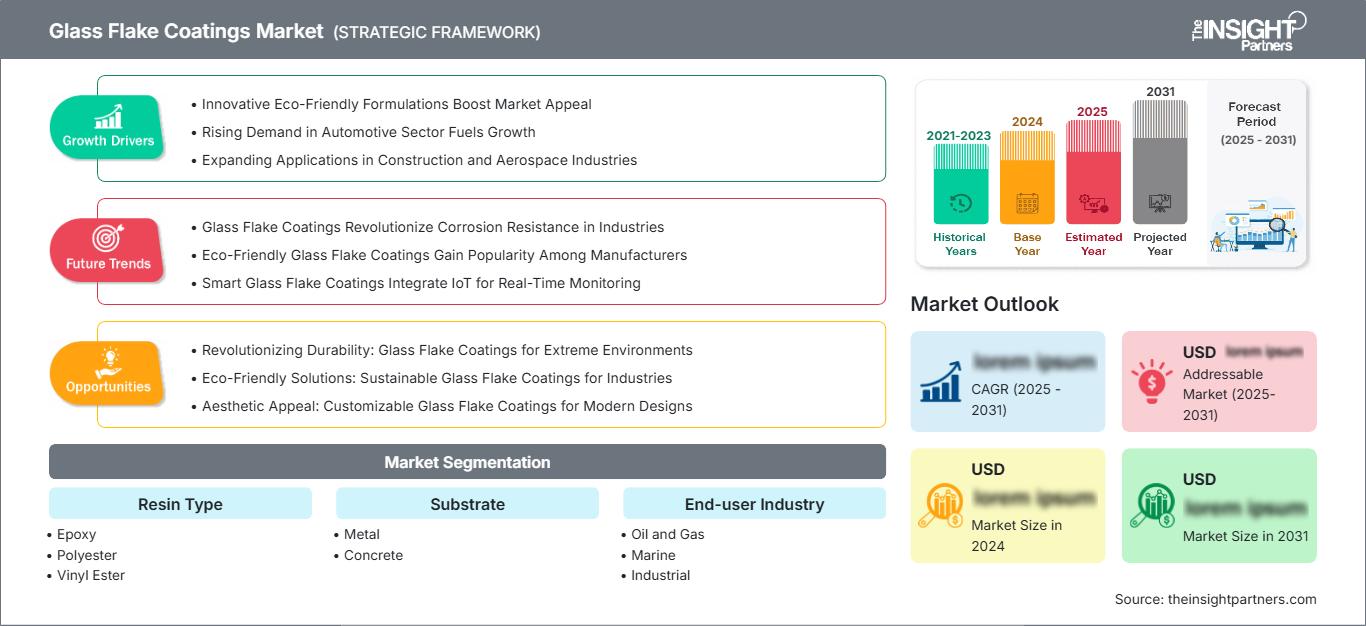
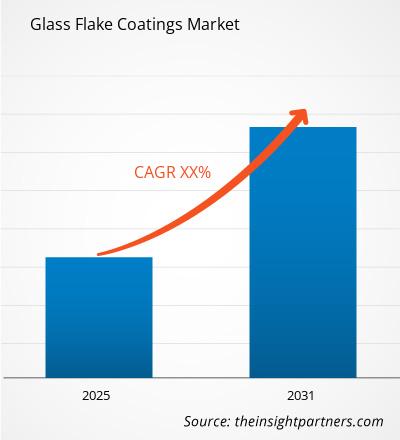
The glass flake coatings market was valued at US$ 1.86 Billion in 2025 and is projected to reach US$ 2.54 Billion by 2034, registering a CAGR of 3.52% during 2026–2034. Growing demand for high-performance anti-corrosion coatings across offshore infrastructure, industrial processing facilities, marine assets, and power generation plants continues to support market expansion. Increasing investments in asset life extension and maintenance programs are further strengthening long-term demand for advanced protective coating technologies.
North America continues to represent a strategically important regional market owing to extensive oil and gas infrastructure, marine maintenance activities, and modernization of industrial facilities. The glass flake coatings market size across the region is supported by stringent corrosion protection standards, rising investments in pipeline rehabilitation, and growing adoption of durable epoxy-based coating systems. The regional market is anticipated to expand at a CAGR ranging between 3.4% and 3.8% during the forecast period.
Glass Flake Coatings Market Assessment and Insights
- North America: Accounted for 32–35% share in 2025 and is projected to grow at a CAGR of 3.4–3.8% during 2026–2034. Continued investments in offshore oil and gas assets, wastewater infrastructure modernization, and industrial asset protection support regional demand for advanced corrosion-resistant coating systems.
- US: Represented 78–82% of the North American market in 2025 and is anticipated to register a CAGR of 3.5–3.9% during 2026–2034, supported by refinery maintenance, marine infrastructure rehabilitation, and replacement of aging industrial equipment.
- Europe: Held 26–29% share in 2025 and is expected to expand at a CAGR of 3.2–3.6% during 2026–2034. Germany, the UK, Norway, and the Netherlands continue to lead demand owing to offshore energy assets and stringent industrial corrosion protection standards.
- Asia Pacific: Captured 28–31% share in 2025 and is forecast to record a CAGR of 4.1–4.5% during 2026–2034. China, Japan, South Korea, and India remain key contributors due to industrial expansion, marine shipbuilding activities, and increasing infrastructure investments.
- Largest Segment: Epoxy accounted for a market share of 52–56% in 2025 and is projected to grow at a CAGR of 3.5–3.9% during 2026–2034, driven by superior chemical resistance, strong adhesion, and long operational life.
- High Growth Segment: Wastewater Treatment represented a market share of 11–14% in 2025 and is projected to register a CAGR of 4.7–5.1% during 2026–2034, supported by expanding municipal treatment capacity and corrosion management investments.
- Key companies analyzed in detail: Hempel A/S, Akzo Nobel N.V., PPG Industries, Inc., The Sherwin-Williams Company, Jotun A/S, Kansai Paint Co., Ltd., KCC Corporation, Berger Paints India Limited, Nippon Paint Holdings Co., Ltd., Chugoku Marine Paints, Ltd.
Source: The Insight Partners' analysis based on proprietary research, government publications, company annual reports, investor presentations, industry databases, and expert interviews.
There has been an increasing focus on lifecycle cost optimization from industry players over the last ten years, which has transformed the protective coatings scenario to some extent. There has been a shift towards developing coatings that offer better barrier properties, less need for maintenance, and greater resistance to wear and tear, as well as chemicals and saltwater exposure. Advances in resin technology, glass flake dispersion methods, and application techniques have resulted in greater durability and less downtime for marine ships, offshore rigs, storage tanks, and processing units. Such technological advancements will further drive the market for glass flake coatings in developed and emerging countries.
Going forward, the development of infrastructure, offshore renewable energy projects, and industrial operations in emerging nations will provide the impetus for the glass flake coatings market. Environmental laws requiring longer service life and less frequent maintenance have encouraged customers to adopt high-end protective coating systems. The construction of facilities for wastewater treatment, power transmission, desalination, and heavy industrial manufacturing will create growth prospects, while manufacturers will expand capacity and develop application-specific coatings to boost their market presence.
Glass Flake Coatings Market Report Scope
| Report Attribute | Details |
|---|---|
| Market size in 2025 | US$ 1.86 Billion |
| Market Size by 2034 | US$ 2.54 Billion |
| Global CAGR (2026 - 2034) | 3.52% |
| Historical Data | 2021-2024 |
| Forecast period | 2026-2034 |
Glass Flake Coatings Market Analysis
Investments in industrial assets conservation continues to be the key growth driver in the global market. Critical infrastructure operating under highly corrosive conditions needs protective coatings that minimize degradation and allow longer maintenance intervals. Offshore oil exploration and shipping operations, growing chemical manufacturing capacity, and investments in power generation sectors will continue to drive the use of such products. Growth in the market for glass flake coatings is supported by increased infrastructure maintenance expenses and the importance of corrosion resistance in improving efficiency and reducing ownership costs.
The industry's value chain includes raw material providers, resin manufacturers, glass flake producers, coating producers, distribution companies, coating application specialists, inspection service providers, and end-users. Constant cooperation between material providers and coating producers led to increased consistency in formulations, mechanical strength, and the applicability of coating materials.
The competitive environment is likely to become fiercer as manufacturers become more adept at research, region-based manufacturing, and technology services. According to the glass flake coatings market analysis, manufacturers are focusing on developing specialized coatings for offshore, marine, wastewater treatment, and industrial applications. Hempel A/S, Akzo Nobel N.V., PPG Industries, Inc., The Sherwin-Williams Company, and Jotun A/S continue with investments in new protective coating technology, while Kansai Paint Co., Ltd., KCC Corporation, Berger Paints India Limited, Nippon Paint Holdings Co., Ltd., and Chugoku Marine Paints, Ltd. develop their regional manufacturing and technical services capacity.
Investments focus on sustainable manufacturing, digital inspection of coatings, and the development of products that would decrease maintenance frequency and increase longevity. Manufacturing companies are developing partnerships with engineering contractors and owners of industrial assets to secure long-term supply contracts. Expansion of capacity in Asia Pacific and innovation in high-performance epoxy and vinyl ester systems would be likely to result in increased competitive differentiation and continued market development during the forecast period.
● REPORT CUSTOMIZATION
Tailor This Report To Align With Your Specific Business Requirements
This report can be customized to align precisely with your business objectives, scope, and target markets. Customization options include tailored segmentation, geography, competitive analysis, and strategic insights to support informed decision-making.
Customize This Report →WHAT YOU CAN ADJUST
- ● Segmentations
- ● Geography
- ● Competitive Analysis
- ● Language Preferences
Glass Flake Coatings Market: Strategic Insights
Regional Insights
North America Glass Flake Coatings Market
North America accounted for 32–35% of the global glass flake coatings market share in 2025 and is projected to expand at a CAGR of 3.4–3.8% during 2026–2034. Demand is supported by extensive offshore oil and gas assets, petrochemical facilities, marine infrastructure, and aging industrial equipment requiring long-term corrosion protection. Regulatory emphasis on infrastructure resilience and lifecycle cost reduction continues to encourage adoption of advanced protective coating technologies across critical industrial sectors.
The US and Canada continue investing in pipeline rehabilitation, LNG terminals, wastewater treatment facilities, and power generation infrastructure. Growing maintenance expenditure by industrial asset owners, together with increasing application of high-performance epoxy and vinyl ester coating systems, is expected to sustain regional demand. Expanding renewable energy installations, particularly offshore wind structures, are also creating additional opportunities for durable corrosion-resistant coatings capable of withstanding aggressive operating environments.
U.S. Glass Flake Coatings Market
The US represented 78–82% of the North American market in 2025 and is anticipated to register a CAGR of 3.5–3.9% during 2026–2034. The country's well-established refining industry, offshore production facilities, marine transportation infrastructure, and chemical manufacturing plants continue generating consistent demand for premium protective coatings. The glass flake coatings market share in the United States remains dominant within North America due to its extensive industrial asset base and continuous maintenance investments.
Leading coating manufacturers maintain strong manufacturing, distribution, and technical service operations throughout the country to support industrial customers. Demand is further strengthened by increasing refurbishment of storage tanks, bridges, wastewater treatment facilities, and power plants. Asset owners increasingly prioritize coatings offering longer maintenance intervals, improved abrasion resistance, and enhanced chemical durability, contributing to steady market expansion across industrial and infrastructure applications.
Europe Glass Flake Coatings Market
Europe held 26–29% of the global market in 2025 and is forecast to grow at a CAGR of 3.2–3.6% during 2026–2034. Germany remains the leading national market due to its extensive chemical processing industry, manufacturing base, and industrial engineering expertise. Offshore infrastructure investments across Northern Europe and modernization of energy facilities continue supporting regional demand for advanced corrosion-resistant coating systems.
The UK will benefit from maintenance services provided to offshore oil and gas installations, ports, and marine structures. Increasing investments in offshore wind energy plants and coastal assets are promoting the usage of glass flake coatings that provide long-lasting protection in aggressive marine environments. Asset operators focus on minimizing lifecycle costs by applying the most advanced coating systems.
Germany remains the country with the highest demand among all regions due to its diversified industries, including chemical manufacturing and engineering. Industrial modernization programs, along with equipment renewal in manufacturing plants, ensure stable consumption of protective coatings. Environmental protection legislation promotes the usage of coating systems with long service life.
France, Italy, and Spain are making an important contribution to the region's demand through investments in the construction of wastewater treatment facilities, marine transportation, renewable energy installations, and industrial plants. Increasing the refurbishment of public infrastructure and the development of desalination and coastal protection projects will maintain the demand for protective coatings.
APAC Glass Flake Coatings Market
Asia Pacific captured 28–31% of the global market in 2025 and is expected to register the fastest regional expansion with a CAGR of 4.1–4.5% during 2026–2034. China leads regional demand owing to large-scale industrial manufacturing, petrochemical investments, shipbuilding activities, and expanding infrastructure development. Japan and South Korea continue benefiting from established marine and heavy engineering industries.
India is experiencing increasing adoption across refinery expansion, wastewater treatment, and industrial infrastructure projects, while Australia supports demand through mining, offshore energy, and coastal infrastructure investments. Government initiatives promoting industrial modernization and environmental protection continue encouraging greater adoption of advanced corrosion-resistant coating technologies across the region.
Middle East & Africa Glass Flake Coatings Market
The Middle East & Africa is expected to witness a CAGR of 3.8–4.2% in 2026–2034, owing to continued investments in oil & gas, desalination plants, petrochemicals, and industrial infrastructure. Saudi Arabia continues to be the dominant country in the region, and the UAE continues to build on its industrial and maritime activities that require robust coatings technology.
South Africa will contribute in the areas of mining, power generation, and industrial processing facilities, which have high requirements for corrosion protection due to the severe conditions prevailing in such environments. The Rest of the Middle East & Africa will benefit from infrastructure diversification, investments in water treatment technologies, and energy projects, thereby driving growth in glass flake coatings technology.
Segmentation Analysis
Resin Type
The Resin Type segment is projected to register a CAGR of 3.5–3.9% during 2026–2034. Resin selection directly influences corrosion resistance, chemical durability, adhesion strength, and service life of protective coating systems. The glass flake coatings market scope continues to expand as industries increasingly adopt advanced resin formulations capable of extending maintenance intervals and improving lifecycle performance in highly aggressive operating environments such as offshore platforms, chemical plants, and wastewater treatment facilities.
- Epoxy: Epoxy-based glass flake coatings remain the dominant sub-segment owing to excellent adhesion, outstanding chemical resistance, and superior mechanical strength. They are extensively used for offshore structures, storage tanks, pipelines, and industrial processing equipment operating under severe corrosion conditions.
- Polyester: Polyester resin coatings provide a balanced combination of corrosion resistance, weatherability, and cost-effectiveness. They are widely adopted across industrial structures and selected marine applications where moderate chemical exposure and long-term durability are required without premium material costs.
- Vinyl Ester: Vinyl ester formulations are preferred in highly aggressive chemical environments due to exceptional resistance to acids, alkalis, solvents, and elevated temperatures. Their performance makes them suitable for chemical processing plants, flue gas desulfurization systems, and wastewater treatment infrastructure.
Substrate
The Substrate segment is anticipated to grow at a CAGR of 3.4–3.8% during 2026–2034. Protective coating requirements vary according to substrate characteristics, operating conditions, and environmental exposure. Metal and concrete structures represent the primary application surfaces because both require long-term protection against corrosion, chemical attack, moisture ingress, and mechanical wear across industrial, marine, and infrastructure facilities.
- Metal: Metal substrates account for the majority of coating demand due to extensive utilization across offshore platforms, ships, storage tanks, pipelines, bridges, and industrial machinery. High corrosion susceptibility drives continuous maintenance activities and recurring demand for durable glass flake coating systems.
- Concrete: Concrete substrates increasingly utilize glass flake coatings to protect against chemical penetration, moisture damage, abrasion, and chloride attack. Wastewater treatment plants, desalination facilities, containment structures, and industrial flooring applications continue supporting demand within this sub-segment.
End-user Industry
The End-user Industry segment is forecast to expand at a CAGR of 3.8–4.2% during 2026–2034. Industrial asset owners continue prioritizing protective coating solutions that reduce maintenance frequency, improve operational reliability, and extend infrastructure lifespan. Demand remains closely associated with capital investments in energy, marine transportation, industrial manufacturing, water infrastructure, and heavy processing industries where corrosion management significantly influences operational efficiency.
- Oil and Gas: Oil and gas remains the largest end-user owing to continuous exposure of offshore platforms, pipelines, refineries, and storage facilities to highly corrosive environments. Long asset lifecycles and stringent maintenance standards sustain steady coating demand.
- Marine: Marine applications utilize glass flake coatings to safeguard ship hulls, ballast tanks, cargo holds, offshore vessels, ports, and coastal infrastructure. High resistance to seawater, abrasion, and mechanical impact supports widespread adoption throughout commercial and naval operations.
- Industrial: Industrial facilities employ these coatings across chemical processing plants, manufacturing equipment, storage tanks, structural steel, and production units where aggressive chemicals, humidity, and elevated operating temperatures accelerate material degradation.
- Power Generation: Power generation facilities apply glass flake coatings to cooling systems, chimneys, flue gas desulfurization units, storage tanks, and process equipment. Increasing refurbishment of aging thermal and renewable energy infrastructure supports continued market demand.
- Wastewater Treatment: Wastewater treatment facilities increasingly utilize advanced protective coatings to withstand constant chemical exposure, moisture, microbial activity, and abrasive operating conditions. Expanding municipal treatment capacity and stricter environmental regulations continue strengthening adoption across public and industrial water infrastructure.
Opportunity Snapshot
| End User Industry | Revenue Contribution | Trend Tag | Adoption Stage |
| Oil and Gas | High | Offshore Assets | Mature |
| Marine | High | Fleet Renewal | Mature |
| Industrial | High | Plant Modernization | Scaling |
| Power Generation | Medium | Grid Reliability | Scaling |
| Wastewater Treatment | Medium | Water Reuse | Emerging |
Glass Flake Coatings Market Growth Drivers and Impact Analysis
Expansion of Offshore Energy and Industrial Infrastructure Investments
Growing investments in offshore oil and gas production, petrochemical complexes, LNG terminals, and coastal industrial infrastructure continue to strengthen demand for high-performance protective coatings. Offshore structures are exposed to continuous saltwater immersion, humidity, ultraviolet radiation, and mechanical wear, making corrosion protection a critical operational requirement. Asset owners are increasingly adopting glass flake coatings because their layered barrier structure minimizes moisture permeation and extends maintenance intervals. Large capital expenditure programs across Asia Pacific, the Middle East, and North America are expected to sustain coating consumption throughout the forecast period. As offshore wind farms, marine terminals, and industrial ports expand, demand for advanced corrosion-resistant coating systems capable of delivering long-term asset reliability will continue increasing across multiple industrial sectors.
Growing Modernization of Water and Wastewater Infrastructure
The aging of municipal and industrial water infrastructures is fueling the growth of investments in rehabilitation projects that require highly resistant coating applications. Concrete storage tanks, pipelines, clarifiers, chemical storage tanks, and treatment equipment are often exposed to high levels of aggressive chemicals and moisture, posing corrosion risks. The glass flake coatings exhibit very good chemical and mechanical resistance, resulting in lower maintenance costs and increased operational time. Governments invest more money in projects related to wastewater reuse, desalination, and environmental regulation to ensure long-term water security. Another factor that will increase the need for coating materials is the expansion of wastewater treatment capacities across various industries.
Advancements in Protective Coating Technologies and Lifecycle Management
Industrial asset owners are increasingly evaluating coating systems based on lifecycle performance rather than initial procurement costs. Manufacturers continue developing advanced epoxy, polyester, and vinyl ester formulations offering improved adhesion, lower permeability, higher chemical resistance, and extended service life. Digital inspection technologies, predictive maintenance programs, and improved surface preparation methods further enhance coating effectiveness. These technological advancements enable infrastructure operators to reduce shutdown frequency and maintenance expenditure while improving operational reliability. Increasing collaboration between coating manufacturers, engineering contractors, and industrial operators is also accelerating the development of application-specific solutions that address demanding environments across offshore energy, marine transportation, heavy manufacturing, and power generation industries.
Glass Flake Coatings Market Future Trends
Increasing Adoption of Sustainable High-Performance Protective Coatings
The manufacturers are targeting coating solutions that ensure extended service life and a reduced environmental footprint. In the area of product innovation, less volatile organic compound emissions, greater material efficiency, and increased maintenance intervals are being emphasized. The latest glass flake coatings market trends suggest increasing favor for developing coating solutions that not only provide better corrosion protection but also help achieve sustainable goals through their performance. The manufacturers are also adopting environmentally friendly production methods and more efficient use of raw materials. As regulations become more stringent globally, the need for protective coatings that consume fewer resources over the asset's lifetime is likely to increase.
Digital Asset Management Supporting Predictive Maintenance Strategies
Industrial operators are integrating digital inspection platforms, remote monitoring technologies, and predictive maintenance software into asset management strategies. Protective coating performance is increasingly monitored using advanced inspection tools that identify degradation before structural failures occur. These technologies improve maintenance planning, reduce operational interruptions, and optimize coating replacement schedules. Manufacturers are responding by developing coating systems compatible with digital lifecycle management programs and performance monitoring initiatives. Integration of inspection data with maintenance planning is expected to improve coating utilization efficiency while strengthening long-term demand for premium protective coating solutions across critical industrial infrastructure.
Glass Flake Coatings Market Opportunities
Expansion Across Emerging Industrial Economies
Rapid industrialization across Asia, the Middle East, and selected African economies presents substantial investment opportunities for coating manufacturers. The glass flake coatings market Forecasts suggest that expanding petrochemical production, marine infrastructure, power generation projects, and wastewater treatment investments will create sustained demand for corrosion-resistant coating technologies. Companies capable of establishing regional production facilities, technical service centers, and localized distribution networks are expected to strengthen competitive positioning. Strategic partnerships with engineering firms and infrastructure developers will further improve market penetration while supporting long-term revenue growth through recurring maintenance and refurbishment projects.
Specialized Solutions for Renewable Energy and Critical Infrastructure
The expansion of offshore wind farms, coastal renewable energy projects, hydrogen infrastructure, and modern transmission networks is creating attractive opportunities for advanced protective coating suppliers. These assets require long-term resistance against harsh environmental conditions, chemical exposure, and mechanical stress. Manufacturers investing in application-specific formulations, faster curing technologies, and enhanced abrasion resistance are likely to secure competitive advantages. Continuous innovation, supported by technical service capabilities and lifecycle performance guarantees, will enable suppliers to address evolving customer requirements while expanding their presence in high-value industrial infrastructure projects worldwide.
Recent Developments
- March 2026: PPG Industries, Inc. launched PPG SIGMASHIELD 950 and PPG SIGMASHIELD 899 GF, two advanced glass flake epoxy coatings designed for offshore energy, oil and gas, marine, and infrastructure applications. The products provide enhanced abrasion resistance, corrosion protection, and compliance with NORSOK M-501 standards, supporting longer service life in harsh operating environments.
- January 2026: PPG Industries, Inc. announced strong 2025 financial performance, highlighting double-digit growth in its protective and marine coatings businesses. The company emphasized continued investments in technology-driven coating solutions, manufacturing optimization, and innovation supporting industrial corrosion protection, reinforcing its strategic focus on high-performance protective coatings worldwide.
Frequently Asked Questions

- Comprehensive Market Sizing and Forecast Analysis
- Detailed Segmentation Analysis
- In-Depth Market Dynamics Assessment
- Regional and Country-Level Insights
- Competitive Landscape and Company Benchmarking
- Strategic Business Intelligence
Recent Reports
Testimonials

The Insight Partners' SCADA System Market report is comprehensive, with valuable insights on current trends and future forecasts. The team was highly professional, responsive, and supportive throughout. We are very satisfied and highly recommend their services.
RAN KEDEM Partner, Reali Technologies LTDs
I requested a report on a very specific software market and the team produced the report in a few days. The information was very relevant and well presented. I then requested some changes and additions to the report. The team was again very responsive and I got the final report in less than a week.
JEAN-HERVE JENN Chairman, Future Analytica
We worked with The Insight Partners for an important market study and forecast. They gave us clear insights into opportunities and risks, which helped shape our plans. Their research was easy to use and based on solid data. It helped us make smart, confident decisions. We highly recommend them.
PIYUSH NAGPAL Sr. Vice President, High Beam Global
The Insight Partners delivered insightful, well-structured market research with strong domain expertise. Their team was professional and responsive throughout. The user-friendly website made accessing industry reports seamless. We highly recommend them for reliable, high-quality research services
YUKIHIKO ADACHI CEO, Deep Blue, LLC.
This is the first time I have purchased a market report from The Insight Partners.While I was unsure at first, I visited their web site and felt more comfortable to take the risk and purchase a market report.I am completely satisfied with the quality of the report and customer service. I had several questions and comments with the initial report, but after a couple of dialogs over email with their analyst I believe I have a report that I can use as input to our strategic planning process.Thank you so much for taking the extra time and making this a positive experience.I will definitely recommend your service to others and you will be my first call when we need further market data.
JOHN SUZUKI President and Chief Executive Officer, Board Director, BK Technologies
I wish to appreciate your support and the professionalism you displayed in the course of attending to my request for information regarding to infectious disease IVD market in Nigeria. I appreciate your patience, your guidance, and the fact that you were willing to offer a discount, which eventually made it possible for us to close a deal. I look forward to engaging The Insight Partners in the future, all thanks to the impression you have created in me as a result of this first encounter.
DR CHIJIOKE ONYIA MANAGING DIRECTOR, PineCrest Healthcare Ltd.Reason to Buy
- Informed Decision-Making
- Understanding Market Dynamics
- Competitive Analysis
- Identifying Emerging Markets
- Customer Insights
- Market Forecasts
- Risk Mitigation
- Boosting Operational Efficiency
- Strategic Planning
- Investment Justification
- Tracking Industry Innovations
- Aligning with Regulatory Trends





 Get Free Sample for