Glucaric Acid Market Trends, Share & Demand by 2034
Coverage: by Product (Pure Glucaric Acid, Calcium D-glucarate, Potassium sodium D-glucarate, D-glucaric acid-1, 4-lactone, Other Products); Application (Food Ingredients, Detergents, Corrosion Inhibitors, De-icing Chemicals, Other Applications) , and Geography (North America, Europe, Asia Pacific, and South and Central America)
- Status : Data Released
- Report Code : TIPRE00010016
- Category : Chemicals and Materials
- No. of Pages : 150
- Available Report Formats :

- Last update date : July 28, 2026
2025 Market Size
US$ 460.60 Mn
Base year value
2034 Forecast
US$ 1,203.60 Mn
Projected by 2034
CAGR 2026-2034
11.26 %
Growth rate
Addressable Market
US$ 7,338.66 Mn
(2026-2034)
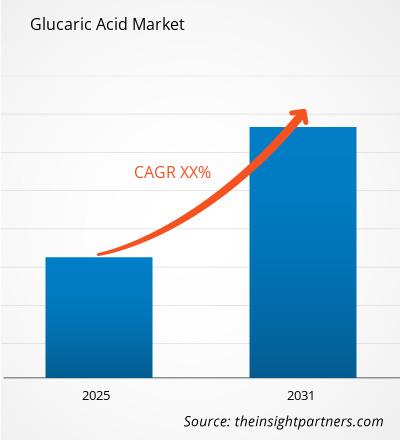
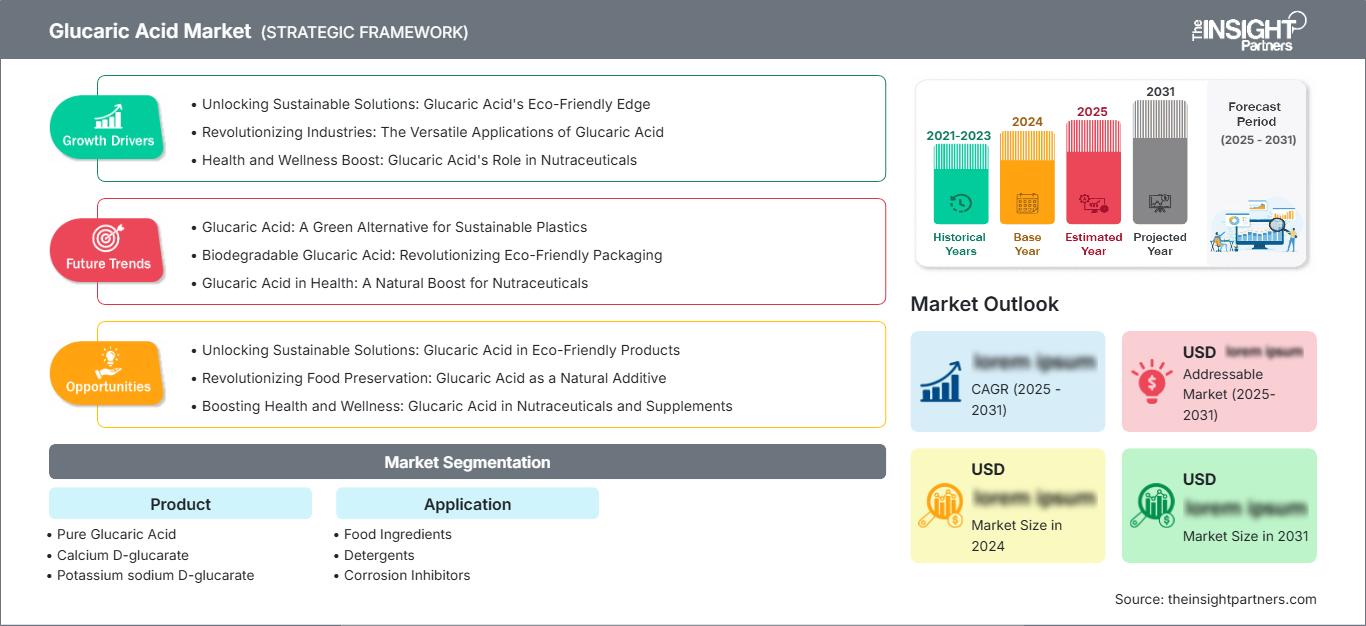
The glucaric acid market was valued at US$ 460.60 million in 2025 and is projected to reach US$ 1,203.60 million by 2034, expanding at a CAGR of 11.26% during 2026–2034. Rising preference for bio-based chemicals, increasing adoption of environmentally sustainable formulations, and expanding applications across detergents, corrosion inhibitors, food ingredients, and specialty chemicals continue to strengthen commercial demand for glucaric acid across developed and emerging industrial economies.
Across North America, favorable regulatory frameworks supporting renewable chemicals, expanding investments in green chemistry, and increasing commercialization of bio-based intermediates continue to reinforce industry expansion. The glucaric acid market size is expected to benefit from growing demand in detergent formulations, corrosion protection systems, and nutraceutical ingredients. Regional growth is projected at a CAGR ranging between 10.2% and 11.0% during 2026–2034, supported by advanced biotechnology capabilities and strong research collaborations.
Glucaric Acid Market Assessment and Insights
- North America: Accounted for 34–37% share in 2025 and is projected to expand at a CAGR of 10.2–11.0% during 2026–2034, supported by established biotechnology infrastructure, favorable environmental regulations, and rising investments in renewable chemical manufacturing.
- U.S.: Represented 80–84% of the North American market in 2025 and is anticipated to grow at a CAGR of 10.4–11.2% during 2026–2034, driven by innovation in bio-based chemicals, detergent ingredients, and specialty industrial formulations.
- Europe: Held 27–30% share in 2025 and is expected to register a CAGR of 10.8–11.6% during 2026–2034, with Germany, France, the UK, and the Netherlands leading demand through sustainable chemical manufacturing initiatives.
- Asia Pacific: Captured 24–27% share in 2025 and is forecast to grow at a CAGR of 12.4–13.3% during 2026–2034, supported by expanding industrial production, renewable chemical investments, and increasing adoption across China, Japan, South Korea, and India.
- Largest Segment: Detergents accounted for 33–36% market share in 2025 and is projected to expand at a CAGR of 11.1–11.9% during 2026–2034, owing to increasing replacement of phosphate-based ingredients with environmentally safer alternatives.
- High Growth Segment: Food Ingredients represented 17–20% market share in 2025 and is expected to register a CAGR of 12.7–13.5% during 2026–2034, supported by growing consumer preference for functional ingredients and nutraceutical formulations.
- Key companies analyzed in detail: AK Scientific, Inc., Alfa Chemistry, Carbosynth Limited, Cayman Chemical Company, Chemos GmbH & Co. KG, NutriScience Innovations, LLC, Kalion, Inc., Merck KGaA, Rivertop Renewables, Inc., Tokyo Chemical Industry Co., Ltd. (TCI).
Source: The Insight Partners' analysis based on proprietary research, government publications, company annual reports, investor presentations, industry databases, and expert interviews.
Increased focus on renewable feedstocks has revolutionized production methods in the glucaric acid market, compelling manufacturers to embrace biotechnology-based oxidation methods and increase efficiencies. Extensive research in the use of catalysis, fermentation and biomass has increased commercial viability while reducing environmental impacts. Cooperation between chemical firms, research organizations, and ingredient providers is leading to innovation and increasing applications in detergents, food ingredients, corrosion inhibitors and industrial chemicals.
In future years, commercialization is anticipated to become more prevalent in the Asia Pacific region and selected economies in Latin America due to government incentives for bio-based manufacturing and circular economy projects. Funding in sustainable chemistry, increased regulation, and investment in green industrial infrastructure are likely to enhance production capabilities. The continued growth of renewable chemical value chains and industrial biotechnology will enhance availability, reduce production costs, and foster market development.
Glucaric Acid Market Report Scope
| Report Attribute | Details |
|---|---|
| Market size in 2025 | US$ 460.60 Million |
| Market Size by 2034 | US$ 1,203.60 Million |
| Global CAGR (2026 - 2034) | 11.26% |
| Historical Data | 2021-2024 |
| Forecast period | 2026-2034 |
Glucaric Acid Market Analysis
Growing environmental awareness and tightening regulations on conventional petrochemical ingredients continue to accelerate adoption across multiple industries. The glucaric acid market growth is increasingly supported by demand for biodegradable detergent builders, environmentally compatible corrosion inhibitors, and renewable chemical intermediates. Manufacturers are investing in advanced fermentation technologies, catalytic oxidation methods, and biomass-derived production routes to improve product purity while lowering production costs. Expanding interest from food ingredient manufacturers and specialty chemical companies further strengthens commercial demand as sustainability becomes a strategic purchasing criterion across industrial value chains.
Ecosystem of the market includes agricultural feedstock producers, biotechnology firms, catalysts manufacturers, specialty chemical producers, formulation firms, distributors and end users. Innovation in the field of enzyme engineering, microbial strains and downstream purification processes is making the production process more efficient. There has been resilience built into the supply chain through localized production, which cuts down on the dependence on foreign chemical intermediaries.
Competitive intensity continues to increase as established specialty chemical suppliers and biotechnology innovators expand product portfolios and production capabilities. The glucaric acid market analysis indicates that companies, including Merck KGaA, Tokyo Chemical Industry Co., Ltd. (TCI), Carbosynth Limited, Cayman Chemical Company, Chemos GmbH & Co. KG, and Alfa Chemistry, emphasize high-purity products for laboratory, pharmaceutical, and industrial applications. Meanwhile, Kalion, Inc., Rivertop Renewables, Inc., NutriScience Innovations, LLC, and AK Scientific, Inc. continue to strengthen their presence through product innovation, strategic collaborations, and application-specific developments.
Current investments in the industry are directed towards large bio-refineries, sustainable oxidation processes, and novel renewable chemicals that can enhance economic efficiencies. With government funding for low-carbon production and investments by private companies in industrial biotechnology, growth in capacity and research is being spurred. Technology developers working in tandem with academia and specialty chemical producers will likely lead to the commercial success of these technologies through applications in detergents, food products, corrosion inhibitors, and other specialty chemicals.
● REPORT CUSTOMIZATION
Tailor This Report To Align With Your Specific Business Requirements
This report can be customized to align precisely with your business objectives, scope, and target markets. Customization options include tailored segmentation, geography, competitive analysis, and strategic insights to support informed decision-making.
Customize This Report →WHAT YOU CAN ADJUST
- ● Segmentations
- ● Geography
- ● Competitive Analysis
- ● Language Preferences
Glucaric Acid Market: Strategic Insights
Regional Insights
North America Glucaric Acid Market
North America accounted for 34–37% of the global market share in 2025 and is projected to register a CAGR of 10.2–11.0% during 2026–2034. The region maintains leadership because of advanced biotechnology capabilities, favorable environmental regulations, and strong investment in renewable chemicals. The glucaric acid market share remains supported by increasing commercialization of bio-based ingredients used in detergents, corrosion inhibitors, and specialty industrial formulations. Government initiatives encouraging sustainable manufacturing and reduced dependence on petroleum-derived chemicals further reinforce long-term market expansion.
Collaborative efforts of various research institutes, biotech companies, and producers of specialty chemicals can be seen as an important characteristic of this regional ecosystem. Increasing demand for eco-friendly cleaning agents and solutions among consumers is encouraging innovation in the sector. Furthermore, increased investments in pilot- and full-scale biorefineries enhance capacity in the country, while existing distribution networks facilitate deliveries to various industries in the region.
U.S. Glucaric Acid Market
The U.S. represented 80–84% of the North American market in 2025 and is expected to expand at a CAGR of 10.4–11.2% during 2026–2034. The nation benefits from biotechnology research, specialty chemical manufacturers, and growing investments in renewable feedstocks. There is an increase in demand for the product not only in detergents but also in food ingredients, corrosion inhibitors, and lab chemicals due to the growing importance of sustainability in terms of industrial purchasing decisions.
Commercialization is facilitated by cooperation among universities, biotechnology firms, and industrial manufacturers with the aim of enhancing fermentation processes and catalytic oxidation processes. A high degree of regulation towards environmentally friendly chemicals makes their adoption highly likely in various sectors. In addition, innovations in bio-manufacturing and application as functional ingredients/industrial chemicals make the United States the main revenue generator in the North American market.
Europe Glucaric Acid Market
Europe held 27–30% of the global market share in 2025 and is forecast to grow at a CAGR of 10.8–11.6% during 2026–2034. Germany maintains its position as the leading country due to the high development of the specialty chemicals industry and sustainable manufacturing technology investments. In the UK, market growth is facilitated by research initiatives aimed at industrial biotechnology and renewable chemicals innovations.
In the region, France, Italy, and Spain together meet the demands due to the rising use of environmentally friendly detergents, food additives, and specialty industrial chemicals. Both the European Green Deal and growing trends towards the circular economy drive producers to substitute petrochemical products with renewable ones.
APAC Glucaric Acid Market
Asia Pacific accounted for 24–27% of the global market in 2025 and is anticipated to register the fastest expansion with a CAGR of 12.4–13.3% during 2026–2034. China leads regional demand, followed by Japan, South Korea, and India, supported by expanding industrial manufacturing, biotechnology investments, and favorable government policies promoting renewable chemicals.
Australia continues to witness increasing research activity related to sustainable industrial chemistry, while regional manufacturers invest in bio-based production technologies. Rapid industrialization, rising environmental awareness, and expanding chemical processing capacity are expected to strengthen regional competitiveness and increase adoption across multiple end-use industries.
Middle East & Africa Glucaric Acid Market
The Middle East & Africa are projected to witness a CAGR of 10.0–10.8% during 2026–2034, supported by the gradual diversification of chemical manufacturing and increasing focus on sustainable industrial development. Saudi Arabia leads regional investment in specialty chemicals, while the UAE continues to strengthen biotechnology research and industrial innovation initiatives.
South Africa remains an important consumer of industrial chemicals for mining and manufacturing applications, whereas the Rest of MEA presents emerging opportunities through infrastructure expansion and industrial diversification. Growing investments in renewable chemical production and sustainable industrial processes are expected to improve long-term market prospects.

Segmentation Analysis
Product
The Product segment is projected to grow at a CAGR of 11.0–11.8% during 2026–2034. The glucaric acid market scope continues to expand as manufacturers develop high-purity derivatives for industrial, food, pharmaceutical, and specialty chemical applications. Technological improvements in bio-based production and purification processes are supporting broader commercialization while enabling manufacturers to meet stringent quality and sustainability requirements across multiple end-use industries.
- Pure Glucaric Acid – Widely utilized as a renewable chemical intermediate owing to its biodegradability, high purity, and compatibility with environmentally sustainable industrial formulations, making it suitable for specialty chemical synthesis and research applications.
- Calcium D-glucarate – Demand is increasing within nutraceutical and functional food industries because of its growing use in dietary supplement formulations emphasizing metabolic wellness and detoxification support.
- Potassium Sodium D-glucarate – Primarily adopted in detergent formulations where its chelating characteristics improve cleaning efficiency while supporting environmentally preferable product formulations that comply with evolving sustainability regulations.
- D-glucaric Acid-1, 4-lactone – Increasingly preferred for pharmaceutical research and biochemical applications because of its high analytical purity and role in laboratory investigations involving enzyme inhibition and metabolic pathways.
Application
The Application segment is expected to register a CAGR of 11.3–12.1% during 2026–2034. Expanding commercialization across industrial cleaning products, corrosion protection, food ingredients, and specialty formulations continues to drive market demand. Manufacturers are emphasizing renewable feedstocks and sustainable product development to meet regulatory expectations while improving product performance across diversified industrial applications.
- Food Ingredients – Growing utilization in functional foods and nutraceutical products is driven by increasing consumer awareness regarding health-supporting ingredients and preference for naturally derived specialty compounds.
- Detergents – The largest application owing to increasing replacement of phosphate-based builders with biodegradable alternatives that enhance cleaning efficiency while supporting compliance with stringent environmental regulations.
- Corrosion Inhibitors – Industrial users increasingly adopt glucaric acid derivatives to improve corrosion protection in metal processing systems while reducing environmental impact compared with conventional chemical inhibitors.
- De-icing Chemicals – Demand is expanding due to the need for environmentally compatible formulations capable of minimizing infrastructure damage while delivering effective performance under cold-weather operating conditions.
Opportunity Snapshot
| Application | Revenue Contribution | Trend Tag | Adoption Stage |
|---|---|---|---|
| Food Ingredients | Medium | Functional Nutrition | Scaling |
| Detergents | High | Phosphate Replacement | Mature |
| Corrosion Inhibitors | Medium | Green Protection | Scaling |
| De-icing Chemicals | Low | Eco Deicing | Emerging |
| Other Applications | Low | Specialty Chemistry | Emerging |
Glucaric Acid Market Growth Drivers and Impact Analysis
Expanding Demand for Bio-based Chemicals Across Industrial Value Chains
The move toward renewable and eco-friendly chemicals is boosting the use of glucaric acid in various sectors. Regulators in North America and Europe have been continuously advocating for the shift from oil-based chemicals to biodegradable options, which is conducive to the manufacturers of eco-friendly chemicals. The use of glucaric acid in detergents, specialty chemicals, and industrial formulations has been growing, as there has been a need to enhance chelating activity while protecting the environment. Technical developments in microbial fermentation, catalytic oxidation, and purification have been reducing the cost of production. With industries focusing on meeting their sustainability goals and cutting carbon emissions, the investments in renewable sources and manufacturing techniques are set to bolster future demand in established and developing markets.
Growing Adoption in Sustainable Detergent and Cleaning Formulations
The environmental problems associated with the phosphate detergents have led to exploration by detergent producers of other options that can give the same efficiency as the phosphates. Glucaric acid derivatives such as potassium sodium D-glucarate show good sequestering of metal ions and environment-friendly properties and therefore make great detergent ingredients. Growing concern among consumers about environmentally friendly products is influencing purchases and forcing multinational detergent companies to change their products. Innovation in cleaning technologies and tougher discharge requirements on wastewater will further promote the trend. Growing needs from institutional, commercial, and industrial applications will add support to production while providing market opportunities to suppliers of renewable chemical intermediates and advanced formulation technologies.
Advancements in Industrial Biotechnology and Green Manufacturing
The fast-paced developments in the field of industrial biotechnology will make the commercial production of glucaric acid more economically viable. Innovations in areas such as enzyme engineering, microbial strain improvement, and controlled fermentation have resulted in better yield levels with decreased consumption of raw materials and generation of waste in the process. Programs launched by governments that provide financial support to bioeconomy projects and sustainable industrial development will promote the establishment of commercial-scale production units as well as pilot plants in various regions. Collaborations between biotechnology firms, specialty chemical manufacturers, and scientific organizations will help facilitate technology transfer and commercialization efforts. This will boost supply availability and broaden the applicability range for use in applications other than conventional ones, such as pharmaceutical products, food additives, anti-corrosion agents, and specialty industrial chemicals.
Glucaric Acid Market Future Trends
Commercial Expansion of Renewable Chemical Manufacturing
Renewable chemical manufacturing is expected to become a defining trend as companies seek alternatives to petroleum-derived raw materials. The glucaric acid market trends indicate increasing investment in commercial biorefineries capable of producing high-purity glucaric acid through sustainable production routes. Manufacturers are expected to integrate digital process monitoring, advanced fermentation systems, and low-carbon processing technologies to improve efficiency and reduce operating costs. Expanding government incentives supporting bio-based manufacturing, combined with rising corporate sustainability commitments, will further accelerate commercialization. As production capacity increases and economies of scale improve, glucaric acid is expected to become increasingly competitive across detergent, industrial chemical, and food ingredient applications worldwide.
Expansion of Functional Ingredient Applications
The rising consumer interest in health-related products will promote greater application of glucaric acid derivatives as active components in functional foods and nutraceuticals. Manufacturers have been making investments in the development of products emphasizing purity and traceability as a response to the emerging demands of consumers. Scientific studies on further health-based applications could add more value to the commercial prospects of glucaric acid derivatives as dietary supplements and nutrition products. However, increased efficiency of production and improved supply chain integration will lead to higher availability of products in the international market.
Glucaric Acid Market Opportunities
Scaling Production Through Commercial Biorefineries
Commercial-scale biorefineries present a significant opportunity for manufacturers seeking to reduce production costs while increasing supply reliability. Glucaric acid market Forecasts indicate that continued investment in integrated biomass processing facilities can improve feedstock utilization, enhance manufacturing efficiency, and support the transition toward renewable industrial chemistry. Those companies that will have the ability to form strategic alliances with agricultural suppliers, biotech firms, and specialty chemical makers will have the upper hand in benefiting from economies of scale. Regional manufacturing plants' expansion will help lower shipping costs and increase supply chain resiliency, especially in regions experiencing growth in demand for eco-friendly chemicals. This is expected to create a competitive advantage for the company in the long run.
Expanding High-value Specialty Chemical Applications
These new opportunities are not limited to the development of detergents but are spreading out to specialized industrial areas needing high-quality renewable chemical building blocks. There are growing developments in customizing the derivatives of glucaric acid for use in corrosion inhibition, advanced materials, laboratory chemicals, and other specialized products, all of which require high purity. Such collaborations among the biotech companies, universities, and industrial clients are anticipated to foster innovation and discover further applications in the future. Those willing to develop specific products, comply with regulations, and offer technical services to their clients would benefit from premium markets.
Recent Developments
- April 2026: Merck KGaA announced the acquisition of JSR Life Sciences' chromatography business to strengthen its downstream purification portfolio.
- September 2025: Merck KGaA announced a strategic expansion of its partnership with Siemens to accelerate AI-enabled, data-driven research and development across life science applications.
Frequently Asked Questions
- Comprehensive Market Sizing and Forecast Analysis
- Detailed Segmentation Analysis
- In-Depth Market Dynamics Assessment
- Regional and Country-Level Insights
- Competitive Landscape and Company Benchmarking
- Strategic Business Intelligence
Recent Reports
Testimonials

The Insight Partners' SCADA System Market report is comprehensive, with valuable insights on current trends and future forecasts. The team was highly professional, responsive, and supportive throughout. We are very satisfied and highly recommend their services.
RAN KEDEM Partner, Reali Technologies LTDsI requested a report on a very specific software market and the team produced the report in a few days. The information was very relevant and well presented. I then requested some changes and additions to the report. The team was again very responsive and I got the final report in less than a week.
JEAN-HERVE JENN Chairman, Future AnalyticaWe worked with The Insight Partners for an important market study and forecast. They gave us clear insights into opportunities and risks, which helped shape our plans. Their research was easy to use and based on solid data. It helped us make smart, confident decisions. We highly recommend them.
PIYUSH NAGPAL Sr. Vice President, High Beam GlobalThe Insight Partners delivered insightful, well-structured market research with strong domain expertise. Their team was professional and responsive throughout. The user-friendly website made accessing industry reports seamless. We highly recommend them for reliable, high-quality research services
YUKIHIKO ADACHI CEO, Deep Blue, LLC.This is the first time I have purchased a market report from The Insight Partners.While I was unsure at first, I visited their web site and felt more comfortable to take the risk and purchase a market report.I am completely satisfied with the quality of the report and customer service. I had several questions and comments with the initial report, but after a couple of dialogs over email with their analyst I believe I have a report that I can use as input to our strategic planning process.Thank you so much for taking the extra time and making this a positive experience.I will definitely recommend your service to others and you will be my first call when we need further market data.
JOHN SUZUKI President and Chief Executive Officer, Board Director, BK TechnologiesI wish to appreciate your support and the professionalism you displayed in the course of attending to my request for information regarding to infectious disease IVD market in Nigeria. I appreciate your patience, your guidance, and the fact that you were willing to offer a discount, which eventually made it possible for us to close a deal. I look forward to engaging The Insight Partners in the future, all thanks to the impression you have created in me as a result of this first encounter.
DR CHIJIOKE ONYIA MANAGING DIRECTOR, PineCrest Healthcare Ltd.Reason to Buy
- Informed Decision-Making
- Understanding Market Dynamics
- Competitive Analysis
- Identifying Emerging Markets
- Customer Insights
- Market Forecasts
- Risk Mitigation
- Boosting Operational Efficiency
- Strategic Planning
- Investment Justification
- Tracking Industry Innovations
- Aligning with Regulatory Trends