
Glue Applied Labels Market Trends, Size & Growth by 2034
Coverage: by Layer Type (Laminated, Non-laminated); Application (Food and beverage, Pharmaceutical, Tracking, Logistics, And transportation, Home and personal care, Semiconductor and electronics, Retail labels, Other products) , and Geography (North America, Europe, Asia Pacific, and South and Central America)
- Status : Data Released
- Report Code : TIPRE00012412
- Category : Chemicals and Materials
- No. of Pages : 150
- Available Report Formats :


- Last update date : July 20, 2026


2025 Market Size
US$ 23.11 Bn
Base year value
2034 Forecast
US$ 29.65 Bn
Projected by 2034
CAGR 2026-2034
3.16 %
Growth rate
Addressable Market
US$ 243.78 Bn
(2026-2034)
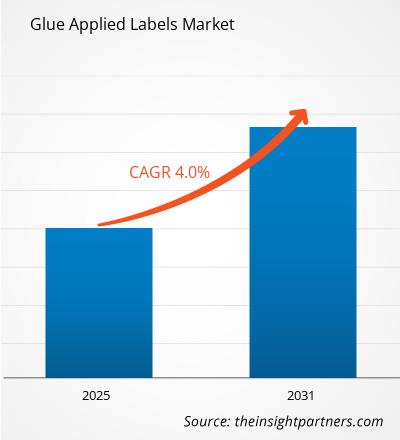
The glue applied labels market size stood at US$ 23.11 Billion in 2025 and is estimated to reach US$ 29.65 Billion by 2034, exhibiting a CAGR of 3.16% from 2026 to 2034. The market is driven by high demand for effective labels in the packaged goods, pharmaceuticals, logistics, and electronics industry to help identify and comply with regulations.
In North America, the glue applied labels market is fueled by the increasing trend towards sustainability in packaging materials, automation in labeling operations, and increased demand for tracking and tracing solutions. North America is estimated to witness a CAGR of 2.8 – 3.5% over the period 2026 to 2034, owing to investments in food safety compliance and pharmaceutical serialization.
Glue Applied Labels Market Assessment and Insights
- North America has a mature labeling ecosystem with strong adoption across food, beverage, pharmaceutical, and logistics applications. The region accounted for an estimated 28–32% glue applied labels market share in 2025 and is projected to grow at a CAGR of 2.8–3.5% between 2026–2034, supported by automation and sustainability initiatives.
- US represents the leading market within North America due to extensive packaged goods production, pharmaceutical manufacturing, and retail distribution networks. The country held an estimated 20–24% share in 2025 and is expected to expand at a CAGR of 2.9–3.6% during 2026–2034.
- Europe maintains a significant position due to stringent packaging regulations and advanced consumer goods industries across Germany, the UK, France, Italy, and Spain. The region contributed an estimated 24–28% share in 2025 and is anticipated to register a CAGR of 2.5–3.3% from 2026–2034.
- Asia Pacific is the fastest-expanding regional market, supported by manufacturing growth, rising packaged food consumption, and pharmaceutical production in China, India, Japan, and South Korea. The region represented an estimated 30–34% share in 2025 and is forecast to grow at a CAGR of 3.8–4.6% during 2026–2034.
- Largest Segment is Food and Beverage application, driven by extensive packaged product manufacturing and regulatory labeling requirements. This segment held an estimated 32–36% market share in 2025 and is projected to grow at a CAGR of 3.2–4.0% during 2026–2034.
- High Growth Segment is Semiconductor and Electronics application, supported by increasing component identification and inventory tracking requirements. The segment accounted for an estimated 8–12% market share in 2025 and is expected to expand at a CAGR of 4.0–5.0% during 2026–2034.
- Key companies analyzed in detail: 3M Company, Avery Dennison Corporation, CCL Industries Inc., Constantia Flexibles Group GmbH, Coveris Management GmbH, Henkel AG & Co. KGaA, Inland Packaging LLC, LINTEC Corporation, Multi-Color Corporation, Resource Label Group, LLC, Fuji Seal International, Inc., and UPM-Kymmene Corporation.
Source: The Insight Partners' analysis based on proprietary research, government publications, company annual reports, investor presentations, industry databases, and expert interviews.
Technological developments have been driving the glue-applied labels market through innovations in adhesive science, printing technologies, and applicator machines. Companies are investing more in the development of labels that can work with recyclable packagings, fast production processes, and variable data printing technology. The shift towards lighter packaging and greater visibility of logistics in supply chains is also driving innovation in papers, films, and specialized label stock products. New innovations in adhesives will result in higher performances of labels on tough surfaces.
The glue applied labels market forecasts indicate that the market will be shaped by developments in smart labeling, sustainable adhesives, and regional manufacturing facilities. Opportunities for growth in emerging markets will arise through increased retail coverage and digitization of industries. Regulatory focus on product information, recyclability, and consumer transparency will drive companies to upgrade their labels. Partnership among material producers, converters, and consumers is expected to boost innovation in the market.
Glue Applied Labels Market Report Scope
| Report Attribute | Details |
|---|---|
| Market size in 2025 | US$ 23.11 Billion |
| Market Size by 2034 | US$ 29.65 Billion |
| Global CAGR (2026 - 2034) | 3.16% |
| Historical Data | 2021-2024 |
| Forecast period | 2026-2034 |
Glue Applied Labels Market Analysis
The main source of demand in the glue applied labels industry is derived from sectors that need reliable identification, branding, and compliance information regarding products. There are several parties within the supply chain including adhesive companies, substrate providers, label printers, technologies of print, and users in the sectors such as foods, pharmaceuticals, electronics, and logistics industries. E-commerce distribution, packaging of consumer goods, and tracking needs continue increasing the demand.
The factors that drive supply in this sector include developments in the materials used to manufacture paper and synthetic labels, adhesives, and automation of processes. Suppliers have been concentrating on making their adhesives more compatible with automation in the process of labeling products and recyclable. Raw material cost increases have also driven suppliers towards finding alternative materials and optimizing efficiency.
The competitive positioning in the glue applied labels market entails technology development, geographical expansion, and personalized label solutions. The companies such as 3M Company, Avery Dennison Corporation, CCL Industries Inc., and Henkel AG & Co. KGaA continue to develop their market position through adhesive technologies, sustainable products development, and personalized solutions for customers. Meanwhile, other companies such as Constantia Flexibles Group GmbH, Coveris Management GmbH, LINTEC Corporation, and Multi-Color Corporation emphasize their efforts in the direction of expansion of conversion technologies and application of labels in certain industries.
The glue applied labels market trends indicate that investments are increasingly becoming oriented towards digital printing, automation, and sustainable manufacturing of labels. The companies Inland Packaging LLC, Resource Label Group, LLC, Fuji Seal International, Inc., and UPM-Kymmene Corporation improve their competencies in response to the new customer demands. Acquisitions, capacity expansions, and innovations related to recyclable labels formats are among key strategies to maintain competitiveness in the fragmented global market.
● REPORT CUSTOMIZATION
Tailor This Report To Align With Your Specific Business Requirements
This report can be customized to align precisely with your business objectives, scope, and target markets. Customization options include tailored segmentation, geography, competitive analysis, and strategic insights to support informed decision-making.
Customize This Report →WHAT YOU CAN ADJUST
- ● Segmentations
- ● Geography
- ● Competitive Analysis
- ● Language Preferences
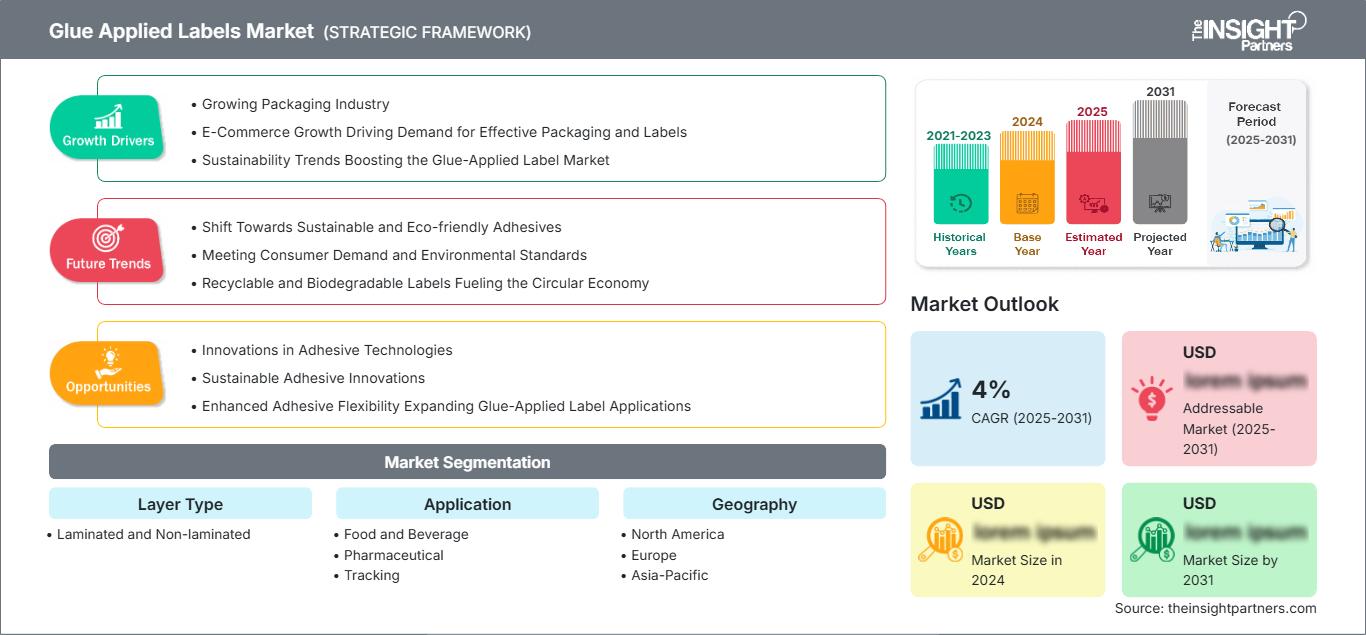
Glue Applied Labels Market: Strategic Insights
Regional Insights
North America Glue Applied Labels Market
According to the glue applied labels market report, North America represented a market share of around 28-32% in 2025 and is expected to grow at a CAGR of 2.8-3.5% during 2026-2034. The region has advantages such as well-established packaging industry, extensive usage of automated labeling systems, along with robust demand in sectors such as food & beverages, healthcare, and logistics. The US and Canada continue to invest in the growth of their markets in areas such as smart manufacturing and sustainable packaging.
Factors contributing to growth in this region include advanced print technology, well-established label converters, and stringent regulations concerning product information. Growing demand for recyclable packaging solutions and improved supply chain management has encouraged manufacturers to develop better adhesives. Pharmaceutical serialization and industrial identification are creating growth opportunities in the region.
U.S. Glue Applied Labels Market
The US accounted for an approximate share of 20–24% in the North American region in 2025, and it is projected to grow at a CAGR of 2.9–3.6% during 2026–2034. It continues to be a significant contributor owing to the presence of numerous manufacturers in the food and beverage sector, pharmaceutical companies, and sophisticated retail distribution channels.
Various players operating in the labels segment and adhesive technology providers are well-established across the nation. The rise in the need for labels used in product authentication and inventory management is boosting up the growth rate of the market. The rise in e-commerce logistics and warehousing operations has added new opportunities for the use of durable identification labels.
Europe Glue Applied Labels Market
Europe had a share estimate of 24–28% in 2025 and is expected to register a CAGR of 2.5–3.3% in 2026-2034. The European market is aided by the availability of advanced packaging practices, stringent sustainability regulations, and demand for food & beverages, pharmaceuticals, and personal care products. Germany continues to be among the dominant players because of its industrial manufacturing base. Meanwhile, the UK, France, Italy, and Spain add value to the European market through consumer goods manufacturing.
The UK is driven by premium packaging needs, retail labeling, and compliance requirements in various industries. Germany benefits from labeling needs across the automotive, industrial, and pharmaceutical industries, which require precise labeling performance. On the other hand, France, Italy, and Spain benefit from the rising food processing and beverage sector and the adoption of sustainable packaging solutions. There are many regulations that favor recyclable packaging solutions in Europe.
APAC Glue Applied Labels Market
The APAC region accounted for an estimated 30-34% of the total share in 2025 and is expected to expand at a CAGR of 3.8-4.6% during 2026-2034. The largest country-level demand in the region is attributed to China owing to its manufacturing capacity, increasing packaged food industry, and logistics operations. Demand in the region is being driven by Japan and South Korea through their electronics, pharmaceutical, and precision manufacturing operations.
The market in APAC has been aided by Australia's need for effective labeling due to its food processing and consumer goods manufacturing operations. Government efforts aimed at boosting manufacturing and digitization in the region have provided an added impetus to growth.
Middle East & Africa Glue Applied Labels Market
The market in the Middle East & Africa is forecasted to grow with a CAGR of 2.7–3.5% from 2026–2034 because of increasing packaged food manufacture, investment in pharma, and logistics development. In Saudi Arabia, industrial diversification efforts and production of consumer goods serve as driving factors for market development. Another country in the Middle East that contributes to market growth is UAE due to its retail market and sophisticated distribution network.
In South Africa, the contribution to market development comes through already developed food, beverages, and industrial segments of the economy. In Rest of MEA, there is an ongoing adoption of the modern labeling systems as producers increase their efficiencies and export capacities. Further investments, energy industry supply chains, and product traceability needs will provide the opportunities for market development.
Segmentation Analysis
Layer Type
Layer Type segmentation includes laminated and non-laminated solutions, with the segment expected to register a CAGR of 2.9–3.7% during 2026–2034. Manufacturers are focusing on improving label durability, print quality, and resistance against moisture, chemicals, and handling conditions. The increasing need for longer-lasting product identification across industrial and consumer applications is shaping adoption patterns.
- Laminated labels are widely adopted where enhanced protection, durability, and resistance to environmental exposure are required. These solutions support applications including logistics, industrial products, and premium consumer packaging requiring extended label performance.
- Non-laminated labels maintain demand due to cost efficiency and suitability for short-life-cycle products. These solutions are commonly used in food, beverage, and retail applications where economical labeling requirements remain important.
Application
Application segmentation is expected to grow at a CAGR of 3.1–4.0% during 2026–2034, driven by increasing labeling requirements across multiple industries. The segment benefits from rising product complexity, regulatory requirements, and the need for accurate identification throughout manufacturing and distribution networks. Diverse end-use adoption continues to support market expansion.
- Food and Beverage applications represent the largest demand area due to extensive packaged product volumes and mandatory information labeling requirements. Manufacturers increasingly require adhesive labels compatible with sustainable packaging and high-speed production operations.
- Pharmaceutical applications are expanding with rising requirements for authentication, serialization, and compliance-based product information. Reliable labels support accurate identification throughout healthcare supply chains and regulated distribution environments.
- Tracking applications are gaining importance as companies implement inventory visibility and asset management systems. Adhesive labels enable efficient monitoring of products, equipment, and shipments across industrial and commercial operations.
- Logistics and Transportation applications benefit from increasing e-commerce activity and warehouse automation. Durable labels support shipment identification, routing efficiency, and supply chain management across regional and international distribution networks.
- Home and Personal care applications continue to utilize adhesive labels for branding, product information, and packaging differentiation. Growth is supported by expanding consumer product portfolios and increasing demand for visually appealing packaging formats.
- Semiconductor and Electronics applications are driven by precision identification needs for components and devices. Labels must withstand manufacturing processes while supporting inventory control, traceability, and quality management requirements.
- Retail Labels applications remain important for pricing, branding, and product communication. Growth is supported by retail modernization, organized commerce expansion, and increasing demand for efficient product presentation solutions.
Opportunity Snapshot
| Application | Revenue Contribution (High/Medium/Low) | Trend Tag | Adoption Stage |
|---|---|---|---|
| Food and Beverage | High | Sustainable Packaging | Mature |
| Pharmaceutical | High | Smart Traceability | Scaling |
| Tracking | Medium | Asset Visibility | Scaling |
| Logistics and Transportation | Medium | Digital Logistics | Scaling |
| Home and Personal care | Medium | Premium Branding | Mature |
| Semiconductor and Electronics | Medium | Component Tracking | Emerging |
| Retail Labels | Medium | Retail Automation | Mature |
Glue Applied Labels Market Growth Drivers and Impact Analysis
Rising Demand for Sustainable Packaging-Compatible Labels
Growing awareness of environmental responsibility in packaging is affecting the development of adhesive labels for both consumers and industries. There is a need for labels that will be friendly to recyclable paper, light weight, and enhanced packaging recycling methods. This trend has motivated manufacturers to come up with adhesives that not only perform well but also support sustainability goals. The rising trend in circular packaging is creating more opportunities for companies that make labels to produce low-impact materials and efficient structures. Manufacturers of sustainable labeling solutions have grown in importance due to the tightening of packaging rules in various markets.
Expansion of Automated Manufacturing and Supply Chain Operations
Automation across manufacturing facilities, warehouses, and distribution centers is increasing the requirement for reliable identification solutions. Adhesive labels play an essential role in automated tracking systems, inventory management, and production monitoring processes. Industries including logistics, electronics, pharmaceuticals, and consumer goods are integrating advanced labeling technologies to improve operational accuracy and reduce manual intervention. Growth in e-commerce fulfillment networks is further strengthening demand for efficient labeling systems capable of handling high shipment volumes. Manufacturers are developing labels with improved adhesion, machine compatibility, and durability to support automated environments. This operational transformation is creating long-term demand opportunities for suppliers offering application-specific solutions.
Increasing Regulatory Requirements for Product Identification
Regulatory compliance requirements across food, healthcare, and industrial sectors are increasing the importance of accurate labeling systems. Governments and industry bodies are emphasizing product traceability, safety information, and supply chain transparency, encouraging companies to adopt dependable adhesive labeling solutions. Pharmaceutical manufacturers require labels supporting serialization and authentication, while food producers need accurate ingredient and regulatory information. These requirements are pushing businesses to upgrade labeling processes and invest in higher-performance materials. The growing complexity of global supply chains is further increasing the need for reliable identification throughout product lifecycles. Regulatory-driven adoption is expected to remain an important factor shaping market development.
Glue Applied Labels Market Future Trends
Integration of Smart Labeling Technologies
Future adoption of smart labeling technologies is expected to reshape the industry by combining adhesive labels with digital identification capabilities. Increasing use of QR codes, RFID integration, and connected packaging solutions will improve consumer engagement, inventory visibility, and authentication processes. Companies are exploring advanced label structures that support digital interaction while maintaining traditional printing efficiency. The evolution of smart packaging ecosystems will encourage collaboration between label manufacturers, technology providers, and brand owners. As supply chains become more data-driven, intelligent labeling solutions are expected to gain broader acceptance across pharmaceuticals, retail, logistics, and industrial applications. These developments represent a shift toward labels functioning as information platforms rather than simple identification tools.
Growth of Circular Economy Label Solutions
The transition toward circular economy practices is expected to influence future label material development and manufacturing strategies. Companies are increasingly evaluating adhesive formulations, substrates, and production methods that improve packaging recyclability and reduce environmental impact. Future solutions are likely to focus on compatibility between labels and recycling systems, enabling easier separation and material recovery. Collaboration among packaging manufacturers, recyclers, and adhesive suppliers will become increasingly important for developing practical sustainability solutions. Regulatory initiatives targeting waste reduction and resource efficiency will further accelerate innovation. The adoption of circular labeling approaches is expected to become a significant differentiating factor as customers prioritize environmentally responsible packaging systems.
Glue Applied Labels Market Opportunities
Expansion in Emerging Manufacturing Economies
Emerging manufacturing economies present significant opportunities due to increasing industrialization, consumer product expansion, and infrastructure development. Countries across Asia Pacific, the Middle East, and Africa are investing in manufacturing capacity, logistics networks, and organized retail systems, creating demand for efficient labeling solutions. Companies can benefit by establishing regional production capabilities, strengthening distribution networks, and developing products suited to local requirements. Growing pharmaceutical manufacturing, packaged food production, and export-oriented industries are expected to generate additional demand. Businesses focusing on cost-effective, durable, and sustainable label technologies can capture opportunities in these developing markets. Strategic partnerships with regional converters and end users may further improve market penetration.
Advancement in Sustainable Adhesive Technologies
Innovation in sustainable adhesive technologies creates opportunities for companies seeking differentiation in a competitive environment. Developing adhesives compatible with recyclable substrates, bio-based materials, and advanced packaging formats can help suppliers address evolving customer expectations. The growing emphasis on reducing packaging waste is encouraging investments in research and development activities focused on environmentally responsible solutions. Companies that successfully balance performance, cost efficiency, and sustainability requirements may strengthen their market positions. Future Glue Applied Labels Market Forecasts are expected to reflect increasing adoption of solutions designed for circular packaging systems and regulatory compliance. Investment in material innovation, testing capabilities, and customer collaboration will remain important for capturing emerging opportunities.
Recent Developments
- March 2026: CCL Industries announced that it will acquire Sleever International, expanding sustainable labeling solutions for global brands.
- September 2025: Avery Dennison Corporation introduced new labeling solutions at Labelexpo Europe 2025 focused on recycling, connectivity, and packaging safety. The innovations included expanded clean-release label technologies designed to improve packaging circularity and support reusable packaging systems.
Frequently Asked Questions

- Comprehensive Market Sizing and Forecast Analysis
- Detailed Segmentation Analysis
- In-Depth Market Dynamics Assessment
- Regional and Country-Level Insights
- Competitive Landscape and Company Benchmarking
- Strategic Business Intelligence
Recent Reports
Testimonials

The Insight Partners' SCADA System Market report is comprehensive, with valuable insights on current trends and future forecasts. The team was highly professional, responsive, and supportive throughout. We are very satisfied and highly recommend their services.
RAN KEDEM Partner, Reali Technologies LTDs
I requested a report on a very specific software market and the team produced the report in a few days. The information was very relevant and well presented. I then requested some changes and additions to the report. The team was again very responsive and I got the final report in less than a week.
JEAN-HERVE JENN Chairman, Future Analytica
We worked with The Insight Partners for an important market study and forecast. They gave us clear insights into opportunities and risks, which helped shape our plans. Their research was easy to use and based on solid data. It helped us make smart, confident decisions. We highly recommend them.
PIYUSH NAGPAL Sr. Vice President, High Beam Global
The Insight Partners delivered insightful, well-structured market research with strong domain expertise. Their team was professional and responsive throughout. The user-friendly website made accessing industry reports seamless. We highly recommend them for reliable, high-quality research services
YUKIHIKO ADACHI CEO, Deep Blue, LLC.
This is the first time I have purchased a market report from The Insight Partners.While I was unsure at first, I visited their web site and felt more comfortable to take the risk and purchase a market report.I am completely satisfied with the quality of the report and customer service. I had several questions and comments with the initial report, but after a couple of dialogs over email with their analyst I believe I have a report that I can use as input to our strategic planning process.Thank you so much for taking the extra time and making this a positive experience.I will definitely recommend your service to others and you will be my first call when we need further market data.
JOHN SUZUKI President and Chief Executive Officer, Board Director, BK Technologies
I wish to appreciate your support and the professionalism you displayed in the course of attending to my request for information regarding to infectious disease IVD market in Nigeria. I appreciate your patience, your guidance, and the fact that you were willing to offer a discount, which eventually made it possible for us to close a deal. I look forward to engaging The Insight Partners in the future, all thanks to the impression you have created in me as a result of this first encounter.
DR CHIJIOKE ONYIA MANAGING DIRECTOR, PineCrest Healthcare Ltd.Reason to Buy
- Informed Decision-Making
- Understanding Market Dynamics
- Competitive Analysis
- Identifying Emerging Markets
- Customer Insights
- Market Forecasts
- Risk Mitigation
- Boosting Operational Efficiency
- Strategic Planning
- Investment Justification
- Tracking Industry Innovations
- Aligning with Regulatory Trends





 Get Free Sample for