
Glue Laminated Timber Market Trends, Size & Forecast by 2034
Coverage: By Shape (Straight, Cambered, Custom); Application (Residential, Commercial, Industrial) , and Geography (North America, Europe, Asia Pacific, and South and Central America)
- Status : Data Released
- Report Code : TIPRE00024882
- Category : Chemicals and Materials
- No. of Pages : 150
- Available Report Formats :


- Last update date : July 21, 2026


2025 Market Size
US$ 8.04 Bn
Base year value
2034 Forecast
US$ 12.84 Bn
Projected by 2034
CAGR 2026-2034
5.34 %
Growth rate
Addressable Market
US$ 94.71 Bn
(2026-2034)
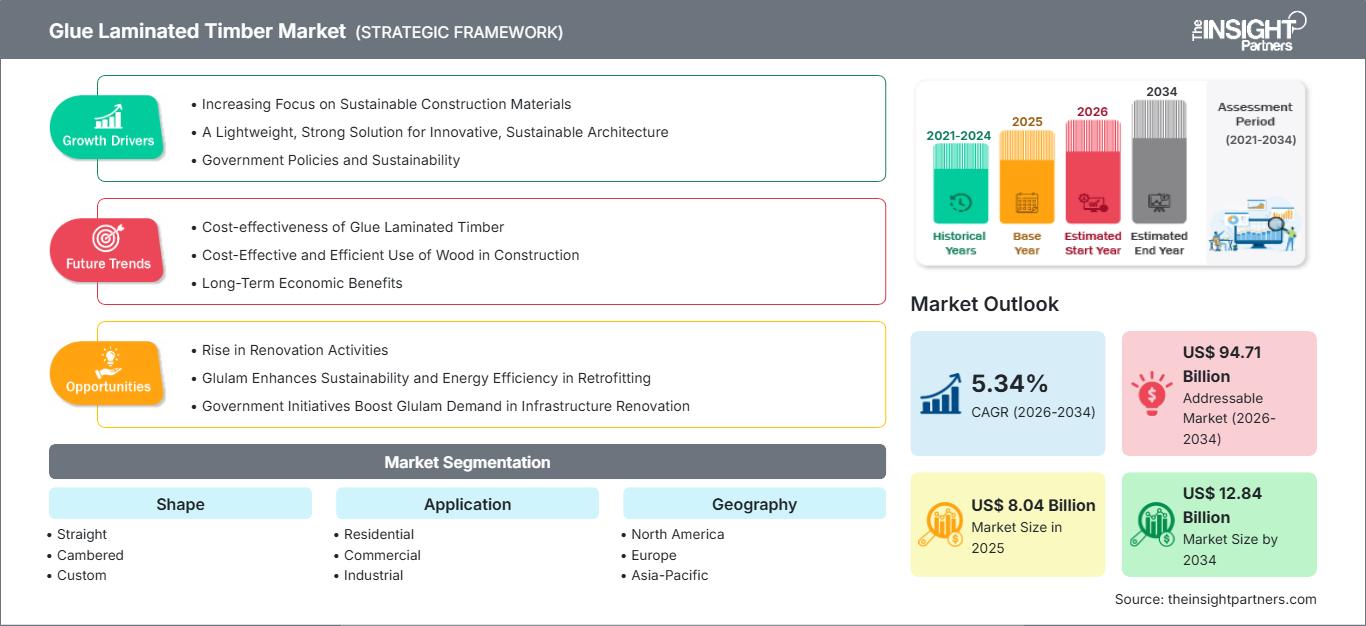
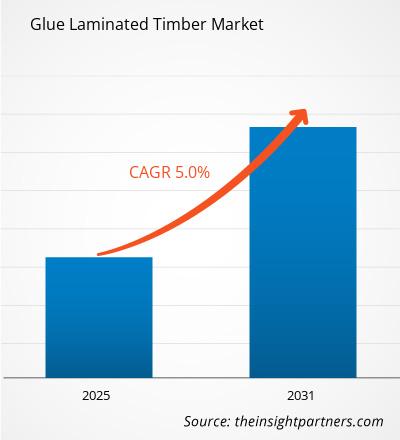
The glue laminated timber market was valued at US$ 8.04 Billion in 2025 and is projected to reach US$ 12.84 Billion by 2034, expanding at a CAGR of 5.34% during 2026–2034. With the rise in the usage of engineered wood for the construction industry and increasing importance of sustainable building materials, there is increasing demand from all around the world. Further technological advances in the production of the engineered wood, including improvements in digital manufacturing, and adhesive technology have also been aiding the increased use for structural purposes.
In the North American region, demand is being fueled by green building policies, rising mass timber construction, and investments into infrastructure that emits less carbon dioxide. Glued laminated timber market size is increasing owing to an increase in engineered wood usage for commercial and institutional buildings. Moreover, the modernization of building codes is encouraging structural usage.
Glue Laminated Timber Market Assessment and Insights
- North America: Accounted for 31–33% of the Glue Laminated Timber Market share in 2025 and is expected to register a CAGR of 5.1–5.5% during 2026–2034, supported by sustainable construction policies, expanding mass timber adoption, and investments in commercial and institutional buildings.
- U.S.: Represented 78–82% of the North American market in 2025 and is anticipated to grow at a CAGR of 5.2–5.6% during 2026–2034, driven by favorable building regulations and increasing engineered wood utilization.
- Europe: Held 34–36% share in 2025 and is projected to expand at a CAGR of 4.9–5.3% during 2026–2034, led by Germany, Sweden, Austria, Finland, and France through mature timber construction ecosystems.
- Asia Pacific: Captured 24–26% share in 2025 and is forecast to grow at a CAGR of 5.8–6.2% during 2026–2034, with China, Japan, Australia, and South Korea driving demand through urban development and sustainable building initiatives.
- Largest Segment: Commercial accounted for 42–45% market share in 2025 and is anticipated to record a CAGR of 5.3–5.7% during 2026–2034, supported by office complexes, educational institutions, and public infrastructure developments.
- High Growth Segment: Residential represented 33–36% market share in 2025 and is expected to expand at a CAGR of 5.8–6.2% during 2026–2034, fueled by low-carbon housing projects and increasing consumer preference for engineered timber structures.
- Key companies analyzed in detail: binderholz GmbH, Boise Cascade Company, Calvert Company, Inc., Canfor Corporation, Eugen Decker Holzindustrie KG, Glulam Ltd, Pfeifer Holding GmbH, Schilliger Holz AG, Setra Group AB, Structurlam Mass Timber Corporation.
Source: The Insight Partners' analysis based on proprietary research, government publications, company annual reports, investor presentations, industry databases, and expert interviews.
Increasing environmental concerns and advances in building codes have turned engineered wood products into strategically used construction materials in contemporary infrastructure initiatives. The glued laminated timber industry has moved past its classic structural uses through technological advancements in lamination, adhesion, machining, and digital manufacturing techniques. In addition to enhancing production efficiency, manufacturers are customizing their products to enable the incorporation of large spans, complex structures, and visually attractive timber constructions in line with structural, fire, and sustainable criteria.
Future growth is likely to be driven by more investment in carbon-free construction, mass timber buildings, and policy backing for renewable construction materials. The developing nations are implementing new building regulations that view engineered wood products as an acceptable structural material choice, while infrastructure developments promote material diversity. Future growth drivers include modular construction, prefabrication of building materials, and the growth of industrial manufacturing capacity in Asia Pacific and selected Latin American regions.
Glue Laminated Timber Market Report Scope
| Report Attribute | Details |
|---|---|
| Market size in 2025 | US$ 8.04 Billion |
| Market Size by 2034 | US$ 12.84 Billion |
| Global CAGR (2026 - 2034) | 5.34% |
| Historical Data | 2021-2024 |
| Forecast period | 2026-2034 |
Glue Laminated Timber Market Analysis
Increasing investments into sustainable building have been consistently fueling glue laminated timber market growth as governmental bodies, developers, and institutional investors are focused on low-carbon building materials. Engineered timber represents a material type with a relatively lower carbon footprint than the majority of conventional structural materials. Engineered timber can also provide high strength-to-weight characteristics along with the ability to design buildings in an efficient way. Increasing demand for prefabricated construction solutions is another factor that encourages the application of glue laminated timber because glulam allows minimizing the number of laborers required at the construction site, enhancing installation efficiency, and minimizing construction waste. The growing number of green certification programs as well as evolving building codes has been motivating architects to choose engineered timber as a material for office, residential, school, and public infrastructure buildings.
Supply chain integration has become a trend in the industry because the entire value chain includes forest certification programs, sawmills, adhesive producers, engineered wood producers, fabricators, and construction companies working together to ensure high quality and sustainability of materials. Automated digital design, CNC machinery, and Building Information Modeling allow increasing production accuracy and minimizing material loss.
Competitive pressure in the glue laminated timber market report stems from consistent development of manufacturing operations, innovation in products, and strategic cooperation. binderholz GmbH, Pfeifer Holding GmbH, Schilliger Holz AG, Setra Group AB, Structurlam Mass Timber Corporation, and Canfor Corporation are consistently investing in their capacity for the increase in mass timber production to cater to the growing demand for such type of construction. At the same time, Boise Cascade Company and Calvert Company, Inc. utilize large distribution networks for increasing access to the end customers from different construction industries. Finally, Eugen Decker Holzindustrie KG and Glulam Ltd develop specialized engineered wood materials for specific architectural purposes.
Increasingly, capital investments are directed at innovative manufacturing operations, digital technologies for manufacturing, certified sources of wood, and environmentally safe adhesives. Strategic collaboration of manufacturers with architects, contractors, and governmental organizations is continuously facilitating penetration of the market due to the demonstration of performance and advantages of engineered wood systems. In addition, companies are developing international distribution networks in order to respond to growing glue laminated timber market opportunities in economies with rapid urbanization.
● REPORT CUSTOMIZATION
Tailor This Report To Align With Your Specific Business Requirements
This report can be customized to align precisely with your business objectives, scope, and target markets. Customization options include tailored segmentation, geography, competitive analysis, and strategic insights to support informed decision-making.
Customize This Report →WHAT YOU CAN ADJUST
- ● Segmentations
- ● Geography
- ● Competitive Analysis
- ● Language Preferences
Glue Laminated Timber Market: Strategic Insights
Regional Insights
North America Glue Laminated Timber Market
North America accounted for 31–33% of the global glue laminated timber market in 2025 and is projected to expand at a CAGR of 5.1–5.5% during 2026–2034. The region enjoys the advantage of state-of-the-art engineering woods production, availability of timber certification, and conducive regulations that favor green buildings. The share of glue laminated timber continues to be favorable because of increasing usage in educational institutions, commercial buildings, transportation network, and public infrastructure aimed at cutting down carbon footprint.
Mass timber production is still being pursued in the U.S. and Canada, while architects are also recommending engineered timber for mid-rise and institutional buildings. Codes allowing for taller timber constructions have helped speed up development of projects in urban centers. Increasing demand for prefabricated building technologies, together with government policies encouraging resilient infrastructure, will aid in further expansion in the region.
U.S. Glue Laminated Timber Market
The U.S. represented 78–82% of the North American market in 2025 and is anticipated to register a CAGR of 5.2–5.6% during 2026–2034. Increasingly greater focus on low-carbon buildings, improvement of commercial structures, and increased investments in education and healthcare infrastructure keep boosting market demand. Domestic producers of engineered wood are increasing their capacities to satisfy growing needs of projects and increase reliability of supply chains.
Commercial office spaces, schools, sports facilities, warehouses, and multifamily residential buildings are using more glue laminated timber due to its effectiveness, flexibility, and sustainable nature. Close cooperation between timber producers, engineering organizations, and construction firms helps in development of new products and increases the market reach. Good certification practices and increased public awareness about carbon emissions also help improve market prospects.
Europe Glue Laminated Timber Market
Europe held 34–36% of the global market in 2025 and is forecast to grow at a CAGR of 4.9–5.3% during 2026–2034, maintaining its leadership through mature timber engineering expertise and supportive environmental regulations. Germany still leads in engineered wood production because of its huge production capability, high prefabrication level, and use of sustainable construction technologies.
Increasing usage of engineered timber for domestic housing, public constructions, and urban regeneration is currently being observed in the UK due to low-carbon construction materials being used. The government’s sustainability policies and innovations in construction methods push to utilize more factory-made structural components in infrastructural constructions.
Engineered timber is increasingly being used in France, Italy, and Spain due to their environmentally friendly policies and innovations in building constructions. In addition to Austria and Nordic countries, they help boost the competitiveness of Europe due to innovations in certified forests and timber production technologies.
APAC Glue Laminated Timber Market
Asia Pacific accounted for 24–26% of the global market in 2025 and is expected to record the fastest regional expansion at a CAGR of 5.8–6.2% during 2026–2034. China drives regional demand by means of urbanization and sustainable construction material investment. Japan keeps pushing engineered wood for construction of earthquake resistant structures.
South Korea, India, and Australia are making steady progress in increasing their adoption through green building projects, industrial growth, and favorable construction policies. Continued investments in prefabricated buildings and infrastructures keep providing positive prospects for regional producers and international suppliers.
Segmentation Analysis
Shape
The Shape segment is projected to expand at a CAGR of 5.2–5.6% during 2026–2034. Product innovation, architectural flexibility, and advancements in precision manufacturing continue supporting broader adoption across commercial and residential construction. The glue laminated timber market scope continues expanding as customized structural solutions enable architects to achieve longer spans, improved aesthetics, and enhanced structural performance while meeting sustainability objectives.
- Straight – The most widely utilized configuration due to its structural efficiency, manufacturing simplicity, and suitability for beams, columns, bridges, and large-span commercial buildings requiring reliable load-bearing performance.
- Cambered – Preferred for projects requiring enhanced architectural appearance and improved structural performance by compensating for anticipated deflection, particularly in public infrastructure, sports facilities, and institutional buildings.
- Custom – Increasingly adopted for iconic architectural projects requiring unique geometries, curved structural elements, and complex engineered solutions supported by advanced digital fabrication technologies.
Application
The Application segment is anticipated to grow at a CAGR of 5.4–5.8% during 2026–2034, supported by expanding investments in sustainable construction across residential, commercial, and industrial sectors. Commercial developments continue generating the largest revenue contribution owing to extensive utilization in offices, educational institutions, airports, retail facilities, and public infrastructure requiring durable engineered timber solutions.
- Residential – Demand continues increasing through low-rise and mid-rise housing developments emphasizing sustainability, energy efficiency, faster construction timelines, and improved architectural aesthetics using engineered timber products.
- Commercial – The dominant application segment benefits from growing investments in office buildings, schools, hospitals, shopping centers, and recreational facilities seeking environmentally responsible structural materials.
- Industrial – Warehouses, manufacturing plants, logistics centers, and agricultural buildings increasingly utilize engineered timber because of its strength, dimensional stability, and ability to support wide-span structural designs.
Opportunity Snapshot
| Application | Revenue Contribution | Trend Tag | Adoption Stage |
| Residential | Medium | Green Housing | Scaling |
| Commercial | High | Mass Timber | Mature |
| Industrial | Medium | Wide Span | Scaling |
Glue Laminated Timber Market Growth Drivers and Impact Analysis
Expansion of sustainable and low-carbon construction worldwide
Increasing emphasis on reducing greenhouse gas emissions from the construction sector is accelerating demand for engineered wood products across developed and emerging economies. Governments are introducing policies that encourage the use of renewable building materials, while developers are prioritizing structures with lower embodied carbon to meet environmental certification requirements. Glue laminated timber provides an attractive alternative because it combines structural strength with renewable raw materials and efficient resource utilization. Public investments in schools, transportation hubs, sports facilities, and civic infrastructure increasingly include mass timber components to support national climate objectives. As corporate sustainability commitments become more ambitious, developers are expected to allocate greater capital toward engineered timber solutions, strengthening long-term market expansion and encouraging manufacturers to increase production capacity, improve product quality, and expand certified timber sourcing networks.
Growth in prefabricated and modular building construction
The rapid adoption of off-site construction methods is creating substantial opportunities for engineered timber manufacturers. Prefabricated structural components improve construction efficiency by reducing project timelines, minimizing material waste, and lowering labor requirements at project sites. Glue laminated timber is particularly well suited for modular construction because of its dimensional accuracy, consistent quality, and compatibility with digital design platforms. Contractors increasingly utilize factory-produced timber elements to address skilled labor shortages while improving project scheduling and cost control. As governments continue investing in affordable housing, healthcare facilities, educational institutions, and commercial developments, demand for prefabricated structural systems is expected to increase steadily. This transition supports broader utilization of engineered timber products across both public and private sector construction projects.
Advancements in engineered wood manufacturing technologies
Continuous technological innovation is improving the performance, durability, and production efficiency of glue laminated timber products. Automated manufacturing systems, CNC machining, robotics, and digital quality monitoring enable producers to manufacture complex structural elements with high precision and consistent mechanical properties. Modern adhesive technologies enhance moisture resistance, structural integrity, and long-term durability, allowing engineered timber to be specified for increasingly demanding applications. Digital integration between architects, engineers, and manufacturers further streamlines project execution while reducing material losses during fabrication. These technological improvements also support greater customization, enabling producers to supply longer spans, curved members, and architecturally distinctive structures that expand the application range of engineered timber across commercial, residential, and industrial construction.
Glue Laminated Timber Market Future Trends
Growing adoption of hybrid timber construction systems
Hybrid structural systems combining glue laminated timber with steel and reinforced concrete are expected to gain wider acceptance across large commercial and institutional developments. These designs maximize the structural advantages of each material while reducing overall carbon emissions and improving construction efficiency. Glue laminated timber market trends indicate increasing collaboration among architects, structural engineers, and developers to optimize hybrid building designs for taller structures, longer spans, and enhanced architectural flexibility. Continued improvements in structural analysis software and building codes are expected to accelerate adoption across urban infrastructure projects during the forecast period.
Digital manufacturing transforming engineered timber production
Digitalization is expected to reshape engineered timber manufacturing through greater adoption of Building Information Modeling, artificial intelligence, robotics, and automated production systems. Manufacturers are increasingly integrating digital workflows from design through fabrication to improve production accuracy, reduce waste, and shorten delivery schedules. Advanced modeling technologies also enable greater customization while supporting efficient collaboration among project stakeholders. As digital manufacturing capabilities continue expanding, producers will be better positioned to deliver high-quality structural components for increasingly complex commercial and infrastructure developments while maintaining cost competitiveness and operational efficiency.
Glue Laminated Timber Market Opportunities
Expansion into emerging urban infrastructure markets
Rapid urbanization across Asia Pacific, the Middle East, and selected Latin American economies is creating favorable investment opportunities for engineered timber manufacturers. Glue laminated timber Market Forecasts indicate increasing government expenditure on educational institutions, transportation infrastructure, healthcare facilities, and public buildings that prioritize sustainable construction materials. Manufacturers expanding local production capabilities, technical partnerships, and distribution networks can strengthen their competitive position while reducing logistics costs. Investment in regional manufacturing facilities will also improve supply chain responsiveness and support compliance with evolving local building standards, enabling companies to capture long-term growth opportunities.
Development of advanced customized structural solutions
Demand for architecturally distinctive buildings is encouraging manufacturers to invest in highly customized engineered timber solutions capable of supporting complex geometries and longer structural spans. Advanced digital fabrication technologies enable producers to manufacture curved beams, large-span roof systems, and aesthetically differentiated structural components for commercial, institutional, and cultural projects. Companies that combine engineering expertise with digital design capabilities can establish stronger relationships with architects and contractors while expanding their participation in premium construction projects. Continued investment in product innovation, design services, and automated manufacturing technologies is expected to create sustainable competitive advantages throughout the forecast period.
Recent Developments
- December 2025: binderholz GmbH announced excellent Environmental Product Declaration (EPD) certification results for its solid wood panels and glue laminated timber products.
- December 2024: Setra's owners, Sveaskog AB and Mellanskog, announced a letter of intent regarding the sale of Sveaskog's stake in Setra Group AB to Mellanskog. The ownership change is planned to be executed during the first quarter of 2025.
Frequently Asked Questions

- Comprehensive Market Sizing and Forecast Analysis
- Detailed Segmentation Analysis
- In-Depth Market Dynamics Assessment
- Regional and Country-Level Insights
- Competitive Landscape and Company Benchmarking
- Strategic Business Intelligence
Recent Reports
Testimonials

The Insight Partners' SCADA System Market report is comprehensive, with valuable insights on current trends and future forecasts. The team was highly professional, responsive, and supportive throughout. We are very satisfied and highly recommend their services.
RAN KEDEM Partner, Reali Technologies LTDs
I requested a report on a very specific software market and the team produced the report in a few days. The information was very relevant and well presented. I then requested some changes and additions to the report. The team was again very responsive and I got the final report in less than a week.
JEAN-HERVE JENN Chairman, Future Analytica
We worked with The Insight Partners for an important market study and forecast. They gave us clear insights into opportunities and risks, which helped shape our plans. Their research was easy to use and based on solid data. It helped us make smart, confident decisions. We highly recommend them.
PIYUSH NAGPAL Sr. Vice President, High Beam Global
The Insight Partners delivered insightful, well-structured market research with strong domain expertise. Their team was professional and responsive throughout. The user-friendly website made accessing industry reports seamless. We highly recommend them for reliable, high-quality research services
YUKIHIKO ADACHI CEO, Deep Blue, LLC.
This is the first time I have purchased a market report from The Insight Partners.While I was unsure at first, I visited their web site and felt more comfortable to take the risk and purchase a market report.I am completely satisfied with the quality of the report and customer service. I had several questions and comments with the initial report, but after a couple of dialogs over email with their analyst I believe I have a report that I can use as input to our strategic planning process.Thank you so much for taking the extra time and making this a positive experience.I will definitely recommend your service to others and you will be my first call when we need further market data.
JOHN SUZUKI President and Chief Executive Officer, Board Director, BK Technologies
I wish to appreciate your support and the professionalism you displayed in the course of attending to my request for information regarding to infectious disease IVD market in Nigeria. I appreciate your patience, your guidance, and the fact that you were willing to offer a discount, which eventually made it possible for us to close a deal. I look forward to engaging The Insight Partners in the future, all thanks to the impression you have created in me as a result of this first encounter.
DR CHIJIOKE ONYIA MANAGING DIRECTOR, PineCrest Healthcare Ltd.Reason to Buy
- Informed Decision-Making
- Understanding Market Dynamics
- Competitive Analysis
- Identifying Emerging Markets
- Customer Insights
- Market Forecasts
- Risk Mitigation
- Boosting Operational Efficiency
- Strategic Planning
- Investment Justification
- Tracking Industry Innovations
- Aligning with Regulatory Trends





 Get Free Sample for