
Glyphosate Market Growth, Trends, and Forecast by 2034
Coverage: by Crop Type (Genetically Modified and Conventional Crops); Form (Liquid and Dry); Application (Agricultural and Non Agricultural), and Geography (North America, Europe, Asia Pacific, and South and Central America)
- Status : Data Released
- Report Code : TIPRE00003339
- Category : Chemicals and Materials
- No. of Pages : 150
- Available Report Formats :


- Last update date : July 27, 2026


2025 Market Size
US$ 9.23 Bn
Base year value
2034 Forecast
US$ 12.25 Bn
Projected by 2034
CAGR 2026-2034
3.2 %
Growth rate
Addressable Market
US$ 97.56 Bn
(2026-2034)
The glyphosate market was valued at US$ 9.23 Billion in 2025 and is projected to reach US$ 12.25 Billion by 2034, expanding at a CAGR of 3.2% during 2026–2034. Market expansion is supported by the continued adoption of broad-spectrum herbicides in commercial agriculture, increasing focus on improving crop productivity, and the widespread integration of weed management practices across developed and emerging agricultural economies. Demand remains closely linked to cultivation intensity, herbicide-resistant weed management strategies, and advancements in precision farming technologies.
Across North America, demand remains supported by large-scale cultivation of soybean, corn, and canola along with extensive mechanized farming practices. The glyphosate market size continues to benefit from stable herbicide consumption across the region, while regulatory compliance and integrated weed management programs are encouraging product innovation. The regional market is expected to expand at a CAGR of 2.8–3.4% through 2034, supported by precision application technologies, digital farming platforms, and sustained investments in agricultural productivity.
Glyphosate Market Assessment and Insights
- North America: North America accounted for 29–33% share in 2025 and is projected to grow at a CAGR of 2.8–3.4% during 2026–2034. High mechanization, adoption of herbicide-tolerant crops, and advanced precision agriculture continue to strengthen regional demand.
- US: The U.S. represented 74–78% of the North American market in 2025 and is anticipated to expand at a CAGR of 2.7–3.3% through 2034 owing to extensive soybean, corn, and cotton cultivation.
- Europe: Europe held 21–25% market share in 2025 and is forecast to register a CAGR of 2.2–2.9%. Germany, France, Spain, Italy, and the UK remain major agricultural economies supporting herbicide consumption despite evolving regulatory frameworks.
- Asia Pacific: Asia Pacific accounted for 33–37% share in 2025 and is expected to witness the fastest regional expansion at a CAGR of 3.8–4.5%. China, India, Japan, South Korea, and Australia continue investing in agricultural modernization and crop yield optimization.
- Largest Segment: Agricultural applications represented 82–86% market share in 2025 and are anticipated to grow at a CAGR of 3.3–3.7%, supported by rising commercial farming activities and increasing demand for efficient weed control.
- High Growth Segment: Liquid formulations accounted for 64–68% market share in 2025 and are projected to register a CAGR of 3.5–4.0% owing to their ease of handling, compatibility with spraying equipment, and operational efficiency.
- Key companies analyzed in detail: Bayer AG, Syngenta AG, BASF SE, Corteva, Inc., Nufarm Limited, UPL Limited, ADAMA Ltd., FMC Corporation, Sumitomo Chemical Co., Ltd., Jiangsu Good Harvest-Weien Agrochemical Co., Ltd.
Source: The Insight Partners' analysis based on proprietary research, government publications, company annual reports, investor presentations, industry databases, and expert interviews.
Modern agricultural production continues to evolve through precision farming, digital crop monitoring, and integrated weed management practices that optimize herbicide utilization. The glyphosate market growth is supported by increasing cultivation of herbicide-tolerant crops, improvements in spray application technologies, and investments in sustainable farming systems. Manufacturers have been making efforts toward formulation advancements, stewardship efforts, and efficient manufacturing processes, ensuring product availability in line with the regulatory needs and environmental concerns in major agricultural economies.
Moving forward, increased investment in agriculture in the Asia Pacific, Latin America, and some selected African countries will result in new avenues for manufacturers. Government-backed projects on food security, agricultural infrastructure development, and increased use of precision agriculture technologies continue to bolster demand in the long run. Harmonized regulation, innovations in application technology, and increased education of farmers are anticipated to boost efficiency and responsible use of herbicides in agriculture.
Glyphosate Market Report Scope
| Report Attribute | Details |
|---|---|
| Market size in 2025 | US$ 9.23 Billion |
| Market Size by 2034 | US$ 12.25 Billion |
| Global CAGR (2026 - 2031) | 3.2% |
| Historical Data | 2021-2024 |
| Forecast period | 2026-2034 |
Glyphosate Market Analysis
Growing global food demand, shrinking arable land per capita, and increasing labor costs continue to reinforce the need for effective weed management solutions. The glyphosate market benefits from its broad-spectrum weed control capability, compatibility with conservation tillage, and cost-effective application across diverse cropping systems. Increasing use of precision agriculture and satellite-based spraying and integration of farm management systems allows for optimal usage of the herbicides while decreasing unnecessary uses. The value chain keeps on developing as a result of closer cooperation between raw materials providers, formulation companies, distributors, agricultural cooperatives, and commercial farms, providing for stable product availability in all large agricultural areas.
The supply chain is now more focused on manufacturing efficiency, stable intermediate availability, and compliance with local environmental legislation. Capacity growth in Asia and the constant upgrading of formulation plants have increased the supply chain flexibility. On the other hand, manufacturers keep on making investments into the improvement of logistics processes and digital inventory management.
The competitive intensity is high since the leading agrochemical manufacturers are continually investing in building product lines through innovations in formulations, agronomy digital services, and regional distribution agreements. The glyphosate market report highlights investments made in research on efficiency, stewardship and crop protection. Bayer AG, Syngenta AG, BASF SE, Corteva, Inc., UPL Limited, and Nufarm Limited are continuously capitalizing on their wide global distribution networks, whereas ADAMA Ltd., FMC Corporation, Sumitomo Chemical Co., Ltd., and Jiangsu Good Harvest-Weien Agrochemical Co., Ltd. are expanding manufacturing and customer service centers.
The strategic investments being made by the companies have been directed towards precision application technologies, farmer advisory services, and sustainable agricultural production practices, other than volume growth. Partnerships between the manufacturers and the agriculture technology firms will continue growing to ensure that herbicide field application efficiency is optimized.
● REPORT CUSTOMIZATION
Tailor This Report To Align With Your Specific Business Requirements
This report can be customized to align precisely with your business objectives, scope, and target markets. Customization options include tailored segmentation, geography, competitive analysis, and strategic insights to support informed decision-making.
Customize This Report →WHAT YOU CAN ADJUST
- ● Segmentations
- ● Geography
- ● Competitive Analysis
- ● Language Preferences
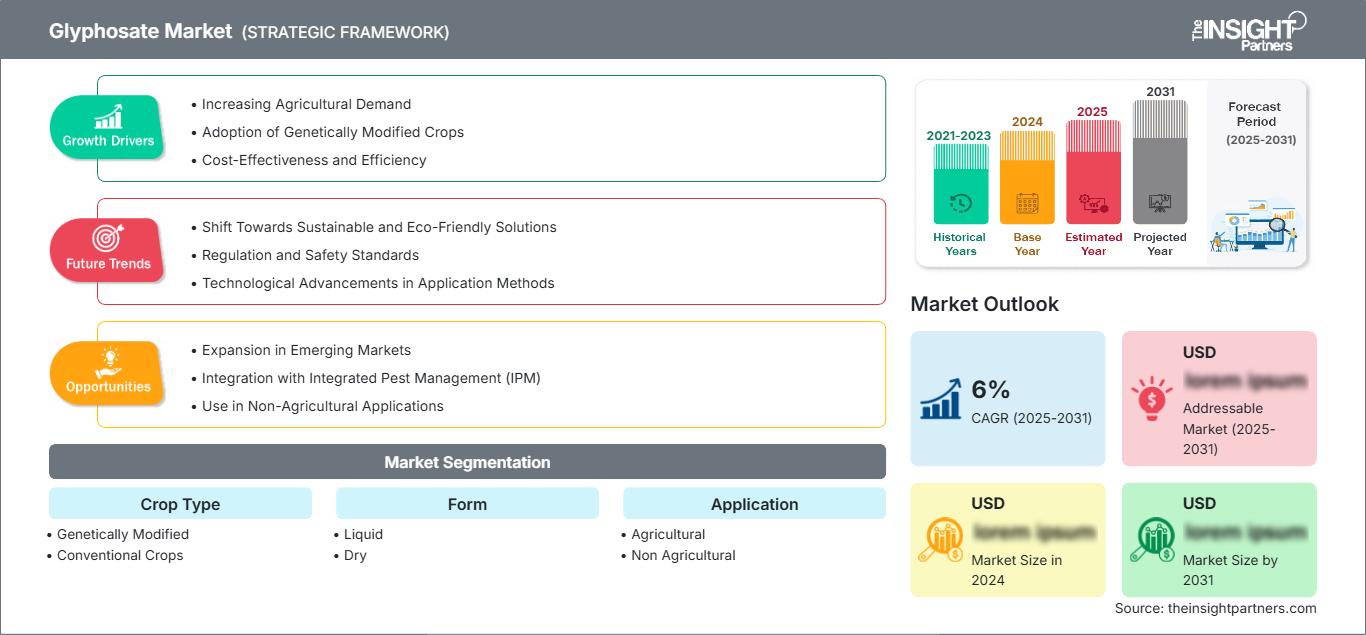
Glyphosate Market: Strategic Insights
Regional Insights
North America Glyphosate Market
North America accounted for 29–33% of the global glyphosate market share in 2025 and is projected to register a CAGR of 2.8–3.4% during 2026–2034. Large commercial farms, extensive cultivation of herbicide-tolerant soybean and corn, and widespread mechanization continue to support regional demand. Precision agriculture technologies, including GPS-guided equipment and variable-rate spraying systems, further enhance herbicide application efficiency while improving farm productivity.
Regional demand is also supported by strong agricultural infrastructure, well-established distribution networks, and continuous investment in farm technology. Integrated weed management practices, conservation tillage, and digital crop monitoring solutions continue improving herbicide utilization efficiency. Manufacturers remain focused on stewardship initiatives, regulatory compliance, and farmer education to ensure sustainable product adoption across commercial farming operations.
U.S. Glyphosate Market
The U.S. represented 74–78% of the North American market during 2025 and is expected to grow at a CAGR of 2.7–3.3% through 2034. Massive cultivation of soybean, corn, cotton, and canola will ensure herbicide demand remains steady in the coming years. High levels of mechanization and the usage of modern technology in farming provide an efficient way of weed control that helps boost the productivity of farmers.
The major players in the agrochemicals industry have huge research, distribution, and technical facilities throughout the nation, which makes it possible to quickly commercialize novel solutions for farmers. Data-driven management tools coupled with precision sprayers help farmers make the most out of their herbicide usage and cut down expenses, and enhance productivity.
Europe Glyphosate Market
Europe accounted for 21–25% of the global market in 2025 and is projected to expand at a CAGR of 2.2–2.9% through 2034. Germany remains the leading national market due to its advanced agricultural sector and high adoption of modern farming technologies. The country continues investing in precision agriculture and integrated weed management to improve resource efficiency while meeting stringent environmental standards.
The United Kingdom continues emphasizing sustainable farming practices supported by digital agriculture technologies and targeted herbicide applications. France, Italy, and Spain collectively contribute significant agricultural production across cereals, vineyards, fruits, and vegetables, sustaining herbicide demand despite evolving regulatory oversight. Continued modernization of agricultural practices and investments in precision equipment are expected to support steady regional market development.
APAC Glyphosate Market
Asia Pacific represented 33–37% of global demand in 2025 and is forecast to register the fastest CAGR of 3.8–4.5% through 2034. China remains the leading regional producer and consumer, while India continues expanding herbicide adoption through agricultural modernization and increasing mechanization.
Japan, South Korea, and Australia continue emphasizing precision farming, efficient crop protection, and sustainable agricultural practices. Government initiatives supporting food security, productivity improvement, and advanced farming technologies are expected to sustain long-term regional demand.
Middle East & Africa Glyphosate Market
The Middle East & Africa market is projected to expand at a CAGR of 3.1–3.7% through 2034. Saudi Arabia and the UAE continue investing in advanced agricultural technologies to improve domestic food production, while South Africa remains the region's largest commercial agriculture market supporting herbicide utilization.
Growing investment in irrigation infrastructure, climate-resilient farming, and agricultural modernization across several African economies is creating new opportunities for herbicide suppliers. Continued improvements in farming efficiency and crop productivity are expected to support gradual regional market expansion.
Segmentation Analysis
Crop Type
The Crop Type segment is expected to register a CAGR of 3.1–3.5% during 2026–2034. The glyphosate market scope continues to expand across diverse cropping systems as growers prioritize efficient weed management to improve crop yields and reduce production costs. Adoption patterns vary according to farming practices, regulatory environments, and the cultivation of herbicide-tolerant varieties. Commercial farming operations increasingly rely on integrated weed management strategies that combine herbicides with precision application technologies for improved field performance.
- Genetically Modified – This sub-segment represents a significant share of herbicide consumption because glyphosate-tolerant crops enable effective post-emergence weed control, simplify field operations, and reduce labor requirements across large-scale commercial farming systems.
- Conventional Crops – Demand remains stable as growers continue using glyphosate for pre-planting, pre-harvest, and non-selective weed management. Adoption depends on regional regulations, crop rotation practices, and integrated agronomic programs.
Form
The Form segment is anticipated to grow at a CAGR of 3.3–3.8% during 2026–2034. Product selection is influenced by handling convenience, storage requirements, application efficiency, and compatibility with modern spraying equipment. Manufacturers continue introducing improved formulations that enhance field performance while supporting efficient transportation, mixing, and operational flexibility across commercial agricultural operations.
- Liquid – Liquid formulations remain the preferred option because they provide convenient handling, rapid mixing, compatibility with precision spraying systems, and consistent application across large agricultural fields and plantation crops.
- Dry – Dry formulations continue serving specialized agricultural applications where extended storage stability, easier transportation, or customized formulation requirements are important for distributors and commercial farming enterprises.
Application
The Application segment is projected to expand at a CAGR of 3.3–3.7% during 2026–2034. Agricultural activities account for the majority of herbicide demand due to increasing cultivation intensity, expanding commercial farming, and continuous efforts to improve productivity. Outside agriculture, glyphosate supports vegetation management programs across transportation corridors, industrial sites, and public infrastructure where effective weed control improves operational efficiency.
- Agricultural – This sub-segment dominates overall consumption through broad usage across cereals, oilseeds, pulses, fruits, vegetables, and plantation crops. Demand is reinforced by mechanized farming, conservation tillage, and precision agriculture practices.
- Non Agricultural – Municipal authorities, utility companies, railway operators, industrial facilities, and infrastructure managers use glyphosate for vegetation management to maintain operational safety, reduce maintenance frequency, and improve land management efficiency.
Opportunity Snapshot
| Application | Revenue Contribution | Trend Tag | Adoption Stage |
|---|---|---|---|
| Agricultural | High | Precision Farming | Mature |
| Non Agricultural | Medium | Vegetation Control | Scaling |
Glyphosate Market Growth Drivers and Impact Analysis
Increasing demand for higher agricultural productivity
Increasing levels of food consumption, a growing population, and scarcity of usable farmland areas keep motivating farmers to increase crop yield using efficient weed control methods. Glyphosate has been found to be essential since it helps control a wide range of weeds and also helps maintain conservation tillage as well as reducing the cost of field preparation. Various agricultural authorities around various nations are still advocating for increased productivity through precision agriculture and the mechanization of farming. The use of GPS technology in spraying and crop monitoring makes the use of herbicides more efficient.
Expansion of precision agriculture technologies
Digital solutions for agriculture, satellite monitoring, UAVs, and spraying systems using sensors are revolutionizing herbicide application technology. Precision agriculture enables the application of crop protection chemicals only in required areas, which is efficient and environmentally friendly in the sense that there is no use of excess chemicals. The manufacturers of spraying machinery keep on incorporating technologies like AI, GIS, and real-time analysis into spraying activities. This will not only be accurate but also cost-effective and environmentally sustainable. With the growing adoption of precision agriculture worldwide, the formulation of herbicides is becoming more sophisticated to compete in the market.
Growing commercialization of large-scale farming operations
Farmer enterprises are increasingly growing in the Asia Pacific, Latin America, and some selected African nations in order to increase food security as well as agricultural exports. As more farms become large-scale in size, they focus on mechanical farming practices, effective cropping management techniques, and proper weed control programs to ensure maximum efficiency throughout the cropping period. Advanced farm machinery, better irrigation systems, and enhanced agronomy consultancy facilities contribute to herbicide use. Agricultural modernization efforts by governments also aim at promoting efficient land usage and advanced farm technology. Such structural changes contribute to consistent demand for broad-spectrum herbicides and motivate herbicide producers to enhance their production and distribution activities.
Glyphosate Market Future Trends
Integration of digital agronomy with herbicide management
Digital agriculture platforms are increasingly connecting field mapping, weather analytics, soil monitoring, and application equipment into integrated crop management systems. One of the most significant glyphosate market trends is the growing adoption of data-driven herbicide planning that enables farmers to optimize application timing, improve operational efficiency, and reduce unnecessary product use. Equipment manufacturers and agrochemical companies are expanding collaborations to deliver connected farming ecosystems capable of supporting long-term productivity, sustainability, and regulatory compliance across commercial agricultural operations.
Development of advanced formulation technologies
Formulation research by manufacturers is going to remain active in areas of improved spray retention, rainfastness, ease of handling, and general performance in the field. In the future, development will be geared more towards being compatible with precision application technologies while at the same time promoting proper stewardship of the herbicides. Improved formulations will make it easier for the operator to minimize loss, facilitate storage and transport, and improve application efficiency in various weather conditions.
Glyphosate Market Opportunities
Investment in emerging agricultural economies
Rapid agricultural modernization across Asia Pacific, Latin America, and parts of Africa continues creating favorable investment opportunities for manufacturers and distributors. Governments are expanding irrigation infrastructure, mechanization programs, and agricultural extension services to improve domestic food production. These initiatives are expected to support long-term glyphosate market forecasts, particularly where commercial farming and precision agriculture adoption remain at relatively early stages. Companies establishing localized manufacturing, technical support, and distribution partnerships can strengthen market access while improving responsiveness to regional customer requirements and regulatory expectations.
Expansion of integrated crop management solutions
Producers in agriculture are demanding complete crop management solution packages and not single crop protection products. There is room in the market for companies manufacturing herbicides to offer digital agronomy, precision spraying technology, advice, and stewardship programs, along with their existing portfolios of products. It will also help these companies get into collaborative partnerships with agricultural technology companies, machinery manufacturers, and research institutions. The companies that will be able to do so will be better positioned to compete in the market and create value in agriculture.
Recent Developments
- July 2026: Bayer Group announced the consolidation of the U.S. glyphosate business into Ruveon LLC to optimize and align the business with the specific needs of the U.S. market environment. Ruveon will focus on all aspects of U.S. glyphosate, pricing, go-to-market strategies, production and logistics and will be solely responsible for the U.S. glyphosate business.
- May 2025: ADAMA Ltd. – ADAMA received U.S. registration for Temper More, a broad-spectrum herbicide developed with the company's SESGAMA formulation technology. The product is designed to improve management of herbicide-resistant weeds and complements integrated weed control programs where glyphosate is widely used alongside multiple modes of action.
Frequently Asked Questions

- Comprehensive Market Sizing and Forecast Analysis
- Detailed Segmentation Analysis
- In-Depth Market Dynamics Assessment
- Regional and Country-Level Insights
- Competitive Landscape and Company Benchmarking
- Strategic Business Intelligence
Recent Reports
Testimonials

The Insight Partners provided valuable market intelligence that supported our global go-to-market strategy. Their team was professional, responsive, and attentive to our feedback, providing thoughtful analysis and helpful methodological clarifications throughout the project.
Junmo Kim Chief Financial Officer (CFO), Enertech Co., Ltd.
The Insight Partners' SCADA System Market report is comprehensive, with valuable insights on current trends and future forecasts. The team was highly professional, responsive, and supportive throughout. We are very satisfied and highly recommend their services.
RAN KEDEM Partner, Reali Technologies LTDs
I requested a report on a very specific software market and the team produced the report in a few days. The information was very relevant and well presented. I then requested some changes and additions to the report. The team was again very responsive and I got the final report in less than a week.
JEAN-HERVE JENN Chairman, Future Analytica
We worked with The Insight Partners for an important market study and forecast. They gave us clear insights into opportunities and risks, which helped shape our plans. Their research was easy to use and based on solid data. It helped us make smart, confident decisions. We highly recommend them.
PIYUSH NAGPAL Sr. Vice President, High Beam Global
The Insight Partners delivered insightful, well-structured market research with strong domain expertise. Their team was professional and responsive throughout. The user-friendly website made accessing industry reports seamless. We highly recommend them for reliable, high-quality research services
YUKIHIKO ADACHI CEO, Deep Blue, LLC.
This is the first time I have purchased a market report from The Insight Partners.While I was unsure at first, I visited their web site and felt more comfortable to take the risk and purchase a market report.I am completely satisfied with the quality of the report and customer service. I had several questions and comments with the initial report, but after a couple of dialogs over email with their analyst I believe I have a report that I can use as input to our strategic planning process.Thank you so much for taking the extra time and making this a positive experience.I will definitely recommend your service to others and you will be my first call when we need further market data.
JOHN SUZUKI President and Chief Executive Officer, Board Director, BK Technologies
I wish to appreciate your support and the professionalism you displayed in the course of attending to my request for information regarding to infectious disease IVD market in Nigeria. I appreciate your patience, your guidance, and the fact that you were willing to offer a discount, which eventually made it possible for us to close a deal. I look forward to engaging The Insight Partners in the future, all thanks to the impression you have created in me as a result of this first encounter.
DR CHIJIOKE ONYIA MANAGING DIRECTOR, PineCrest Healthcare Ltd.Reason to Buy
- Informed Decision-Making
- Understanding Market Dynamics
- Competitive Analysis
- Identifying Emerging Markets
- Customer Insights
- Market Forecasts
- Risk Mitigation
- Boosting Operational Efficiency
- Strategic Planning
- Investment Justification
- Tracking Industry Innovations
- Aligning with Regulatory Trends





 Get Free Sample for