
Graphic Films Market Size, Trends & Demand by 2034
Coverage: by Type (Polypropylene (PP), Polyethylene (PE), Vinyl, Polycarbonate, Polyester, Others); Film Type (Opaque Films, Reflective Films, Transparent Films, Translucent Films, Others); Application (Automotive, Promotional and Advertisement, Labels and Packaging, Textile, Decorative Film, Others) , and Geography (North America, Europe, Asia Pacific, and South and Central America)
- Status : Data Released
- Report Code : TIPRE00004226
- Category : Chemicals and Materials
- No. of Pages : 150
- Available Report Formats :


- Last update date : July 28, 2026


2025 Market Size
US$ 35.06 Bn
Base year value
2034 Forecast
US$ 57.16 Bn
Projected by 2034
CAGR 2026-2034
5.58 %
Growth rate
Addressable Market
US$ 418.04 Bn
(2026-2034)
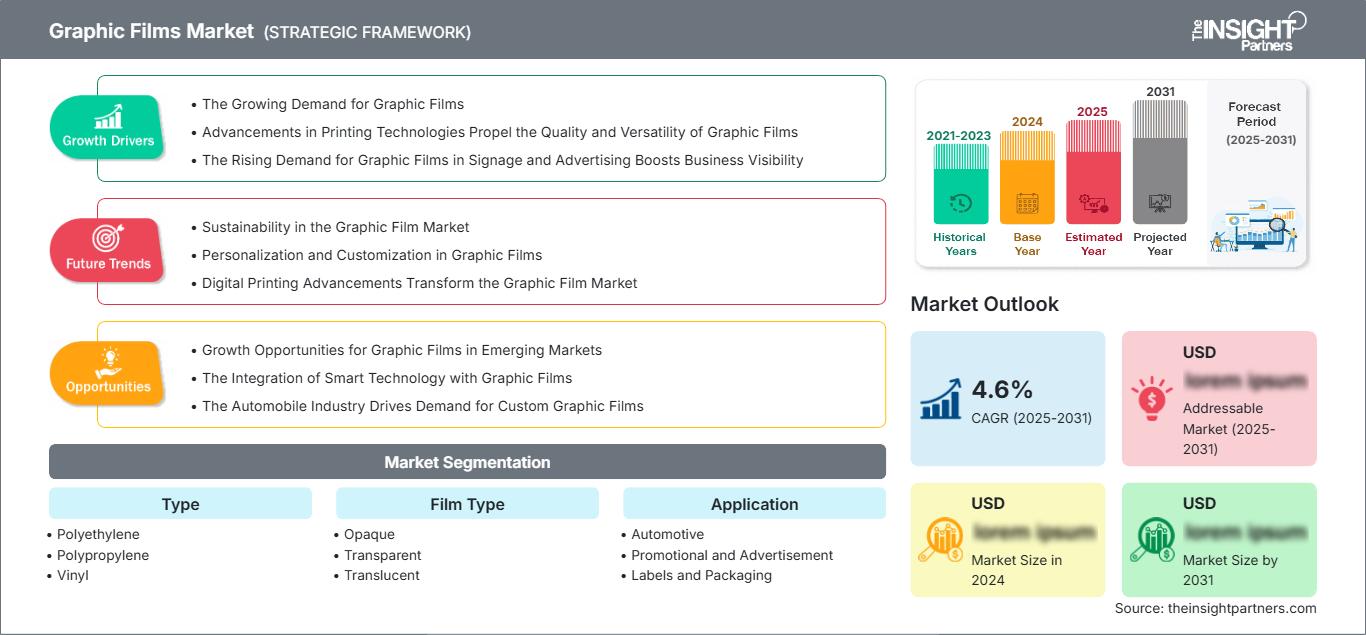
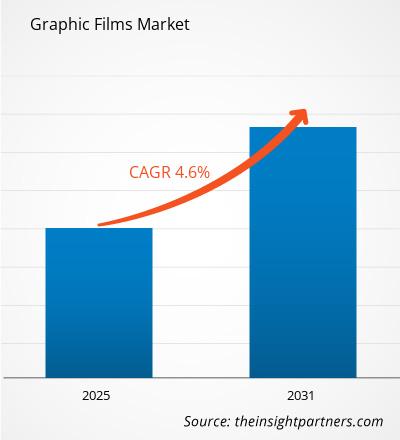
The graphic films market had a market value of US$ 35.06 billion in 2025 and is expected to rise to US$ 57.16 billion in 2034, growing at a CAGR of 5.58% between 2026 and 2034. The demand is driven by rising utilization of durable graphic films in applications including advertising, automotive graphics, industrial labeling, decorative purposes, and retail branding. Growing innovations in the products and improvements in print ability, weatherability, and sustainability are prompting manufacturers and consumers to adopt advanced film solutions.
Across North America, demand continues to benefit from high investments in fleet graphics, commercial advertising, and premium architectural applications. The graphic films market size in the region is supported by mature digital printing infrastructure, growing vehicle customization, and replacement demand for high-performance films. Increasing adoption of recyclable polymer films, coupled with stringent environmental regulations and technological advancements in pressure-sensitive adhesives, is expected to support a regional CAGR ranging between 4.8% and 5.3% through 2034.
Graphic Films Market Assessment and Insights
- North America: Accounted for 31–33% share in 2025 and is anticipated to expand at a CAGR of 4.8–5.3% during 2026–2034, supported by advanced printing technologies, vehicle wrapping applications, and sustained investments in commercial signage and retail branding.
- U.S.: Represented 76–79% of the North American market in 2025 and is projected to register a CAGR of 4.9–5.4% during 2026–2034, driven by automotive graphics, promotional advertising, and continuous innovation in printable film materials.
- Europe: Held 27–29% share in 2025 and is expected to record a CAGR of 5.0–5.5% during 2026–2034. Germany, the UK, France, Italy, and Spain continue to lead regional demand owing to mature automotive, industrial, and commercial printing sectors.
- Asia Pacific: Accounted for 30–32% share in 2025 and is forecast to grow at a CAGR of 6.4–6.9% during 2026–2034, supported by manufacturing expansion, infrastructure development, urban advertising, and rising demand across China, Japan, South Korea, and India.
- Largest Segment: Vinyl represented a graphic films market share of 40–43% in 2025 and is anticipated to register a CAGR of 5.3–5.8% during 2026–2034, owing to excellent durability, flexibility, printability, and outdoor weather resistance.
- High Growth Segment: Promotional and Advertisement accounted for 27–30% share in 2025 and is projected to expand at a CAGR of 6.4–6.9% during 2026–2034, supported by increasing retail branding, event marketing, and digital signage investments.
- Key companies analyzed in detail: 3M Company, Avery Dennison Corporation, CCL Industries Inc., Drytac Corporation, DUNMORE Corporation, DuPont de Nemours, Inc., HEXIS S.A.S., Kay Premium Marking Films Ltd. (KPMF), TEKRA, LLC, ORAFOL Europe GmbH.
Source: The Insight Partners' analysis based on proprietary research, government publications, company annual reports, investor presentations, industry databases, and expert interviews.
The increased use of digital printing methods has changed the dynamics of the market for graphic films through higher quality printing, shorter production timeframes, and enhanced customizability. Improvements in polymers, adhesive compounds, and coatings have made possible the increased durability of products suitable for both indoor and outdoor uses. The emphasis on recycling, environmentally friendly materials and adhesives and high-performing laminates becomes the key element of compliance with regulatory requirements and customer demands for durable graphics in automotive, retail, industrial and architecture segments.
In terms of future developments, further growth will be enabled by investment in production capacities in Asia Pacific and some Middle East countries due to the rapid development of their infrastructure and organized retailing segment. Regulatory support for the recycling of plastics, improvement of solvent-free coating technologies, and increased demand for sustainable solutions for branding become the drivers of future competitiveness of the industry. Innovation of printable specialty films will open up new commercial opportunities in transportation, healthcare and construction industry.
Graphic Films Market Report Scope
| Report Attribute | Details |
|---|---|
| Market size in 2025 | US$ 35.06 Billion |
| Market Size by 2034 | US$ 57.16 Billion |
| Global CAGR (2026 - 2034) | 5.58% |
| Historical Data | 2021-2024 |
| Forecast period | 2026-2034 |
Graphic Films Market Analysis
Increased spending on retail branding, fleet graphics, commercial interior applications, and digital signs is driving the continued growth of the graphic films market worldwide. Brand owners are increasingly opting for higher quality graphic films because they are durable, offer consistent color and are easier to apply to many substrates. Growing e-commerce, organized retailing and infrastructure development are creating greater need for labeling, promotional and decorative graphic films. Improved technology in areas such as UV-curable inkjet ink, latex inkjet printing and eco-friendly adhesives are further fueling growth through improved operational efficiencies and reduced maintenance requirements.
The value chain for the market has become more integrated through collaborations among resin makers, coatings companies, adhesive producers, converters, digital printers, distributors, and installers to create custom solutions. Advancements in polyethylene, polypropylene, polyester, vinyl and polycarbonate resin formulation have improved mechanical performance and allowed for compatibility with fast printing presses. Sustainable practices emphasizing recycling and solvent free production continue to change procurement trends.
The competitive intensity in the graphic films market report is characterized by sustained spending on research, development, and capacity building. Global companies like 3M Company, Avery Dennison Corporation, ORAFOL Europe GmbH, DuPont de Nemours, Inc., and CCL Industries Inc. are constantly launching cutting-edge printable films with better weather resistance, repositionable adhesion properties, and increased UV protection. Specialists such as Drytac Corporation, HEXIS S.A.S., DUNMORE Corporation, TEKRA, LLC, and Kay Premium Marking Films Ltd. have been developing their positions in the market by offering tailor-made products for applications in architecture graphics, transportation, industry labeling, and premium car wraps.
The focus of investments is shifting towards sustainable polymer chemistry, automation, and digital manufacturing in order to increase efficiency and decrease the negative environmental impact. Partnerships between material providers and printing technology manufacturers remain a driving force of the development of recyclable graphic films for modern digital printers. Regional producers are increasing their capacities in order to lower the risk of supply problems and ensure fast response to emerging customers' demands.
● REPORT CUSTOMIZATION
Tailor This Report To Align With Your Specific Business Requirements
This report can be customized to align precisely with your business objectives, scope, and target markets. Customization options include tailored segmentation, geography, competitive analysis, and strategic insights to support informed decision-making.
Customize This Report →WHAT YOU CAN ADJUST
- ● Segmentations
- ● Geography
- ● Competitive Analysis
- ● Language Preferences
Graphic Films Market: Strategic Insights
Regional Insights
North America Graphic Films Market
The market share in North America was valued at 31-33% in 2025 and is forecast to register a CAGR of 4.8-5.3% from 2026-2034. This growth can be attributed to its well-developed commercial printing industry infrastructure, higher usage of wraps on vehicles, and increased spending on brand identities in the retail sector. The high requirement from logistics fleet, commercial construction, and public transportation segments will help fuel the demand for durable graphic films.
Advanced technological capabilities in the United States and Canada have been instrumental in promoting the use of recycled graphic materials, non-solvent adhesives, and digital printing films. Ongoing investments in automation of converting machines, along with the rise in architectural renovations and higher spend on digital advertising will aid in sustaining regional competitiveness and replacement demand for premium graphic products.
U.S. Graphic Films Market
The US was estimated to account for 76-79% of North America's market in 2025 and forecasted to grow at a CAGR of 4.9-5.4% between 2026-2034. Leadership is ensured by the presence of a substantial commercial printing industry in the country, advanced manufacturing facilities, and widespread use of automotive wrapping films.
Key players such as 3M Company, Avery Dennison Corporation, TEKRA, LLC, and DUNMORE Corporation have established their major manufacturing and distribution networks within the US. Further investment in digital printing technologies, eco-friendly polymer compositions, and developments in pressure-sensitive adhesives will further help in establishing the competitiveness in the domestic market and broadening usage in industrial labeling, architectural graphics, and promotional advertising.
Europe Graphic Films Market
Europe represented 27–29% of the worldwide market in 2025 and it is estimated to witness a CAGR of 5.0–5.5% during 2026–2034. The leading country in the region will be Germany owing to its developed automotive industry, industrial printing services, and availability of advanced material providers. The rising sustainability laws promote the usage of recyclable and eco-friendly graphic films within different industries.
The United Kingdom still profits from significant capitalization in the area of retail advertising, public transportation graphics, and building renovations. France, Italy, and Spain jointly provide notable demands through interior decoration, package graphics, tourism advertisements, and car branding. ORAFOL Europe GmbH and HEXIS S.A.S. still innovate in the region through advanced printable films, specialty adhesives, and environmentally friendly manufacturing technologies.
APAC Graphic Films Market
Asia Pacific represented 30–32% of the global market in 2025 and is expected to register the fastest regional expansion with a CAGR of 6.4–6.9% during 2026–2034. China remains the largest producer and consumer, supported by strong manufacturing capacity and rapid commercial infrastructure development.
Japan, South Korea, India, and Australia continue increasing investments in digital printing technologies, automotive production, organized retail, and smart city initiatives. Government support for manufacturing modernization and sustainable industrial materials further strengthens long-term regional demand for advanced graphic films.
Middle East & Africa Graphic Films Market
It is estimated that the growth rate of the Middle East and Africa would be between 5.7% and 6.2% in 2026-2034 owing to advancements in infrastructure, business real estate construction, as well as tourism and transport developments.
The United Arab Emirates are experiencing growth in commercial advertising and retail facilities whereas South Africa is a key market for industrial graphics and transport. Growing investment in construction, logistics, and branded retail facilities would support future demand for high-quality graphic films.
Segmentation Analysis
Type
The Type segment is expected to register a CAGR of 5.5–6.0% during 2026–2034. Material selection remains a critical purchasing factor because performance requirements differ across outdoor advertising, automotive wraps, industrial labeling, and decorative applications. The graphic films market scope continues to expand as manufacturers introduce advanced polymer formulations that improve printability, weather resistance, flexibility, and recyclability while reducing lifecycle costs and supporting sustainability objectives.
- Polyethylene: Widely used for flexible promotional graphics and short-term signage owing to its lightweight structure, chemical resistance, and cost competitiveness. Growing preference for recyclable materials continues supporting adoption across commercial printing applications.
- Polypropylene: Increasingly adopted for premium labels, retail graphics, and packaging applications because it provides excellent moisture resistance, dimensional stability, and compatibility with high-resolution digital printing technologies.
- Vinyl: The dominant material for vehicle wraps, outdoor signage, wall graphics, and window films due to exceptional durability, flexibility, UV resistance, and long service life under demanding environmental conditions.
- Polycarbonate: Preferred for industrial graphics, equipment identification, membrane switches, and safety labels requiring high impact resistance, dimensional stability, and excellent optical clarity under challenging operating environments.
- Polyester: Extensively utilized in durable labels, industrial overlays, and specialty graphics because it delivers superior tensile strength, thermal stability, abrasion resistance, and excellent compatibility with advanced coating technologies.
Film Type
The Film Type segment in the Graphic Films Market is anticipated to expand at a CAGR of 5.6–6.1% during 2026–2034. Product differentiation increasingly depends on optical characteristics that enhance branding effectiveness, visibility, privacy, and decorative appeal. Manufacturers continue investing in specialty coatings and multilayer technologies that improve color performance, durability, and environmental resistance across indoor and outdoor installations.
- Opaque: Preferred for advertising panels, fleet graphics, and indoor displays where complete background coverage, vibrant color reproduction, and high visual impact remain essential performance requirements.
- Transparent: Extensively used for window graphics, architectural glazing, retail storefronts, and protective overlays because it enables clear visibility while supporting premium branding and decorative applications.
- Translucent: Commonly adopted in illuminated signs and backlit displays where uniform light diffusion enhances visual quality and improves advertising effectiveness during both daytime and nighttime operations.
- Reflective: Increasingly utilized in transportation, road safety, emergency response vehicles, and industrial safety signage owing to superior nighttime visibility and compliance with regulatory safety requirements.
Application
The Application segment in the Graphic Films Market is projected to record a CAGR of 5.9–6.4% during 2026–2034. Expanding investments in commercial branding, transportation graphics, packaging innovation, and architectural decoration continue supporting demand across diverse end-use industries. Digital printing technologies and premium adhesive systems further improve installation efficiency and lifecycle performance.
- Automotive: Vehicle wraps, fleet branding, paint protection, and interior customization continue driving demand as businesses increasingly utilize mobile advertising and consumers seek personalized vehicle aesthetics.
- Promotional and Advertisement: This application benefits from rapid growth in retail branding, outdoor media, exhibitions, events, and commercial campaigns where high-quality printable films improve visual communication and brand recognition.
- Labels and Packaging: Demand remains strong as manufacturers adopt premium printable films that enhance product identification, regulatory compliance, traceability, and shelf appeal across consumer and industrial goods.
- Textile: Specialized graphic films support apparel decoration, sportswear customization, promotional merchandise, and fashion branding through durable heat-transfer technologies compatible with modern textile manufacturing processes.
- Decorative Film: Growing architectural renovation activities and commercial interior upgrades continue encouraging adoption for furniture, walls, partitions, glass surfaces, and premium interior finishing applications.
Opportunity Snapshot
| Application | Revenue Contribution | Trend Tag | Adoption Stage |
|---|---|---|---|
| Automotive | High | Vehicle Wraps | Mature |
| Promotional and Advertisement | High | Digital Signage | Scaling |
| Labels and Packaging | High | Smart Labels | Scaling |
| Textile | Medium | Heat Transfer | Scaling |
| Decorative Film | Medium | Interior Décor | Emerging |
Graphic Films Market Growth Drivers and Impact Analysis
Expansion of Digital Printing Across Commercial Industries
The continued transition from conventional printing methods to digital printing technologies is reshaping demand for premium graphic films across retail, transportation, construction, healthcare, and industrial applications. Modern inkjet, UV-curable, latex, and eco-solvent printing systems require highly engineered substrates capable of delivering consistent image quality, dimensional stability, and long-term durability. Improvements in printer productivity have reduced production lead times, enabling customized graphics for shorter marketing campaigns and personalized branding solutions. Commercial organizations increasingly replace static advertising with frequently updated promotional materials, creating recurring demand for printable films. The widespread availability of high-speed digital printing equipment and automation technologies is expected to improve production efficiency while encouraging manufacturers to develop films with enhanced compatibility, sustainability, and performance characteristics.
Growth in Vehicle Wrapping and Fleet Branding Applications
Rapid expansion of vehicle customization and commercial fleet branding continues strengthening demand for high-performance graphic films worldwide. Fleet operators increasingly utilize vehicle graphics as cost-effective mobile advertising platforms capable of reaching broad audiences throughout daily operations. At the same time, private vehicle owners are adopting premium wraps for personalization, paint protection, and resale value preservation. Technological improvements in pressure-sensitive adhesives, air-release channels, and removable film systems have significantly reduced installation complexity while improving finish quality. Automotive dealerships, logistics providers, public transportation agencies, and ridesharing operators continue investing in professionally installed graphics, supporting sustained consumption of durable vinyl-based films with superior weather resistance and long operational lifecycles.
Increasing Preference for Sustainable Graphic Film Solutions
Environmental regulations and corporate sustainability commitments are accelerating development of recyclable polymers, solvent-free adhesives, and lower-emission manufacturing processes across the graphic film industry. Brand owners increasingly evaluate packaging and promotional materials based on environmental performance alongside functionality and cost. Manufacturers are therefore investing in mono-material constructions, recycled-content polymers, and energy-efficient coating technologies that simplify recycling and reduce lifecycle emissions. Improvements in water-based coating systems and low-VOC adhesive formulations further support compliance with environmental standards established across North America and Europe. These developments enable suppliers to differentiate their product portfolios while responding to procurement requirements established by multinational corporations pursuing ambitious sustainability objectives.
Graphic Films Market Future Trends
Growth of Smart and Functional Graphic Films
Demand for multifunctional graphic films is expected to increase as end users seek products offering decorative performance alongside functional capabilities. The graphic films market trends indicate rising investment in antimicrobial coatings, anti-graffiti surfaces, self-healing films, UV-blocking technologies, and energy-efficient architectural applications. Integration of advanced coatings and nanomaterials is likely to improve product durability while supporting healthcare, transportation, commercial construction, and public infrastructure projects. Manufacturers capable of commercializing high-value specialty films with enhanced functional performance are expected to strengthen competitive positioning over the forecast period.
Adoption of Circular Material Strategies
Circular economy initiatives are expected to reshape product development priorities throughout the coming decade. Manufacturers increasingly focus on recyclable polymer systems, simplified material structures, bio-based feedstocks, and closed-loop manufacturing practices that reduce environmental impact without compromising performance. Improvements in mechanical recycling technologies and material recovery systems are likely to encourage broader commercial adoption of sustainable graphic films. Strategic collaboration between resin suppliers, converters, printers, and brand owners will accelerate commercialization of environmentally responsible solutions capable of meeting evolving regulatory and customer expectations.
Graphic Films Market Opportunities
Expansion into Emerging Infrastructure and Urban Branding Projects
Rapid urbanization across Asia Pacific, the Middle East, and selected Latin American economies continues creating substantial investment potential for premium graphic film manufacturers. Large transportation projects, commercial real estate developments, airports, shopping centers, healthcare facilities, and tourism infrastructure require durable branding, decorative, and informational graphics. Graphic Films Market Forecasts indicate that suppliers establishing localized manufacturing, distribution, and technical support capabilities will be better positioned to capture long-term contracts while reducing supply chain risks. Strategic collaboration with regional printing companies and construction firms can further strengthen market penetration and accelerate commercialization of innovative specialty film solutions.
Development of High-Performance Sustainable Product Portfolios
Growing customer preference for environmentally responsible materials presents significant opportunities for companies investing in recyclable polymers, bio-based feedstocks, and advanced coating technologies. Product differentiation through sustainability certifications, improved lifecycle performance, and lower carbon footprints is expected to become increasingly important across commercial procurement decisions. Manufacturers introducing premium films that combine durability, print quality, ease of recycling, and regulatory compliance will strengthen long-term competitiveness. Continued investments in research, strategic partnerships, and advanced manufacturing technologies are expected to accelerate commercialization of next-generation graphic films across automotive, architectural, packaging, and industrial applications.
Recent Developments
- July 2026: Avery Dennison Graphics Solutions launched new and improved XTRM pro solar window films.
- February 2026: Avery Dennison Graphics Solutions released a new Professional-grade cast film addition to its suite of digitally printable films. The new MPI 1903 Cast Wrapping Film is a high-gloss, multi-purpose film that delivers strong performance at an affordable price point.
Frequently Asked Questions

- Comprehensive Market Sizing and Forecast Analysis
- Detailed Segmentation Analysis
- In-Depth Market Dynamics Assessment
- Regional and Country-Level Insights
- Competitive Landscape and Company Benchmarking
- Strategic Business Intelligence
Recent Reports
Testimonials

The Insight Partners provided valuable market intelligence that supported our global go-to-market strategy. Their team was professional, responsive, and attentive to our feedback, providing thoughtful analysis and helpful methodological clarifications throughout the project.
Junmo Kim Chief Financial Officer (CFO), Enertech Co., Ltd.
The Insight Partners' SCADA System Market report is comprehensive, with valuable insights on current trends and future forecasts. The team was highly professional, responsive, and supportive throughout. We are very satisfied and highly recommend their services.
RAN KEDEM Partner, Reali Technologies LTDs
I requested a report on a very specific software market and the team produced the report in a few days. The information was very relevant and well presented. I then requested some changes and additions to the report. The team was again very responsive and I got the final report in less than a week.
JEAN-HERVE JENN Chairman, Future Analytica
We worked with The Insight Partners for an important market study and forecast. They gave us clear insights into opportunities and risks, which helped shape our plans. Their research was easy to use and based on solid data. It helped us make smart, confident decisions. We highly recommend them.
PIYUSH NAGPAL Sr. Vice President, High Beam Global
The Insight Partners delivered insightful, well-structured market research with strong domain expertise. Their team was professional and responsive throughout. The user-friendly website made accessing industry reports seamless. We highly recommend them for reliable, high-quality research services
YUKIHIKO ADACHI CEO, Deep Blue, LLC.
This is the first time I have purchased a market report from The Insight Partners.While I was unsure at first, I visited their web site and felt more comfortable to take the risk and purchase a market report.I am completely satisfied with the quality of the report and customer service. I had several questions and comments with the initial report, but after a couple of dialogs over email with their analyst I believe I have a report that I can use as input to our strategic planning process.Thank you so much for taking the extra time and making this a positive experience.I will definitely recommend your service to others and you will be my first call when we need further market data.
JOHN SUZUKI President and Chief Executive Officer, Board Director, BK Technologies
I wish to appreciate your support and the professionalism you displayed in the course of attending to my request for information regarding to infectious disease IVD market in Nigeria. I appreciate your patience, your guidance, and the fact that you were willing to offer a discount, which eventually made it possible for us to close a deal. I look forward to engaging The Insight Partners in the future, all thanks to the impression you have created in me as a result of this first encounter.
DR CHIJIOKE ONYIA MANAGING DIRECTOR, PineCrest Healthcare Ltd.Reason to Buy
- Informed Decision-Making
- Understanding Market Dynamics
- Competitive Analysis
- Identifying Emerging Markets
- Customer Insights
- Market Forecasts
- Risk Mitigation
- Boosting Operational Efficiency
- Strategic Planning
- Investment Justification
- Tracking Industry Innovations
- Aligning with Regulatory Trends





 Get Free Sample for