
Green Solvents Market Key Companies Profile and SWOT Analysis by 2034
Coverage: By Type (Bioalcohols, Bioglycols, Bio-Diols, D-Limonene, Lactate Esters, Methyl Solate, And Others), Application (Paints & Coatings, Printing Inks, Adhesives And Sealants, Cosmetics, Pharmaceuticals, Agriculture, Cleaning Products, And Others)
- Status : Data Released
- Report Code : TIPRE00003436
- Category : Chemicals and Materials
- No. of Pages : 150
- Available Report Formats :


- Last update date : August 07, 2026


2025 Market Size
US$ 2.26 Bn
Base year value
2034 Forecast
US$ 4.75 Bn
Projected by 2034
CAGR 2026-2034
8.6 %
Growth rate
Addressable Market
US$ 31.43 Bn
(2026-2034)
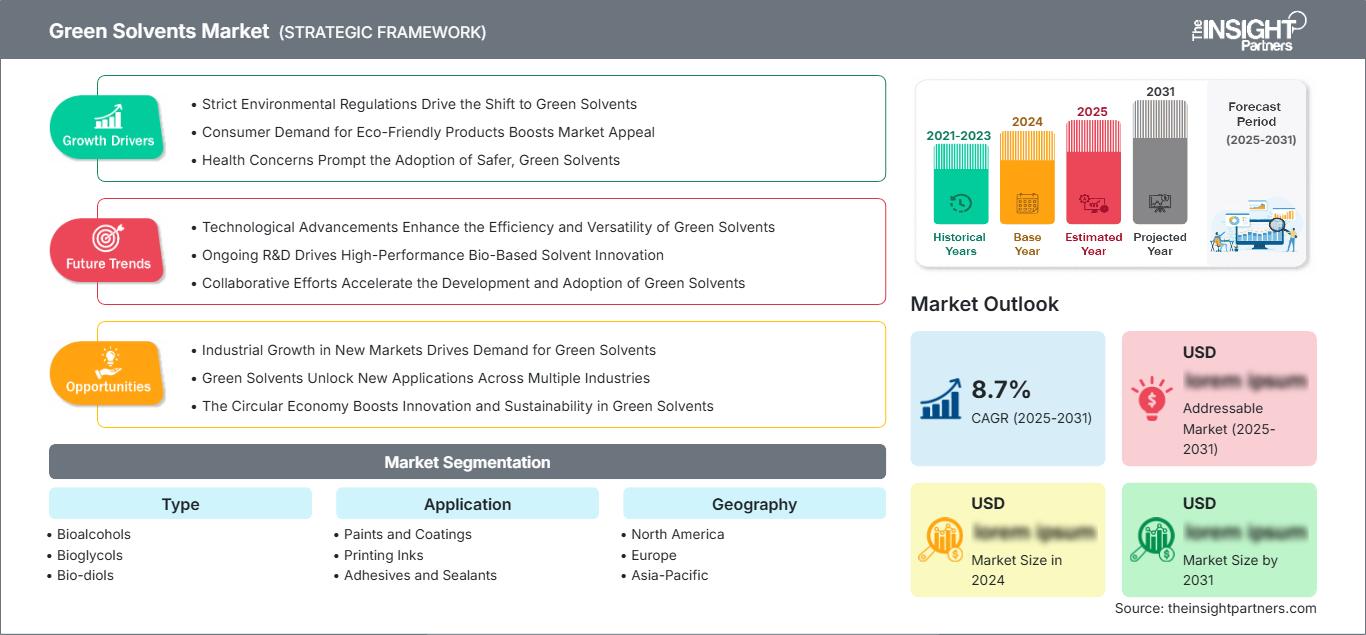
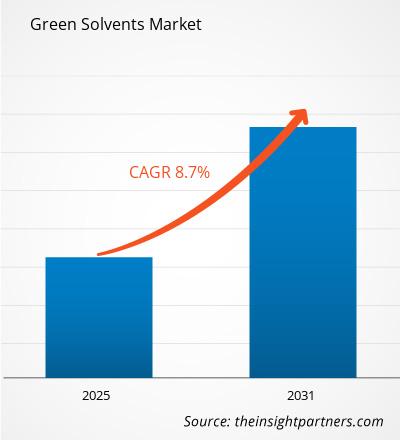
The green solvents market was valued at US$ 2.26 Billion in 2025 and is anticipated to grow to US$ 4.75 Billion by 2034, with a CAGR of 8.60% from 2026-2034. Increasing environmental awareness, stringent VOC emission regulations, and the rising trend of sustainable manufacturing processes is pushing industries to use renewable solvents as an alternative to traditional petroleum-based solvents.
North America continues to be one of the technologically advanced markets due to favorable environmental regulations, established bio-based chemicals industry, and increasing focus on sustainable product development. Green solvents market size in the region is growing owing to the use of renewable raw materials by the manufacturers to meet the stringent emission requirements as well as the growing consumer preference for environment-friendly products.
Green Solvents Market Assessment and Insights
- North America: Accounted for 33–37% share in 2025 and is anticipated to expand at a CAGR of 8.2–8.8% during 2026–2034, supported by stringent environmental regulations, strong investments in bio-based chemicals, and growing demand from paints, coatings, pharmaceuticals, and cleaning product manufacturers.
- U.S.: Represented 76–80% of the North American market in 2025 and is projected to grow at a CAGR of 8.3–8.9% during 2026–2034, driven by advanced manufacturing capabilities, federal sustainability initiatives, and increasing industrial adoption of renewable solvent technologies.
- Europe: Held 28–32% share in 2025 and is expected to register a CAGR of 8.0–8.6% during 2026–2034. Germany, France, Italy, the UK, and the Netherlands continue leading regional demand through circular economy initiatives and stringent chemical safety regulations.
- Asia Pacific: Captured 24–28% share in 2025 and is forecast to expand at a CAGR of 9.2–9.8% during 2026–2034, supported by rapid industrialization, expanding coatings production, favorable government sustainability programs, and increasing manufacturing activities across China, India, Japan, and South Korea.
- Largest Segment: Paints and Coatings accounted for 30–34% market share in 2025 and is expected to grow at a CAGR of 8.5–9.1% during 2026–2034, owing to increasing replacement of conventional solvents in architectural and industrial coating formulations.
- High Growth Segment: Cosmetics represented 11–15% market share in 2025 and is projected to witness a CAGR of 9.8–10.4% during 2026–2034, supported by growing consumer preference for natural ingredients and sustainable personal care formulations.
- Key companies analyzed in detail: BASF SE, Cargill, Incorporated, DuPont de Nemours, Inc., Florida Chemical Company, GC Innovation America, Gevo, Inc., LyondellBasell Industries N.V., Dow Inc., Vertec BioSolvents Inc., Corbion N.V.
Source: The Insight Partners' analysis based on proprietary research, government publications, company annual reports, investor presentations, industry databases, and expert interviews.
The bio-based chemical industry has come a long way due to the development of processes involving the use of agricultural raw materials, catalytic conversion systems, and fermentation processes to produce solvents on a large scale. There have been efforts made towards integrating sustainable sourcing and low carbon footprints to achieve better performance and quality of the products. Regulatory actions favoring lower emissions and adoption of greener chemicals will continue to positively impact the growth of the market.
Growth during the coming years is anticipated to be driven by the increasing investments in bio-refineries, commercialization of innovative biomass conversion systems, and commitment towards sustainability among the multinationals. Growing production capacity in the regions of Asia Pacific and Latin America coupled with policies favoring renewable chemicals and circular economy will enhance the supply security and create more avenues for adoption by industries.
Green Solvents Market Report Scope
| Report Attribute | Details |
|---|---|
| Market size in 2025 | US$ 2.26 Billion |
| Market Size by 2034 | US$ 4.75 Billion |
| Global CAGR (2026 - 2034) | 8.6% |
| Historical Data | 2021-2024 |
| Forecast period | 2026-2034 |
Green Solvents Market Analysis
The mounting regulatory pressure to limit VOCs emissions is undoubtedly one of the key driving forces shaping the demand in many industrial segments. Indeed, paint producers, pharmaceutical companies, manufacturers of adhesives, and personal care products keep replacing petroleum-based solvents with bio-based counterparts that ensure similar properties yet have smaller environmental footprint. In addition to increased sustainability initiatives of many companies, growing investments in the infrastructure for the bio-based chemicals manufacturing also boost the market.
Today’s value chain becomes more integrated, starting from the renewable raw materials, including corn, sugarcane, soybean oil, and citrus waste, then moving to fermentation and catalysis, purification, and finally to formulating processes. Strategic partnerships between agricultural suppliers, biotech firms, chemical manufacturers, and downstream formulators keep increasing the efficiency of the process and decreasing the amount of emissions in the life cycle.
The competition has grown stronger with existing chemical players broadening their scope of renewable products, and with specialized bio-based players speeding up innovations. From the green solvents market report, it is evident that companies like BASF SE, Dow Inc., DuPont de Nemours, Inc., Corbion N.V., LyondellBasell Industries N.V., Gevo, Inc., and Cargill, Incorporated have been building up their market positions by making innovations, forming alliances, expanding capacities, and investing in advanced renewable feedstock technology.
More and more investments are being made in the scaling of fermentation technology, circularity in production processes, and next-generation solvent formulations that can perform well in tough industrial applications. Companies such as Florida Chemical Company, Vertec BioSolvents Inc., and GC Innovation America still continue to stress specialized bio-based solvent products that meet changing consumer needs and also fulfill the requirements of regulations and sustainability.
● REPORT CUSTOMIZATION
Tailor This Report To Align With Your Specific Business Requirements
This report can be customized to align precisely with your business objectives, scope, and target markets. Customization options include tailored segmentation, geography, competitive analysis, and strategic insights to support informed decision-making.
Customize This Report →WHAT YOU CAN ADJUST
- ● Segmentations
- ● Geography
- ● Competitive Analysis
- ● Language Preferences
Green Solvents Market: Strategic Insights
Regional Insights
North America Green Solvents Market
North America Green Solvents Market share was at 33-37% in 2025 and is anticipated to grow at a CAGR of 8.2-8.8% in 2026-2034. North America offers the advantage of strict environmental policies concerning emissions of volatile organic compounds, well-established biotechnology sector, and rising investment in renewable chemicals manufacturing industry. Growing use of sustainable solvents in paints & coatings, pharmaceutical industry, and industrial cleaning operations supports market growth. The global market share of green solvents is the largest owing to effective commercialization ability and scientific research facilities.
Growing commitment of companies to carbon neutrality and circular manufacturing process is prompting manufacturers to develop their bio-based product portfolio. Various government measures that promote usage of renewable sources along with developments in technologies like fermentation and catalysis are enhancing the production economics. Demand from automotive coatings, construction industry, healthcare, and consumer goods manufacturers is anticipated to drive regional growth during the forecast period.
U.S. Green Solvents Market
The United States accounted for 76–80% share of the North American market in 2025 and is projected to achieve a CAGR of 8.3–8.9% from 2026 to 2034. There are many major players operating in the region such as Dow Inc., DuPont de Nemours, Inc., Cargill, Incorporated, Gevo, Inc., Vertec BioSolvents Inc., and GC Innovation America who are constantly developing new technologies and production capacity.
Sustainability projects initiated by the federal government, more investments in low carbon production techniques, and advancements in the use of biomass are continuously boosting market competitiveness. Users in the industry have started using renewable chemicals as solvents instead of petroleum based chemicals to meet the environmental standards as well as keeping the efficiency intact. Innovations in feedstocks and processes are expected to enhance supply security.
Europe Green Solvents Market
Europe had a 28-32% share in 2025 and is estimated to achieve a growth of CAGR of 8.0-8.6% between 2026-2034. Germany holds the position of the most dominant market in the region because of its strong chemical manufacturing presence, investments in sustainable industrial manufacturing processes and bio-based chemicals. The European Green Deal, REACH laws and circular economic practices motivate manufacturers towards shifting their production towards renewable solvents.
The United Kingdom sees an increasing adoption of renewable chemicals in specialized coatings, pharmaceuticals and consumer goods on account of its innovative initiatives in sustainable manufacturing. Germany dominates the region with continuous investments in industrial biotechnology and chemical processes. The growth of demand in France, Italy, and Spain is increasing due to manufacturing of cosmetics, food processing and eco-friendly industrial coatings.
APAC Green Solvents Market
Asia Pacific accounted for 24%–28% share in 2025 and is forecasted to achieve CAGR of 9.2%–9.8% from 2026 to 2034. China continues to be the largest regional market in the industry, whereas India is considered one of the most rapidly developing economies due to industrial manufacturing growth, environment-friendly policies, and investment in bio-based chemicals.
Japan and South Korea continue to focus on innovation in materials and sustainable chemistry technology, whereas Australia promotes renewable chemistry by means of bioeconomy policies. Growth in coatings, pharmaceuticals, and agriculture industries in the region should contribute to the growing demand for solvent solutions.
Middle East & Africa Green Solvents Market
CAGR for the Middle East & Africa market is forecast to be between 7.6% and 8.2% from 2026 to 2034. In the region, the dominant player is Saudi Arabia due to investments in downstream chemical diversification, followed by the UAE that continues its initiatives toward sustainable industrial manufacturing. Another significant consumer is South Africa due to increased consumption from coating and industrial cleaning applications.
Increased investments in infrastructure, diversification strategies of industries, and sustainability initiatives have been making the adoption of renewable chemicals increasingly popular in the region. Despite the lower market penetration compared to North America and Europe, higher awareness of environmentally sound manufacturing and industrial production will ensure stable growth in the long run.
Segmentation Analysis
Type
The Type segment is expected to expand at a CAGR of 8.4–9.0% during 2026–2034. Product innovation, availability of renewable feedstocks, and increasing industrial demand continue driving adoption across multiple solvent categories. The green solvents market scope continues expanding as manufacturers develop high-performance bio-based alternatives capable of replacing conventional petrochemical solvents while meeting increasingly stringent environmental regulations and customer sustainability requirements.
- Bioalcohols – Widely utilized across paints, coatings, pharmaceuticals, and cleaning formulations owing to their excellent solvency, renewable origin, and compatibility with sustainable manufacturing processes. Increasing production from biomass supports wider commercial adoption.
- Bioglycols – Growing demand from cosmetics, heat transfer fluids, and industrial formulations is encouraging manufacturers to increase production capacity while improving product purity and performance characteristics for specialized applications.
- Bio-diols – Adoption is increasing due to their role in high-performance polymers, specialty coatings, and advanced chemical formulations requiring renewable raw materials with consistent quality and improved environmental performance.
- D-limonene – Derived primarily from citrus processing by-products, this solvent is gaining popularity in industrial cleaning, adhesives, and specialty formulations because of its biodegradability and effective degreasing properties.
- Lactate Esters – Increasingly selected for electronics cleaning, coatings, and precision industrial applications because of their low toxicity, favorable environmental profile, and excellent solvency across multiple formulations.
- Methyl Solate – Demand continues rising in agricultural chemicals, industrial cleaning products, and coatings due to its renewable feedstock origin, biodegradability, and effective replacement of petroleum-derived solvents.
Application
The Application segment is projected to register a CAGR of 8.7–9.3% during 2026–2034. Expanding industrial adoption, tightening environmental regulations, and increasing preference for renewable chemicals continue strengthening demand across diverse end-use sectors, with manufacturers integrating sustainable solvents into both new product development and reformulation strategies.
- Paints and Coatings – The largest application segment, supported by increasing replacement of conventional solvents with low-emission alternatives that comply with environmental regulations while maintaining coating durability, appearance, and processing performance.
- Printing Inks – Adoption is increasing as packaging manufacturers transition toward environmentally responsible formulations offering lower emissions, improved worker safety, and compatibility with sustainable printing technologies.
- Adhesives and Sealants – Renewable solvents are increasingly incorporated into formulations requiring high performance, regulatory compliance, and reduced environmental impact across construction, automotive, and packaging industries.
- Cosmetics – Demand continues increasing because manufacturers prioritize naturally derived ingredients, clean-label product development, and sustainable formulation strategies to satisfy evolving consumer preferences.
- Pharmaceuticals – Bio-based solvents are increasingly utilized during formulation and manufacturing processes owing to stringent quality requirements, improved safety characteristics, and growing sustainability initiatives across pharmaceutical production.
- Agriculture – Renewable solvents support environmentally responsible crop protection formulations by improving ingredient compatibility while reducing dependence on petroleum-derived chemical inputs.
- Cleaning Products – Industrial and household cleaning product manufacturers increasingly utilize renewable solvents to improve biodegradability, reduce emissions, and enhance compliance with evolving environmental standards.
Opportunity Snapshot
| Application | Revenue Contribution | Trend Tag | Adoption Stage |
|---|---|---|---|
| Paints and Coatings | High | Low VOC | Mature |
| Printing Inks | Medium | Bio Printing | Scaling |
| Adhesives and Sealants | Medium | Green Bonding | Scaling |
| Cosmetics | High | Clean Beauty | Scaling |
| Pharmaceuticals | Medium | Green Chemistry | Scaling |
| Agriculture | Medium | Bio Formulation | Emerging |
| Cleaning Products | High | Industrial Hygiene | Mature |
Green Solvents Market Growth Drivers and Impact Analysis
Stringent environmental regulations accelerating bio-based solvent adoption
The governments of North America, Europe, and even some areas of the Asia-Pacific region have been increasing their regulation on volatile organic compounds emissions, hazardous air pollutants, and industrial chemicals safety. Regulatory systems like REACH from Europe and VOC regulations applied in many advanced economies are motivating chemical manufacturers to switch from petrochemical solvents to renewable solvents. The paints and coatings industry, adhesives industry, pharmaceutical industry, and industrial cleaners are increasingly using sustainable solvents to comply with regulatory demands and create a safer workplace environment. Corporate commitment to sustainability is also supporting the purchase of renewable chemicals. These trends motivate chemical companies to develop bio-solvent production facilities, improve feedstock technology, and produce better performing solvent solutions.
Expansion of renewable feedstock availability and biorefinery investments
Increasing production of agricultural feedstocks including corn, sugarcane, soybean oil, and citrus processing residues is strengthening raw material availability for renewable solvent manufacturing. Simultaneously, investments in integrated biorefineries are improving conversion efficiency through fermentation, catalytic processing, and biomass valorization technologies. These advancements reduce dependence on fossil-derived raw materials while improving supply chain resilience. Chemical manufacturers continue collaborating with agricultural producers and biotechnology companies to establish stable sourcing networks that support large-scale commercialization. As production efficiency improves, renewable solvents become increasingly cost competitive, enabling broader penetration across industrial sectors requiring sustainable alternatives without compromising technical performance or product consistency.
Growing sustainability commitments across end-use manufacturing industries
Manufacturers across automotive, construction, pharmaceuticals, cosmetics, and consumer goods industries continue adopting comprehensive sustainability strategies aimed at reducing lifecycle emissions and improving environmental performance. Renewable solvents enable companies to develop products with lower carbon footprints while supporting circular economy objectives and customer sustainability expectations. Rising demand for eco-labeled products and stricter procurement requirements from multinational corporations further accelerate adoption. Innovation in solvent formulations also enhances compatibility with advanced coatings, specialty chemicals, and high-performance industrial processes. As sustainability reporting becomes increasingly important, organizations continue prioritizing renewable chemical inputs that strengthen regulatory compliance and improve long-term environmental performance throughout global manufacturing value chains.
Green Solvents Market Future Trends
Advanced biotechnology enabling next-generation renewable solvents
Continuous progress in synthetic biology, precision fermentation, and enzyme engineering is expected to reshape future production of renewable solvents. The green solvents market trends increasingly reflect commercialization of high-purity bio-based molecules offering improved solvency, lower toxicity, and enhanced process efficiency. Manufacturers are investing in genetically optimized microorganisms and advanced catalytic systems capable of converting agricultural residues into high-value solvents with reduced energy consumption. These technological developments are expected to improve production economics while expanding commercial availability across specialty chemicals, coatings, pharmaceuticals, and electronics manufacturing applications during the forecast period.
Integration of circular economy principles into solvent manufacturing
Industrial producers are increasingly adopting circular manufacturing strategies that utilize agricultural waste, forestry residues, and industrial by-products as renewable feedstocks for solvent production. Greater emphasis on waste valorization, recycling technologies, and carbon footprint reduction is expected to transform production systems over the coming decade. Strategic investments in closed-loop manufacturing and resource optimization will strengthen supply security while supporting sustainability targets established by governments and multinational manufacturers. These developments are anticipated to improve long-term competitiveness and accelerate adoption of renewable solvents across global industrial value chains.
Green Solvents Market Opportunities
Expansion into emerging industrial economies through localized manufacturing
Rapid industrialization across Southeast Asia, Latin America, the Middle East, and selected African economies presents significant opportunities for renewable solvent manufacturers. The green solvents market Forecasts indicate that localized production facilities, supported by regional agricultural feedstocks and government sustainability initiatives, can improve supply chain efficiency while reducing transportation costs. Companies investing in regional partnerships, technology transfer, and localized product development will be better positioned to address expanding demand from coatings, pharmaceuticals, cleaning products, and specialty chemical manufacturers. Early investments in these emerging markets can strengthen long-term competitive positioning while supporting broader commercialization of renewable chemical technologies.
Development of specialty high-performance formulations for regulated industries
Increasing quality requirements across pharmaceutical manufacturing, electronics production, cosmetics, and advanced industrial applications create opportunities for premium renewable solvent formulations. Companies capable of delivering high-purity products with consistent technical performance can establish strong differentiation within value-added market segments. Continued investment in research, process optimization, and application-specific product development is expected to support commercialization of specialty solvent portfolios. Strategic collaboration with downstream manufacturers will accelerate product qualification, strengthen customer relationships, and enable long-term revenue growth through innovation-driven market expansion.
Recent Developments
- April 2026: Merck, a science and technology company, announced the launch of the first bio-based solvent portfolio specifically for high-performance liquid chromatography (HPLC). Manufactured using renewable feedstocks, these new patent-pending solvents deliver on average 25.9% lower CO2 equivalents compared to conventional fossil-fuel-based HPLC-grade solvents, while preserving the performance required for demanding analytical workflows.
- October 2025: CPM|Crown unveiled its new Monarc Clean Oilseed Processing, a revolutionary, patent-pending alcohol-based solvent extraction technology that is projected to have competitive operational efficiency to traditional hexane-based extraction systems while delivering significant advantages in safety, environmental impact and consumer appeal.
Frequently Asked Questions

- Comprehensive Market Sizing and Forecast Analysis
- Detailed Segmentation Analysis
- In-Depth Market Dynamics Assessment
- Regional and Country-Level Insights
- Competitive Landscape and Company Benchmarking
- Strategic Business Intelligence
Recent Reports
Testimonials

The Insight Partners' SCADA System Market report is comprehensive, with valuable insights on current trends and future forecasts. The team was highly professional, responsive, and supportive throughout. We are very satisfied and highly recommend their services.
RAN KEDEM Partner, Reali Technologies LTDs
I requested a report on a very specific software market and the team produced the report in a few days. The information was very relevant and well presented. I then requested some changes and additions to the report. The team was again very responsive and I got the final report in less than a week.
JEAN-HERVE JENN Chairman, Future Analytica
We worked with The Insight Partners for an important market study and forecast. They gave us clear insights into opportunities and risks, which helped shape our plans. Their research was easy to use and based on solid data. It helped us make smart, confident decisions. We highly recommend them.
PIYUSH NAGPAL Sr. Vice President, High Beam Global
The Insight Partners delivered insightful, well-structured market research with strong domain expertise. Their team was professional and responsive throughout. The user-friendly website made accessing industry reports seamless. We highly recommend them for reliable, high-quality research services
YUKIHIKO ADACHI CEO, Deep Blue, LLC.
This is the first time I have purchased a market report from The Insight Partners.While I was unsure at first, I visited their web site and felt more comfortable to take the risk and purchase a market report.I am completely satisfied with the quality of the report and customer service. I had several questions and comments with the initial report, but after a couple of dialogs over email with their analyst I believe I have a report that I can use as input to our strategic planning process.Thank you so much for taking the extra time and making this a positive experience.I will definitely recommend your service to others and you will be my first call when we need further market data.
JOHN SUZUKI President and Chief Executive Officer, Board Director, BK Technologies
I wish to appreciate your support and the professionalism you displayed in the course of attending to my request for information regarding to infectious disease IVD market in Nigeria. I appreciate your patience, your guidance, and the fact that you were willing to offer a discount, which eventually made it possible for us to close a deal. I look forward to engaging The Insight Partners in the future, all thanks to the impression you have created in me as a result of this first encounter.
DR CHIJIOKE ONYIA MANAGING DIRECTOR, PineCrest Healthcare Ltd.Reason to Buy
- Informed Decision-Making
- Understanding Market Dynamics
- Competitive Analysis
- Identifying Emerging Markets
- Customer Insights
- Market Forecasts
- Risk Mitigation
- Boosting Operational Efficiency
- Strategic Planning
- Investment Justification
- Tracking Industry Innovations
- Aligning with Regulatory Trends





 Get Free Sample for