
Halogenated Butyl Rubber Market Share, Growth & Demand by 2034
Coverage: By Type (Chlorinated Butyl Rubber, Brominated Butyl Rubber); Application (Tires, Pharmaceutical Stoppers, Vibration-Absorptive Materials), and Geography (North America, Europe, Asia Pacific, and South and Central America)
- Status : Data Released
- Report Code : TIPRE00016531
- Category : Chemicals and Materials
- No. of Pages : 150
- Available Report Formats :


- Last update date : August 07, 2026


2025 Market Size
US$ 5.94 Bn
Base year value
2034 Forecast
US$ 10.63 Bn
Projected by 2034
CAGR 2026-2034
6.68 %
Growth rate
Addressable Market
US$ 74.90 Bn
(2026-2034)
The halogenated butyl rubber market size stood at US$ 5.94 Billion in 2025 and is expected to witness growth till 2034 reaching US$ 10.63 Billion, registering a CAGR of 6.68% in 2026-2034. Market dynamics such as increasing demand for premium elastomers for use in tire manufacturing, pharmaceutical packaging, and industrial vibration control applications drive the market growth. Innovation and developments in polymers along with focus on durability, chemical resistance, and air retention are creating a strong competitive environment in both established and emerging manufacturing locations.
In North America, the halogenated butyl rubber market size will continue to gain impetus due to advancements in automotive manufacturing, demand for pharmaceutical packaging, and investments in specialty elastomer production. The regional market is forecast to experience growth at a CAGR between 6.1% and 6.6% till 2034 driven by tire replacement, healthcare packaging industry modernization, and research related to rubber compound performance improvement.
Halogenated Butyl Rubber Market Assessment and Insights
- North America: Supported by mature automotive and healthcare industries, North America accounted for 29–31% share in 2025 and is expected to expand at a CAGR of 6.1–6.6% during 2026–2034. Stable replacement tire demand and pharmaceutical manufacturing investments continue supporting regional consumption.
- US: The US represented 76–79% of the North American halogenated butyl rubber market share in 2025 and is projected to register a CAGR of 6.2–6.7% during 2026–2034, driven by advanced tire production, pharmaceutical packaging, and specialty rubber processing capabilities.
- Europe: Europe captured 24–26% share in 2025 and is anticipated to grow at a CAGR of 5.8–6.3% during 2026–2034. Germany, France, Italy, and the UK remain the principal contributors through automotive manufacturing and industrial engineering activities.
- Asia Pacific: Asia Pacific held 36–39% share in 2025 and is forecast to expand at a CAGR of 7.1–7.6% during 2026–2034. China, India, Japan, and South Korea continue strengthening regional production capacity and downstream rubber processing industries.
- Largest Segment: Tires represented the leading application with a market share of 62–65% in 2025 and is expected to record a CAGR of 6.4–6.9% during 2026–2034, supported by sustained demand for premium inner liners and commercial vehicle tires.
- High Growth Segment: Brominated Butyl Rubber accounted for 53–56% market share in 2025 and is projected to expand at a CAGR of 7.0–7.5% during 2026–2034, reflecting increasing preference for enhanced curing efficiency and compatibility with advanced tire compounds.
- Key companies analyzed in detail: ARLANXEO Holding B.V., Exxon Mobil Corporation, LANXESS AG, Nizhnekamskneftekhim PJSC, Reliance Sibur Elastomers Private Limited, Japan Butyl Co., Ltd., Sibur Holding PJSC, PJSC Tatneft, Zhejiang Cenway New Materials Co., Ltd., and Timco Rubber Industries Co., Ltd.
Source: The Insight Partners' analysis based on proprietary research, government publications, company annual reports, investor presentations, industry databases, and expert interviews.
Rising demands for high-quality elastomers in the industrial sector have been transforming the market for halogenated butyl rubber through the development of improved technologies in catalysts, polymerization techniques, and efficiencies in manufacturing processes. More manufacturers are now concentrating on enhancing their halogenation techniques to achieve improved air-tightness, heat stability, and compatibility with modern tire formulations. Meanwhile, standards in the pharmaceutical industry and sealing needs in industrial applications are constantly motivating investments in higher quality elastomer production capacities, whereas petrochemical supply chains are helping to improve raw materials supplies and manufacturing operations in key production countries.
Expanding operations in the future would be stimulated by increased investments in Asia Pacific and some Middle Eastern petrochemical centers, which are benefiting from government support to their downstream elastomer industries. Growing sustainability trends favoring long-life cycles, circular manufacturing processes, and production efficiencies are motivating technological innovations all through the value chain. The regulatory push for pharmaceutical safety, automobile performance, and industrial applications is forecasted to accelerate innovations and facilitate international trade and production competencies.
Halogenated Butyl Rubber Market Report Scope
| Report Attribute | Details |
|---|---|
| Market size in 2025 | US$ 5.94 Billion |
| Market Size by 2034 | US$ 10.63 Billion |
| Global CAGR (2026 - 2034) | 6.68% |
| Historical Data | 2021-2024 |
| Forecast period | 2026-2034 |
Halogenated Butyl Rubber Market Analysis
Halogenated butyl rubber market growth is driven mainly by increased automobile production worldwide, growing demand for replacement tires, and the use of pharmaceutical closures with high chemical stability and sealing performance. The reason why the material is considered to be preferred for making tire inner liners lies in its properties such as low permeation to gases and its ability to resist high temperatures, oxidation, and chemicals. The advantages of the value chain include integration of the producers of feedstocks, manufacturers of polymers, compounders, tire manufacturers, firms engaged in pharmaceutical packaging, and other types of businesses.
The supply situation continues to improve due to the fact that manufacturers upgrade their production capacity, modernize the technology of polymerization and develop regional distribution networks. Investments in the optimization of the process and energy-saving production decrease production costs and help satisfy increasingly stringent requirements of the customers in the automotive and health care sectors.
As highlighted by the halogenated butyl rubber market analysis, the industry is one which features a competition which revolves around technological proficiency, manufacturing capability and customer relationships instead of being purely price-based. The major companies such as ARLANXEO Holding B.V., Exxon Mobil Corporation, LANXESS AG, Sibur Holding PJSC, Nizhnekamskneftekhim PJSC, Reliance Sibur Elastomers Private Limited, Japan Butyl Co., Ltd., PJSC Tatneft, Zhejiang Cenway New Materials Co., Ltd., and Timco Rubber Industries Co., Ltd. have continued to invest heavily in capacity optimization, product specialization and development for niche applications for enhanced global market presence.
Such investments have shifted their focus on developing advanced polymers, efficient manufacturing processes and localized supply chains which cater to the automotive and pharmaceutical customers. Such companies are also looking at increasing efficiency in operations through the use of digital manufacturing, process automation and quality control system. Such measures have also seen increased collaboration with downstream compounders and tire manufacturers.
● REPORT CUSTOMIZATION
Tailor This Report To Align With Your Specific Business Requirements
This report can be customized to align precisely with your business objectives, scope, and target markets. Customization options include tailored segmentation, geography, competitive analysis, and strategic insights to support informed decision-making.
Customize This Report →WHAT YOU CAN ADJUST
- ● Segmentations
- ● Geography
- ● Competitive Analysis
- ● Language Preferences
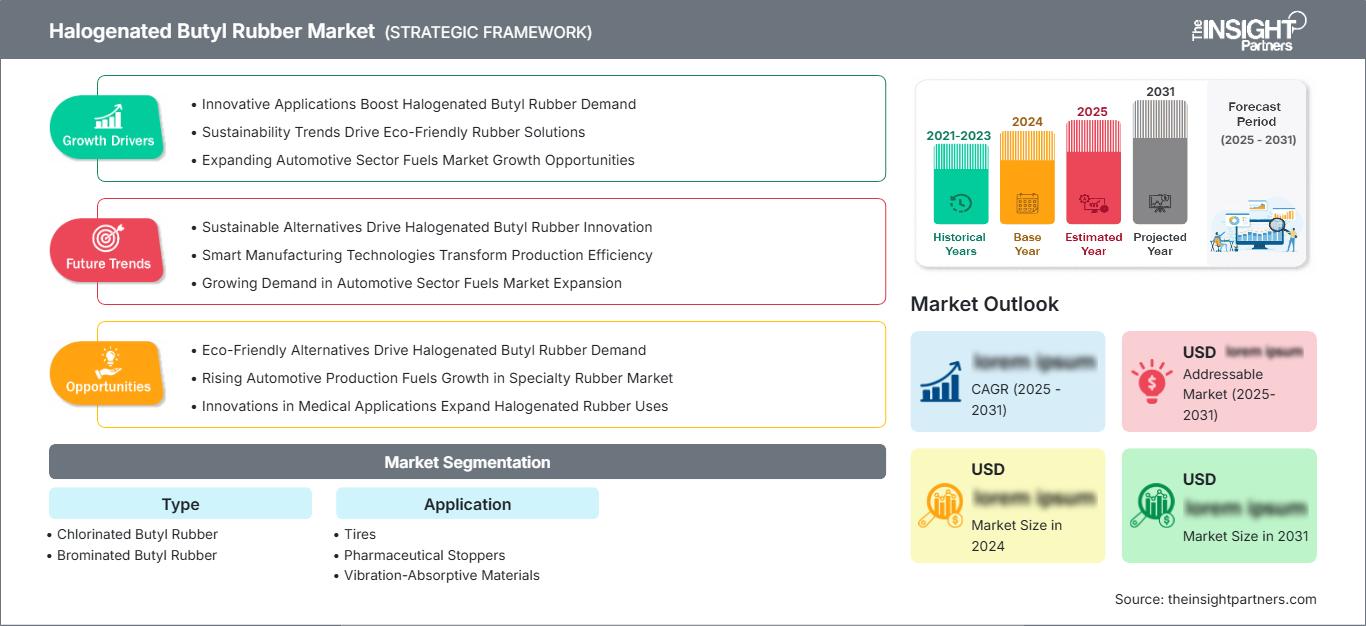
Halogenated Butyl Rubber Market: Strategic Insights
Regional Insights
North America Halogenated Butyl Rubber Market
North America held a share of 29-31% in the overall market during 2025 and is expected to witness a CAGR of 6.1-6.6% during 2026-2034. The market share of halogenated butyl rubber in the region is driven by the established industry of tire production, sophisticated production of pharmaceutical packaging, and petrochemical facilities. Growing consumption of high-end car tires along with growing health care expenditures is likely to drive the demand within the region. Advancements in rubber compounding and polymer processing technologies also increase the performance of the products for challenging industrial applications.
The United States and Canada act as key producers and consumers of the products due to advanced manufacturing capabilities and intensive research efforts. Growing needs for replacement tires, biologics packaging, and modern industrial sealing applications encourage companies to manufacture advanced halogenated elastomers. Sufficient availability of raw materials and strict quality requirements ensure the long-term competitive position of North American players and exports of products to international markets.
U.S. Halogenated Butyl Rubber Market
The US holds 76–79% share of the North American market for the year 2025 and it is expected to grow at the rate of 6.2–6.7% CAGR from 2026 to 2034. Good manufacturing in the automotive sector, thriving industry in terms of replacing tires and advanced development in the manufacturing of pharmaceutical products continue to drive demand in the US market. The presence of key polymer manufacturers and tire manufacturers allows effective integration of the supply chain along with continuous investment in advanced elastomers.
The demand in the US is rising owing to increased adoption of quality elastomer closures in the pharmaceutical industry used in various injectable drugs, vaccines and biological products. Alongside, the demand in the automotive sector will increase owing to better performance with regards to fuel efficiency and safety and thus adoption of brominated and chlorinated butyl rubber compounds is encouraged.
Europe Halogenated Butyl Rubber Market
Europe accounted for 24–26% of the global market share in 2025 and is projected to grow at a CAGR of 5.8–6.3% from 2026 to 2034. Germany is the leading market in the region due to its well-developed automotive manufacturing industry and robust industrial chemicals market. In the United Kingdom, there is steady demand for premium grade elastomers on account of specialty pharmaceutical packaging manufacturing facilities and ongoing investments in healthcare manufacturing sectors.
In France, Italy, and Spain, there is notable demand for the product due to diversified automotive components manufacturing, industrial machinery manufacturing, and specialty rubber processing sectors. Rising environment policies are prompting companies to make their processes more efficient as well as adopt sustainable manufacturing technologies. Investments in electric vehicles, medical packaging, and industrial materials in the region are anticipated to keep demand for halogenated butyl rubber stable during the forecast period.
APAC Halogenated Butyl Rubber Market
Asia Pacific held a share of 36-39% in the global market in 2025 and is expected to experience a CAGR of 7.1-7.6% over 2026-2034. China is leading the consumption in the region, followed by India, Japan, and South Korea with rising production of tires, integrated petrochemicals production, and industrialization.
The supportive government policies regarding domestic manufacturing, expansion of infrastructure, and automotive manufacturing drive the market growth. In Australia, mining and industrial machinery drives the market, while Japan and South Korea focus on high-end specialty elastomers for applications in automotive and pharmaceutical industries. The increasing investment in manufacturing capacity and export-oriented manufacturing drives the growth of Asia Pacific market.
Middle East & Africa Halogenated Butyl Rubber Market
The Middle East & Africa is projected to record a CAGR of 6.3–6.8% during 2026–2034, supported by expanding petrochemical integration and industrial diversification strategies. Saudi Arabia leads regional development through large-scale downstream chemical investments, while the United Arab Emirates continues strengthening specialty materials manufacturing and logistics infrastructure serving regional industrial customers.
South Africa remains an important consumer owing to its automotive component manufacturing and mining industries, whereas the Rest of the Middle East & Africa benefits from gradual industrial expansion and infrastructure projects. Growing investments in refining, petrochemicals, and value-added manufacturing are expected to create additional opportunities for high-performance elastomer production and downstream industrial applications.
Segmentation Analysis
Type
The Type segment represents the foundation of product differentiation, addressing varying performance requirements across automotive, healthcare, and industrial applications. The segment is anticipated to register a CAGR of 6.7–7.2% during 2026–2034. Product selection is influenced by curing characteristics, compatibility with rubber compounds, chemical resistance, and processing efficiency. The halogenated butyl rubber market scope continues expanding as manufacturers develop specialized formulations that improve production flexibility and end-product durability while meeting evolving industrial performance standards.
- Chlorinated Butyl Rubber – Widely utilized in tire inner liners and industrial rubber products because of its excellent air-retention capability, chemical resistance, and reliable processing characteristics. Its balanced performance supports consistent adoption across mature manufacturing industries.
- Brominated Butyl Rubber – Increasingly preferred for premium tire compounds and advanced pharmaceutical closures due to faster curing behavior, enhanced compatibility with natural and synthetic rubbers, and improved mechanical performance under demanding operating conditions.
Application
The Application segment remains the primary driver of commercial demand as manufacturers increasingly require elastomers with superior impermeability, durability, and chemical resistance. This segment is projected to expand at a CAGR of 6.6–7.1% during 2026–2034. Growth is supported by sustained investments in automotive manufacturing, healthcare packaging, and industrial vibration-control systems requiring reliable long-term material performance under challenging operating environments.
- Tires – The largest application owing to widespread use in inner liners that minimize air loss, improve fuel efficiency, enhance durability, and support increasingly stringent automotive safety and performance requirements across passenger and commercial vehicles.
- Pharmaceutical Stoppers – Demand continues increasing with expanding production of injectable drugs, vaccines, and biologics requiring high-purity elastomer closures that provide superior sealing performance, low extractables, and excellent compatibility with sensitive pharmaceutical formulations.
- Vibration-Absorptive Materials – Utilized across industrial machinery, transportation systems, and infrastructure applications where effective vibration damping, impact resistance, durability, and operational reliability contribute to longer equipment life and reduced maintenance requirements.
Opportunity Snapshot
| Application | Revenue Contribution | Trend Tag | Adoption Stage |
|---|---|---|---|
| Tires | High | Green Tires | Mature |
| Pharmaceutical Stoppers | Medium | Biologics Packaging | Scaling |
| Vibration-Absorptive Materials | Low | Industrial Damping | Emerging |
Halogenated Butyl Rubber Market Growth Drivers and Impact Analysis
Expansion of Global Tire Manufacturing and Replacement Demand
The automotive industry continues to be the largest consumer of halogenated butyl rubber because the material provides outstanding air-retention, heat resistance, and durability for tire inner liners. Rising passenger vehicle ownership, increasing commercial transportation activity, and the growing popularity of electric vehicles are driving demand for premium tire materials that improve energy efficiency and operational safety. Replacement tire demand remains resilient across both developed and developing economies due to increasing vehicle parc and stricter safety regulations. Tire manufacturers are also introducing compounds designed to reduce rolling resistance while extending service life, encouraging greater consumption of brominated and chlorinated butyl rubber. Continuous investment in tire manufacturing facilities across Asia Pacific and North America is expected to strengthen long-term demand and improve supply chain resilience for specialty elastomers.
Growing Pharmaceutical Packaging Requirements for Injectable Medicines
The increasing production of injectable pharmaceuticals, vaccines, biosimilars, and biologics has strengthened demand for high-performance elastomer closures capable of maintaining product integrity throughout storage and transportation. Pharmaceutical manufacturers require materials with low permeability, excellent chemical resistance, and minimal extractables to meet stringent international quality standards. Regulatory agencies continue emphasizing contamination prevention and packaging reliability, encouraging the adoption of premium halogenated butyl rubber formulations in vial stoppers and pharmaceutical seals. Expansion of biologics manufacturing capacity, particularly across North America, Europe, and Asia Pacific, is supporting investments in advanced pharmaceutical packaging solutions. As healthcare spending increases globally, suppliers capable of producing consistent, high-purity elastomer products are expected to benefit from stable long-term demand and stronger customer relationships.
Technological Advancements in Specialty Elastomer Manufacturing
Manufacturers continue investing in advanced polymerization technologies, process automation, and energy-efficient production systems to improve product consistency and operational efficiency. Digital monitoring solutions, improved catalyst technologies, and optimized halogenation processes enhance material performance while reducing manufacturing waste and production costs. These innovations enable suppliers to develop specialized grades tailored to evolving automotive, healthcare, and industrial performance requirements. Sustainability initiatives encouraging resource efficiency and lower manufacturing emissions are further accelerating modernization across production facilities. Companies integrating research, production, and downstream application development can respond more effectively to changing customer specifications while strengthening competitive differentiation. Continued technological progress is therefore expected to support higher-value product portfolios and sustainable industry expansion throughout the forecast period.
Halogenated Butyl Rubber Market Future Trends
Increasing Adoption of Sustainable Specialty Elastomer Manufacturing
Manufacturers are increasingly integrating sustainable production practices into specialty elastomer manufacturing by improving energy efficiency, optimizing feedstock utilization, and reducing process emissions. The halogenated butyl rubber market trends indicate that customers are placing greater emphasis on environmentally responsible sourcing without compromising product performance. Digital manufacturing platforms, advanced quality monitoring systems, and circular manufacturing initiatives are expected to improve operational efficiency while supporting compliance with evolving environmental regulations. Companies investing in cleaner production technologies are likely to strengthen their competitive position as sustainability becomes an increasingly important procurement criterion across automotive, healthcare, and industrial sectors.
Development of Advanced Materials for Electric Mobility
Electric vehicle manufacturers increasingly require tire materials capable of supporting higher torque, heavier battery loads, and lower rolling resistance while maintaining durability. These changing performance requirements encourage continuous innovation in brominated and chlorinated butyl rubber formulations. Material producers are collaborating with tire manufacturers to develop advanced compounds that improve safety, energy efficiency, and operational lifespan. Future product development is expected to focus on enhanced compatibility with next-generation tire technologies, enabling suppliers to capture emerging opportunities associated with the continued expansion of global electric mobility markets.
Halogenated Butyl Rubber Market Opportunities
Expansion of Pharmaceutical Manufacturing Capacity Across Emerging Economies
Expanding pharmaceutical manufacturing investments throughout Asia, Latin America, and selected Middle Eastern countries present attractive long-term opportunities for premium elastomer suppliers. Increasing domestic production of vaccines, injectable medicines, and biosimilars requires reliable packaging materials that comply with international quality standards. Halogenated butyl rubber market Forecasts indicate sustained investment in pharmaceutical infrastructure, creating favorable conditions for suppliers capable of delivering high-purity elastomer closures with consistent quality and regulatory compliance. Companies establishing regional manufacturing, technical support, and strategic partnerships with pharmaceutical packaging producers can strengthen market penetration while reducing delivery lead times and improving supply chain responsiveness.
Specialty Elastomer Innovation for High-Performance Industrial Applications
Industrial machinery manufacturers increasingly require advanced elastomer solutions capable of delivering superior vibration control, chemical resistance, and long operational life under demanding operating conditions. Growth opportunities exist in mining equipment, transportation infrastructure, heavy machinery, and advanced sealing systems where performance reliability directly influences equipment efficiency. Suppliers investing in application-specific product development, collaborative engineering programs, and customized compound formulations can differentiate themselves from conventional manufacturers. Continued industrial modernization, infrastructure development, and automation across emerging economies are expected to create additional demand for high-value specialty elastomer products beyond traditional tire and pharmaceutical applications.
Recent Developments
- October 2025: Zhejiang Cenway New Materials Co. Ltd. (Cenway) launched a public consultation on a previously announced 70 kilotonnes per annum expansion of its butyl rubber production facilities in Zhejiang province.
- September 2025: LANXESS expanded production capabilities with the addition of rubber processing promoters at its Bushy Park facility in Goose Creek, South Carolina, USA. The expansion project, currently underway, aims to meet increasing demand and improve supply reliability, with new production expected to come online in November 2025.
Frequently Asked Questions

- Comprehensive Market Sizing and Forecast Analysis
- Detailed Segmentation Analysis
- In-Depth Market Dynamics Assessment
- Regional and Country-Level Insights
- Competitive Landscape and Company Benchmarking
- Strategic Business Intelligence
Recent Reports
Testimonials

The Insight Partners' SCADA System Market report is comprehensive, with valuable insights on current trends and future forecasts. The team was highly professional, responsive, and supportive throughout. We are very satisfied and highly recommend their services.
RAN KEDEM Partner, Reali Technologies LTDs
I requested a report on a very specific software market and the team produced the report in a few days. The information was very relevant and well presented. I then requested some changes and additions to the report. The team was again very responsive and I got the final report in less than a week.
JEAN-HERVE JENN Chairman, Future Analytica
We worked with The Insight Partners for an important market study and forecast. They gave us clear insights into opportunities and risks, which helped shape our plans. Their research was easy to use and based on solid data. It helped us make smart, confident decisions. We highly recommend them.
PIYUSH NAGPAL Sr. Vice President, High Beam Global
The Insight Partners delivered insightful, well-structured market research with strong domain expertise. Their team was professional and responsive throughout. The user-friendly website made accessing industry reports seamless. We highly recommend them for reliable, high-quality research services
YUKIHIKO ADACHI CEO, Deep Blue, LLC.
This is the first time I have purchased a market report from The Insight Partners.While I was unsure at first, I visited their web site and felt more comfortable to take the risk and purchase a market report.I am completely satisfied with the quality of the report and customer service. I had several questions and comments with the initial report, but after a couple of dialogs over email with their analyst I believe I have a report that I can use as input to our strategic planning process.Thank you so much for taking the extra time and making this a positive experience.I will definitely recommend your service to others and you will be my first call when we need further market data.
JOHN SUZUKI President and Chief Executive Officer, Board Director, BK Technologies
I wish to appreciate your support and the professionalism you displayed in the course of attending to my request for information regarding to infectious disease IVD market in Nigeria. I appreciate your patience, your guidance, and the fact that you were willing to offer a discount, which eventually made it possible for us to close a deal. I look forward to engaging The Insight Partners in the future, all thanks to the impression you have created in me as a result of this first encounter.
DR CHIJIOKE ONYIA MANAGING DIRECTOR, PineCrest Healthcare Ltd.Reason to Buy
- Informed Decision-Making
- Understanding Market Dynamics
- Competitive Analysis
- Identifying Emerging Markets
- Customer Insights
- Market Forecasts
- Risk Mitigation
- Boosting Operational Efficiency
- Strategic Planning
- Investment Justification
- Tracking Industry Innovations
- Aligning with Regulatory Trends





 Get Free Sample for