
Helideck Monitoring System Market Share, Growth & Forecast by 2034
Coverage: by Component (Hardware (Sensors, GPS, and Others) and Software); Application (Defence, and Commercial); Sales Channel (OEMs and Aftermarket); , and Geography (North America, Europe, Asia Pacific, and South and Central America)
- Status : Data Released
- Report Code : TIPAD00002122
- Category : Electronics and Semiconductor
- No. of Pages : 150
- Available Report Formats :


- Last update date : September 17, 2026


2025 Market Size
US$ 338.65 Mn
Base year value
2034 Forecast
US$ 607.01 Mn
Projected by 2034
CAGR 2026-2034
6.70 %
Growth rate
Addressable Market
US$ 4,274.51 Mn
(2026-2034)
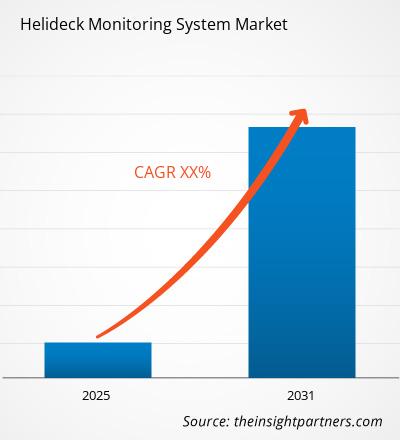
The Helideck Monitoring System market is valued at US$ 338.65 Million in 2025 and is projected to reach US$ 607.01 Million by 2034, expanding at a CAGR of 6.70% during 2026–2034. The demand is bolstered by stringent rules of offshore aviation, digital monitoring, and growth in offshore energy. The market is viewed as a safety-critical technology market that will enable offshore helicopter operations by way of real-time monitoring of helideck movement, weather conditions, and limits of operation.
North America Helideck Monitoring System market size still continues to be an adoption region, which will receive its impetus from offshore energy installations, helicopter logistics, and upgrades to the safety critical monitoring infrastructure. The forecast for the region shows modeled CAGR of 6.20–6.80% for the period of 2026–2034.
Helideck Monitoring System Market Assessment and Insights
- North America: North America is estimated to account for a 31–35% share in 2025 and is expected to grow at a CAGR of 6.20–6.80% between 2026–2034, supported by offshore energy operations, fleet modernization, and stringent aviation safety practices.
- US: The US represents approximately 72–76% of North America's 2025 demand and is projected to expand at a CAGR of 6.30–6.90%, supported by offshore platforms, defense applications, and helicopter logistics.
- Europe: Europe is estimated to hold a 27–31% share in 2025 and grow at 6.50–7.10% CAGR between 2026–2034. Norway, the UK, Denmark, and the Netherlands provide strong demand through offshore energy, maritime safety, and regulatory compliance.
- Asia Pacific: Asia Pacific is modeled at a 20–24% share in 2025 and is expected to register 7.10–7.70% CAGR during 2026–2034, led by China, Australia, Japan, South Korea, and India through offshore infrastructure development.
- Largest Segment: Hardware is modeled as the largest component, with a 58–62% market share in 2025 and a 6.20–6.70% CAGR during 2026–2034, reflecting sensor-intensive installations.
- High Growth Segment: Software is modeled as the high-growth component, representing 38–42% share in 2025 and expanding at 7.30–7.90% CAGR during 2026–2034 as analytics and remote monitoring advance.
- Key companies analyzed in detail: Kongsberg Gruppen ASA, Vaisala, Monitor Systems Ltd., Observator Group, Fugro N.V., ASB Systems PVT. LTD., ABB Ltd., Miros AS, RIGSTAT, LP., and Dynamax Inc.
Source: The Insight Partners' analysis based on proprietary research, government publications, company annual reports, investor presentations, industry databases, and expert interviews.
The evolution of technology means that the monitoring of helidecks will be moving away from simple instruments to comprehensive safety systems incorporating motion detection, weather analysis, alarms, data archiving, and remote access capabilities. Kongsberg’s HMS 300, for example, monitors roll, pitch, heaving, inclination, acceleration, and meteorological variables, whereas Vaisala’s platform incorporates weather and lightning detection, forecasting, and vertical wind. Regulatory changes are driving this shift.
The future demand in the Helideck Monitoring System market will grow due to offshore wind energy production, floating production, maritime security operations, and remote logistics that require continuous assessments of landing conditions. New requirements of the revised CAP 437 and the Helideck Certification Agency mean that operators have to evaluate their equipment, software, training, and options for upgrading. This investment cycle will support interoperable systems that can accommodate on-board crews and shore-side operational staff.
Helideck Monitoring System Market Report Scope
| Report Attribute | Details |
|---|---|
| Market size in 2025 | US$ 338.65 Million |
| Market Size by 2034 | US$ 607.01 Million |
| Global CAGR (2026 - 2034) | 6.70% |
| Historical Data | 2021-2024 |
| Forecast period | 2026-2034 |
Helideck Monitoring System Market Analysis
The growth profile of the Helideck Monitoring System is driven by the requirement to constantly monitor motion, wind, visibility, clouds, pressure, humidity, and various other factors prior to and during the time when helicopters land or take off. The components of the value chain consist of sensors, motion reference units, weather instruments, hardware, software, installation services, certification, and maintenance services. The operators in the offshore industry have started preferring integrated solutions over individual instruments because they simplify operations and help make decisions.
Since the supply side will always be driven by the latest technology as the devices need to be able to work properly amid vibrations, salt water, temperature changes, and other factors, the competition among suppliers of hardware will be based on precision, durability, compatibility, and compliance of the hardware. As far as software is concerned, companies will compete for providing visualization, notifications, data storage, remote access, forecasting, and system integration with the vessel/platform.
The Helideck Monitoring System market report reveals a competitive industry structure with maritime technology companies, meteorologists, engineering companies, and specialized monitor suppliers. Kongsberg Gruppen ASA has a dominant position based on motion measuring and offshore monitoring, whereas Vaisala is the integration of meteorological instruments and software. Fugro N.V. provides offshore geospatial and environment experience, whereas ABB Ltd. has an advantage due to industrial automation and digital infrastructure skills.
The competitive positioning in this industry is based on the ability to provide a combination of certified hardware and software-based operational intelligence. Monitor Systems Ltd., Observator Group, Miros AS, ASB Systems PVT. LTD., RIGSTAT, LP., and Dynamax Inc. are involved through specialized monitoring services, instrumenting, weather, motion, and offshore services. Investments will therefore be allocated towards modular systems, remote access, security, predictive maintenance, and interoperability with offshore communications infrastructure.
● REPORT CUSTOMIZATION
Tailor This Report To Align With Your Specific Business Requirements
This report can be customized to align precisely with your business objectives, scope, and target markets. Customization options include tailored segmentation, geography, competitive analysis, and strategic insights to support informed decision-making.
Customize This Report →WHAT YOU CAN ADJUST
- ● Segmentations
- ● Geography
- ● Competitive Analysis
- ● Language Preferences
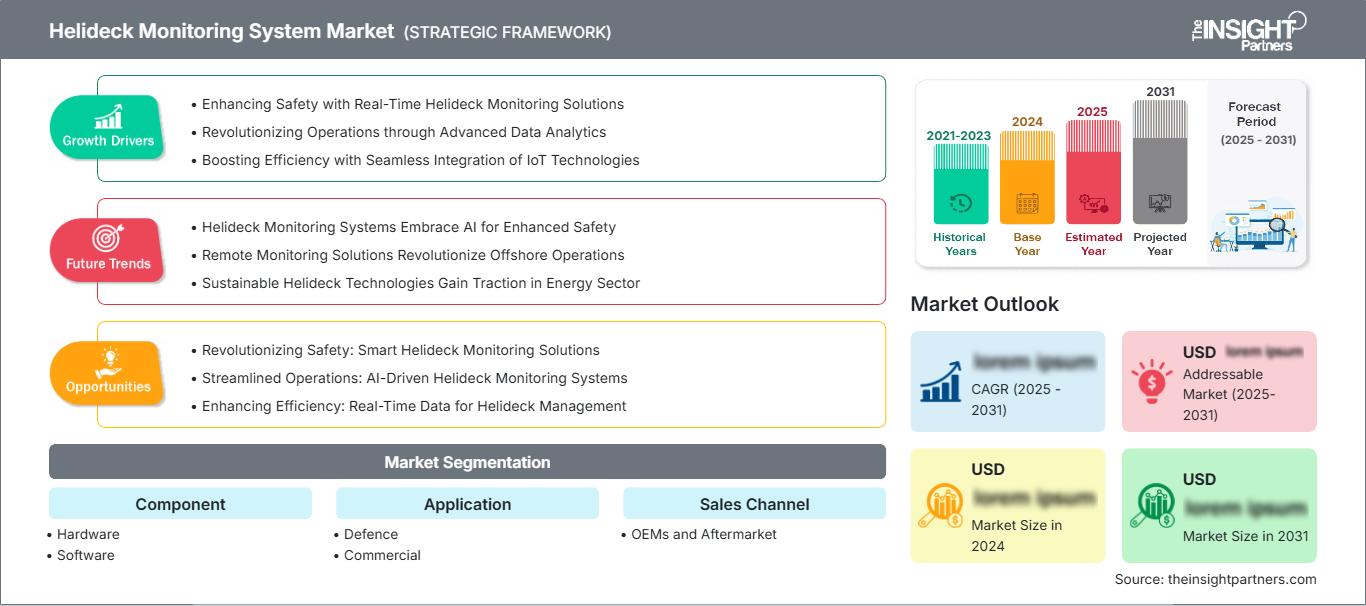
Helideck Monitoring System Market: Strategic Insights
Regional Insights
North America Helideck Monitoring System Market
North America has been forecasted at 31–35% of the Helideck Monitoring System market share in 2025, and it shows a CAGR of 6.20–6.80% until 2034. The United States will continue to be the largest market for demand due to offshore logistics, naval activities, helicopter transportation, and safety management. Canada's contribution comes from offshore marine activities and unique aviation capabilities. The demand will favor integrated weather and motion systems rather than separate devices.
There is a well-established aftermarket environment in the region. The operators of floating production systems, offshore vessels, and other specialized installations will need devices capable of operating under difficult marine conditions. Regulatory compliance, risk management, remote monitoring, and equipment upgrades will contribute to the replacement demand. The North American buyers tend to assess the lifecycle management, calibration, cybersecurity issues, data access, and integration with control systems when choosing a platform.
U.S. Helideck Monitoring System Market
America accounts for 72-76% of the total 2025 market of North America, with an estimated CAGR of 6.30-6.90% up to 2034. The offshore energy sector, military operations, marine transport, and unique helicopter flights necessitate the use of continuous environmental and deck-motion monitoring. Different application needs exist on fixed platforms versus floating vessels, thus offering scope for adaptable solutions.
Some of the companies with solutions in the domain include Kongsberg Gruppen ASA, Vaisala, Fugro N.V., and Dynamax Inc., which offer solutions including motion monitoring, weather measuring equipment, offshore environment intelligence, and even systems. Remote operations visibility and lifecycle maintenance have become important aspects in the adoption of such technology. Data integrity, redundancy, cybersecurity, and integration into existing ship-to-ship communications infrastructure have become critical criteria for operators in the US.
Europe Helideck Monitoring System Market
Europe is expected to have a 27–31% share in 2025 and is forecast to have a 6.50–7.10% CAGR during the period of 2026–2034. Norway dominates, with the UK, Denmark, Netherlands, and other offshore operators following. Advanced offshore energy infrastructure, harsh marine environment conditions, and high aviation safety standards contribute to continuous replacement and upgrading of helidecks.
United Kingdom is important due to the regulation of CAP 437, which provides the guidelines for the standard landing facility of helicopters offshore. The amendment in 2026 of the regulations incorporates the list of Master Minimum Helideck Equipment. Norway consists of the combination of offshore helicopter industry and national needs along with maritime technology industry. Other smaller but important markets are France, Italy, and Spain.
APAC Helideck Monitoring System Market
APAC is estimated at 20-24% market share in 2025 and CAGR of 7.10-7.70% through 2034. China drives regional consumption, whereas Japan, South Korea, India, and Australia have an impact due to their contribution to offshore energy, shipbuilding, defense industry, and maritime infrastructure. Australia, in particular, is significant with respect to offshore assets and remote logistics.
Development of industries and offshore structures demands increasingly accurate data regarding weather and motion. Hardware solutions with rugged design along with regional service support and remote diagnostics services will be a great asset. Installation challenges of the region create the need for flexible systems for different types of offshore vessels, fixed structures, and defense equipment.
Middle East & Africa Helideck Monitoring System Market
Middle East and Africa demand is driven by offshore hydrocarbons, maritime, defense activities, and logistics. Saudi Arabia and the UAE dominate regional adoption, and South Africa makes its contribution via maritime, energy, and specialized air traffic operations. Rest of MEA is rather fragmented, but there are prospects related to offshore facilities and remote operations.
Region is forecasted to develop at 5.80–6.40% CAGR up to 2034, with Saudi Arabia being the leader among markets. High temperatures, dust conditions, maritime conditions, and geographic dispersion of the facilities make demands for robust environmental sensors and reliable remote connection more intense. Investment in energy infrastructure can help modernize surveillance solutions if helicopter operation still has its place.
Segmentation Analysis
Component
The component segment in the Helideck Monitoring System market is divided between Hardware and Software. Hardware remains central because compliant installations require physical sensing, measurement, processing, display, and signaling equipment. Software is becoming increasingly important as operators seek centralized visibility, automated alerts, forecasting, data retention, and remote access. The overall component segment is expected to maintain a balanced technology mix, with software adoption gradually increasing its strategic importance. The modeled component growth range is 6.20–7.90% during 2026–2034. The market scope increasingly extends beyond measurement toward decision support.
- Hardware: Hardware remains the foundation of monitoring installations, incorporating weather sensors, motion measurement units, processing equipment, displays, and signaling interfaces. Reliability and marine ruggedization strongly influence purchasing decisions.
- Software: Software supports visualization, data processing, alert management, remote access, forecasting, and historical analysis. Its strategic importance is increasing as operators consolidate operational information across offshore assets.
Application
The application segment in the Helideck Monitoring System market comprises Defence and Commercial. Commercial applications currently represent the broader installed base because offshore energy and maritime logistics use helicopters for personnel transfer, inspection, maintenance, and emergency response. Defence demand remains strategically significant because naval and military operations require dependable landing-condition information in demanding environments. The application segment is modeled to expand at 6.40–7.20% CAGR during 2026–2034 as both sectors prioritize operational assurance and digital situational awareness.
- Defence: Defence applications require dependable monitoring under mission-specific conditions, including naval vessels and remote installations. Procurement emphasizes ruggedization, interoperability, secure communications, and dependable performance during challenging operations.
- Commercial: Commercial installations support offshore energy, maritime logistics, construction, and remote servicing. Demand centers on regulatory compliance, operational availability, passenger safety, and efficient helicopter scheduling.
Sales Channel
The sales channel segment in the Helideck Monitoring System market includes OEMs and Aftermarket. OEM procurement is important for new installations where monitoring systems are incorporated into vessel or platform specifications. Aftermarket demand is supported by upgrades, replacement cycles, regulatory revisions, maintenance, and modernization of installed systems. The sales channel segment is expected to grow at 6.30–7.10% CAGR during 2026–2034, with aftermarket activity gaining importance as installed fleets age.
- OEMs: OEM channels support integrated procurement for new offshore platforms, vessels, and specialized installations. Early engineering involvement allows monitoring architecture, sensor placement, communications, and safety interfaces to be specified together.
- Aftermarket: Aftermarket demand arises from equipment replacement, compliance upgrades, modernization, calibration, and system expansion. Operators value service availability, retrofit compatibility, documentation, and minimal operational disruption.
Opportunity Snapshot
| Application | Revenue Contribution (High/Medium/Low) | Trend Tag | Adoption Stage |
|---|---|---|---|
| Defence | Medium | Mission Safety | Scaling |
| Commercial | High | Offshore Logistics | Mature |
Helideck Monitoring System Market Growth Drivers and Impact Analysis
Expansion of Offshore Energy and Remote Helicopter Logistics
Offshore energy development increases the operational value of helicopter transportation because personnel, equipment, and maintenance teams frequently move between remote installations and shore bases. Offshore wind adds another demand layer through construction, inspection, maintenance, and crew-transfer activities. Monitoring systems help operators determine whether wind, visibility, lightning, and deck-motion conditions remain within operational limits. This creates direct demand for integrated measurement platforms on fixed and floating installations. The impact extends beyond new projects because existing fleets require equipment modernization as standards evolve. Suppliers capable of supporting diverse vessel types can therefore address both initial installation and replacement demand. The driver also strengthens demand for remote data access, allowing shore teams to evaluate conditions before flight operations commence.
Regulatory Modernization and Stronger Helideck Safety Requirements
Regulatory requirements create a structural replacement mechanism because operators must maintain safety-critical equipment and demonstrate compliance with applicable offshore aviation standards. CAP 437 and associated Helideck Certification Agency requirements provide a framework for monitoring equipment, operational limitations, and safety procedures. The implementation of Revision 9C and subsequent CAP 437 updates has encouraged operators to assess installed systems, upgrade equipment, and strengthen training. Kongsberg has specifically addressed the transition to newer requirements through HMS 300 upgrade guidance and operator training provisions. This regulatory cycle benefits suppliers with established certification knowledge and upgrade pathways while increasing the importance of documentation, calibration, testing, and lifecycle support.
Integration of Weather, Motion, and Digital Decision Support
The integration of multiple environmental variables into one operational interface is improving the usefulness of monitoring platforms. Traditional systems focused heavily on individual measurements, whereas modern solutions combine wind, pressure, visibility, cloud conditions, lightning, motion, and forecasting. Vaisala's 2025 software update illustrates this direction by combining vertical wind profiling, lightning detection, and forecast information within its helideck monitoring platform. This integration can reduce fragmented decision-making and provide a common operational picture for pilots, deck crews, control rooms, and maintenance teams. Commercial value increasingly depends on actionable information rather than raw measurements, encouraging suppliers to invest in software, cloud connectivity, secure communications, and analytical capabilities.
Helideck Monitoring System Market Future Trends
AI-Assisted Operational Risk Interpretation
The Helideck Monitoring System market trends are expected to move toward AI-assisted interpretation of environmental and motion data rather than simple threshold-based alarms. Future platforms may combine historical measurements, weather forecasts, vessel motion, operational schedules, and maintenance records to identify changing risk conditions before they become restrictive. Machine learning can support anomaly detection, sensor-health assessment, and predictive maintenance without replacing certified operational procedures. This approach could reduce nuisance alerts and improve planning for offshore helicopter movements. Software architectures are also likely to become more modular, allowing operators to add analytics without replacing core sensing hardware. Cybersecurity will remain essential as remote monitoring expands. Vendors that combine explainable analytics with established compliance frameworks are likely to gain stronger acceptance among safety-critical offshore operators.
Cloud-Connected Multi-Asset Monitoring
Cloud-connected monitoring will increasingly allow offshore operators to view multiple helidecks through a centralized operational interface. Instead of treating each installation as an isolated system, future architectures can consolidate weather, motion, status, alerts, and historical information across vessels and platforms. This model supports fleet-level planning, centralized maintenance, comparative performance analysis, and faster technical assistance. Kongsberg already provides optional cloud-based access for live vessel and helideck information, while Vaisala is expanding software capabilities around weather intelligence and remote information delivery. Adoption will depend on reliable communications, cybersecurity controls, data ownership policies, and clear separation between operational technology and enterprise networks. The strongest platforms will combine local resilience with secure remote accessibility.
Helideck Monitoring System Market Opportunities
Retrofitting Aging Offshore Installations
A substantial opportunity exists in upgrading older helideck monitoring installations that remain operational but require improved compliance, connectivity, sensing, or data management. Operators can often preserve parts of existing infrastructure while replacing outdated processors, sensors, interfaces, or software. This creates a lower-disruption investment pathway compared with complete system replacement. Vendors can develop standardized retrofit packages covering motion measurement, weather instrumentation, communications, displays, and remote access. Training and certification support can be bundled with technical upgrades to reduce implementation risk. The Helideck Monitoring System market forecast opportunity is particularly relevant where regulatory revisions create defined upgrade requirements. Suppliers with installed-base knowledge can use compatibility engineering and lifecycle support to improve customer retention while expanding recurring service revenue through calibration, software updates, monitoring subscriptions, and maintenance agreements.
Digital Services for Fleet-Level Monitoring
Helideck Monitoring System Forecasts increasingly point toward service models that connect individual installations with centralized operational platforms. This creates an opportunity to provide recurring digital services rather than relying solely on hardware sales. Operators managing multiple vessels or offshore facilities could benefit from fleet dashboards, historical data repositories, alert management, equipment health monitoring, cybersecurity services, and remote technical support. Suppliers can also integrate forecast information, lightning intelligence, and environmental data to improve planning. The commercial model could combine initial installation with annual software licensing and support contracts. Successful offerings will need strong data governance, high availability, secure connectivity, and clear compliance boundaries. Such services can create predictable revenue while giving operators a more consistent view of geographically dispersed assets.
Recent Developments
- January 2026: UK Civil Aviation Authority published the first amendment to the ninth edition of CAP 437, introducing the Master Minimum Helideck Equipment List in Appendix L and updating requirements for offshore helicopter landing areas. The revision provides an updated framework for managing unserviceability of safety-critical helideck equipment.
- May 2025: Vaisala introduced its Elements Helideck Monitoring Software, adding WindCube lidar vertical wind profiling, lightning detection, and graphical and data forecasts to its offshore monitoring platform. The release broadened the system from conventional weather observation toward integrated operational intelligence for helicopter, crane, and offshore installation activities.
- November 2023: SES Energy (SES) has launched its Scalable Aviation Weather Observation System (SAWOS), becoming the first offshore aviation service provider to have its own CAA approved helideck monitoring system.
Frequently Asked Questions

- Comprehensive Market Sizing and Forecast Analysis
- Detailed Segmentation Analysis
- In-Depth Market Dynamics Assessment
- Regional and Country-Level Insights
- Competitive Landscape and Company Benchmarking
- Strategic Business Intelligence
Recent Reports
Testimonials

The Insight Partners' SCADA System Market report is comprehensive, with valuable insights on current trends and future forecasts. The team was highly professional, responsive, and supportive throughout. We are very satisfied and highly recommend their services.
RAN KEDEM Partner, Reali Technologies LTDs
I requested a report on a very specific software market and the team produced the report in a few days. The information was very relevant and well presented. I then requested some changes and additions to the report. The team was again very responsive and I got the final report in less than a week.
JEAN-HERVE JENN Chairman, Future Analytica
We worked with The Insight Partners for an important market study and forecast. They gave us clear insights into opportunities and risks, which helped shape our plans. Their research was easy to use and based on solid data. It helped us make smart, confident decisions. We highly recommend them.
PIYUSH NAGPAL Sr. Vice President, High Beam Global
The Insight Partners delivered insightful, well-structured market research with strong domain expertise. Their team was professional and responsive throughout. The user-friendly website made accessing industry reports seamless. We highly recommend them for reliable, high-quality research services
YUKIHIKO ADACHI CEO, Deep Blue, LLC.
This is the first time I have purchased a market report from The Insight Partners.While I was unsure at first, I visited their web site and felt more comfortable to take the risk and purchase a market report.I am completely satisfied with the quality of the report and customer service. I had several questions and comments with the initial report, but after a couple of dialogs over email with their analyst I believe I have a report that I can use as input to our strategic planning process.Thank you so much for taking the extra time and making this a positive experience.I will definitely recommend your service to others and you will be my first call when we need further market data.
JOHN SUZUKI President and Chief Executive Officer, Board Director, BK Technologies
I wish to appreciate your support and the professionalism you displayed in the course of attending to my request for information regarding to infectious disease IVD market in Nigeria. I appreciate your patience, your guidance, and the fact that you were willing to offer a discount, which eventually made it possible for us to close a deal. I look forward to engaging The Insight Partners in the future, all thanks to the impression you have created in me as a result of this first encounter.
DR CHIJIOKE ONYIA MANAGING DIRECTOR, PineCrest Healthcare Ltd.Reason to Buy
- Informed Decision-Making
- Understanding Market Dynamics
- Competitive Analysis
- Identifying Emerging Markets
- Customer Insights
- Market Forecasts
- Risk Mitigation
- Boosting Operational Efficiency
- Strategic Planning
- Investment Justification
- Tracking Industry Innovations
- Aligning with Regulatory Trends





 Get Free Sample for