
Herbicides Market Size, Share & Forecast by 2034
Coverage: by Type (Glyphosate, Diquat, 2,4-D, Others); Mode of Action (Non-Selective, Selective); Crop Type (Cereals and Grains, Oilseeds and Pulses, Fruits and Vegetables, Others) , and Geography (North America, Europe, Asia Pacific, and South and Central America)
- Status : Data Released
- Report Code : TIPRE00007594
- Category : Chemicals and Materials
- No. of Pages : 150
- Available Report Formats :


- Last update date : August 17, 2026


2025 Market Size
US$ 39.27 Bn
Base year value
2034 Forecast
US$ 62.68 Bn
Projected by 2034
CAGR 2026-2034
5.33 %
Growth rate
Addressable Market
US$ 462.34 Bn
(2026-2034)
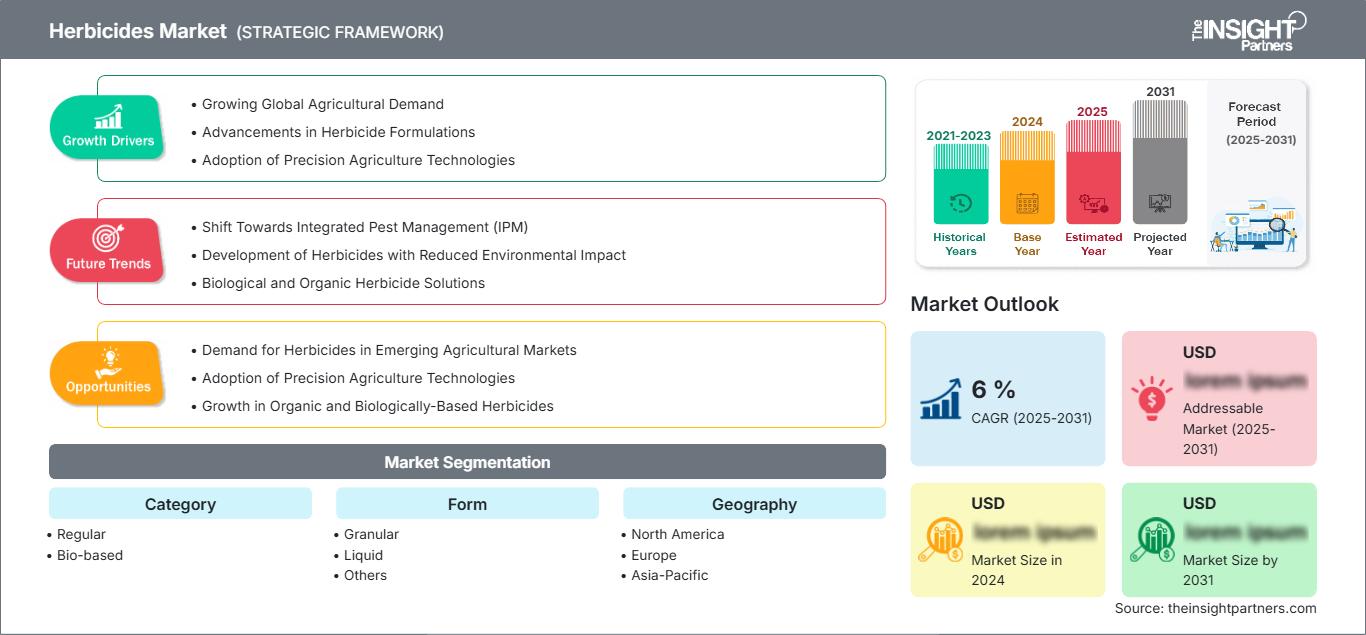
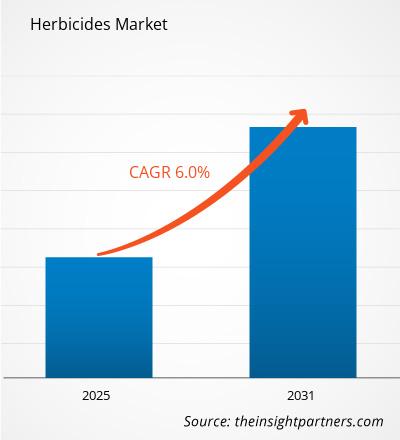
The herbicides market was valued at US$ 39.27 Billion in 2025 and is projected to reach US$ 62.68 Billion by 2034, expanding at a CAGR of 5.33% during 2026–2034. Rising emphasis on improving agricultural productivity, increasing weed resistance to conventional practices, and expanding commercial cultivation of high-value crops continue to support demand. Technological advances in herbicide formulations, precision farming, and integrated weed management are also strengthening long-term industry development.
Across North America, adoption remains supported by large-scale mechanized farming, widespread cultivation of corn, soybean, wheat, and cotton, and increasing investment in precision agriculture. The herbicides market size in the region is expected to expand at a CAGR of 4.8–5.2% during 2026–2034, driven by herbicide-tolerant cropping systems, digital farm management technologies, and continued innovation in biological crop protection products that comply with evolving environmental regulations.
Herbicides Market Assessment and Insights
- North America: Accounted for 31–34% share in 2025 and is anticipated to expand at a CAGR of 4.8–5.2% during 2026–2034. Strong adoption of precision agriculture, large commercial farms, and continuous product innovation support regional demand.
- US: Represented 76–80% of the North American market in 2025 and is projected to register a CAGR of 4.9–5.3% during 2026–2034. Broad acreage under corn and soybean cultivation and increasing use of integrated weed management sustain market expansion.
- Europe: Held 23–26% share in 2025 and is expected to grow at a CAGR of 4.5–4.9% during 2026–2034. Germany, France, Spain, Italy, and the UK remain leading markets, supported by advanced farming practices and regulatory-driven product innovation.
- Asia Pacific: Captured 28–31% share in 2025 and is forecast to record a CAGR of 6.2–6.7% during 2026–2034. China, India, Japan, South Korea, and Australia continue expanding adoption owing to increasing food demand, mechanization, and government-backed agricultural modernization.
- Largest Segment: Non-Selective herbicides accounted for an assessed 52–56% market share in 2025 and are projected to register a 4.8–5.3% CAGR during 2026–2034, supported by broad-spectrum weed management.
- High Growth Segment: Cereals and Grains accounted for an assessed 38–42% market share in 2025 and are projected to record a 5.8–6.3% CAGR during 2026–2034, supported by extensive cultivated acreage.
- Key companies analyzed in detail: ADAMA Agricultural Solutions Ltd., BASF SE, Drexel Chemical Company, FMC Corporation, Bayer AG, Nissan Chemical Corporation, Nufarm Limited, Corteva, Inc., Syngenta Crop Protection AG, Corteva Agriscience LLC
Source: The Insight Partners' analysis based on proprietary research, government publications, company annual reports, investor presentations, industry databases, and expert interviews.
The rapid advancements in formulations, integrated crop management, and digital agriculture have changed the face of competition. Firms are working on selective herbicides, reduced dosage of active compounds, and biological options which will provide improved weed management while having minimal effects on the environment. The manufacturing approach is shifting towards creating more resilient supply chains, diversified sources for active compounds, and collaborating with agricultural technology firms.
Moving forward, investments in this industry are forecasted to become even more attractive in Asia Pacific, Latin America, and some agricultural regions of Middle East due to food security and sustainable farming being among top priorities for respective governments. The presence of favorable regulatory environment which encourages production of environmentally-friendly solutions, growing use of precision applications, and rising popularity of contract farming can serve as the foundation for innovations and expansion.
Herbicides Market Report Scope
| Report Attribute | Details |
|---|---|
| Market size in 2025 | US$ 39.27 Billion |
| Market Size by 2034 | US$ 62.68 Billion |
| Global CAGR (2026 - 2034) | 5.33% |
| Historical Data | 2021-2024 |
| Forecast period | 2026-2034 |
Herbicides Market Analysis
The increasing demand for higher agricultural production efficiency, along with reducing crop damage from the infestation of weeds, is continuing to drive the growth of the herbicides market in developed as well as emerging agricultural markets. Rising cultivation of cereals, oilseeds, fruits, and vegetables, in addition to decreasing available arable land per head, has led to increased adoption of new weed control systems.
The industry value chain includes manufacturers of active ingredients, formulation companies, distributors, agriculture cooperatives, retailers, and commercial farms. Increased investments into localization of the supply chain and formulation of herbicides are increasing availability while mitigating the effects of price fluctuations of raw materials. Moreover, biological formulations and integrated weed management systems are gaining popularity among growers due to their effectiveness and regulatory compliance.
The competitive intensity will continue to rise as multinational crop protection firms engage in further investment in research, regional manufacturing abilities, and formulation differentiation. In the herbicides market report, it is evident that companies such as BASF SE, Bayer AG, Syngenta Crop Protection AG, FMC Corporation, Corteva, Inc., ADAMA Agricultural Solutions Ltd., Nufarm Limited, Nissan Chemical Corporation, Drexel Chemical Company, and Corteva Agriscience LLC have been focusing on selective herbicides, resistance management programs, and digital agronomy support in order to enhance their market position globally.
Strategic alliances and acquisitions are increasingly becoming more significant as companies broaden their portfolio and fast-track the commercialization process for sustainable crop protection technologies. Capital investments will increasingly be made in biological herbicides, precision technology applications, and regional manufacturing plants to ensure improved supply security. Moreover, the strategic collaborations with agriculture research organizations and technology providers will aid in the development of integrated weed management systems.
● REPORT CUSTOMIZATION
Tailor This Report To Align With Your Specific Business Requirements
This report can be customized to align precisely with your business objectives, scope, and target markets. Customization options include tailored segmentation, geography, competitive analysis, and strategic insights to support informed decision-making.
Customize This Report →WHAT YOU CAN ADJUST
- ● Segmentations
- ● Geography
- ● Competitive Analysis
- ● Language Preferences
Herbicides Market: Strategic Insights
Regional Insights
North America Herbicides Market
The North American held at 31–34% in the herbicides market share in 2025 and will continue to grow at a CAGR of 4.8–5.2% during 2026-2034. The availability of commercial agriculture, use of herbicide-tolerant crops, and use of precision agriculture technologies makes North America a fertile area for growth. With increasing investment in digital agriculture, automatic spraying methods, and weed management systems, efficient use of herbicides becomes more effective in improving crop production.
The US and Canada are the primary drivers for demand in the region as both countries have significant acreage of corn, soybean, wheat, and cotton. Sustainable crop protection has become the priority in the regulatory environment; therefore, the manufacturers are developing low-dose products and bioherbicides. Resistance management activities along with strong agricultural extension networks and innovations in products make steady market growth expected throughout the forecast period.
U.S. Herbicides Market
In 2025, the U.S. accounted for 76-80% of the North America market, and it is projected to report a CAGR of 4.9-5.3% from 2026 to 2034. The prevalence of large-scale farming practices, cultivation of vast land in corn and soybean production, and adoption of highly sophisticated technologies of crop protection keep sustaining the demand for the products. Innovations in digital agriculture, GPS-enabled spraying equipment, and precision application technology help to optimize farm operations and minimize wastage of herbicides.
Several top manufacturers, such as BASF SE, Bayer AG, Corteva, Inc., FMC Corporation, and Syngenta Crop Protection AG operate from production, research, and business facilities in the country. Excellent research expertise, along with collaboration between agricultural bodies and players in the industry, drives innovation in the development of selective herbicides, biological formulations, and weed management systems.
Europe Herbicides Market
Europe held a share of 23–26% in the global market in 2025 and is projected to register a CAGR of 4.5–4.9% in 2026-2034. Germany retains its top spot due to highly evolved agronomic practices, large-scale growth of cereals, and high levels of investment in precision agriculture technology. The UK keeps focusing on sustainable management of crops and the development of precision spray solutions, while the regulatory initiatives promote the development of herbicides formulated for compatibility with the environment.
France, Italy, and Spain together account for a significant portion of the regional agricultural production owing to large-scale production of cereals, wine-growing regions, fruits and vegetables, and oilseeds. Growing need for weed control along with modernization of agricultural equipment and farm management systems boosts herbicide consumption in these regions. Development of the regulatory framework continues to motivate the manufacturers to develop more efficient and environmentally friendly formulations in order to further expand the market.
APAC Herbicides Market
Asia Pacific holds a share of 28-31% in the global market in 2025 and is expected to grow at a CAGR of 6.2-6.7% in 2026-2034. China is the largest market in the region, whereas India shows a quick uptake through its increasing agricultural mechanization and productivity initiatives backed by the government.
Japan, South Korea, and Australia are continuously working on precision farming and crop protection techniques along with sustainable agriculture practices. The growing demand for food, modernization of farms, and agricultural policies in the region are anticipated to drive the regional market.
Middle East & Africa Herbicides Market
The Middle East & Africa is anticipated to register a CAGR of 5.4–5.8% during 2026–2034. Saudi Arabia and the United Arab Emirates continue investing in modern agriculture and efficient irrigation systems, encouraging adoption of advanced crop protection products for improved agricultural productivity.
The country still holds the position of the biggest market in agriculture in the region owing to its agricultural industry and diversity in crop products. The constant focus on food security projects, infrastructure building, and sustainable farming technology will help ensure consistent demand for herbicides in Rest of the Middle East & Africa.
Segmentation Analysis
Type
The Type segment is projected to expand at a 5.1–5.6% CAGR during 2026–2034. The Herbicides Market scope across active-ingredient types reflects differences in weed spectrum, crop compatibility, application timing, resistance profile, and regulatory status. Glyphosate maintains broad agronomic relevance, while 2,4-D remains important for broadleaf weed control. Diquat serves targeted weed-management requirements where registrations permit its use.
- Glyphosate: Broad-spectrum systemic activity sustains glyphosate's importance in pre-plant weed control, noncrop vegetation management, and conservation tillage systems, although resistant weeds increasingly require complementary residual and alternative-mode chemistry.
- Diquat: This contact herbicide supports rapid vegetation control in permitted applications, with purchasing decisions influenced heavily by country-specific registrations, application requirements, crop systems, and availability of alternative non-selective chemistries.
- 2,4-D: Established broadleaf weed efficacy maintains 2,4-D's strategic position across cereal and row-crop programs, while herbicide-tolerant cropping systems have expanded its relevance within diversified resistance-management approaches.
Mode of Action
The Mode of Action segment is projected to register a 5.0–5.5% CAGR during 2026–2034. Non-selective products retain substantial importance for broad-spectrum control, field preparation, fallow management, and reduced-tillage systems. Selective herbicides remain critical after crop establishment, where effective weed suppression must be achieved without unacceptable crop injury. Resistance pressures increasingly encourage combinations and rotation between different mechanisms.
- Non-Selective: Broad-spectrum weed control supports extensive use before planting and in noncrop applications, while conservation tillage strengthens agronomic relevance by enabling vegetation management without intensive mechanical soil disturbance.
- Selective: Crop-safe weed suppression makes selective chemistry essential across cereals, grains, oilseeds, pulses, and specialty crops, particularly where growers require targeted post-emergence control of grasses or broadleaf weeds.
Crop Type
The Crop Type segment is projected to expand at a 5.4–5.9% CAGR during 2026–2034. Cereals and grains generate extensive treatment demand because of their global acreage, while oilseeds and pulses require increasingly sophisticated resistance-management programs. Fruits and vegetables support specialized selective solutions where crop safety, residue compliance, and effective control of difficult weeds carry significant economic importance.
- Cereals and Grains: Extensive wheat, corn, rice, and other grain acreage creates recurring herbicide requirements, with resistance management and yield protection encouraging combinations of pre-emergence residual and post-emergence selective products.
- Oilseeds and Pulses: Soybean, canola, pulses, and related crops support diversified weed-control programs, particularly where herbicide-tolerant varieties and resistant weed populations influence active-ingredient selection and application sequencing.
- Fruits and Vegetables: High crop value makes dependable weed suppression economically important, while residue requirements, crop selectivity, labor availability, and precision application strongly influence herbicide selection across horticultural production systems.
Opportunity Snapshot
| Crop Type | Revenue Contribution | Trend Tag | Adoption Stage |
|---|---|---|---|
| Cereals and Grains | High | Resistance Control | Mature |
| Oilseeds and Pulses | High | Trait Stacking | Scaling |
| Fruits and Vegetables | Medium | Precision Spraying | Scaling |
| Others | Low | Crop Diversification | Mature |
Herbicides Market Growth Drivers and Impact Analysis
Expansion of Precision Agriculture and Mechanized Farming
Increased use of technologies of precision agriculture is reshaping the process of weeds management in commercial farming. With the help of GPS guided sprayers, variable rate applicators, drones and farm management systems, farmers can apply herbicides in a more efficient way while reducing the costs and loss of inputs. Increased mechanization in North America, Europe, China, Australia and Brazil is driving the need for advanced herbicide solutions that can be used on such machinery. Agricultural modernization initiatives by the government and development of smart farm technologies have led to increased efficiency of the processes. The need for productivity from less available land will drive the herbicides market growth in future.
Growing Weed Resistance and Need for Advanced Formulations
Herbicide-resistant weed varieties have become increasingly common; therefore, there is more demand for novel methods of protecting crops. Farmers are implementing various mechanisms of actions, selective formulations, and integrated weed management techniques in order to ensure crop production and minimize the development of resistance. The companies continue researching and developing products containing new active ingredients, combination products, and bioherbicides which are able to cope with changing agronomic problems. Joint efforts of agricultural research institutions, universities, and crop protection companies contribute to ongoing innovations. The improvements facilitate weed elimination and increase the lifespan of herbicide technologies commercially.
Increasing Global Food Demand and Commercial Crop Production
Rapid increase in the population, change in dietary needs, and rise in the demand for agricultural products will continue to spur the growth of commercial agriculture around the world. The need to produce more crops such as cereals, oilseeds, fruits, vegetables, and speciality crops has made the need for effective weed control more critical throughout the growing process. The use of effective herbicides by farmers, which guarantee protection of yield and reduce cost of labour and production, is on the increase. The government efforts geared towards improving agricultural output and farming techniques would boost their use.
Herbicides Market Future Trends
Accelerating Commercialization of Bio-based Weed Management Solutions
Growing environmental awareness and increasingly stringent regulations on synthetic crop protection products are encouraging manufacturers to commercialize bio-based herbicides. The herbicides market trends indicate that agricultural producers are integrating biological products with conventional weed management programs to improve sustainability while maintaining crop productivity. Advancements in microbial technologies, plant-derived active ingredients, and fermentation-based production processes are improving product efficacy and consistency. Continued investment in research partnerships, regulatory approvals, and formulation innovation is expected to expand commercial availability, enabling bio-based solutions to address a broader range of crops and weed species over the coming decade.
Integration of Artificial Intelligence with Precision Crop Protection
Artificial intelligence, machine vision, and sensor-based application technologies are expected to redefine herbicide usage across commercial agriculture. AI-powered systems can identify weed species in real time, enabling site-specific herbicide application that minimizes chemical consumption while improving operational efficiency. Equipment manufacturers are increasingly integrating autonomous sprayers, drones, and field analytics with cloud-based farm management platforms. As digital agriculture adoption accelerates globally, intelligent spraying technologies are likely to improve productivity, reduce environmental impact, and optimize crop protection strategies through data-driven decision-making.
Herbicides Market Opportunities
Expansion in Emerging Agricultural Economies
Rapid agricultural modernization across Asia Pacific, Africa, and selected Latin American countries presents significant long-term investment potential. Herbicides market Forecasts indicate sustained demand for efficient weed management solutions as governments prioritize food security, irrigation development, mechanization, and higher crop productivity. Increasing cultivation of cereals, oilseeds, fruits, and vegetables, together with expanding distribution networks and farmer education programs, creates opportunities for manufacturers to strengthen regional production, introduce locally adapted formulations, and establish strategic partnerships with agricultural cooperatives and distributors.
Development of Sustainable Integrated Crop Protection Platforms
Manufacturers have significant opportunities to combine conventional herbicides, biological products, digital advisory platforms, and precision application technologies into comprehensive crop management solutions. Such integrated offerings help growers improve weed control while optimizing chemical usage, reducing operational costs, and meeting evolving sustainability requirements. Investments in formulation science, digital agriculture, and agronomic support services are expected to differentiate suppliers and strengthen customer relationships. Companies capable of delivering complete weed management ecosystems rather than standalone products are likely to secure stronger long-term competitive positioning across both mature and emerging agricultural markets.
Recent Developments
- June 2026: ADAMA Ltd. announced the launch of Novali, a unique high-load liquid Pyroxasulfone herbicide designed to provide row crop growers, including soybeans and corn producers, with a highly efficient and flexible solution for residual weed control.
- July 2025: Bayer AG submitted regulatory applications for its novel herbicide active ingredient icafolin-methyl across the European Union after completing submissions in Brazil, the United States, and Canada.
- May 2025: ADAMA Agricultural Solutions Ltd. announced that Temper More, its broad-spectrum herbicide powered by Sesgama formulation technology, received U.S. registration. The product provides both burndown and long-lasting residual weed control, helping growers improve resistance management and reduce multiple herbicide applications in row crops.
Frequently Asked Questions

- Comprehensive Market Sizing and Forecast Analysis
- Detailed Segmentation Analysis
- In-Depth Market Dynamics Assessment
- Regional and Country-Level Insights
- Competitive Landscape and Company Benchmarking
- Strategic Business Intelligence
Recent Reports
Testimonials

The Insight Partners' SCADA System Market report is comprehensive, with valuable insights on current trends and future forecasts. The team was highly professional, responsive, and supportive throughout. We are very satisfied and highly recommend their services.
RAN KEDEM Partner, Reali Technologies LTDs
I requested a report on a very specific software market and the team produced the report in a few days. The information was very relevant and well presented. I then requested some changes and additions to the report. The team was again very responsive and I got the final report in less than a week.
JEAN-HERVE JENN Chairman, Future Analytica
We worked with The Insight Partners for an important market study and forecast. They gave us clear insights into opportunities and risks, which helped shape our plans. Their research was easy to use and based on solid data. It helped us make smart, confident decisions. We highly recommend them.
PIYUSH NAGPAL Sr. Vice President, High Beam Global
The Insight Partners delivered insightful, well-structured market research with strong domain expertise. Their team was professional and responsive throughout. The user-friendly website made accessing industry reports seamless. We highly recommend them for reliable, high-quality research services
YUKIHIKO ADACHI CEO, Deep Blue, LLC.
This is the first time I have purchased a market report from The Insight Partners.While I was unsure at first, I visited their web site and felt more comfortable to take the risk and purchase a market report.I am completely satisfied with the quality of the report and customer service. I had several questions and comments with the initial report, but after a couple of dialogs over email with their analyst I believe I have a report that I can use as input to our strategic planning process.Thank you so much for taking the extra time and making this a positive experience.I will definitely recommend your service to others and you will be my first call when we need further market data.
JOHN SUZUKI President and Chief Executive Officer, Board Director, BK Technologies
I wish to appreciate your support and the professionalism you displayed in the course of attending to my request for information regarding to infectious disease IVD market in Nigeria. I appreciate your patience, your guidance, and the fact that you were willing to offer a discount, which eventually made it possible for us to close a deal. I look forward to engaging The Insight Partners in the future, all thanks to the impression you have created in me as a result of this first encounter.
DR CHIJIOKE ONYIA MANAGING DIRECTOR, PineCrest Healthcare Ltd.Reason to Buy
- Informed Decision-Making
- Understanding Market Dynamics
- Competitive Analysis
- Identifying Emerging Markets
- Customer Insights
- Market Forecasts
- Risk Mitigation
- Boosting Operational Efficiency
- Strategic Planning
- Investment Justification
- Tracking Industry Innovations
- Aligning with Regulatory Trends





 Get Free Sample for