
Hybrid Wireless Speakers Market Strategies, Top Players, Growth Opportunities, Analysis and Forecast by 2034
Coverage: By Type (Single-speakers, Double-speakers, Multi-speakers); Application (Household Use, Commercial Use) , and Geography (North America, Europe, Asia Pacific, and South and Central America)
- Status : Data Released
- Report Code : TIPRE00022499
- Category : Electronics and Semiconductor
- No. of Pages : 150
- Available Report Formats :


- Last update date : October 26, 2026


2025 Market Size
US$ 14.34 Bn
Base year value
2034 Forecast
US$ 27.65 Bn
Projected by 2034
CAGR 2026-2034
9.23 %
Growth rate
Addressable Market
US$ 205.93 Bn
(2026-2034)
The Hybrid Wireless Speakers Market was valued at US$ 14.34 Billion in 2025 and is projected to reach US$ 27.65 Billion by 2034, registering a CAGR of 9.23% during 2026–2034. Product demand spans Single-speakers, Double-speakers, and Multi-speakers across Household Use and Commercial Use, reflecting expanding interest in flexible audio systems that combine wireless streaming with wired, battery, mains-powered, or networked operation.
Across North America, Hybrid Wireless Speakers Market size is expected to expand at a modeled 8.6–9.0% CAGR through 2034. Broadband availability, multiroom audio adoption, and replacement of conventional home entertainment equipment support demand. Commercial buyers additionally value interoperable systems for hospitality, education, retail, and small venues, while households increasingly prioritize voice control, low-latency connectivity, portable power, and synchronized playback across rooms.
Hybrid Wireless Speakers Market Assessment and Insights
- North America: Represents 31–33% share in 2025 and grows at an 8.6–9.0% CAGR during 2026–2034, supported by connected homes, premium audio replacement, streaming subscriptions, and established retail channels.
- US: Accounts for 82–84% of North America in 2025 and advances at an 8.7–9.1% CAGR as households and businesses adopt interoperable portable and installed systems.
- Europe: Holds 26–28% share in 2025 and grows at an 8.4–8.8% CAGR, led by Germany, the UK, France, Italy, and Spain through home automation and hospitality modernization.
- Asia Pacific: Captures 28–30% share in 2025 and expands at a 10.6–11.0% CAGR, with China, Japan, South Korea, India, and Australia anchoring production and adoption.
- Largest Segment: Single-speakers hold 46–50% market share in 2025 and grow at an 8.3–8.7% CAGR through 2034, reflecting affordability, portability, and broad household applicability.
- High Growth Segment: Multi-speakers represent 22–26% market share in 2025 and advance at an 11.0–11.4% CAGR through 2034 as synchronized multiroom and commercial deployments scale.
- Key companies analyzed in detail: Edifier Technology Co., Ltd.; HARMAN International Industries, Incorporated; Logitech International S.A.; TP Vision Europe B.V.; Pioneer Corporation; Bose Corporation; RCA Techmart Private Limited; Home Theater Direct, Inc.; Sony Corporation; Clavier.
Source: The Insight Partners' analysis based on proprietary research, government publications, company annual reports, investor presentations, industry databases, and expert interviews.
The evolution of products has taken wireless speakers from simple Bluetooth accessories to hybrid audio endpoints that are capable of using Wi-Fi, Bluetooth, auxiliary connections, USB-C audio, voice services, and even wired networking. Efficiency of amplification, signal processing, acoustic modeling, and use of passive radiators has enabled better sound from smaller devices. The production of wireless speakers relies on drivers, batteries, semiconductors, microphones, plastics, metal grilles, firmware, and applications, highlighting the need for more advanced component testing, radio certification, acoustic tuning, and update mechanisms.
From 2024 to 2034, investments are likely to flow into the Indian market, Southeast Asia, Latin America, the Gulf hospitality markets, and the need to replace North American and European equipment. Enhanced infrastructure including broadband connections, intelligent buildings, and universal wireless standards will drive adoption. AuroraCast, WiFi, and efficient battery technology will make adoption easier; whereas, reparability and cyber security measures will raise the standard for updates and compatibility.
Hybrid Wireless Speakers Market Report Scope
| Report Attribute | Details |
|---|---|
| Market size in 2025 | US$ 14.34 Billion |
| Market Size by 2034 | US$ 27.65 Billion |
| Global CAGR (2026 - 2034) | 9.23% |
| Historical Data | 2021-2024 |
| Forecast period | 2026-2034 |
Hybrid Wireless Speakers Market Analysis
The growth in Hybrid Wireless Speakers Ecosystem is due to streaming-enabled listening, flexible space design, and consumer demand for devices that connect the old and new worlds. Consumers want portable speakers that can seamlessly switch between AC and battery power modes, while business consumers require reliable device grouping, paging, and source switching capabilities. The ecosystem includes acoustic elements, chipsets, batteries, cloud platform providers, applications, distribution companies, integrators, and post-sale services.
The value creation that occurs upstream includes transducers, amplifiers, Bluetooth/Wi-Fi module, microphone, memory, power management system, lithium ion batteries, enclosure, and connector. Midstream manufacturers include acoustic design, firmware integration, radio testing, and assembly in their operations. The considerations for the supply chain include cost of transportation, semiconductor availability, battery conformity, and platform certification. Businesses with numerous factories and modular electronics systems get an advantage through this trend.
The Hybrid Wireless Speakers Market report has competitive rivalry with the portable audio players, computer peripherals, home theatre manufacturers, and the value for money oriented local suppliers. HARMAN International Industries, Incorporated and Bose Corporation distinguish themselves with eco-systems and signal processing, Sony Corporation and TP Vision Europe B.V. integrate speakers with entertainment system, Edifier Technology Co., Ltd. and Logitech International S.A. target desktops, gaming and lifestyle applications.
Technological innovation involves software based acoustics, efficient power amplifiers, battery pack, spatial sound and synchronized audio playback. Pioneer Corporation and Home Theater Direct, Inc. have expertise in audio installation solutions and channels, while RCA Techmart Private Limited and Clavier provide expertise in cost focused mobility applications. The competitive strategy is becoming more and more dependent on interoperability, software capability, reputation for audio excellence, reach and lifecycle management.
● REPORT CUSTOMIZATION
Tailor This Report To Align With Your Specific Business Requirements
This report can be customized to align precisely with your business objectives, scope, and target markets. Customization options include tailored segmentation, geography, competitive analysis, and strategic insights to support informed decision-making.
Customize This Report →WHAT YOU CAN ADJUST
- ● Segmentations
- ● Geography
- ● Competitive Analysis
- ● Language Preferences
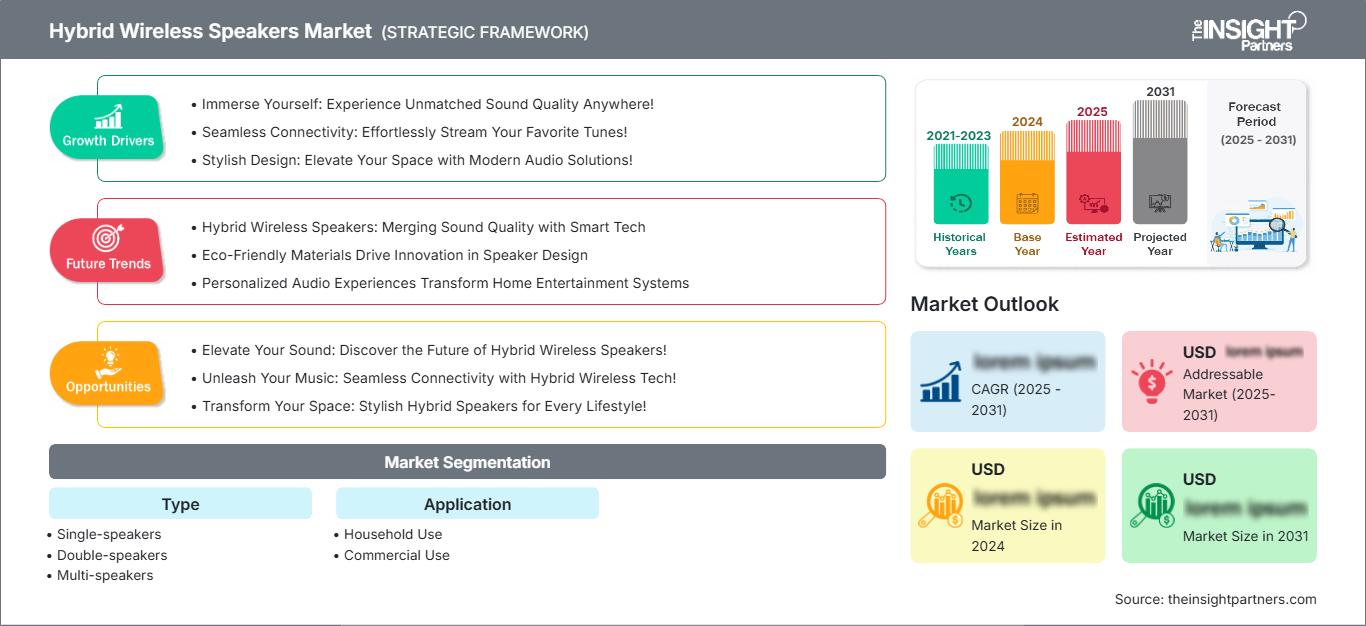
Hybrid Wireless Speakers Market: Strategic Insights
Regional Insights
North America Hybrid Wireless Speakers Market
North America accounted for 31–33% of worldwide revenue in 2025 and is expected to generate a 8.6–9.0% CAGR from 2026 to 2034. Share in Hybrid Wireless Speakers Market Share is influenced by higher penetration of streaming, smart home infrastructure, and frequent replacement of portable speakers and TV audio devices. Customers now desire a product that combines the ability to stream via Bluetooth, Wi-Fi, USB-C, voice, stereo pair, and be battery-powered.
United States is dominant market value-wise, whereas Canada provides superior household segment, and Mexico provides assembly facility and sensitive to pricing volume. Commercial applications include hotels, restaurants, classrooms, office premises, gyms, and small-scale events. Competitors compete based on dependable group functionality, firmware, privacy management and availability of services. Market growth continues despite intense competition owing to introduction of Auracast and cross-platform casting technology making installation easy.
U.S. Hybrid Wireless Speakers Market
United States comprised 82-84% of North American revenue in 2025 and is projected to grow at an 8.7-9.1% CAGR until 2034. The driving factors include mobile entertainment, multi-room home systems, game PCs, patios, and small business sound. Luxury consumers use synchronized soundbars, subwoofers, and loudspeakers, whereas renters purchase small battery-powered devices that need minimum installation.
These companies are found in major distribution channels: HARMAN International Industries, Inc., Bose Corporation, Logitech International S.A., Sony Corporation, and Home Theater Direct, Inc. Usage case studies involve low latency connections, voice commands, application equalization, television integration, and out-of-the-box usage cases. Businesses focus on reliability of the network, mountability, warranties, and centralization management. Retailers are high and hence time-to-market is fast; however, discounts impact profit margins.
Europe Hybrid Wireless Speakers Market
The Europe region had a market share of 26–28%, and it is projected to have an 8.4–8.8% CAGR. Germany is leading through premium household electronics, specialty retail, and smart homes and is growing at an 8.3–8.7% CAGR. The UK is growing at an 8.5–8.9% CAGR due to streaming, smaller homes, hospitality renovation, and voice-controlled audio that drive the need for portable and multiroom devices.
France has an 8.6–9.0% CAGR growth driven by connected home and lifestyle needs, while Italy has an 8.2–8.6% CAGR through design-oriented consumers and hospitality, and Spain has an 8.7–9.1% CAGR growth through tourism and city demands. Cybersecurity, ecodesign, battery, and repair regulations of Europe favor suppliers who can provide software support and energy-efficient products.
APAC Hybrid Wireless Speakers Market
APAC has generated a 28%-30% market share in 2025 and is expected to expand at a CAGR of 10.6%-11.0%. APAC countries have been dominating due to electronics manufacturing, compactness, and domestic consumption. Japanese and South Korean players have an expertise in size, ecosystems, Indian players provide volume momentum, and Australian players enable premium household adoption.
Clusters, increasing incomes, brands, e-commerce, and expanding broadband infrastructure aid in manufacturing and adoption. The commercial adoption is driven by hotel usage, education institutes, retail outlets, and event venues. There is more government interest in battery safety, radio compatibility, and domestic manufacturing in the procurement process, whereas multilingualism and affordable multi-speakers enable more demand.
Middle East & Africa Hybrid Wireless Speakers Market
MEA is forecast to progress at a rate of 7.8–8.2% CAGR until 2034. The UAE excels in premium hospitality, residential automation, and events, while Saudi Arabia invests in tourism and entertainment, making it a good place for projects. South Africa offers the best developed consumer electronics distribution network and replacement market in the region.
Growth in Rest-of-MEA will depend on import costs, broadband penetration, power supply, and availability of services. Both battery and power line solutions are viable under varied infrastructural circumstances. Those distributors who keep inventories, offer language support, and provide replacement parts will be able to leverage project demand into repeat orders.
Segmentation Analysis
Type
Type is projected to expand at a 9.1–9.5% CAGR during 2026–2034. The Hybrid Wireless Speakers Market scope reflects portability, stereo imaging, room coverage, application control, and installation complexity. Single-speakers lead through accessibility, double-speakers improve channel separation, and multi-speakers create the highest-value opportunity through synchronized household zones and managed commercial audio.
- Single-speakers: The largest configuration serves personal listening, kitchens, bedrooms, travel, and compact offices, rewarding affordability, battery endurance, simple pairing, and durable enclosures.
- Double-speakers: Stereo pairs balance spatial performance and setup simplicity, supporting desktops, televisions, small living rooms, gaming stations, and premium portable listening.
- Multi-speakers: Networked systems are strategically important for whole-home audio, hospitality, retail, and venues, where synchronized playback, zoning, centralized control, and scalable installation justify higher spending.
Application
Application is modeled to grow at a 9.2–9.6% CAGR through 2034. Household Use supplies broad unit volume through streaming, smart homes, television enhancement, and outdoor leisure. Commercial Use creates larger system values and recurring service needs, requiring dependable networking, access control, mounting flexibility, remote management, and integration with microphones, displays, or building systems.
- Household Use: Residential demand spans portable listening, desktop use, television enhancement, patios, parties, and multiroom audio, favoring intuitive apps, attractive design, voice control, and flexible power.
- Commercial Use: Hotels, restaurants, retailers, classrooms, offices, gyms, and small venues prioritize zoning, uptime, secure control, consistent coverage, serviceability, and scalable deployment.
Opportunity Snapshot
| Application | Revenue Contribution | Trend Tag | Adoption Stage |
| Household Use | High | Multiroom Living | Mature |
| Commercial Use | Medium | Managed Audio | Scaling |
Hybrid Wireless Speakers Market Growth Drivers and Impact Analysis
Streaming and Smart-Home Convergence Expands Everyday Use
Streaming services have made speakers persistent household endpoints rather than occasional accessories. Consumers expect immediate access from phones, televisions, computers, and voice platforms, creating demand for products that move between Bluetooth convenience and Wi-Fi quality. Hybrid connectivity reduces dependence on one source or ecosystem and extends product usefulness when networks fail or visitors need simple pairing. Market impact appears in higher attachment rates for companion speakers, stereo pairs, and subwoofers. Manufacturers that support major casting approaches, stable applications, and long firmware lifecycles can improve retention. Retailers also benefit from demonstrable ecosystem upgrades, while fragmented standards remain a risk for buyers seeking durable interoperability.
Commercial Spaces Adopt Flexible Managed Audio
Hospitality, retail, education, fitness, and small venues increasingly require audio systems that can be deployed without extensive cabling yet retain dependable wired fallbacks. Hybrid speakers allow operators to stream background music, connect local sources, reconfigure zones, and support temporary events using common hardware. Real-world impact extends beyond equipment sales to design, installation, software, support, and replacement services. Buyers evaluate coverage, latency, network resilience, access permissions, mounts, and centralized volume control. Suppliers that package speakers with management applications and documented integration can move from transactional device sales toward recurring commercial relationships, although cybersecurity and music-licensing responsibilities require clear operating practices.
Battery Efficiency and Compact Acoustics Improve Portability
Advances in amplifier efficiency, battery management, driver materials, passive radiators, and digital signal processing enable smaller speakers to deliver stronger output and longer use. This expands applications from personal travel to patios, classrooms, mobile work, and pop-up commercial events. USB-C charging and power-bank functions further increase utility, while ruggedized enclosures protect investment. Market impact includes faster replacement at entry and midrange price points and greater willingness to own multiple devices for different rooms. Manufacturers must balance bass performance, thermal control, cell longevity, weight, and repairability. Transparent endurance testing and replaceable batteries can become differentiators as regulators and buyers scrutinize lifecycle performance.
Hybrid Wireless Speakers Market Future Trends
Broadcast Audio and Cross-Brand Interoperability
Hybrid Wireless Speakers Market trends will increasingly center on broadcast audio and cross-brand grouping. Auracast and evolving Wi-Fi interoperability can allow one source to reach multiple compatible speakers without conventional pair-by-pair setup. This creates new listening patterns in households, classrooms, gyms, waiting areas, and events, while reducing dependence on proprietary ecosystems. Vendors will compete on discovery speed, synchronization, privacy, and graceful fallback to wired or direct Bluetooth inputs. Adoption will remain uneven while installed devices lack support, but modular radio platforms and software-upgradable products can reduce transition risk. Clear certification and user education will determine whether interoperability becomes dependable infrastructure.
Context-Aware Acoustic Personalization
Future speakers will use microphones, inertial sensors, and device-location signals to adjust equalization, channel balance, and loudness for room geometry, placement, and listening distance. Privacy-preserving on-device processing will become important as buyers resist continuous cloud recording. Adaptive systems can simplify installation and improve sound consistency across portable, desktop, and multiroom products. Commercial deployments may add occupancy-aware zoning and automated volume policies. Success depends on transparent controls, accurate calibration, and low processing latency. Companies that combine acoustic data with intuitive applications can differentiate without relying solely on larger drivers, while poor calibration could erode trust and generate support costs.
Hybrid Wireless Speakers Market Opportunities
Managed Audio Packages for Hospitality and Retail
Suppliers can build commercial packages combining speakers, network gateways, mounts, configuration software, warranties, and partner installation. Hotels, restaurants, retailers, and fitness operators often need repeatable designs across multiple locations but lack specialist audio staff. Standardized room templates, remote diagnostics, role-based access, and replacement inventories can shorten deployment and reduce downtime. Investment should prioritize channel training, cybersecurity, and integration with displays, microphones, and building networks. Subscription-based management can create recurring revenue if pricing remains transparent and offline operation is available. Regional distributors in the Hybrid Wireless Speakers Market Forecast provide an efficient route to fragmented small and midsize customers that global enterprise sales teams may not reach economically.
Localized Value Platforms for Emerging Markets
India, Southeast Asia, Latin America, and parts of Africa offer opportunities for durable speakers optimized around mobile-first listening, intermittent power, multilingual control, and aggressive price points. Manufacturers can reuse core acoustic and radio modules while localizing batteries, chargers, enclosures, packaging, and applications. Distribution partnerships with electronics retailers, digital marketplaces, and telecom operators can broaden reach. Investment should include radio certification, repair networks, spare batteries, and protection against heat, humidity, and dust. Products that combine Bluetooth, memory-card or USB playback, auxiliary input, and charging flexibility can serve customers beyond continuous broadband environments without sacrificing migration toward connected ecosystems.
Recent Developments
- January 2026: TDM introduced Neo, a hybrid audio device at CES 2026 that combines the functionality of wireless headphones and a portable Bluetooth speaker. The concept is designed to give users the flexibility to switch between private listening and shared audio without carrying two separate devices.
- August 2026: Sony has announced the pricing and release date for its PlayStation Pulse Elevate wireless speakers, marking the company’s first wireless speaker system designed specifically for desktop gaming. The speakers will launch on November 12, 2026, with pre-orders opening September 1. The Pulse Elevate will be priced at $219.99 in the US, with regional pricing set at €219.99 in Europe, £199.99 in the UK and ¥37,980 in Japan. The speakers will be offered in Midnight Black and White, although availability of the white version will be limited to selected markets.
- January 2025: Soundcore, Anker’s audio brand, showcased a broad lineup of new products at CES 2026, spanning headphones, earbuds, portable speakers, sleep technology, AI-powered audio and home entertainment. The launches highlight the company’s push toward more versatile and intelligent consumer-audio devices.
Frequently Asked Questions

- Comprehensive Market Sizing and Forecast Analysis
- Detailed Segmentation Analysis
- In-Depth Market Dynamics Assessment
- Regional and Country-Level Insights
- Competitive Landscape and Company Benchmarking
- Strategic Business Intelligence
Recent Reports
Testimonials

The Insight Partners provided valuable market intelligence that supported our global go-to-market strategy. Their team was professional, responsive, and attentive to our feedback, providing thoughtful analysis and helpful methodological clarifications throughout the project.
Junmo Kim Chief Financial Officer (CFO), Enertech Co., Ltd.
The Insight Partners' SCADA System Market report is comprehensive, with valuable insights on current trends and future forecasts. The team was highly professional, responsive, and supportive throughout. We are very satisfied and highly recommend their services.
RAN KEDEM Partner, Reali Technologies LTDs
I requested a report on a very specific software market and the team produced the report in a few days. The information was very relevant and well presented. I then requested some changes and additions to the report. The team was again very responsive and I got the final report in less than a week.
JEAN-HERVE JENN Chairman, Future Analytica
We worked with The Insight Partners for an important market study and forecast. They gave us clear insights into opportunities and risks, which helped shape our plans. Their research was easy to use and based on solid data. It helped us make smart, confident decisions. We highly recommend them.
PIYUSH NAGPAL Sr. Vice President, High Beam Global
The Insight Partners delivered insightful, well-structured market research with strong domain expertise. Their team was professional and responsive throughout. The user-friendly website made accessing industry reports seamless. We highly recommend them for reliable, high-quality research services
YUKIHIKO ADACHI CEO, Deep Blue, LLC.
This is the first time I have purchased a market report from The Insight Partners.While I was unsure at first, I visited their web site and felt more comfortable to take the risk and purchase a market report.I am completely satisfied with the quality of the report and customer service. I had several questions and comments with the initial report, but after a couple of dialogs over email with their analyst I believe I have a report that I can use as input to our strategic planning process.Thank you so much for taking the extra time and making this a positive experience.I will definitely recommend your service to others and you will be my first call when we need further market data.
JOHN SUZUKI President and Chief Executive Officer, Board Director, BK Technologies
I wish to appreciate your support and the professionalism you displayed in the course of attending to my request for information regarding to infectious disease IVD market in Nigeria. I appreciate your patience, your guidance, and the fact that you were willing to offer a discount, which eventually made it possible for us to close a deal. I look forward to engaging The Insight Partners in the future, all thanks to the impression you have created in me as a result of this first encounter.
DR CHIJIOKE ONYIA MANAGING DIRECTOR, PineCrest Healthcare Ltd.Reason to Buy
- Informed Decision-Making
- Understanding Market Dynamics
- Competitive Analysis
- Identifying Emerging Markets
- Customer Insights
- Market Forecasts
- Risk Mitigation
- Boosting Operational Efficiency
- Strategic Planning
- Investment Justification
- Tracking Industry Innovations
- Aligning with Regulatory Trends





 Get Free Sample for