
Hydrocephalus Shunts Market Insights & Outlook 2034
Coverage: By Age Group (Pediatric, Adult); Type (Ventriculo-Peritoneal, Ventriculo-Atrial, Ventriculo-Pleural, Lumbo-Peritoneal); End User (Hospitals, Ambulatory Surgical Centers); and Geography
- Status : Data Released
- Report Code : TIPRE00028558
- Category : Life Sciences
- No. of Pages : 150
- Available Report Formats :


- Last update date : January 23, 2026


2025 Market Size
US$ 329.40 Mn
Base year value
2034 Forecast
US$ 452.02 Mn
Projected by 2034
CAGR 2026-2034
3.58 %
Growth rate
Addressable Market
US$ 3,549.24 Mn
(2026-2034)
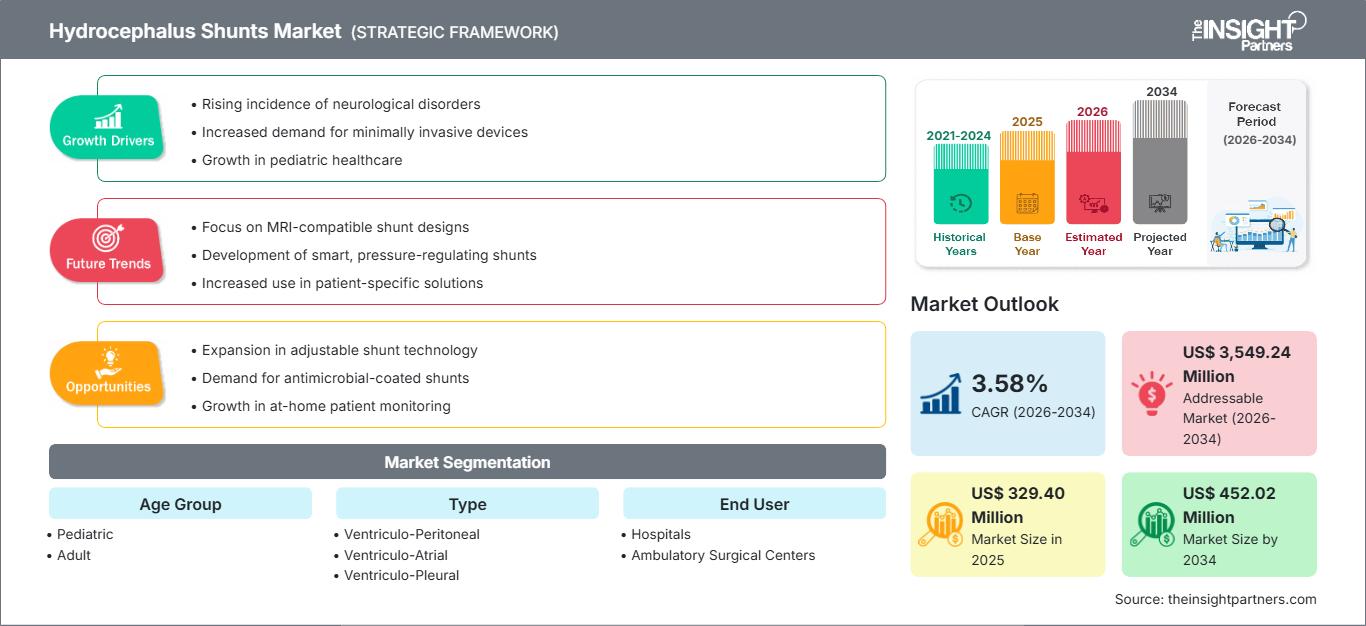
The hydrocephalus shunts market size is expected to reach US$ 452.02 million by 2034 from US$ 329.40 million in 2025. The market is anticipated to register a CAGR of 3.58% during 2026–2034.
Hydrocephalus Shunts Market Analysis
The Hydrocephalus Shunts market is experiencing significant growth, primarily driven by the increasing global prevalence of hydrocephalus, especially in the pediatric and geriatric populations. As shunt-based interventions account for a large percentage of hydrocephalus treatments, demand for implantable cerebrospinal fluid (CSF) drainage systems remains high. Technological advancements, particularly the introduction and growing adoption of programmable valves and anti-siphon devices, are improving patient outcomes by reducing complications like infection, over-drainage, and the need for frequent revision surgeries. However, the market faces challenges from the high cost of devices and the risk of shunt complications, which require specialized medical care.
Hydrocephalus Shunts Market Overview
A hydrocephalus shunt is a medical device implanted surgically to drain excess cerebrospinal fluid (CSF) from the brain's ventricles to another part of the body, such as the abdominal cavity (ventriculoperitoneal shunt), where it can be absorbed. This helps relieve intracranial pressure caused by hydrocephalus. The shunt system consists primarily of two or more catheters and a valve that regulates the flow and pressure of the CSF. Technological advances have led to the widespread adoption of programmable and adjustable valves, which allow non-invasive pressure setting adjustments post-surgery, greatly enhancing treatment flexibility and efficacy.
Market Assessment and Insights
- Global market for Hydrocephalus Shunts was valued at US$ 329.40 Million in 2025
- Annual market size is expected to reach US$ 452.02 Million by 2034
- Total addressable market (TAM) during 2026-2034 is projected to reach approximately US$ 3,549.24 Million
- Market is anticipated to register a CAGR of 3.58% during the forecast period
- The United States represents a key market, supported by Rising incidence of neurological disorders, Increased demand for minimally invasive devices, Growth in pediatric healthcare, as well as evolving industry dynamics
- Market analysis covers North America, Europe, Asia-Pacific, South and Central America, Middle East and Africa, with growth evaluated across the forecast period
- Market opportunities such as Expansion in adjustable shunt technology, Demand for antimicrobial-coated shunts, Growth in at-home patient monitoring are expected to influence market dynamics and addressable market
- Report profiles industry participants, including B. Braun Melsungen AG (CHRISTOPH MIETHKE GMBH & CO. KG), Sophysa, HpBio Pr?teses, Inc., Integra LifeSciences Holdings Corporation, KANEKA MEDIX CORP., Medtronic, Natus Medical Incorporated, Spiegelberg GmbH & Co. KG, Desu Medical, while analyzing competitive strategies and innovation developments
-
Source: The Insight Partners' analysis based on proprietary research, government publications, company annual reports, investor presentations, industry databases, and expert interviews.
● REPORT CUSTOMIZATION
Tailor This Report To Align With Your Specific Business Requirements
This report can be customized to align precisely with your business objectives, scope, and target markets. Customization options include tailored segmentation, geography, competitive analysis, and strategic insights to support informed decision-making.
Customize This Report →WHAT YOU CAN ADJUST
- ● Segmentations
- ● Geography
- ● Competitive Analysis
- ● Language Preferences
Hydrocephalus Shunts Market: Strategic Insights
-
Get Top Key Market Trends of this report.This FREE sample will include data analysis, ranging from market trends to estimates and forecasts.
Hydrocephalus Shunts Market Drivers and Opportunities
Market Drivers:
- Growing Number of Hydrocephalus Cases: The increased incidence of congenital hydrocephalus in newborn babies, approximating 1 in every 500 live births, plus the rise in the incidence of hydrocephalus in the rapidly expanding geriatric population, mainly due to pathologies such as dementia, stroke, and hemorrhage, are factors that directly fuel the demand for shunt devices.
- Technological Advancements in Shunt Systems: Innovations such as programmable valves and anti-siphon devices help improve treatment efficacy while reducing the rates of complications and revisions, which motivates higher adoption.
- Advancements in Healthcare Infrastructure and Awareness: Advancing diagnostic capabilities, increasing awareness of neurological disorders, and better access to centers with neurosurgical specialists in emerging economies result in earlier diagnosis and timely surgical intervention, which, in turn, fuels the demand for shunts.
Market Opportunities:
- Minimally Invasive Techniques and Product Innovation: The development of less invasive techniques for implanting shunts has the potential to minimize patient discomfort, reduce recovery time, and diminish complications, thereby providing an advantage over competitors. Emphasis on improved shunt materials regarding biocompatibility and functionality is a continuous opportunity.
- Rising Demand in Emerging Markets: Countries in the Asia Pacific region (like India and China) and parts of the Middle East and Africa represent significant opportunities due to increasing healthcare spending, growing elderly populations, and government initiatives to enhance medical facilities and awareness.
- Integration of Monitoring Technologies: The development and integration of non-invasive sensors and telehealth systems for remote shunt monitoring (e.g., to detect shunt malfunction or infection early) can improve post-operative care, reduce hospital visits, and drive demand for advanced systems.
Hydrocephalus Shunts Market Report Segmentation Analysis
The hydrocephalus shunts market share is analyzed across various segments to provide a clearer understanding of its structure, growth potential, and emerging trends. Below is the standard segmentation approach used in most industry reports:
By Age Group:
- Pediatric
- Adult
By Type:
- Ventriculo-Peritoneal
- Ventriculo-Atrial
- Ventriculo-Pleural
- Lumbo-Peritoneal
By End User:
- Hospitals
- Ambulatory Surgical Centers
By Geography:
- North America
- Europe
- Asia-Pacific
- South & Central America
- Middle East & Africa
Hydrocephalus Shunts Market Report Scope
| Report Attribute | Details |
|---|---|
| Market size in 2025 | US$ 329.40 Million |
| Market Size by 2034 | US$ 452.02 Million |
| Global CAGR (2026 - 2034) | 3.58% |
| Historical Data | 2021-2024 |
| Forecast period | 2026-2034 |
| Segments Covered |
By Age Group
|
| Regions and Countries Covered |
North America
|
| Market leaders and key company profiles |
|
Hydrocephalus Shunts Market Players Density: Understanding Its Impact on Business Dynamics
The Hydrocephalus Shunts Market is growing rapidly, driven by increasing end-user demand due to factors such as evolving consumer preferences, technological advancements, and greater awareness of the product's benefits. As demand rises, businesses are expanding their offerings, innovating to meet consumer needs, and capitalizing on emerging trends, which further fuels market growth.
Hydrocephalus Shunts Market Share Analysis by Geography
North America dominated the Hydrocephalus Shunts market and holds the highest revenue share. The region's dominance is attributed to factors such as advanced healthcare infrastructure, high adoption of cutting-edge technologies (like programmable shunts), favorable reimbursement policies, and a large concentration of leading market players. The rising prevalence of hydrocephalus, coupled with a focus on neurological illness treatment, further strengthens this dominance.
The Hydrocephalus Shunts market shows a different growth trajectory in each region:
North America
- Market Share: Holds the largest market share, driven by the robust presence of advanced neurosurgical centers, favorable reimbursement scenarios, and high R&D investment.
- Key Drivers:
- High adoption of technologically advanced shunts (programmable, anti-siphon).
- Well-developed healthcare infrastructure and specialized neurosurgical expertise.
- Increasing prevalence of hydrocephalus in both pediatric and geriatric populations.
- Trends: Focus on reducing shunt revision rates through advanced device innovation and non-invasive monitoring.
Europe
- Market Share: Expected to register significant revenue growth, driven by medical innovation and technological advancements in shunt technology.
- Key Drivers:
- Emphasis on medical research and technological advancements in neurology.
- Rising aging population increasing the incidence of Normal Pressure Hydrocephalus (NPH).
- Strong public and private healthcare systems providing good access to treatment.
- Trends: Growth in demand for precision-adjustable valve systems.
Asia Pacific
- Market Share: Anticipated to be the fastest-growing regional market, driven by improving healthcare infrastructure and growing awareness.
- Key Drivers:
- Increasing birth rates and rising elderly populations contribute to the patient pool.
- Growing healthcare investments and improving access to diagnostic and treatment services.
- Government-backed programs to enhance healthcare facilities in developing economies (e.g., China, India).
- Trends: Higher adoption of advanced shunts due to rising patient awareness and increasing disposable income.
South and Central America
- Market Share: An emerging region with growing adoption driven by the modernization of digital infrastructure and increasing access to global medical technology.
- Key Drivers:
- Gradual improvement and expansion of healthcare facilities.
- Increasing governmental and private investment in healthcare.
- Trends: Focus on affordable, effective shunt solutions.
Middle East and Africa
- Market Share: Emerging market with strong growth potential, led by digital transformation and healthcare initiatives in countries like the UAE and Saudi Arabia.
- Key Drivers:
- Major national digital and healthcare strategies fostering innovation.
- Increasing focus on addressing unmet medical demands for neurological disorders.
- Trends: Investment in specialized medical centers and better diagnostic tools.
Hydrocephalus Shunts Market Players Density: Understanding Its Impact on Business Dynamics
The Hydrocephalus Shunts market is moderately concentrated, with top players. It is characterized by intense competition driven by technological innovation and a focus on improving patient outcomes. Major global medical technology providers compete alongside specialized companies.
The competitive landscape is driving vendors to differentiate through:
- Companies are heavily focused on developing advanced valves, such as programmable shunts (to minimize revision surgeries) and anti-siphon mechanisms (to prevent over-drainage complications).
- Increased focus on developing shunts with antimicrobial coatings to mitigate the high risk of shunt infection, which is a major complication.
- Vendors are leveraging mergers, acquisitions, and strategic partnerships to strengthen their R&D capabilities, expand their geographic reach, and integrate advanced technologies (like neuronavigation systems) into their offerings.
Opportunities and Strategic Moves
- Developing shunts tailored to the unique physiological and anatomical needs of infants/children and specialized shunts for Normal Pressure Hydrocephalus (NPH) in adults.
- Large players are expanding their distribution networks, particularly into high-growth emerging economies in Asia-Pacific and Latin America, to address the increasing patient burden.
- Collaborating with technology companies to integrate non-invasive monitoring devices for real-time shunt performance tracking.
Major Companies Operating in the Hydrocephalus Shunts Market Are:
- B. Braun Melsungen AG (CHRISTOPH MIETHKE GMBH & CO. KG)
- Sophysa
- HpBio Próteses, Inc.
- Integra LifeSciences Holdings Corporation
- KANEKA MEDIX CORP.
- Medtronic
- Natus Medical Incorporated
- Spiegelberg GmbH & Co. KG
- Desu Medical
Disclaimer: The companies listed above are not ranked in any particular order.
Hydrocephalus Shunts Market Report Coverage and Deliverables
The "Hydrocephalus Shunts Market Size and Forecast (2021–2034)" report provides a detailed analysis of the market covering below areas:
- Hydrocephalus Shunts Market size and forecast at global, regional, and country levels for all the key market segments covered under the scope
- Hydrocephalus Shunts Market trends, as well as market dynamics such as drivers, restraints, and key opportunities
- Detailed PEST and SWOT analysis
- Hydrocephalus Shunts Market analysis covering key market trends, global and regional framework, major players, regulations, and recent market developments
- Industry landscape and competition analysis covering market concentration, heat map analysis, prominent players, and recent developments in the Hydrocephalus Shunts Market. Detailed company profiles.
Frequently Asked Questions

- Comprehensive Market Sizing and Forecast Analysis
- Detailed Segmentation Analysis
- In-Depth Market Dynamics Assessment
- Regional and Country-Level Insights
- Competitive Landscape and Company Benchmarking
- Strategic Business Intelligence
Recent Reports
Testimonials

The Insight Partners' SCADA System Market report is comprehensive, with valuable insights on current trends and future forecasts. The team was highly professional, responsive, and supportive throughout. We are very satisfied and highly recommend their services.
RAN KEDEM Partner, Reali Technologies LTDs
I requested a report on a very specific software market and the team produced the report in a few days. The information was very relevant and well presented. I then requested some changes and additions to the report. The team was again very responsive and I got the final report in less than a week.
JEAN-HERVE JENN Chairman, Future Analytica
We worked with The Insight Partners for an important market study and forecast. They gave us clear insights into opportunities and risks, which helped shape our plans. Their research was easy to use and based on solid data. It helped us make smart, confident decisions. We highly recommend them.
PIYUSH NAGPAL Sr. Vice President, High Beam Global
The Insight Partners delivered insightful, well-structured market research with strong domain expertise. Their team was professional and responsive throughout. The user-friendly website made accessing industry reports seamless. We highly recommend them for reliable, high-quality research services
YUKIHIKO ADACHI CEO, Deep Blue, LLC.
This is the first time I have purchased a market report from The Insight Partners.While I was unsure at first, I visited their web site and felt more comfortable to take the risk and purchase a market report.I am completely satisfied with the quality of the report and customer service. I had several questions and comments with the initial report, but after a couple of dialogs over email with their analyst I believe I have a report that I can use as input to our strategic planning process.Thank you so much for taking the extra time and making this a positive experience.I will definitely recommend your service to others and you will be my first call when we need further market data.
JOHN SUZUKI President and Chief Executive Officer, Board Director, BK Technologies
I wish to appreciate your support and the professionalism you displayed in the course of attending to my request for information regarding to infectious disease IVD market in Nigeria. I appreciate your patience, your guidance, and the fact that you were willing to offer a discount, which eventually made it possible for us to close a deal. I look forward to engaging The Insight Partners in the future, all thanks to the impression you have created in me as a result of this first encounter.
DR CHIJIOKE ONYIA MANAGING DIRECTOR, PineCrest Healthcare Ltd.Reason to Buy
- Informed Decision-Making
- Understanding Market Dynamics
- Competitive Analysis
- Identifying Emerging Markets
- Customer Insights
- Market Forecasts
- Risk Mitigation
- Boosting Operational Efficiency
- Strategic Planning
- Investment Justification
- Tracking Industry Innovations
- Aligning with Regulatory Trends





 Get Free Sample for