
Hydrophilic Coatings Market Size, Share & Trends by 2034
Coverage: By Substrate (Polymers, Glass/Ceramics, Metals, Others); Application (Medical Devices, Automotive, Aerospace, Others) , and Geography (North America, Europe, Asia Pacific, and South and Central America)
- Status : Data Released
- Report Code : TIPRE00022548
- Category : Chemicals and Materials
- No. of Pages : 150
- Available Report Formats :


- Last update date : September 02, 2026


2025 Market Size
US$ 19.60 Bn
Base year value
2034 Forecast
US$ 28.63 Bn
Projected by 2034
CAGR 2026-2034
4.30 %
Growth rate
Addressable Market
US$ 219.02 Bn
(2026-2034)
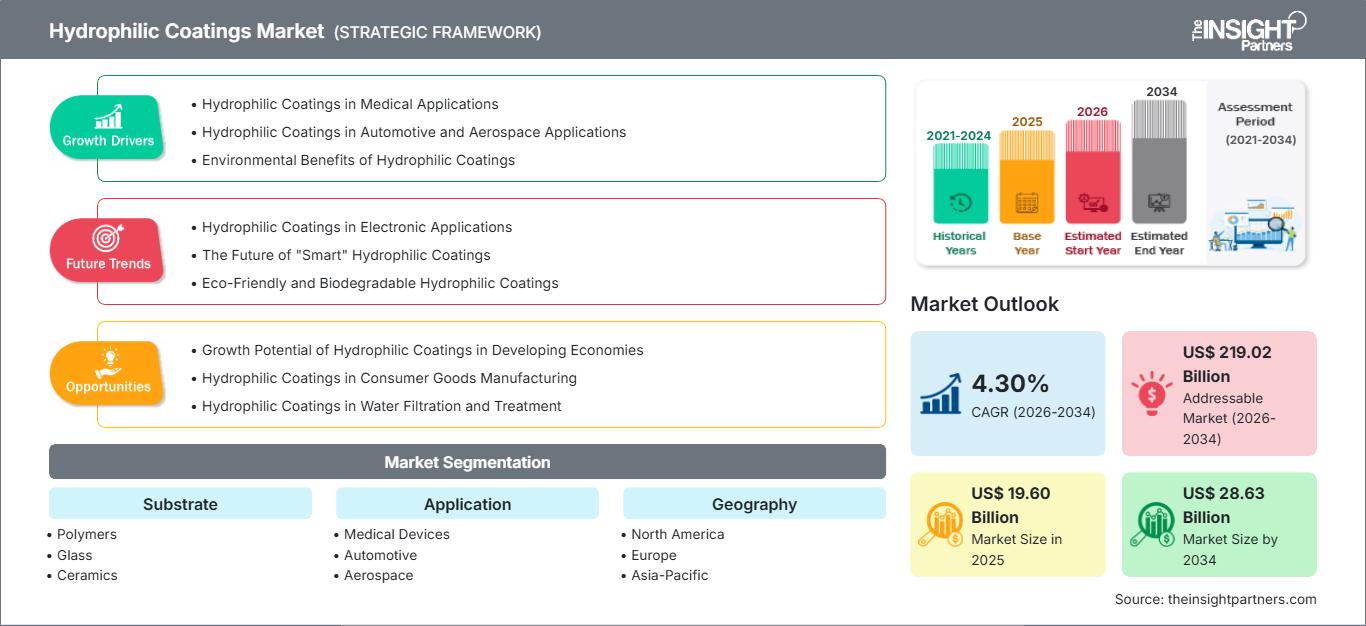
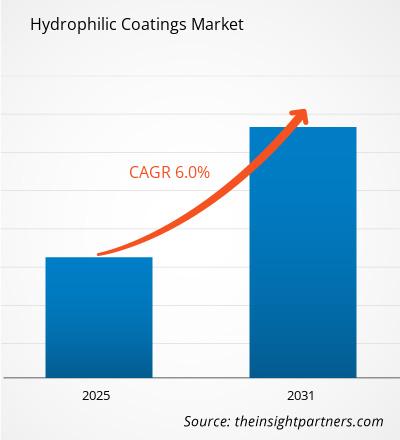
The hydrophilic coatings market was valued at US$ 19.60 Billion in 2025 and is projected to reach US$ 28.63 Billion by 2034, expanding at a CAGR of 4.30% during 2026–2034. Market expansion is supported by the increasing use of surface-engineered materials that improve wettability, lubricity, biocompatibility, and fluid interaction across medical devices and selected industrial applications.
North America remains an important innovation and commercialization center, supported by its advanced medical technology ecosystem and concentration of specialized surface-engineering companies. The hydrophilic coatings market size in the region is expected to expand at an estimated CAGR of 4.0–4.5% during 2026–2034, supported by minimally invasive procedures, device miniaturization, and continued investment in high-performance polymer and biomaterial technologies.
Hydrophilic Coatings Market Assessment and Insights
- North America: North America accounted for an estimated 32–36% hydrophilic coatings market share in 2025 and is projected to grow at a CAGR of 4.0–4.5% during 2026–2034. Strong medical device manufacturing capabilities, established regulatory infrastructure, and demand for advanced lubricious surfaces support regional technology adoption.
- U.S.: The U.S. represented approximately 78–82% of North American demand in 2025 and is expected to grow at a CAGR of 4.0–4.5% during 2026–2034, supported by specialized coating developers and advanced interventional device manufacturing.
- Europe: Europe held an estimated 24–28% share in 2025 and is anticipated to expand at a CAGR of 3.8–4.3% during 2026–2034. Germany, the UK, France, Italy, and Spain remain important markets due to their healthcare manufacturing and engineering capabilities.
- Asia Pacific: Asia Pacific accounted for approximately 28–32% of demand in 2025 and is projected to grow at a CAGR of 4.8–5.4% during 2026–2034. China, Japan, South Korea, India, and Australia benefit from expanding healthcare infrastructure and manufacturing investment.
- Largest Segment: Polymers represented an estimated 45–50% market share in 2025 and are expected to expand at a CAGR of 4.5–5.0% during 2026–2034, reflecting their extensive use in flexible and minimally invasive devices.
- High Growth Segment: Medical Devices accounted for approximately 40–45% market share in 2025 and are anticipated to grow at a CAGR of 5.0–5.6% during 2026–2034, supported by procedural innovation and device performance requirements.
- Key companies analyzed in detail: Hydromer, Inc.; Surmodics, Inc.; Biocoat Incorporated; Covalon Technologies Ltd.; Harland Medical Systems, Inc.; AdvanSource Biomaterials Corporation; DONTECH, Inc.; Henkel AG & Co. KGaA; Henniker Scientific Limited; and Freudenberg Medical, LLC.
Source: The Insight Partners' analysis based on proprietary research, government publications, company annual reports, investor presentations, industry databases, and expert interviews.
Surface modification has shifted from an essentially application-specific process to an ever more integral part of product design and manufacturing. The hydrophilic coatings market is experiencing positive impacts arising from advancements in UV curable, thermal curable, plasma-assisted, and multifunctional surface coating technologies. Manufacturers are increasingly concerned about coating quality with respect to uniformity, adhesion, wear resistance, and particle contamination, especially on parts having complex geometries. Suppliers are increasingly developing process development and contract coating capabilities so that original equipment manufacturers can leverage their validated surface coating technologies without developing their own internal coating capacity.
Future trends include opportunities in emerging manufacturing sites in Asia Pacific and selected European regions. Increasing regulatory emphasis on biocompatibility, process validation, and material consistency is also leading to more reproducible coating platforms being developed by suppliers. Increased investments are being made in multifunctional surfaces that incorporate both hydrophilicity and additional attributes, such as antimicrobial, hemocompatible, or controlled interaction.
Hydrophilic Coatings Market Report Scope
| Report Attribute | Details |
|---|---|
| Market size in 2025 | US$ 19.60 Billion |
| Market Size by 2034 | US$ 28.63 Billion |
| Global CAGR (2026 - 2034) | 4.30% |
| Historical Data | 2021-2024 |
| Forecast period | 2026-2034 |
Hydrophilic Coatings Market Analysis
According to the hydrophilic coatings market report, demand is largely driven by applications where surface contact with water or biofluids significantly impacts product functionality. Projections for the market growth of hydrophilic coatings are heavily driven by medical devices that need reduced friction, enhanced navigability, and controlled tissue contact. Hydrophilic technology can greatly enhance the functionalities of both the metal and polymer components that are used in catheters and guidewires. Hydromer is an example of a company that has developed coating technologies that are applicable to a wide variety of polymeric and metallic substrates used in interventional and minimally invasive devices.
The value chain consists of specialty polymer and chemical formulation, formulation, substrate preparation, coating process, cure, test and validation. Consequently, supply dynamics will favor firms that have the technical capability rather than those who compete purely on volumes of the coating. The growing demands for customer-specific coatings that need to meet adhesion, lubricity, sterilization and durability properties at the same time have further increased the importance of collaborations.
Competitive positioning results from proprietary technology, experience with regulation, production capacity, and customer support throughout feasibility and commercialization. Hydrophilic coatings market analysis demonstrates that the specialized coating providers have significant roles to play along with diversified material providers since many uses need substrate-specific solutions. SurModics, Inc. provides both hydrophilic coatings technology and other medical device coatings, along with contract manufacturing and analytical services, representing the evolution towards offering integrated technical services in this industry.
Hydromer, Inc., Biocoat Incorporated, Covalon Technologies Ltd., and Harland Medical Systems, Inc. compete through their specialized surface technologies and relationships with customers, while Henkel AG & Co. KGaA adds expertise in the field of functional materials and medical manufacturing technologies. AdvanSource Biomaterials Corporation, DONTECH, Inc., and Henniker Scientific Limited add value through their offerings in the fields of biomaterials, optical and specialty surfaces, and plasma surface technologies. Strategic investments are now being made in processes and functions rather than capacity.
● REPORT CUSTOMIZATION
Tailor This Report To Align With Your Specific Business Requirements
This report can be customized to align precisely with your business objectives, scope, and target markets. Customization options include tailored segmentation, geography, competitive analysis, and strategic insights to support informed decision-making.
Customize This Report →WHAT YOU CAN ADJUST
- ● Segmentations
- ● Geography
- ● Competitive Analysis
- ● Language Preferences
Hydrophilic Coatings Market: Strategic Insights
Regional Insights
North America hydrophilic coatings market
North America accounted for an estimated 32–36% share in 2025 and is projected to expand at a CAGR of 4.0–4.5% during 2026–2034. The region enjoys the advantage of having existing medical technology clusters, a significant amount of research infrastructure, and coating companies that have specialized expertise. The demand is especially high in critical applications, where the coating needs to exhibit certain lubricity, wettability, and biocompatibility characteristics.
The regional expansion is also aided by the trend of outsourcing specialized activities in development and production. The coating service providers help in minimizing the capital expenditure of the device manufacturers by providing them with process development, validated manufacturing, and analysis services.
U.S. hydrophilic coatings market
The U.S. represented approximately 78–82% of North American demand in 2025 and is expected to grow at a CAGR of 4.0–4.5% during 2026–2034. The composition of its management speaks to the strength in medical devices manufacture and the presence of experts in coating technology. There is growing preference for coatings that are suited to intricate designs of catheters, guidewires, and delivery systems.
There is a trend towards the development of coatings that can endure even the most intricate processes. Hydromer and Surmodics have strong capabilities in hydrophilic medical devices technologies. Other vendors add expertise in different coatings and processing. The number of original equipment manufacturers and development partners aids in quick feedback between the coating formulation and device design.
Europe hydrophilic coatings market
Europe held an estimated 24–28% share in 2025 and is projected to register a CAGR of 3.8–4.3% during 2026–2034. The area blends medical manufacturing experience with materials knowledge, which necessitates technically differentiated surface treatments. The need for efficiency and sustainability is driving material selection and manufacturing processes toward better solutions by suppliers.
The UK continues to be relevant for the study of biomaterials and surface engineering that requires specific control of interaction between biological substances and liquids. Germany stands out as a European manufacturer due to wide engineering know-how and the medical equipment industry along with well-developed chemical supply chain. France, Italy, and Spain offer complementary opportunities with healthcare manufacturing, innovation, and increasing demand for advanced medical equipment.
Within Europe, manufacturers continue to consider surface technologies from the perspective of an integrated approach to the overall performance of their products, not the final production stage. This creates a growing need for technical cooperation at the early development stage and proven application process. Germany will continue to be among leaders in terms of country market, while the rest of the European countries create a varied customer base for medical, optical, transport, and specialized industrial uses.
APAC hydrophilic coatings market
Asia Pacific accounted for approximately 28–32% share in 2025 and is expected to grow at a CAGR of 4.8–5.4% during 2026–2034. China spearheads the growth in manufacturing within the region, Japan and South Korea provide expertise in materials development. India provides an emerging platform for medical manufacturing, and Australia provides innovations in healthcare solutions.
Government backing for local manufacturing, along with investments into healthcare infrastructure, is driving demand in the region. Companies are now looking for coating technology that can be scalable and replicated irrespective of production location. China is set to continue to be the largest market in the region, and India is an expansion opportunity.
Middle East & Africa hydrophilic coatings market
The Middle East & Africa is expected to grow at a CAGR of 3.5–4.2% during 2026–2034, supported by healthcare investment and infrastructure development. Saudi Arabia and the UAE are strengthening advanced healthcare capabilities, while South Africa remains an important industrial and medical technology market.
Energy and infrastructure investment also supports specialized industrial surface applications across the region. However, demand remains comparatively fragmented, creating opportunities for technology suppliers using distributor partnerships and project-based customer engagement. Saudi Arabia is expected to remain a leading regional growth market as healthcare and industrial diversification programs continue.
Segmentation Analysis
Substrate
The substrate segment is projected to expand at a CAGR of 4.3–4.8% during 2026–2034. Substrate compatibility is fundamental because hydrophilic performance depends on achieving reliable adhesion without compromising the mechanical, optical, or functional properties of the underlying material. The hydrophilic coatings market scope is therefore broadened by formulation advances that enable application across flexible polymers, rigid materials, and increasingly complex component geometries.
- Polymers: Polymer substrates occupy a central market position because of their widespread use in flexible devices and components. Demand emphasizes coating adhesion, flexibility, low friction, and durability during sterilization and repeated mechanical movement.
- Glass: Glass-based applications require controlled wettability without sacrificing optical performance. Demand is concentrated in specialized medical, diagnostic, and optical applications where surface clarity and consistent fluid interaction are strategically important.
- Ceramics: Ceramic substrates represent a smaller but technically important category. Their use in specialized medical and industrial components creates demand for surface treatments capable of improving fluid interaction while maintaining hardness and chemical resistance.
- Metals: Metallic substrates are important in guidewires, needles, instruments, and engineered components. Hydrophilic treatments can reduce friction and improve handling while requiring strong adhesion under mechanical stress and demanding processing conditions.
Application
The application segment is expected to expand at a CAGR of 4.5–5.1% during 2026–2034. Adoption patterns vary according to performance requirements, but medical applications remain strategically important because surface lubricity and biological interaction can directly influence procedural outcomes. Increasing product sophistication is also encouraging developers to integrate surface functionality earlier in the design process rather than treating coatings solely as a downstream manufacturing activity.
- Medical Devices: Medical devices remain the most strategically significant application, driven by minimally invasive procedures and demand for improved device navigation. Coatings increasingly combine lubricity with durability and compatibility with demanding sterilization and regulatory requirements.
- Automotive: Automotive applications use specialized surface technologies where moisture interaction, reduced friction, visibility, or component performance can be improved. Adoption depends on cost-effective processing and compatibility with high-volume manufacturing requirements.
- Aerospace: Aerospace demand is comparatively specialized and emphasizes reliability, environmental resistance, and controlled surface behavior. Qualification requirements can create long development cycles but also support technically differentiated, high-value applications.
- Marine: Marine applications offer opportunities where surface interaction with water and environmental exposure influence equipment performance. Adoption remains selective, with requirements varying according to component material, operating conditions, and maintenance practices.
Opportunity Snapshot
| Application | Revenue Contribution | Trend Tag | Adoption Stage |
|---|---|---|---|
| Medical Devices | High | Minimally Invasive | Mature |
| Automotive | Medium | Functional Surfaces | Scaling |
| Aerospace | Medium | Lightweight Systems | Scaling |
| Marine | Low | Water Interaction | Emerging |
Hydrophilic Coatings Market Growth Drivers and Impact Analysis
Expansion of Minimally Invasive Medical Procedures
Minimally invasive procedures continue to increase the technical requirements placed on catheters, guidewires, introducers, and delivery systems. Hydrophilic surfaces can lower friction and improve device movement through complex anatomical pathways, making surface engineering increasingly relevant to product performance. Manufacturers are consequently investing in coatings that maintain lubricity while minimizing particulate release and preserving adhesion under bending, sterilization, and repeated use. Hydromer reports applications spanning cardiovascular, neurovascular, peripheral, and other interventional devices, demonstrating the breadth of clinical demand for lubricious surfaces. As device geometries become more complex, coating suppliers capable of supporting formulation, application, and scale-up are positioned to capture additional value.
Growing Need for Multifunctional Surface Performance
Demand is shifting from single-property coatings toward surfaces that deliver multiple performance characteristics within one engineered layer or coating system. Medical manufacturers increasingly evaluate hydrophilicity alongside hemocompatibility, antimicrobial performance, controlled drug delivery, or reduced protein interaction. This convergence creates opportunities for suppliers with deep polymer chemistry and application expertise, while increasing technical barriers for undifferentiated producers. Surmodics highlights integrated approaches that combine hydrophilic and hemocompatible technologies for demanding device applications. The ability to tailor surface functionality to a specific clinical or industrial requirement can improve product differentiation and support longer-term customer relationships.
Outsourcing of Specialized Coating Development and Manufacturing
Many original equipment manufacturers prefer external specialists for technically demanding coating processes because in-house capability requires investment in equipment, validation, quality systems, and scientific expertise. Contract coating models allow customers to access established manufacturing infrastructure while concentrating internal resources on device design and commercialization. This structural shift benefits suppliers offering integrated development, analytical testing, process validation, and commercial-scale application services. It also supports more efficient technology transfer as device manufacturers expand internationally. As regulatory expectations rise, access to experienced coating partners can reduce development risk and improve consistency across production locations.
Hydrophilic Coatings Market Future Trends
Multifunctional and Durable Coating Platforms
One of the most significant hydrophilic coatings market trends will be the development of multifunctional platforms designed to address several surface-performance requirements simultaneously. Future products are likely to combine lubricity with hemocompatibility, antimicrobial activity, drug delivery, or enhanced durability. This direction reflects the increasing complexity of advanced devices and the desire to reduce the number of separate processing steps. Suppliers will need stronger capabilities in polymer design, interface engineering, and validation. Commercial success will depend not only on laboratory performance but also on reproducible manufacturing, compatibility with different substrates, and the ability to maintain functionality throughout sterilization, storage, and real-world use.
Greater Adoption of Faster and More Flexible Curing Technologies
Manufacturing efficiency will increasingly influence technology selection as customers seek shorter processing cycles and greater compatibility with complex device geometries. UV-curable systems offer rapid processing advantages, while thermal technologies remain important for applications requiring deep or uniform coverage in intricate structures. Future innovation is likely to focus on balancing throughput with coating integrity and substrate compatibility. Advanced curing platforms may also support more localized and precise application, reducing material consumption and process variability. As manufacturers diversify production footprints, standardized and transferable coating processes will become increasingly valuable for maintaining equivalent product performance across multiple facilities.
Hydrophilic Coatings Market Opportunities
Expansion into Emerging Medical Manufacturing Hubs
The hydrophilic coatings market Forecasts point to opportunities for suppliers that establish technical and manufacturing partnerships in emerging medical device production centers. Asia Pacific offers particular potential because device manufacturing capacity is expanding alongside healthcare investment and local innovation. Rather than relying exclusively on product exports, coating companies can pursue licensing, contract manufacturing, application laboratories, and regional technical support models. Local capability can shorten development cycles and improve customer responsiveness while supporting technology transfer under controlled quality systems. Investors should prioritize locations with growing device clusters, established regulatory pathways, and access to skilled engineering talent, as these factors improve the prospects for sustainable regional commercialization.
Development of Coatings for Complex and Internal Geometries
Complex internal surfaces represent an important technology opportunity because consistent coating of narrow lumens and intricate structures remains technically challenging. New formulations and application processes that provide reliable inner-diameter coverage can address a growing need as devices become smaller and more sophisticated. Hydromer has highlighted the technical challenges associated with coating internal medical-device surfaces and the importance of specialized approaches for complex geometries. Companies investing in equipment, formulation design, and process monitoring for these applications can build differentiated positions. Commercial opportunities extend beyond coating chemistry to process development and validation services that help customers transition complex products from prototype stages to commercial manufacturing.
Recent Developments
- June 2026: Hydromer published a technical resource examining the role of hydrophilic coatings in addressing surface limitations associated with polymer medical-device substrates.
- February 2026: Freudenberg Medical, LLC launched LUBRITEQ, a UV-curable, single-step hydrophilic coating solution designed for medical devices. The development focuses on improving lubricity, durability, and manufacturability while supporting customers across the product lifecycle, from feasibility and development through commercial production.
Frequently Asked Questions

- Comprehensive Market Sizing and Forecast Analysis
- Detailed Segmentation Analysis
- In-Depth Market Dynamics Assessment
- Regional and Country-Level Insights
- Competitive Landscape and Company Benchmarking
- Strategic Business Intelligence
Recent Reports
Testimonials

The Insight Partners' SCADA System Market report is comprehensive, with valuable insights on current trends and future forecasts. The team was highly professional, responsive, and supportive throughout. We are very satisfied and highly recommend their services.
RAN KEDEM Partner, Reali Technologies LTDs
I requested a report on a very specific software market and the team produced the report in a few days. The information was very relevant and well presented. I then requested some changes and additions to the report. The team was again very responsive and I got the final report in less than a week.
JEAN-HERVE JENN Chairman, Future Analytica
We worked with The Insight Partners for an important market study and forecast. They gave us clear insights into opportunities and risks, which helped shape our plans. Their research was easy to use and based on solid data. It helped us make smart, confident decisions. We highly recommend them.
PIYUSH NAGPAL Sr. Vice President, High Beam Global
The Insight Partners delivered insightful, well-structured market research with strong domain expertise. Their team was professional and responsive throughout. The user-friendly website made accessing industry reports seamless. We highly recommend them for reliable, high-quality research services
YUKIHIKO ADACHI CEO, Deep Blue, LLC.
This is the first time I have purchased a market report from The Insight Partners.While I was unsure at first, I visited their web site and felt more comfortable to take the risk and purchase a market report.I am completely satisfied with the quality of the report and customer service. I had several questions and comments with the initial report, but after a couple of dialogs over email with their analyst I believe I have a report that I can use as input to our strategic planning process.Thank you so much for taking the extra time and making this a positive experience.I will definitely recommend your service to others and you will be my first call when we need further market data.
JOHN SUZUKI President and Chief Executive Officer, Board Director, BK Technologies
I wish to appreciate your support and the professionalism you displayed in the course of attending to my request for information regarding to infectious disease IVD market in Nigeria. I appreciate your patience, your guidance, and the fact that you were willing to offer a discount, which eventually made it possible for us to close a deal. I look forward to engaging The Insight Partners in the future, all thanks to the impression you have created in me as a result of this first encounter.
DR CHIJIOKE ONYIA MANAGING DIRECTOR, PineCrest Healthcare Ltd.Reason to Buy
- Informed Decision-Making
- Understanding Market Dynamics
- Competitive Analysis
- Identifying Emerging Markets
- Customer Insights
- Market Forecasts
- Risk Mitigation
- Boosting Operational Efficiency
- Strategic Planning
- Investment Justification
- Tracking Industry Innovations
- Aligning with Regulatory Trends





 Get Free Sample for