
Industrial Ammonium Sulfate Market Growth, Trends & Forecast by 2034
Coverage: By Type (Culture Agent, Tannage, Batteries, Catalysts, Others); Application (Agricultural, Food, Pharmaceutical, Others), and Geography (North America, Europe, Asia Pacific, and South and Central America)
- Status : Data Released
- Report Code : TIPRE00015900
- Category : Chemicals and Materials
- No. of Pages : 150
- Available Report Formats :


- Last update date : September 02, 2026


2025 Market Size
US$ 14.58 Bn
Base year value
2034 Forecast
US$ 31.64 Bn
Projected by 2034
CAGR 2026-2034
8.99 %
Growth rate
Addressable Market
US$ 206.83 Bn
(2026-2034)
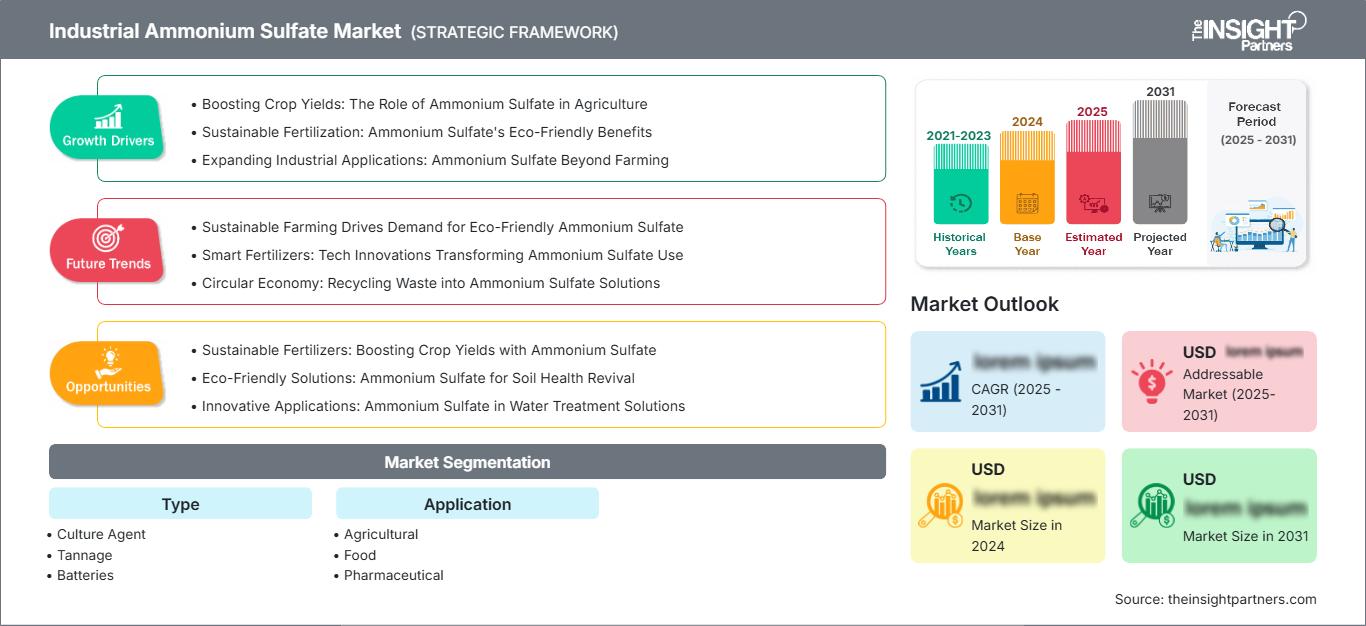
The industrial ammonium sulfate market was valued at US$ 14.58 Billion in 2025 and is projected to reach US$ 31.64 Billion by 2034, registering a CAGR of 8.99% during 2026–2034. Market expansion is supported by the compound's multifunctional role across agricultural and industrial processes, alongside increasing requirements for nitrogen and sulfur-containing inputs, specialty chemical formulations, and regulated production processes.
In North America, the industrial ammonium sulfate market size is supported by established chemical processing infrastructure and demand from agriculture, food processing, pharmaceuticals, and specialty industrial applications. The regional market is expected to expand at an estimated CAGR of 7.2–8.2% during 2026–2034, supported by nutrient management requirements and the availability of integrated chemical production networks.
Industrial Ammonium Sulfate Market Assessment and Insights
- North America: North America accounted for an estimated 24–28% industrial ammonium sulfate market share in 2025 and is expected to grow at a CAGR of 7.2–8.2% between 2026–2034, supported by established industrial infrastructure, specialty chemical demand, and continued agricultural consumption of nitrogen- and sulfur-containing products.
- U.S.: The U.S. represented approximately 78–82% of the North American market in 2025 and is projected to expand at a CAGR of 7.4–8.4% during 2026–2034, supported by diversified downstream applications and domestic chemical production capabilities.
- Europe: Europe held an estimated 26–30% share in 2025 and is projected to register a CAGR of 6.8–7.8% during 2026–2034. Germany, France, Italy, Spain, and the UK remain important markets due to established manufacturing, agricultural, and specialty chemical sectors.
- Asia Pacific: Asia Pacific accounted for approximately 34–38% of the market in 2025 and is expected to grow at a CAGR of 10.0–11.0% between 2026–2034. China, India, Japan, South Korea, and Australia support regional demand through industrial expansion and agricultural activity.
- Largest Segment: Agricultural applications represented an estimated 48–52% market share in 2025 and are anticipated to grow at a CAGR of 9.2–10.2% during 2026–2034, supported by demand for sulfur-containing nutrient inputs.
- High Growth Segment: Pharmaceutical applications accounted for an estimated 12–16% market share in 2025 and are expected to advance at a CAGR of 10.5–11.5% during 2026–2034, driven by specialized processing and quality requirements.
- Key companies analyzed in detail: CG Chemikalien GmbH & Co. KG, Chemos GmbH & Co. KG, Fox Chemicals GmbH, ICC Chemical Corporation, Merck KGaA, Simagchem Corporation, UBE Corporation, ViaChem, LLC, BASF SE, and Evonik Industries AG.
Source: The Insight Partners' analysis based on proprietary research, government publications, company annual reports, investor presentations, industry databases, and expert interviews.
From a supply-side perspective, production trends in the industrial ammonium sulfate market have shifted from being focused on commoditized products to a more diversified ecosystem geared toward applications in industry, laboratories, agriculture, and others. The availability of ammonium sulfate in selected chemical manufacturing as a byproduct continues to be significant in terms of cost economics of the supply side, while the provision of specific purification, packaging, and distribution capacity begins to play an increasing role in product positioning. Consistency, traceability, and application-related specifications are becoming increasingly relevant due to increased quality standards required by downstream industries.
Moving forward, expansion in the industrial ammonium sulfate market will become increasingly focused on countries characterized by both modernization of their agricultural sector and growth in manufacturing of chemicals and pharmaceuticals. Industrial infrastructure investments in Asia Pacific and certain Middle Eastern economies have opened up new avenues for demand growth. Regulatory focus on nutrients' efficiency, quality of products, workplace safety, and environmental impact is driving manufacturers toward better process control and diversification of product range.
Industrial Ammonium Sulfate Market Report Scope
| Report Attribute | Details |
|---|---|
| Market size in 2025 | US$ 14.58 Billion |
| Market Size by 2034 | US$ 31.64 Billion |
| Global CAGR (2026 - 2034) | 8.99% |
| Historical Data | 2021-2024 |
| Forecast period | 2026-2034 |
Industrial Ammonium Sulfate Market Analysis
Ammonium sulfate market growth is driven by nutrient demand, process chemistry demands, and economic drivers in the supply chain of upstream chemical production. Demand from agriculture forms an important demand base since ammonium sulfate offers both nitrogen and sulfur nutrients, while industrial demand is driven by process chemical demand and grades. The value chain has various feedstock and intermediates suppliers, producers of chemicals, purifying/packaging companies, distribution companies, and end users. Supply may be affected by various factors such as sulfuric acid and ammonia economics, presence of co-products, plant utilization rates, transport costs, and warehousing capabilities in various regions.
Diversification of demand in the industrial ammonium sulfate market has become crucial due to seasonal demand pattern arising from agricultural activities on the one hand, and food, pharmaceuticals, catalysts and other industrial demands on the other. Producers who are able to meet demand for purity, physical properties, documentation, and logistics will find themselves able to serve a broader customer base. Regional trade will continue to remain significant where local supply does not match downstream consumption, which means that port facilities, bulk terminal facilities, warehousing, and distribution will form part of the supply network.
The competitive analysis of the industrial ammonium sulfate market consists of both large diversified chemical companies and specialty chemical suppliers. Companies such as BASF SE and Evonik Industries AG rely on general chemical knowledge and established industrial contacts, whereas UBE Corporation relies on its knowledge in terms of integrated chemical supply chain processes. Merck KGaA specializes in expensive chemicals for laboratory purposes and specialty chemicals, where the specifications and quality control may have more effect on purchases than the bulk price.
Specialized suppliers and distributors such as CG Chemikalien GmbH & Co. KG, Chemos GmbH & Co. KG, Fox Chemicals GmbH, ICC Chemical Corporation, Simagchem Corporation, and ViaChem, LLC play their role in terms of flexible sourcing, access to local customers, and customized delivery arrangements. Positioning is increasingly becoming less about scale and more about reliability. The investments will include efficiency, high-value chemicals, improved logistics, documentation process, and partnerships, which minimize supply risk in geographically spread industrial markets.
● REPORT CUSTOMIZATION
Tailor This Report To Align With Your Specific Business Requirements
This report can be customized to align precisely with your business objectives, scope, and target markets. Customization options include tailored segmentation, geography, competitive analysis, and strategic insights to support informed decision-making.
Customize This Report →WHAT YOU CAN ADJUST
- ● Segmentations
- ● Geography
- ● Competitive Analysis
- ● Language Preferences
Industrial Ammonium Sulfate Market: Strategic Insights
Regional Insights
North America Industrial Ammonium Sulfate Market
North America accounted for an estimated 24–28% share in 2025 and is projected to expand at a CAGR of 7.2–8.2% during 2026–2034. The demand is reinforced by extensive agricultural production operations, well-established chemical manufacture and distribution channels. Structural growth is also driven by growing importance of nutrient management and the requirement for reliable industrial inputs. The producers and distributors have an advantage of well-developed rail, road and port logistics allowing movement from production centers to end consumers scattered around.
Additional demand from industry adds stability as it lowers dependency on one sector of consumption. Opportunities for differentiation and specialization are created by food processing, pharmaceutical manufacture, specialty chemicals and catalyst applications. Competitiveness in the region will be based on economic aspects of feedstock availability, capability for compliance and supply reliability. Domestic manufacture and supply chain development investments are likely to drive incremental utilization and distribution of value-added products, though energy and transportation costs will remain an important consideration in purchases.
U.S. Industrial Ammonium Sulfate Market
The U.S. represented approximately 78–82% of North American demand in 2025 and is anticipated to grow at a CAGR of 7.4–8.4% through 2034. Its size derives from the sizable agricultural business, along with a notable amount of chemicals manufacturing, pharmaceutical production, and food processing operations. There is the ability of domestic production and distribution to facilitate access throughout the large farming areas and industrial centers, and specific chemical producers serve those customers that require purity control.
The diversity of application types continues to be the primary characteristic of the market. Agricultural customers account for a considerable amount of consumption, although more sophisticated applications can create possibilities for differentiation on the supply side. The presence of diverse corporations like BASF SE, as well as specialty distributors like ViaChem, LLC and other chemical providers, increases accessibility in different end uses. Future development will depend upon nutrient economics, manufacturing spending, regulations, and logistical efficiency of suppliers in a large domestic market.
Europe Industrial Ammonium Sulfate Market
Europe accounted for an estimated 26–30% share in 2025 and is expected to register a CAGR of 6.8–7.8% during 2026–2034. The area blends traditional agricultural markets with advanced chemical and pharmaceutical industries. Germany is still the top nation due to its advanced chemical manufacturing industry and technical supply chain. Product stewardship and traceability in addition to improved control over industrial chemical management are favored by the region’s regulatory framework.
According to the industrial ammonium sulfate market report, the UK sustains its demand with the help of specialty chemicals, pharmaceuticals, food processing, and strong distribution channels, whereas Germany continues to be the key to continental industrial consumption. France, Italy, and Spain provide the necessary demand through agriculture and manufacturing operations. Different types of demand are observed depending on the intensity of crop production and presence of industries. Increasing emphasis is placed by European manufacturers on efficiency, reduced emissions, and regional supply sources.
APAC Industrial Ammonium Sulfate Market
Asia Pacific held approximately 34–38% share in 2025 and is projected to grow at a CAGR of 10.0–11.0% during 2026–2034, making it the fastest-expanding major region. China remains the leading country due to its extensive chemical and manufacturing base, while India benefits from agricultural intensity and growing industrial capacity. Japan and South Korea support higher-value specialty chemical demand, and Australia contributes through agriculture and resource-linked industrial activity.
Industrial expansion, agricultural modernization, and policy support for domestic manufacturing strengthen regional consumption. Investment in logistics and chemical infrastructure is also improving market accessibility across emerging economies.
Middle East & Africa Industrial Ammonium Sulfate Market
The Middle East & Africa is expected to expand at a CAGR of 8.5–9.5% during 2026–2034, supported by infrastructure development and diversification of industrial economies. Saudi Arabia and the UAE benefit from integrated petrochemical ecosystems and investments in downstream manufacturing, while South Africa provides demand through agriculture, chemicals, and industrial processing. Other MEA countries present smaller but developing opportunities linked to food security and agricultural productivity initiatives.
Energy availability and industrial investment provide a supportive foundation, although market development differs significantly across countries. Infrastructure expansion can improve access to customers and strengthen regional distribution capabilities.
Segmentation Analysis
Type
The Type segment is expected to grow at a CAGR of 8.4–9.4% during 2026–2034. Demand across these uses is shaped by the functional properties of ammonium sulfate, including its role in controlled chemical environments and specialized processing. The industrial ammonium sulfate market scope under this segmentation is influenced by product-grade requirements, technical specifications, and the ability of suppliers to provide consistent quality for distinct manufacturing and processing applications.
- Culture Agent: Demand is supported by controlled laboratory and biological processing environments where consistent chemical quality and reliable supply are important. Specialized grades strengthen its strategic relevance within research and industrial workflows.
- Tannage: Tannage-related demand reflects the continuing need for chemicals used in leather-processing operations. Regional manufacturing activity and environmental requirements influence purchasing patterns and encourage more controlled chemical handling practices.
- Batteries: Battery-related applications represent an emerging technical opportunity as electrochemical research and specialized industrial formulations expand. Demand remains dependent on application development, performance requirements, and qualification standards.
- Catalysts: Catalyst applications benefit from ongoing process optimization across chemical manufacturing. The segment is strategically important because customers may prioritize specification consistency, technical support, and dependable sourcing over purely commodity-oriented purchasing.
Application
The Application segment is projected to grow at a CAGR of 9.3–10.3% during 2026–2034. Agricultural uses provide the largest demand base, while food and pharmaceutical applications broaden the market's exposure to higher-value and specification-sensitive consumption. Different regulatory and quality requirements across these applications encourage portfolio segmentation, supporting suppliers that can combine bulk-scale capabilities with specialized handling and documentation.
- Agricultural: Agriculture remains the principal volume outlet because nitrogen and sulfur requirements support use across diverse cropping systems. Nutrient management practices, soil conditions, and fertilizer distribution networks shape demand patterns.
- Food: Food-related applications require careful attention to quality specifications and regulatory compliance. This segment offers suppliers opportunities to differentiate through traceability, documentation, and dependable technical-grade availability.
- Pharmaceutical: Pharmaceutical demand is strategically significant because qualification requirements can favor consistent suppliers and controlled grades. Expansion of pharmaceutical manufacturing in emerging economies is expected to support longer-term consumption.
Opportunity Snapshot
| Application | Revenue Contribution | Trend Tag | Adoption Stage |
|---|---|---|---|
| Agricultural | High | Sulfur Nutrition | Mature |
| Food | Medium | Quality Processing | Scaling |
| Pharmaceutical | Low | Specialty Formulation | Emerging |
Industrial Ammonium Sulfate Market Growth Drivers and Impact Analysis
Growing Need for Nitrogen and Sulfur Nutrient Management
The continued focus on balanced crop nutrition is a major demand driver because sulfur availability can influence nutrient utilization and crop productivity. Ammonium sulfate provides both nitrogen and sulfur, creating a practical value proposition in agricultural systems where sulfur replenishment is required. Changes in fertilizer application practices are also increasing interest in products selected for specific soil and crop conditions rather than solely for nitrogen content. This creates opportunities for differentiated nutrient programs and regional distribution strategies. The impact extends beyond agricultural volumes because stronger farm-sector demand can improve supply-chain scale and support more efficient logistics. Suppliers with agronomic expertise, reliable product availability, and effective distribution networks are positioned to benefit from this structural driver.
Expansion of Specialty Chemical and Process Industries
Growth in pharmaceutical production, food processing, catalyst manufacturing, and other specialty chemical activities is increasing the importance of application-specific chemical supply. These industries frequently require greater consistency in purity, documentation, packaging, and traceability than conventional bulk markets. As manufacturing capacity expands in Asia Pacific and selected emerging economies, demand for dependable industrial chemicals is expected to broaden geographically. The resulting market impact favors companies that can maintain quality assurance systems while serving smaller, technically demanding customer segments. Specialized distributors also gain importance by connecting producers with fragmented end-user markets. This shift supports value creation through product differentiation and service capabilities rather than relying exclusively on volume expansion.
Integrated Chemical Production and Supply-Chain Optimization
Ammonium sulfate availability is influenced by broader chemical production systems, making integration and operational efficiency important competitive factors. Producers can improve supply economics by optimizing co-product streams, energy use, storage, and transportation across interconnected facilities. Supply-chain optimization is particularly important because the product serves customers with different purchasing patterns, geographic locations, and packaging requirements. Investment in terminals, warehousing, and regional distribution can reduce delivery uncertainty and improve customer responsiveness. The market impact is a gradual separation between suppliers competing primarily on bulk availability and those creating additional value through service and specialized grades. Efficient integration can also help companies manage feedstock volatility and strengthen resilience during regional supply disruptions.
Industrial Ammonium Sulfate Market Future Trends
Shift Toward Application-Specific Grades and Quality Assurance
The industrial ammonium sulfate market trends are expected to increasingly favor application-specific products as downstream industries tighten requirements for purity, consistency, traceability, and documentation. Rather than supplying a uniform commodity grade, producers and distributors are likely to develop portfolios aligned with agricultural, food, pharmaceutical, laboratory, and technical applications. Digital quality records and improved batch-management systems can strengthen supplier qualification processes. This trend may increase barriers for undifferentiated suppliers while creating opportunities for companies with analytical capabilities and established customer relationships. Over time, procurement decisions are expected to place greater weight on supply reliability and compliance performance, particularly in regulated industries where inconsistent inputs can create operational or quality risks.
Lower-Carbon Chemical Production Becomes a Strategic Differentiator
Decarbonization is expected to influence industrial chemical sourcing as producers seek to reduce energy intensity and customers increasingly assess upstream environmental attributes. Renewable feedstocks, improved energy efficiency, electrification, and mass-balance approaches could gradually affect how chemical products are differentiated. BASF's development of renewable ammonia demonstrates broader momentum toward lower-carbon ammonia value chains, which may indirectly support innovation across downstream nitrogen-based products. Future investments will likely focus on economically viable process improvements rather than uniform technology adoption. Suppliers capable of documenting environmental performance may gain strategic advantages with multinational customers, although adoption will remain dependent on regional energy costs, infrastructure, regulations, and customers' willingness to pay for differentiated products.
Industrial Ammonium Sulfate Market Opportunities
Expansion into Emerging Industrial Manufacturing Hubs
The industrial ammonium sulfate market Forecasts indicate meaningful opportunities in countries where industrialization is expanding alongside agricultural modernization. Investors can evaluate India, Southeast Asia, the Middle East, and selected African markets for localized distribution, storage, packaging, and customer-service operations. A phased market-entry approach can reduce capital exposure by establishing commercial partnerships before committing to dedicated production assets. Local technical support may also help suppliers understand application-specific requirements and regulatory conditions. The strongest opportunities are likely to emerge where fragmented customer bases create a need for dependable intermediaries between large producers and end users. Strategic partnerships can therefore provide faster access while reducing the logistical complexity associated with cross-border chemical distribution.
Development of High-Specification and Service-Led Supply Models
An attractive opportunity lies in moving beyond bulk supply toward higher-specification products and integrated customer services. Companies can invest in purification, analytical testing, customized packaging, documentation, and inventory-management capabilities to address pharmaceutical, food, laboratory, and technical applications. Such investments can improve customer retention and reduce direct exposure to commodity price competition. Suppliers may also develop long-term agreements that combine product delivery with quality support and supply assurance. The opportunity is particularly relevant for distributors and specialty chemical companies that already maintain customer relationships but can expand technical capabilities. Successful execution requires disciplined quality systems and careful assessment of addressable demand before committing capital to specialized infrastructure.
Recent Developments
- July 2026: According to the website of the General Administration of Customs of the People's Republic of China, the GACC issued Announcement No. 97 of 2026, adjusting the "Catalogue of Import and Export Commodities Subject to Statutory Inspection." Statutory inspection requirements for export have been added for two types of ammonium sulfate commodities. The new regulations will be officially implemented on July 16, 2026.
- May 2026: AdvanSix announced a new process design and licensing agreement aimed at evaluating the expansion of its integrated ammonia platform at its Hopewell, Virginia facility to support domestic production of Diesel Exhaust Fluid (DEF). The initiative reflects the company’s strategy to strengthen its position in the U.S. chemicals and emissions-control markets while addressing the rapidly rising regional demand for DEF, particularly across the Mid-Atlantic and Northeastern United States.
Frequently Asked Questions

- Comprehensive Market Sizing and Forecast Analysis
- Detailed Segmentation Analysis
- In-Depth Market Dynamics Assessment
- Regional and Country-Level Insights
- Competitive Landscape and Company Benchmarking
- Strategic Business Intelligence
Recent Reports
Testimonials

The Insight Partners provided valuable market intelligence that supported our global go-to-market strategy. Their team was professional, responsive, and attentive to our feedback, providing thoughtful analysis and helpful methodological clarifications throughout the project.
Junmo Kim Chief Financial Officer (CFO), Enertech Co., Ltd.
The Insight Partners' SCADA System Market report is comprehensive, with valuable insights on current trends and future forecasts. The team was highly professional, responsive, and supportive throughout. We are very satisfied and highly recommend their services.
RAN KEDEM Partner, Reali Technologies LTDs
I requested a report on a very specific software market and the team produced the report in a few days. The information was very relevant and well presented. I then requested some changes and additions to the report. The team was again very responsive and I got the final report in less than a week.
JEAN-HERVE JENN Chairman, Future Analytica
We worked with The Insight Partners for an important market study and forecast. They gave us clear insights into opportunities and risks, which helped shape our plans. Their research was easy to use and based on solid data. It helped us make smart, confident decisions. We highly recommend them.
PIYUSH NAGPAL Sr. Vice President, High Beam Global
The Insight Partners delivered insightful, well-structured market research with strong domain expertise. Their team was professional and responsive throughout. The user-friendly website made accessing industry reports seamless. We highly recommend them for reliable, high-quality research services
YUKIHIKO ADACHI CEO, Deep Blue, LLC.
This is the first time I have purchased a market report from The Insight Partners.While I was unsure at first, I visited their web site and felt more comfortable to take the risk and purchase a market report.I am completely satisfied with the quality of the report and customer service. I had several questions and comments with the initial report, but after a couple of dialogs over email with their analyst I believe I have a report that I can use as input to our strategic planning process.Thank you so much for taking the extra time and making this a positive experience.I will definitely recommend your service to others and you will be my first call when we need further market data.
JOHN SUZUKI President and Chief Executive Officer, Board Director, BK Technologies
I wish to appreciate your support and the professionalism you displayed in the course of attending to my request for information regarding to infectious disease IVD market in Nigeria. I appreciate your patience, your guidance, and the fact that you were willing to offer a discount, which eventually made it possible for us to close a deal. I look forward to engaging The Insight Partners in the future, all thanks to the impression you have created in me as a result of this first encounter.
DR CHIJIOKE ONYIA MANAGING DIRECTOR, PineCrest Healthcare Ltd.Reason to Buy
- Informed Decision-Making
- Understanding Market Dynamics
- Competitive Analysis
- Identifying Emerging Markets
- Customer Insights
- Market Forecasts
- Risk Mitigation
- Boosting Operational Efficiency
- Strategic Planning
- Investment Justification
- Tracking Industry Innovations
- Aligning with Regulatory Trends





 Get Free Sample for