
Industrial and Institutional Cleaning Chemicals Market Size, Growth & Demand by 2034
Coverage: By Raw Material (Chlor-alkali, Surfactants, Solvents, Phosphates, Biocides, Others); Product Type (General Purpose Cleaners, Disinfectants and Sanitizers, Laundry Care Products, Vehicle Wash Products); End Use (Industrial, Institutional) , and Geography (North America, Europe, Asia Pacific, and South and Central America)
- Status : Data Released
- Report Code : TIPRE00004230
- Category : Chemicals and Materials
- No. of Pages : 150
- Available Report Formats :


- Last update date : September 01, 2026


2025 Market Size
US$ 102.67 Bn
Base year value
2034 Forecast
US$ 210.28 Bn
Projected by 2034
CAGR 2026-2034
8.3 %
Growth rate
Addressable Market
US$ 1,406.02 Bn
(2026-2034)
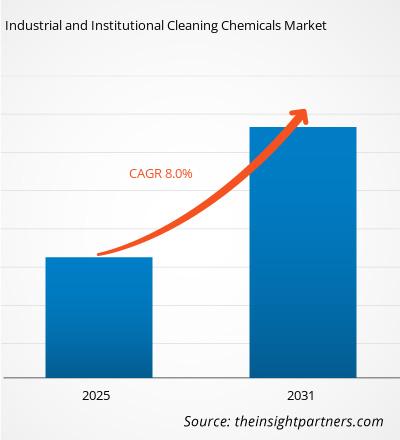
The industrial and institutional cleaning chemicals market was valued at US$ 102.67 billion in 2025 and is projected to reach US$ 210.28 billion by 2034, registering a CAGR of 8.3% during 2026–2034. Growth indicates the increasing need for chemicals that help keep things clean, sanitary, hygienic, and reliable in manufacturing operations, healthcare organizations, food services, educational establishments, transportations, and other commercial premises.
The industrial and institutional cleaning chemicals market size in North America is forecast to grow at a projected rate of 7.2-8.0% CAGR from 2026 to 2034. The stringent hygiene requirements, extensive healthcare and food processing infrastructures, and increasing use of specific formulations are structural drivers behind the growth of the market.
Industrial and Institutional Cleaning Chemicals Market Assessment and Insights
- North America: Share in 2025 is estimated at 30–34%, supported by established institutional infrastructure and high professional-cleaning intensity. The region is projected to grow at a 7.2–8.0% CAGR between 2026–2034, with healthcare, food processing, education, and commercial facilities sustaining demand.
- U.S.: The country is estimated to account for 80–84% of North American demand in 2025 and is expected to grow at a 7.4–8.2% CAGR between 2026–2034, supported by regulatory compliance, outsourcing, and specialized hygiene applications.
- Europe: Share in 2025 is estimated at 24–28%, with Germany, the UK, France, Italy, and Spain representing major consumption centers. The region is projected to record a 6.8–7.6% CAGR between 2026–2034, supported by sustainability requirements and industrial hygiene standards.
- Asia Pacific: Share in 2025 is estimated at 32–36%, making the region the largest geographic market range. China, Japan, India, South Korea, and Australia are key contributors, with a projected 9.0–9.8% CAGR between 2026–2034 driven by industrialization and institutional expansion.
- Largest Segment: Industrial is the largest end-use segment, estimated to hold a 54–58% market share in 2025 and projected to expand at a 7.8–8.6% CAGR during 2026–2034, supported by manufacturing sanitation and maintenance requirements.
- High Growth Segment: Sanitizers and Disinfectants are expected to demonstrate strong expansion, with an estimated 24–28% market share in 2025 and a projected 9.2–10.0% CAGR during 2026–2034, supported by persistent hygiene and infection-control requirements.
- Key companies analyzed in detail: 3M Company, Akzo Nobel N.V., BASF SE, Clariant AG, Croda International Plc, Eastman Chemical Company, Henkel AG & Co. KGaA, Huntsman International LLC, Solvay SA, Ecolab Inc.
Source: The Insight Partners' analysis based on proprietary research, government publications, company annual reports, investor presentations, industry databases, and expert interviews.
The market for industrial and institutional cleaning chemicals has been transitioning from a supply chain structure that was primarily commodity-focused to one where efficacy, occupational safety, dosage effectiveness, material compatibility, and environmental performance play an increasingly important role in driving the choice of product. Manufacturers are developing concentrated products, automatic dispensing systems, low-temperature cleaning systems, and chemistries that are aimed at minimizing water usage. Changes are also being seen in the production dynamics as the companies are seeking higher supply chain resilience through localized manufacturing, raw materials integration, and reformulation of products to minimize their reliance on petrochemicals and energy.
The market for industrial and institutional cleaning chemicals is expected to be positively impacted in the coming years by increasing formal cleaning infrastructure in emerging markets, especially in Asia Pacific and some Middle Eastern regions. Increased investments in healthcare facilities, food processing, hospitality industry, logistics, and infrastructure developments will widen the customer base for professional cleaning formulations. Regulations related to chemical safety, antimicrobial resistance, wastewater discharge, and sustainable packaging will lead to increased product differentiation and investment in biodegradable surfactants, lower-impact solvents, and digital chemical management systems.
Industrial and Institutional Cleaning Chemicals Market Report Scope
| Report Attribute | Details |
|---|---|
| Market size in 2025 | US$ 102.67 Billion |
| Market Size by 2034 | US$ 210.28 Billion |
| Global CAGR (2026 - 2034) | 8.3% |
| Historical Data | 2021-2024 |
| Forecast period | 2026-2034 |
Industrial and Institutional Cleaning Chemicals Market Analysis
Cleaning needs in the industrial and institutional cleaning chemicals market are getting more sophisticated since end users are assessing the effectiveness of the chemicals not only based on the hygiene results achieved, but also in terms of cost, labor and resource use, protection of the equipment and potential operator exposure. Growth of the industrial and institutional cleaning chemicals industry is thus underpinned by a value chain comprising of surfactant, chlor-alkali, solvent, acid, biocide producers, formulators, distributors, cleaning services, and end users. Particularly robust demand is observed in applications where unsanitary conditions may affect operations, food safety, HCAIs, and asset longevity. This creates repeat business opportunities through consistent product consumption.
Supply factors include the supply of raw materials, price of chemical raw materials, regional regulation, logistics costs, and formula complexity. Surfactants will play an important role in detergent formulations, whereas chlor-alkali derivatives will be essential for bleaching and sanitation purposes. Solvents, acids, and biocides serve as additives in degreasing, descaling and antibacterial applications. Formulators continue working on optimizing formulations in order to decrease the chemical dosage per cleaning cycle.
The industrial and institutional cleaning chemicals market report suggests that the competitive landscape has moved away from size of formulation and revolves around application knowledge, compliance skills, distribution capabilities, and delivery of integrated cleaning solutions. Ecolab Inc. and 3M Company have wide-ranging portfolios in professional and specialty uses, whereas BASF SE, Clariant AG, Croda International Plc, Eastman Chemical Company, Huntsman International LLC, and Solvay SA are notable suppliers of formulations. Henkel AG & Co. KGaA and Akzo Nobel N.V. bring valuable technology capabilities in relation to appropriate chemical technologies and industrial customers.
Strategic positioning is becoming more dependent upon investments in sustainable chemistry, formulation concentration, digital monitoring, and localized production. Big players can exploit research facilities and global sourcing, while niche players can play up their formulation and application abilities. Investments are also being made in the area of sustainable or low-impact raw materials, packaging reduction, and dosing control at the point of application.
● REPORT CUSTOMIZATION
Tailor This Report To Align With Your Specific Business Requirements
This report can be customized to align precisely with your business objectives, scope, and target markets. Customization options include tailored segmentation, geography, competitive analysis, and strategic insights to support informed decision-making.
Customize This Report →WHAT YOU CAN ADJUST
- ● Segmentations
- ● Geography
- ● Competitive Analysis
- ● Language Preferences
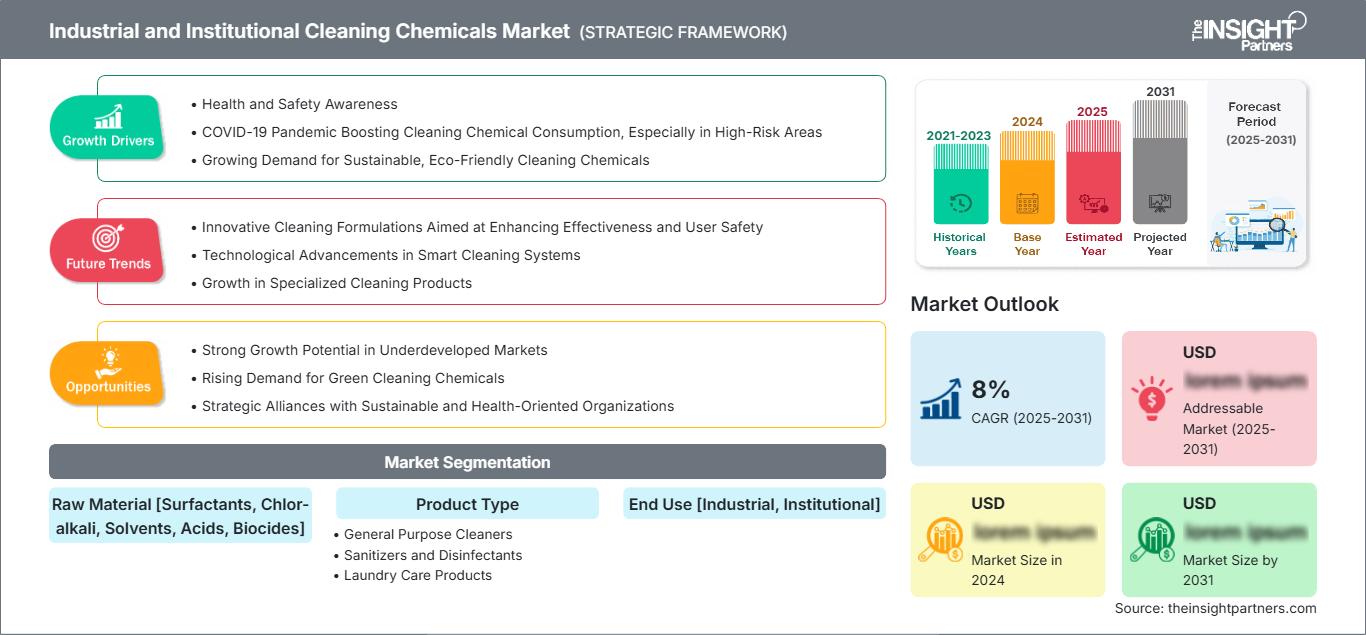
Industrial and Institutional Cleaning Chemicals Market: Strategic Insights
Regional Insights
North America Industrial and Institutional Cleaning Chemicals Market
North America is predicted to constitute 30–34% of the industrial and institutional cleaning chemicals market share in 2025 and is expected to grow at a 7.2–8.0% CAGR from 2026 to 2034. The demand will be driven by the well-established healthcare, food processing, commercial real estate, education, and manufacturing industries, which have established protocols of sanitation that involve a constant requirement of chemicals. Additionally, expensive labor drives the preference for concentrated products, dispensing equipment, and cleaning systems that lower handling time without sacrificing application efficiency.
The local market is fueled by tough regulations on workplace safety, food hygiene, infection control, and chemical labeling requirements. Institutions are looking beyond the price of individual products and increasingly considering the cost of cleaning as a whole. This has strengthened the demand for solutions that comprise chemicals, dosing systems, engineering, and performance monitoring. Sustainability also plays a part in purchases as institutions look for solutions that minimize packaging waste, water usage, emissions, and harmful chemical exposure.
U.S. Industrial and Institutional Cleaning Chemicals Market
The United States accounts for 80–84% of North America’s demand in 2025, registering a 7.4–8.2% CAGR from 2026 to 2034. The country’s extensive industrial activities, strong healthcare sector, capacity for food and beverages manufacturing, and presence of commercial buildings drive ongoing need for detergents, degreasers, disinfectants, descalers, and other specialized cleaning chemicals.
The presence of company is beneficial for the development of the market with Ecolab Inc., 3M Company, BASF SE and others being active through their products and chemicals. New application patterns tend to include closed loop dispensing systems, high-concentrated chemicals, and evidence-based hygiene management. Food safety, healthcare sanitation, industrial maintenance, and facility management continue to be key consumption sectors; sustainable requirements are promoting reformulations to more environmental-friendly formulations and packaging systems.
Europe Industrial and Institutional Cleaning Chemicals Market
Europe accounts for an approximate market share of 24–28% in 2025 and is expected to grow at a rate of 6.8–7.6% CAGR between 2026 and 2034. Germany accounts for the largest market share with its robust industrial infrastructure and a professionally structured professional-cleaning environment. UK, France, Italy, and Spain are also large contributors through healthcare, hospitality, food, manufacturing, and commercial industries. The regulatory oversight of chemical ingredients and performance affects the formulations, packaging, and product selection process.
The UK is a market driven by large institution demand from the fields of healthcare, education, hospitality, retail, and outsourced facility management services. Germany is influenced by a combination of industrial cleaning and the demand for technical formulation. France, Italy, and Spain benefit from consumption driven by food and beverages, tourism, healthcare, and commercial establishments. Across these markets, companies are differentiating on the basis of concentrated formulation, safety, reduced packaging, and technically oriented application support.
APAC Industrial and Institutional Cleaning Chemicals Market
Asia Pacific is estimated to account for 32–36% of the industrial and institutional cleaning chemicals market in 2025 and is projected to grow at a 9.0–9.8% CAGR during 2026–2034. China is the leading country, while Japan, South Korea, India, and Australia provide important demand centers. Manufacturing expansion, rising institutional capacity, and increasingly formalized hygiene practices are strengthening consumption across industrial and professional cleaning applications.
With regard to the policy focus on issues such as sanitation, working conditions, industrialization, and environmental management, there has been increasing uptake of specialized formulations. Fast development in India and continued investment in industry in China have created demand, while Japan and South Korea have been contributing through technologically advanced manufacturing.
Middle East & Africa Industrial and Institutional Cleaning Chemicals Market
The Middle East & Africa market is projected to expand at an estimated 8.4–9.2% CAGR during 2026–2034. Saudi Arabia is expected to remain the leading country, supported by industrial investment, large-scale infrastructure development, and expanding commercial facilities. The UAE contributes through hospitality, aviation-related infrastructure, healthcare, and high-density commercial activity, while South Africa remains an important industrial and institutional market.
Activities within the energy sector generate specific needs for equipment maintenance and industrial cleaning, whereas infrastructure development extends the demand for facility management chemicals. The Rest of MEA presents potential for growth due to developments in urbanization, health care, food processing, and professional cleaning services. Manufacturers with flexible logistics and technical capabilities are poised to capitalize on such fragmented demand situation.
Segmentation Analysis
Raw Material
The raw material segment is projected to grow at a 7.9–8.7% CAGR during 2026–2034. Formulation performance depends on balancing cleaning efficiency, material compatibility, safety, cost, and regulatory acceptability. The industrial and institutional cleaning chemicals market scope increasingly favors ingredients that support concentrated products, lower environmental impact, and improved worker handling characteristics. Feedstock availability and petrochemical price movements remain important influences on formulation economics and supplier strategies.
- Surfactants: Surfactants remain strategically important because they provide detergency, wetting, emulsification, and soil removal. Demand increasingly favors efficient chemistries that enable concentrated formulations, lower-temperature cleaning, and improved compatibility across diverse industrial and institutional surfaces.
- Chlor-alkali: Chlor-alkali inputs support bleaching, sanitation, pH adjustment, and chemical processing requirements. Their strategic importance is reinforced by established supply infrastructure, although transportation, energy costs, and handling requirements influence delivered formulation economics.
- Solvents: Solvents are essential in degreasing and specialized cleaning applications where water-based systems may offer insufficient performance. Suppliers increasingly focus on lower-impact alternatives that balance solvency, worker safety, emissions requirements, and operational efficiency.
- Acids: Acids are widely used for descaling, mineral deposit removal, equipment cleaning, and specialized industrial maintenance. Demand is supported by applications requiring controlled chemical action, with formulation expertise important for corrosion management and safe handling.
- Biocides: Biocides support antimicrobial performance in applications requiring microbial control, preservation, or sanitation. Regulatory oversight and responsible-use requirements increase the importance of validated efficacy, formulation stability, and application-specific technical guidance.
Product Type
The product type segment is expected to expand at a 8.4–9.2% CAGR during 2026–2034, reflecting increasing differentiation between routine cleaning and specialized hygiene requirements. Buyers are shifting toward products that address defined operational challenges, including grease removal, microbial control, textile care, and vehicle maintenance. Product development is increasingly linked to dosing precision, concentrated formats, and measurable reductions in water, energy, or chemical consumption.
- General Purpose Cleaners: General purpose cleaners maintain broad demand because they support routine surface cleaning across multiple environments. Their strategic value lies in versatility, cost efficiency, and compatibility with institutional cleaning programs and standardized operating procedures.
- Sanitizers and Disinfectants: Sanitizers and disinfectants are positioned as high-value products where hygiene assurance and microbial control are critical. Healthcare, food handling, education, and high-traffic facilities support sustained demand for validated and application-specific formulations.
- Laundry Care Products: Laundry care products serve commercial and institutional facilities requiring consistent textile hygiene and operational efficiency. Concentrated detergents, low-temperature performance, and automated dosing systems are increasingly important for controlling utility and labor costs.
- Vehicle Wash Products: Vehicle wash products support commercial fleets, transportation operators, automotive facilities, and specialized service providers. Demand is influenced by water-use efficiency, surface protection, cleaning speed, and compatibility with automated or high-throughput washing systems.
End Use
The end-use segment is projected to grow at a 8.1–8.9% CAGR during 2026–2034. Industrial applications account for the largest demand base because manufacturing operations require recurring cleaning, sanitation, degreasing, and maintenance activities. Institutional consumption is increasingly shaped by hygiene standards, outsourced facility management, and demand for products that combine efficacy with simplified handling. The industrial and institutional cleaning chemicals market therefore benefits from recurring consumption across both end-use environments.
- Industrial: Industrial users require specialized chemicals for production equipment, processing areas, floors, utilities, and maintenance operations. Manufacturing intensity, sanitation protocols, asset protection, and downtime reduction make cleaning performance an important operational consideration.
- Institutional: Institutional users include facilities requiring standardized hygiene across healthcare, education, hospitality, offices, and public infrastructure. Demand increasingly favors products supported by efficient dispensing, clear usage instructions, safer handling characteristics, and consistent performance.
Opportunity Snapshot
| End Use | Revenue Contribution | Trend Tag | Adoption Stage |
| Industrial | High | Automated Dosing | Mature |
| Institutional | High | Hygiene Protocols | Scaling |
Industrial and Institutional Cleaning Chemicals Market Growth Drivers and Impact Analysis
Stricter Hygiene and Sanitation Requirements Across Professional Facilities
Stringent hygiene requirements are increasing chemical consumption across facilities where contamination, infection, product spoilage, or operational disruption can create significant costs. Healthcare providers require structured environmental hygiene, while food and beverage processors depend on validated sanitation procedures to support product safety. Manufacturing sites also use specialized cleaners to protect equipment and maintain production conditions. These requirements support recurring demand rather than purely discretionary purchasing. The impact is strongest for suppliers offering application-specific products with documented performance and controlled dosing. As professional users standardize cleaning procedures, purchasing decisions increasingly incorporate technical support, worker safety, chemical compatibility, and total cost per cleaning cycle. This broadens opportunities for integrated suppliers while raising barriers for undifferentiated commodity formulations.
Industrial Expansion and Growth of Professional Facility Management
Expansion of manufacturing capacity, logistics infrastructure, commercial buildings, and organized facility-management services is increasing the number of sites requiring systematic cleaning programs. Industrial facilities consume chemicals for degreasing, descaling, sanitation, equipment maintenance, and surface preparation, while institutional facilities require routine hygiene across large, frequently used spaces. Outsourced cleaning providers further support volume purchasing because they standardize products across multiple client locations. This creates opportunities for suppliers to develop scalable product portfolios and service contracts. Growth in emerging economies is particularly relevant because formal cleaning practices are becoming more established alongside urbanization and infrastructure investment. The resulting demand increasingly favors suppliers capable of combining reliable distribution, technical training, product consistency, and locally relevant regulatory support.
Resource Efficiency and Safer Chemistry Reshape Product Selection
Professional users are increasingly seeking formulations that reduce water, energy, packaging, and chemical consumption without compromising cleaning performance. Concentrated products can lower transportation and storage requirements, while automated dispensing can improve dosage consistency and reduce unnecessary chemical use. Safer ingredient profiles are also becoming important as employers seek to manage worker exposure and comply with evolving chemical regulations. These priorities are influencing formulation development across detergents, disinfectants, degreasers, and maintenance chemicals. The market impact extends beyond product substitution because efficiency requirements encourage suppliers to provide dispensing equipment, monitoring tools, and application expertise. Companies that can demonstrate measurable operational savings may gain stronger customer retention, particularly where cleaning budgets are assessed through total operating cost rather than unit chemical prices.
Industrial and Institutional Cleaning Chemicals Market Future Trends
Digitally Managed Dosing and Connected Hygiene Systems
The industrial and institutional cleaning chemicals market trends increasingly point toward digitally managed dosing systems that connect chemical consumption with operational controls. Sensors, connected dispensers, and usage data can help facility operators reduce overconsumption, monitor inventory, and improve consistency across multiple locations. Suppliers are likely to combine chemical products with software-enabled service models, shifting competition toward measurable performance outcomes. This trend is particularly relevant for large healthcare networks, food processors, hospitality groups, and contract cleaners. Future adoption will depend on equipment affordability, interoperability, and data usability. As connected systems mature, purchasing decisions may increasingly evaluate chemical suppliers according to their ability to provide actionable operational information alongside cleaning performance.
Low-Impact Ingredients and Circular Formulation Strategies
Future product development is expected to place greater emphasis on biodegradable surfactants, renewable feedstocks, readily degradable chelating agents, and formulations designed to reduce persistence after use. Circularity considerations will also extend to packaging, with refillable containers, concentrated formats, and lower material intensity gaining importance. Chemical suppliers will need to balance sustainability attributes with cleaning efficacy, stability, cost, and regulatory acceptance. Innovation is therefore likely to focus on formulation systems rather than individual ingredients alone. Companies that develop technically credible alternatives for demanding industrial and institutional applications may capture opportunities as procurement standards increasingly incorporate environmental criteria, lifecycle considerations, and supplier transparency into qualification processes.
Industrial and Institutional Cleaning Chemicals Market Opportunities
Expansion of Integrated Hygiene Solutions in Emerging Economies
The industrial and institutional cleaning chemicals market Forecasts point to significant opportunities for suppliers that build integrated hygiene platforms in rapidly developing economies. Industrialization, urban construction, healthcare investment, organized retail, hospitality expansion, and professional facility management are increasing the number of sites requiring standardized cleaning systems. Rather than competing only through individual chemical products, companies can invest in local formulation, distribution, dosing equipment, technical training, and compliance support. Partnerships with facility-management providers and industrial service companies can accelerate customer access. The strongest opportunities are likely to emerge where formal cleaning practices are expanding from basic commodity products toward documented procedures and specialized applications. Success will depend on adapting formulations, pack sizes, service models, and pricing structures to local operating conditions.
Specialized Chemistry for Water and Energy Efficient Cleaning
Investment opportunities are expanding around cleaning technologies that deliver equivalent or improved performance while reducing water and energy requirements. Low-temperature laundry systems, high-efficiency surfactants, optimized enzyme combinations, and controlled dispensing can create measurable savings for high-volume users. Food processing, hospitality, healthcare, transportation, and industrial manufacturing represent attractive targets because cleaning is recurring and resource-intensive. Suppliers can strengthen commercial propositions by quantifying water, energy, labor, and chemical savings at customer facilities. Investment in formulation research should therefore be paired with field validation and digital measurement capabilities. Companies able to translate sustainability objectives into verifiable operating benefits may establish longer-term contracts and create higher switching costs than suppliers competing primarily on product price.
Recent Developments
- April 2026: Ecolab unleashed water intelligence to drive growth in the AI era. Ecolab’s AI-enabled insights and advanced technologies deliver performance and positive impact at scale.
- July 2025: BASF SE expanded its liquid enzyme portfolio for the laundry and cleaning industry by adding lipase, cellulase, and amylase offerings. BASF stated that the broader range addresses customer requirements for high-performance formulations and strengthens its position in ingredients for home care and industrial and institutional cleaning applications, including solutions supporting effective cleaning at lower wash temperatures.
Frequently Asked Questions

- Comprehensive Market Sizing and Forecast Analysis
- Detailed Segmentation Analysis
- In-Depth Market Dynamics Assessment
- Regional and Country-Level Insights
- Competitive Landscape and Company Benchmarking
- Strategic Business Intelligence
Recent Reports
Testimonials

The Insight Partners provided valuable market intelligence that supported our global go-to-market strategy. Their team was professional, responsive, and attentive to our feedback, providing thoughtful analysis and helpful methodological clarifications throughout the project.
Junmo Kim Chief Financial Officer (CFO), Enertech Co., Ltd.
The Insight Partners' SCADA System Market report is comprehensive, with valuable insights on current trends and future forecasts. The team was highly professional, responsive, and supportive throughout. We are very satisfied and highly recommend their services.
RAN KEDEM Partner, Reali Technologies LTDs
I requested a report on a very specific software market and the team produced the report in a few days. The information was very relevant and well presented. I then requested some changes and additions to the report. The team was again very responsive and I got the final report in less than a week.
JEAN-HERVE JENN Chairman, Future Analytica
We worked with The Insight Partners for an important market study and forecast. They gave us clear insights into opportunities and risks, which helped shape our plans. Their research was easy to use and based on solid data. It helped us make smart, confident decisions. We highly recommend them.
PIYUSH NAGPAL Sr. Vice President, High Beam Global
The Insight Partners delivered insightful, well-structured market research with strong domain expertise. Their team was professional and responsive throughout. The user-friendly website made accessing industry reports seamless. We highly recommend them for reliable, high-quality research services
YUKIHIKO ADACHI CEO, Deep Blue, LLC.
This is the first time I have purchased a market report from The Insight Partners.While I was unsure at first, I visited their web site and felt more comfortable to take the risk and purchase a market report.I am completely satisfied with the quality of the report and customer service. I had several questions and comments with the initial report, but after a couple of dialogs over email with their analyst I believe I have a report that I can use as input to our strategic planning process.Thank you so much for taking the extra time and making this a positive experience.I will definitely recommend your service to others and you will be my first call when we need further market data.
JOHN SUZUKI President and Chief Executive Officer, Board Director, BK Technologies
I wish to appreciate your support and the professionalism you displayed in the course of attending to my request for information regarding to infectious disease IVD market in Nigeria. I appreciate your patience, your guidance, and the fact that you were willing to offer a discount, which eventually made it possible for us to close a deal. I look forward to engaging The Insight Partners in the future, all thanks to the impression you have created in me as a result of this first encounter.
DR CHIJIOKE ONYIA MANAGING DIRECTOR, PineCrest Healthcare Ltd.Reason to Buy
- Informed Decision-Making
- Understanding Market Dynamics
- Competitive Analysis
- Identifying Emerging Markets
- Customer Insights
- Market Forecasts
- Risk Mitigation
- Boosting Operational Efficiency
- Strategic Planning
- Investment Justification
- Tracking Industry Innovations
- Aligning with Regulatory Trends





 Get Free Sample for