
Industrial Gases for Plastic and Rubber Industry Market Trends, Size & Forecast by 2034
Industrial Gases for Plastic and Rubber Industry Market Size and Forecasts (2021 - 2034), Global and Regional Share, Trends, and Growth Opportunity Analysis Report Coverage : by Gas Type (Nitrogen, Carbon Monoxide, Carbon Dioxide); Storage and Distribution (Cylinder and Packaged Gas, Merchant Liquid Distribution, Tonnage Distribution); Process (Injection Molding, extrusion, Foaming, Blow Molding); End Use (Plastics and Polymers, Rubber); and Geography (North America, Europe, Asia Pacific, and South and Central America)
- Status : Data Released
- Report Code : TIPRE00039883
- Category : Chemicals and Materials
- No. of Pages : 150
- Available Report Formats :


- Last update date : September 01, 2026


2025 Market Size
US$ 7.46 Bn
Base year value
2034 Forecast
US$ 14.3 Bn
Projected by 2034
CAGR 2026-2034
7.50 %
Growth rate
Addressable Market
US$ 98.08 Bn
(2026-2034)
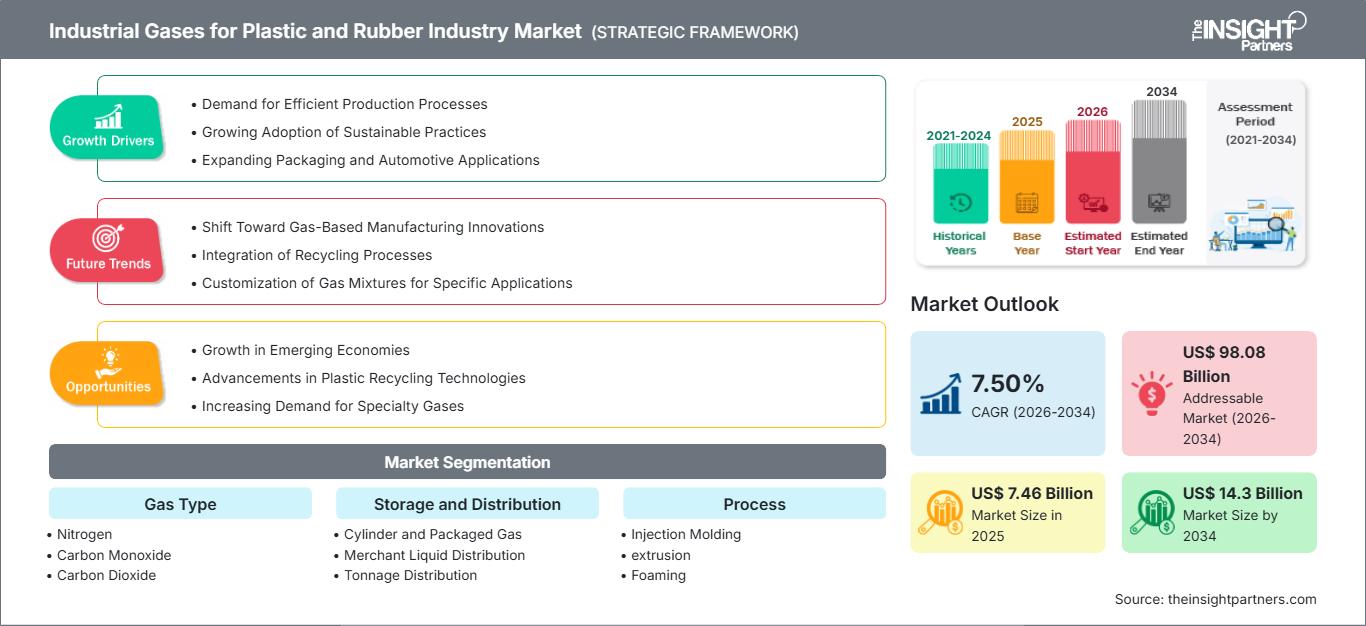
The industrial gases for plastic and rubber industry market was valued at US$ 7.46 billion in 2025 and is projected to reach US$ 14.3 billion by 2034, expanding at a CAGR of 7.50% during 2026–2034. Market expansion is supported by the increasing use of nitrogen and carbon dioxide in gas-assisted molding, physical foaming, cryogenic finishing, cooling, and rubber processing applications, where process efficiency and material optimization remain important purchasing considerations.
North America is expected to remain a technologically significant demand center, with the industrial gases for plastic and rubber industry market size in the region benefiting from an estimated CAGR of 6.8–7.3% during 2026–2034. Growth is supported by advanced injection molding capacity, automotive lightweighting requirements, and replacement investment in high-performance processing equipment. Greater adoption of physical foaming and cryogenic finishing is also increasing demand for integrated gas supply, storage, pressure-control, and process-monitoring systems.
Industrial Gases for Plastic and Rubber Industry Market Assessment and Insights
- North America: North America accounted for an estimated 28–32% share in 2025 and is expected to grow at a 6.8–7.3% CAGR between 2026–2034. Advanced polymer processing, automotive production, packaging applications, and investment in efficient molding technologies support continued industrial gas consumption.
- US: The US represented approximately 78–82% of North American demand in 2025 and is projected to expand at a 6.9–7.4% CAGR between 2026–2034, supported by large-scale plastics processing and advanced manufacturing investments.
- Europe: Europe held an estimated 24–28% share in 2025 and is projected to grow at a 6.5–7.0% CAGR between 2026–2034. Germany, France, Italy, and the UK remain major centers for automotive, packaging, machinery, and specialty polymer processing.
- Asia Pacific: Asia Pacific accounted for approximately 34–38% of the market in 2025 and is expected to register a 8.0–8.6% CAGR between 2026–2034. China, Japan, South Korea, and India are supported by expanding polymer production and manufacturing capacity.
- Largest Segment: Nitrogen represented the largest segment, with an estimated 42–46% market share in 2025, and is anticipated to expand at a 7.2–7.8% CAGR during 2026–2034, supported by molding, tire curing, cooling, and cryogenic applications.
- High Growth Segment: Foaming is expected to be the high-growth process segment, accounting for approximately 22–26% share in 2025 and advancing at a 8.2–8.8% CAGR during 2026–2034, supported by lightweight material development.
- Key companies analyzed in detail: Linde plc, Air Liquide S.A., Air Products and Chemicals, Inc., Messer SE & Co. KGaA, Nippon Sanso Holdings Corporation, Merck KGaA, Universal Industrial Gases, Inc., Yingde Gases Group Co., Ltd., INOX Air Products Private Limited, and SOL Group S.p.A.
Source: The Insight Partners' analysis based on proprietary research, government publications, company annual reports, investor presentations, industry databases, and expert interviews.
The industrial gases for plastic and rubber industry market has changed from the traditional bulk supply of industrial gases to application-oriented gas systems including generation of gas, storage, pressure regulation, metering, gas injection equipment and process engineering. Nitrogen continues to play a vital role in gas-assisted injection molding, tire curing and cryogenics. Carbon dioxide, on the other hand, is becoming significant in physical foaming, mold cooling and cleaning. Providers of technology now compete through improved performance in terms of gas purity, dosing, cycle consistency and equipment integration, apart from the quantity of gases supplied.
In the future, the industrial gases for plastic and rubber industry market will be driven by growth in new manufacturing centers where polymer conversion capacity is growing faster than industrial infrastructure development. The investments in local production of gas, liquid supply chains and distribution at customers' sites will enhance the supply of gases. Regulations for high global warming potential processing gases will encourage the development of physical foaming technologies that utilize carbon dioxide gas. Manufacturers will increasingly base their assessment of industrial gas systems on productivity, energy efficiency, scrap reduction and life cycle cost.
Industrial Gases for Plastic and Rubber Industry Market Report Scope
| Report Attribute | Details |
|---|---|
| Market size in 2025 | US$ 7.46 Billion |
| Market Size by 2034 | US$ 14.3 Billion |
| Global CAGR (2026 - 2034) | 7.50% |
| Historical Data | 2021-2024 |
| Forecast period | 2026-2034 |
Industrial Gases for Plastic and Rubber Industry Market Analysis
The rising demand for lightweight, dimensionally stable, and efficient utilization of raw materials in polymer components has been helping to drive growth in the industrial gases sector for the plastic and rubber industry market. Nitrogen helps in gas-assisted injection molding by forming voids and decreasing the amount of material used in suitable components, while carbon dioxide helps with physical foaming and precise cooling. The value chain in the industrial gases for plastic and rubber industry market covers air separation, gases production, liquefaction, compression, storage, transport, and incorporation of the process at the customer site. The needs for supply vary significantly depending on the volume, purity, pressure, and continuity of production.
In the ecosystem, big customers tend to favor molecule supply solutions incorporating storage infrastructure, pressure management, and technical know-how. Cylinder supply and packaged gases have their relevance for smaller processors and specialized processes, while merchant liquids offer advantages to bigger consumers needing continuous supply. Tonnage supply gains strategic significance in cases where big polymer or rubber plants can afford specific supply infrastructure.
Competitive Environment within the industrial gases for plastic and rubber industry market report of the Industrial Gases for Plastic and Rubber Industry can be defined through the ability to integrate the extensive infrastructure in gas production together with the engineering specific to certain applications. Linde plc, Air Liquide S.A., and Air Products and Chemicals, Inc. have developed extensive expertise in both production and distribution of gases, while Messer SE & Co. KGaA and Nippon Sanso Holdings Corporation boost the competitive environment through the presence of regional infrastructure and industrial supply specialization. The involvement of Merck KGaA comes from the company’s advanced materials and specialty technology through the acquisition of Versum Materials.
Positioning Strategies are also affected by regional experts and growing domestic players. Universal Industrial Gases, Inc., Yingde Gases Group Co., Ltd., INOX Air Products Private Limited, and SOL Group S.p.A. provide the needed solutions using the production facilities, packaged gases, merchant distribution, and customer-specific solutions. Investments are increasingly focused on automation, remote monitoring, efficient storage and application technologies that minimize waste and accelerate production cycle. In order to increase reliability of the operations on behalf of customers, suppliers will benefit from the integration of gases with molding and foaming equipment.
● REPORT CUSTOMIZATION
Tailor This Report To Align With Your Specific Business Requirements
This report can be customized to align precisely with your business objectives, scope, and target markets. Customization options include tailored segmentation, geography, competitive analysis, and strategic insights to support informed decision-making.
Customize This Report →WHAT YOU CAN ADJUST
- ● Segmentations
- ● Geography
- ● Competitive Analysis
- ● Language Preferences
Industrial Gases for Plastic and Rubber Industry Market: Strategic Insights
Regional Insights
North America Industrial Gases for Plastic and Rubber Industry Market
North America contributed approximately 28% to 32% of the industrial gases for plastic and rubber industry market share for industrial gases used in the plastic and rubber industry in 2025 and is anticipated to grow at a CAGR of 6.8% to 7.3% between 2026 and 2034. The growth is driven by the presence of established industries for plastics converting, manufacturing of auto components, packaging, and processing of rubber.
North America also has robust infrastructure for the manufacturing and distribution of industrial gases. The bigger processors have bulk and tonnage availability for their needs while smaller units depend on merchant liquids and packaged gases. Investments in the automation of manufacturing, reshoring of some industrial operations, and upgrading of polymer processing equipment will continue to drive the need for specific nitrogen and carbon dioxide systems in North America.
U.S. Industrial Gases for Plastic and Rubber Industry Market
The U.S. contributed approximately 78–82% towards the demand in North America in 2025 and is forecast to record a CAGR of 6.9–7.4% in 2026–2034. The presence of significant manufacturing capabilities has facilitated consumption in applications like injection molding, extrusion, foaming, blow molding, tire manufacturing, and specialty rubber manufacturing. Lightweighting in automobiles, advanced packaging techniques, and the manufacture of engineered polymers continues to generate opportunities for gases that enhance process control.
The competitive supply environment is helped by the existence of companies such as Linde plc, Air Liquide S.A., Air Products and Chemicals, Inc., Messer SE & Co. KGaA, and Universal Industrial Gases, Inc. via their production plants, logistics infrastructure, and technological expertise. Some of the technological trends involve the growing desire for systems that increase the efficiency of dosing and manufacturing process. Investments in local production capacity will help to increase the demand for on-site gases, bulk gases, and merchant gases.
Europe Industrial Gases for Plastic and Rubber Industry Market
Europe held an estimated 24–28% share of the industrial gases for plastic and rubber industry market in 2025 and is forecast to expand at a CAGR of 6.5–7.0% during 2026–2034. Germany remains the leading country because of its extensive automotive, machinery, chemical, and polymer-processing industries. The UK maintains demand through specialty plastics, packaging, aerospace-related manufacturing, and technical rubber applications, with modernization initiatives supporting more efficient processing technologies.
Together, France, Italy, and Spain represent a diversified pool of demand for products that range from automotive parts, consumer goods, industrial machinery, packaging, and rubber goods. Application-specific usage of gas is catered to in Italy via its machinery and plastics processing industry, while France and Spain have an advantage of packaging and automotive industries respectively. Material efficiency and recycled polymer processing are gaining importance among manufacturers in Europe.
APAC Industrial Gases for Plastic and Rubber Industry Market
APAC accounted for approximately 34–38% of the industrial gases for plastic and rubber industry market in 2025 and is expected to record the fastest regional CAGR of 8.0–8.6% during 2026–2034. China is the leading market, supported by its extensive plastics conversion and industrial manufacturing base. Japan and South Korea maintain demand for high-value polymers and advanced processing technologies.
India will receive advantages from increased manufacturing and packaging capabilities whereas Australia provides through industrial applications. Development will be aided by industry development, infrastructure development, domestic manufacturing programs, and increased use of lightweight materials. Increased gas production in India and its distribution network will continue to play an important role in facilitating geographical dispersion of processing plants.
Middle East & Africa Industrial Gases for Plastic and Rubber Industry Market
The Middle East & Africa segment is anticipated to register growth at a CAGR of 7.4–8.0% between 2026 and 2034. The largest regional consumption is estimated for Saudi Arabia due to its downstream petrochemical integration and increasing polymer processing activity. Additionally, UAE gains advantages of diversification of its manufacturing, packaging manufacturing, logistics and industrial investments.
In turn, South Africa provides demand for rubber products used in automotive, mining and industrial industries, whereas the Rest of MEA holds developing demand tied to infrastructure and consumer manufacturing. Increasing investment in industrial parks and downstream plants will raise needs for reliable gas transportation and storage systems.
Segmentation Analysis
Gas Type
The Gas Type segment in the industrial gases for plastic and rubber industry market is expected to expand at a CAGR of 7.2–7.8% during 2026–2034. Demand patterns are determined by processing requirements, material characteristics, purity specifications, and the ability of gases to improve molding, cooling, foaming, or finishing operations. Nitrogen maintains broad industrial relevance, while carbon dioxide is increasingly adopted for physical foaming and selected processing applications. Carbon monoxide remains more specialized, supporting applications where controlled chemical or process conditions require its specific properties.
- Nitrogen: Nitrogen holds a leading position because of its extensive use in gas-assisted injection molding, tire manufacturing, cooling, purging, and cryogenic applications. Its availability and compatibility with automated delivery systems reinforce strategic importance across high-volume processing facilities.
- Carbon Monoxide: Carbon monoxide serves specialized applications requiring controlled chemical functionality and process conditions. Demand remains comparatively concentrated, making technical handling capabilities, safety systems, and reliable supply arrangements important differentiators for suppliers serving qualified industrial users.
- Carbon Dioxide: Carbon dioxide is increasingly important in physical foaming, cooling, and material-processing applications. Its ability to support lower-density polymer structures and process optimization makes it strategically relevant as manufacturers pursue material efficiency and lightweight product designs.
Storage and Distribution
The Storage and Distribution segment in the industrial gases for plastic and rubber industry market is projected to register a CAGR of 7.4–8.0% during 2026–2034. Supply configuration depends primarily on customer consumption volume, site location, production continuity requirements, and capital availability. Suppliers are increasingly combining physical distribution assets with monitoring and inventory-management capabilities. This approach enables customers to select supply models aligned with throughput requirements while reducing the operational risks associated with gas shortages or inefficient storage utilization.
- Cylinder and Packaged Gas: Cylinder and packaged gas systems remain important for smaller processors, laboratories, pilot operations, and facilities with intermittent consumption. Their flexibility allows users to access specialized gases without investing in extensive onsite storage or dedicated infrastructure.
- Merchant Liquid Distribution: Merchant liquid distribution supports medium-to-high-volume customers requiring regular deliveries and consistent gas availability. The model offers scalable supply while allowing processors to maintain operational flexibility without committing to dedicated onsite production facilities.
- Tonnage Distribution: Tonnage distribution is strategically important for large, continuously operating polymer and rubber facilities. Dedicated supply arrangements can improve reliability, support high-volume consumption, and enable closer integration between gas suppliers and customer production operations.
Process
The Process segment is expected to advance at a CAGR of 7.8–8.4% during 2026–2034. Technology selection is increasingly influenced by pressure to reduce material use, shorten cycle times, improve surface quality, and manufacture lightweight components. The industrial gases for plastic and rubber industry market scope is therefore widening as processors incorporate gases directly into production methods rather than using them solely for conventional cooling or utility purposes.
- Injection Molding: Injection molding represents a major consumption area because gas-assisted processes can reduce sink marks, optimize wall structures, and lower material usage. Advanced molding facilities increasingly integrate controlled gas injection with automated process-monitoring technologies.
- extrusion: extrusion applications use industrial gases for cooling, foaming, inerting, and specialized process control. Demand is supported by continuous production of pipes, films, sheets, profiles, insulation materials, and other polymer products requiring consistent operating conditions.
- Foaming: Foaming is gaining strategic importance as producers develop lighter materials for transportation, packaging, insulation, and consumer applications. Physical blowing technologies using industrial gases can support density reduction while maintaining required structural and functional characteristics.
- Blow Molding: Blow molding applications benefit from gases used in cooling and process optimization for containers, automotive components, industrial packaging, and technical products. Rising production of specialized hollow components supports continued demand for integrated gas-management systems.
End Use
The End Use segment in the industrial gases for plastic and rubber industry market is anticipated to grow at a CAGR of 7.3–7.9% during 2026–2034. Consumption patterns vary according to material volumes, manufacturing complexity, and the adoption of specialized processing technologies. Plastics and polymers account for broad gas use across multiple conversion processes, whereas rubber applications generate demand through tire production, component manufacturing, cryogenic finishing, and process-control requirements.
- Plastics and Polymers: Plastics and polymers constitute the principal end-use area, supported by extensive injection molding, extrusion, foaming, and blow molding activity. Lightweighting, packaging innovation, and demand for engineered components continue to strengthen the strategic role of industrial gases.
- Rubber: Rubber processing requires industrial gases across tire production, cryogenic deflashing, cooling, and specialized manufacturing operations. Automotive demand and industrial replacement requirements support consistent consumption, particularly where precision finishing and productivity improvements are prioritized.
Opportunity Snapshot
| End Use | Revenue Contribution | Trend Tag | Adoption Stage |
| Plastics and Polymers | High | Physical Foaming | Mature |
| Rubber | Medium | Cryogenic Finishing | Scaling |
Industrial Gases for Plastic and Rubber Industry Market Growth Drivers and Impact Analysis
Material Efficiency and Lightweight Component Manufacturing
Manufacturers are increasingly evaluating processing technologies according to their ability to reduce material consumption while maintaining product performance. Gas-assisted injection molding and physical foaming support this objective by enabling lower-density structures, optimized wall sections, and reduced resin requirements in suitable applications. Automotive manufacturers are particularly interested in lightweight polymer and rubber components because lower component weight can contribute to broader efficiency objectives. Packaging producers are also seeking ways to optimize material intensity without compromising functionality. These requirements increase the value of accurately controlled nitrogen and carbon dioxide delivery systems. The resulting market impact extends beyond gas consumption, as processors increasingly invest in integrated equipment, monitoring systems, and application engineering that improve repeatability and reduce scrap during production.
Expansion of Advanced Polymer Processing Capacity
Growth in polymer conversion capacity is increasing the installed base of injection molding, extrusion, foaming, and blow molding equipment across established and emerging manufacturing regions. New facilities require dependable access to industrial gases, particularly when production technologies incorporate gas directly into molding or material-formation processes. Expanding capacity also encourages suppliers to develop localized storage and distribution networks capable of serving customers with different consumption profiles. Large processors may justify bulk or tonnage supply, while smaller operations require flexible packaged or merchant delivery. This diversification supports a broader addressable customer base. As manufacturing facilities become increasingly automated, demand is also expected to shift toward gas systems with remote monitoring, inventory visibility, and tighter integration with production-control equipment.
Pressure to Improve Process Consistency and Reduce Scrap
Production losses, inconsistent component quality, and extended cycle times directly affect manufacturing economics. Industrial gases can support improved process control through applications involving cooling, inerting, controlled injection, foaming, and cryogenic finishing. Processors are therefore placing greater emphasis on gas purity, pressure stability, dosing precision, and reliable delivery infrastructure. The industrial gases for plastic and rubber industry market benefits when gas suppliers move beyond molecule supply and provide technical support tailored to individual production environments. Better integration between gas systems and processing equipment can help manufacturers achieve more consistent output and lower reject rates. This creates opportunities for suppliers offering engineering expertise, automated controls, onsite storage, and service capabilities alongside conventional industrial gas distribution.
Industrial Gases for Plastic and Rubber Industry Market Future Trends
Integrated Gas Delivery and Digital Process Control
The next phase of industrial gases for plastic and rubber industry market trends is likely to involve deeper integration between gas-delivery infrastructure and polymer-processing equipment. Sensors, automated pressure regulation, digital flow meters, and production-control interfaces can enable processors to monitor gas consumption and identify deviations during molding, foaming, and cooling. Suppliers are expected to increasingly package gases with monitoring, maintenance, and process-engineering services rather than treating gas supply as an isolated utility. For large facilities, predictive inventory management could reduce supply interruptions and improve storage utilization. This transition may also support more precise dosing in applications where gas quantity directly influences density, cavity pressure, cooling performance, or component quality. Over time, data-driven process optimization is likely to become an important differentiator between conventional distribution models and higher-value application solutions.
Lower-Emission Processing and Alternative Physical Foaming Technologies
Environmental requirements are expected to influence technology selection across polymer processing, particularly where manufacturers seek alternatives to higher-impact chemical blowing agents. Carbon dioxide and nitrogen can support physical foaming approaches that create cellular polymer structures while reducing dependence on selected conventional chemical systems. Adoption will depend on equipment compatibility, required cell morphology, product performance, gas purity, pressure control, and overall economics. Producers of insulation, packaging, automotive components, and specialty polymer products are likely to evaluate these technologies according to both material efficiency and environmental performance. Suppliers may respond by developing higher-precision gas injection systems and application-specific engineering packages. The resulting opportunity is not limited to gas volume growth, because process conversion can generate demand for storage equipment, dosing systems, control technology, technical services, and plant modifications.
Industrial Gases for Plastic and Rubber Industry Market Opportunities
Localized Supply Infrastructure in Emerging Manufacturing Hubs
The industrial gases for plastic and rubber industry market Forecasts indicate an opportunity to develop localized supply infrastructure around rapidly expanding plastics and rubber manufacturing clusters. Emerging production centers in India, Southeast Asia, the Middle East, and selected Latin American markets can require dependable gas availability as polymer conversion capacity expands. Suppliers can target these clusters through strategically located filling facilities, merchant liquid terminals, bulk storage, and customer-site generation. The commercial opportunity is particularly attractive where transportation distances make conventional cylinder distribution less efficient or where production interruptions carry substantial costs. Partnerships with polymer processors and machinery manufacturers can further improve market access by embedding gas solutions into new production projects. Companies that combine reliable molecule supply with engineering, maintenance, inventory management, and application support may capture higher-value contracts while reducing customer switching through integrated infrastructure.
Application-Specific Gas Solutions for Advanced Polymer Processing
Application specialization provides another opportunity as processors adopt more sophisticated molding and foaming technologies. Rather than supplying standardized gases alone, producers can develop solutions tailored to cavity pressure, polymer formulation, cooling requirements, foaming density, and production throughput. Such packages can include gas purification, pressure control, metering, storage, injection equipment, and technical optimization. Automotive suppliers, medical-device manufacturers, electronics producers, and high-performance packaging companies may represent attractive customer groups because component specifications can justify investment in tighter process control. Industrial gas companies can also collaborate with equipment manufacturers to validate gas parameters during machine development and commissioning. This model can create recurring revenue through consumable gas supply and service agreements while improving customer retention. The opportunity is therefore centered on technical integration and measurable production outcomes rather than simple expansion of delivered gas volumes.
Recent Developments
- April 2026: Air Products expanded its US industrial gas footprint with plans to build, own and operate a new air separation unit (ASU) in Cocoa, Florida, reinforcing its push into high-demand industrial and space-sector markets.
- October 2025: Air Liquide announced the acquisition and integration of NovaAir, expanding its industrial gas footprint across East and South India. NovaAir serves customers in steel, automotive, fabrication, electronics, photovoltaic manufacturing, and healthcare, complementing Air Liquide's existing operations in northern and western India and strengthening its ability to provide production, bulk supply, specialty gases, onsite services, and engineering support.
Frequently Asked Questions

- Comprehensive Market Sizing and Forecast Analysis
- Detailed Segmentation Analysis
- In-Depth Market Dynamics Assessment
- Regional and Country-Level Insights
- Competitive Landscape and Company Benchmarking
- Strategic Business Intelligence
Recent Reports
Testimonials

The Insight Partners' SCADA System Market report is comprehensive, with valuable insights on current trends and future forecasts. The team was highly professional, responsive, and supportive throughout. We are very satisfied and highly recommend their services.
RAN KEDEM Partner, Reali Technologies LTDs
I requested a report on a very specific software market and the team produced the report in a few days. The information was very relevant and well presented. I then requested some changes and additions to the report. The team was again very responsive and I got the final report in less than a week.
JEAN-HERVE JENN Chairman, Future Analytica
We worked with The Insight Partners for an important market study and forecast. They gave us clear insights into opportunities and risks, which helped shape our plans. Their research was easy to use and based on solid data. It helped us make smart, confident decisions. We highly recommend them.
PIYUSH NAGPAL Sr. Vice President, High Beam Global
The Insight Partners delivered insightful, well-structured market research with strong domain expertise. Their team was professional and responsive throughout. The user-friendly website made accessing industry reports seamless. We highly recommend them for reliable, high-quality research services
YUKIHIKO ADACHI CEO, Deep Blue, LLC.
This is the first time I have purchased a market report from The Insight Partners.While I was unsure at first, I visited their web site and felt more comfortable to take the risk and purchase a market report.I am completely satisfied with the quality of the report and customer service. I had several questions and comments with the initial report, but after a couple of dialogs over email with their analyst I believe I have a report that I can use as input to our strategic planning process.Thank you so much for taking the extra time and making this a positive experience.I will definitely recommend your service to others and you will be my first call when we need further market data.
JOHN SUZUKI President and Chief Executive Officer, Board Director, BK Technologies
I wish to appreciate your support and the professionalism you displayed in the course of attending to my request for information regarding to infectious disease IVD market in Nigeria. I appreciate your patience, your guidance, and the fact that you were willing to offer a discount, which eventually made it possible for us to close a deal. I look forward to engaging The Insight Partners in the future, all thanks to the impression you have created in me as a result of this first encounter.
DR CHIJIOKE ONYIA MANAGING DIRECTOR, PineCrest Healthcare Ltd.Reason to Buy
- Informed Decision-Making
- Understanding Market Dynamics
- Competitive Analysis
- Identifying Emerging Markets
- Customer Insights
- Market Forecasts
- Risk Mitigation
- Boosting Operational Efficiency
- Strategic Planning
- Investment Justification
- Tracking Industry Innovations
- Aligning with Regulatory Trends





 Get Free Sample for