
Industrial Maintenance Coatings Market Trends, Share & Demand by 2034
Industrial Maintenance Coatings Market Size and Forecasts (2021–2034), Global and Regional Share, Trends, and Growth Opportunity Analysis Report Coverage : by Product Type (Acrylic, Alkyd, Polyurethane, Epoxy, Polyesters); Technology (Solvent Borne, Water Borne, Powder Based); End Use (Marine, Automotive, Electronics, Aerospace, Oil & Gas, Mining, Power Generation); and Geography (North America, Europe, Asia Pacific, and South and Central America)
- Status : Data Released
- Report Code : TIPRE00040333
- Category : Chemicals and Materials
- No. of Pages : 150
- Available Report Formats :


- Last update date : August 27, 2026


2025 Market Size
US$ 4.8 Bn
Base year value
2034 Forecast
US$ 5.77 Bn
Projected by 2034
CAGR 2026-2034
2.07 %
Growth rate
Addressable Market
US$ 47.93 Bn
(2026-2034)
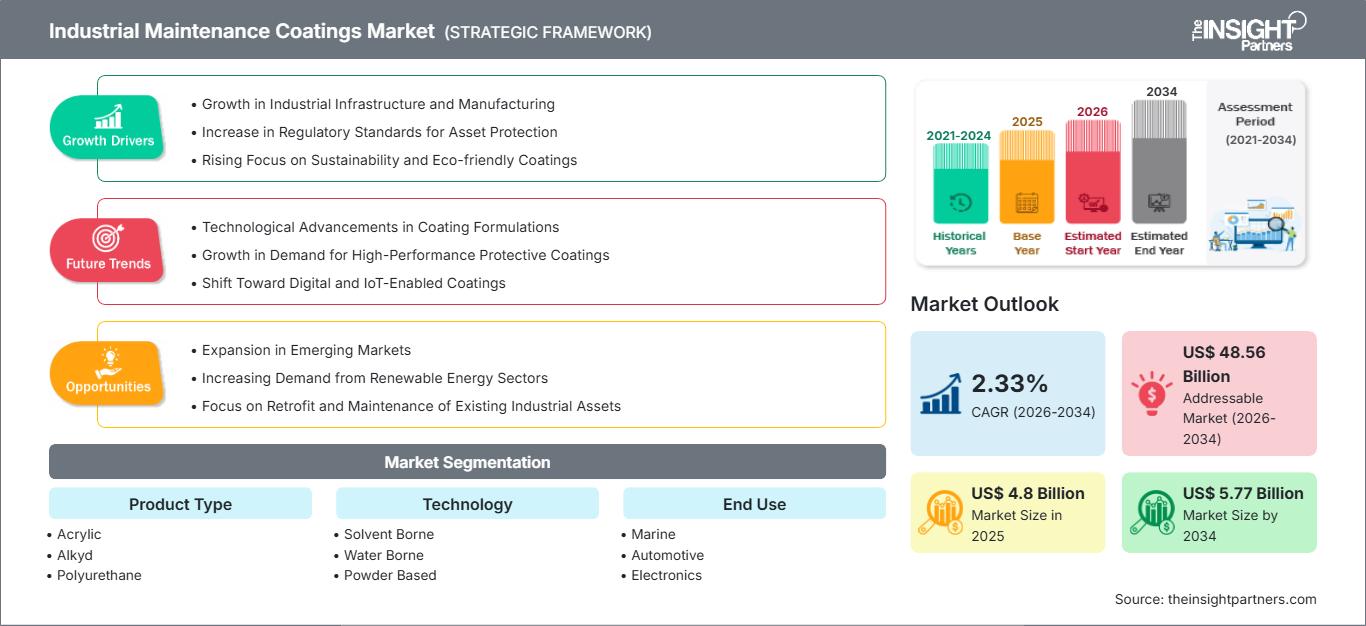
The Industrial Maintenance Coatings market was valued at US$ 4.8 billion in 2025 and is expected to reach US$ 5.77 billion by 2034; it is estimated to record a CAGR of 2.07% during 2026-2034.
Industrial Maintenance Coatings Market Assessment and Insights
- North America: Share in 2025 is estimated at 30–34%, supported by established industrial assets, infrastructure rehabilitation, energy facilities, and protective maintenance programs. The region is expected to grow at a CAGR of 1.8–2.4% between 2026–2034.
- US: The US accounts for an estimated 78–82% of North American demand in 2025, with refinery, power, manufacturing, and infrastructure maintenance supporting a CAGR of 1.9–2.5% between 2026–2034.
- Europe: Europe represents an estimated 24–28% share in 2025, led by Germany, the UK, France, Italy, and Spain. Asset refurbishment and environmental compliance support a CAGR of 1.7–2.3% between 2026–2034.
- Asia Pacific: Asia Pacific accounts for an estimated 34–38% share in 2025 and is led by China, Japan, South Korea, and India. Industrial investment supports a CAGR of 2.8–3.4% between 2026–2034.
- Largest Segment: Epoxy holds an estimated 28–32% market share in 2025, supported by corrosion resistance and adhesion. The segment is projected to expand at a CAGR of 2.4–3.0% during 2026–2034.
- High Growth Segment: Water Borne technology represents an estimated 20–24% share in 2025 and is projected to register a CAGR of 3.5–4.1% during 2026–2034 as lower-emission formulations gain wider industrial acceptance.
- Key companies analyzed in detail: BASF SE, Akzo Nobel N.V., The Sherwin-Williams Company, Axalta Coating Systems Ltd., Jotun A/S, PPG Industries, Inc., Hempel A/S, RPM International Inc., Kansai Paint Co., Ltd., Nippon Paint Holdings Co., Ltd.
Source: The Insight Partners' analysis based on proprietary research, government publications, company annual reports, investor presentations, industry databases, and expert interviews.
There is a shift from traditional painting methods to protective processes that have a lifecycle focus. The formulators are working on enhancing the chemistry of resins, pigmenting technology, surface tolerance, curing process, and productivity of the application process. At the same time, there is a trend towards production locations close to industrial areas. Solvent-based products still have a significant share where tough film-forming and working conditions are present, whereas water- and powder-based technologies are gaining popularity among industry customers due to their sustainability and efficiency.
In terms of future growth, opportunities will increasingly arise in the Asia Pacific, the Middle East, and specific industrial zones in Africa. Developments in the realm of renewable energy, power transmission facilities, port facilities, industrial facilities, and advanced manufacturing facilities will expand the number of assets to be protected periodically. Concerns over volatile organic compounds and waste management will drive the adoption of better formulations, while the asset managers will opt for systems that optimize the costs of the coating with regard to inspections and repairs.
Industrial Maintenance Coatings Market Report Scope
| Report Attribute | Details |
|---|---|
| Market size in 2025 | US$ 4.8 Billion |
| Market Size by 2034 | US$ 5.77 Billion |
| Global CAGR (2026 - 2034) | 2.07% |
| Historical Data | 2021-2024 |
| Forecast period | 2026-2034 |
Industrial Maintenance Coatings Market Analysis
Industrial asset maintenance is the principal demand foundation for the industrial maintenance coatings market growth. There is a need for marine structures, pipelines, storage tanks, mining equipment, power-generating structures, industrial machines, and transportation systems to be protected from corrosion and deterioration. The value chain starts from resin manufacturers, solvent manufacturers, pigment producers, additive suppliers, and curing agents producers and moves forward to formulators, distributors, applicators, engineering companies, inspection firms, and property owners. Supplier-side factors include raw materials availability, manufacturing capacity within a specific region, energy costs, logistics, and regulations. However, epoxy and polyurethane paints are still used when there is a need for high-performance materials.
Application conditions have become more influential in the decision-making process. Industrial consumers consider issues such as substrate preparation, temperature, humidity, cure time, film thickness, reparability, and compatibility with other coatings before choosing a coating system. It pushes suppliers to offer technical assistance to purchasers instead of only lowering material cost.
The industrial maintenance coatings market analysis also reflects a competitive environment in which formulation capability, geographic service coverage, technical specifications, and customer relationships determine strategic positioning. The BASF SE provides resin and additives for protective coatings, whereas Akzo Nobel N.V., The Sherwin-Williams Company, Jotun A/S, PPG Industries, Inc. and Hempel A/S have strong market presence in the protective and marine coatings systems segment. The contribution of Axalta Coating Systems Ltd. and Kansai Paint Co., Ltd. has been seen through their industrial and transportation coatings segments.
RPM International Inc. and Nippon Paint Holdings Co., Ltd. are diversifying their competitiveness through a wide range of coatings and geographical spread of operations. Increasing investments are being made towards low emissions products, process efficiencies, color and specification software and application systems that improve productivity. BASF has increased its polyester and polyurethane resin production capacity at Caojing, China, from 8,000 to 18,800 metric tons per year in 2025.
● REPORT CUSTOMIZATION
Tailor This Report To Align With Your Specific Business Requirements
This report can be customized to align precisely with your business objectives, scope, and target markets. Customization options include tailored segmentation, geography, competitive analysis, and strategic insights to support informed decision-making.
Customize This Report →WHAT YOU CAN ADJUST
- ● Segmentations
- ● Geography
- ● Competitive Analysis
- ● Language Preferences
Industrial Maintenance Coatings Market: Strategic Insights
Regional Insights
North America industrial maintenance coatings market
North America accounted for an estimated 30–34% of the global Industrial Maintenance Coatings Market demand in 2025 and is expected to expand at a CAGR of 1.8–2.4% during 2026–2034. Demand is sustained by an extensive existing stock of bridges, industrial facilities, storage facilities, pipelines, manufacturing operations, and energy installations. The maintenance cycles are increasingly driven by considerations related to life cycle cost evaluation, labor productivity, environmental regulations, and reduced downtime, both planned and unplanned.
The US is the market leader, but Canada has a role to play as well through mining, energy, transport, and processing activities. Suppliers get help from an existing system of technical specifications and professional contractors. Water-based products are becoming popular, but solvent-based and high solids solutions are still needed in cases where environmental conditions, corrosion resistance, and other factors have to be considered.
U.S. industrial maintenance coatings Market
The US represents an estimated 78–82% of North American Industrial Maintenance Coatings Market demand in 2025 and is projected to register a CAGR of 1.9–2.5% during 2026–2034. Refining, petrochemicals, manufacturing, power generation, marine facilities, transportation infrastructure, and commercial asset maintenance create a diversified application base. The country also benefits from the strong presence of The Sherwin-Williams Company, PPG Industries, Inc., RPM International Inc., BASF SE, and Axalta Coating Systems Ltd.
Application trends increasingly emphasize faster return-to-service, reduced surface-preparation requirements, high-solids systems, and lower-emission technologies. Asset owners are also seeking coatings that can extend inspection intervals and reduce maintenance labor. Continued investment in grid resilience, industrial reshoring, energy infrastructure, and advanced manufacturing should support replacement demand. Growth is nevertheless moderated by the maturity of the installed industrial base and periodic variability in construction and capital expenditure.
Europe industrial maintenance coatings market
Europe accounted for an estimated 24–28% share of the Industrial Maintenance Coatings Market in 2025 and is forecast to grow at a CAGR of 1.7–2.3% through 2034. Environmental compliance, asset refurbishment, offshore maintenance, industrial decarbonization, and transport infrastructure modernization support demand. Germany remains the leading European market due to its large manufacturing and process-industrial base.
The UK supports demand through offshore energy, marine infrastructure, transport assets, and industrial refurbishment. Maintenance programs increasingly prioritize lower-emission products and longer service intervals. Germany benefits from chemicals, machinery, automotive production, and advanced manufacturing, where protective systems are selected according to detailed performance and durability requirements.
France, Italy, and Spain collectively provide demand through energy infrastructure, marine facilities, manufacturing, transportation, and industrial equipment. France benefits from aerospace and power-generation activity, while Italy supports machinery and process industries. Spain contributes through marine, renewable energy, and infrastructure assets. Their combined demand reinforces Europe’s diversified application structure.
APAC industrial maintenance coatings market
Asia Pacific represented an estimated 34–38% of the Industrial Maintenance Coatings Market share in 2025 and is expected to grow at a CAGR of 2.8–3.4% during 2026–2034. China is the leading market, supported by manufacturing, infrastructure, energy, and industrial equipment. Japan and South Korea add demand from marine, electronics, automotive, and advanced industrial assets.
India and Australia strengthen regional demand through infrastructure, mining, energy, and industrial investment. Expanding production capacity, local supply chains, and environmental policy are accelerating technology development. BASF's Caojing capacity expansion also demonstrates the strategic importance of regionalized resin production for Asian coatings demand.
Middle East & Africa industrial maintenance coatings market
The Middle East & Africa region is expected to record a CAGR of 2.5–3.1% during 2026–2034, supported by energy infrastructure, desalination, ports, industrial processing, and construction. Saudi Arabia and the UAE are the leading demand centers, where refinery, petrochemical, and infrastructure assets require high-performance corrosion protection.
South Africa Industrial Maintenance Coatings Market contributes through mining, power, transport, and industrial equipment, while the Rest of MEA presents selective opportunities linked to infrastructure development. Harsh climatic conditions, saline exposure, and remote maintenance requirements increase the importance of coating durability and application reliability.
Segmentation Analysis
Product Type
Product Type demand is expected to expand at a CAGR of 2.3–2.9% during 2026–2034. Selection depends on substrate, exposure environment, expected service life, application method, and repair requirements. Epoxy systems lead performance-critical applications, while polyurethane, acrylic, alkyd, and polyester technologies serve different combinations of weatherability, productivity, cost, flexibility, and finish requirements. The industrial maintenance coatings market scope therefore, extends across multiple resin platforms rather than a single dominant chemistry.
- Acrylic: Acrylic coatings support applications requiring weatherability, color retention, and relatively efficient application. Their strategic importance is increasing where water-borne technology development improves industrial performance and supports lower-emission maintenance specifications.
- Alkyd: Alkyd systems retain relevance in conventional industrial maintenance because of formulation familiarity, application simplicity, and cost effectiveness. Demand is strongest in less severe service environments and routine maintenance programs.
- Polyurethane: Polyurethane coatings are strategically important for topcoats requiring durability, abrasion resistance, gloss retention, and weatherability. They are widely specified where long-term exterior performance and appearance influence maintenance planning.
- Epoxy: Epoxy systems hold the strongest market position among listed product types because of adhesion and corrosion resistance. They are particularly important in marine, oil and gas, power, and heavy industrial environments.
- Polyesters: Polyester technologies provide useful performance characteristics across industrial and powder applications. Their importance increases where efficient curing, durable finishes, and compatibility with modern production or maintenance processes are required.
Technology
The technology segment of the Industrial Maintenance Coatings Market is projected to grow at a CAGR of 2.7–3.3% during 2026–2034. Regulatory pressure and customer sustainability targets are reshaping formulation choices, although performance requirements continue to limit direct substitution. Solvent-borne products remain essential for demanding field conditions, while water-borne and powder systems benefit from lower-emission objectives and controlled application environments.
- Solvent Borne: Solvent-borne systems remain strategically important for difficult substrates, demanding climates, and applications requiring established performance under variable field conditions. Their future position depends on continued formulation improvements and compliance management.
- Water Borne: Water-borne coatings show a strengthening demand pattern as users seek lower volatile organic compound emissions. Advances in corrosion protection, adhesion, and drying behavior are expanding adoption across industrial maintenance applications.
- Powder Based: Powder-based technology is strategically relevant in controlled facilities where overspray recovery, low solvent use, and efficient material utilization can improve production economics and environmental performance.
End Use
End Use Industrial Maintenance Coatings Market demand is forecast to advance at a CAGR of 2.4–3.0% during 2026–2034. Application requirements vary substantially by asset exposure and maintenance practice. Marine and oil and gas assets prioritize corrosion protection, while automotive, electronics, aerospace, mining, and power generation create specialized requirements involving temperature resistance, chemical exposure, abrasion, appearance, electrical equipment protection, and operational uptime.
- Marine: Marine demand depends on protection against saltwater, humidity, mechanical wear, and atmospheric corrosion. Ship maintenance, ports, offshore structures, and associated equipment support recurring coating requirements.
- Automotive: Automotive applications require durable protection for production assets, components, service equipment, and selected aftermarket surfaces. Process efficiency and environmental compliance increasingly influence technology selection.
- Electronics: Electronics-related industrial assets require coatings and surface treatments suited to controlled manufacturing environments. Demand emphasizes equipment protection, process reliability, and compatibility with increasingly specialized production systems.
- Aerospace: Aerospace maintenance applications prioritize strict performance specifications, substrate compatibility, durability, and operational reliability. Demand is supported by maintenance requirements for facilities, equipment, and selected aircraft-related industrial surfaces.
- Oil & Gas: Oil and gas remain strategically important because pipelines, tanks, offshore equipment, refineries, and processing facilities operate under severe corrosion and chemical exposure conditions requiring high-performance systems.
- Mining: Mining equipment experiences abrasion, moisture, chemical exposure, and mechanical stress. Protective coatings help extend equipment life and reduce maintenance disruption in geographically dispersed and demanding operating environments.
- Power Generation: Power-generation assets require protection for structural steel, turbines, auxiliary equipment, storage systems, and transmission-related infrastructure. Reliability and outage reduction are central selection criteria.
Opportunity Snapshot
| End Use | Revenue Contribution | Trend Tag | Adoption Stage |
| Marine | High | Offshore Protection | Mature |
| Automotive | Medium | Refinish Efficiency | Mature |
| Electronics | Low | Equipment Protection | Scaling |
| Aerospace | Medium | Lightweight Protection | Mature |
| Oil & Gas | High | Corrosion Control | Mature |
| Mining | Medium | Abrasion Resistance | Mature |
| Power Generation | High | Grid Modernization | Scaling |
Industrial Maintenance Coatings Market Growth Drivers and Impact Analysis
Expansion of Asset Life Extension Programs
There is a rising trend towards longevity of industrial equipment operations, which in turn raises the importance of maintenance coatings due to the increasing demand for maintenance systems. Rebuilding and replacement of bridges, tanks, pipelines, processing equipment and structural steel require more capital expenditure compared to maintenance. Thus, asset owners assess coatings in terms of their lifetime performance, inspection schedule, surface preparation needs, and downtime. Moreover, corrosion protection helps achieve resource-efficiency goals by increasing the lifetime of metallic materials. According to BASF, better corrosion protection decreases the use of replacement materials and reduces the release of greenhouse gases into the atmosphere.
Infrastructure and Energy Asset Modernization
Energy, power transmission, processing industries, ports, and transportation infrastructure spending increases the number of systems that need periodic coating. Investments increase the demand for coatings during the initial installation stage, while already functioning infrastructure requires continuous maintenance throughout its life cycle. Oil and gas, electricity generation, mining, and maritime industries are especially significant since exposure to water, chemicals, abrasion, and changes in temperature can increase substrate damage rates. It is favorable for coatings manufacturers when there are maintenance standards and asset integrity management practices associated with investments into infrastructure. The greatest effect can be seen when specification purchases become a priority for buyers, along with other criteria such as material price and performance.
Environmental Compliance and Lower-Emission Formulations
Environmental regulation and corporate sustainability targets are accelerating the development of lower-emission maintenance technologies. Water-borne systems can help reduce volatile organic compound emissions while improved resin chemistry seeks to preserve corrosion protection and application performance. BASF's protective-maintenance portfolio highlights water-borne acrylic and hybrid technologies designed for direct-to-metal applications and reduced environmental impact. The transition will not eliminate solvent-borne products because many industrial environments require proven field performance, but it will shift research investment toward high-solids, water-borne, powder, and hybrid systems. The resulting technology mix should create differentiated opportunities for suppliers with formulation expertise and regulatory capability.
Industrial Maintenance Coatings Market Future Trends
Data-Enabled Corrosion Management
The industrial maintenance coatings market trends increasingly include the use of digital tools to improve corrosion research, formulation selection, inspection planning, and asset management. Historical performance data can help identify failure patterns and improve predictive maintenance decisions. BASF has highlighted the use of machine learning to analyze historical research data and chemical properties in corrosion-protection research. Over time, closer integration between coating suppliers, inspection providers, and asset owners may support condition-based recoating strategies. This can shift competition toward measurable lifecycle performance, documented application quality, and technical services that reduce uncertainty around maintenance timing and coating-system selection.
Greater Localization of Coatings Supply
Future supply strategies are likely to emphasize regional manufacturing and shorter supply chains for critical resins and formulated products. BASF's 2025 Caojing expansion increased polyester and polyurethane resin capacity to 18,800 metric tons annually and included further binder optimization planned from 2026. Similar localization strategies can improve supply reliability and reduce response times for industrial customers. Regional production also allows suppliers to adapt products to local climate, regulation, substrate conditions, and application practices. This trend may increase competition among multinational suppliers and strengthen the importance of local technical service, distribution infrastructure, and manufacturing flexibility.
Industrial Maintenance Coatings Market Opportunities
High-Performance Solutions for Energy Transition Assets
Energy transition investments create an opportunity for coating suppliers to develop specialized systems for renewable power infrastructure, transmission equipment, industrial electrification, and associated storage or processing assets. These applications may combine outdoor exposure, corrosion, thermal cycling, and demanding maintenance-access conditions. The industrial maintenance coatings market Forecasts indicate that suppliers able to validate longer service life and reduced maintenance frequency can strengthen their position in these emerging asset categories. Investment should focus on application testing, compatibility with regional standards, and partnerships with engineering contractors and asset operators. The most attractive strategies will connect formulation performance with measurable lifecycle benefits rather than relying solely on sustainability claims.
Service-Led Industrial Maintenance Partnerships
A second opportunity lies in expanding from product supply toward integrated technical support. Asset owners increasingly require specification guidance, applicator training, surface assessment, coating-system selection, and failure analysis. Suppliers can invest in digital specification tools and regional technical teams to improve customer retention and capture value beyond material sales. This approach is particularly relevant in oil and gas, marine, mining, and power generation, where coating failure can create substantial operational consequences. Companies that combine reliable product availability with documented application expertise may gain strategic advantage, especially in emerging markets where local contractor capability and climate-specific technical support remain important differentiators.
Recent Developments
- July 2026: BASF SE — BASF and Carlyle completed the transaction separating BASF Coatings into an independent business, now operating as Surventis. The move materially changes the ownership and operating structure of a major global coatings platform.
- April 2026: Axalta Coating Systems Ltd launched Zencore, a cabinet coating system for high-volume North American manufacturers. The system combines primer and enamel functionality and is designed to reduce the number of finishing steps from three to two while maintaining durability and finish quality, emphasizing throughput and process simplification.
Frequently Asked Questions

- Comprehensive Market Sizing and Forecast Analysis
- Detailed Segmentation Analysis
- In-Depth Market Dynamics Assessment
- Regional and Country-Level Insights
- Competitive Landscape and Company Benchmarking
- Strategic Business Intelligence
Recent Reports
Testimonials

The Insight Partners provided valuable market intelligence that supported our global go-to-market strategy. Their team was professional, responsive, and attentive to our feedback, providing thoughtful analysis and helpful methodological clarifications throughout the project.
Junmo Kim Chief Financial Officer (CFO), Enertech Co., Ltd.
The Insight Partners' SCADA System Market report is comprehensive, with valuable insights on current trends and future forecasts. The team was highly professional, responsive, and supportive throughout. We are very satisfied and highly recommend their services.
RAN KEDEM Partner, Reali Technologies LTDs
I requested a report on a very specific software market and the team produced the report in a few days. The information was very relevant and well presented. I then requested some changes and additions to the report. The team was again very responsive and I got the final report in less than a week.
JEAN-HERVE JENN Chairman, Future Analytica
We worked with The Insight Partners for an important market study and forecast. They gave us clear insights into opportunities and risks, which helped shape our plans. Their research was easy to use and based on solid data. It helped us make smart, confident decisions. We highly recommend them.
PIYUSH NAGPAL Sr. Vice President, High Beam Global
The Insight Partners delivered insightful, well-structured market research with strong domain expertise. Their team was professional and responsive throughout. The user-friendly website made accessing industry reports seamless. We highly recommend them for reliable, high-quality research services
YUKIHIKO ADACHI CEO, Deep Blue, LLC.
This is the first time I have purchased a market report from The Insight Partners.While I was unsure at first, I visited their web site and felt more comfortable to take the risk and purchase a market report.I am completely satisfied with the quality of the report and customer service. I had several questions and comments with the initial report, but after a couple of dialogs over email with their analyst I believe I have a report that I can use as input to our strategic planning process.Thank you so much for taking the extra time and making this a positive experience.I will definitely recommend your service to others and you will be my first call when we need further market data.
JOHN SUZUKI President and Chief Executive Officer, Board Director, BK Technologies
I wish to appreciate your support and the professionalism you displayed in the course of attending to my request for information regarding to infectious disease IVD market in Nigeria. I appreciate your patience, your guidance, and the fact that you were willing to offer a discount, which eventually made it possible for us to close a deal. I look forward to engaging The Insight Partners in the future, all thanks to the impression you have created in me as a result of this first encounter.
DR CHIJIOKE ONYIA MANAGING DIRECTOR, PineCrest Healthcare Ltd.Reason to Buy
- Informed Decision-Making
- Understanding Market Dynamics
- Competitive Analysis
- Identifying Emerging Markets
- Customer Insights
- Market Forecasts
- Risk Mitigation
- Boosting Operational Efficiency
- Strategic Planning
- Investment Justification
- Tracking Industry Innovations
- Aligning with Regulatory Trends





 Get Free Sample for