
Industrial Paint Booth Market Growth, Share & Trends by 2034
Coverage: By Product (Crossdraft Paint Booth, Semi Downdraft Paint Booth, Side Draft Paint Booth, Others); End Use (Automotive, Industrial, Aerospace, Others) , and Geography (North America, Europe, Asia Pacific, and South and Central America)
- Status : Data Released
- Report Code : TIPRE00020257
- Category : Manufacturing and Construction
- No. of Pages : 150
- Available Report Formats :


- Last update date : August 28, 2026


2025 Market Size
US$ 792.91 Mn
Base year value
2034 Forecast
US$ 1,011.64 Mn
Projected by 2034
CAGR 2026-2034
2.74 %
Growth rate
Addressable Market
US$ 8,188.82 Mn
(2026-2034)
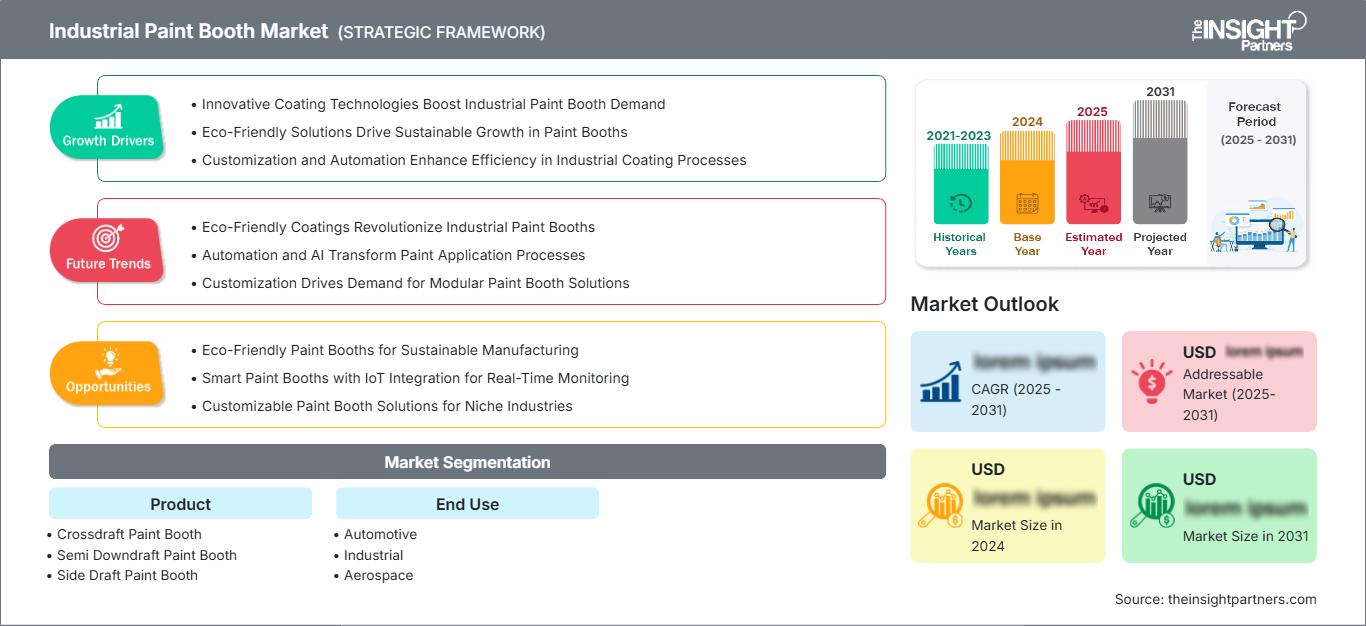
The industrial paint booth market was valued at US$ 792.91 Million in 2025 and is projected to reach US$ 1,011.64 Million by 2034, registering a CAGR of 2.74% during 2026–2034. Demand reflects the continuing need for controlled coating environments across automotive, industrial, and aerospace operations, where airflow management, overspray capture, operator protection, and finish consistency remain central purchasing criteria.
Within North America, the industrial paint booth market size is expected to advance at a modeled 2.4–2.8% CAGR through 2034. Replacement of aging collision-repair infrastructure and investment in code-compliant, energy-conscious finishing lines support demand. Remote monitoring, variable-frequency drives, waterborne-coating compatibility, and disciplined filter management increasingly shape procurement, particularly among multi-site repair groups and manufacturers seeking repeatable quality with lower operating costs.
Industrial Paint Booth Market Assessment and Insights
- North America represented a modeled 31–33% share in 2025 and is expected to grow at a 2.4–2.8% CAGR during 2026–2034, supported by automotive refinishing, industrial retrofits, and enforcement of ventilation and emissions requirements.
- US accounted for a modeled 80–82% of North American revenue in 2025 and is projected to expand at a 2.5–2.9% CAGR during 2026–2034.
- Europe held a modeled 27–29% share in 2025 and should advance at a 2.1–2.5% CAGR through 2034, with Germany leading and the UK, France, Italy, and Spain sustaining replacement demand.
- Asia Pacific captured a modeled 30–32% share in 2025 and is forecast to record a 3.3–3.7% CAGR, led by China, Japan, South Korea, and India as manufacturing capacity expands.
- Largest Segment Automotive held a modeled 52–56% market share in 2025 and is expected to register a 2.6–3.0% CAGR during 2026–2034.
- High Growth Segment Aerospace represented a modeled 12–15% market share in 2025 and is projected to grow at a 3.4–3.8% CAGR during 2026–2034.
- Key companies analyzed in detail: SAIMA of North America, Inc. (Accudraft), Spray Systems, Inc., Global Finishing Solutions LLC, Standard Tools and Equipment Co. Inc., Rely-On Technologies, RTT Engineered Solutions, Airblast AFC, Nova Verta International S.p.A., Celiber Industries, and Rohner Finishing Systems.
Source: The Insight Partners' analysis based on proprietary research, government publications, company annual reports, investor presentations, industry databases, and expert interviews.
The Industrial Paint Booth Market has moved from basic ventilated structures to sophisticated process tools that include balance ventilation, filtering, curing, lighting, and digital controls. Crossdraft booths remain a cost-effective choice for facilities where digging below the floor is not practical, but semi downdraft and side draft booths offer improved contamination control and visibility. The approach to production will move towards modular cells, recipes, variable-frequency drives, and connectivity, thus saving energy, increasing coating consistency, and allowing manufacturers to expand their capacity without rebuilding their whole finishing line.
In terms of the forecast period, spending needs to extend from traditional automotive clusters to Asia's manufacturing zones and Gulf region's infrastructure development projects. Permits related to the environment, combustible vapors, and operator exposure will favor certified solutions, and the need for finishing of aircraft maintenance and electric vehicles components will increase the specification level of the solutions required. Booths' suppliers who can deliver not only the booths themselves but also installation and maintenance services will find themselves in better shape than just equipment providers.
Industrial Paint Booth Market Report Scope
| Report Attribute | Details |
|---|---|
| Market size in 2025 | US$ 792.91 Million |
| Market Size by 2034 | US$ 1,011.64 Million |
| Global CAGR (2026 - 2034) | 2.74% |
| Historical Data | 2021-2024 |
| Forecast period | 2026-2034 |
Industrial Paint Booth Market Analysis
Repetitive replacement, expansion and compliance drive Industrial Paint Booth Market. Refinishing booths are a necessity for automobile repair shops, whereas steel producers, aircraft makers, rail makers, and metal fabricators all need a suitable environment for their highly sophisticated coating process.
The booth system includes steel enclosures manufacturing, fans, burners, filters, controls, lighting, fire protection, installation, permit coordination, and maintenance. The supply chain favors those suppliers that have the capability of engineering and service in the field, since booth performance is an integrated function and not an add-on piece. Lead times are very sensitive to motors, control panels, installation, and customer site civil work.
The paint booth industrial market analysis has revealed that the competition in the market is fragmented across global integrators and regional players. The engineered systems and lifecycle are stressed by SAIMA of North America, Inc. (Accudraft), Global Finishing Solutions LLC, and RTT Engineered Solutions, while customizing and application skills are the main criteria for winning by Spray Systems, Inc., Airblast AFC, Rely-On Technologies, and Rohner Finishing Systems.
The focus of investment is being shifted towards intelligent control systems, standardization, energy recovery, curing time, and retrofitting systems. Standard Tools and Equipment Co. Inc. targets users who care about value, while Nova Verta International S.p.A. and Celiber Industries increase geographic options. Positioning of companies is becoming more dependent on compliance, commissioning services, local service, and throughput.
● REPORT CUSTOMIZATION
Tailor This Report To Align With Your Specific Business Requirements
This report can be customized to align precisely with your business objectives, scope, and target markets. Customization options include tailored segmentation, geography, competitive analysis, and strategic insights to support informed decision-making.
Customize This Report →WHAT YOU CAN ADJUST
- ● Segmentations
- ● Geography
- ● Competitive Analysis
- ● Language Preferences
Industrial Paint Booth Market: Strategic Insights
Regional Insights
North America industrial paint booth market
The industrial paint booth market share in North America was modeled at 31–33% in 2025, with a 2.4–2.8% CAGR expected during 2026–2034. Automotive collision repair, truck and equipment refinishing, aerospace maintenance, and fabricated-metal production sustain a diversified demand base. Replacement activity is important because installed booths require controls, burners, fans, filters, lighting, and enclosure upgrades to remain productive and code compliant.
There is a preference for systems with energy saving technology like variable frequency drives, programmed cycles, LED lights, and remote performance monitoring systems. The region also gets the advantage of having fully developed distributors, installers, and service providers that minimize downtime risks. Canada contributes through mining and transit needs while Mexico contributes automotive production and export manufacturing. Ventilation, fire safety, and hazardous air pollutant compliance improves specifications and makes integrated suppliers competitive against low-cost enclosures suppliers.
U.S. Industrial Paint Booth Market
The U.S. accounted for a modeled 80–82% of North American revenue in 2025 and is projected to grow at a 2.5–2.9% CAGR through 2034. The high volume of vehicles, extensive collision repair network, production of defense and aerospace products, and wide range of metal fabrication activities drive purchases in the market. Multiple shop owners now require repeatable booth design and control integration to optimize usage, control filtration efficiency, and achieve coating uniformity.
SAIMA of North America, Inc. (Accudraft), Global Finishing Solutions LLC, Spray Systems, Inc., RTT Engineered Solutions, and Rohner Finishing Systems are all represented in the U.S. by way of their products and services. The current trend in the application process is the provision of booths compatible with waterborne paints, booths for large equipment, recirculation booths, and booths with fast curing options. The compliance issues of federal hazardous air pollutants regulations and local fire codes affect the approval process and maintenance of equipment.
Europe Industrial Paint Booth Market
Europe represented a modeled 27–29% Industrial Paint Booth Market share in 2025 and is expected to expand at a 2.1–2.5% CAGR during 2026–2034. Germany is driven by demand for high-quality automotive, machinery, and coatings of industrial machinery. High prices for energy and regulations on emissions promote heat recovery, recycling, efficient motors, and proper maintenance practices. Also, Germany’s developed automotive and aerospace industries help in replacement cycles.
Aerospace and motorsport needs along with repairs and special production make the UK the country that has a lot of opportunities for the industry. In France, the need for aerospace coatings along with transport equipment coatings exists. Italy has demand for automotive, machinery, and domestic booth coating solutions, whereas Spain is driven by vehicle and part production. Retrofit projects are crucial because many of such facilities are limited in terms of space and approvals.
APAC Industrial Paint Booth Market
Asia Pacific held a modeled 30–32% share in 2025 and should post a 3.3–3.7% CAGR through 2034, the fastest regional pace. China leads on manufacturing scale, automotive output, machinery, and aerospace investment, while Japan and South Korea sustain advanced automation and quality requirements.
India adds vehicle, rail, defense, and general industrial capacity; Australia contributes mining-equipment and maintenance demand. Policy support for domestic manufacturing, industrial upgrading, and cleaner production encourages modern ventilation, filtration, and energy controls. Local fabrication remains price competitive, but complex projects favor suppliers offering validated engineering and dependable commissioning.
Middle East & Africa Industrial Paint Booth Market
The Middle East and Africa market is expected to advance at a modeled 2.8–3.2% CAGR during 2026–2034. Saudi Arabia leads as industrial diversification, aviation maintenance, defense localization, and infrastructure programs expand finishing requirements. The UAE supports aerospace services and premium automotive repair.
South Africa provides the region’s broadest established automotive and industrial base, while the rest of MEA offers selective opportunities in transport, energy equipment, and fabrication. Harsh ambient conditions increase cooling, filtration, and maintenance requirements. Project success depends on local installation capability, spare-parts access, and designs adapted to dust, heat, and variable utility quality.
Segmentation Analysis
Product
The Product segment is projected to expand at a modeled 2.5–2.9% CAGR during 2026–2034. The industrial paint booth market scope covers three specified airflow architectures, each balancing capital cost, floor constraints, finish quality, and overspray control. Selection depends on workpiece geometry, throughput, coating chemistry, permitting, and whether excavation or raised-floor construction is feasible.
- Crossdraft Paint Booth – Crossdraft units retain a strong value position because horizontal airflow simplifies installation and lowers civil-work requirements, supporting repair shops, fabrication cells, and facilities with constrained capital budgets.
- Semi Downdraft Paint Booth – Semi downdraft designs balance improved contamination control with reduced excavation, making them strategically important for retrofit projects that need cleaner finishes without the full cost of downdraft infrastructure.
- Side Draft Paint Booth – Side draft booths attract users handling large or irregular workpieces because lateral exhaust can support even airflow, accessible maintenance, and flexible installation in industrial and aerospace environments.
End Use
The End Use segment is expected to record a modeled 2.7–3.1% CAGR during 2026–2034. Automotive remains the volume anchor, industrial applications diversify revenue across machinery and fabricated products, and aerospace raises technical requirements. Buyers increasingly assess booths as process systems, linking airflow, curing, controls, and service to throughput, finish acceptance, and regulatory compliance.
- Automotive – Automotive contributes the broadest demand through OEM production, collision repair, commercial vehicles, and component finishing, with purchasing centered on repeatability, waterborne compatibility, rapid cycles, energy efficiency, and network standardization.
- Industrial – Industrial users span machinery, agriculture, rail, construction equipment, metal fabrication, and woodworking, creating demand for configurable enclosures that accommodate varied workpiece sizes, coating systems, and batch-production schedules.
- Aerospace – Aerospace is strategically significant because aircraft and component finishes require contamination control, large working envelopes, documentation, and precise environmental management, supporting customized systems and high-value lifecycle service.
Opportunity Snapshot
| End Users | Revenue Contribution | Trend Tag | Adoption Stage |
| Automotive | High | Connected Refinish | Mature |
| Industrial | High | Flexible Cells | Scaling |
| Aerospace | Medium | Precision Finishing | Scaling |
Industrial Paint Booth Market Growth Drivers and Impact Analysis
Compliance-Led Replacement of Aging Booth Infrastructure
Regulatory obligations in the Industrial Paint Booth Market convert booth maintenance from discretionary spending into operational necessity. The regulations for hazardous air pollutants in surface coating for U.S. facilities mandate that there should be a controlled spraying area, good transfer efficiency and good filter management techniques. In addition, fire codes address ventilation and combustible vapor concerns. In Europe, the same requirements are met through enhanced energy and emissions standards. Over time, the aging systems will exhibit decreasing fan efficiency, damaged panels, outdated controls, poor lighting and poor pressure control. Upgrading such systems will help to enhance the quality of finish and facilitate compliance monitoring. The commercial value of the system does not end in the sale of booths since there is continuous revenue through air flow testing, burners, controls, filtration and fire suppression interface among others.
Rising Value of Consistent, Contamination-Controlled Finishes
Finish defects result in the costs associated with rework, wastage, late delivery, and reject by the customer, which makes proper airflow an economic issue. The clearcoat systems for automobiles, paints for aerospace, and the protective coatings for industry need controlled airspeeds, temperatures, cleanliness, and exhausts. Semi downdraft and side draft systems make for better control of the movement of the overspray where downdraft construction cannot be used, and lighting is more useful to support the visual inspection of the process. Current technology enables the operator to save recipes for spraying, flashing, and curing, making for reduced variability of the processes between shifts. The effects are the greatest in shops that work with various coatings or valuable substrates because one bad coating may offset any energy savings resulting from the use of less expensive equipment.
Expansion of Automotive, Aerospace, and General Manufacturing Capacity
There is direct demand for controlled finishing environments due to new production lines and repair capability. The automotive industry is the largest end user since both production and repairs require consistent coating results. Aerospace projects have bigger facilities, require precision environment control, and involve commissioning documentation. It allows designing customized and high-end installations. Demand from general industry includes machinery, agriculture, rail, construction equipment, and metal fabrication. It provides diversification beyond reliance on one production cycle. Capacity expansions in Asia Pacific and industrial diversifications in the Gulf add to the potential customer base, while developed markets offer retrofit installations. The market effect is a mixed income approach: standard booths for small customers, modular installations for growing facilities, and custom lines for difficult products.
Industrial Paint Booth Market Future Trends
Connected Booth Intelligence Becomes a Standard Specification
The industrial paint booth market trends point toward continuous measurement of booth cycles, pressure, filter loading, burner status, energy use, alarms, and idle time. Dashboards of cloud technology will become commonplace purchasing parameters, more so among multi-facility users desiring consistent performance. Predictive alarms could set reminders for filter replacement before airflow degradation starts having an impact on finish quality or fan life. In the long run, operational data generated from experience will improve quoting, staffing, maintenance, and even capital budgets. The vendors will differentiate themselves using user-friendly interfaces, security measures for remote control, ease of retrofitting, and processes, not just sensors. It should enhance vendor-client relationship by transforming occasional maintenance into lifecycle programs.
Energy Optimization Extends Beyond Efficient Components
Future booth design will coordinate airflow, heat, cure time, and production scheduling instead of treating efficiency as a component-level feature. Variable-frequency drives, direct-fired heating, insulated panels, LED lighting, recirculation, and heat recovery will be combined with programmable operating modes that match each coating step. This approach lowers unnecessary ventilation and heating during idle, flash, or partial-load periods while preserving safety interlocks. Customers will increasingly request lifecycle-cost evidence alongside purchase price, including modeled utility use and maintenance intervals. Engineering teams that can validate savings without compromising air balance or code compliance will command stronger positions, particularly in Europe and energy-intensive industrial applications.
Industrial Paint Booth Market Opportunities
Retrofit Packages for Installed Booth Fleets
Installed booths represent an attractive serviceable base because many customers can improve performance without replacing enclosures. Investment opportunities include controls, variable-frequency drives, burners, LED lighting, pressure sensing, filter monitoring, panel sealing, airflow balancing, and accelerated curing. The industrial paint booth market forecasts support a steady rather than explosive expansion profile, making recurring retrofit and maintenance revenue strategically valuable. Suppliers should develop tiered packages with documented baseline testing, expected operating benefits, installation windows, and post-upgrade verification. Distributor training and stocked replacement components can reduce downtime. Financing or phased modernization may widen adoption among independent repair shops and mid-sized manufacturers that face compliance or productivity constraints but cannot absorb a complete greenfield project.
Localized Engineering and Service in High-Growth Corridors
Asia Pacific and selected Middle Eastern markets offer room for suppliers that pair standardized manufacturing with local application engineering. Customers need booths adapted to factory layouts, dust conditions, utilities, coating chemistry, and permitting practices, making imported equipment without service support less competitive. Investment priorities should include regional design teams, authorized installers, spare-parts hubs, and commissioning protocols. Partnerships with coating suppliers, fire-protection specialists, and automation integrators can create complete project coverage. Aerospace maintenance, electric-vehicle components, rail, defense, and heavy equipment are especially suitable because they value documentation and customization. A localized operating model also shortens response times and helps global vendors compete with price-focused fabricators while protecting quality and brand consistency.
Recent Developments
- November 2025: Global Finishing Solutions LLC presented its automotive refinish portfolio at SEMA 2025, including high-performance paint booths, prep environments, controls, and REVO Spot accelerated infrared curing. The showcased curing unit targets small repair areas and illustrates how booth suppliers are integrating application and curing technologies to improve throughput within existing shop footprints.
- December 2025: FANUC announced its new P-55/15-21A mid-size paint robot, designed for a wide range of painting applications, from general industries to automotive. The robot features a reach of more than 2 meters and a 15 kg payload capacity, supporting flexible painting of large components. It also introduces FANUC's new R-50iA controller for paint robots, with simplified maintenance and installation
Frequently Asked Questions

- Comprehensive Market Sizing and Forecast Analysis
- Detailed Segmentation Analysis
- In-Depth Market Dynamics Assessment
- Regional and Country-Level Insights
- Competitive Landscape and Company Benchmarking
- Strategic Business Intelligence
Recent Reports
Testimonials

The Insight Partners' SCADA System Market report is comprehensive, with valuable insights on current trends and future forecasts. The team was highly professional, responsive, and supportive throughout. We are very satisfied and highly recommend their services.
RAN KEDEM Partner, Reali Technologies LTDs
I requested a report on a very specific software market and the team produced the report in a few days. The information was very relevant and well presented. I then requested some changes and additions to the report. The team was again very responsive and I got the final report in less than a week.
JEAN-HERVE JENN Chairman, Future Analytica
We worked with The Insight Partners for an important market study and forecast. They gave us clear insights into opportunities and risks, which helped shape our plans. Their research was easy to use and based on solid data. It helped us make smart, confident decisions. We highly recommend them.
PIYUSH NAGPAL Sr. Vice President, High Beam Global
The Insight Partners delivered insightful, well-structured market research with strong domain expertise. Their team was professional and responsive throughout. The user-friendly website made accessing industry reports seamless. We highly recommend them for reliable, high-quality research services
YUKIHIKO ADACHI CEO, Deep Blue, LLC.
This is the first time I have purchased a market report from The Insight Partners.While I was unsure at first, I visited their web site and felt more comfortable to take the risk and purchase a market report.I am completely satisfied with the quality of the report and customer service. I had several questions and comments with the initial report, but after a couple of dialogs over email with their analyst I believe I have a report that I can use as input to our strategic planning process.Thank you so much for taking the extra time and making this a positive experience.I will definitely recommend your service to others and you will be my first call when we need further market data.
JOHN SUZUKI President and Chief Executive Officer, Board Director, BK Technologies
I wish to appreciate your support and the professionalism you displayed in the course of attending to my request for information regarding to infectious disease IVD market in Nigeria. I appreciate your patience, your guidance, and the fact that you were willing to offer a discount, which eventually made it possible for us to close a deal. I look forward to engaging The Insight Partners in the future, all thanks to the impression you have created in me as a result of this first encounter.
DR CHIJIOKE ONYIA MANAGING DIRECTOR, PineCrest Healthcare Ltd.Reason to Buy
- Informed Decision-Making
- Understanding Market Dynamics
- Competitive Analysis
- Identifying Emerging Markets
- Customer Insights
- Market Forecasts
- Risk Mitigation
- Boosting Operational Efficiency
- Strategic Planning
- Investment Justification
- Tracking Industry Innovations
- Aligning with Regulatory Trends





 Get Free Sample for