
Industrial PU Elastomer Market Growth, Share & Trends by 2034
Industrial PU Elastomer Market Size and Forecasts (2021 - 2034), Global and Regional Share, Trends, and Growth Opportunity Analysis Report Coverage : by Type (Thermoset PU Elastomer and Thermoplastic PU Elastomer); End User (Automotive, Aerospace, Industrial, Mining Equipment, Building & Construction); and Geography (North America, Europe, Asia Pacific, and South and Central America)
- Status : Data Released
- Report Code : TIPRE00040320
- Category : Chemicals and Materials
- No. of Pages : 150
- Available Report Formats :


- Last update date : August 28, 2026


2025 Market Size
US$ 3.66 Bn
Base year value
2034 Forecast
US$ 6.30 Bn
Projected by 2034
CAGR 2026-2034
6.22 %
Growth rate
Addressable Market
US$ 45.08 Bn
(2026-2034)
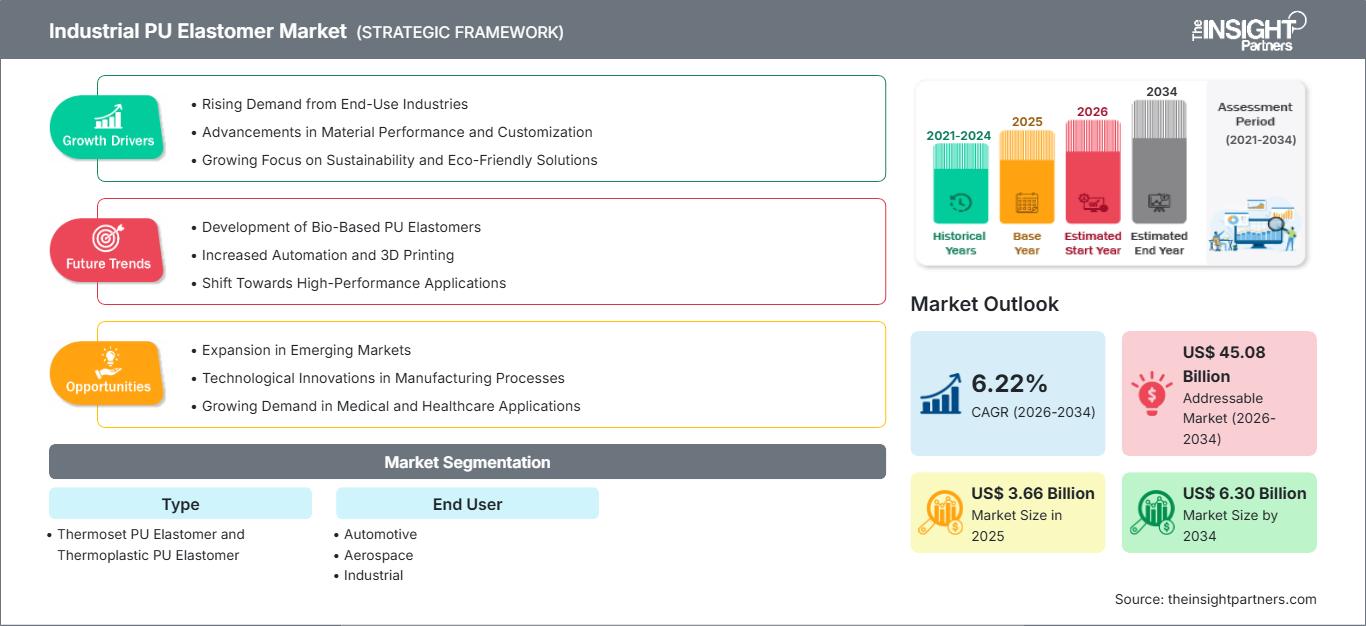
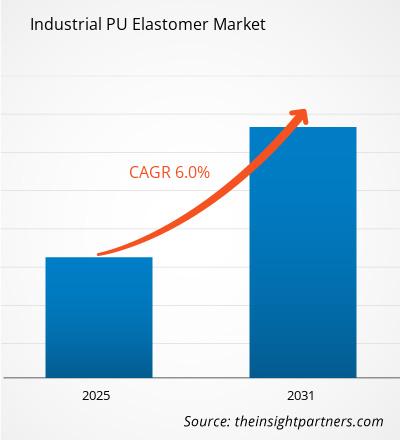
The industrial PU elastomer market was valued at US$ 3.66 Billion in 2025 and is projected to reach US$ 6.30 Billion by 2034, registering a CAGR of 6.22% during 2026–2034. Market expansion is supported by demand for durable, abrasion-resistant, lightweight, and chemically resistant elastomeric materials across automotive, aerospace, industrial, mining equipment, and building and construction applications, alongside continued substitution of conventional rubber and selected engineering plastics.
The Industrial PU Elastomer Market Size in North America represents a technically mature market, with an estimated 5.7–6.4% CAGR during 2026–2034. Growth is supported by the replacement of conventional elastomers in demanding industrial components and the continued adoption of lightweight materials in automotive and aerospace applications. Domestic manufacturing capabilities, established polyurethane processing infrastructure, and investment in automation are also strengthening demand for high-performance cast and thermoplastic polyurethane grades.
Industrial PU Elastomer Market Assessment and Insights
- North America: North America is projected to account for 25–29% share in 2025 and grow at a CAGR of 5.7–6.4% between 2026–2034, supported by automotive, aerospace, industrial machinery, and infrastructure applications requiring durable elastomeric components.
- US: The US is estimated to represent 72–77% of North America's 2025 market and expand at a CAGR of 5.6–6.3% during 2026–2034, led by aerospace, automotive, and industrial equipment demand.
- Europe: Europe is estimated at 22–26% share in 2025 and is expected to grow at 5.1–5.8% CAGR during 2026–2034, with Germany, France, Italy, and the UK providing substantial demand through automotive engineering and industrial manufacturing.
- Asia Pacific: Asia Pacific is estimated at 36–40% share in 2025 and is projected to expand at 7.0–7.8% CAGR between 2026–2034, led by China, Japan, South Korea, and India through manufacturing, transportation, mining, and construction.
- Largest Segment: Thermoplastic PU Elastomer is estimated to hold a 56–60% market share in 2025 and expand at a 6.4–7.1% CAGR during 2026–2034 because of processing flexibility and application breadth.
- High Growth Segment: Aerospace is estimated to hold a 7–10% market share in 2025 and grow at a 7.4–8.2% CAGR during 2026–2034, supported by lightweighting and demanding performance specifications.
- Key companies analyzed in detail: BASF SE, Evonik Operations GmbH, Huntsman International LLC, Asahi Kasei Corporation, DIC Corporation, Covestro AG, Dow Inc., LANXESS AG, Wacker Chemie AG, The Lubrizol Corporation, Wanhua Chemical Group Co., Ltd., Mitsui Chemicals, Inc.
Source: The Insight Partners' analysis based on proprietary research, government publications, company annual reports, investor presentations, industry databases, and expert interviews.
The evolution of technology has changed the competitive advantage from basic elasticity to performance engineering properties, such as abrasion resistance, hydrolysis resistance, low-temperature flexibility, flame retardancy, chemical resistance, and controlled hardness. The production of thermoplastics is becoming more favorable using injection molding, extrusion, overmolding, and film manufacturing processes, but the significance of thermosets lies in situations where high load-bearing performance is required.
The Industrial PU Elastomer Market Share is expected to be influenced by investment trends favoring localized production, sustainable feedstocks, circular material solutions, and application-specific formulations over the forecast period. Asia Pacific should gain manufacturing capacity, while North America and Europe remain important for specialty grades. Regulatory pressure on vehicle recyclability, emissions, material traceability, and product durability will encourage suppliers to develop lower-impact polyurethane systems without compromising mechanical performance.
Industrial PU Elastomer Market Report Scope
| Report Attribute | Details |
|---|---|
| Market size in 2025 | US$ 3.66 Billion |
| Market Size by 2034 | US$ 6.30 Billion |
| Global CAGR (2026 - 2034) | 6.22% |
| Historical Data | 2021-2024 |
| Forecast period | 2026-2034 |
Industrial PU Elastomer Market Analysis
Demand is based on industries desiring increased lifespan, reduced maintenance and lightweight components. The benefits of the use of PU elastomers include resilience, abrasion resistance, tear resistance, energy absorption, and chemical resistance. Applications include rollers, seals, wheels, belts, bushings, cable protection, hoses, vibration control components and interior parts. Supply factors include raw material pricing, plant capacity, energy prices and local availability of intermediate products.
The supply dynamics continue to be affected by raw material pricing, plant utilization, energy prices and local availability of polyurethane intermediates. Increasing competition is being observed in differentiated products, which can be seen in the use of specialized hardness, processing characteristics, flame retardancy, hydrolysis resistance and low-emission formulas. This allows producers to differentiate themselves through premium positioning in technical applications, with commodity parts being vulnerable to raw material cost increases.
Competition combines integrated chemical producers with specialty polyurethane and elastomer suppliers. BASF SE, Covestro AG, Huntsman International LLC, and The Lubrizol Corporation maintain broad material portfolios, while LANXESS AG and Wacker Chemie AG strengthen specialty-performance capabilities. Wanhua Chemical Group Co., Ltd. benefits from an expanding Asian manufacturing base, while DIC Corporation, Asahi Kasei Corporation, Mitsui Chemicals, Inc., Dow Inc., and Evonik Operations GmbH compete through formulation expertise and application development.
The Industrial PU Elastomer Market Report indicates that investment is increasingly directed toward regional supply security, sustainable raw materials, advanced processing, and differentiated grades rather than capacity expansion alone. BASF SE has localized flame-retardant TPU production in Shanghai, while Covestro AG emphasizes circular automotive material concepts. Evonik Operations GmbH continues investing in polyurethane-related additives. Such strategies indicate that competitive positioning is moving toward technical support, regulatory readiness, material efficiency, and application-specific innovation.
● REPORT CUSTOMIZATION
Tailor This Report To Align With Your Specific Business Requirements
This report can be customized to align precisely with your business objectives, scope, and target markets. Customization options include tailored segmentation, geography, competitive analysis, and strategic insights to support informed decision-making.
Customize This Report →WHAT YOU CAN ADJUST
- ● Segmentations
- ● Geography
- ● Competitive Analysis
- ● Language Preferences
Industrial PU Elastomer Market: Strategic Insights
Regional Insights
North America Industrial PU Elastomer Market
North America is estimated to represent 25–29% of the global Industrial PU Elastomer Market in 2025 and is projected to grow at a 5.7–6.4% CAGR through 2034. The US is the major contributor to demand in the region, owing to the production of aerospace products, automotives, industrial automation, mining equipment, and maintenance of infrastructure. Elastomers made of PU material can prove quite effective in cases requiring abrasion resistance, shock absorbers, and dimensional stability.
PU wheel, rollers, seals, bushings, conveyor components, and protective systems used in manufacturing of industrial equipment have helped cut down on the frequency of maintenance required. In the case of aerospace products, the material is light and high performing, whereas in the case of automotives, thermoplastic PU material is used for interior, cable, sealing, and protective applications.
U.S. Industrial PU Elastomer Market Market
The US represents an estimated 72–77% of North America's 2025 Industrial PU Elastomer Market and is projected to grow at a 5.6–6.3% CAGR during 2026–2034. Demand is supported by aerospace, automotive, industrial machinery, logistics equipment, and construction applications. Domestic engineering capabilities and extensive industrial replacement markets reinforce recurring demand for durable elastomer components.
Major suppliers maintain technical and commercial operations in the country, supporting formulation development and customer qualification. Automotive applications include seals, interior components, protective films, and vibration-control parts, while industrial users apply PU elastomers in wheels, rollers, belts, and wear-resistant components. Increasing automation and demand for longer service intervals should favor higher-performance formulations over conventional elastomer solutions.
Europe Industrial PU Elastomer Market Market
Europe is estimated to account for 22–26% of the 2025 Industrial PU Elastomer Market and is projected to expand at a 5.1–5.8% CAGR through 2034. Germany is the dominant country due to automotive engineering, machines, industrial automation, and specialty chemicals. There are also sustainability needs driving the use of recyclable thermoplastics and eco-friendlier polyurethane products.
The United Kingdom sustains demand through aerospace, automobiles, construction, and machinery sectors. Germany is the largest manufacturer in the area, producing PU products in machinery, transport, and material handling industries. France, Italy, and Spain participate through automobile production, machinery, infrastructure, and construction processes, with Italy specifically participating in machinery and processing machines. Vehicle recycling regulations in Europe will drive demand for recyclable products.
APAC Industrial PU Elastomer Market Market
APAC is estimated to hold 36–40% share of the Industrial PU Elastomer Market in 2025 and is projected to grow at a 7.0–7.8% CAGR through 2034, making it the leading regional market. China remains dominant, followed by Japan, South Korea, India, and Australia. Manufacturing expansion and infrastructure investment support broad consumption.
China's automotive, electronics, industrial machinery, mining, and construction industries provide the largest application base. Japan and South Korea emphasize precision and high-performance materials, while India benefits from expanding automotive manufacturing and infrastructure. Australia contributes through mining equipment and heavy-duty applications. Regional policy support for manufacturing localization, electric mobility, and industrial modernization further supports demand for engineered elastomers.
Middle East & Africa Industrial PU Elastomer Market Market
The Middle East and Africa Industrial PU Elastomer Market demand is smaller but supported by infrastructure, mining, oil and gas-related equipment, logistics, and construction. Saudi Arabia and the UAE lead Middle Eastern consumption, while South Africa represents a major African market. Regional growth is estimated at a 5.8–6.6% CAGR during 2026–2034.
Saudi Arabia and the UAE benefit from large infrastructure and industrial diversification programs, while South Africa's mining sector requires abrasion-resistant wheels, liners, rollers, seals, and material-handling components. Rest-of-MEA demand remains linked to construction, energy infrastructure, and industrial maintenance. High temperatures, dust exposure, mechanical wear, and chemical contact create application requirements favorable to appropriately formulated PU elastomers.
Segmentation Analysis
Type
The Industrial PU Elastomer Market Forecast indicates that type segmentation comprises Thermoset PU Elastomer and Thermoplastic PU Elastomer. Thermoplastic PU Elastomer is estimated to grow at a 6.4–7.1% CAGR during 2026–2034, supported by processing efficiency, recyclability potential, design flexibility, and growing use in automotive and industrial components. Thermoset materials remain important for heavy-duty cast applications requiring high load-bearing capability and abrasion resistance.
- Thermoset PU Elastomer: Thermoset grades remain strategically important in cast wheels, rollers, bushings, seals, mining components, and high-load industrial parts where abrasion resistance, resilience, and dimensional stability outweigh remolding flexibility.
- Thermoplastic PU Elastomer: Thermoplastic grades benefit from injection molding, extrusion, overmolding, film processing, and shorter manufacturing cycles, supporting applications requiring flexible design, consistent quality, surface performance, and scalable production.
End User
The Industrial PU Elastomer Market Trends indicate that end user segmentation includes Automotive, Aerospace, Industrial, Mining Equipment, and Building & Construction. Automotive is estimated to grow at a 6.1–6.8% CAGR during 2026–2034, supported by lightweighting, electrification, durability requirements, and expanded use of engineered polymer components. Industrial applications provide a broad demand base across machinery, material handling, and automation.
- Automotive: Demand centers on seals, cable protection, interior components, vibration-control systems, films, and molded parts where low weight, durability, abrasion resistance, and design flexibility support vehicle performance.
- Aerospace: Aerospace users prioritize lightweight, reliable, chemically resistant elastomeric components, particularly where material performance must remain consistent under demanding mechanical, thermal, and environmental operating conditions.
- Industrial: Industrial demand spans rollers, wheels, belts, profiles, seals, gaskets, hoses, vibration-control parts, and protective components, making this segment highly diversified across manufacturing and automation.
- Mining Equipment: Mining applications emphasize abrasion resistance, impact absorption, load capacity, and service life, supporting polyurethane use in wheels, screens, liners, rollers, and material-handling components.
- Building & Construction: Construction applications use polyurethane elastomers where flexibility, weather resistance, durability, sealing performance, and resistance to repeated mechanical exposure are required in demanding building environments.
Opportunity Snapshot
| End User | Revenue Contribution | Trend Tag | Adoption Stage |
| Automotive | High | Lightweighting | Scaling |
| Aerospace | Medium | Material Efficiency | Scaling |
| Industrial | High | Wear Protection | Mature |
| Mining Equipment | Medium | Abrasion Control | Mature |
| Building & Construction | Medium | Durable Sealing | Scaling |
Industrial PU Elastomer Market Growth Drivers and Impact Analysis
Lightweighting and Material Substitution in Transportation
There is an ongoing effort on the part of car and aircraft makers to weigh reduced weight against durability, safety, and component life. PU Elastomers may be able to offer these properties, along with being used as a replacement for metallic parts and normal rubber components in certain applications. The move towards electrification will accentuate this trend since there is a need for EVs in terms of cable protection, sealing, vibration dampening, and light interior components. However, the commercial viability is high where there is a demonstrated cycle life benefit and not just materials substitution. There may be other situations where re-designing the component may allow the use of overmolding or integral design, which minimizes assembly operations. As the qualification cycles move forward, the demand will likely favor engineered grades with low emissions, controlled hardness, thermal stability, and repeatability under mechanical loading.
Expansion of Automated and High-Speed Industrial Equipment
Industrial automation leads to increased cycles of operation of rollers, belts, wheels, guides, seals, jackets of the cables, and vibration control elements. PU elastomers are well-suited for applications where equipment users require high abrasion resistance, rebound, dimensional stability, and minimal maintenance needs. Automated warehouses, robots, conveyor systems, machine tools, and material handling machinery thus result in additional demand for engineered elastomer components. The effect is not limited to the volumes of materials used, as higher efficiency of equipment results in increasing the commercial value of the long service life of components. The ability to provide special grades for various speeds, loads, temperatures, and chemical environments gives a competitive advantage to the suppliers of PU elastomers.
Infrastructure and Heavy-Duty Equipment Modernization
Investments in infrastructure, modernization of heavy equipment, all contribute to the need for components that can work in conditions of abrasion, impact, moisture, dust, and varying loads. The use of such components as a way to avoid unscheduled machine stoppages becomes more relevant for mining, construction, material handling, and infrastructure maintenance. The use of polyurethane elastomers can be beneficial as they possess both properties of toughness and resilience. For instance, wear-resistant polyurethane components may increase the availability of mining equipment due to the fact that the presence of abrasive materials leads to the rapid destruction of conventional materials. Thus, the commercial benefit can be associated with the cost of ownership of a particular component.
Industrial PU Elastomer Market Future Trends
Movement Toward Circular and Lower-Carbon Polyurethane Systems
In terms of material development, there will be an increased emphasis on combining mechanical characteristics with environmentally measurable characteristics in the future. It is anticipated that material suppliers will enhance their portfolio of recycled, bio-based, mass balance, and low-carbon feedstock while simultaneously enhancing their traceability by means of certifications and digital material tracking. Thermoplastic polyurethane has a particular edge in the case of circularity as its manufacturing scrap can be recovered and reprocessed under specific conditions. There might be a possibility of using the automotive sector as one of the first testing grounds due to the search for materials that will suit vehicle recycling criteria by the OEMs. Formulations will focus on reduced processing energy, enhanced yield, and product lifetime extension.
Advanced Functional Grades for Electrification and Smart Industry
The next wave of polyurethane development is expected to focus on specialized functionality for electrification, robotics, sensors, and automated equipment. Flame-retardant, halogen-free, low-emission, electrically insulating, static-dissipative, and high-flexibility grades can address requirements emerging from EV charging infrastructure, industrial robotics, cable systems, and connected machinery. Material suppliers are likely to develop narrower performance windows around application-specific requirements rather than relying exclusively on broad general-purpose grades. Digital simulation and process monitoring should also improve formulation consistency and shorten customer qualification cycles. As equipment becomes more compact and highly utilized, elastomer components will face tighter requirements for thermal management, dynamic fatigue, chemical resistance, and dimensional stability. This trend should increase the value of specialty TPU and engineered cast PU systems relative to undifferentiated materials.
Industrial PU Elastomer Market Opportunities
Localized Specialty Production in High-Growth Manufacturing Economies
A major opportunity exists for suppliers to establish or expand localized specialty production in China, India, and other Asian manufacturing centers. Local production can shorten lead times, improve formulation support, reduce exposure to international freight disruptions, and allow faster response to OEM qualification requirements. The opportunity is particularly attractive for flame-retardant cable materials, automotive grades, industrial rollers, hoses, and mining components. Producers can combine regional compounding with centralized technology platforms, allowing common formulations to be adapted to local processing equipment and regulatory requirements. Strategic partnerships with component manufacturers can accelerate market entry because elastomer adoption depends heavily on application validation. Companies that combine local technical service with reliable feedstock access can strengthen customer retention and reduce the competitive disadvantage associated with importing specialized grades.
High-Performance Mining and Infrastructure Component Development
Mining and infrastructure provide opportunities for polyurethane suppliers to move beyond commodity component sales toward engineered solutions based on service-life extension. Components such as rollers, screens, liners, wheels, seals, and impact elements can be designed around specific abrasive media, load profiles, temperatures, and maintenance schedules. Suppliers can use application testing to demonstrate reduced replacement frequency and lower downtime, supporting value-based pricing. The opportunity is especially relevant in Australia, South Africa, Saudi Arabia, and other regions with substantial mining or infrastructure activity. Partnerships with equipment manufacturers and maintenance contractors can create recurring demand because component specifications are often linked to equipment platforms. Developing region-specific grades for dust, high temperatures, hydrolysis, and severe abrasion can further differentiate suppliers from general-purpose polyurethane producers.
Recent Developments
- April 2026: Evonik Operations GmbH inaugurated an expanded specialty amine production facility in Nanjing following a double-digit-million-euro investment. The expansion strengthens supply security and access to polyurethane-related additives, with China identified as an important growth market for higher-performance and more sustainable application technologies.
- March 2026: BASF SE began commercial production of its Elastollan flame-retardant TPU grade at its Shanghai plant. The localized portfolio includes flame-retardant and halogen-free grades intended for cable applications such as industrial automation, robotics, and EV charging, strengthening regional supply responsiveness and supporting more demanding compliance requirements.
Frequently Asked Questions

- Comprehensive Market Sizing and Forecast Analysis
- Detailed Segmentation Analysis
- In-Depth Market Dynamics Assessment
- Regional and Country-Level Insights
- Competitive Landscape and Company Benchmarking
- Strategic Business Intelligence
Recent Reports
Testimonials

The Insight Partners provided valuable market intelligence that supported our global go-to-market strategy. Their team was professional, responsive, and attentive to our feedback, providing thoughtful analysis and helpful methodological clarifications throughout the project.
Junmo Kim Chief Financial Officer (CFO), Enertech Co., Ltd.
The Insight Partners' SCADA System Market report is comprehensive, with valuable insights on current trends and future forecasts. The team was highly professional, responsive, and supportive throughout. We are very satisfied and highly recommend their services.
RAN KEDEM Partner, Reali Technologies LTDs
I requested a report on a very specific software market and the team produced the report in a few days. The information was very relevant and well presented. I then requested some changes and additions to the report. The team was again very responsive and I got the final report in less than a week.
JEAN-HERVE JENN Chairman, Future Analytica
We worked with The Insight Partners for an important market study and forecast. They gave us clear insights into opportunities and risks, which helped shape our plans. Their research was easy to use and based on solid data. It helped us make smart, confident decisions. We highly recommend them.
PIYUSH NAGPAL Sr. Vice President, High Beam Global
The Insight Partners delivered insightful, well-structured market research with strong domain expertise. Their team was professional and responsive throughout. The user-friendly website made accessing industry reports seamless. We highly recommend them for reliable, high-quality research services
YUKIHIKO ADACHI CEO, Deep Blue, LLC.
This is the first time I have purchased a market report from The Insight Partners.While I was unsure at first, I visited their web site and felt more comfortable to take the risk and purchase a market report.I am completely satisfied with the quality of the report and customer service. I had several questions and comments with the initial report, but after a couple of dialogs over email with their analyst I believe I have a report that I can use as input to our strategic planning process.Thank you so much for taking the extra time and making this a positive experience.I will definitely recommend your service to others and you will be my first call when we need further market data.
JOHN SUZUKI President and Chief Executive Officer, Board Director, BK Technologies
I wish to appreciate your support and the professionalism you displayed in the course of attending to my request for information regarding to infectious disease IVD market in Nigeria. I appreciate your patience, your guidance, and the fact that you were willing to offer a discount, which eventually made it possible for us to close a deal. I look forward to engaging The Insight Partners in the future, all thanks to the impression you have created in me as a result of this first encounter.
DR CHIJIOKE ONYIA MANAGING DIRECTOR, PineCrest Healthcare Ltd.Reason to Buy
- Informed Decision-Making
- Understanding Market Dynamics
- Competitive Analysis
- Identifying Emerging Markets
- Customer Insights
- Market Forecasts
- Risk Mitigation
- Boosting Operational Efficiency
- Strategic Planning
- Investment Justification
- Tracking Industry Innovations
- Aligning with Regulatory Trends





 Get Free Sample for