
Industrial Rubber Market Trends, Size & Forecast by 2034
Coverage: by Type (Natural Rubber, Synthetic Rubber); Application (Wire and Cables, Hoses, Belts, Adhesives); End Use (Automotive, Aerospace, Building and Construction, Industrial Machinery, Electrical and Electronics, Healthcare, Agriculture) , and Geography (North America, Europe, Asia Pacific, and South and Central America)
- Status : Data Released
- Report Code : TIPRE00009227
- Category : Chemicals and Materials
- No. of Pages : 150
- Available Report Formats :


- Last update date : August 27, 2026


2025 Market Size
US$ 26.26 Bn
Base year value
2034 Forecast
US$ 36.41 Bn
Projected by 2034
CAGR 2026-2034
3.69 %
Growth rate
Addressable Market
US$ 284.53 Bn
(2026-2034)
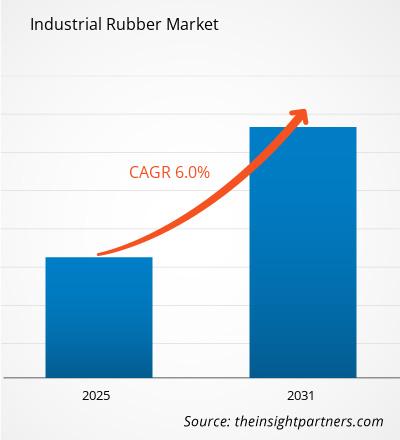
The industrial rubber market was valued at US$ 26.26 Billion in 2025 and is projected to reach US$ 36.41 Billion by 2034, registering a CAGR of 3.69% during 2026–2034. Market expansion is supported by the continued use of elastomeric materials in industrial equipment, transportation systems, electrical insulation, construction components, and specialized applications requiring flexibility, sealing performance, abrasion resistance, and durability under demanding operating conditions.
North America represents a technologically mature but strategically important demand center, with the industrial rubber market size expected to expand at an estimated CAGR of 2.8–3.2% during 2026–2034. Replacement demand for industrial hoses, belts, seals, and electrical components supports consumption, while investment in advanced manufacturing and transportation equipment increases demand for specialty synthetic elastomers with improved thermal, chemical, and operational performance.
Industrial Rubber Market Assessment and Insights
- North America: North America accounted for an estimated 15–19% share in 2025 and is expected to grow at a CAGR of 2.8–3.2% between 2026–2034, supported by automotive production, industrial equipment replacement, electrical applications, and increasing adoption of higher-performance synthetic rubber formulations.
- US: The U.S. represented approximately 84–89% of North American demand in 2025 and is projected to expand at a CAGR of 2.9–3.3% during 2026–2034, supported by manufacturing, transportation, construction, and specialized industrial applications.
- Europe: Europe held an estimated 20–24% share in 2025 and is expected to register a CAGR of 2.7–3.1% during 2026–2034. Germany, the UK, France, Italy, and Spain remain important demand centers for automotive, machinery, construction, and electrical applications.
- Asia Pacific: Asia Pacific accounted for approximately 43–47% of the industrial rubber market share in 2025 and is anticipated to grow at a CAGR of 4.1–4.5% between 2026–2034. China, Japan, South Korea, and India lead consumption through manufacturing, automotive production, infrastructure development, and expanding industrial capacity.
- Largest Segment: Synthetic Rubber represented an estimated 68–72% market share in 2025 and is projected to grow at a CAGR of 3.8–4.2% during 2026–2034, supported by demand for application-specific resistance and performance characteristics.
- High Growth Segment: Electrical and Electronics accounted for approximately 8–12% market share in 2025 and is expected to expand at a CAGR of 4.4–4.8% during 2026–2034, supported by insulation, sealing, protection, and thermal-management requirements.
- Key companies analyzed in detail: The Goodyear Tire & Rubber Company, JSR Corporation, Kumho Petrochemical Co., Ltd., LANXESS AG, LG Chem Ltd., PJSC Nizhnekamskneftekhim, China Petroleum & Chemical Corporation, TSRC Corporation, Versalis S.p.A., ZEON CORPORATION.
Source: The Insight Partners' analysis based on proprietary research, government publications, company annual reports, investor presentations, industry databases, and expert interviews.
Production patterns within the industrial rubber market have shifted toward higher-value compounds designed for specific operating environments rather than standardized elastomer grades alone. Synthetic rubber increasingly supports applications requiring resistance to heat, oils, chemicals, weathering, and electrical stress, while natural rubber retains importance where elasticity and fatigue resistance are critical. Manufacturing is also becoming more regionally diversified as processors seek supply resilience, shorter lead times, and improved control over feedstock exposure.
Looking ahead, investment opportunities are expected to strengthen in Asian manufacturing economies, selected Middle Eastern industrial hubs, and applications linked to electrification and infrastructure renewal. Regulatory attention toward product durability, material efficiency, emissions, and circularity is encouraging reformulation and greater use of recycled or renewable feedstocks. These changes are likely to support differentiated growth across the industrial rubber market rather than uniform expansion across all rubber grades and applications.
Industrial Rubber Market Report Scope
| Report Attribute | Details |
|---|---|
| Market size in 2025 | US$ 26.26 Billion |
| Market Size by 2034 | US$ 36.41 Billion |
| Global CAGR (2026 - 2034) | 3.69% |
| Historical Data | 2021-2024 |
| Forecast period | 2026-2034 |
Industrial Rubber Market Analysis
Demand for industrial rubber is closely linked to equipment operating cycles, infrastructure activity, automotive production, and the need to manage vibration, pressure, temperature, and fluid transfer. The industrial rubber market growth outlook is therefore shaped by both new equipment production and the substantial replacement market for hoses, belts, insulation, seals, and related components. Synthetic materials remain important where application requirements exceed the performance range of conventional natural rubber.
The value chain begins with natural-rubber cultivation or petrochemical feedstocks and extends through monomer production, polymerization, compounding, processing, fabrication, and distribution of finished industrial products. Supply conditions remain sensitive to crude-derived feedstock costs, regional production capacity, and natural rubber availability. Manufacturers increasingly balance local sourcing with global procurement to reduce supply disruptions and maintain compound consistency.
Competitive conditions are characterized by vertically integrated petrochemical producers, specialized synthetic-rubber manufacturers, and multinational suppliers with application-specific portfolios. The industrial rubber market analysis indicates that technological differentiation increasingly depends on compound formulation, sustainability credentials, processing expertise, and the ability to meet customer specifications rather than production scale alone. This creates opportunities for both global suppliers and focused specialists.
In terms of competitive positioning of firms, The Goodyear Tire & Rubber Company, JSR Corporation, Kumho Petrochemical Co., Ltd., LANXESS AG, LG Chem Ltd., PJSC Nizhnekamskneftekhim, China Petroleum & Chemical Corporation, TSRC Corporation, Versalis S.p.A., and ZEON CORPORATION are exposed to major synthetic rubber value chains. More strategic investments are made towards specialty rubbers, less harmful production processes, supply assurance, and materials intended for advanced uses in automobiles, electronics, and industry.
● REPORT CUSTOMIZATION
Tailor This Report To Align With Your Specific Business Requirements
This report can be customized to align precisely with your business objectives, scope, and target markets. Customization options include tailored segmentation, geography, competitive analysis, and strategic insights to support informed decision-making.
Customize This Report →WHAT YOU CAN ADJUST
- ● Segmentations
- ● Geography
- ● Competitive Analysis
- ● Language Preferences
Industrial Rubber Market: Strategic Insights

Regional Insights
North America Industrial Rubber Market
North America accounted for an estimated 15–19% share of the industrial rubber market in 2025 and is projected to expand at a CAGR of 2.8–3.2% during 2026–2034. Replacement demand remains a major structural support factor because industrial hoses, belts, seals, insulation systems, and vibration-control components require periodic renewal across manufacturing and transportation assets. Investments in advanced manufacturing, grid modernization, construction equipment, and specialized mobility applications are also increasing demand for compounds offering greater thermal, chemical, and mechanical resistance.
However, the area is more concerned about formulation excellence, reliability of supply chain and functional performance of applications as opposed to increasing production volumes only. The producers and compounders have the advantage of using the existing petrochemicals infrastructure and the presence of major consumers nearby. Increasing electrification of industrial machinery and automobiles is driving the need for specialized insulation and sealing materials, while increasing automation is driving demand for robust parts used in machinery.
U.S. Industrial Rubber Market
The Industrial Rubber Market Report indicates that the U.S. represented approximately 84–89% of North American demand in 2025 and is anticipated to register a CAGR of 2.9–3.3% during 2026–2034. Its size indicates a diversified production capability across automotive, industrial machines, aerospace, construction equipment, electrical systems, and medical devices. Its demand is driven by original equipment manufacturing and replacement markets, resulting in continuous demand for hoses, belts, seals, insulating materials, and vibration management elements.
The existence of raw-material suppliers, compounders, processors, and downstream producers facilitates domestic value chain integration. Rising demand is driving a preference for synthetic rubber, which can withstand high temperatures, fluids, electricity, and mechanical wear. The creation of semiconductor plants, energy infrastructure, logistics networks, and advanced manufacturing capabilities is opening up new avenues for specialized components. But rising prices of raw materials and shifting trade policies make it necessary to be adaptable.
Europe Industrial Rubber Market
Europe accounted for an estimated 20–24% share of the Industrial Rubber Market in 2025 and is expected to grow at a CAGR of 2.7–3.1% through 2034. Germany remains the leading regional market, supported by automotive, machinery, chemical-processing, and industrial equipment industries. The transition toward electrified mobility and advanced manufacturing is increasing demand for technically differentiated elastomer compounds, particularly where thermal resistance, fluid compatibility, and electrical protection are critical.
These five countries together constitute a diversified base for demand. The United Kingdom has the advantage of demand from aerospace, automotive engineering, energy, and specialized manufacturing uses; France has demand from transportation, aerospace, construction, and electrical sectors; while Italy has machinery industry demand and Spain has automotive manufacturing and infrastructure investments demand. In Europe, environmental laws are encouraging the recycling and reuse of industrial components.
APAC Industrial Rubber Market
Asia Pacific represented approximately 43–47% of the industrial rubber market share in 2025 and is forecast to grow at a CAGR of 4.1–4.5% during 2026–2034. China remains the leading market because of its extensive manufacturing, automotive, construction, electrical, and machinery industries. Japan and South Korea maintain strong demand for high-performance materials, while India benefits from industrialization, infrastructure development, and expanding manufacturing capacity.
Regional growth is reinforced by investment in transportation networks, energy infrastructure, electronics production, and localized supply chains. Australia contributes through mining, infrastructure, and industrial maintenance applications. Government manufacturing initiatives and continued capacity additions support elastomer consumption, although feedstock volatility and environmental requirements are encouraging more efficient processing and material innovation.
Middle East & Africa Industrial Rubber Market
The Middle East & Africa Industrial Rubber Market is expected to expand at a CAGR of 3.5–3.9% during 2026–2034. Saudi Arabia and the UAE support demand through industrial diversification, construction, logistics, energy, and petrochemical investment. Their proximity to hydrocarbon feedstocks also creates strategic advantages for synthetic-rubber value chains and downstream industrial materials.
South Africa remains an important African demand center through mining, automotive, industrial equipment, and infrastructure applications. Across the Rest of MEA, infrastructure development and industrial capacity additions can support the consumption of hoses, belts, seals, and protective components, although market growth varies according to investment conditions and manufacturing development.
Segmentation Analysis
Type
The Industrial Rubber Market Forecast indicates that the Type segment is projected to expand at a CAGR of 3.7–4.1% during 2026–2034. Material selection depends primarily on operating temperature, elasticity, resistance to oils and chemicals, weathering performance, and processing requirements. Natural rubber remains important for applications requiring high resilience and fatigue resistance, whereas synthetic rubber offers greater flexibility in engineering application-specific performance and supporting increasingly demanding industrial operating conditions.
- Natural Rubber: Natural rubber maintains strategic importance in products requiring elasticity, tensile strength, resilience, and resistance to repeated mechanical deformation. Its availability and pricing remain closely influenced by agricultural production patterns, weather conditions, and supply-chain dynamics.
- Synthetic Rubber: Synthetic rubber represented the largest segment, accounting for an estimated 68–72% market share in 2025, and is expected to grow at a CAGR of 3.8–4.2% during 2026–2034, supported by formulation flexibility and broad industrial applicability.
Application
The Industrial Rubber Market Trends indicate that the Application segment is expected to record a CAGR of 3.8–4.2% during 2026–2034. Industrial demand is distributed across fluid transfer, power transmission, electrical protection, and bonding applications. Replacement cycles remain particularly important because many rubber-based components operate under pressure, friction, vibration, or temperature stress, requiring periodic maintenance and creating recurring demand beyond new equipment production.
- Wire and Cables: Rubber materials provide insulation, flexibility, mechanical protection, and resistance to demanding operating conditions. Electrification and industrial automation are strengthening requirements for durable cable compounds across manufacturing, transportation, and energy infrastructure.
- Hoses: Hoses remain essential for transferring fluids, gases, and other materials across industrial operations. Demand is supported by replacement needs in manufacturing, construction, agriculture, energy, and transportation equipment operating under variable pressure conditions.
- Belts: Industrial belts support power transmission and material-handling systems across manufacturing and machinery applications. Their strategic importance is linked to equipment uptime, abrasion resistance, operational reliability, and the replacement requirements of installed industrial assets.
- Adhesives: Rubber-based adhesive applications benefit from their flexibility, bonding capability, and resistance characteristics. Demand spans industrial assembly, construction, automotive components, electrical products, and specialized applications requiring reliable adhesion under mechanical or environmental stress.
End Use
The End Use segment of the Industrial Rubber Market is projected to grow at a CAGR of 3.9–4.3% during 2026–2034. Demand patterns vary according to equipment production, maintenance intensity, regulatory standards, and material-performance requirements. Automotive and industrial machinery remain major consumption centers, while faster adoption in electrical and electronics applications reflects expanding electrification, automation, and the need for specialized protective and insulating materials.
- Automotive: Automotive manufacturing requires elastomeric materials for hoses, belts, sealing systems, insulation, vibration management, and other functional components. Electrification is increasing demand for materials capable of delivering improved thermal and electrical performance.
- Aerospace: Aerospace applications prioritize reliability, temperature resistance, sealing performance, and durability under demanding conditions. Strict qualification requirements create opportunities for specialized formulations while limiting substitution by lower-performance commodity materials.
- Building and Construction: Construction activity supports consumption through sealing, insulation, waterproofing, vibration control, and equipment applications. Infrastructure renewal and industrial development sustain demand, particularly where materials must withstand weathering and repeated mechanical exposure.
- Industrial Machinery: Industrial machinery generates recurring demand for belts, hoses, seals, gaskets, and vibration-control components. Replacement consumption is strategically important because equipment reliability and downtime directly influence maintenance decisions and material specifications.
- Electrical and Electronics: Electrical and Electronics accounted for approximately 8–12% market share in 2025 and is projected to grow at a CAGR of 4.4–4.8% during 2026–2034, supported by insulation, sealing, thermal protection, and component durability requirements.
- Healthcare: Healthcare applications require specialized materials that can meet performance, cleanliness, and reliability requirements. Demand includes tubing, seals, flexible components, and equipment-related applications where material consistency and regulatory compliance are important.
- Agriculture: Agricultural machinery and irrigation systems use rubber components in hoses, belts, seals, and protective applications. Mechanization, equipment replacement, and irrigation investment support demand, particularly in regions expanding commercial agricultural productivity.
Opportunity Snapshot
| Application | Revenue Contribution | Trend Tag | Adoption Stage |
| Wire and Cables | High | Grid Electrification | Scaling |
| Hoses | High | Fluid Handling | Mature |
| Belts | High | Predictive Maintenance | Mature |
| Adhesives | Medium | Lightweight Bonding | Scaling |
Industrial Rubber Market Growth Drivers and Impact Analysis
Expansion of Electrification and Electrical Infrastructure
The increasing extent of electrification opens up new applications for industrial elastomers, from cables and connectors to seals and protective solutions and power equipment. Rubber with consistent dielectric qualities, heat resistance, flexibility, and environmental exposure tolerance is growing more critical as electrical infrastructure grows more intricate. Growth in renewable energy installations, grid modernization, charging stations, and industrial automation adds other components needed beyond industrial equipment itself. The International Energy Agency still considers electricity consumption, investment in grids, and electrification as defining factors in the global energy transition. This trend means that rubber producers will need to innovate around insulated and sealant materials capable of high-temperature operations and extended operational lifetimes. Companies able to combine such electrical properties with durability and processing qualities could foster ties with cable makers, equipment manufacturers, and infrastructure builders.
Rising Industrial Automation and Machinery Modernization
Industrial automation increases the need for high-quality parts able to retain their properties under constant mechanical movement, vibrations, pressures and changing temperatures. In automated production lines, robotics, material handling, pumps, compressors, and precise machinery, rubber hoses, belts, seals, gaskets and components of vibration control are used to guarantee reliable operation of machines. In modernization processes carried out by manufacturers, specifications of the components increasingly require longevity, resistance to wear, stability of shape and compatibility with lubricants and fluids. The demand arising from the replacement of existing components and preventive maintenance programs becomes part of the market effect that exceeds the production of new machines. Companies will be able to extract more value if they create rubber components suitable for particular conditions in machinery rather than focusing on material costs only. The digital maintenance systems can facilitate replacement and decrease machine breakdowns, creating demand for better industrial rubber products.
Growth of Automotive and Mobility Manufacturing
The production of automobiles will continue to be a significant source of demand as elastomers form the components of the systems that manage fluids, sealants, vibrational damping, insulation, and power transmission. Electrification of cars simply results in different material needs and does not reduce the use of rubber products. According to the International Organization of Motor Vehicle Manufacturers, over 90 million cars were produced globally recently. Industrial rubber producers gain from the development trend because vehicle electrification gives them the chance to develop high-voltage, cycling-temperature, coolant-resistant, and longer-life materials that are capable of replacing the existing ones. In addition, production of internal combustion and hybrid cars enables them to continue providing their products for the established applications while gaining more access to higher-value materials.
Industrial Rubber Market Future Trends
Greater Adoption of Circular and Lower-Impact Elastomer Materials
The next stage in the process will most probably be marked by increased attention to circularity, material efficiency, and less impactful feedstocks. In this respect, suppliers will look at recycled rubber, renewables as raw materials, biobased intermediates, and energy-efficient processes that do not negatively affect the mechanical properties. This trend will be reflected in the changes in procurement specifications, as the demand from industrial clients for environmental characteristics will rise. The recycled material will be used first in applications where there is enough flexibility in terms of performance, while other cases that have safety implications can stay dependent on primary materials.
Performance-Specific Rubber Formulations for Electrified Equipment
It is likely that industrial rubber components will become increasingly specialized owing to the new stress combinations that will result from the process of electrification. Traditional formulas might not offer the desired balance of insulating properties, flexibility, resistance to coolants, fire resistance, and dimensional stability needed for the next generation of electrical equipment. This means that material suppliers will be obliged to spend more on developing specialty synthetic elastomers, curing processes, reinforcement, and component architecture according to certain conditions. The need for specialization is likely to extend from chargers, energy storage devices, electric industrial machines, power electronics, and cable systems. Qualifications will also become increasingly difficult since any failure can affect the safety and availability of electrical equipment.
Industrial Rubber Market Opportunities
Localized Specialty Rubber Production in Emerging Manufacturing Hubs
There are possibilities that the emerging manufacturing economies present to suppliers for creating localized production and compounding facilities near growing industrial clients. There is investment taking place by India, Southeast Asia, some economies from the Middle East, and other developmental centers in the automotive, electronic, infrastructure, machinery, and energy segments. Local production has benefits such as reduced logistics risks, faster deliveries, enhanced technical support, and better qualification relations with regional producers. The supplier will be able to concentrate on specialized products for hoses, seals, cables, belts, and electrically complex applications rather than competing in commodity products. The collaboration with local compounders and parts producers will facilitate quick entry into fragmented markets.
Advanced Elastomer Solutions for Energy and Infrastructure Projects
Energy transition and infrastructure programs create opportunities for suppliers to develop specialized elastomer solutions for power transmission, renewable-energy equipment, industrial fluid systems, construction machinery, and large-scale infrastructure assets. Wind, solar, grid, storage, and charging projects require components capable of maintaining performance under weather exposure, temperature cycling, vibration, and extended operating periods. Infrastructure developers increasingly value component reliability because maintenance interruptions can raise lifecycle costs and reduce asset availability. Suppliers can pursue higher-value opportunities through products with longer service intervals, improved environmental resistance, and easier inspection or replacement characteristics. Technical partnerships with engineering contractors and equipment manufacturers can support early material qualification and help align product development with infrastructure specifications, lifecycle economics, and sustainability requirements.
Recent Developments
- June 2026: Zeon Corporation moved ahead with a major restructuring of its elastomers portfolio, accelerating its withdrawal from selected synthetic rubber and latex product lines as part of a broader strategy to improve profitability and strengthen its position in high-value markets.
- June 2026: ARLANXEO and Covestro expanded their partnership to promote more sustainable practices in the synthetic rubber industry by incorporating ISCC PLUS-certified chlorine into the production of chloroprene rubber (CR). This initiative marks a significant advancement in reducing the environmental impact of synthetic rubber manufacturing while supporting the sustainability goals of industries that rely heavily on high-performance elastomer materials.
Frequently Asked Questions

- Comprehensive Market Sizing and Forecast Analysis
- Detailed Segmentation Analysis
- In-Depth Market Dynamics Assessment
- Regional and Country-Level Insights
- Competitive Landscape and Company Benchmarking
- Strategic Business Intelligence
Recent Reports
Testimonials

The Insight Partners' SCADA System Market report is comprehensive, with valuable insights on current trends and future forecasts. The team was highly professional, responsive, and supportive throughout. We are very satisfied and highly recommend their services.
RAN KEDEM Partner, Reali Technologies LTDs
I requested a report on a very specific software market and the team produced the report in a few days. The information was very relevant and well presented. I then requested some changes and additions to the report. The team was again very responsive and I got the final report in less than a week.
JEAN-HERVE JENN Chairman, Future Analytica
We worked with The Insight Partners for an important market study and forecast. They gave us clear insights into opportunities and risks, which helped shape our plans. Their research was easy to use and based on solid data. It helped us make smart, confident decisions. We highly recommend them.
PIYUSH NAGPAL Sr. Vice President, High Beam Global
The Insight Partners delivered insightful, well-structured market research with strong domain expertise. Their team was professional and responsive throughout. The user-friendly website made accessing industry reports seamless. We highly recommend them for reliable, high-quality research services
YUKIHIKO ADACHI CEO, Deep Blue, LLC.
This is the first time I have purchased a market report from The Insight Partners.While I was unsure at first, I visited their web site and felt more comfortable to take the risk and purchase a market report.I am completely satisfied with the quality of the report and customer service. I had several questions and comments with the initial report, but after a couple of dialogs over email with their analyst I believe I have a report that I can use as input to our strategic planning process.Thank you so much for taking the extra time and making this a positive experience.I will definitely recommend your service to others and you will be my first call when we need further market data.
JOHN SUZUKI President and Chief Executive Officer, Board Director, BK Technologies
I wish to appreciate your support and the professionalism you displayed in the course of attending to my request for information regarding to infectious disease IVD market in Nigeria. I appreciate your patience, your guidance, and the fact that you were willing to offer a discount, which eventually made it possible for us to close a deal. I look forward to engaging The Insight Partners in the future, all thanks to the impression you have created in me as a result of this first encounter.
DR CHIJIOKE ONYIA MANAGING DIRECTOR, PineCrest Healthcare Ltd.Reason to Buy
- Informed Decision-Making
- Understanding Market Dynamics
- Competitive Analysis
- Identifying Emerging Markets
- Customer Insights
- Market Forecasts
- Risk Mitigation
- Boosting Operational Efficiency
- Strategic Planning
- Investment Justification
- Tracking Industry Innovations
- Aligning with Regulatory Trends





 Get Free Sample for