
Industrial Specialty Coatings Market Size, Growth & Demand by 2034
Coverage: By Resin (Acrylic, Polyurethane, Epoxy, Polyester, Fluoropolymers, Others); Technology (Solvent-based, Water-based, Powder Coating, Others); End-Use Industry (General Industrial, Marine Protective, Automotive, Aerospace, Packaging, Others) , and Geography (North America, Europe, Asia Pacific, and South and Central America)
- Status : Data Released
- Report Code : TIPRE00019643
- Category : Chemicals and Materials
- No. of Pages : 150
- Available Report Formats :


- Last update date : August 19, 2026


2025 Market Size
US$ 20.05 Bn
Base year value
2034 Forecast
US$ 30.14 Bn
Projected by 2034
CAGR 2026-2034
4.63 %
Growth rate
Addressable Market
US$ 227.82 Bn
(2026-2034)
The global Industrial Specialty Coatings market was valued at US$ 20.05 billion in 2025 and is expected to reach US$ 30.14 billion by 2034; it is estimated to record a CAGR of 4.63% during 2026-2034.
Industrial Specialty Coatings Market Assessment and Insights
- North America: North America is expected to represent 24–28% industrial specialty coatings market share in 2025 and grow at a CAGR of 4.8–5.5% during 2026–2034, supported by industrial refurbishment, aerospace, automotive, machinery, and infrastructure coating requirements.
- US: The US is estimated to account for 65–70% of North America's 2025 value and expand at a CAGR of 4.7–5.4%, reflecting manufacturing renewal and emissions-conscious formulation adoption.
- Europe: Europe is projected to hold 27–31% share in 2025 and grow at a CAGR of 4.4–5.1%, led by Germany, Italy, France, the UK, and Spain, with sustainability and industrial modernization supporting demand.
- Asia Pacific: Asia Pacific is estimated at 31–35% share in 2025 and is expected to grow at a CAGR of 6.0–6.8%, led by China, Japan, South Korea, India, and Australia as industrial capacity expands.
- Largest Segment: Acrylic resin is modeled at a 25–29% market share in 2025, with a 5.0–5.7% CAGR through 2034, supported by versatility, fast curing, weatherability, and broad industrial compatibility.
- High Growth Segment: Powder coating is modeled at an 18–22% market share in 2025 and a 6.2–7.0% CAGR during 2026–2034, benefiting from lower emissions and process efficiency.
- Key companies analyzed in detail: Akzo Nobel N.V., Asian Paints PPG Private Limited, Axalta Coating Systems Ltd., BASF SE, Henkel AG & Co. KGaA, Jotun A/S, Mitsubishi Chemical Group Corporation, Nippon Paint Holdings Co., Ltd., PPG Industries, Inc., The Sherwin-Williams Company.
Source: The Insight Partners' analysis based on proprietary research, government publications, company annual reports, investor presentations, industry databases, and expert interviews.
The industrial specialty coatings market has shifted from traditional solvent-laden products to coating systems that are designed to minimize corrosion, ensure curing, durability and emission. Coatings now take into account the resin types used based on the substrate and the operating environment, whereas the powder coatings and water-based systems are gaining ground wherever the economics and environment allow. EPA has maintained its regulatory pressure on surface coating operations to reduce VOC emissions.
According to the industrial specialty coatings market forecast, in terms of future investments, the focus will be placed on local production robustness, low temperature curing, digital application controls, and customized coatings for the electric power infrastructure, data centers, renewable energy components, and advanced manufacturing systems. According to the IEA, manufacturing investment for six clean energy technologies worldwide fell below $200 billion in 2024 but was still highly concentrated geographically.
Industrial Specialty Coatings Market Report Scope
| Report Attribute | Details |
|---|---|
| Market size in 2025 | US$ 20.05 Billion |
| Market Size by 2034 | US$ 30.14 Billion |
| Global CAGR (2026 - 2034) | 4.63% |
| Historical Data | 2021-2024 |
| Forecast period | 2026-2034 |
Industrial Specialty Coatings Market Analysis
Demand is based on the desire to prolong the life of assets, avoid corrosion, enhance appearance, and ensure performance in the face of exposure to heat, chemicals, mechanical and weathering conditions. The value chain includes resin and additive manufacturers, pigment producers, formulators, equipment manufacturers, applicators, and owners of industrial assets. The supply situation is influenced by petrochemical feedstocks, specialty polymers, solvents, curing agents, and regional manufacturing capacities.
The industrial specialty coatings market is also aided by improved coating requirements in automotive, marine, aerospace, machinery, and packaging segments. Manufacturers are increasingly managing formulation complexity through their technical centers locally, and buyers are assessing coatings based on lifecycle costs rather than purchase costs alone. The manufacturing PMI in China stood at 50.3% in April 2026, which shows ongoing manufacturing growth.
According to the industrial specialty coatings market report, competition integrates extensive portfolio offerings with application-specific competencies. Competition includes Akzo Nobel N.V., PPG Industries, Inc., The Sherwin-Williams Company, Axalta Coating Systems Ltd., and Nippon Paint Holdings Co., Ltd., which compete using worldwide manufacturing operations, technology support, and distinctive resin and technological platforms. Formulation and specialty chemical knowledge, regional distribution, or specialized industrial use applications are brought to the field by BASF SE, Henkel AG & Co. KGaA, Jotun A/S, Mitsubishi Chemical Group Corporation, and Asian Paints PPG Private Limited.
Current investment strategies involve localized capacities, efficient curing techniques, process control systems, and specialized solutions for high-value assets. The latest corporate developments are evidence of this trend: Akzonobel is developing its powder coating capacity, PPG is merging application solutions with protective coatings, and BASF has restructured its coatings segment into an independent unit.
● REPORT CUSTOMIZATION
Tailor This Report To Align With Your Specific Business Requirements
This report can be customized to align precisely with your business objectives, scope, and target markets. Customization options include tailored segmentation, geography, competitive analysis, and strategic insights to support informed decision-making.
Customize This Report →WHAT YOU CAN ADJUST
- ● Segmentations
- ● Geography
- ● Competitive Analysis
- ● Language Preferences
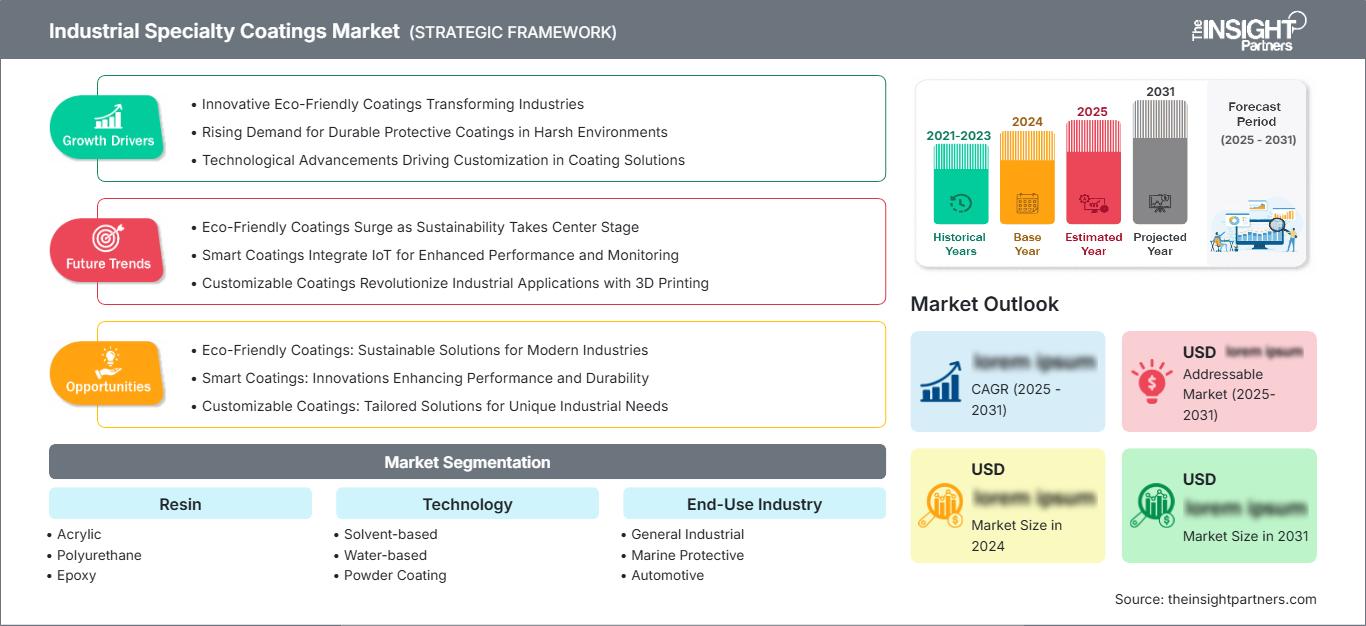
Industrial Specialty Coatings Market: Strategic Insights
Regional Insights
North America industrial specialty coatings market
The North American market share is forecasted at 24–28% of the total world market value in 2025, growing at a CAGR of 4.8–5.5% until 2034. US leads the region's demand driven by machinery, auto parts, aerospace, fabricated metal products, and maintenance needs for the existing infrastructure. Formulations are required that will provide good resistance along with reduced VOC levels, and there is an increased emphasis on fewer number of application stages and increased throughput of production lines.
Canada adds through its energy, mining, transportation equipment, and infrastructure sectors, and Mexico benefits from the development of the manufacturing supply chain and automobile manufacturing sector. Technical assistance for local application is being emphasized by suppliers because the performance of the coatings depends to a large extent on proper substrate preparation, curing process, and production line conditions.
U.S. industrial specialty coatings market Market
The US represents an estimated 65–70% of North America's 2025 market and is modeled to expand at a 4.7–5.4% CAGR through 2034. Industrial equipment, aerospace, transportation, fabricated metal, electronics, and infrastructure applications provide a diversified demand base. PPG Industries, Inc., Axalta Coating Systems Ltd., The Sherwin-Williams Company, and other suppliers maintain broad application capabilities across the country.
A major opportunity lies in coating systems that reduce process time while maintaining corrosion, chemical, thermal, and abrasion resistance. Axalta's 2026 Zencore launch illustrates this direction by combining primer and enamel functionality to reduce finishing steps for high-volume North American cabinet manufacturers. PPG is also promoting integrated protective coating and application services for data centers, including corrosion, thermal, fire, electrical, and dielectric protection.
Europe industrial specialty coatings market Market
Europe is modeled at 27–31% share in 2025 and a 4.4–5.1% CAGR through 2034. Germany leads regional demand because of machinery, automotive, engineering, and industrial manufacturing, while Italy and France contribute strongly through machinery, transportation, marine, and general industrial applications. The UK and Spain provide additional demand through infrastructure, construction-related equipment, transportation, and industrial maintenance.
The strength of Germany in manufacturing enables the need for coatings that have specific surface treatment, increased durability, and proper curing methods. Italy has machinery, furniture, auto parts, and industrial applications, which creates the need for both liquid and powder-based products. France has the aerospace, transportation, infrastructure, and industrial segments, which create opportunities for more advanced products. The UK takes advantage of its marine, aerospace, infrastructure, and general industrial maintenance segment. Spain has automotive, renewable energy, machinery, and infrastructure segments.
APAC industrial specialty coatings market Market
APAC is estimated at 31–35% share in 2025 and is modeled to grow at a 6.0–6.8% CAGR through 2034, making it the leading regional growth engine. China remains the largest country market, followed by Japan, South Korea, India, and Australia.
The PMI for China’s manufacturing sector was 50.3% in April 2026; meanwhile, large, medium, and small firms all registered levels either at or above the level of expansion. India is seeing increased investments in localized capacities for chemicals and coatings, including the 2026 plant from BASF for dispersions in Mangalore.
Middle East & Africa industrial specialty coatings market Market
MEA demand is structured on energy, infrastructure, marine, mining, and maintenance of industrial facilities. Demand from Saudi Arabia and the United Arab Emirates is based on investments in infrastructure and energy-related sectors, whereas South Africa retains importance for its demand for mining and industrial equipment. Rest-of-MEA demand is largely project-related and depends on capex cycles.
The regional market is forecasted to grow at the rate of 4.5–5.3% CAGR until 2034. The significance of protective coatings persists since industrial assets operate under harsh conditions of heat, corrosion, saltiness, chemicals, and abrasiveness. Jotun A/S and other global players keep their relevance in terms of marine and protective coatings, and local production/distribution could be considered for larger infrastructure/energy projects.
Segmentation Analysis
Resin
Resin is modeled to grow at a 4.9–5.6% CAGR during 2026–2034. Resin chemistry determines adhesion, flexibility, hardness, chemical resistance, weatherability, curing behavior, and service life. Industrial users increasingly select chemistry according to substrate and operating conditions rather than relying on generalized coating specifications.
- Acrylic: Acrylic systems provide balanced weatherability, color retention, adhesion, and processing flexibility, supporting applications where appearance and outdoor durability must coexist with manageable formulation cost and straightforward application.
- Polyurethane: Polyurethane coatings occupy demanding applications requiring abrasion resistance, flexibility, gloss retention, and chemical resistance, making them important for transportation equipment, machinery, and high-performance industrial finishing.
- Epoxy: Epoxy systems remain strategically important for corrosion protection and strong substrate adhesion, particularly where chemical resistance, mechanical durability, and robust barrier performance are required across demanding industrial environments.
- Polyester: Polyester chemistry supports durable powder coating formulations and industrial finishing where weather resistance, hardness, and efficient curing are important, particularly across fabricated metal and equipment applications.
- Fluoropolymers: Fluoropolymer systems serve specialized environments requiring exceptional weatherability, chemical resistance, and long service life, supporting premium applications where lifecycle performance can justify higher material and processing costs.
Technology
Technology is modeled to expand at a 5.5–6.2% CAGR from 2026 to 2034. Technology selection increasingly balances emissions, curing energy, throughput, substrate compatibility, and application infrastructure. Water-based and powder systems benefit from regulatory and operational considerations, while solvent-based technologies retain positions where formulation performance or process compatibility remains decisive.
- Solvent-based: Solvent-based coatings remain relevant where rapid drying, substrate wetting, finish quality, and established production infrastructure provide performance advantages, although emissions management increasingly influences formulation selection and plant economics.
- Water-based: Water-based systems are gaining strategic importance where lower VOC emissions, workplace considerations, and regulatory alignment are priorities, especially when manufacturers can modify equipment and curing processes without sacrificing performance.
- Powder Coating: Powder coating offers strong material utilization and low solvent emissions, supporting fabricated metal, appliances, machinery, automotive components, and architectural applications where thermal curing infrastructure is available.
End-Use Industry
End-Use Industry is modeled to grow at a 5.2–5.9% CAGR during 2026–2034. Demand varies according to asset exposure, production volume, coating specifications, and maintenance cycles. Industrial customers increasingly prioritize application consistency, service life, and total lifecycle economics when selecting specialized coating systems.
- General Industrial: General industrial applications represent a broad demand base spanning machinery, equipment, fabricated metals, appliances, and components, with purchasing decisions increasingly shaped by durability, productivity, and coating-line efficiency.
- Marine Protective: Marine protective coatings address corrosion, immersion, saltwater exposure, abrasion, and long maintenance intervals, making specification quality and surface-preparation compatibility critical to vessel and offshore asset economics.
- Automotive: Automotive applications require corrosion resistance, appearance, process compatibility, and rapid production-line performance, while electrification introduces new requirements for battery, thermal-management, electrical, and lightweight-material substrates.
- Aerospace: Aerospace coatings require strict performance against temperature, chemicals, weathering, hydraulic fluids, and aviation operating environments, creating a technically demanding segment with high qualification requirements and long product-development cycles.
- Packaging: Packaging applications require controlled adhesion, chemical resistance, appearance, and regulatory compatibility, with specialized coatings increasingly designed for lightweight substrates, high-speed converting, and improved functional performance.
Opportunity Snapshot
| End-Use Industry | Revenue Contribution | Trend Tag | Adoption Stage |
| General Industrial | High | Asset Renewal | Mature |
| Marine Protective | Medium | Corrosion Control | Mature |
| Automotive | High | EV Protection | Scaling |
| Aerospace | Medium | Lightweighting | Scaling |
| Packaging | Medium | Functional Films | Scaling |
Industrial Specialty Coatings Market Growth Drivers and Impact Analysis
Expansion of advanced manufacturing and asset modernization
The Industrial Specialty Coatings Market trends indicate that industrial asset renewal is a direct demand catalyst because aging machinery, transportation equipment, fabricated structures, and production lines require coatings that extend operating life and reduce maintenance frequency. Manufacturers are also upgrading equipment to improve throughput, energy efficiency, automation, and quality control, creating opportunities for coating systems compatible with faster production cycles. In the US, industrial applications increasingly intersect with data-center construction, aerospace manufacturing, transportation equipment, and specialized machinery. PPG's 2026 data-center initiative demonstrates how coatings are becoming part of infrastructure performance specifications rather than a purely decorative input. The resulting impact is a shift toward coatings with defined corrosion, thermal, fire, electrical, and dielectric properties, increasing value per application while encouraging suppliers to provide formulation expertise, application services, and technical validation.
Regulatory pressure accelerating lower-emission formulation adoption
VOC and hazardous-air-pollutant management is reshaping industrial coating selection by increasing the economic and operational value of water-based, powder, high-solids, and other lower-emission technologies. EPA materials explicitly identify these technologies as approaches for reducing emissions, while specific surface-coating standards establish control requirements for affected facilities. This creates a two-part market effect. First, formulators invest in resin and additive technologies capable of matching solvent-based performance with reduced emissions. Second, industrial users evaluate equipment conversion, curing requirements, worker exposure, and compliance costs alongside coating price. Adoption therefore depends not only on environmental objectives but also on whether alternative technologies can preserve line speed, finish quality, adhesion, and durability. Suppliers with application engineering capabilities can capture opportunities by reducing conversion risk for customers.
Growth of specialized protection for electrification infrastructure
Electrification is creating new surfaces and operating environments that require specialized protection. Battery manufacturing equipment, charging infrastructure, electrical enclosures, power electronics, renewable-energy equipment, and data-center electrical systems require coatings that manage corrosion, heat, insulation, electromagnetic interference, fire behavior, and chemical exposure. The IEA's assessment shows continued investment and supply-chain diversification around clean-energy manufacturing, even after the investment peak of 2023. For coating producers, this translates into opportunities to develop systems tailored to new substrates, thermal loads, and electrical requirements rather than simply adapting legacy formulations. The commercial impact is likely to be strongest for suppliers able to qualify coatings alongside equipment manufacturers and engineering contractors, because specification approval can create longer product lifecycles and higher switching barriers than conventional industrial finishing applications.
Industrial Specialty Coatings Market Future Trends
Low-temperature curing and energy-efficient application
Low-temperature curing is likely to become an increasingly important product-development direction as industrial users seek lower energy consumption without sacrificing throughput or coating performance. Powder coating suppliers are already developing systems that cure below traditional temperature requirements. AkzoNobel has introduced a powder technology designed to cure at 150°C, 30°C below conventional curing conditions, with the company stating that energy consumption can fall by as much as 20% and curing can be up to 25% faster. Future formulations are therefore likely to focus on lower oven temperatures, broader substrate compatibility, faster line speeds, and improved energy productivity.
Digital coating-process optimization
Digitalization will increasingly extend beyond formulation laboratories into coating application and plant management. Industrial customers are expected to adopt monitoring systems that connect paint-shop parameters, application equipment, film thickness, curing conditions, defects, and maintenance information. This enables manufacturers to identify process deviations earlier and reduce rework, material waste, and downtime. PPG's 2026 presentation of digital paint-shop performance tools alongside electrocoat technologies illustrates the direction of travel. Over time, coating suppliers with software, analytics, remote diagnostics, and application engineering capabilities can become embedded in customer production workflows. The trend is particularly relevant to automotive, appliance, fabricated-metal, and high-volume industrial lines where even small improvements in transfer efficiency or cycle time can materially affect operating economics.
Industrial Specialty Coatings Market Opportunities
Localized production in high-growth Asian markets
Asia offers an attractive investment opportunity because industrial capacity expansion is occurring alongside increasing customer expectations for supply reliability, formulation customization, and technical support. India is particularly relevant as manufacturers seek localized chemical supply and reduced dependence on imported intermediates. BASF's February 2026 announcement of a new dispersions production line at Mangalore demonstrates investment in local production to support paints, construction chemicals, and related applications. Similar localization strategies can improve lead times, reduce logistics exposure, and allow suppliers to tailor products to regional substrates and application conditions. Coating producers can capture this opportunity through regional manufacturing, application laboratories, distributor partnerships, and customer qualification programs. The strongest returns are likely where local capacity is combined with differentiated chemistry rather than commodity-scale production alone.
Specialized coatings for data centers and critical infrastructure
Rapid development of data centers creates an emerging opportunity for coatings that protect electrical, structural, thermal, and equipment surfaces under tightly controlled operating conditions. PPG's 2026 portfolio presentation for data-center facilities included corrosion, thermal, fire, electrical, antistatic, conductive, dielectric, and heat-reflective technologies, illustrating the breadth of potential coating specifications. Suppliers can target this opportunity by developing integrated systems for steel structures, electrical equipment, cooling infrastructure, floors, and components rather than selling isolated products. Partnerships with engineering firms, equipment manufacturers, contractors, and facility operators can improve specification access. The opportunity is strategically attractive because critical infrastructure owners generally place greater emphasis on reliability, compliance, maintenance reduction, and operational continuity than on minimizing initial coating expenditure.
Recent Developments
- July 2026: BASF SE — BASF and Carlyle completed the transaction separating BASF Coatings into an independent business, now operating as Surventis. The move materially changes the ownership and operating structure of a major global coatings platform.
- April 2026: Axalta Coating Systems Ltd launched Zencore, a cabinet coating system for high-volume North American manufacturers. The system combines primer and enamel functionality and is designed to reduce the number of finishing steps from three to two while maintaining durability and finish quality, emphasizing throughput and process simplification.
- September 2025: Microban International, Ltd. announced a partnership with Curie Co to advance preservation solutions for household, industrial, and institutional cleaners, paints, and coatings. The collaboration combines Curie's organic-acid preservation technology with Microban's Additive GS platform and targets water-soluble antimicrobial solutions designed to meet stringent regulatory requirements.
Frequently Asked Questions

- Comprehensive Market Sizing and Forecast Analysis
- Detailed Segmentation Analysis
- In-Depth Market Dynamics Assessment
- Regional and Country-Level Insights
- Competitive Landscape and Company Benchmarking
- Strategic Business Intelligence
Recent Reports
Testimonials

The Insight Partners provided valuable market intelligence that supported our global go-to-market strategy. Their team was professional, responsive, and attentive to our feedback, providing thoughtful analysis and helpful methodological clarifications throughout the project.
Junmo Kim Chief Financial Officer (CFO), Enertech Co., Ltd.
The Insight Partners' SCADA System Market report is comprehensive, with valuable insights on current trends and future forecasts. The team was highly professional, responsive, and supportive throughout. We are very satisfied and highly recommend their services.
RAN KEDEM Partner, Reali Technologies LTDs
I requested a report on a very specific software market and the team produced the report in a few days. The information was very relevant and well presented. I then requested some changes and additions to the report. The team was again very responsive and I got the final report in less than a week.
JEAN-HERVE JENN Chairman, Future Analytica
We worked with The Insight Partners for an important market study and forecast. They gave us clear insights into opportunities and risks, which helped shape our plans. Their research was easy to use and based on solid data. It helped us make smart, confident decisions. We highly recommend them.
PIYUSH NAGPAL Sr. Vice President, High Beam Global
The Insight Partners delivered insightful, well-structured market research with strong domain expertise. Their team was professional and responsive throughout. The user-friendly website made accessing industry reports seamless. We highly recommend them for reliable, high-quality research services
YUKIHIKO ADACHI CEO, Deep Blue, LLC.
This is the first time I have purchased a market report from The Insight Partners.While I was unsure at first, I visited their web site and felt more comfortable to take the risk and purchase a market report.I am completely satisfied with the quality of the report and customer service. I had several questions and comments with the initial report, but after a couple of dialogs over email with their analyst I believe I have a report that I can use as input to our strategic planning process.Thank you so much for taking the extra time and making this a positive experience.I will definitely recommend your service to others and you will be my first call when we need further market data.
JOHN SUZUKI President and Chief Executive Officer, Board Director, BK Technologies
I wish to appreciate your support and the professionalism you displayed in the course of attending to my request for information regarding to infectious disease IVD market in Nigeria. I appreciate your patience, your guidance, and the fact that you were willing to offer a discount, which eventually made it possible for us to close a deal. I look forward to engaging The Insight Partners in the future, all thanks to the impression you have created in me as a result of this first encounter.
DR CHIJIOKE ONYIA MANAGING DIRECTOR, PineCrest Healthcare Ltd.Reason to Buy
- Informed Decision-Making
- Understanding Market Dynamics
- Competitive Analysis
- Identifying Emerging Markets
- Customer Insights
- Market Forecasts
- Risk Mitigation
- Boosting Operational Efficiency
- Strategic Planning
- Investment Justification
- Tracking Industry Innovations
- Aligning with Regulatory Trends





 Get Free Sample for