
Industrial Workwear and Gear Market Demand, Trends & Forecast by 2034
Coverage: By Product Type (Workwear and Uniforms, Protective Wear and Gear, Footwear, Gloves, and Others), Category (Men, Unisex, and Women), and End-Use Industry (Construction, Oil and Gas, Chemicals, Heavy Industries and Manufacturing, Mining, Pharmaceuticals, and Others)
- Status : Upcoming
- Report Code : TIPRE00029829
- Category : Consumer Goods
- No. of Pages : 150
- Available Report Formats :


- Last update date : March 06, 2026


2025 Market Size
US$ 52.81 Bn
Base year value
2034 Forecast
US$ 93.08 Bn
Projected by 2034
CAGR 2026-2034
6.5 %
Growth rate
Addressable Market
US$ 659.83 Bn
(2026-2034)
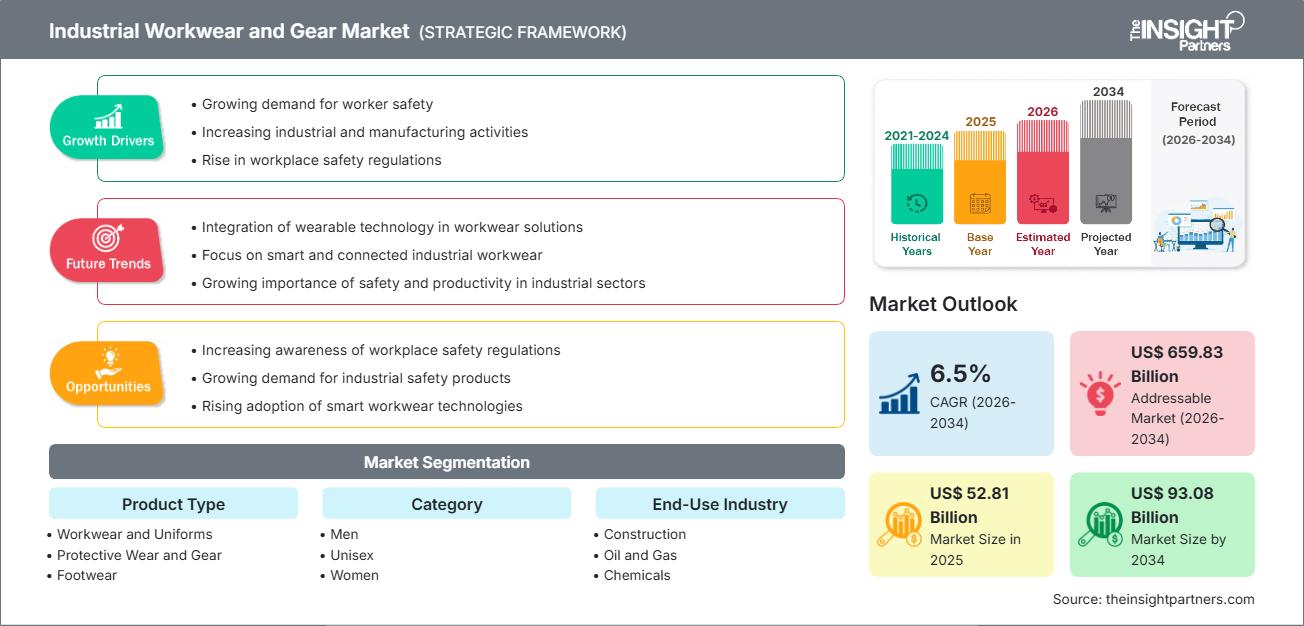
The global industrial workwear and gear market size is projected to reach US$ 93.08 billion by 2034 from US$ 52.81 billion in 2025. The market is anticipated to register a CAGR of 6.5% during the forecast period 2026–2034.
Key market dynamics include a heightening global focus on stringent workplace safety regulations, rising industrialization across key sectors such as manufacturing and construction, and a significant shift toward ergonomically designed and comfortable protective apparel. Additionally, the market is expected to benefit from the growing integration of smart textiles with IoT capabilities, expansion in direct-to-consumer (D2C) e-commerce channels, and the increasing adoption of sustainable, eco-friendly materials to meet corporate ESG targets.
Industrial Workwear and Gear Market Analysis
The industrial workwear and gear market analysis shows a shift toward high-performance functional apparel as employers prioritize worker safety alongside productivity and retention. Procurement trends indicate the market is splitting into high-volume standardized uniforms for general labor and specialized, certified protective gear for high-risk environments such as chemicals and oil and gas. Strategic opportunities are emerging in the development of smart workwear featuring embedded sensors for real-time biometric monitoring and hazard detection. The analysis also notes that market expansion depends on material innovation, particularly in creating lightweight yet durable flame-resistant (FR) and chemical-defending fabrics. Competitive differentiation now stands out depending on branding that emphasizes worker well-being, technical compliance, and the ability to track the ethical sourcing of textiles. This approach helps premium manufacturers maintain high margins in a landscape populated by both global conglomerates and regional niche players.
Industrial Workwear and Gear Market Overview
Industrial workwear has evolved from basic heavy-duty cotton uniforms to sophisticated, multi-hazard protective systems. Industrial Workwear and Gear includes specialized top wear like FR jackets and high-visibility vests, as well as essential gear like safety-toe footwear and cut-resistant gloves. Both global safety leaders and D2C startups compete in this market, using high-performance fibers such as aramid, polyester-cotton blends, and recycled polymers. Growing demand for workleisure gear that bridges the gap between industrial durability and athletic comfort has increased the popularity of moisture-wicking and stretchable fabrics. Asia-Pacific leads in revenue due to its massive manufacturing and construction base, while North America and Europe drive the market through innovation in smart technologies and strict regulatory frameworks.
The US market is driven by rigorous safety compliance and a mature industrial landscape. Stringent occupational health standards mandate certified protective equipment across the construction and energy industries. Recent trends emphasize work-leisure, merging durability with athletic comfort. Additionally, the integration of smart textiles and gender-specific designs ensures widespread adoption among a diverse and safety-conscious workforce.
Market Research Highlights
- Global market for Industrial Workwear and Gear was valued at US$ 52.81 Billion in 2025
- Annual market size is expected to reach US$ 93.08 Billion by 2034
- Total addressable market (TAM) during 2026-2034 is projected to reach approximately US$ 659.83 Billion
- Market is anticipated to register a CAGR of 6.5% during the forecast period
- The United States represents a key market, supported by Growing demand for worker safety, Increasing industrial and manufacturing activities, Rise in workplace safety regulations, as well as evolving industry dynamics
- Market analysis covers North America, Europe, Asia-Pacific, South and Central America, Middle East and Africa, with growth evaluated across the forecast period
- Market opportunities such as Increasing awareness of workplace safety regulations, Growing demand for industrial safety products, Rising adoption of smart workwear technologies are expected to influence market dynamics and addressable market
- Report profiles industry participants, including WATTANA GmbH, Carson Company GmbH, HB Protective Wear GmbH & Co. KG, Engelbert Strauss GmbH and Co. KG, 3M, Carhartt, Inc., Alsico Group, A. LAFONT SAS, Hultafors Group AB, Honeywell International Inc., while analyzing competitive strategies and innovation developments
-
Source: The Insight Partners' analysis based on proprietary research, government publications, company annual reports, investor presentations, industry databases, and expert interviews.
● REPORT CUSTOMIZATION
Tailor This Report To Align With Your Specific Business Requirements
This report can be customized to align precisely with your business objectives, scope, and target markets. Customization options include tailored segmentation, geography, competitive analysis, and strategic insights to support informed decision-making.
Customize This Report →WHAT YOU CAN ADJUST
- ● Segmentations
- ● Geography
- ● Competitive Analysis
- ● Language Preferences
Industrial Workwear and Gear Market: Strategic Insights
-
Get Top Key Market Trends of this report.This FREE sample will include data analysis, ranging from market trends to estimates and forecasts.
Industrial Workwear and Gear Market Drivers and Opportunities
Market Drivers:
- Stringent Safety Regulations and Compliance: Global mandates from authorities like OSHA and EU-OSHA require employers to provide certified protective apparel. This regulatory pressure is the primary driver for sustained demand in high-risk.
- Rapid Industrialization and Infrastructure Growth: Massive urban development and infrastructure projects in emerging economies, particularly India and Southeast Asia, are fueling high volume requirements for durable workwear and high-visibility gear.
- Focus on Sustainability and Eco-Friendly Materials: Increasing corporate awareness regarding environmental impact is driving a shift toward recycled polyester and bio-based fibers, allowing brands to align with global sustainability goals.
Market Opportunities:
- Integration of IoT and Smart Technologies: There is a significant opportunity for gear featuring embedded sensors to track worker health and detect toxic gas exposure, particularly in mining and utilities.
- Expansion of Gender-Specific Product Lines: The rising number of women entering heavy industries presents a massive untapped market for ergonomically designed protective wear tailored for female proportions.
- D2C and E-commerce Expansion: Digital channels allow manufacturers to reach a wider audience, offering customization and faster procurement for small-to-medium enterprises (SMEs) that previously lacked access to specialized gear.
Industrial Workwear and Gear Market Report Segmentation Analysis
The industrial workwear and gear market share is analyzed across various segments to provide a clearer understanding of its structure, growth potential, and emerging trends. Below is the standard segmentation approach used in most industry reports:
By Product Type:
- Workwear and Uniforms: The largest segment, including shirts, trousers, and standardized coveralls used across manufacturing and service.
- Protective Wear and Gear: A high-value segment focused on specialized apparel for flame resistance, arc flash protection, and chemical defense.
- Footwear: Includes safety shoes and boots with puncture-resistant soles, steel toes, and slip-resistant technology.
- Gloves: Essential protective gear for hand safety against chemical exposure, thermal hazards, and mechanical cuts.
By Category:
- Men: The dominant demographic segment, currently accounting for nearly 89% of market share due to employment rates in hazardous industries.
- Unisex: A growing category focused on standardized, cost-effective gear suitable for all workers.
- Women: The fastest-growing category, driven by the need for better-fitting and safer equipment for women in industrial roles.
By End-Use Industry:
- Construction: The leading revenue generator, driven by massive labor forces and mandatory high-visibility and head protection standards.
- Oil and Gas: A critical segment requiring highly specialized flame-retardant and anti-static garments.
- Chemicals: Focuses on splash protection and permeable/impermeable barrier fabrics for hazardous material handling.
- Heavy Industries and Manufacturing: Dominates general-use workwear demand for durability and worker identity.
- Mining: Demands extreme durability and high-visibility gear for surface and underground operations.
- Pharmaceuticals: Centers on clean-room clothing and biological hazard protection for high-sterility environments.
By Geography:
- North America
- Europe
- Asia Pacific
- South and Central America
- Middle East and Africa
Industrial Workwear and Gear Market Report Scope
| Report Attribute | Details |
|---|---|
| Market size in 2025 | US$ 52.81 Billion |
| Market Size by 2034 | US$ 93.08 Billion |
| Global CAGR (2026 - 2034) | 6.5% |
| Historical Data | 2021-2024 |
| Forecast period | 2026-2034 |
| Segments Covered |
By Product Type
|
| Regions and Countries Covered |
North America
|
| Market leaders and key company profiles |
|
Industrial Workwear and Gear Market Players Density: Understanding Its Impact on Business Dynamics
The Industrial Workwear and Gear Market is growing rapidly, driven by increasing end-user demand due to factors such as evolving consumer preferences, technological advancements, and greater awareness of the product's benefits. As demand rises, businesses are expanding their offerings, innovating to meet consumer needs, and capitalizing on emerging trends, which further fuels market growth.
Industrial Workwear and Gear Market Share Analysis by Geography
Asia-Pacific is expected to grow fastest in the coming years due to industrial expansion. Emerging markets in South and Central America, the Middle East, and Africa also have many untapped opportunities for safety gear manufacturers and distributors to expand.
The industrial workwear and gear market is undergoing a significant transformation, moving from basic protective uniforms to high-value, ergonomic, and tech-integrated apparel. Growth is driven by the expansion of infrastructure projects, a surge in safety compliance across emerging economies, and the increasing demand for specialized protective equipment (PPE). Below is a summary of market share and trends by region:
North America
- Market Share: A mature and high-value segment driven by strict OSHA enforcement and a strong industrial base.
- Key Drivers:
- Growing emphasis on premium, task-specific apparel and smart gear integration.
- Rising infrastructure projects and the adoption of work-leisure styles in high-end industrial.
- Trends: Scaling of female-fit safety lines and the successful implementation of recycled material blends to appeal to eco-conscious corporations.
Europe
- Market Share: Anchored by comprehensive EU safety directives and a focus on high-quality, sustainable textile production.
- Key Drivers:
- High consumption of specialized FR and chemical-protective gear in Germany and France.
- Strong government support for worker welfare and strict technical standards (EN ISO).
- Trends: A strategic shift toward Circular Economy models and rental services for industrial workwear to maximize product lifespan and reduce waste.
Asia-Pacific
- Market Share: The largest and fastest-growing region, with China and India serving as global hubs for both production and consumption.
- Key Drivers:
- Massive industrialization and improving workplace safety standards in Southeast Asia and India.
- Government-led infrastructure initiatives and the growth of manufacturing.
- Trends: Heavy reliance on B2B e-commerce platforms and a focus on cost-effective yet certified protective gear for massive workforces.
South and Central America
- Market Share: An emerging market with a growing commercial in countries like Brazil, Argentina, and Chile.
- Key Drivers:
- Modernization of mining and forestry operations requiring specialized footwear and high-visibility gear.
- Rising interest in ergonomic designs to combat worker fatigue in hot and humid climates.
- Trends: Growth of boutique industrial brands and the introduction of moisture-wicking technologies to differentiate from traditional heavy cotton fabrics.
Middle East and Africa
- Market Share: Developing market with deep cultural roots in the energy, transitioning toward formalized commercial safety standards.
- Key Drivers:
- High demand for flame-resistant and heat-reflective apparel for oil and gas refineries in the GCC region.
- Strategic investments in regional manufacturing to reduce reliance on imported PPE.
- Trends: Implementation of modern cooling technologies within garments to manage extreme heat stress for outdoor industrial workers.
High Market Density and Competition
Competition is intensifying due to the presence of established global leaders such as Honeywell, 3M, and DuPont. This competitive environment pushes vendors to differentiate through:
- Premiumization and Functional Branding: Positioning gear as a superior safety solution by emphasizing higher durability, arc ratings, and A2-type comfort levels for industrial users.
- Product Diversification: Offerings now include more than just standard coveralls; companies provide probiotic-treated fabrics, anti-fatigue footwear, and IoT-enabled helmets.
- Vertical Integration: Producers manage the entire supply chain, from sourcing advanced polymers like aramid to local manufacturing, ensuring quality, transparency, and ethical standards.
- Material Science Innovation: New processing technologies, like membrane filtration and antimicrobial coatings, help create high-quality gear for use in pharmaceutical and electronics manufacturing.
Opportunities and Strategic Moves
- Digital and E-commerce Expansion: Partner with high-end retail channels and B2B platforms to tap into the surging demand for customized and certified gear in the Asia-Pacific and North American markets.
- Sustainability Certifications: Incorporate sustainable manufacturing practices and recycled material certifications to appeal to environmentally conscious corporations and younger workers.
Major Companies operating in the Industrial Workwear and Gear Market are:
- WATTANA GmbH
- Carson Company GmbH
- HB Protective Wear GmbH & Co. KG
- Engelbert Strauss GmbH and Co. KG
- 3M
- Carhartt, Inc.
- Alsico Group
- A. LAFONT SAS
- Hultafors Group AB
- Honeywell International Inc.
Disclaimer: The companies listed above are not ranked in any particular order.
Industrial Workwear and Gear Market News and Recent Developments
- In January 2026, MALLCOM introduced the OPAL lightweight safety helmet, which is a contemporary head protection gear aimed at offering a balance between the aspects of safety, comfort, and durability in the current demanding working environments. OPAL is a lightweight safety helmet made to meet the diverse needs of industrial professionals in an industrial setting. The helmet is made of good-quality UV-resistant polypropylene and has reliable impact resistance, as well as long-term strength.
- In March 2025, HB Protective Wear GmbH & Co. KG announced the launch of the HB-ArcSelect® Pro. It is designed to meet the special requirements of arc flash protection and can be used in a wide range of risk situations. All garments are available with class 1 and class 2 arc protection and can be freely combined in several colours. The collection also offers welding, flame, and heat protection as well as high visibility and antistatic properties. It is therefore suitable for many areas of work, such as public utilities and energy suppliers, plant and line construction, electrical trades and electrical installation, as well as work with communication, gas and water networks.
Industrial Workwear and Gear Market Report Coverage and Deliverables
The Industrial Workwear and Gear Market Size and Forecast (2021–2034) report provides a detailed analysis of the market covering below areas:
- Industrial Workwear and Gear Market size and forecast at global, regional, and country levels for all the key market segments covered under the scope
- Industrial Workwear and Gear Market trends, as well as market dynamics such as drivers, restraints, and key opportunities
- Detailed PEST and SWOT analysis
- Industrial Workwear and Gear Market analysis covering key market trends, global and regional framework, major players, regulations, and recent market developments
- Industry landscape and competition analysis covering market concentration, heat map analysis, prominent players, and recent developments in the Industrial Workwear and Gear Market.
- Detailed company profiles
Frequently Asked Questions

- Comprehensive Market Sizing and Forecast Analysis
- Detailed Segmentation Analysis
- In-Depth Market Dynamics Assessment
- Regional and Country-Level Insights
- Competitive Landscape and Company Benchmarking
- Strategic Business Intelligence
Recent Reports
Testimonials

The Insight Partners' SCADA System Market report is comprehensive, with valuable insights on current trends and future forecasts. The team was highly professional, responsive, and supportive throughout. We are very satisfied and highly recommend their services.
RAN KEDEM Partner, Reali Technologies LTDs
I requested a report on a very specific software market and the team produced the report in a few days. The information was very relevant and well presented. I then requested some changes and additions to the report. The team was again very responsive and I got the final report in less than a week.
JEAN-HERVE JENN Chairman, Future Analytica
We worked with The Insight Partners for an important market study and forecast. They gave us clear insights into opportunities and risks, which helped shape our plans. Their research was easy to use and based on solid data. It helped us make smart, confident decisions. We highly recommend them.
PIYUSH NAGPAL Sr. Vice President, High Beam Global
The Insight Partners delivered insightful, well-structured market research with strong domain expertise. Their team was professional and responsive throughout. The user-friendly website made accessing industry reports seamless. We highly recommend them for reliable, high-quality research services
YUKIHIKO ADACHI CEO, Deep Blue, LLC.
This is the first time I have purchased a market report from The Insight Partners.While I was unsure at first, I visited their web site and felt more comfortable to take the risk and purchase a market report.I am completely satisfied with the quality of the report and customer service. I had several questions and comments with the initial report, but after a couple of dialogs over email with their analyst I believe I have a report that I can use as input to our strategic planning process.Thank you so much for taking the extra time and making this a positive experience.I will definitely recommend your service to others and you will be my first call when we need further market data.
JOHN SUZUKI President and Chief Executive Officer, Board Director, BK Technologies
I wish to appreciate your support and the professionalism you displayed in the course of attending to my request for information regarding to infectious disease IVD market in Nigeria. I appreciate your patience, your guidance, and the fact that you were willing to offer a discount, which eventually made it possible for us to close a deal. I look forward to engaging The Insight Partners in the future, all thanks to the impression you have created in me as a result of this first encounter.
DR CHIJIOKE ONYIA MANAGING DIRECTOR, PineCrest Healthcare Ltd.Reason to Buy
- Informed Decision-Making
- Understanding Market Dynamics
- Competitive Analysis
- Identifying Emerging Markets
- Customer Insights
- Market Forecasts
- Risk Mitigation
- Boosting Operational Efficiency
- Strategic Planning
- Investment Justification
- Tracking Industry Innovations
- Aligning with Regulatory Trends





 Get Free Sample for