
Insect Growth Regulators Market Growth, Size & Forecast by 2034
Coverage: By Product (Chitin Synthesis Inhibitors, Juvenile Hormone Analogs and Mimics, Anti-juvenile hormone agents, Others); Form (Aerosol, Liquid, Bait); Application (Agriculture, Residential, Commercial Pest Control) , and Geography (North America, Europe, Asia Pacific, and South and Central America)
- Status : Data Released
- Report Code : TIPRE00021792
- Category : Chemicals and Materials
- No. of Pages : 150
- Available Report Formats :


- Last update date : August 19, 2026


2025 Market Size
US$ 1.12 Bn
Base year value
2034 Forecast
US$ 1.90 Bn
Projected by 2034
CAGR 2026-2034
6.05 %
Growth rate
Addressable Market
US$ 13.68 Bn
(2026-2034)
The insect growth regulators market was valued at US$ 1.12 Billion in 2025 and is projected to reach US$ 1.90 Billion by 2034, expanding at a CAGR of 6.05% during 2026–2034. The growth can be attributed to increasing need for selective technologies that inhibit insect development instead of focusing only on knockdown. The market includes chitin synthesis inhibitors, juvenile hormone analogs and mimics, and anti-juvenile hormone compounds in agricultural and professional pest control applications.
North America offers a structurally appealing insect growth regulators market size owing to well-established integrated pest management practices, pest control professionals, and regulators that are concerned about pesticides. Growth is also driven by increasing need for control in response to the presence of pests in households and commercial spaces and by increased demand for lifecycle control solutions.
Insect Growth Regulators Market Assessment and Insights
- North America: North America is estimated to account for 30–34% of the global insect growth regulators market share in 2025, supported by mature pest-management infrastructure, regulatory scrutiny, and professional applications, with a CAGR of 5.6–6.2% between 2026–2034.
- US: The US represents approximately 82–86% of North America's 2025 market, supported by agricultural pest management and professional structural pest control, with a CAGR of 5.7–6.3% between 2026–2034.
- Europe: Europe is estimated at 22–26% share in 2025, led by Germany, France, Italy, Spain, and the UK, where integrated pest management and regulatory selectivity support a CAGR of 5.2–5.9% between 2026–2034.
- Asia Pacific: Asia Pacific represents approximately 27–31% share in 2025, led by China, Japan, India, South Korea, and Australia, with expanding agricultural protection requirements supporting a CAGR of 6.8–7.5% between 2026–2034.
- Largest Segment: Agriculture is estimated to hold 46–50% market share in 2025, benefiting from crop-protection demand and IPM compatibility, with a CAGR of 6.1–6.7% during 2026–2034.
- High Growth Segment: Bait is estimated at 16–20% market share in 2025 and is projected to expand at a CAGR of 7.0–7.7% during 2026–2034, supported by targeted residential and commercial pest control.
- Key companies analyzed in detail: Bayer AG, Syngenta AG, Corteva Agriscience LLC, HELM Agro US, Inc., Nufarm Limited, Russell IPM Ltd, Valent U.S.A. LLC, McLaughlin Gormley King Company, Sumitomo Chemical Co., Ltd., Control Solutions, Inc.
Source: The Insight Partners' analysis based on proprietary research, government publications, company annual reports, investor presentations, industry databases, and expert interviews.
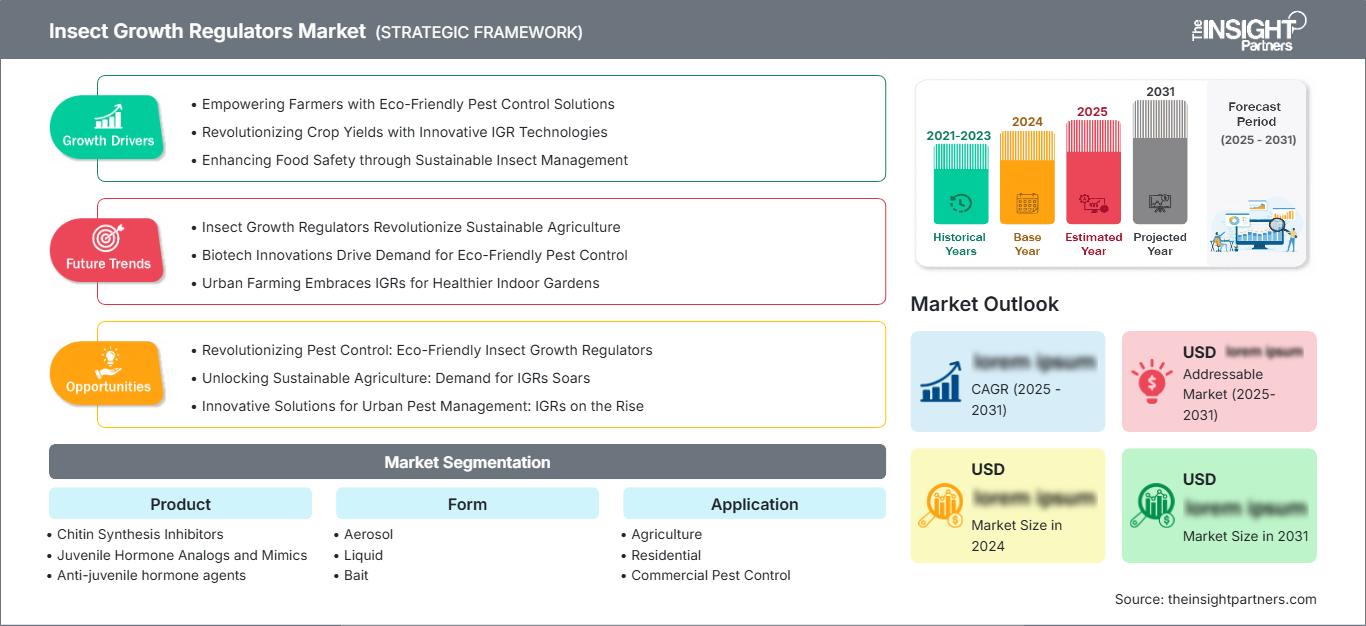
Insect growth regulators market have developed from traditional developmental control agents into more specific compounds suitable for incorporation within integrated pest management programs. Chitin synthesis inhibitors are still used as an integral part of molting disruption, while juvenile hormone analogues act on maturation and reproduction. Formulations have also changed from traditional concentrated products to aerosol, liquid, and bait types.
Further market development will most probably come from those areas in which there is a combination of pest pressure and preference for targeted modes of action by regulators. The potential for growth in terms of agricultural use can be found in Asia Pacific, while professional pest control use can be realized in North America and Europe. Investment emphasis will probably center around improved residuals, reduced use rates, resistance management, and localized use formulations.
Insect Growth Regulators Market Report Scope
| Report Attribute | Details |
|---|---|
| Market size in 2025 | US$ 1.12 Billion |
| Market Size by 2034 | US$ 1.90 Billion |
| Global CAGR (2026 - 2034) | 6.05% |
| Historical Data | 2021-2024 |
| Forecast period | 2026-2034 |
Insect Growth Regulators Market Analysis
Demand is backed by the need for controlling insects at development stages where conventional contact insecticides may not be effective enough. Chitin synthesis inhibitors work by disrupting the process of insect exoskeleton formation, while juvenile hormone insecticides disrupt the process of maturity and reproduction of insects. The value chain encompasses research and manufacture of active-ingredient, formulation, registration, distribution, applicator service provision, and consumer usage. Agricultural demand is associated with cycles of crop protection, while the structural pest management involves cyclic professional demand.
Availability depends on the access to registered active ingredients, formulation, regulatory dossier, and distribution in the region. More and more often companies use the differentiation of their products according to the formulations, residual action, compatibility with the integrated program, and convenience of the treatment. With regard to the ecosystem, chemical manufacturers, formulators, distributors in agriculture, companies engaged in pest management, retailers, and regulators are some of the stakeholders. This is why the availability of the products greatly differs between countries.
Insect growth regulators market continue to have moderate levels of diversification with the presence of multinational crop protection companies along with specialty pest control companies. Among these players, Bayer AG, Syngenta AG, and Corteva Agriscience LLC offer their services as part of their broader range of crop protection chemicals whereas HELM Agro US, Inc. and Nufarm Limited help through formulating and distributing these products. Sumitomo Chemical Co., Ltd. is also known for its capability in terms of technological development within insect control products due to association with McLaughlin Gormley King Company.
Specialty companies including Russell IPM Ltd, Valent U.S.A. LLC, and Control Solutions, Inc. enhance competition with their expertise of pest control products. Investments are being increasingly made in areas related to differentiating modes of action, biological compatibility, formulating technology and registrations within each market. Hence strategic positioning requires more than just ownership of active ingredients; it needs regulatory compliance, distribution channels, technical expertise as well as integration into resistance management and IPM programs.
● REPORT CUSTOMIZATION
Tailor This Report To Align With Your Specific Business Requirements
This report can be customized to align precisely with your business objectives, scope, and target markets. Customization options include tailored segmentation, geography, competitive analysis, and strategic insights to support informed decision-making.
Customize This Report →WHAT YOU CAN ADJUST
- ● Segmentations
- ● Geography
- ● Competitive Analysis
- ● Language Preferences
Insect Growth Regulators Market: Strategic Insights
Regional Insights
North America insect growth regulators market
The insect growth regulators market share of North America in 2025 is expected to be 30–34%, wherein the US will be responsible for the maximum regional demand. The region will witness a compound annual growth rate of 5.6–6.2% during 2025-2034. Professional pest control infrastructure, extensive arable land, and established integrated pest management programs result in regular demand for developmental-control products. Regulatory focus on exposure management further leads to application-specific development of formulations.
The use of developmental control products continues to remain relevant in various agricultural applications including specialty crops, field crops, stored crops, and livestock environments. At the same time, residential and commercial applications widen the scope of the demand from agriculture. Canada provides crop protection as well as structural pest control opportunities, but the US will continue to be the major regional market owing to greater agricultural and professional pest control opportunities.
U.S. insect growth regulators Market
The US makes up about 82%-86% of the 2025 market for North America, growing at a 5.7-6.3% CAGR to 2034. Demand comes from agricultural protection, professional structural pest control, stored-product protection, livestock facilities, and public health. Labeling and regulatory registration rules impact the nature of the products and their applications.
Commercials use products which work with residual sprays, baits, and sanitation programs. Agricultural customers consider lifecycle management and resistance management more as the time progresses. Bayer AG, Sumitomo Chemical Co., Ltd., McLaughlin Gormley King Company, and Control Solutions, Inc. have become relevant players due to having insect-control portfolios. Formulation innovation is still important in the US market because developers can have formulations suitable for different channels.
Europe insect growth regulators Market
Europe is estimated to hold 22–26% of the market in 2025 and is expected to register a 5.2–5.9% CAGR through 2034. Germany is the leading national market, followed by the UK, France, Italy, and Spain. Regulatory requirements favor selective application, residue management, and integrated pest-management approaches, encouraging demand for targeted developmental-control technologies.
The United Kingdom has significant demand for professional pest control in urban and commercial settings, while Germany has a mixture of agricultural and structural applications along with product stewardship. Specialty crop needs in France and Italy, which include the growing of fruit and vegetables, help drive demand because pest timing is important. Spain contributes with intensive horticulture and heat-driven pests. It is forecast that Germany will retain its place as the leading European country due to industrial/agricultural/professional pest control needs.
APAC insect growth regulators Market
APAC is estimated at 27–31% share in 2025 and is projected to grow at a 6.8–7.5% CAGR through 2034. China leads regional demand, followed by Japan, India, South Korea, and Australia. Expanding crop protection needs, urbanization, protected cultivation, and professional pest-control activity support regional adoption.
The agriculture sector in China receives good advantages through intensive cultivation, whereas the potential in India lies in long-term future owing to increasing demands for crop intensification and pest management. Sophistication in formulations and control application is the focus of Japan and South Korea, whereas Australia integrates the need for agricultural and structural pest management into their operations.
Middle East & Africa insect growth regulators Market
Middle East and Africa demand is growing from a lower starting point, where Saudi Arabia is one of the major markets. Expected growth in the region is 5.8-6.6% CAGR till 2034. Modernization in agriculture, use of greenhouses, urbanization, and infrastructural development drive the demand for controlled pest management technologies.
UAE gets a boost from extensive landscaping and hospitality sectors as well as pest control needs for cities, while South Africa derives its demand from commercial farming and professional pest management. The demand from rest of MEA is still associated with food production, food storage, livestock and public health initiatives.
Segmentation Analysis
Product
The Product segment is structured around Chitin Synthesis Inhibitors, Juvenile Hormone Analogs and Mimics, Anti-juvenile hormone agents. The segment is projected to expand at a 6.0–6.6% CAGR during 2026–2034, supported by demand for insect-specific developmental disruption and compatibility with integrated pest-management programs.
- Chitin Synthesis Inhibitors: These compounds remain strategically important because they disrupt exoskeleton formation and molting, making them particularly relevant for larval and nymphal pest stages across agricultural and professional applications.
- Juvenile Hormone Analogs and Mimics: These products influence maturation and metamorphosis, supporting lifecycle control where operators seek suppression of immature populations rather than immediate adult knockdown.
- Anti-juvenile hormone agents: This category provides a specialized developmental-control mechanism by disrupting juvenile-hormone activity, offering targeted opportunities in pest-management programs requiring alternative physiological modes of action.
Form
The Form segment comprises Aerosol, Liquid, Bait and is expected to expand at a 5.8–6.4% CAGR during 2026–2034. Formulation selection is increasingly determined by target habitat, application equipment, residual requirements, operator convenience, and exposure management.
- Aerosol: Aerosols are strategically positioned for rapid, localized application in residential and commercial environments, particularly where operators require convenient delivery to cracks, crevices, and inaccessible pest harborages.
- Liquid: Liquids remain important across agriculture and professional pest control because concentrates and ready-to-use formulations can be adapted to spraying equipment, crop requirements, residual treatments, and large-area applications.
- Bait: Baits support targeted ingestion-based control and are increasingly relevant in residential and commercial environments where localized placement, reduced spray volumes, and discreet application are important operational considerations.
Application
The Application segment includes Agriculture, Residential, Commercial Pest Control and is projected to grow at a 6.1–6.7% CAGR during 2026–2034. Application requirements differ substantially by pest biology, treatment frequency, regulatory conditions, and desired persistence.
- Agriculture: Agriculture remains the principal application because IGRs can target larval and immature pest stages while supporting integrated programs across field crops, horticulture, protected cultivation, and specialty production systems.
- Residential: Residential applications are supported by recurring infestations involving fleas, cockroaches, mosquitoes, and other household pests, where lifecycle disruption can complement sanitation, exclusion, and conventional insecticide treatments.
- Commercial Pest Control: Commercial pest control requires reliable residual performance and application flexibility across hospitality, food handling, warehousing, institutional facilities, and production environments, supporting recurring professional demand for targeted formulations.
Opportunity Snapshot
| Application | Revenue Contribution | Trend Tag | Adoption Stage |
| Agriculture | High | Crop IPM | Mature |
| Residential | Medium | Lifecycle Control | Scaling |
| Commercial Pest Control | High | Professional Baits | Scaling |
Insect Growth Regulators Market Growth Drivers and Impact Analysis
Expansion of integrated pest management programs
Integrated pest management is strengthening the strategic role of developmental-control products because pest suppression increasingly combines monitoring, biological methods, cultural practices, sanitation, and selective chemical intervention. IGRs complement this framework by targeting specific developmental stages rather than relying exclusively on acute toxicity. Their value is particularly evident where immature populations are responsible for future infestation pressure. Agricultural advisers can position developmental regulators within rotation programs, while professional operators can combine them with baits, residual treatments, and exclusion measures. This approach can improve treatment sequencing and reduce unnecessary repeated applications of broad-spectrum products. The commercial impact is a broader addressable use case across agriculture, structural pest control, stored-product environments, and livestock facilities, supporting recurring demand for formulations compatible with integrated programs.
Increasing resistance-management requirements
Resistance management is becoming a stronger purchasing consideration as repeated exposure to the same insecticidal mode of action can reduce field performance. IGRs provide physiological mechanisms that differ from many conventional neurotoxic insecticides, allowing them to contribute to rotation and combination strategies. Their role is not to replace all conventional chemistry, but to diversify the modes of action available to growers and pest-management professionals. Product developers therefore increasingly position lifecycle-control technologies around application timing, pest-stage targeting, and compatibility with integrated treatment schedules. This creates commercial value for companies capable of supplying complementary chemistries and clear stewardship guidance. Demand can also benefit from technical services that help users select products according to pest biology, resistance status, environmental conditions, and application intervals.
Growth of professional and urban pest management
Urbanization and expanding commercial infrastructure increase the number of environments requiring continuous pest prevention, particularly residential complexes, hospitality properties, food facilities, warehouses, and institutional buildings. IGRs are well suited to these settings because many infestations persist through eggs, larvae, or nymphs that may survive conventional knockdown treatments. Professional operators can therefore use developmental regulators to extend lifecycle suppression within broader service programs. Baits and localized liquids are particularly relevant where operators seek controlled placement and reduced treatment disruption. The commercial opportunity extends beyond individual product sales toward recurring service contracts, integrated pest-management programs, and specialized formulations. As urban pest-control providers increasingly use data-driven inspection and treatment scheduling, lifecycle-based products can become a more predictable component of recurring prevention programs.
Insect Growth Regulators Market Future Trends
Precision formulations and localized delivery
The next stage of product development is likely to emphasize formulations that deliver active ingredients more precisely to pest habitats. Advances in encapsulation, controlled release, bait matrices, and application equipment can improve persistence while limiting unnecessary environmental exposure. In agriculture, formulation engineering may support better deposition, rainfastness, and compatibility with precision spraying systems. In professional pest control, localized delivery can improve placement in cracks, harborages, and other areas where insects reproduce. Digital inspection tools may further influence formulation choice by linking pest detection with treatment location and timing. As customers increasingly evaluate total treatment efficiency rather than active-ingredient concentration alone, suppliers with formulation expertise can differentiate through delivery performance, application convenience, and lifecycle coverage. The insect growth regulators market trend is expected to favor products designed around specific pest behavior and operational environments.
Integration with biological and digital pest management
Future pest-control programs are expected to combine developmental regulators with biological products, monitoring technologies, decision-support tools, and automated application systems. Biological compatibility can become particularly valuable where growers seek integrated programs that preserve beneficial organisms while maintaining economic pest suppression. Digital monitoring can improve treatment timing by identifying population development before infestations reach damaging levels. For professional operators, connected inspection systems may help determine whether an IGR, bait, residual spray, or combination treatment is most appropriate. Product portfolios will therefore increasingly be evaluated as components of broader pest-management systems rather than isolated chemistries. Companies capable of combining active-ingredient expertise with formulation, biological, data, and application technologies may gain stronger access to premium segments and recurring service channels.
Insect Growth Regulators Market Opportunities
Expansion of targeted solutions in emerging agricultural markets
Emerging agricultural markets offer opportunities in the insect growth regulators market forecast for suppliers that can adapt developmental-control technologies to local crops, pest complexes, climate conditions, and regulatory frameworks. India, China, Southeast Asia, Latin America, and selected African markets have diverse crop systems where pest timing can materially affect yield and quality. Companies can build positions through localized registration strategies, distributor partnerships, agronomic training, and crop-specific formulation development. Specialty crops are particularly attractive because producers often place greater value on quality, residue management, and precise pest timing. Investment should prioritize molecules with differentiated modes of action, flexible formulation platforms, and compatibility with integrated programs. Partnerships with local research organizations and extension networks can accelerate field validation while reducing commercialization risk. These approaches can create scalable opportunities without relying solely on broad-acre commodity applications.
Premium professional pest-control formulations
Professional pest management offers an opportunity to develop higher-value formulations designed around service efficiency rather than simple volume sales. Commercial operators increasingly need products that provide predictable lifecycle suppression, convenient application, and compatibility with occupied or sensitive environments. Suppliers can target hospitality, food processing, warehousing, healthcare, institutional buildings, and property-management customers with specialized aerosols, liquids, and baits. Product differentiation can include improved placement, extended residual activity, lower odor, reduced application frequency, and clearer resistance-management guidance. Companies can also strengthen recurring revenue through technical training, applicator support, and distributor partnerships. The opportunity is particularly relevant for manufacturers with existing professional channels because incremental formulation innovation can be introduced through established networks. This creates a pathway toward higher-value applications and stronger customer retention.
Recent Developments
- November 2025: Corteva Agriscience LLC announced new nature-inspired insect-control solutions, including Goltrevo, its first bioinsecticide, alongside another nature-inspired solution. The company positioned the products for protection against sap-feeding and chewing insects across crops including apples, oranges, wheat, rice, and corn.
- October 2025: Nufarm Limited announced that Naxypro and Naxypro Plus insecticides received US EPA registration. The formulations use chlorantraniliprole and were positioned for control of lepidopteran and other damaging pests across crops.
Frequently Asked Questions

- Comprehensive Market Sizing and Forecast Analysis
- Detailed Segmentation Analysis
- In-Depth Market Dynamics Assessment
- Regional and Country-Level Insights
- Competitive Landscape and Company Benchmarking
- Strategic Business Intelligence
Recent Reports
Testimonials

The Insight Partners provided valuable market intelligence that supported our global go-to-market strategy. Their team was professional, responsive, and attentive to our feedback, providing thoughtful analysis and helpful methodological clarifications throughout the project.
Junmo Kim Chief Financial Officer (CFO), Enertech Co., Ltd.
The Insight Partners' SCADA System Market report is comprehensive, with valuable insights on current trends and future forecasts. The team was highly professional, responsive, and supportive throughout. We are very satisfied and highly recommend their services.
RAN KEDEM Partner, Reali Technologies LTDs
I requested a report on a very specific software market and the team produced the report in a few days. The information was very relevant and well presented. I then requested some changes and additions to the report. The team was again very responsive and I got the final report in less than a week.
JEAN-HERVE JENN Chairman, Future Analytica
We worked with The Insight Partners for an important market study and forecast. They gave us clear insights into opportunities and risks, which helped shape our plans. Their research was easy to use and based on solid data. It helped us make smart, confident decisions. We highly recommend them.
PIYUSH NAGPAL Sr. Vice President, High Beam Global
The Insight Partners delivered insightful, well-structured market research with strong domain expertise. Their team was professional and responsive throughout. The user-friendly website made accessing industry reports seamless. We highly recommend them for reliable, high-quality research services
YUKIHIKO ADACHI CEO, Deep Blue, LLC.
This is the first time I have purchased a market report from The Insight Partners.While I was unsure at first, I visited their web site and felt more comfortable to take the risk and purchase a market report.I am completely satisfied with the quality of the report and customer service. I had several questions and comments with the initial report, but after a couple of dialogs over email with their analyst I believe I have a report that I can use as input to our strategic planning process.Thank you so much for taking the extra time and making this a positive experience.I will definitely recommend your service to others and you will be my first call when we need further market data.
JOHN SUZUKI President and Chief Executive Officer, Board Director, BK Technologies
I wish to appreciate your support and the professionalism you displayed in the course of attending to my request for information regarding to infectious disease IVD market in Nigeria. I appreciate your patience, your guidance, and the fact that you were willing to offer a discount, which eventually made it possible for us to close a deal. I look forward to engaging The Insight Partners in the future, all thanks to the impression you have created in me as a result of this first encounter.
DR CHIJIOKE ONYIA MANAGING DIRECTOR, PineCrest Healthcare Ltd.Reason to Buy
- Informed Decision-Making
- Understanding Market Dynamics
- Competitive Analysis
- Identifying Emerging Markets
- Customer Insights
- Market Forecasts
- Risk Mitigation
- Boosting Operational Efficiency
- Strategic Planning
- Investment Justification
- Tracking Industry Innovations
- Aligning with Regulatory Trends





 Get Free Sample for