
Insect Pheromones in Agriculture Market Size, Share & Forecast by 2034
Coverage: By Type (Sex pheromones, Aggregation pheromones, Others); Crop Type (Cereals and Grains, Oilseeds and Pulses, Fruits and Vegetables, Others); Mode of Application (Dispensers, Sprayers, Traps), and Geography (North America, Europe, Asia Pacific, and South and Central America)
- Status : Data Released
- Report Code : TIPRE00018699
- Category : Chemicals and Materials
- No. of Pages : 150
- Available Report Formats :


- Last update date : August 19, 2026


2025 Market Size
US$ 4.85 Bn
Base year value
2034 Forecast
US$ 17.64 Bn
Projected by 2034
CAGR 2026-2034
15.43 %
Growth rate
Addressable Market
US$ 95.71 Bn
(2026-2034)
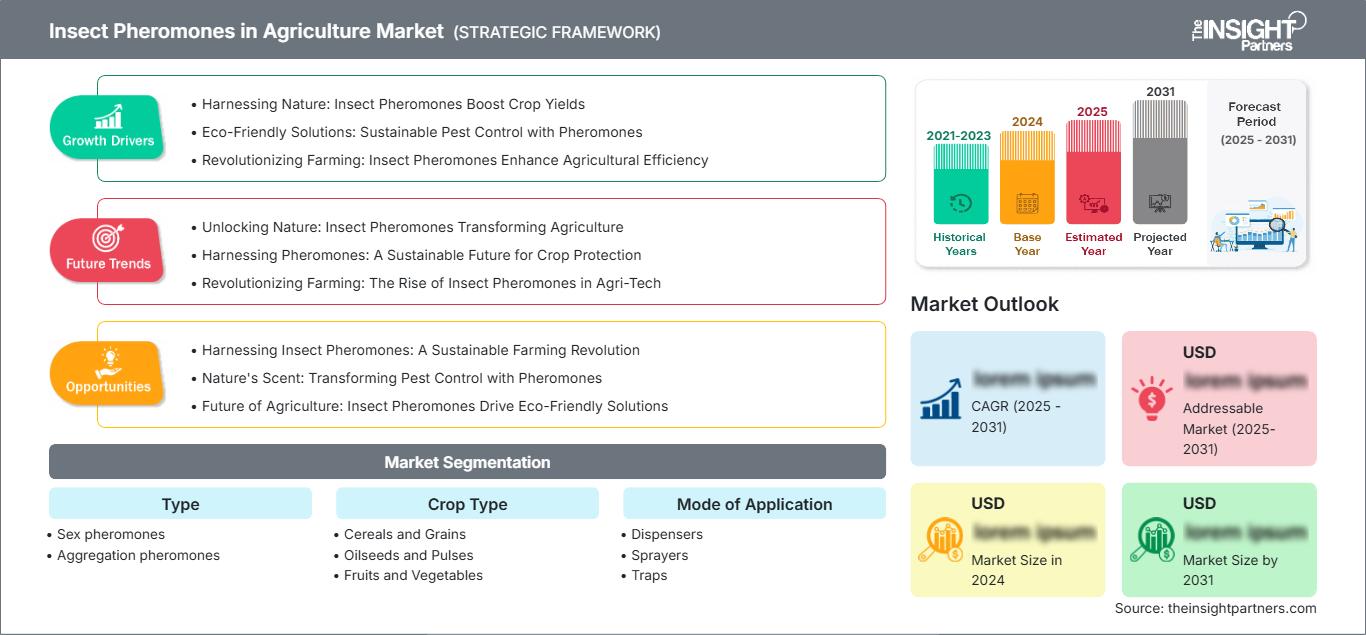
The insect pheromones in agriculture market is projected to expand from US$ 4.85 Billion in 2025 to US$ 17.64 Billion by 2034, registering a CAGR of 15.43% during 2026–2034. Market includes pheromone solutions that can be used for insect monitoring, attraction, trapping, and disruption in agricultural production systems. The increasing use with IPM, precise application, and residue-aware crop protection makes pheromones more commercially significant in high-value and broad-acre farms.
North America will continue to be one of the key regional insect pheromones in agriculture market size owing to existing use of pheromones in orchards, vineyards, nuts, and specialty crops. Favorable regulatory approval of bio-based pest control products and existing extension networks along with grower experience with mating disruption make the market more significant. North America continues to be a key region as pheromones are increasingly used with monitoring, resistance management, and spray reduction programs.
Insect Pheromones in Agriculture Market Assessment and Insights
- North America: North America is expected to account for a 31–35% share in 2025 and grow at a 13.8–15.2% CAGR during 2026–2034, supported by established mating-disruption programs and regulatory familiarity with pheromone-based crop protection.
- US: The US is estimated to represent 80–84% of North America's 2025 market and expand at a 13.9–15.3% CAGR during 2026–2034, led by orchard, nut, vineyard, and specialty-crop applications.
- Europe: Europe is estimated at a 25–29% share in 2025 and a 14.4–15.8% CAGR through 2034, with Spain, Italy, France, Germany, and the UK benefiting from integrated pest management requirements and established biocontrol adoption.
- Asia Pacific: Asia Pacific is estimated at a 27–31% share in 2025 and a 16.2–17.8% CAGR through 2034, led by China, Japan, India, South Korea, and Australia as protected cultivation and export-oriented horticulture expand.
- Largest Segment: Sex pheromones hold an estimated 76–80% market share in 2025 and are expected to grow at a 14.9–16.1% CAGR during 2026–2034, reflecting broad mating-disruption adoption.
- High Growth Segment: Sprayers are estimated at a 17–21% share in 2025 and projected to grow at an 17.0–18.5% CAGR, supported by sprayable microencapsulation and precision application.
- Key companies analyzed in detail: Bedoukian Research, Inc.; Biocont Laboratory spol. s r.o.; ISCA Technologies, Inc.; Laboratorios Agrochem S.L.; Pacific Biocontrol Corporation; Pherobank B.V.; Russell IPM Ltd.; Suterra LLC; Shin-Etsu Chemical Co., Ltd.; SEDQ Healthy Crops S.L.
Source: The Insight Partners' analysis based on proprietary research, government publications, company annual reports, investor presentations, industry databases, and expert interviews.
The advancements in the insect pheromones in agriculture market comprise of the transition from conventional lure monitoring to mating disruption by the particular species, mass trapping, aerosol and spray applications. Advancements in the synthesis method, release technologies, microencapsulation methods and emitter design have enhanced their lifespan and ease of application. The Environmental Protection Agency classifies the pheromone as a biochemical pesticide and recognizes its value in mating disruption, while the recent products mainly concentrate on minimizing the application rate and being suitable for IPM programs.
Future developments will focus on biodegradable carrier technology, digital monitoring techniques, automation of application methods, and crop-specific pheromone formulations. Markets that emerge based on future growth will attract investors as farmers are looking for residue free pest management solutions, and the regulatory environment supports bio-targeted pest control mechanisms. The company Shin-Etsu Chemical Company is working on biodegradable-resin based pheromones.
Insect Pheromones in Agriculture Market Report Scope
| Report Attribute | Details |
|---|---|
| Market size in 2025 | US$ 4.85 Billion |
| Market Size by 2034 | US$ 17.64 Billion |
| Global CAGR (2026 - 2034) | 15.43% |
| Historical Data | 2021-2024 |
| Forecast period | 2026-2034 |
Insect Pheromones in Agriculture Market Analysis
The demand has been driven by the requirement for reduction in broad spectrum insecticides along with the maintenance of the quality of crops and biologicals. Insect pheromones in agriculture market growth is related to orchards, vineyards, nuts, horticulture, and specialty crop cultivation, where specific pest treatments allow high costs in terms of technology.
On the supply side, the dynamics are defined by the capacity of chemical synthesis, knowledge in formulations, registration status, and reliability of release technology. The manufacturers control an increasing number of steps in order to ensure the quality and consistency of their products and appropriate release technology. For instance, Suterra claims that it manufactures the active substances and develops its products in-house, whereas Russell IPM offers more than 150 insect pheromone lures.
The competitive intensity is splintered amongst specialist pheromone producers, formulators, and biological crop protection providers. Based on the insect pheromones in agriculture market report, there is a trend towards differentiation being based on pest coverage, release time, ease of application, registration, and support rather than pheromone composition alone. Pacific Biocontrol focuses on hand application and aerosols whereas Suterra relies on dispensers, aerosols, and sprayable formats to cater to the needs of different crops.
Hence the investment will focus on formulating platforms, pest registrations and regional commercialization of products. Companies that possess R&D and manufacturing competencies can accelerate the cycle of development and release system customization depending upon the region. SEDQ has synthesis and formulation competencies in addition to being involved in European pheromone registration programs.
● REPORT CUSTOMIZATION
Tailor This Report To Align With Your Specific Business Requirements
This report can be customized to align precisely with your business objectives, scope, and target markets. Customization options include tailored segmentation, geography, competitive analysis, and strategic insights to support informed decision-making.
Customize This Report →WHAT YOU CAN ADJUST
- ● Segmentations
- ● Geography
- ● Competitive Analysis
- ● Language Preferences
Insect Pheromones in Agriculture Market: Strategic Insights
Regional Insights
North America Insect pheromones in agriculture market
North America is expected to have a insect pheromones in agriculture market share of 31-35% in 2025 and to witness a CAGR of 13.8-15.2% until 2034. The USA will be the dominant region with regards to market demand; however, there will be opportunities in Canada and Mexico, especially in fruit, vegetables and protected crops. In terms of application, pheromones are more established in orchards, vineyards, nuts and specialties.
Furthermore, field-based studies are increasing the technology application to areas beyond traditional orchards. For example, USDA studies on swede midge are evaluating the efficacy of dispensers, their durability, cost-effectiveness and applicability to vegetable rotations. Also, earlier studies have developed aerosols for mating disruption of navel orangeworm in California nut production.
U.S. Insect pheromones in agriculture Market
The US represents an estimated 80–84% of North America's 2025 market and is projected to grow at a 13.9–15.3% CAGR through 2034. Regulatory recognition, commercial grower experience, and extensive orchard and specialty-crop production underpin demand. EPA specifically identifies pheromones as biochemical pesticides used to interfere with mating behavior.
Pacific Biocontrol, Suterra, Bedoukian Research, and ISCA Technologies have strong technology and product presences in both monitoring and mating disruption systems. Deployment trends involve point-source dispensers, aerosol sprayers, trapping devices, and sprayable materials. Even USDA-funded projects are considering economic deployment possibilities in annual crops as well.
Europe Insect pheromones in agriculture Market
Europe is estimated at a 25–29% share in 2025 and is expected to grow at a 14.4–15.8% CAGR through 2034. Spain is a leading country, supported by horticulture, vineyards, citrus, and biological crop-protection expertise. The region's integrated pest management framework favors preventive and non-chemical measures when they provide satisfactory control.
There is a well-established specialist eco-system in the UK with Russell IPM claiming to be one of the biggest European producers of pheromone based monitoring and control products. Germany boasts an advanced horticulture and the adoption of biological crop protection methods whereas France and Italy offer significant potential due to the vineyards, orchards, and specialist crops present in the countries.
APAC Insect pheromones in agriculture Market
APAC is anticipated to possess 27–31% market share in 2025 and exhibit 16.2–17.8% CAGR till 2034 and emerge as the most prominent high-growth region. China and Japan represent key demand hubs whereas India, South Korea, and Australia present growing opportunities in horticulture and broad-acre crops.
Growth within the regional market is driven by demand for export-oriented fruits production, protected cultivation, pest monitoring needs, and growing usage of biological products in crop protection. Japan gains on account of advanced formulation capabilities while China and India present advantages related to scale and pest management. Australia has developed use-cases for orchards and horticulture.
Middle East & Africa Insect pheromones in agriculture Market
Middle East and Africa is expected to record a 12.6–14.2% CAGR through 2034. Saudi Arabia and the UAE are important for protected cultivation and intensive horticulture, while South Africa provides established fruit and vineyard applications. The region's investment in controlled agriculture supports targeted pest-management technologies.
Infrastructure upgrades, water shortages, export-grade conditions, and controlled environment agriculture are enhancing the business proposition for pest management that is species-specific. Fruit production in South Africa is opening up possibilities for mating disruption, and Gulf countries have the possibility of using pheromone-based systems in their greenhouse cultivation of premium products. MEA countries not considered yet have good future potential.
Segmentation Analysis
Type
Type segmentation is led by sex pheromones because mating disruption and monitoring programs commonly rely on species-specific sexual communication signals. The segment is expected to grow at a 14.9–16.1% CAGR during 2026–2034. Aggregation pheromones provide a complementary route for pest attraction and trapping, particularly where collective insect behavior can improve monitoring efficiency. EPA recognizes sex pheromones as biochemical pest-control substances.
- Sex pheromones: Sex pheromones maintain the dominant market position because they support mating disruption and monitoring across orchard, vineyard, nut, and horticultural pest programs with established agronomic protocols.
- Aggregation pheromones: Aggregation pheromones are strategically important for attracting multiple insects toward monitoring or trapping points, supporting pest surveillance and targeted intervention where population behavior favors aggregation.
Crop Type
Crop Type is increasingly influenced by crop value, pest specificity, export standards, and the economic consequences of cosmetic or yield losses. The segment is expected to grow at a 15.1–16.5% CAGR during 2026–2034. High-value fruits and vegetables remain important because targeted pest control can support quality requirements and reduce reliance on repeated broad-spectrum treatments.
- Cereals and Grains: Cereals and grains offer a large potential acreage base, with pheromone technologies particularly relevant to monitoring and targeted pest management where stored-product and field pest pressures justify specialized systems.
- Oilseeds and Pulses: Oilseeds and pulses represent an expanding application area as growers seek alternatives to repeated insecticide use, although adoption remains dependent on pest biology, crop economics, and practical deployment.
- Fruits and Vegetables: Fruits and vegetables remain strategically important because high crop value, appearance standards, export requirements, and intensive pest pressure improve the economic attractiveness of precision pheromone interventions.
Mode of Application
Mode of Application is shifting toward flexible delivery platforms that improve coverage, labor efficiency, and release consistency. The segment is projected to grow at a 15.8–17.2% CAGR during 2026–2034. Dispensers remain established, while sprayable and automated delivery systems are gaining attention because they can integrate more readily with mechanized farm operations. Suterra's sprayable formulations illustrate this transition.
- Dispensers: Dispensers remain widely used for mating disruption because point-source systems can provide season-long release and targeted placement, particularly in orchards and vineyards with established installation practices.
- Sprayers: Sprayers are gaining strategic importance as microencapsulation enables liquid formulations to deliver controlled release through conventional equipment, backpack systems, or precision platforms.
- Traps: Traps support monitoring, mass trapping, and decision-making by linking pheromone attraction with direct pest detection or removal, making them useful within integrated pest management programs.
Opportunity Snapshot
| Mode of Application | Revenue Contribution (High/Medium/Low) | Trend Tag | Adoption Stage |
| Dispensers | High | Season Release | Mature |
| Sprayers | Medium | Precision Spray | Scaling |
| Traps | Medium | Pest Monitoring | Mature |
Insect Pheromones in Agriculture Market Growth Drivers and Impact Analysis
Expansion of integrated pest management programs
Integrated pest management is creating a structural demand base because pheromones can be deployed as highly targeted tools before broader chemical intervention is considered. The European Commission identifies IPM as a cornerstone of sustainable crop protection and requires professional users to apply its principles, while the US EPA recommends targeted controls such as pheromones before less selective measures. This framework improves the strategic position of pheromone products within crop-protection programs. Commercial impact extends beyond direct product sales because growers increasingly value monitoring, threshold-based treatment, resistance management, and beneficial-insect protection. Suppliers capable of combining lures, dispensers, traps, advisory support, and digital monitoring can therefore capture a larger portion of farm-level spending and build recurring seasonal demand.
Pressure to reduce conventional insecticide dependence
Growing concern about pesticide residues, resistance development, and non-target effects is encouraging growers to diversify pest-management programs. Pheromones offer a species-specific mode of action that can reduce mating or attract target insects without functioning as broad-spectrum toxicants. Shin-Etsu highlights the potential of synthetic pheromones to reduce chemical pesticide frequency and help conserve biodiversity, while Suterra positions pheromone technologies as tools for reducing conventional insecticide use. The commercial effect is strongest in crops where repeated applications are costly or where export markets impose strict quality requirements. As growers evaluate total crop-protection costs rather than individual product prices, pheromone systems can gain adoption when reduced spray frequency, residue management, and crop-quality protection offset installation and deployment expenses.
Advances in controlled-release formulation technology
Controlled-release technology is improving the practicality of pheromone deployment by extending release periods and broadening available application methods. Microencapsulation, improved polymers, aerosol emitters, and biodegradable carriers allow manufacturers to tailor release profiles to pest biology, climate, and crop architecture. Suterra's sprayable CheckMate platform uses microencapsulation and can be applied through spray rigs, backpacks, or drones, while Shin-Etsu is developing biodegradable-resin formulations. These advances can reduce labor requirements and increase compatibility with existing agricultural equipment. Commercially, better formulation performance also allows suppliers to address crops and geographies where conventional point-source dispensers are difficult to install or maintain. As application flexibility improves, pheromones can move from specialized orchard programs toward broader integrated pest-management systems.
Insect Pheromones in Agriculture Market Future Trends
Biodegradable and low-residue delivery systems
A major future direction will be the development of pheromone formulations using biodegradable carriers, recyclable components, and improved release-control materials. The insect pheromones in agriculture market trends are likely to increasingly reflect environmental performance alongside pest-control efficacy. Formulation developers are working to maintain consistent release while reducing the persistence of non-active components in agricultural environments. Shin-Etsu's work on biodegradable resin-based synthetic pheromone formulations demonstrates how material science is becoming part of product differentiation. Over the forecast period, suppliers are likely to prioritize carrier systems that withstand heat, rainfall, and ultraviolet exposure while degrading predictably after their useful life. Such developments can support adoption in jurisdictions with stronger environmental requirements and among growers seeking measurable reductions in crop-protection residues.
Integration with precision agriculture and automated monitoring
Pheromone deployment is likely to become increasingly connected with digital scouting, automated traps, remote sensing, and farm-management platforms. Future systems can combine pest counts, weather data, crop stage, and pheromone activity to support more precise intervention timing. Automated monitoring can also reduce labor requirements and provide more consistent population data than periodic manual scouting. The commercial opportunity is particularly relevant to large farms and high-value horticultural operations where early detection has measurable economic value. Over time, pheromone suppliers may increasingly compete through complete monitoring-and-control platforms rather than standalone lures or dispensers. Integration with drones and precision spraying could further improve field coverage and enable variable deployment according to pest pressure, crop architecture, and localized treatment requirements.
Insect Pheromones in Agriculture Market Opportunities
Expansion across emerging horticultural production centers
The insect pheromones in agriculture market Forecasts indicate attractive opportunities in emerging horticultural centers where export quality, residue compliance, and intensive cultivation are increasing. India, China, Southeast Asia, the Middle East, and selected African markets offer opportunities for companies able to localize pest targets, formulation durability, and distribution models. Expansion should prioritize crops with high value per hectare and clearly defined pest species because these conditions improve the return on pheromone deployment. Partnerships with local distributors, agricultural universities, extension agencies, and grower cooperatives can accelerate field validation and adoption. Companies should also develop region-specific registration strategies because product authorization, permitted application methods, and labeling requirements differ substantially across markets. Local technical support will remain important for demonstrating correct placement, timing, and integration with existing IPM programs.
Development of integrated pheromone service platforms
A second opportunity lies in moving from product sales toward integrated pest-management services that combine pheromone products, monitoring, analytics, and agronomic recommendations. Suppliers can differentiate through recurring seasonal contracts covering traps, dispensers, field scouting, pest identification, and digital reporting. This approach can reduce adoption barriers because growers receive a complete pest-management program rather than having to design deployment independently. Service models are particularly suitable for high-value orchards, vineyards, protected cultivation, and export-oriented horticulture where pest thresholds and crop quality are closely monitored. Strategic partnerships with farm-management software providers and agricultural technology companies could further expand the addressable customer base. Over time, data collected through these services could support better pest forecasting, formulation optimization, and customer-specific deployment strategies.
Recent Developments
- July 2025: Bayer signed a development and distribution agreement with French pheromones expert company M2i Group for the gels for the Asia- exclusive distribution of pheromone Pacific as well as the Latin America region and the United States building on its successful collaboration and related product launches in Europe and Africa.
- April 2025: FMC Corporation announced that it has received registration in Brazil for Sofero Fall pheromone targeting fall armyworm (Spodoptera frugiperda). Sofero Fall is the first in the company’s lineup of distinctive pheromone products for row crops offering growers a novel approach to sustainably control pests, manage resistance and boost productivity.
Frequently Asked Questions

- Comprehensive Market Sizing and Forecast Analysis
- Detailed Segmentation Analysis
- In-Depth Market Dynamics Assessment
- Regional and Country-Level Insights
- Competitive Landscape and Company Benchmarking
- Strategic Business Intelligence
Recent Reports
Testimonials

The Insight Partners provided valuable market intelligence that supported our global go-to-market strategy. Their team was professional, responsive, and attentive to our feedback, providing thoughtful analysis and helpful methodological clarifications throughout the project.
Junmo Kim Chief Financial Officer (CFO), Enertech Co., Ltd.
The Insight Partners' SCADA System Market report is comprehensive, with valuable insights on current trends and future forecasts. The team was highly professional, responsive, and supportive throughout. We are very satisfied and highly recommend their services.
RAN KEDEM Partner, Reali Technologies LTDs
I requested a report on a very specific software market and the team produced the report in a few days. The information was very relevant and well presented. I then requested some changes and additions to the report. The team was again very responsive and I got the final report in less than a week.
JEAN-HERVE JENN Chairman, Future Analytica
We worked with The Insight Partners for an important market study and forecast. They gave us clear insights into opportunities and risks, which helped shape our plans. Their research was easy to use and based on solid data. It helped us make smart, confident decisions. We highly recommend them.
PIYUSH NAGPAL Sr. Vice President, High Beam Global
The Insight Partners delivered insightful, well-structured market research with strong domain expertise. Their team was professional and responsive throughout. The user-friendly website made accessing industry reports seamless. We highly recommend them for reliable, high-quality research services
YUKIHIKO ADACHI CEO, Deep Blue, LLC.
This is the first time I have purchased a market report from The Insight Partners.While I was unsure at first, I visited their web site and felt more comfortable to take the risk and purchase a market report.I am completely satisfied with the quality of the report and customer service. I had several questions and comments with the initial report, but after a couple of dialogs over email with their analyst I believe I have a report that I can use as input to our strategic planning process.Thank you so much for taking the extra time and making this a positive experience.I will definitely recommend your service to others and you will be my first call when we need further market data.
JOHN SUZUKI President and Chief Executive Officer, Board Director, BK Technologies
I wish to appreciate your support and the professionalism you displayed in the course of attending to my request for information regarding to infectious disease IVD market in Nigeria. I appreciate your patience, your guidance, and the fact that you were willing to offer a discount, which eventually made it possible for us to close a deal. I look forward to engaging The Insight Partners in the future, all thanks to the impression you have created in me as a result of this first encounter.
DR CHIJIOKE ONYIA MANAGING DIRECTOR, PineCrest Healthcare Ltd.Reason to Buy
- Informed Decision-Making
- Understanding Market Dynamics
- Competitive Analysis
- Identifying Emerging Markets
- Customer Insights
- Market Forecasts
- Risk Mitigation
- Boosting Operational Efficiency
- Strategic Planning
- Investment Justification
- Tracking Industry Innovations
- Aligning with Regulatory Trends





 Get Free Sample for