
Inspection Robotics for Industrial Gas Market Growth, Demand & Size by 2034
Coverage: By Component (Hardware, Software, Services); Application (Offshore, Onshore) , and Geography (North America, Europe, Asia Pacific, and South and Central America)
- Status : Data Released
- Report Code : TIPRE00019473
- Category : Manufacturing and Construction
- No. of Pages : 150
- Available Report Formats :


- Last update date : July 10, 2026


2025 Market Size
US$ 305.08 Mn
Base year value
2034 Forecast
US$ 423.17 Mn
Projected by 2034
CAGR 2026-2034
4.17 %
Growth rate
Addressable Market
US$ 3,386.75 Mn
(2026-2034)
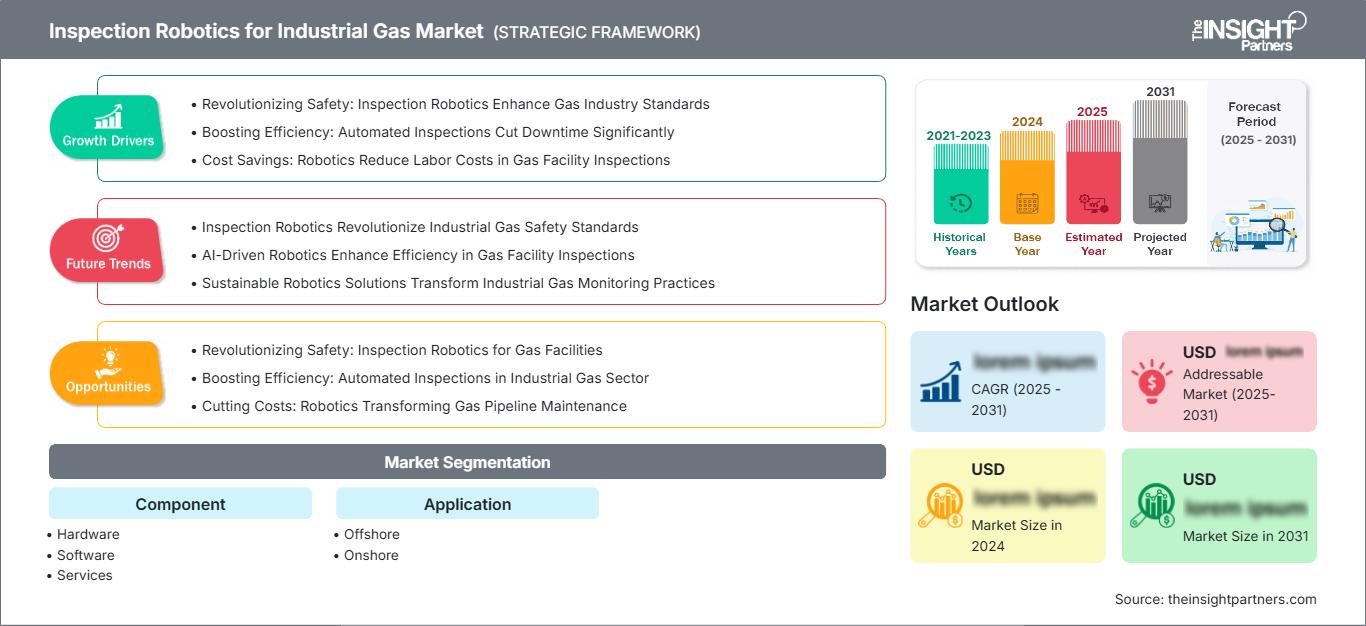
The inspection robotics for industrial gas market size is projected to grow from US$ 305.08 Million in 2025 to US$ 423.17 Million by 2034, registering a CAGR of 4.17% during 2026–2034. Demand is shaped by industrial gas networks, LNG facilities, refineries, compressor stations, and storage assets that require safe, repeatable, and data-rich inspection in hazardous, confined, elevated, or submerged operating environments.
North America is expected to expand at a CAGR of 4.4–4.8% during 2026–2034, supported by aging midstream infrastructure, LNG export capacity, and stricter methane monitoring expectations. Operators in the US and Canada are shifting from periodic manual inspection toward robotics-enabled integrity programs that reduce personnel exposure while improving defect traceability across pipelines, tanks, process units, and offshore platforms.
Inspection Robotics for Industrial Gas Market Assessment and Insights
- North America: The region accounted for 31–33% share in 2025 and is growing at a CAGR of 4.4–4.8% between 2026–2034, driven by pipeline modernization, LNG terminals, and hazardous-area certification pathways.
- US: The US represented 78–82% of North America in 2025 and is growing at a CAGR of 4.5–4.9% between 2026–2034, led by shale gas infrastructure, refining, and emissions monitoring.
- Europe: Europe held 24–26% share in 2025 and is growing at a CAGR of 3.8–4.2% between 2026–2034, with the UK, Germany, Norway, France, and Italy leading adoption.
- Asia Pacific: Asia Pacific captured 27–29% share in 2025 and is growing at a CAGR of 4.7–5.1% between 2026–2034, supported by China, Japan, South Korea, India, and Australia.
- Largest Segment: Hardware held 56–60% of the inspection robotics for industrial gas market share in 2025 and is growing at a CAGR of 3.7–4.1% between 2026–2034 as operators prioritize rugged platforms and sensor payloads.
- High Growth Segment: Software held 18–22% market share in 2025 and is growing at a CAGR of 5.0–5.4% between 2026–2034 as analytics, autonomy, and digital twins scale.
- Key companies analyzed in detail: ABB Ltd.; Alstom Inspection Robots; Cyberhawk Innovations Ltd.; ExRobotics B.V.; Flyability SA; General Electric Company; Honeybee Robotics, LLC; IKM Subsea AS; Saab Seaeye Ltd.; and TechnipFMC plc.
Source: The Insight Partners' analysis based on proprietary research, government publications, company annual reports, investor presentations, industry databases, and expert interviews.
Inspection methodologies are shifting from plant shutdown dependent visual inspections to robotic enabled methodologies using optics, ultrasonics, acoustics, thermal and gases detection methods. Industrial Gas Operators today have to find the best balance between uptime and safety assurance and this trend can already be observed in offshore tanks, onshore compressors, LNG trains and refineries where use of robotic data helps in improving inspection reliability and condition-based maintenance decision making.
Going forward, the most promising areas would be those combining regulation requirements, labor shortage and aging assets issues. Growing LNG hubs in Asia Pacific and Middle East region will also start to invest in automation of inspection processes together with gas processing facilities expansion, while operators in North America would speed up implementation of methane detection and hazardous area robotics solutions. Thus, Inspection Robotics for Industrial Gas Market forecast would be expanding beyond pure inspection tools towards asset intelligence process.
Inspection Robotics for Industrial Gas Market Report Scope
| Report Attribute | Details |
|---|---|
| Market size in 2025 | US$ 305.08 Million |
| Market Size by 2034 | US$ 423.17 Million |
| Global CAGR (2026 - 2034) | 4.17% |
| Historical Data | 2021-2024 |
| Forecast period | 2026-2034 |
Inspection Robotics for Industrial Gas Market Analysis
Demand will be driven by the requirement for inspection of assets that may be hard to reach and/or unsafe for humans to access. Industrial gas infrastructure comprises pressurized pipe lines, vessels, tanks, cryogenic storage systems, subsea structures, and offshore process units, thus necessitating a range of applications for crawlers, drones, remotely operated vehicles, and mobile robots.
The ecosystem involves robot producers, non-destructive testing sensors suppliers, integrity services providers, cloud computing services providers, and oil and gas producers. The supply chain will continue to be highly hardware intensive, although the importance of service-based approaches is increasing because many operators now favor inspection-as-a-service approach for niche inspections.
The competitive landscape is fragmented but increasingly capability-led. The inspection robotics for industrial gas market report focuses on key players including Flyability SA, Cyberhawk Innovations Ltd., ExRobotics B.V., IKM Subsea AS, Saab Seaeye Ltd., and TechnipFMC plc emphasize access, data capture, subsea inspection, or hazardous-area operation. ABB Ltd., General Electric Company, Honeybee Robotics, LLC, and Alstom Inspection Robots strengthen the broader automation, sensing, and robotics base.
Investment is moving toward autonomy software, payload miniaturization, explosion-safe designs, and cloud-based defect analytics. Strategic positioning depends less on robot mobility alone and more on verified inspection data, asset context, reporting speed, and regulatory defensibility. This makes inspection robotics for industrial gas market analysis essential for procurement teams assessing lifecycle value rather than equipment price.
● REPORT CUSTOMIZATION
Tailor This Report To Align With Your Specific Business Requirements
This report can be customized to align precisely with your business objectives, scope, and target markets. Customization options include tailored segmentation, geography, competitive analysis, and strategic insights to support informed decision-making.
Customize This Report →WHAT YOU CAN ADJUST
- ● Segmentations
- ● Geography
- ● Competitive Analysis
- ● Language Preferences
Inspection Robotics for Industrial Gas Market: Strategic Insights
Regional Insights
North America Inspection Robotics for Industrial Gas
North America held 31–33% share in 2025 and is advancing at a CAGR of 4.4–4.8% through 2034. The region benefits from extensive gas pipelines, LNG export infrastructure, refineries, and mature offshore assets that require frequent inspection without extended shutdowns.
Regulatory focus on methane control and worker safety strengthens adoption of aerial, crawler, and autonomous inspection systems. US Gulf Coast facilities, Canadian gas processing assets, and offshore installations create recurring demand for ultrasonic testing, optical gas imaging, thermal inspection, and digital reporting workflows.
U.S. Inspection Robotics for Industrial Gas Market
The US accounted for 78–82% of North America in 2025 and is expected to grow at a CAGR of 4.5–4.9% during 2026–2034. Its leadership reflects shale gas production, LNG exports, refining capacity, and dense pipeline networks requiring continuous integrity management.
Company presence is supported by robotics vendors, inspection service providers, and digital asset-management specialists serving onshore and offshore operators. Applications are expanding from tank and flare inspection to methane leak detection, compressor station monitoring, and remote verification of high-risk assets.
Europe Inspection Robotics for Industrial Gas Market
Europe represented 24–26% share in 2025 and is expanding at a CAGR of 3.8–4.2% between 2026–2034. The UK leads regional deployment through North Sea offshore platforms, LNG terminals, and inspection programs that reduce rope access and confined-space entry.
Germany’s demand is linked to industrial gas storage, chemical parks, hydrogen-ready networks, and pipeline conversion projects. Operators value robotic inspection because it supports non-destructive testing, corrosion mapping, and documentation under strict safety and environmental rules.
France, Italy, and Spain contribute through refineries, LNG import terminals, and gas distribution modernization. Norway remains influential in offshore and subsea inspection due to demanding operating conditions and advanced integrity management practices across upstream assets.
APAC Inspection Robotics for Industrial Gas Market
APAC held 27–29% share in 2025 and is growing at a CAGR of 4.7–5.1% through 2034. China is the leading country, supported by gas pipeline expansion, LNG import terminals, petrochemical complexes, and state-backed industrial automation programs.
Japan and South Korea emphasize LNG storage, shipyard-linked offshore engineering, and high-reliability inspection workflows. India is increasing adoption as city gas distribution, refining, and fertilizer-linked industrial gas infrastructure expands.
Australia’s role is tied to LNG export assets, remote upstream facilities, and safety-focused inspection in harsh operating environments. Policy support for digital industry and energy security reinforces regional procurement of robotic inspection platforms.
Middle East & Africa Inspection Robotics for Industrial Gas Market
Middle East & Africa is advancing at a CAGR of 4.1–4.5% during 2026–2034. Saudi Arabia is the leading country, driven by gas processing, petrochemical expansion, and large-scale energy infrastructure requiring safer inspection access.
The UAE supports adoption through LNG, refining, offshore platforms, and digital oilfield initiatives. Operators prioritize robotics where heat, height, confined spaces, and explosive atmospheres increase manual inspection complexity.
South Africa and the rest of MEA create selective demand in refineries, storage terminals, and transmission infrastructure. Budget discipline slows widespread adoption, but high-risk assets justify targeted robotic inspection spending.
Segmentation Analysis
Component
The component segment is projected to grow at a CAGR of 4.0–4.4% during 2026–2034. Hardware remains the revenue anchor because robots, sensors, batteries, tethers, cameras, ultrasonic probes, and explosion-safe enclosures represent the largest deployment cost. Software and services are gaining strategic importance as operators move toward analytics-led inspection programs and recurring data management.
- Hardware holds the strongest market position because industrial gas inspection requires rugged robots, NDT payloads, navigation systems, imaging tools, and certified designs for hazardous or confined operating environments.
- Software demand is scaling as operators use autonomy, mapping, defect recognition, digital twins, and reporting platforms to convert inspection data into maintenance actions and compliance records.
- Services remain strategically important where operators outsource specialist missions, pilot expertise, maintenance planning, and data interpretation rather than building in-house robotics teams.
Application
The application segment is expected to grow at a CAGR of 4.1–4.5% during 2026–2034. Onshore applications dominate because pipelines, compressor stations, storage tanks, refineries, and gas-processing plants require recurring inspection. Offshore applications are expanding steadily as operators replace manual access, diving, and rope-based methods with drones, crawlers, and subsea robotic systems.
- Offshore inspection uses aerial drones, ROVs, and crawlers to examine tanks, hulls, risers, platforms, and subsea gas infrastructure where access costs and safety risks are high.
- Onshore inspection benefits from broader asset density across pipelines, LNG terminals, compressor stations, refineries, and storage facilities, making it central to routine integrity and emissions programs.
Opportunity Snapshot
| Application | Revenue Contribution | Trend Tag | Adoption Stage |
| Offshore | Medium | Subsea Access | Scaling |
| Onshore | High | Methane Monitoring | Mature |
Inspection Robotics for Industrial Gas Market Growth Drivers and Impact Analysis
Hazardous-area safety and workforce exposure reduction
The inspection of industrial gas assets often involves inspections in confined tanks, pipe racks at height, offshore modules, compressor stations, and in environments containing flammable gases. The use of robotics decreases the amount of personnel exposed to these environments without decreasing the rate of inspection. This has an important operational effect in that fewer hours of rope access, tank entry, and scaffolding are required, which in turn could decrease planning time and safety incidents. The more that robotic technology becomes certified, the more that standardized inspection will occur.
Aging pipelines and integrity management requirements
The gas infrastructure in mature areas consists of pipelines, storage tanks, pressure vessels, and processing equipment that have been used under conditions exceeding their initial design considerations. The use of robots to conduct inspections would provide for the more frequent analysis of condition through access to hard-to-reach areas and obtaining reliable data from non-destructive testing methods. This factor directly influences the cost efficiency of maintenance because it can help avoid forced shutdowns or urgent repairs in cases of corrosion, cracking, coating damage, or leakage.
Methane detection and environmental compliance pressure
The regulation and management of methane are becoming key areas to focus on due to the requirement for quantifiable reduction in emissions by the regulatory authorities, investors, and end-users of energy. The use of robots that feature OGI systems, acoustic sensors, thermal imagery technology, and point gas detection equipment can perform inspections of valves, flanges, compressors, and processes more often than human teams can. The market effect would be a move from periodic compliance to ongoing verification.
Inspection Robotics for Industrial Gas Market Future Trends
Autonomous inspection fleets linked to digital twins
Further implementations will include robotic deployment alongside facility twins, such that inspection paths, defect history, and maintenance activities can be analyzed through one asset model. This development brings about a shift from data gathering to decision-making in terms of robotics. Robots will operate based on risks within the asset, and the software will analyze new readings against historical baselines. In relation to industrial gas operations, this could enhance better planning and prevent duplication of inspections among other benefits.
Payload convergence for multi-sensor missions
Combination payloads incorporating both visual, ultrasonic, LiDAR, infrared, acoustic and chemical sensors are becoming standard practice on robotic platforms with the aim of reducing redundancy of deployments while making better contextual assessment of any discovered defect possible. The Inspection Robotics for Industrial Gas Market trends indicate that the future lies in modular sensor design, where the operator can choose what payload is appropriate for particular asset depending on its risk profile.
Inspection Robotics for Industrial Gas Market Opportunities
Inspection-as-a-service for mid-sized operators
Mid-sized gas processors, terminal operators, and industrial gas asset owners often lack the capital budget or technical workforce to own and maintain advanced robots. Service-led models create an opportunity for vendors to package equipment, certified operators, analytics, reporting, and maintenance recommendations under recurring contracts. This approach lowers adoption barriers while giving operators access to specialized inspection capabilities. It also creates predictable revenue for providers and supports wider penetration beyond large integrated oil and gas companies.
Robotics for LNG and hydrogen-ready infrastructure
LNG terminals, cryogenic tanks, hydrogen-blending pilots, and converted gas networks create inspection needs that differ from conventional pipeline programs. Vendors can target these assets with robots designed for cold environments, confined access, leak localization, and high-resolution structural monitoring. The opportunity is strongest where governments and operators are expanding gas import capacity or preparing lower-carbon fuel pathways. Early involvement in design-stage inspection planning can position robotics providers as long-term integrity partners rather than episodic equipment suppliers.
Recent Developments
- June 2026: UL Solutions Inc. (NYSE: ULS), a global leader in applied safety science, today announced it has issued its first certification for a remotely operated robot designed for hazardous locations to ExRobotics for its ExR-2.5 inspection robot, helping shift high-risk inspections from people to robots in potentially explosive atmospheres.
- May 2026: ADNOC has successfully deployed Taurob’s heavy-duty inspector robot at its Taweelah Gas Compression Plant, where it will conduct routine inspections in hazardous environments without putting people at risk.
- November 2025: Cyberhawk Innovations Ltd. — partnered with Skygauge Robotics to deliver robotic ultrasonic thickness inspections globally, integrating Skygauge data into the iHawk platform for energy, industrial, and critical infrastructure customers seeking safer inspection at height and in hazardous areas.
Frequently Asked Questions

- Comprehensive Market Sizing and Forecast Analysis
- Detailed Segmentation Analysis
- In-Depth Market Dynamics Assessment
- Regional and Country-Level Insights
- Competitive Landscape and Company Benchmarking
- Strategic Business Intelligence
Recent Reports
Testimonials

The Insight Partners' SCADA System Market report is comprehensive, with valuable insights on current trends and future forecasts. The team was highly professional, responsive, and supportive throughout. We are very satisfied and highly recommend their services.
RAN KEDEM Partner, Reali Technologies LTDs
I requested a report on a very specific software market and the team produced the report in a few days. The information was very relevant and well presented. I then requested some changes and additions to the report. The team was again very responsive and I got the final report in less than a week.
JEAN-HERVE JENN Chairman, Future Analytica
We worked with The Insight Partners for an important market study and forecast. They gave us clear insights into opportunities and risks, which helped shape our plans. Their research was easy to use and based on solid data. It helped us make smart, confident decisions. We highly recommend them.
PIYUSH NAGPAL Sr. Vice President, High Beam Global
The Insight Partners delivered insightful, well-structured market research with strong domain expertise. Their team was professional and responsive throughout. The user-friendly website made accessing industry reports seamless. We highly recommend them for reliable, high-quality research services
YUKIHIKO ADACHI CEO, Deep Blue, LLC.
This is the first time I have purchased a market report from The Insight Partners.While I was unsure at first, I visited their web site and felt more comfortable to take the risk and purchase a market report.I am completely satisfied with the quality of the report and customer service. I had several questions and comments with the initial report, but after a couple of dialogs over email with their analyst I believe I have a report that I can use as input to our strategic planning process.Thank you so much for taking the extra time and making this a positive experience.I will definitely recommend your service to others and you will be my first call when we need further market data.
JOHN SUZUKI President and Chief Executive Officer, Board Director, BK Technologies
I wish to appreciate your support and the professionalism you displayed in the course of attending to my request for information regarding to infectious disease IVD market in Nigeria. I appreciate your patience, your guidance, and the fact that you were willing to offer a discount, which eventually made it possible for us to close a deal. I look forward to engaging The Insight Partners in the future, all thanks to the impression you have created in me as a result of this first encounter.
DR CHIJIOKE ONYIA MANAGING DIRECTOR, PineCrest Healthcare Ltd.Reason to Buy
- Informed Decision-Making
- Understanding Market Dynamics
- Competitive Analysis
- Identifying Emerging Markets
- Customer Insights
- Market Forecasts
- Risk Mitigation
- Boosting Operational Efficiency
- Strategic Planning
- Investment Justification
- Tracking Industry Innovations
- Aligning with Regulatory Trends





 Get Free Sample for