
Instrumentation Valves and Fittings Market Size, Share & Growth by 2034
Coverage: by Product Type (Fittings, Valves, Pneumatic Actuators, Others); Industry Vertical (Energy and Power, Healthcare, Oil and Gas, Food and Beverages, Chemicals, Others) , and Geography (North America, Europe, Asia Pacific, and South and Central America)
- Status : Data Released
- Report Code : TIPRE00008831
- Category : Manufacturing and Construction
- No. of Pages : 150
- Available Report Formats :


- Last update date : July 10, 2026


2025 Market Size
US$ 3.17 Bn
Base year value
2034 Forecast
US$ 5.6 Bn
Projected by 2034
CAGR 2026-2034
6.54 %
Growth rate
Addressable Market
US$ 39.69 Bn
(2026-2034)
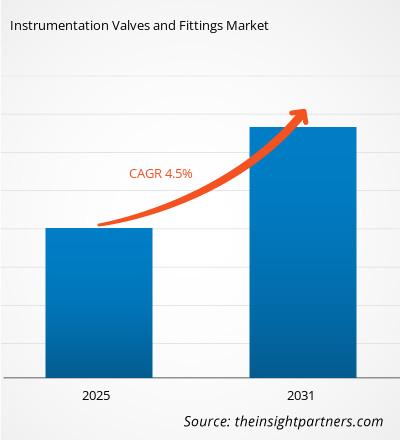
The Instrumentation Valves and Fittings Market size is projected to grow from US$ 3.17 Billion in 2025 to US$ 5.6 Billion by 2034; it is expected to register a CAGR of 6.54% from 2026 to 2034. The market is fueled by the need for precision flow control in the energy sector, oil and gas, chemicals, healthcare, food processing and power infrastructures where safety, leak protection and uptime are important purchasing considerations.
North America is forecast to grow at a CAGR of 5.9–6.4% between 2026 and 2034, driven by shale gas processing, refinery upgrades, hydrogen-compatible energy systems, and stringent safety regulations for high pressure assets. In North America, existing assets drive the replacement market, while automation upgradations in chemicals, power generation and gas infrastructure in healthcare offer continuous opportunities for certified stainless steel valves, fittings and pneumatic assemblies.
Instrumentation Valves and Fittings Market Assessment and Insights
- North America: The region accounted for 31–34% share in 2025 and is projected to grow at a CAGR of 5.9–6.4% during 2026–2034, led by process safety upgrades, LNG terminals, and automation-led plant modernization.
- US: The US represented 76–80% of North America instrumentation valves and fittings market share in 2025 and is expected to grow at a CAGR of 5.8–6.3% through 2034, supported by refineries, shale gas, and semiconductor-grade utilities.
- Europe: Europe held 24–27% share in 2025 and is projected to grow at a CAGR of 5.4–5.9%, with Germany, the UK, France, Italy, and Spain driving replacement demand under pressure equipment and emissions compliance.
- Asia Pacific: Asia Pacific represented 27–30% share in 2025 and is expected to grow at a CAGR of 7.1–7.7%, led by China, India, Japan, South Korea, and Australia across energy, chemicals, and food processing.
- Largest Segment: Fittings held 41–45% instrumentation valves and fittings market share in 2025 and are expected to grow at a CAGR of 6.1–6.6%, reflecting recurring replacement cycles and broad use in tubing networks.
- High Growth Segment: Pneumatic actuators held 10–13% market share in 2025 and are projected to grow at a CAGR of 7.4–8.0%, supported by automated valve control and remote operations.
- Key companies analyzed in detail: CIRCOR International, Inc., FITOK Group, HAM-LET Group, Hy-Lok USA, Inc., Mcneil Instruments Inc., Met-Lok Valves and Fittings, Panam Engineers Ltd., Parker-Hannifin Corporation, PMT Valves Pvt. Ltd., and Swagelok Company.
Source: The Insight Partners' analysis based on proprietary research, government publications, company annual reports, investor presentations, industry databases, and expert interviews.
The instrumentation valves and fittings market has evolved from commodity tube connections toward engineered systems designed for leak-tight performance, repeatability, and compatibility with digital plant architectures. Stainless steel remains the preferred material for corrosive and hygienic environments, while alloys gain relevance in offshore, chemical, and hydrogen applications. Production strategies increasingly emphasize localized machining, certified testing, and shorter lead times, as end users require traceability, pressure integrity, and assemblies aligned with ASME, ISO, and regional safety standards.
Instrumentation Valves and Fittings Market Forecast highlights that the market continues to be shaped by emerging manufacturing corridors, LNG and petrochemical investments, medical gas infrastructure, and stricter environmental monitoring. Asia Pacific and the Middle East are expected to attract new capacity, while North America and Europe will prioritize replacing aging instrumentation loops. The Instrumentation Valves and Fittings Market growth outlook is therefore linked to safety assurance, automation density, and the shift toward low-emission, high-reliability industrial assets.
Instrumentation Valves and Fittings Market Report Scope
| Report Attribute | Details |
|---|---|
| Market size in 2025 | US$ 3.17 Billion |
| Market Size by 2034 | US$ 5.6 Billion |
| Global CAGR (2026 - 2034) | 6.54% |
| Historical Data | 2021-2024 |
| Forecast period | 2026-2034 |
Instrumentation Valves and Fittings Market Analysis
The demand lies in process industries where there is a need for pressure, temperature, and flow measurement involving reliable interface components. There is also a demand for isolation, calibration, and venting components in energy and power industries such as turbines, boilers, hydrogen blending, and batteries. There is a demand for valves and fitting components in oil and gas industry in wells, separators, refineries, and pipelines.
The instrumentation valves and fittings market value chain includes stainless steel and alloy suppliers, precision machining companies, seal and ferrule manufacturers, testing laboratories, distributors, EPC contractors, and maintenance service providers. Supply dynamics remain sensitive to nickel, molybdenum, and specialty alloy costs, but buyers increasingly evaluate lifecycle reliability over unit price. This supports the market share held by certified suppliers with documented pressure-testing and application-engineering capabilities.
The competitive landscape in the instrumentation valves and fittings market report is moderately consolidated among global and regional specialists. Parker-Hannifin Corporation and Swagelok Company compete through broad distribution, training, and system engineering, while CIRCOR International, Inc., FITOK Group, HAM-LET Group, and Hy-Lok USA, Inc. focus on pressure-rated product portfolios. Indian suppliers such as Panam Engineers Ltd., PMT Valves Pvt. Ltd., and Met-Lok Valves and Fittings strengthen cost-competitive regional availability.
Investment trends favor automated production, cleanroom-compatible product lines, digital catalogs, and faster customization for EPC projects. Strategic positioning increasingly depends on material certification, interchangeability, leakage performance, and local stockholding near industrial clusters. The Instrumentation Valves and Fittings Market analysis indicates that suppliers able to combine engineering support with resilient inventories will gain preference in high-specification projects.
● REPORT CUSTOMIZATION
Tailor This Report To Align With Your Specific Business Requirements
This report can be customized to align precisely with your business objectives, scope, and target markets. Customization options include tailored segmentation, geography, competitive analysis, and strategic insights to support informed decision-making.
Customize This Report →WHAT YOU CAN ADJUST
- ● Segmentations
- ● Geography
- ● Competitive Analysis
- ● Language Preferences
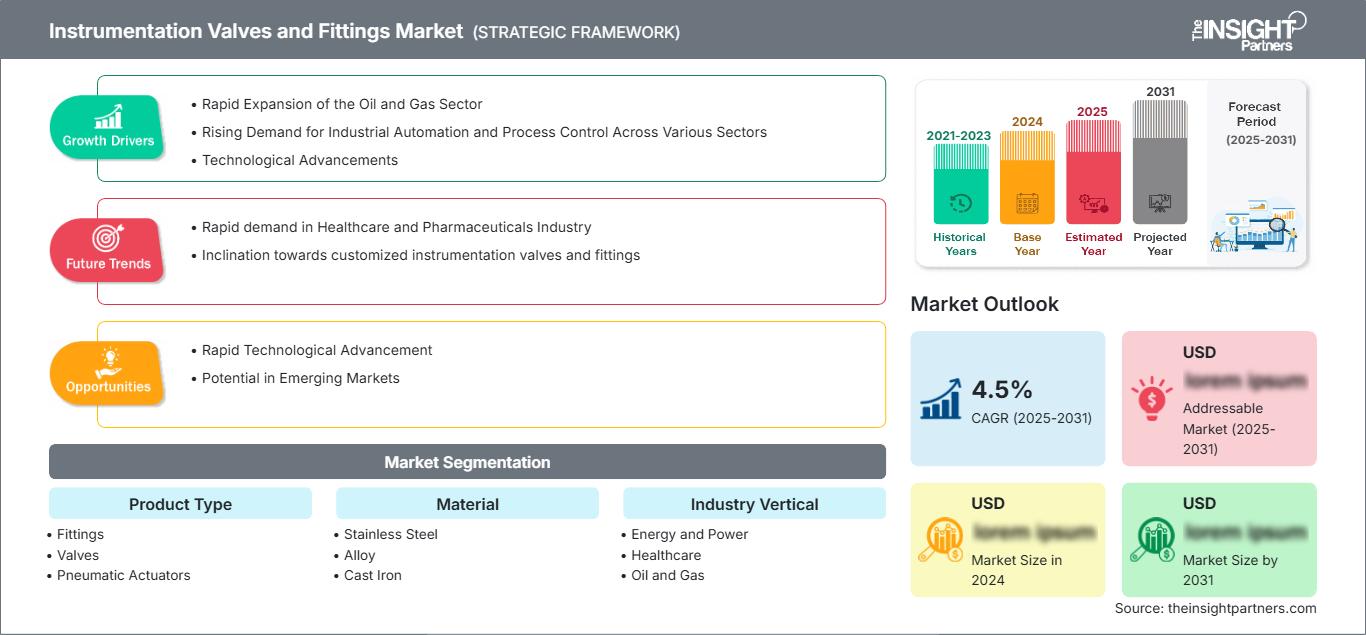
Instrumentation Valves and Fittings Market: Strategic Insights
Regional Insights
North America Instrumentation Valves and Fittings
North America accounted for 31–34% instrumentation valves and fittings market share in 2025 and is expected to grow at a CAGR of 5.9–6.4% from 2026 to 2034. The demand is driven by shale gas processing, refining facilities' upgrades, LNG export facilities, and safety-related instrumentation replacement. The projection of energy investments for 2025 by the IEA shows that there is ongoing investment in fuel and power systems, thus ensuring further procurement of the certified products. Regional consumers require stainless steel fittings, manifold valves, and pneumatic actuation for tough environments, emission monitoring, and remote applications. Canadian demand comes from oil sands, LNG, and power projects, whereas the Mexican market includes process manufacturing and food production. The installed base creates recurring maintenance revenue, making the region central to the Instrumentation Valves and Fittings Market scope.
U.S. Instrumentation Valves and Fittings Market
The US represented 76–80% of the North America instrumentation valves and fittings market in 2025 and is projected to grow at a CAGR of 5.8–6.3% through 2034. Refinery maintenance, shale basin gathering systems, chemical manufacturing, hydrogen pilots, and semiconductor-grade utilities support demand for high-purity fittings and precision valves. Company presence is strong through Parker-Hannifin Corporation, Swagelok Company, CIRCOR International, Inc., and Hy-Lok USA, Inc. Trends in applications include an increase in the use of double ferrules tube fittings, miniaturized manifolds, and pneumatically operated valves on automated skids. Health care gas distribution systems and food processing applications will drive requirements for clean and traceable parts. Compliance with OSHA, EPA, and pressure vessel codes is another factor driving purchasing decisions.
Europe Instrumentation Valves and Fittings Market
Europe held 24–27% instrumentation valves and fittings market share in 2025 and is expected to grow at a CAGR of 5.4–5.9%. Germany leads regional demand due to chemicals, process automation, machinery, and hydrogen infrastructure. Buyers emphasize DIN, EN, ATEX, and Pressure Equipment Directive alignment, supporting premium stainless steel and alloy-based assemblies. The UK market relies on the availability of offshore energy maintenance, downstream refining plants, pharmaceuticals manufacturing, and water treatment facility upgrade. Suppliers who have the reputation of having excellent leakage records along with good technical support on-site for hazardous area instruments and plant modernization projects in brownfield facilities will be preferred by operators. France, Italy, and Spain increase the demand for Instrumentation Valves and Fittings with their demand for food & beverages production, specialty chemical products, healthcare gases management, and power generation refurbishment. France will rely on its nuclear industry and healthcare infrastructure, Italy on process equipment manufacturing, and Spain on LNG and renewable energy-related industrial projects.
APAC Instrumentation Valves and Fittings Market
Asia Pacific accounted for 27–30% instrumentation valves and fittings market share in 2025 and is projected to grow at a CAGR of 7.1–7.7%, the fastest regional pace. China remains the leading country through petrochemicals, power, electronics, and industrial automation, while India gains from refining, chemicals, healthcare infrastructure, and food processing capacity. Japan and South Korea provide high-end demands for semiconductor utilities, hydrogen, LNG, and high-grade manufacturing. Australia provides mining, LNG, and water treatment demands. Supportive policies for domestic manufacturing, energy security, and industrial safety help to promote certification of instrumentation assemblies, particularly when it comes to leakage control and predictive maintenance.
Middle East & Africa Instrumentation Valves and Fittings Market
Middle East and Africa is expected to grow at a CAGR of 6.2–6.8% during 2026–2034. Saudi Arabia leads regional demand through refining, petrochemicals, gas processing, desalination, and industrial city investments. High-pressure service, corrosion resistance, and fast project execution shape product selection across new-build and maintenance projects. UAE facilitates the demand by supplying liquefied natural gas, downstream chemicals, healthcare, and water systems. The other country is South Africa, which will supply mining, power, and process industries. Markets in RoMEA are driven by projects, where the choice of suppliers is dictated by EPC contractors. Energy infrastructure remains the key anchor in regional procurement.
Segmentation Analysis
Product Type
Product type is expected to grow at a CAGR of 6.2–6.8% between 2026 and 2034 as end users upgrade from stand-alone components to integrated, pressure-tested assemblies. Demand is strongest where tubing density, calibration frequency, and safety compliance increase component count. The segment benefits from replacement cycles, skid manufacturing, and automation projects across oil and gas, chemicals, energy, healthcare, and food processing.
- Fittings dominate due to extensive use in tubing networks, pressure transmitters, analyzers, and sampling systems, making them strategically important for leak prevention and routine maintenance across continuous process plants.
- Valves hold strong demand in isolation, venting, calibration, and flow control applications where operational safety, pressure integrity, and fast shutoff capability directly influence uptime and regulatory performance.
- Pneumatic actuators are increasingly adopted in automated skids, remote valve operations, and hazardous locations where manual access is limited and operators require safer, faster process control.
Material
Material demand is projected to grow at a CAGR of 6.0–6.6% from 2026 to 2034, reflecting stronger preference for corrosion resistance, hygienic performance, and longer service life. Material selection is increasingly tied to media compatibility, temperature extremes, pressure ratings, and certification requirements. Stainless steel remains the baseline, while alloys gain importance in aggressive chemical, offshore, and hydrogen-related environments.
- Stainless steel leads demand because it combines corrosion resistance, cleanability, mechanical strength, and wide certification acceptance, making it suitable for chemicals, food processing, healthcare, and energy applications.
- Alloy materials are strategically important in sour gas, offshore, high-temperature, and corrosive chemical services where standard stainless grades may face accelerated degradation or compatibility limitations.
- Cast iron is used selectively in less corrosive, utility-oriented applications where cost sensitivity is higher, although its role is constrained by pressure, hygiene, and corrosion requirements.
Industry Vertical
Industry vertical demand is expected to grow at a CAGR of 6.3–6.9% during 2026–2034 as process industries expand instrumentation density and safety monitoring. Energy transition projects, refinery maintenance, healthcare infrastructure, food safety compliance, and chemical process control are creating broad-based demand. Procurement decisions increasingly emphasize certified materials, documented testing, supplier reliability, and application-specific engineering support.
- Energy and Power demand is linked to turbines, boilers, hydrogen blending, nuclear refurbishment, and grid-support assets where instrumentation reliability helps maintain safe pressure and flow control.
- Healthcare adoption is driven by medical gas distribution, laboratory utilities, sterilization systems, and hospital infrastructure where clean, traceable, and reliable fittings support patient safety and compliance.
- Oil and Gas remains a core vertical because upstream, midstream, LNG, and refining assets require high-pressure valves, manifolds, and fittings for isolation, sampling, monitoring, and maintenance.
- Food and Beverages demand hygienic, corrosion-resistant, and easy-to-maintain components for processing lines, clean utilities, and quality-critical fluid handling where contamination risk must be minimized.
- Chemicals require alloy and stainless steel products for aggressive media, high temperatures, and hazardous operations, making leak-tight instrumentation essential for safety, emissions control, and process stability.
Opportunity Snapshot
| Industry Vertical | Revenue Contribution | Trend Tag | Adoption Stage |
| Energy and Power | High | Hydrogen Utilities | Scaling |
| Healthcare | Medium | Medical Gases | Scaling |
| Oil and Gas | High | LNG Expansion | Mature |
| Food and Beverages | Medium | Hygienic Lines | Scaling |
| Chemicals | High | Corrosion Control | Mature |
| Others | Low | Utility Skids | Emerging |
Instrumentation Valves and Fittings Market Growth Drivers and Impact Analysis
Automation-Led Process Safety Upgrades
Industrial operators are adding more instrument points in order to minimize equipment breakdowns, enhance their ability to control emissions, and to support predictive maintenance efforts. Each addition to a transmitter, an analyzer, or even a control loop means the inclusion of valves, fittings, manifolds, and tubing assemblies. This creates greater component density at each plant. Automation drives requirements towards remote monitoring of pneumatic actuators and miniaturized assemblies. It affects the chemicals, refinery, power generation, and liquefied natural gas industries the most, as small leaks in these areas can cause significant safety, environmental, and production problems.
Energy Infrastructure Expansion and Replacement
The energy sector is growing and changing to the extent that the demand for equipment and instrumentation is increasing among oil and gas, liquefied natural gas (LNG), hydrogen, power generation, and grid support. Projects require instrumentation under high pressure, whereas old plants have to replace the components under new requirements in terms of safety and the environment. The IEA emphasized the importance of energy security and investment in the fuel and electricity sectors, which is increasing the demand for process instrumentation. Valves and fittings are insignificant in cost but critical in any project.
Stricter Hygiene, Emissions, and Pressure Compliance
There has been increasing regulatory pressure in areas such as food processing, health care, chemical production, and industrial facilities that contain hazards. Clean and secure connections are needed in medical gases, while food and beverages require hygienic designs to reduce chances of contamination. For chemical and oil and gas, the pressures have increased regarding fugitive emissions and integrity of pressure. These demands create the need for stainless steel and alloys that have undergone tests. The effect on the market is the transition from cheap components to assemblies and processes.
Instrumentation Valves and Fittings Market Future Trends
Smart Assemblies for Predictive Maintenance
Product development going forward will extend beyond mechanical dependability to include assemblies that allow for condition monitoring, documentation, and planning of maintenance. Although typically passive parts, the contribution made by valves and fittings will be more noticeable because of leakage, pressure variation, vibration, and cycle performance being tracked by plants. Differentiation could come through QR code-enabled certification, assembly digital twin, and compatibility with predictive maintenance systems. This will be especially relevant for applications in liquefied natural gas, chemical, hydrogen, and pharmaceutical utilities, where minimizing downtime and being audit-ready is very important.
Material Innovation for Hydrogen and Corrosive Media
The Instrumentation Valves and Fittings Market Trend is being shaped by growing investments in hydrogen, carbon capture, specialty chemicals, and offshore developments, which are increasing demand for materials capable of withstanding embrittlement, corrosion, and high-pressure cycling. While stainless steel is expected to remain the dominant material base, higher-grade alloys and advanced sealing systems will gain greater specification share in severe-service applications. End users will increasingly require validated compatibility data and longer service intervals, particularly where leakage poses safety or emissions risks. Manufacturers investing in advanced metallurgy, rigorous testing protocols, and application engineering are well positioned to secure higher-margin opportunities, as documented performance and qualification standards become as critical as product availability.
Instrumentation Valves and Fittings Market Opportunities
Localized Manufacturing Near Industrial Clusters
Lead-time sensitivity presents an obvious advantage for suppliers to bring their machining, assembling, testing, and stocking capabilities closer to refining, petrochemical, semiconductor, and food processing hubs. The equipment procurement and maintenance teams require certified parts urgently in order not to cause any delays in schedules and shutdown periods. Regional manufacturing facilities may even tailor products to meet local requirements in respect of tubing size and certification documentation. Suppliers that will be able to combine their global quality control system with local service centers will be able to conclude framework and after-sales agreements. Such a strategy is especially applicable in India, Southeast Asia, the Middle East, and North America.
Integrated Skid and System Packages
Process industries are increasingly purchasing pre-engineered skids for sampling, analyzer shelters, hydrogen blending, dosing, sterilization, and gas distribution. This creates an opportunity for component manufacturers to partner with system integrators and offer complete packages that include valves, fittings, tubing, actuators, and documentation. Integrated offerings reduce installation errors, shorten commissioning time, and improve accountability when performance issues arise. Suppliers that develop modular packages for high-growth applications can move up the value chain and improve margins. The opportunity is especially relevant in healthcare, energy transition, specialty chemicals, and high-purity manufacturing.
Recent Developments
- May 2026: RuB, Inc. announced it will participate in AHR Expo 2026, taking place from February 2nd through 4th, 2026, in the Las Vegas Convention Center. At Booth SL240, the company showcases ball valve and actuator solutions engineered for a wide range of applications, including industrial, gas, drinking water, pneumatic, firefighting, and plumbing systems.
- December 2025: OMB and Vogt are exhibiting together at the Hydrogen Technology World Expo 2025. The company is unveiling an innovative new line of ball valves specifically designed for liquid hydrogen applications.
- March 2025: Valworx announced the launch of their new line of V-port stainless steel ball valves. V-port valves are used for applications requiring precise flow control. The “V” shaped bore of the valve ball creates a more linear flow characteristic, making flow adjustments easier over the range of the valve.
Frequently Asked Questions

- Comprehensive Market Sizing and Forecast Analysis
- Detailed Segmentation Analysis
- In-Depth Market Dynamics Assessment
- Regional and Country-Level Insights
- Competitive Landscape and Company Benchmarking
- Strategic Business Intelligence
Recent Reports
Testimonials

The Insight Partners provided valuable market intelligence that supported our global go-to-market strategy. Their team was professional, responsive, and attentive to our feedback, providing thoughtful analysis and helpful methodological clarifications throughout the project.
Junmo Kim Chief Financial Officer (CFO), Enertech Co., Ltd.
The Insight Partners' SCADA System Market report is comprehensive, with valuable insights on current trends and future forecasts. The team was highly professional, responsive, and supportive throughout. We are very satisfied and highly recommend their services.
RAN KEDEM Partner, Reali Technologies LTDs
I requested a report on a very specific software market and the team produced the report in a few days. The information was very relevant and well presented. I then requested some changes and additions to the report. The team was again very responsive and I got the final report in less than a week.
JEAN-HERVE JENN Chairman, Future Analytica
We worked with The Insight Partners for an important market study and forecast. They gave us clear insights into opportunities and risks, which helped shape our plans. Their research was easy to use and based on solid data. It helped us make smart, confident decisions. We highly recommend them.
PIYUSH NAGPAL Sr. Vice President, High Beam Global
The Insight Partners delivered insightful, well-structured market research with strong domain expertise. Their team was professional and responsive throughout. The user-friendly website made accessing industry reports seamless. We highly recommend them for reliable, high-quality research services
YUKIHIKO ADACHI CEO, Deep Blue, LLC.
This is the first time I have purchased a market report from The Insight Partners.While I was unsure at first, I visited their web site and felt more comfortable to take the risk and purchase a market report.I am completely satisfied with the quality of the report and customer service. I had several questions and comments with the initial report, but after a couple of dialogs over email with their analyst I believe I have a report that I can use as input to our strategic planning process.Thank you so much for taking the extra time and making this a positive experience.I will definitely recommend your service to others and you will be my first call when we need further market data.
JOHN SUZUKI President and Chief Executive Officer, Board Director, BK Technologies
I wish to appreciate your support and the professionalism you displayed in the course of attending to my request for information regarding to infectious disease IVD market in Nigeria. I appreciate your patience, your guidance, and the fact that you were willing to offer a discount, which eventually made it possible for us to close a deal. I look forward to engaging The Insight Partners in the future, all thanks to the impression you have created in me as a result of this first encounter.
DR CHIJIOKE ONYIA MANAGING DIRECTOR, PineCrest Healthcare Ltd.Reason to Buy
- Informed Decision-Making
- Understanding Market Dynamics
- Competitive Analysis
- Identifying Emerging Markets
- Customer Insights
- Market Forecasts
- Risk Mitigation
- Boosting Operational Efficiency
- Strategic Planning
- Investment Justification
- Tracking Industry Innovations
- Aligning with Regulatory Trends





 Get Free Sample for