
Insulated Storage Vessels Market Trends, Size & Forecast by 2034
Coverage: By Type (Pressure vessel, Process vessel, Storage tank, Chemical vessel, Reaction vessel, Jacketed vessel, Ms vessel, Industrial vessel); Insulation material (Polyurethane foam, Mineral wool, Expanded Polystyrene, Vacuum insulation panel, Mineral wood, Rockwool, Rubber); Commercial application (Chemical, Oil and Gas, Food and Beverage, Dairy, Energy and Power, Agricultural application, Water treatment, Sanitary) , and Geography (North America, Europe, Asia Pacific, and South and Central America)
- Status : Data Released
- Report Code : TIPRE00021330
- Category : Manufacturing and Construction
- No. of Pages : 150
- Available Report Formats :


- Last update date : July 10, 2026


2025 Market Size
US$ 4.90 Bn
Base year value
2034 Forecast
US$ 7.34 Bn
Projected by 2034
CAGR 2026-2034
4.59 %
Growth rate
Addressable Market
US$ 55.56 Bn
(2026-2034)
The insulated storage vessels market size is projected to grow from US$ 4.90 Billion in 2025 to US$ 7.34 Billion by 2034, registering a CAGR of 4.59% during 2026–2034. The market demonstrates increasing usage in chemicals, oil & gas, food & beverages, dairy, energy & power, agriculture, water treatment, and sanitary industries, wherein thermal control and containment remain important criteria during procurement.
The growth rate of North America is projected to be 4.1%-4.5% CAGR during 2024-2034 due to modernization of chemical processing equipment and need for controlled temperature storage facilities in food, dairy, and water treatment plants. The replacement demand in the industry is increasingly becoming associated with efficiency goals, pressure safety standards, and reduction in thermal loss from storage facilities within industrial units.
Insulated Storage Vessels Market Assessment and Insights
- North America: Share in 2025 is estimated at 28–31%, growing at a CAGR between 2026–2034 of 4.1–4.5%, led by chemical storage upgrades, dairy capacity renewal, and oilfield processing reliability investments.
- US: Share in 2025 represents 74–78% of the North America insulated storage vessels market, growing at a CAGR between 2026–2034 of 4.2–4.6%, supported by refinery maintenance and food-grade vessel replacement.
- Europe: Share in 2025 is estimated at 24–27%, growing at a CAGR between 2026–2034 of 3.8–4.2%, with Germany, the UK, France, Italy, and Spain leading demand.
- Asia Pacific: Share in 2025 is estimated at 32–35%, growing at a CAGR between 2026–2034 of 5.0–5.4%, driven by China, India, Japan, South Korea, and Australia.
- Largest Segment: Storage tank holds 34–38% insulated storage vessels market share in 2025 and grows at a 4.2–4.6% CAGR between 2026–2034, reflecting broad industrial applicability.
- High Growth Segment: Vacuum insulation panel records 8–11% insulated storage vessels market share in 2025 and grows at a 6.1–6.6% CAGR between 2026–2034, favored for high-efficiency thermal control.
- Key companies analyzed in detail: COMAP SRL, Omnia Technologies S.p.A., Fletcher European Containers Limited, Indian Oil Corporation Limited, Kingspan Group plc, Müller Group, Pneumatech MGS, Toro Equipment S.L., Wärtsilä Corporation, Werner GmbH, Chart Industries, Inc., Linde plc.
Source: The Insight Partners' analysis based on proprietary research, government publications, company annual reports, investor presentations, industry databases, and expert interviews.
The insulated storage vessels market report highlights that the market is shifting from basic insulated shells to engineered vessels that combine corrosion-resistant materials, pressure-rated designs, improved insulation density, and sensor-ready monitoring. Manufacturing companies have answered stricter regulations on food safety, chemical management, and energy efficiency with the improvement of welding quality, modular assembly systems, and jacketing designs. The manufacturing trends now tend towards regional fabrication closer to process industries to minimize transportation costs for heavy tanks and increase customization speed to meet specific requirements of temperature, pressure, and hygiene.
Future demand will grow in Asia Pacific, the Middle East, and selected regions of Latin America along with industrial growth in food processing, water purification, and energy industry. Increasing regulatory support for safe storage, emission management, and hygienic food manufacturing is likely to fuel specifications-driven purchases. Insulated storage vessels market report suggests that the market is supported by investment in process intensification, LNG infrastructure, and localized dairy and beverages production facilities.
Insulated Storage Vessels Market Report Scope
| Report Attribute | Details |
|---|---|
| Market size in 2025 | US$ 4.90 Billion |
| Market Size by 2034 | US$ 7.34 Billion |
| Global CAGR (2026 - 2034) | 4.59% |
| Historical Data | 2021-2024 |
| Forecast period | 2026-2034 |
Insulated Storage Vessels Market Analysis
The demand for such vessels is influenced by the necessity to maintain quality of liquids, control process temperatures, and prevent heat absorption or loss when storing them. Manufacturers of chemicals require tanks able to process sensitive or reactive substances, and food processing plants prefer those that provide sanitized environment and standardized batches.
The insulated storage vessels market value chain includes steel and alloy suppliers, insulation material producers, fabrication specialists, instrumentation providers, engineering contractors, and maintenance service firms. Supply dynamics remain linked to stainless steel availability, energy costs, and skilled welding capacity. The Insulated Storage Vessels market analysis indicates that buyers increasingly assess lifecycle energy savings, cleaning efficiency, safety certification, and installation footprint rather than vessel price alone.
The competitive landscape in the insulated storage vessels market is moderately fragmented, with European process-equipment specialists, global insulation groups, industrial gas equipment suppliers, and regional fabricators competing on customization, certification, and service responsiveness. COMAP SRL and Omnia Technologies S.p.A. serve process and beverage-linked applications, while Kingspan Group plc strengthens insulated infrastructure expertise and Chart Industries, Inc. and Linde plc support cryogenic and industrial gas requirements.
Key insulated storage vessels market trends favor higher-performance insulation, hygienic designs, and monitoring-ready vessels compatible with digital plant management. Strategic positioning is increasingly based on end-market specialization: Toro Equipment S.L. is relevant in water treatment, Wärtsilä Corporation in energy systems, and Indian Oil Corporation Limited as a large industrial user influencing procurement standards. The Insulated Storage Vessels share will remain sensitive to regional fabrication networks and after-sales capability.
● REPORT CUSTOMIZATION
Tailor This Report To Align With Your Specific Business Requirements
This report can be customized to align precisely with your business objectives, scope, and target markets. Customization options include tailored segmentation, geography, competitive analysis, and strategic insights to support informed decision-making.
Customize This Report →WHAT YOU CAN ADJUST
- ● Segmentations
- ● Geography
- ● Competitive Analysis
- ● Language Preferences
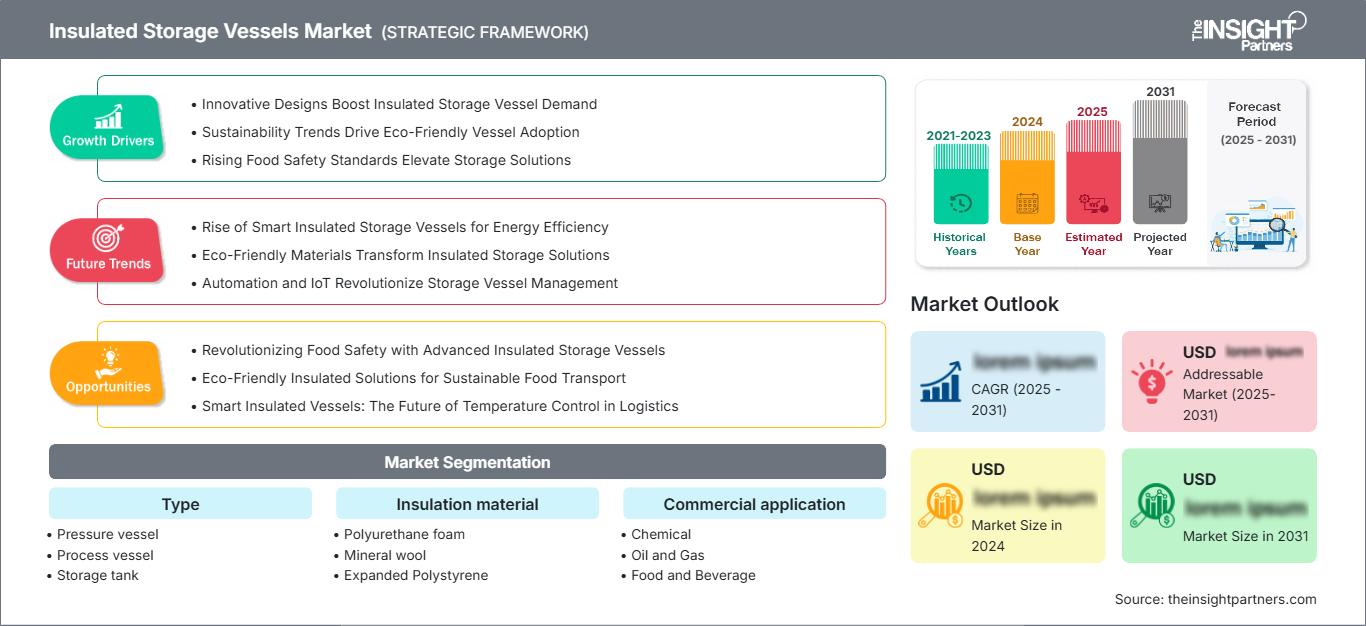
Insulated Storage Vessels Market: Strategic Insights
Regional Insights
North America Insulated Storage Vessels
North America accounts for 28–31% of the insulated storage vessels market share in 2025 and is expected to grow at a 4.1–4.5% CAGR. The demand depends on chemical processing, dairy, beverage, energy, and municipal water installations needing efficient heat storage.
Regional buying is affected by pressure vessels standards, hygiene requirements, and quick reaction in terms of maintenance. United States has leading volumes, whereas Canada brings demand from energy, agricultural and food processing industry. In North America market trends for Insulated Storage Vessels there is going to be more usage of polyurethane foam, mineral wool and vacuum insulation panel design solutions, where lifetime efficiency can be assessed.
U.S. Insulated Storage Vessels Market
The US represents 74–78% of North America insulated storage vessels market in 2025 and is projected to grow at a 4.2–4.6% CAGR. The demand will be highest in the manufacture of chemicals, food products, refineries, dairy products, and water purification industries. The buyers look for tanks that can provide temperature retention capability, ease of cleaning, pressurization capability, and predictable maintenance schedule.
The industry participants consist of global insulation suppliers and manufacturers who are catering to the needs of plant expansion, modification, and replacement projects. The investment made by Kingspan Group plc in the United States towards insulation technology is indicative of the high demand for thermal infrastructure technology, while Chart Industries, Inc. and Linde plc will add value to cryogenic systems.
Europe Insulated Storage Vessels Market
Europe holds 24–27% insulated storage vessels market share in 2025 and is expected to grow at a 3.8–4.2% CAGR. Germany is the most prominent country because of investments in chemical, industrial gas, beverages, and energy-efficient solutions. Purchasers focus on conformity, manufacturing, and insulation properties of vessels intended for the regulated industrial and food sectors.
The United Kingdom provides demand in the brewery, dairy, water treatment, and specialty chemicals industries. Recycling schedules depend on the impact of energy prices and sustainability reporting on reducing heat transfer. Local engineering companies and EU manufacturers try to compete with their smaller, hygienic, and easy-maintained tanks intended for brownfield locations.
France, Italy, and Spain contribute to regional adoption via wine production, dairy industry, water processing, and food manufacturing. The market includes Omnia Technologies S.p.A., COMAP SRL, Toro Equipment S.L., and Müller Group. The region shows a strong preference for tailored tanks and not standard commodity tanks.
APAC Insulated Storage Vessels Market
APAC accounts for 32–35% insulated storage vessels market share in 2025 and grows at a 5.0–5.4% CAGR. Chemical production, energy storage, and food processing drive China's demand, whereas dairy processing, water purification, agricultural needs, and storage connected to refineries drive India's expansion.
Japan and South Korea need good quality ships for speciality chemicals, sanitary processing, and industrial gases. Australia drives demand in agriculture, dairy, water, and mining infrastructure.
Government policies favoring industrial development, food safety, and water security boost the application scope of the Insulated Storage Vessels in the region. The presence of local ship fabrication facilities will assist in reducing delivery time.
Middle East & Africa Insulated Storage Vessels Market
The Middle East and Africa insulated storage vessels market is growing at a 4.3–4.7% CAGR, with Saudi Arabia leading in energy, petrochemical, and industrial infrastructure projects. Demand centers on temperature-stable storage for fuels, chemicals, water, and process liquids.
UAE uses logistics in terms of food transportation, water treatment, and industry parks, whereas South Africa utilizes agricultural, mining, and beverage applications. Rest of MEA is project-based.
Diversification in energy, desalination, and storage requirements provide long-term prospects. Companies that are capable of dealing with thermal exposure, corrosion resistance, and service requirements can benefit from the projects in the region.
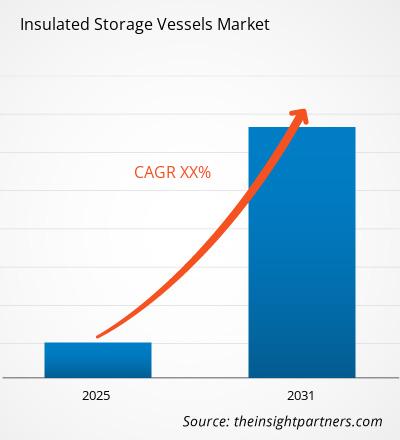
Segmentation Analysis
Type
The type segment in the insulated storage vessels market is expected to grow at a 4.3–4.7% CAGR during 2026–2034. Selection depends on pressure rating, process chemistry, cleaning cycles, installation footprint, and temperature differential. Storage tanks remain the largest format because they serve broad liquid and bulk material needs, while jacketed and reaction vessels gain relevance in controlled processing environments.
- Pressure vessel demand is tied to regulated storage and processing environments where containment integrity, pressure safety, and insulation performance are essential for chemicals, energy fluids, and industrial gases.
- Process vessel adoption reflects the need for controlled thermal conditions during mixing, holding, or intermediate production steps, especially in food, beverage, chemical, and dairy operations.
- Storage tank remains the broadest category because it supports bulk storage, temperature retention, and operational buffering across chemicals, water treatment, agriculture, oil, and food applications.
- Chemical vessel demand is driven by compatibility with corrosive or sensitive materials, requiring insulation, material selection, and safety features aligned with plant-specific handling risks.
- Reaction vessel use is concentrated in process industries where thermal control directly affects yield, reaction stability, product consistency, and safe handling of active chemical systems.
- Jacketed vessel demand is expanding where operators need heating or cooling control around stored or processed media, especially in viscous liquids, dairy, and specialty chemicals.
- Ms vessel adoption remains cost-sensitive and application-specific, serving industrial users that require durable storage while balancing insulation performance with capital expenditure limits.
- Industrial vessel demand reflects customized fabrication requirements across sectors, including pressure, sanitary, and thermal specifications that standard storage tanks cannot fully address.
Insulation material
The insulation material segment in the insulated storage vessels market is projected to grow at a 4.6–5.0% CAGR during 2026–2034. Material choice is increasingly linked to thermal conductivity, moisture resistance, fire behavior, hygiene requirements, and total cost of ownership. Polyurethane foam remains widely used for balanced performance, while vacuum insulation panels gain share in premium applications requiring superior heat-transfer control.
- Polyurethane foam is widely specified where balanced insulation, weight, manufacturability, and cost efficiency are required for food, dairy, chemical, and water treatment storage applications.
- Mineral wool is favored in higher-temperature environments where fire resistance, acoustic damping, and stable thermal performance support industrial safety and durability expectations.
- Expanded Polystyrene serves cost-sensitive storage needs where moderate insulation, light weight, and ease of fabrication are important but extreme thermal performance is not required.
- Vacuum insulation panel demand is strongest in high-efficiency and space-constrained systems where reduced insulation thickness and improved thermal retention justify premium procurement.
- Mineral wood is used in selected industrial insulation systems where inorganic composition, heat tolerance, and mechanical stability support longer operating life under harsh conditions.
- Rockwool supports demanding industrial and process settings because it combines thermal resistance, fire performance, and dimensional stability for tanks exposed to variable temperatures.
- Rubber insulation is relevant where flexibility, condensation control, and vibration tolerance are needed around smaller vessels, fittings, and temperature-sensitive auxiliary storage systems.
Commercial application
The commercial application segment in the insulated storage vessels market is expected to grow at a 4.5–4.9% CAGR during 2026–2034. Demand reflects the operational consequences of temperature variation, contamination risk, and process downtime. Chemical and oil and gas users emphasize safety and reliability, while food, dairy, sanitary, and water treatment users prioritize hygiene, cleanability, and product integrity.
- Chemical applications require vessels that protect temperature-sensitive liquids, reduce handling hazards, and maintain process consistency in plants managing corrosive, reactive, or regulated materials.
- Oil and Gas demand is linked to viscosity control, fuel handling, refinery support, and field storage needs where insulation improves flow assurance and operational reliability.
- Food and Beverage users prioritize sanitary construction, temperature stability, and batch quality, making insulated vessels important for brewing, processing, storage, and ingredient handling.
- Dairy applications require hygienic vessels that maintain cooling or heating profiles for milk, cream, cultures, and processed products while supporting frequent cleaning cycles.
- Energy and Power applications use insulated storage to manage fuels, process liquids, thermal systems, and auxiliary fluids where heat loss affects reliability and efficiency.
- Agricultural application demand includes storage for liquids, nutrients, and temperature-sensitive inputs, particularly where seasonal operating conditions require stable containment performance.
- Water treatment applications require corrosion-resistant, insulated storage for chemicals, sludge, or process water where temperature control supports dosing accuracy and treatment reliability.
- Sanitary applications emphasize clean surfaces, controlled temperatures, and contamination prevention for regulated environments requiring consistent hygiene and dependable vessel performance.
Opportunity Snapshot
| Segment Name | Revenue Contribution | Trend Tag | Adoption Stage |
| Chemical | High | Safe Storage | Mature |
| Oil and Gas | High | Viscosity Control | Mature |
| Food and Beverage | High | Batch Quality | Scaling |
| Dairy | Medium | Cold Holding | Scaling |
| Energy and Power | Medium | Thermal Buffering | Scaling |
| Agricultural application | Low | Seasonal Storage | Emerging |
| Water treatment | Medium | Dosing Stability | Scaling |
| Sanitary | Medium | Hygienic Holding | Scaling |
Insulated Storage Vessels Market Growth Drivers and Impact Analysis
Energy-efficiency mandates in process storage
The operators in the industrial facilities are closely monitoring the heat losses due to the impact of the storage on the usage of utilities, quality of the product, and the emission of the gases. The insulated tanks decrease the energy losses by minimizing the heat transfer, which is particularly important for viscous liquid, dairy products, chemicals, and the water treatment components. With the energy costs being highly variable, the justification of investment in insulation is carried out based on life cycle savings and not on the initial costs.
Expansion of sanitary and regulated production
Controlled storage is needed for facilities dealing with food products, beverages, dairy products, chemicals, and pharmaceuticals to ensure continuous quality and compliance. Insulated sanitary tanks can help with maintaining batch temperatures, lowering microbial contamination risks, and facilitating more efficient cleaning operations. For such applications, the design of tanks plays an important role not only for ensuring smooth processes but also being ready for inspections. Tank suppliers that provide tanks with hygienic surfaces, validated welding, easy access for maintenance operations, and appropriate insulation systems gain more popularity.
Industrial infrastructure buildout in emerging regions
The construction of new industrial parks, food processing plants, refineries, desalination facilities, and water treatment plants in Asia Pacific and the Middle East is fueling the need for highly durable insulated storage tanks. Such facilities typically have a requirement for customized tanks capable of withstanding high temperatures, corrosive conditions, and diverse operating procedures. In-region fabrication alliances serve to cut down logistic expenses and lead times for large tank deliveries. Implications on the market include more competition from suppliers, tough mechanical engineering coupled with climate-adaptive insulation technology.
Insulated Storage Vessels Market Future Trends
Sensor-ready vessels for predictive operations
Future specifications of vessels will see inclusion of port and mount points as well as connections to monitor temperature, pressure, fill levels and insulating performance. Rather than viewing storage as an inert component, the vessels will be integrated into overall facility condition monitoring systems. Early warnings can help prevent losses, identify degraded insulating performance, and facilitate maintenance. Such developments will be more favorable to those companies that design instrumentation-friendly equipment without compromising cleanability, pressure integrity, and insulating performance.
Premium insulation for compact industrial footprints
For plants where the size constraints are greater, the use of better performing insulation material would be necessary to meet the thermal requirements without enlarging the vessel and making it more complex to install. Vacuum insulated panels and advanced composite insulation kits would decrease wall thickness while providing stable temperatures. This would be important for plants that process food in cities and those that have to undergo retrofitting work in restricted spaces. This development would force manufacturers to weigh insulation performance along with durability and cost.
Insulated Storage Vessels Market Opportunities
Retrofit programs for aging tank farms
There are many chemical plants, food processing facilities, oil terminals, and municipalities with storage systems that were put in place before the present-day standards for efficiency and performance were established. There is an opening for suppliers who will provide retrofits that include installation of new insulation, jacketing, safety analysis, and sensors. This is a good area to explore because it is focused on saving operating expenses rather than capital investments in a completely redesigned plant. Firms that are able to prove energy savings, reduce downtime, and follow pressure and sanitation regulations are likely to excel.
Localized fabrication for high-growth economies
Large insulated tanks are expensive to transport, making local fabrication a practical route to capture demand in India, Southeast Asia, the Gulf, and Africa. International suppliers can partner with certified regional fabricators to combine design standards with local production, installation, and service. This approach reduces lead times, import costs, and project execution risk. It also allows customization for climate, utilities, and sector-specific requirements. The opportunity is strongest where food processing, water infrastructure, chemicals, and energy projects are expanding simultaneously.
Recent Developments
- June 2026, The Port of Huelva has approved a €255 (US$ 290.28) million investment plan for the 2025-2029 period. The programme aims to strengthen the port’s position as a logistics, industrial and energy hub. It also supports future growth and the energy transition.
- April 2026: Wärtsilä Corporation — announced that Wärtsilä Gas Solutions cargo handling and fuel gas supply systems were selected for new gas carrier projects, reinforcing the company’s role in engineered storage, handling, and thermal management systems for energy transition fuels. Such projects support demand for specialized insulated vessel know-how in marine and energy infrastructure.
- October 2025: The U.S. will begin phasing in new service fees for maritime transport services of Chinese-owned and Chinese-built vessels calling U.S. ports, introduced gradually over a three-year period. A.P. Moller – Maersk doesn’t make any plan to apply any surcharge in connection with this rule, and do not anticipate changes to their U.S. port rotations or existing service plans.
Frequently Asked Questions

- Comprehensive Market Sizing and Forecast Analysis
- Detailed Segmentation Analysis
- In-Depth Market Dynamics Assessment
- Regional and Country-Level Insights
- Competitive Landscape and Company Benchmarking
- Strategic Business Intelligence
Recent Reports
Testimonials

The Insight Partners' SCADA System Market report is comprehensive, with valuable insights on current trends and future forecasts. The team was highly professional, responsive, and supportive throughout. We are very satisfied and highly recommend their services.
RAN KEDEM Partner, Reali Technologies LTDs
I requested a report on a very specific software market and the team produced the report in a few days. The information was very relevant and well presented. I then requested some changes and additions to the report. The team was again very responsive and I got the final report in less than a week.
JEAN-HERVE JENN Chairman, Future Analytica
We worked with The Insight Partners for an important market study and forecast. They gave us clear insights into opportunities and risks, which helped shape our plans. Their research was easy to use and based on solid data. It helped us make smart, confident decisions. We highly recommend them.
PIYUSH NAGPAL Sr. Vice President, High Beam Global
The Insight Partners delivered insightful, well-structured market research with strong domain expertise. Their team was professional and responsive throughout. The user-friendly website made accessing industry reports seamless. We highly recommend them for reliable, high-quality research services
YUKIHIKO ADACHI CEO, Deep Blue, LLC.
This is the first time I have purchased a market report from The Insight Partners.While I was unsure at first, I visited their web site and felt more comfortable to take the risk and purchase a market report.I am completely satisfied with the quality of the report and customer service. I had several questions and comments with the initial report, but after a couple of dialogs over email with their analyst I believe I have a report that I can use as input to our strategic planning process.Thank you so much for taking the extra time and making this a positive experience.I will definitely recommend your service to others and you will be my first call when we need further market data.
JOHN SUZUKI President and Chief Executive Officer, Board Director, BK Technologies
I wish to appreciate your support and the professionalism you displayed in the course of attending to my request for information regarding to infectious disease IVD market in Nigeria. I appreciate your patience, your guidance, and the fact that you were willing to offer a discount, which eventually made it possible for us to close a deal. I look forward to engaging The Insight Partners in the future, all thanks to the impression you have created in me as a result of this first encounter.
DR CHIJIOKE ONYIA MANAGING DIRECTOR, PineCrest Healthcare Ltd.Reason to Buy
- Informed Decision-Making
- Understanding Market Dynamics
- Competitive Analysis
- Identifying Emerging Markets
- Customer Insights
- Market Forecasts
- Risk Mitigation
- Boosting Operational Efficiency
- Strategic Planning
- Investment Justification
- Tracking Industry Innovations
- Aligning with Regulatory Trends





 Get Free Sample for