
Integrated Sinks Market Trends, Size & Growth by 2034
Coverage: By Product Type (Integrated Stainless Steel Sink, Integrated Ceramic Sinks, Integrated Artificial Stone Sink); Application (Bathroom Sinks, Kitchen Sinks), and Geography (North America, Europe, Asia Pacific, and South and Central America)
- Status : Data Released
- Report Code : TIPRE00014801
- Category : Manufacturing and Construction
- No. of Pages : 150
- Available Report Formats :


- Last update date : July 13, 2026


2025 Market Size
US$ 2.66 Bn
Base year value
2034 Forecast
US$ 4.1 Bn
Projected by 2034
CAGR 2026-2034
4.91 %
Growth rate
Addressable Market
US$ 30.66 Bn
(2026-2034)
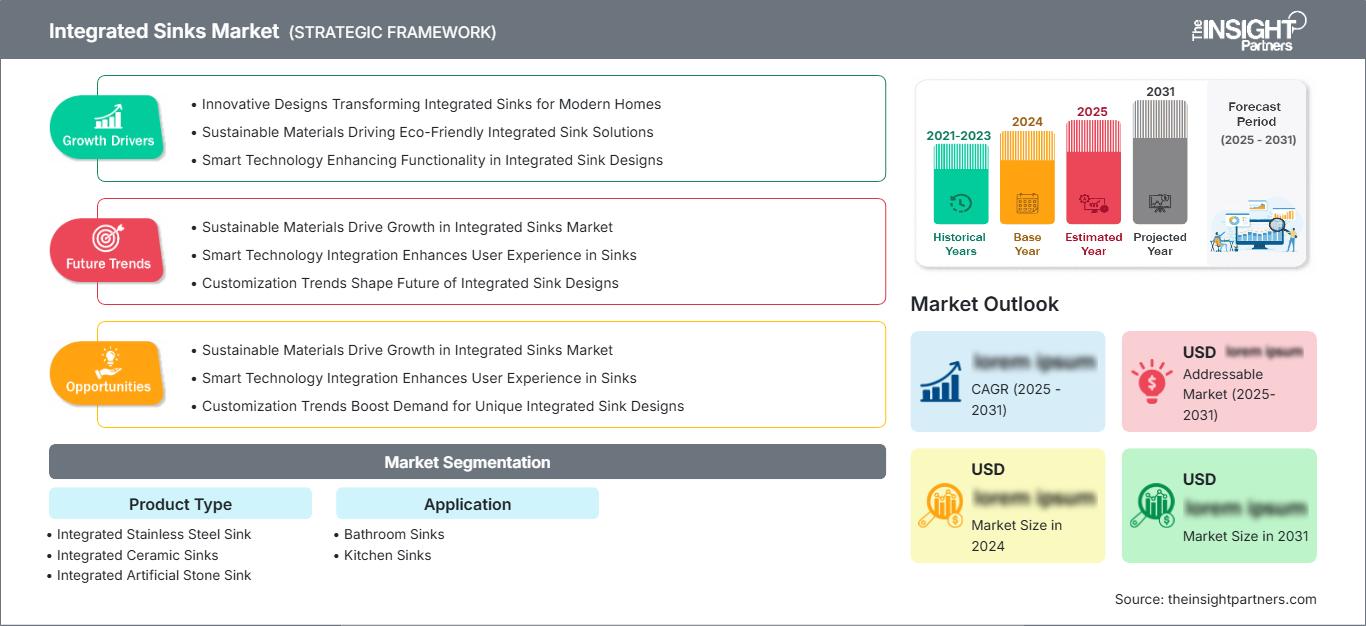
The integrated sinks market size is projected to grow from US$ 2.66 Billion in 2025 to US$ 4.1 Billion by 2034; it is expected to register a CAGR of 4.91% during 2026–2034. Integrated sinks have found favor among residential and commercial interior consumers owing to their smooth surfaces, easy maintenance, and aesthetic appeal in kitchen and bathroom areas. The growth in the market is attributed to demands emanating from renovations, replacement of expensive fixture products, and increased availability of sinks made of stainless steel, ceramics, and synthetic stone.
North America is set to record a CAGR of 4.3–4.8% during 2026–2034 owing to robust kitchen and bathroom renovations, replacements of drop-in style traditional fixtures, and increased installations of workstation-style sinks in expensive homes. Home improvements and repairs in the US was estimated at US$ 509 billion by Harvard’s Joint Center for Housing Studies in 2025, thus supporting demand in states that undertake extensive renovations.
Integrated Sinks Market Assessment and Insights
- North America: The region accounted for 32–35% share in 2025 and is projected to grow at a 4.3–4.8% CAGR between 2026–2034, supported by remodeling intensity, premium countertop upgrades, and broader showroom-led adoption.
- US: The country represented 78–82% of North America integrated sinks market in 2025 and is expected to grow at a 4.4–4.9% CAGR between 2026–2034, driven by kitchen replacement and bath modernization.
- Europe: Europe held 25–28% share in 2025 and is forecast to expand at a 4.0–4.5% CAGR between 2026–2034, with Germany, the UK, France, Italy, and Spain leading demand.
- Asia Pacific: APAC represented 27–30% integrated sinks market share in 2025 and is expected to grow at a 5.5–6.1% CAGR between 2026–2034 as China, India, Japan, South Korea, and Australia expand urban housing and premium interiors.
- Largest Segment: Integrated Stainless Steel Sink held 38–42% market share in 2025 and is projected to grow at a 4.4–4.9% CAGR between 2026–2034 due to durability and cost-performance balance.
- High Growth Segment: Integrated Artificial Stone Sink held 24–28% integrated sinks market share in 2025 and is projected to grow at a 5.7–6.3% CAGR between 2026–2034 as quartz and composite aesthetics gain preference.
- Key companies analyzed in detail: LIXIL Corporation, BLANCO GmbH + Co KG, Zurn Elkay Water Solutions Corporation, Franke Holding AG, FULEKA, Houzer Inc., Kohler Co., Kraus USA Plumbing LLC, Fortune Brands Innovations, Inc., Ruvati USA, and Duravit AG.
Source: The Insight Partners' analysis based on proprietary research, government publications, company annual reports, investor presentations, industry databases, and expert interviews.
Product development in the Integrated Sinks Market has moved from basic basin fabrication toward coordinated sink, faucet, accessory, and countertop systems. Manufacturers are using tighter forming tolerances, composite molding, improved ceramic glazing, and stainless steel workstation platforms to reduce seams and expand functional surface area. Production dynamics are also shifting as brands balance regional fabrication, imported components, and retailer-specific ranges to protect margins while meeting demand for design consistency, hygiene, and installation efficiency.
The outlook favors markets where new apartment completions, hospitality refurbishments, and organized home improvement channels are expanding together. APAC and the Middle East show investment upside as urban housing, mixed-use developments, and premium hotel pipelines raise specification levels. Regulatory tailwinds around water efficiency, hygienic surfaces, and durable building products should reinforce growth in the Integrated Sinks Market, especially when distributors combine installation training with modular kitchen and bathroom packages.
Integrated Sinks Market Report Scope
| Report Attribute | Details |
|---|---|
| Market size in 2025 | US$ 2.66 Billion |
| Market Size by 2034 | US$ 4.1 Billion |
| Global CAGR (2026 - 2034) | 4.91% |
| Historical Data | 2021-2024 |
| Forecast period | 2026-2034 |
Integrated Sinks Market Analysis
Demand is shaped by the convergence of remodeling, smaller urban kitchens, and heightened hygiene expectations. Seamless sink-to-counter interfaces reduce dirt traps, while workstation accessories improve utility in compact spaces. The integrated sinks market forecast indicates that kitchen sinks remain the primary value pool, but bathroom sinks benefit from hotel refurbishment and premium vanity installations. The Integrated Sinks scope is therefore broader than replacement plumbing fixtures, extending into interior design, cabinetry, and countertop specification.
The value chain includes steel mills, ceramic producers, quartz and resin suppliers, countertop fabricators, faucet manufacturers, distributors, kitchen studios, and installers. Supply dynamics depend on stainless steel pricing, engineered stone availability, and logistics from Asia and Europe. Brands that simplify cut-outs, standardize accessories, and offer coordinated finishes can reduce installation risk and improve channel acceptance, directly influencing Integrated Sinks' share across premium retail and project-based sales.
The competitive landscape in the integrated sinks market report is moderately fragmented, with global sanitaryware groups, kitchen-system specialists, and regional sink manufacturers competing on material, finish, accessories, and channel depth. Kohler Co., LIXIL Corporation, BLANCO GmbH + Co KG, Franke Holding AG, and Zurn Elkay Water Solutions Corporation emphasize design ecosystems, while Kraus USA Plumbing LLC, Ruvati USA, Houzer Inc., FULEKA, and Duravit AG target differentiated price points and style-led ranges.
Investment trends include workstation sinks, antimicrobial or easy-to-clean surfaces, recycled content, and direct-to-consumer merchandising. Manufacturers are now marketing integrated solutions as part of larger kitchen water-place solutions rather than isolated basins, which allows for upselling in faucets, filtration, disposals, and under-sink organization, while assisting retailers in protecting their margins. Integrated Sinks trends are leaning more toward solutions that combine installation ease with high design.
● REPORT CUSTOMIZATION
Tailor This Report To Align With Your Specific Business Requirements
This report can be customized to align precisely with your business objectives, scope, and target markets. Customization options include tailored segmentation, geography, competitive analysis, and strategic insights to support informed decision-making.
Customize This Report →WHAT YOU CAN ADJUST
- ● Segmentations
- ● Geography
- ● Competitive Analysis
- ● Language Preferences
Integrated Sinks Market: Strategic Insights
Regional Insights
North America Integrated Sinks
North America accounted for 32–35% integrated sinks market share in 2025 and is forecast to expand at a 4.3–4.8% CAGR through 2034. Demand is centered in remodeling channels, whereby consumers replace laminate counter tops and top mount sinks with undermount sinks and work station sinks. The expenditure by American homeowners on renovation, marketing campaigns of retailers, and the design build networks of contractors ensure consistent demand for sinks in kitchens and bathrooms.
There is existing distribution channels in regional markets that have established distribution in home centers, plumbing wholesalers, and kitchen studios. Stainless steel continues to form the functional base line while artificial stone is becoming popular in upscale remodels because of matching colors and low noise.
U.S. Integrated Sinks Market
The US represented 78–82% of North America integrated sinks market in 2025 and is expected to grow at a 4.4–4.9% CAGR from 2026 to 2034. Kitchen applications prevail since countertop change, refacing of cabinets, and upgrading of faucets usually go together. Nowadays, there is an increasing tendency to sell kits for sinks which include grates, panels, drain components, and accessories in order to make it easier for both consumers and installers.
The list of participants in the industry is long and includes such companies as Kohler Co., Zurn Elkay Water Solutions Corporation, Kraus USA Plumbing LLC, Ruvati USA, BLANCO GmbH + Co KG, and Fortune Brands Innovations, Inc. Trends for applications are large single-bowl kitchens, ADA-compliant bathroom upgrades, and workstations.
Europe Integrated Sinks Market
Europe held 25–28% integrated sinks market share in 2025 and is projected to grow at a 4.0–4.5% CAGR through 2034. Germany leads regional demand because of high penetration of fitted kitchens, high-end appliances and effective installer network helping in more installation of engineered sinks.
United Kingdom is an important player because of small house sizes, renovations of rental homes and design-driven kitchens resulting in demand for durable materials like stainless steel and composite sinks. Consistency in the retail industry helps in standardization of the product range, while bathroom renovation programs help ceramic integrated basins in the mid-premium segment.
Italy, France and Spain help in providing regional design diversification with Italy being aesthetics-driven kitchen systems, France being renovation-driven bathrooms, and Spain profiting through hotel renovation activities. The European consumer focuses on durability, repairability and finish coordination; hence the brands coordinate sinks with faucets, countertops and cabinets.
APAC Integrated Sinks Market
APAC accounted for 27–30% integrated sinks market share in 2025 and is expected to grow at a 5.5–6.1% CAGR, the fastest regional range. China is at the forefront in terms of volume via apartment building, countertop upgrade and domestic production capacity.
Japan and South Korea encourage premium penetration via small kitchens, clean surfaces and quality fabrication capabilities. India is growing in terms of urban modular kitchens, whereas Australia provides stable replacement needs via renovations and detached home renovations.
Availability is strengthened by industrial capacity, government housing initiatives and increasing organized retail presence in APAC. The focus on urban infrastructure and water efficient fixtures in policy also helps specification prospects in residential towers and serviced apartments.
Middle East & Africa Integrated Sinks Market
Middle East & Africa is projected to grow at a 4.6–5.2% CAGR through 2034. Saudi Arabia leads regional momentum as housing programs, hospitality assets, and mixed-use developments increase demand for premium kitchen and bathroom fixtures.
The UAE highlights luxurious apartments, hotels, and branded residences where artificial stone and ceramic integrated basins suit expensive interior designs. Choices of specifications are always based on consistency in finishes, durability, and easy cleaning of highly frequented places.
For South Africa and the rest of the MEA region, opportunities for select growth are through urban retail developments, renovations, and commercial refurbishments. Investments in energy and infrastructure development help fuel construction activities, but dependency on imports and exchange rate volatility limit premium product penetration.
Segmentation Analysis
Product Type
The product type segment in the integrated sinks market is projected to grow at a 4.7–5.3% CAGR between 2026 and 2034 as consumers choose materials based on durability, stain resistance, acoustics, and visual integration with counters. Stainless steel retains practical leadership because of cost efficiency and professional familiarity, while ceramic remains strong in bathrooms. Artificial stone gains momentum where color continuity and premium kitchen aesthetics influence purchasing decisions.
- Integrated Stainless Steel Sink remains the largest product type, favored for durability, corrosion resistance, recyclability, and broad contractor familiarity across kitchen renovations, rental housing, and commercial food-preparation settings.
- Integrated Ceramic Sinks hold a strong bathroom position because glazed surfaces support hygiene, color stability, and premium vanity aesthetics, particularly in hotels, apartments, and residential bath upgrades.
- Integrated Artificial Stone Sink is strategically important in premium kitchens, where quartz and composite surfaces enable color continuity, quieter use, and differentiated design language for countertop-led renovation projects.
Application
The application segment in the integrated sinks market is projected to grow at a 4.8–5.4% CAGR between 2026 and 2034, led by kitchen sinks because meal preparation, cleaning, and water-place organization are increasingly integrated into countertop design. Bathroom sinks benefit from compact vanity formats and hotel-style refurbishments. The Integrated Sinks size opportunity is strongest when kitchens and bathrooms are renovated together as part of whole-home upgrades.
- Bathroom Sinks benefit from vanity modernization, easier cleaning requirements, and ceramic-led design continuity, with demand rising in apartment refurbishments, hospitality bathrooms, and aging-in-place remodels.
- Kitchen Sinks dominate application demand as workstation accessories, large single bowls, and coordinated faucets help consumers maximize preparation space and simplify cleaning in open-plan homes.
Opportunity Snapshot
| Application | Revenue Contribution | Trend Tag | Adoption Stage |
| Bathroom Sinks | Medium | Vanity Upgrade | Scaling |
| Kitchen Sinks | High | Workstation Prep | Mature |
Integrated Sinks Market Growth Drivers and Impact Analysis
Renovation-Led Replacement of Conventional Sink Formats
Homeowners are focusing on extending the lifecycle of their housing rather than relocating, which means that money is spent on improving the kitchen and bathroom space. Remodeling expectations from Harvard in the US estimate that the amount of money spent on owner-occupied improvement and repairs will be US$509 billion in 2025, providing an excellent opportunity for fixture replacement. The integration of sinks works well as the installation of new countertops usually leads to sink replacements along with other components of the sink such as the faucet and drain.
Shift Toward Hygienic and Easy-Clean Interior Surfaces
The design of integrated sinks minimizes any exposed joints where water can form and food can stick. In environments such as kitchens, restrooms, health care-related facilities, serviced apartments, and the hospitality sector, where the cost of cleaning and hygiene is paramount to operations, this is especially relevant. Ceramics, brushed stainless steel, and engineered stone are materials available that offer specifiers flexibility depending on their requirements. The effect of this on the market is that consumers will move away from basing purchases solely on price to lifecycle value considerations.
Expansion of Modular Kitchen and Bath Retail Ecosystems
Retailers, kitchen studios, and even online channels are bundling sinks with faucets, drains, grids, chopping blocks, and filtering systems. This holistic concept streamlines the choice process and increases the basket size. Brands which offer cut-outs in standard sizes along with their accessories make installers' life easier, thus increasing productivity and reducing project friction. This effect proves to be particularly effective in the kitchen segment due to growing recognition of the sink as a workplace instead of a plumbing element.
Integrated Sinks Market Future Trends
Workstation Sinks Become the Standard in Premium Kitchens
Future product planning will increasingly treat the sink as a modular preparation hub. Integrated ledges, cutting boards, colanders, trays, drying racks, and below-sink organizers help consumers manage smaller counters without sacrificing cooking routines. BLANCO’s 2025 INTEOS launch and Elkay’s Crosstown Workstation expansion show how leading brands are formalizing accessory ecosystems. Over the forecast period, this trend should push retailers to merchandise sinks by workflow, not just size or material, supporting higher ticket values and clearer differentiation in the Integrated Sinks Market.
Material Innovation Moves Toward Sustainability and Texture
It is anticipated that material development will involve the usage of recycled stainless steel content, low-waste ceramic processes, bio-resins, and engineered stone material with enhanced scratch and heat resistance qualities. The consumers desire texture finishes, matte hues, and countertops that would seamlessly blend with bowls. It is possible for the manufacturers to use sustainable material claim statements only if they have been certified for it, but there is no denying the direction that sustainability will become an integral part of specifications, blending aesthetics with durability and sustainability.
Integrated Sinks Market Opportunities
Installer Training and Cut-Out Standardization
Installation is critical for product acceptance as sinks must be seamlessly aligned with countertops, cabinets, and plumbing. A brand can add value to its product line through certification of installers, templates, digital measuring technology, and standardized cut-outs on all materials. It mitigates chances of errors and ensures that the contractor is confident enough to sell more expensive products. The distributor that stocks the product line and offers training to customers becomes a favored partner for the remodelers and developers.
Bundled Water-Place Solutions for Premium Retail
For retailers, additional revenue sources will be realized from bundling sinks with faucets, filters, disposers, accessories, and cabinet storage components. The approach benefits the end users by providing them with coordinated products and enhanced design results. For manufacturers, they gain from cross-category connections and increased visibility in retail showrooms and online listing sites. The best chance for success will lie in kitchen sinks, where consumers are already comparing workflow and aesthetic value.
Recent Developments
- January 2026: Zurn Elkay Water Solutions Corporation — Elkay’s Liv EZ built-in filtered water dispenser won a 2025 Kitchen & Bath Business Product Award for innovation in water quality. The recognition supports the company’s broader home water-place strategy and strengthens its ability to pair sinks with hydration and filtration upgrades in residential kitchens.
- July 2025: BLANCO GmbH + Co KG — BLANCO UNIT received multiple 2025 Red Dot Product Design Awards, including recognition for the INTEOS workstation sink. The award highlighted integrated accessories, stainless steel and SILGRANIT availability, and kitchen workflow design, reinforcing the company’s positioning in premium sink systems.
- March 2025: Zurn Elkay Water Solutions Corporation — Elkay released new stainless steel Crosstown Workstation sinks with accessories designed to maximize workspace and keep countertops clear. The launch expanded Elkay’s workstation portfolio and aligned with consumer demand for integrated kitchen preparation, cleaning, and organization zones.
Frequently Asked Questions

- Comprehensive Market Sizing and Forecast Analysis
- Detailed Segmentation Analysis
- In-Depth Market Dynamics Assessment
- Regional and Country-Level Insights
- Competitive Landscape and Company Benchmarking
- Strategic Business Intelligence
Recent Reports
Testimonials

The Insight Partners provided valuable market intelligence that supported our global go-to-market strategy. Their team was professional, responsive, and attentive to our feedback, providing thoughtful analysis and helpful methodological clarifications throughout the project.
Junmo Kim Chief Financial Officer (CFO), Enertech Co., Ltd.
The Insight Partners' SCADA System Market report is comprehensive, with valuable insights on current trends and future forecasts. The team was highly professional, responsive, and supportive throughout. We are very satisfied and highly recommend their services.
RAN KEDEM Partner, Reali Technologies LTDs
I requested a report on a very specific software market and the team produced the report in a few days. The information was very relevant and well presented. I then requested some changes and additions to the report. The team was again very responsive and I got the final report in less than a week.
JEAN-HERVE JENN Chairman, Future Analytica
We worked with The Insight Partners for an important market study and forecast. They gave us clear insights into opportunities and risks, which helped shape our plans. Their research was easy to use and based on solid data. It helped us make smart, confident decisions. We highly recommend them.
PIYUSH NAGPAL Sr. Vice President, High Beam Global
The Insight Partners delivered insightful, well-structured market research with strong domain expertise. Their team was professional and responsive throughout. The user-friendly website made accessing industry reports seamless. We highly recommend them for reliable, high-quality research services
YUKIHIKO ADACHI CEO, Deep Blue, LLC.
This is the first time I have purchased a market report from The Insight Partners.While I was unsure at first, I visited their web site and felt more comfortable to take the risk and purchase a market report.I am completely satisfied with the quality of the report and customer service. I had several questions and comments with the initial report, but after a couple of dialogs over email with their analyst I believe I have a report that I can use as input to our strategic planning process.Thank you so much for taking the extra time and making this a positive experience.I will definitely recommend your service to others and you will be my first call when we need further market data.
JOHN SUZUKI President and Chief Executive Officer, Board Director, BK Technologies
I wish to appreciate your support and the professionalism you displayed in the course of attending to my request for information regarding to infectious disease IVD market in Nigeria. I appreciate your patience, your guidance, and the fact that you were willing to offer a discount, which eventually made it possible for us to close a deal. I look forward to engaging The Insight Partners in the future, all thanks to the impression you have created in me as a result of this first encounter.
DR CHIJIOKE ONYIA MANAGING DIRECTOR, PineCrest Healthcare Ltd.Reason to Buy
- Informed Decision-Making
- Understanding Market Dynamics
- Competitive Analysis
- Identifying Emerging Markets
- Customer Insights
- Market Forecasts
- Risk Mitigation
- Boosting Operational Efficiency
- Strategic Planning
- Investment Justification
- Tracking Industry Innovations
- Aligning with Regulatory Trends





 Get Free Sample for