
Iron Ore Pellets Market Size, Share & Demand by 2034
Coverage: By Grade (Direct Reduced Iron Grade, Blast Furnace Grade); Application (Construction, Automotive, Consumer Goods, Aerospace, Others) , and Geography (North America, Europe, Asia Pacific, and South and Central America)
- Status : Data Released
- Report Code : TIPRE00010023
- Category : Chemicals and Materials
- No. of Pages : 150
- Available Report Formats :


- Last update date : August 14, 2026


2025 Market Size
US$ 57.55 Bn
Base year value
2034 Forecast
US$ 100.89 Bn
Projected by 2034
CAGR 2026-2034
6.44 %
Growth rate
Addressable Market
US$ 716.86 Bn
(2026-2034)
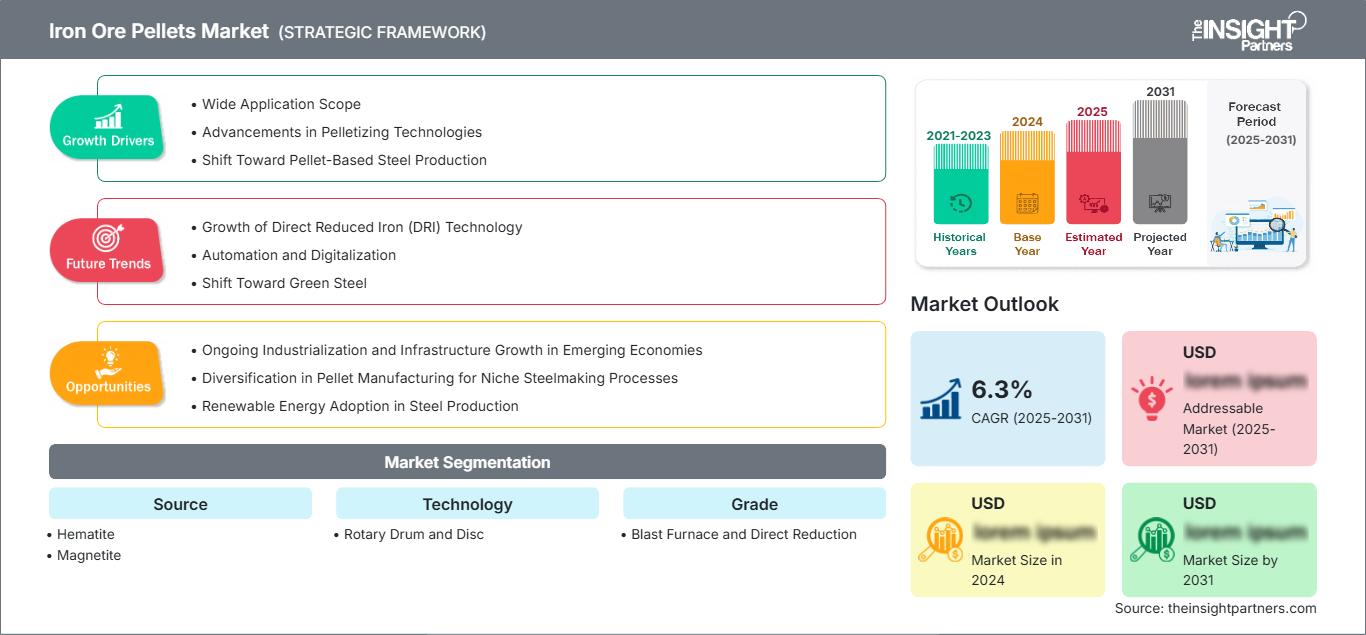
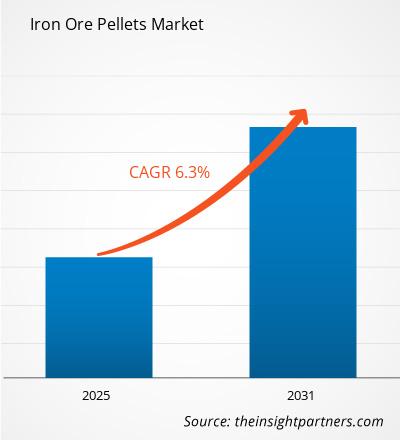
The iron ore pellets market was valued at US$ 57.55 Billion in 2025 and is projected to reach US$ 100.89 Billion by 2034, registering a CAGR of 6.44% during 2026–2034. The market plays a critical role in the steel value chain by supplying high-grade feedstock for blast furnace and direct reduction processes. Rising steel consumption across infrastructure, automotive, renewable energy, and industrial manufacturing sectors continues to support demand for premium-grade pellets with improved metallurgical performance and lower impurity content.
Across North America, increasing investments in direct reduced iron facilities and electric arc furnace-based steelmaking are strengthening pellet demand. The region benefits from established iron ore reserves, advanced beneficiation capabilities, and growing emphasis on lower-carbon steel production. The iron ore pellets market size in North America is supported by long-term industrial modernization programs, domestic steel manufacturing expansion, and increasing adoption of direct reduction technologies, resulting in a projected regional CAGR of 5.5–6.5% through the forecast period.
Iron Ore Pellets Market Assessment and Insights
- North America accounted for approximately 18–22% share in 2025. Growing investments in direct reduction iron facilities, steel sector modernization, and decarbonization initiatives support demand, with the market expected to grow at a CAGR of 5.5–6.5% during 2026–2034.
- US represented nearly 70–75% of North American demand in 2025. Expansion of electric arc furnace capacity and domestic steel production supports growth at a CAGR of 5.7–6.7% during 2026–2034.
- Europe held an estimated 20–24% share in 2025, led by Germany, Sweden, and France. Green steel investments and hydrogen-based direct reduction projects support a CAGR of 5.8–6.8% through 2034.
- Asia Pacific accounted for approximately 42–46% share in 2025, led by China, India, Japan, and South Korea. Large-scale steel manufacturing capacity and infrastructure development support a CAGR of 6.8–7.8% during 2026–2034.
- Largest Segment – Blast Furnace Grade held approximately 62–66% market share in 2025 due to its extensive use in integrated steel plants worldwide and is projected to grow at a CAGR of 5.8–6.8% through 2034.
- High Growth Segment – Direct Reduction Grade represented approximately 34–38% market share in 2025 and is expected to register a CAGR of 7.2–8.2% owing to increasing investments in low-carbon steelmaking technologies.
- Key companies analyzed in detail: BHP Group Limited, Vale S.A., Metso Corporation, Rio Tinto Group, Fortescue Ltd, Bahrain Steel B.S.C., KIOCL Limited, NMDC Limited, Luossavaara-Kiirunavaara Aktiebolag (LKAB), ArcelorMittal S.A.
Source: The Insight Partners' analysis based on proprietary research, government publications, company annual reports, investor presentations, industry databases, and expert interviews.
Production economics within the market have evolved considerably as steel producers increasingly prioritize feedstocks that improve furnace efficiency, reduce coke consumption, and support emissions reduction targets. Advances in beneficiation, filtration, and pelletizing technologies have enabled manufacturers to process lower-grade ores into premium products with consistent metallurgical properties. At the same time, growing adoption of direct reduction steelmaking has increased demand for higher-grade pellets capable of delivering improved productivity and lower carbon intensity throughout the steel production cycle, reinforcing the industry dynamics highlighted in the Iron Ore Pellets Market Report.
These developments are set to influence the industry dynamics during the forecast period. Regions with abundant resources, including access to high-grade deposits of iron ore, have become more appealing for pelletizing plants, while environment-related concerns along with commitments toward carbon reduction are driving the steel producers toward using premium-quality raw materials. It is anticipated that this will generate opportunities for growth in the long run.
Iron Ore Pellets Market Report Scope
| Report Attribute | Details |
|---|---|
| Market size in 2025 | US$ 57.55 Billion |
| Market Size by 2034 | US$ 100.89 Billion |
| Global CAGR (2026 - 2034) | 6.44% |
| Historical Data | 2021-2024 |
| Forecast period | 2026-2034 |
Iron Ore Pellets Market Analysis
Steel production remains the primary demand driver for the market growth, supported by ongoing investments in transportation infrastructure, urban construction, renewable energy installations, and industrial manufacturing. Pelletized iron ore provides superior permeability, uniform size distribution, and enhanced metallurgical performance compared to many alternative iron-bearing feedstocks. These characteristics enable steel producers to improve operational efficiency while reducing energy consumption and emissions during ironmaking operations, supporting a favorable Iron Ore Pellets Market Forecast over the assessment period.
The value chain encompasses the mining process, beneficiation process, concentration, pelletizing, transport, and the manufacturing of steel. The supply will be affected by the nature of the ores being mined, logistics, energy availability, and environmental factors. The large-scale mining firms are still making investments in the construction of pelletizing plants and beneficiation plants to make better use of their resources and increase the value they derive from iron ore mining.
Competitive positioning within the iron ore pellets market analysis is increasingly determined by access to high-grade reserves, pellet quality, logistics efficiency, and sustainability performance. Companies such as Vale S.A., Luossavaara-Kiirunavaara Aktiebolag (LKAB), BHP Group Limited, Rio Tinto Group, and Fortescue Ltd continue strengthening supply capabilities through operational optimization and strategic investments. Integrated steelmakers and pellet producers are also pursuing partnerships to secure long-term feedstock availability and improve supply chain resilience.
The investments would still be made for the expansion of beneficiation capacity, expansion of pellet facilities, and low-carbon steelmaking operations. ArcelorMittal S.A., as well as some regional players, are looking at opportunities in relation to direct reduction ironmaking, and equipment providers like Metso Corporation are working towards improving technology related to pelletizing processes. There would be an increased focus on sustainability, efficiency, and quality of the product.
● REPORT CUSTOMIZATION
Tailor This Report To Align With Your Specific Business Requirements
This report can be customized to align precisely with your business objectives, scope, and target markets. Customization options include tailored segmentation, geography, competitive analysis, and strategic insights to support informed decision-making.
Customize This Report →WHAT YOU CAN ADJUST
- ● Segmentations
- ● Geography
- ● Competitive Analysis
- ● Language Preferences
Iron Ore Pellets Market: Strategic Insights
Regional Insights
North America Iron ore pellets market
North America represented an estimated 18–22% of the iron ore pellets market share in 2025 and is projected to expand at a CAGR of 5.5–6.5% between 2026–2034. The industry in the region is driven by traditional mining, steel-making plants, and the growing use of direct reduction plants. The United States and Canada continue playing an important role because of their presence in iron ore and pelletizing facilities.
The market needs in North America are affected by the modernization of the steel industry, electric arc furnaces, and the reduction of CO2 emissions in iron production processes. The businesses pay attention to pellets’ quality in order to conduct efficient steel production. Also, the infrastructure, automotive production, and renewable energy equipment manufacturing cause the rising demand for steel products.
U.S. Iron Ore Pellets Market
The U.S. accounted for approximately 70–75% of North American market demand in 2025 and is expected to register a CAGR of 5.7–6.7% during 2026–2034. Domestic pellet producers benefit from proximity to major steel manufacturing centers and established transportation networks, including Great Lakes shipping routes. The country remains a significant consumer due to its large-scale steel production base, reinforcing key Iron Ore Pellets Market Trends throughout the forecast period.
Growing US demand is being driven by investment in electric arc furnace plants and direct reduced iron plants aimed at producing steel with lower emissions. The companies that operate in the region are improving the quality of pellets produced and the efficiency of their production process to match the changing demands of steel producers. Demand for steel products manufactured through pelletization continues to be led by the automotive, construction, energy, and manufacturing industries.
Europe Iron Ore Pellets Market
Europe held an estimated 20–24% share of the iron ore pellets market in 2025 and is forecast to grow at a CAGR of 5.8–6.8% through 2034. Germany, Sweden, France, Italy, and Spain represent key markets due to their established steel industries and increasing focus on sustainable production methods. Sweden remains strategically important because of its high-grade iron ore resources and investments in green steel technologies.
While the UK market will be driven by modernization in the steel sector and infrastructure demand, Germany is still working on the low-carbon steel manufacturing processes. France, Italy, and Spain have been working on industrial efficiencies and renewable energy-driven steel demand. There are many new opportunities emerging for pellet makers in Europe due to the emphasis of European steelmakers on direct reduction grade pellets.
APAC Iron Ore Pellets Market
Asia Pacific accounted for approximately 42–46% share of the iron ore pellets market in 2025 and is expected to register a CAGR of 6.8–7.8% during 2026–2034. China continues to be the largest consumer in the region because of its ability to manufacture a lot of steel. Other major consumers in the region include India, Japan, South Korea, and Australia.
Regional development is enhanced by infrastructural development, urbanization, and government efforts aimed at making steel production effective. China and India are developing capacity for steel production, while Japan and South Korea have taken steps towards developing low-carbon technologies. Australia has bolstered supply through large-scale mining activities.
Middle East & Africa Iron Ore Pellets Market
Middle East & Africa accounted for a smaller but strategically important share of the iron ore pellets market in 2025, supported by steel capacity expansion and industrial diversification initiatives. Saudi Arabia and the UAE are some of the most important markets in the region, owing to investments made in the manufacture of steel as well as direct reduction plants. The region is expected to experience growth at a CAGR of 6.0-7.0% between 2026 and 2034.
South Africa will be a contributor in terms of mining abilities as well as steel production infrastructure, whereas Middle Eastern markets are developing downstream metal industries. Increased availability of energy, investment in infrastructure, and economic diversification initiatives have been driving the development of steel plants.
Segmentation Analysis
Source
The source segment includes hematite and magnetite-based pellets, with the overall segment expected to expand at a CAGR of 6.0–7.0% during 2026–2034. Source selection depends on ore availability, beneficiation requirements, pellet quality, and steelmaking efficiency. Mining companies continue improving processing technologies to enhance recovery rates and produce pellets suitable for evolving steel production requirements.
- Hematite pellets remain widely used due to their availability, established processing routes, and compatibility with conventional steelmaking operations. They support blast furnace applications where consistent quality and operational reliability are essential for large-scale iron production.
- Magnetite pellets are gaining strategic importance because beneficiation can produce high-grade concentrates with lower impurities. Their adoption is supported by demand from direct reduction facilities seeking premium feedstock for lower-carbon steel production.
Technology
The technology segment includes rotary drum and disc pelletizing methods and is expected to grow at a CAGR of 5.8–6.8% during 2026–2034. Technology selection is influenced by production scale, operational efficiency, energy consumption, and desired pellet characteristics. Producers are increasingly upgrading pelletizing facilities to improve productivity and environmental performance.
- Rotary Drum technology remains important for large-volume pellet production due to continuous operation capability, durability, and suitability for established industrial facilities. It is widely adopted where consistent output and operational stability are prioritized.
- Disc technology provides improved control over pellet size distribution and is preferred for applications requiring flexibility and optimized pellet quality. Its adoption supports facilities focusing on customized production requirements.
Grade
The grade segment comprises blast furnace and direct reduction pellets, with the segment expected to register a CAGR of 6.2–7.2% during 2026–2034. Steelmakers increasingly evaluate pellet grades based on emissions targets, process efficiency, and production technology requirements. The transition toward cleaner steelmaking is influencing demand patterns across global markets.
- Blast Furnace grade pellets continue to represent a significant portion of consumption due to their established role in integrated steel plants. They provide operational advantages through improved furnace permeability and reduced processing challenges.
- Direct Reduction grade pellets are becoming increasingly important as steel producers invest in hydrogen-based and gas-based reduction technologies. Their higher iron content and lower impurity levels support efficient low-carbon steel production pathways.
Application
Application segmentation is projected to register a 6.0–6.7% CAGR during 2026–2034. Construction represents the broadest downstream steel demand pool, while automotive manufacturing requires high-quality flat steels produced through tightly controlled steelmaking processes. Consumer goods and aerospace contribute smaller but quality-sensitive demand. Pellet consumption therefore responds indirectly to infrastructure expenditure, vehicle production, manufacturing investment, and changing steel production routes.
- Construction: Construction generates substantial steel consumption through buildings, bridges, railways, utilities, and infrastructure, creating broad underlying demand for iron units used in primary steelmaking across developing and mature economies.
- Automotive: Automotive applications support demand for high-quality steel products requiring consistent metallurgy, encouraging steel producers to optimize raw-material quality, furnace efficiency, chemistry control, and lower-emission production pathways.
- Consumer Goods: Appliances, machinery, packaging, and durable consumer products create diversified steel requirements, supporting pellet demand indirectly through sheet, coated steel, engineered components, and other manufactured products.
- Aerospace: Aerospace represents a comparatively specialized downstream application, with pellet-related demand transmitted through high-specification steel and alloy supply chains requiring rigorous material quality, traceability, and production control.
Opportunity Snapshot
| Application | Revenue Contribution (High/Medium/Low) | Trend Tag | Adoption Stage |
| Construction | High | Infrastructure Steel | Mature |
| Automotive | High | Lightweight Steel | Mature |
| Renewable Energy Infrastructure | Medium | Green Steel | Scaling |
| Industrial Manufacturing | Medium | Steel Expansion | Mature |
Iron Ore Pellets Market Growth Drivers and Impact Analysis
Expansion of Low-Carbon Steel Production Facilities
Greater emphasis on low-carbon steel production means that there will be new demand patterns for pellets that can support direct reduction processes. There have been many developments where steel producers have resorted to methods that do not rely on conventional carbon-intensive iron production techniques. Such developments encourage pellet producers to make pellets that are high in quality and contain a higher amount of iron and fewer impurities. Increased interest in hydrogen-based steel projects in Europe and elsewhere around the world implies greater demand for pellets used in the direct reduction of iron.
Rising Infrastructure and Industrial Steel Consumption
Development of infrastructure projects in emerging as well as developed nations will keep driving the demand for steel and the associated raw material. Development in transportation networks, renewable energy infrastructure, urbanization, and industries needs considerable amounts of steel material. This will generate steady demand for iron ore pellets as the steel industry continues searching for steady sources of feedstocks. Government-led infrastructure projects in the Asia Pacific and the Middle East region have a key role to play in driving the demand for pellets in the future. Development in the manufacturing industries, such as the automobile and machinery sectors, will be additional demand drivers for the steel sector.
Technological Improvements in Pelletizing Operations
Technological developments in pelletization processes have been contributing significantly towards increasing efficiency, effective utilization of resources, and consistency of products. Current technological processes allow producers to use poor grades of iron ore in the production of pellets, while still ensuring that quality pellets are produced for use by the steel mills. Innovations related to automation and energy-saving machinery have contributed to lowering operational costs and improving the environmental performance of companies. Innovations by the machinery manufacturers have been aimed at improving the processes of forming of pellets, drying, and increasing the overall productivity of plants.
Iron Ore Pellets Market Future Trends
Increasing Adoption of Hydrogen-Based Direct Reduction Pellets
It can be predicted that the adoption of hydrogen technology in the steel industry will affect the demand for pellets in the future because the steel producers will need a raw material suitable for producing environmentally friendly iron. The direct reduction plants need high-quality pellets with a high concentration of iron and low concentration of impurities to work effectively. As hydrogen networks emerge in Europe, Asia-Pacific, and the Middle East regions, pellet manufacturers will have to concentrate on developing unique products. The mining companies will probably improve their processing capacities and conclude long-term contracts with steel producers.
Digitalization and Automation of Pellet Production Facilities
Pellet production is anticipated to be changed through the use of new technologies that will increase visibility of processes, predictive maintenance, and efficiency in resource usage. Through better monitoring and control of the pelletization process with artificial intelligence, manufacturers will be able to use less energy and keep up the same level of quality of their pellets. Future developments in the field are expected to include more efficient solutions for mining and pelletization with less downtime and higher flexibility in production. With the increasing competition between global suppliers of the mineral, excellence in operations will become a key differentiating factor.
Iron Ore Pellets Market Opportunities
Expansion of Direct Reduction Grade Pellet Supply Networks
The increasing deployment of direct reduction technologies creates opportunities for pellet producers to develop specialized products and strengthen supply partnerships. Steelmakers transitioning toward lower-carbon production require reliable access to high-quality direct reduction pellets with consistent metallurgical properties. Producers with access to premium iron ore resources and advanced beneficiation capabilities are positioned to benefit from this shift. Investments in new pelletizing capacity, upgrading existing facilities, and improving logistics infrastructure can help companies capture emerging demand. The expansion of direct reduction steel projects across Europe, Asia Pacific, and the Middle East provides opportunities for suppliers to establish long-term contracts and participate in the transformation of global steel production.
Strategic Investments in Emerging Steel Manufacturing Regions
Emerging steel-producing regions offer significant opportunities for pellet suppliers due to increasing industrialization, infrastructure development, and manufacturing expansion. Countries investing in steel capacity additions require dependable raw material supply chains to support new production facilities. Regions such as India, Southeast Asia, and the Middle East are attracting investments in integrated steel plants and direct reduction projects. Pellet producers can strengthen market presence by developing regional partnerships, improving transportation networks, and establishing localized supply arrangements. These opportunities are supported by economic diversification programs, infrastructure modernization, and growing demand for steel products across construction, energy, and industrial sectors.
Recent Developments
- July 2026: BHP announced a US$ 0.9 billion investment (100% basis) into the future of Western Australia Iron Ore, approving execution of the Ministers North Project, a high-grade Brockman ore deposit southeast of Yandi in Western Australia’s Pilbara region.
- May 2026: Mining company BHP Group increased its iron ore production by nearly 1 million tons in 2025 thanks to the implementation of AI-based solutions. This was announced by the company’s Chief Digital Officer, Mikko Teponen, during an industry conference in Perth.
Frequently Asked Questions

- Comprehensive Market Sizing and Forecast Analysis
- Detailed Segmentation Analysis
- In-Depth Market Dynamics Assessment
- Regional and Country-Level Insights
- Competitive Landscape and Company Benchmarking
- Strategic Business Intelligence
Recent Reports
Testimonials

The Insight Partners' SCADA System Market report is comprehensive, with valuable insights on current trends and future forecasts. The team was highly professional, responsive, and supportive throughout. We are very satisfied and highly recommend their services.
RAN KEDEM Partner, Reali Technologies LTDs
I requested a report on a very specific software market and the team produced the report in a few days. The information was very relevant and well presented. I then requested some changes and additions to the report. The team was again very responsive and I got the final report in less than a week.
JEAN-HERVE JENN Chairman, Future Analytica
We worked with The Insight Partners for an important market study and forecast. They gave us clear insights into opportunities and risks, which helped shape our plans. Their research was easy to use and based on solid data. It helped us make smart, confident decisions. We highly recommend them.
PIYUSH NAGPAL Sr. Vice President, High Beam Global
The Insight Partners delivered insightful, well-structured market research with strong domain expertise. Their team was professional and responsive throughout. The user-friendly website made accessing industry reports seamless. We highly recommend them for reliable, high-quality research services
YUKIHIKO ADACHI CEO, Deep Blue, LLC.
This is the first time I have purchased a market report from The Insight Partners.While I was unsure at first, I visited their web site and felt more comfortable to take the risk and purchase a market report.I am completely satisfied with the quality of the report and customer service. I had several questions and comments with the initial report, but after a couple of dialogs over email with their analyst I believe I have a report that I can use as input to our strategic planning process.Thank you so much for taking the extra time and making this a positive experience.I will definitely recommend your service to others and you will be my first call when we need further market data.
JOHN SUZUKI President and Chief Executive Officer, Board Director, BK Technologies
I wish to appreciate your support and the professionalism you displayed in the course of attending to my request for information regarding to infectious disease IVD market in Nigeria. I appreciate your patience, your guidance, and the fact that you were willing to offer a discount, which eventually made it possible for us to close a deal. I look forward to engaging The Insight Partners in the future, all thanks to the impression you have created in me as a result of this first encounter.
DR CHIJIOKE ONYIA MANAGING DIRECTOR, PineCrest Healthcare Ltd.Reason to Buy
- Informed Decision-Making
- Understanding Market Dynamics
- Competitive Analysis
- Identifying Emerging Markets
- Customer Insights
- Market Forecasts
- Risk Mitigation
- Boosting Operational Efficiency
- Strategic Planning
- Investment Justification
- Tracking Industry Innovations
- Aligning with Regulatory Trends





 Get Free Sample for