
Jaw Crusher Market Demand, Share & Growth by 2034
Coverage: by Type (Single Toggle Jaw Crusher, Double Toggle Jaw Crusher); Application (Construction, Mining, Demolition, Aggregates, Others) , and Geography (North America, Europe, Asia Pacific, and South and Central America)
- Status : Data Released
- Report Code : TIPRE00010621
- Category : Manufacturing and Construction
- No. of Pages : 150
- Available Report Formats :


- Last update date : July 13, 2026


2025 Market Size
US$ 2.86 Bn
Base year value
2034 Forecast
US$ 4.28 Bn
Projected by 2034
CAGR 2026-2034
4.58 %
Growth rate
Addressable Market
US$ 32.42 Bn
(2026-2034)
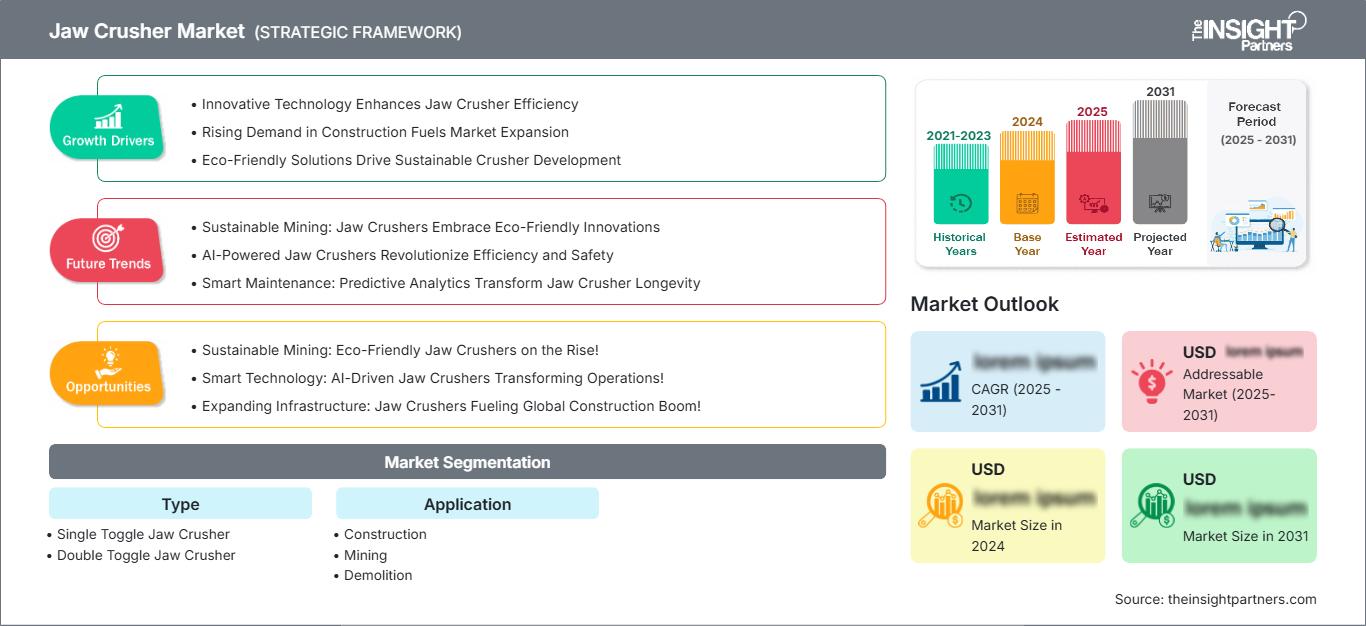
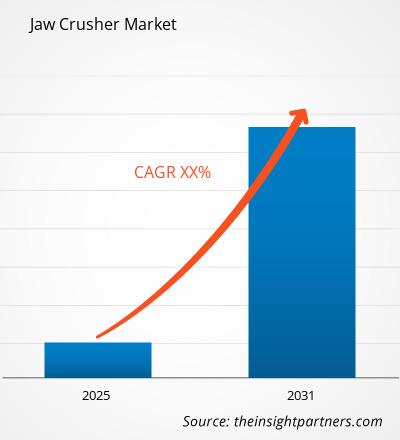
The jaw crusher market size is projected to grow from US$ 2.86 Billion in 2025 to US$ 4.28 Billion by 2034, registering a CAGR of 4.58% during 2026–2034. The jaw crusher continues to be significant in primary size reduction in the construction, mining, demolition, and aggregate industries, where robust equipment, stable output levels, and precise sizing of particles affect efficiency.
North America will have a CAGR of 4.1% to 4.6% until 2034, driven by the rehabilitation of highways, upgrading quarries, and the replacement of mining equipment. The need for jaw crushers is prevalent in portable and fixed crushing systems used in aggregates, metals, and concrete recycling. Site safety regulations and investments in public infrastructure are pushing companies to adopt automated, safe jaw crusher systems.
Jaw Crusher Market Assessment and Insights
- North America accounted for 24–27% share in 2025 and is projected to grow at a 4.1–4.6% CAGR between 2026–2034, led by quarry upgrades, roadwork backlogs, and replacement demand.
- The US represented 78–82% of North America in 2025 and is expected to expand at a 4.2–4.7% CAGR between 2026–2034, supported by aggregates and mining applications.
- Europe held 28–32% share in 2025 and is forecast to grow at a 3.7–4.2% CAGR between 2026–2034, with Germany, the UK, France, Italy, and Spain leading demand.
- Asia Pacific captured 32–36% share in 2025 and is expected to grow at a 5.0–5.5% CAGR between 2026–2034, led by China, India, Japan, South Korea, and Australia.
- Largest Segment: Single Toggle Jaw Crusher held 62–66% market share in 2025 and is projected to grow at a 4.4–4.9% CAGR between 2026–2034.
- High Growth Segment: Mining accounted for 28–32% jaw crusher market share in 2025 and is forecast to grow at a 5.1–5.6% CAGR between 2026–2034.
- Key companies analyzed in detail: FLSmidth & Co. A/S, H-E Parts International LLC, Henan Hongxing Mining Machinery Co., Ltd., Komatsu Ltd., McLanahan Corporation, Metso Corporation, Sandvik AB, Astec Industries, Inc., Terex Corporation, ThyssenKrupp AG.
Source: The Insight Partners' analysis based on proprietary research, government publications, company annual reports, investor presentations, industry databases, and expert interviews.
The evolution of the market includes shifting from mechanically demanding and location-specific machinery to modular designs of crushers featuring hydraulic adjustment, optimized wear parts and service through telemetry. Manufacturers are now concentrating on uptime as any disruption during primary crushing will impact screening, conveying, grinding and loading. Trends in the Jaw Crushers Market include development of machines with robust constructions, maintenance-friendly designs and reliable output curves along with improved quality of casting, design of chambers and service network.
Over the forecast period, the growth will extend to developing areas including infrastructure corridors, mineral processing facilities and circular construction complexes. Focus will be on energy-efficient motors and hybrid mobile solutions along with stringent dust, noise and worker safety regulations. The Jaw Crusher forecast is widening as contractors and miners seek standardized crushing platforms that can serve aggregates, hard-rock extraction, and recycled material processing without sacrificing reliability.
Jaw Crusher Market Report Scope
| Report Attribute | Details |
|---|---|
| Market size in 2025 | US$ 2.86 Billion |
| Market Size by 2034 | US$ 4.28 Billion |
| Global CAGR (2026 - 2034) | 4.58% |
| Historical Data | 2021-2024 |
| Forecast period | 2026-2034 |
Jaw Crusher Market Analysis
Demand is tied to materials throughput rather than equipment replacement alone. Aggregates producers require consistent feed reduction for asphalt, concrete, and rail ballast, while mining operators use jaw crushers to stabilize ore feed before secondary crushing or grinding. Infrastructure renewal, quarry permitting, and recycled concrete processing collectively strengthen the jaw crusher market report in both fixed and mobile configurations.
Value chain covers steel castings, wear liners, drive systems, control modules, distributors, renting fleets, and after-sales services. Supply conditions vary depending on alloy supply, casting plant capacities, and lead times for big pieces. Consumers have started evaluating total costs per ton, therefore, liner lifespan, fuel efficiency, mobility, and servicing intervals become important in the Jaw Crusher market analysis.
Competitive environment is dominated by diverse companies offering crushing equipment and individual parts. Metso Corporation, Sandvik AB, Terex Corporation, Astec Industries, Inc., and thyssenkrupp AG offer their products via wide product range, automation technologies, distribution networks, and service contracts. McLanahan Corporation, Komatsu Ltd., FLSmidth & Co. A/S, H-E Parts International LLC, and Henan Hongxing Mining Machinery Co., Ltd. target different applications in mining, aggregates, and replacement parts.
Investment trends indicate a shift from standalone equipment purchases toward integrated crushing stations, automation packages, and lifecycle support. Strategic positioning is shaped by installed-base density, parts availability, and the ability to support contractors operating across multiple sites. The Jaw Crusher market share of crushing-equipment spending remains resilient because primary crushing is essential before higher-value downstream processing can occur.
● REPORT CUSTOMIZATION
Tailor This Report To Align With Your Specific Business Requirements
This report can be customized to align precisely with your business objectives, scope, and target markets. Customization options include tailored segmentation, geography, competitive analysis, and strategic insights to support informed decision-making.
Customize This Report →WHAT YOU CAN ADJUST
- ● Segmentations
- ● Geography
- ● Competitive Analysis
- ● Language Preferences
Jaw Crusher Market: Strategic Insights
Regional Insights
North America Jaw Crusher
North America had a share of 24-27% in 2025 and is expected to register a CAGR of 4.1-4.6% up to 2034. Demand is driven by aggregates production, road resurfacing, hard-rock mining and mine-site modernization. Public infrastructure investment is behind steady demand for crushed stone, whereas companies are upgrading old equipment with safe, automated and maintenance-friendly primary crushers.
Equipment upgrade is especially common among contractors working on dispersed projects, when portable jaw crushers reduce transportation costs and facilitate recycling on-site. Competitiveness of suppliers rests on dealership presence, rapid supply of parts and service availability. The region’s Jaw Crusher Market demand is therefore less cyclical than new construction starts alone, because maintenance, resurfacing, and quarry output sustain recurring replacement cycles.
U.S. Jaw Crusher Market
The share of the US in the region of North America was estimated at 78–82% in 2025. The compound annual growth rate (CAGR) of the United States is anticipated to be 4.2–4.7% in the forecast period from 2026 to 2034. In addition, the demand will be driven by quarries, contractors, demolition and recycle companies, and metal mines.
Leading manufacturers ensure their presence in the US through their distribution channels, fabrication partners, and after-market network. Such companies as Astec Industries, Inc., McLanahan Corporation, Metso Corporation, Sandvik AB, and Terex Corporation operate in the country. Their competition is based on uptime, spare part availability, and automation readiness. Local demand depends on road surfacing, capacity upgrades in quarries, and higher safety requirements.
Europe Jaw Crusher Market
Europe accounted for 28–32% share in 2025 and is projected to grow at a 3.7–4.2% CAGR between 2026–2034. Germany is the leading country, supported by aggregates, recycling, and engineered equipment demand. The UK adds demand from infrastructure renewal and recycled construction material processing.
The advantages of Germany’s equipment include the efficiency standards of quarries, expensive labor force, and stringent safety standards, which encourage investments in automation, wear protection, and enclosed crushing plants. The demand in the UK is project-dependent, with demolition recycling and road construction generating demand for mobile jaw crushers and rentals.
France, Italy, and Spain generate demand via cement aggregates, road repair, and circular building strategies. The equipment used by producers can crush demolition materials and natural stones in sizes similar to each other. European Jaw Crusher Market demand remains disciplined, with purchasing decisions closely tied to emissions rules, site footprint, and lifecycle service economics.
APAC Jaw Crusher Market
APAC held 32–36% share in 2025 and is forecast to grow at a 5.0–5.5% CAGR through 2034, making it the leading regional market. China remains the largest country market due to quarrying, mining, and infrastructure intensity.
While India is stimulating demand through its roads, railways, and urban infrastructure projects, Australia is encouraging acquisitions in relation to mining that include iron ore, copper, and rare earth minerals. Japan and South Korea have placed an emphasis on reliability, automation, and compactness.
Policy support for infrastructure corridors, mineral security, and industrial capacity expansion strengthens regional Jaw Crusher Market forecast. Suppliers compete through localization, pricing, parts access, and mobile crushing portfolios suited to dispersed project sites.
Middle East & Africa Jaw Crusher Market
Middle East & Africa is expected to grow at a 4.4–4.9% CAGR between 2026–2034. Saudi Arabia is the leading country, supported by infrastructure, quarrying, and industrial-city development linked to long-term diversification programs.
The UAE provides construction aggregates, recycling, and logistical development. South Africa is involved in mining and quarry replacement requirements, whereas the rest of MEA region is project-based, whereby purchase of the product is linked to cement production, road development, port facilities, and mining activities.
Infrastructure development in the energy sector and mining diversification lead to increased requirement for durable crusher equipment which can perform in harsh environments. Simplicity, efficiency, and spare parts availability play an important role in buyer’s decision-making process.
Segmentation Analysis
Type
The Type segment is projected to grow at a 4.3–4.8% CAGR between 2026–2034. Product selection depends on feed hardness, output requirements, site mobility, and maintenance capability. Single-toggle units remain preferred for compact design and lower energy consumption, while double-toggle units retain relevance in heavy-duty applications requiring high crushing force and stable performance under abrasive feed conditions.
- Single Toggle Jaw Crusher holds the strongest position because its lighter structure, fewer moving parts, and operating efficiency suit mobile plants, aggregates production, construction sites, and mid-capacity quarry applications.
- Double Toggle Jaw Crusher remains strategically important for heavy-duty mining and abrasive rock processing, where higher crushing force, stable motion, and durability justify larger footprints and maintenance needs.
Application
The Application segment is expected to grow at a 4.6–5.1% CAGR between 2026–2034. Demand is spread across construction, mining, demolition, and aggregates, each requiring primary reduction but differing in mobility, feed variability, and operating intensity. Mining shows the fastest expansion, while construction and aggregates provide the broadest installed base and recurring replacement demand.
- Construction demand is sustained by roads, bridges, industrial sites, and urban projects requiring crushed stone and prepared base materials, making crusher reliability critical to contractor productivity.
- Mining applications require rugged primary crushers that handle ore variability, abrasive feed, and high utilization, making uptime, liner durability, and service access central procurement criteria.
- Demolition applications are expanding as contractors process reinforced concrete and mixed rubble on site, reducing disposal costs and improving circular material recovery.
- Aggregates remain a core application because quarry operators depend on consistent particle sizing, high throughput, and low cost per ton for concrete, asphalt, and infrastructure supply chains.
Opportunity Snapshot
| Segment Name | Revenue Contribution | Trend Tag | Adoption Stage |
| Construction | High | Road Aggregates | Mature |
| Mining | High | Ore Throughput | Scaling |
| Demolition | Medium | Concrete Recycling | Scaling |
| Aggregates | High | Quarry Output | Mature |
Jaw Crusher Market Growth Drivers and Impact Analysis
Infrastructure Renewal and Aggregate Consumption
Infrastructure development is one of the key drivers due to the high consumption of aggregate materials such as crushed stones, asphalt raw material, and concrete aggregates. The jaw crushers occupy the primary place in the production process; therefore, the quality of equipment influences schedule and material supply chain. The government programs guarantee multi-year visibility for the quarry and construction equipment renting companies. With tighter requirements on base layer and concrete components, producers invest in crushing equipment providing more precise reduction ratio and better safety systems.
Mining Capacity Expansion and Ore Processing Bottlenecks
Mine managers are increasingly investing in crushing circuits that can process not only copper, iron ore, gold, and lithium ores but any other minerals connected with the development of industry electrification and construction. The primary crushing plant performance plays an essential role in ensuring the operational integrity of conveyors, screens, mills, and even beneficiation plant. If feed size or crusher performance is limited, it affects the overall performance of the whole processing plant. This makes jaw crushers extremely important equipment when considering its performance. Purchasers prefer to buy robust equipment with wear parts and remote control capabilities.
Recycling Mandates and On-Site Material Reuse
Waste policies concerning construction and demolition are encouraging companies to recycle concrete, masonry, and asphalt instead of dumping this material in the landfill. Jaw crusher can facilitate this by providing means of coarse crushing at the demolition site and minimizing transportation costs to produce usable aggregates for backfilling, road bed, and non-structural concrete. In cases where space is a constraint and transportation cost makes economic sense, mobile jaw crushing becomes an even more interesting proposition. There is a significant market effect on the driver since recycling is another reason to have a crusher besides natural stone crushing.
Jaw Crusher Market Future Trends
Automation-Led Primary Crushing Control
Automation will increasingly define purchasing decisions as operators seek repeatable output, safer adjustment, and reduced reliance on manual inspection. Future jaw crushers are expected to integrate sensors for bearing temperature, vibration, hydraulic pressure, liner wear, and feed behavior. These systems will help operators maintain optimal closed-side settings and detect abnormal conditions before failure. The trend is especially relevant for multi-site quarry groups and mining companies that benchmark asset performance centrally. Over time, automated control will shift equipment evaluation from nominal capacity toward verified availability, energy use per ton, and predictive maintenance accuracy.
Hybrid and Electric Crushing Platforms
Hybrid and electric crushing platforms are expected to gain relevance as operators manage fuel costs, emissions limits, and noise constraints. Electric drives can improve energy efficiency in stationary plants, while hybrid mobile crushers offer flexibility for contractors working across sites with variable power access. Adoption will depend on grid availability, charging infrastructure, and total operating hours, but early demand is likely in Europe, North America, and advanced Asian markets. This trend supports Jaw Crusher Market growth by linking equipment modernization with sustainability, permitting, and lower operating-cost objectives.
Jaw Crusher Market Opportunities
Aftermarket Services and Wear-Part Optimization
Aftermarket services represent a durable opportunity because installed jaw crushers require liners, bearings, toggles, hydraulic components, and periodic rebuilds throughout long operating lives. Suppliers that combine predictive inspections, application engineering, and rapid parts logistics can capture recurring revenue beyond equipment sales. Wear-part optimization is particularly valuable where abrasive feed causes frequent liner changes or inconsistent product shape. By tailoring metallurgy and chamber profiles to site conditions, vendors can reduce cost per ton and strengthen customer retention. This opportunity rewards companies with local service networks, digital diagnostics, and inventory discipline.
Localized Manufacturing for Emerging Infrastructure Corridors
Localized manufacturing and assembly can improve competitiveness in fast-growing infrastructure corridors across Asia, the Middle East, Africa, and Latin America. Buyers in these markets often balance upfront price, service access, financing, and parts lead times. Establishing regional fabrication, dealer training, and component stocking can shorten delivery cycles and reduce foreign-exchange exposure. The opportunity is action-oriented for global suppliers and regional challengers because it supports customization for local feed materials, transport limits, and operator skill levels. It also helps capture replacement demand as project fleets mature.
Recent Developments
- May 2026: May 2026: EvoQuip has confirmed its return to Hillhead 2026, taking place from 23–25 June 2026 in Buxton, England, where the brand will exhibit on Stand L4. EvoQuip has confirmed its return to Hillhead 2026, taking place from 23–25 June 2026 in Buxton, England, where the brand will exhibit on Stand L4.
- July 2026: Sandvik AB announces the completion of its upgraded jaw crusher range, now offering a fully unified portfolio designed to improve safety, simplify operation and deliver reliable performance across applications.
- June 2025: Sandvik AB launched a new generation of upgraded jaw crushers with enhanced guarding, improved power pack, hydraulic adjustment, role-based documentation, and a three-year standard warranty to improve safety, productivity, and availability. Sandvik jaw crushers are now better equipped than ever to deliver the performance customers expect from a global leader in mining and quarry solutions.
Frequently Asked Questions

- Comprehensive Market Sizing and Forecast Analysis
- Detailed Segmentation Analysis
- In-Depth Market Dynamics Assessment
- Regional and Country-Level Insights
- Competitive Landscape and Company Benchmarking
- Strategic Business Intelligence
Recent Reports
Testimonials

The Insight Partners provided valuable market intelligence that supported our global go-to-market strategy. Their team was professional, responsive, and attentive to our feedback, providing thoughtful analysis and helpful methodological clarifications throughout the project.
Junmo Kim Chief Financial Officer (CFO), Enertech Co., Ltd.
The Insight Partners' SCADA System Market report is comprehensive, with valuable insights on current trends and future forecasts. The team was highly professional, responsive, and supportive throughout. We are very satisfied and highly recommend their services.
RAN KEDEM Partner, Reali Technologies LTDs
I requested a report on a very specific software market and the team produced the report in a few days. The information was very relevant and well presented. I then requested some changes and additions to the report. The team was again very responsive and I got the final report in less than a week.
JEAN-HERVE JENN Chairman, Future Analytica
We worked with The Insight Partners for an important market study and forecast. They gave us clear insights into opportunities and risks, which helped shape our plans. Their research was easy to use and based on solid data. It helped us make smart, confident decisions. We highly recommend them.
PIYUSH NAGPAL Sr. Vice President, High Beam Global
The Insight Partners delivered insightful, well-structured market research with strong domain expertise. Their team was professional and responsive throughout. The user-friendly website made accessing industry reports seamless. We highly recommend them for reliable, high-quality research services
YUKIHIKO ADACHI CEO, Deep Blue, LLC.
This is the first time I have purchased a market report from The Insight Partners.While I was unsure at first, I visited their web site and felt more comfortable to take the risk and purchase a market report.I am completely satisfied with the quality of the report and customer service. I had several questions and comments with the initial report, but after a couple of dialogs over email with their analyst I believe I have a report that I can use as input to our strategic planning process.Thank you so much for taking the extra time and making this a positive experience.I will definitely recommend your service to others and you will be my first call when we need further market data.
JOHN SUZUKI President and Chief Executive Officer, Board Director, BK Technologies
I wish to appreciate your support and the professionalism you displayed in the course of attending to my request for information regarding to infectious disease IVD market in Nigeria. I appreciate your patience, your guidance, and the fact that you were willing to offer a discount, which eventually made it possible for us to close a deal. I look forward to engaging The Insight Partners in the future, all thanks to the impression you have created in me as a result of this first encounter.
DR CHIJIOKE ONYIA MANAGING DIRECTOR, PineCrest Healthcare Ltd.Reason to Buy
- Informed Decision-Making
- Understanding Market Dynamics
- Competitive Analysis
- Identifying Emerging Markets
- Customer Insights
- Market Forecasts
- Risk Mitigation
- Boosting Operational Efficiency
- Strategic Planning
- Investment Justification
- Tracking Industry Innovations
- Aligning with Regulatory Trends





 Get Free Sample for