
Kitchen Countertop Market Overview and Growth by 2034
Coverage: Type (Granite, Solid Surface, Quartz, Marble, Laminates, and Ceramic Slab); Application (Commercial and Residential), and Geography
- Status : Data Released
- Report Code : TIPMC00002591
- Category : Manufacturing and Construction
- No. of Pages : 150
- Available Report Formats :


- Last update date : July 15, 2026


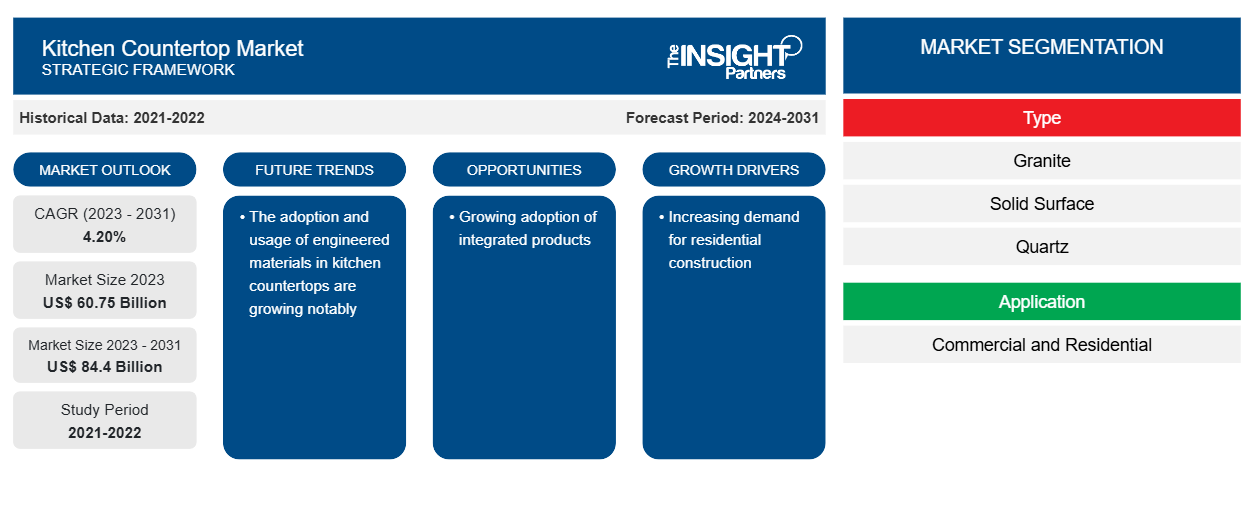
2023 Market Size
US$ 60.75 Bn
Base year value
2031 Forecast
US$ 84.4 Bn
Projected by 2031
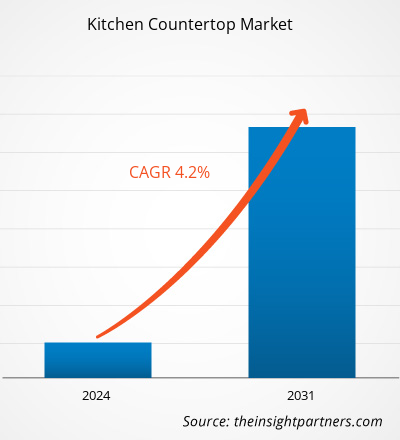
CAGR 2024-2031
4.20 %
Growth rate
Addressable Market
US$ 587.45 Bn
(2024-2031)
The kitchen countertop market size is projected to grow from US$ 65.96 Billion in 2025 to US$ 95.52 Billion by 2034, registering a CAGR of 4.20% during 2026–2034. The demand will be driven by house renovation and refurbishment, use of modular kitchen systems, construction of hospitality properties, and commercial fit-outs. There is a gradual move towards using engineered materials which are maintenance-free, hygienic, and have uniform appearance in both residential and commercial food preparation facilities.
It is anticipated that North America will grow at a 3.6%-4.0% compound annual growth rate between 2026 and 2034 on account of repair and remodel expenditures and premium residential improvements. North America enjoys advantages of established manufacturing network, home improvements focused on kitchens, and high demand for quartz, porcelain, and low silica mineral surfaces.
Kitchen Countertop Market Assessment and Insights
- North America: The region accounted for 32–34% share in 2025 and is growing at a CAGR of 3.6–4.0% between 2026–2034, driven by remodeling activity and higher specification surfaces.
- US: The country represented 78–82% of the North America kitchen countertop market in 2025 and is growing at a CAGR of 3.7–4.1% between 2026–2034, supported by renovation spending.
- Europe: Europe held 23–25% share in 2025 and is growing at a CAGR of 3.2–3.6% between 2026–2034, with Germany, the UK, Italy, France, and Spain leading demand.
- Asia Pacific: APAC captured 27–29% share in 2025 and is growing at a CAGR of 5.1–5.5% between 2026–2034, led by China, India, Japan, South Korea, and Australia.
- Largest Segment: Quartz accounted for 34–37% kitchen countertop market share in 2025 and is growing at a CAGR of 4.5–4.9% between 2026–2034, supported by durability and design consistency.
- High Growth Segment: Ceramic slab held 8–10% market share in 2025 and is growing at a CAGR of 5.6–6.0% between 2026–2034, driven by large-format adoption.
- Key companies analyzed in detail: Caesarstone Ltd.; Asian Granito India Limited; Cambria Company LLC; Cosentino Global, S.L.U.; Florim Ceramiche S.p.A.; Laminam S.p.A.; LX Hausys, Ltd.; Neolith Distribution, S.L.; Pokarna Limited; Iris Ceramica Group S.p.A.; Strasser Steine GmbH; Tile & Stone Works; Vicostone Joint Stock Company; Wilsonart LLC.
Source: The Insight Partners' analysis based on proprietary research, government publications, company annual reports, investor presentations, industry databases, and expert interviews.
The kitchen countertop market forecast has evolved from stone-dominant fabrication toward engineered surfaces, digital templating, CNC cutting, and factory-controlled slab production. The popularity of quartz and ceramic slabs is on account of their ability to offer consistency, ease of maintenance and repeatability of the specification process by architects and builders. At the production stage, manufacturers are exploring recycled raw materials, low silica content, and machine polishing to increase safety, yield, and certainty of delivery.
Until 2034, investments will go to regions with demand for urban homes, refurbishment of hospitality and kitchens of institutions in the Asia Pacific region, Gulf Cooperation Council nations and certain countries in Europe. Increasing regulation of respirable crystalline silica is encouraging material reformulations, while energy efficiency and circularity are becoming criteria of choice. All these trends broaden the scope of the Kitchen Countertops market.
Kitchen Countertop Market Report Scope
| Report Attribute | Details |
|---|---|
| Market size in 2023 | US$ 60.75 Billion |
| Market Size by 2031 | US$ 84.4 Billion |
| Global CAGR (2023 - 2031) | 4.20% |
| Historical Data | 2021-2022 |
| Forecast period | 2024-2031 |
Kitchen Countertop Market Analysis
The kitchen countertop market report is tied to residential remodeling, new housing completions, restaurant refurbishment, and institutional foodservice upgrades. The market profile is moderate because countertops are durable assets, yet replacement is triggered by kitchen redesign, water damage, property resale, and commercial hygiene standards. Quartz, ceramic slab, and solid surface materials benefit from predictable appearance and lower maintenance versus many natural stones.
This includes mining of minerals, resins, and binders, slab production, distribution centers, fabrication, kitchen studios, contractors, and installers. The supply situation still remains regional due to the heavy weight, breakable nature, and the installation process involved in handling the slabs. The fabrication capabilities, labor availability, and presence of showrooms will determine how long it takes for the deliveries to be made. According to kitchen countertop market analysis, those brands with technical knowledge, warranties, and consistent color range would be able to maintain their margins from the imported commodities.
The competition is spread out among the global surface brand companies, regional stone processors, laminates producers, and independents fabricators. This competition exists between Caesarstone Ltd, Cosentino Global, S.L.U., Cambria Company LLC, Vicostone Joint Stock Company, LX Hausys, Ltd., and Wilsonart LLC through product portfolio, installer support, channel partnerships, and safety-oriented innovations. European ceramic specialists like Florim Ceramiche S.p.A. and Laminam S.p.A. are building up their positions in the large format slabs.
Investment trends emphasize low-silica engineered surfaces, recycled raw materials, automated cutting, and digital visualization tools. Strategic positioning increasingly depends on serving both residential and commercial applications with consistent lead times. Brands that combine design libraries, certified fabrication guidance, and regional inventory are better placed to capture the kitchen countertop market share as buyers balance cost, safety, durability, and aesthetics.
● REPORT CUSTOMIZATION
Tailor This Report To Align With Your Specific Business Requirements
This report can be customized to align precisely with your business objectives, scope, and target markets. Customization options include tailored segmentation, geography, competitive analysis, and strategic insights to support informed decision-making.
Customize This Report →WHAT YOU CAN ADJUST
- ● Segmentations
- ● Geography
- ● Competitive Analysis
- ● Language Preferences
Kitchen Countertop Market: Strategic Insights
Regional Insights
North America Kitchen Countertop
North America comprised 32–34% of 2025 revenue and is expected to increase at a 3.6–4.0% CAGR from 2026 through 2034. Renovation has been the structural driver, and the homeowners prefer kitchen renovation which boosts the resale value, storage, and flow within their homes. Premium quartz, porcelain, and low silica mineral stones have found application in both single-family homes and multifamily developments.
Commercial applications will come mainly from hotel, quick service restaurant (QSR), assisted living, and healthcare foodservice sectors. Localized fabricator channels are expected, however, leading brands are expected to leverage regional distribution centers as well as installer training and certification to avoid breakage, callbacks, and delivery inconsistency. The kitchen countertop trends in North America are aligned towards safety compliance, resistance to staining, and design-based replacement.
U.S. Kitchen Countertop Market
The U.S. represented 78–82% of North America kitchen countertop market in 2025 and is projected to expand at a 3.7–4.1% CAGR during 2026–2034. Demand is strongest in kitchen remodeling, multifamily renovation, luxury residential projects, and foodservice upgrades. The country hosts strong channel presence for Caesarstone Ltd., Cambria Company LLC, Cosentino Global, S.L.U., Wilsonart LLC, and Vicostone Joint Stock Company.
Trends in applications suggest quartz as being used for daily domestic applications, ceramic slab materials as being used for luxury kitchens and outdoor cooking surfaces, and laminates as being used for cost-conscious renovation of rented spaces and commercial premises. There is also an increased awareness in low silica content materials following the assessment of health issues associated with fabrication dust exposure in occupations.
Europe Kitchen Countertop Market
Europe accounted for 23–25% share in 2025 and is expected to grow at a 3.2–3.6% CAGR during 2026–2034. Germany drives the demand by means of replacing fitted kitchens, energy-efficient home renovations, and luxury apartment renovations. The UK market is backed up by home improvement retail distribution, small kitchen renovation, and middle-priced quartz usage.
Italy is still strategically relevant due to the presence of ceramic slabs and porcelain production hubs that help to innovate, export, and design architecture. Such companies as Florim Ceramiche S.p.A., Laminam S.p.A., and Iris Ceramica Group S.p.A. promote regional expertise in large-sized slabs, thin slabs, and luxury finishes of residential and commercial interiors.
France and Spain demonstrate stable replacement demand driven by urban apartments, hospitality renovations, and design-oriented kitchen studios. Spanish demand is also driven by the innovation base and export capacity of Cosentino Global, S.L.U. In Europe, low emission binders, recycling content, and safety during manufacturing become procurement criteria due to sustainability considerations.
APAC Kitchen Countertop Market
APAC held 27–29% share in 2025 and is forecast to grow at a 5.1–5.5% CAGR during 2026–2034. China leads production and consumption through urban housing, modular kitchens, and slab manufacturing scale.
India expands through structured real estate, luxury apartments, and kitchen retail stores, while Japan and South Korea focus on small, cleanable surfaces.
Australia has taken a higher value approach towards the use of engineered and porcelain slabs. The policy focus on silica exposure has led to reformulations by suppliers and fabrication restrictions.
Middle East & Africa Kitchen Countertop Market
Middle East & Africa is projected to grow at a 4.3–4.7% CAGR during 2026–2034. Saudi Arabia leads regional demand through housing programs, hotels, and mixed-use developments.
UAE prefers high-quality stone, quartz, and ceramic slabs for luxury residential and hospitality spaces such as hotels that require quality and aesthetics.
MEA, especially South Africa, demonstrates selective development in urban retail kitchens, commercial kitchens, and infrastructure-related accommodation developments owing to cost implications on materials.
Segmentation Analysis
Type
The type segment in the kitchen countertop market is expected to grow at a 4.1–4.5% CAGR during 2026–2034 as buyers compare lifecycle cost, fabrication risk, repairability, and design flexibility. Quartz remains the largest material category, while ceramic slab is the fastest-growing option because large formats reduce joints and support premium visual continuity. Laminates retain relevance in cost-sensitive projects.
- Granite remains important for natural-stone buyers seeking unique veining, heat tolerance, and long service life, particularly in premium homes and selected hospitality projects.
- Solid Surface is preferred where seamless joints, repairability, and hygienic detailing matter, especially healthcare, laboratories, foodservice counters, and institutional applications.
- Quartz leads specification because consistent patterns, non-porous performance, and broad color ranges align with remodelers, builders, and kitchen studios seeking predictable installation outcomes.
- Marble serves luxury residential and boutique hospitality demand, but staining sensitivity and maintenance requirements limit adoption in high-traffic food-preparation environments.
- Laminates remain strategic for rental housing, budget kitchens, staff areas, and quick commercial refurbishments where affordability, rapid installation, and design variety are essential.
- Ceramic Slab is gaining share in premium kitchens, outdoor counters, and commercial interiors because large formats, heat resistance, and thin profiles support modern design.
Application
The application segment in the kitchen countertop market is forecast to grow at a 4.0–4.4% CAGR during 2026–2034, reflecting steady demand across commercial and residential spaces. Residential projects generate higher volume through remodels, modular kitchens, and resale-led upgrades. Commercial adoption is more specification-driven, emphasizing hygiene, impact resistance, cleaning efficiency, and compliance in restaurants, hotels, healthcare, offices, and education facilities.
- Commercial demand is concentrated in hospitality, restaurants, healthcare, offices, and institutional kitchens where surfaces must withstand cleaning chemicals, impact, moisture, and intensive daily use.
- Residential demand remains the volume anchor, driven by kitchen remodeling, modular cabinetry, premium apartments, and homeowner preference for durable, easy-clean surfaces.
Opportunity Snapshot
| Application | Revenue Contribution | Trend Tag | Adoption Stage |
| Commercial | Medium | Hygienic Fitouts | Scaling |
| Residential | High | Remodel Kitchens | Mature |
Kitchen Countertop Market Growth Drivers and Impact Analysis
Renovation-Led Kitchen Replacement Cycles
Remodeling of the kitchen continues to be the most reliable demand generator, as countertops are visible, essential, and regularly changed in the course of refurbishing cabinetry and appliances. While in developed countries, replacement demand compensates for lower frequency of constructing new housing units, in developing cities, the installation of first modular kitchens creates additional demand. This demand effect is mostly felt by the quartz, laminate, and solid surface material segments, owing to their reliable cost and quick availability. Contractors prefer to work with those materials that do not require callback visits, fit standard templates, and complement popular cabinets.
Shift Toward Engineered and Low-Maintenance Surfaces
Engineered surfaces have become more popular due to the demand from homeowners, architects, and commercial clients for uniform looks, stain protection, and reduced maintenance over many natural stones. The benefits of using quartz and ceramic slabs include the ability to control colors, create consistent patterns, and incorporate backsplashes, which makes such materials ideal for mass residential applications as well as hospitality. The result is a gradual shift of budget allocation from natural stone to engineered brands. There are advantages to be gained by manufacturers in terms of differentiation via warranties, safety information, recycling and training programs.
Commercial Hygiene and Durability Requirements
Restaurants, hotels, healthcare facilities, schools, and offices require surfaces that withstand frequent cleaning, impact, moisture, and food-contact routines. This creates demand for non-porous, repairable, and chemically resistant countertops in preparation zones, serving counters, restrooms, and break areas. The impact is a more specification-led purchasing process, where facility managers consider lifecycle cost, downtime, and replacement frequency. Solid surface, quartz, ceramic slab, and high-pressure laminate products benefit when suppliers provide technical data and approved fabrication practices. Commercial procurement also favors brands with reliable distribution and consistent color continuity for multi-site rollouts.
Kitchen Countertop Market Future Trends
Low-Silica and Recycled Mineral Formulations
Material innovation will increasingly focus on lowering crystalline silica content while increasing recycled mineral, glass, and industrial by-product inputs. This trend reflects rising occupational health scrutiny in fabrication workshops and growing sustainability expectations from architects, retailers, and institutional buyers. Suppliers that reformulate without compromising impact resistance, heat tolerance, or color depth can gain specification advantages. The trend may also reshape training, labeling, and installation documentation, making safety performance a commercial differentiator. Over time, low-silica portfolios could become standard in premium engineered surfaces, particularly in markets with stricter workplace exposure rules.
Digital Design, Templating, and Fabrication Integration
Digital workflows will become more central to countertop selection and installation. Homeowners increasingly use visualization tools before visiting showrooms, while fabricators rely on laser templating, nesting software, and CNC equipment to reduce waste and improve fit accuracy. This trend supports faster quotation, fewer site errors, and better slab utilization, especially for expensive quartzite-look ceramic and engineered surfaces. For suppliers, integrated digital libraries can influence early design decisions and improve conversion rates. The result is a more connected ecosystem where design, inventory, fabrication, and installation data reinforce each other.
Kitchen Countertop Market Opportunities
Certified Fabricator Networks for Safer Installation
Manufacturers can strengthen market access by building certified fabricator networks that combine product education, safety practices, installation standards, and warranty compliance. This opportunity is especially relevant for low-silica quartz, ceramic slabs, and large-format materials that require specialized handling. Certified networks reduce breakage, improve customer satisfaction, and help retailers recommend higher-value products with confidence. They also create a defensible channel advantage because installers become familiar with specific slab behavior, adhesives, cutting requirements, and care protocols. For buyers, certification lowers project risk and supports consistent outcomes across multiple locations.
Premium Surfaces for Hospitality and Outdoor Kitchens
Hospitality renovation and outdoor living create an opportunity for heat-resistant, UV-stable, stain-resistant, and visually distinctive surfaces. Hotels, resorts, restaurants, rooftop bars, and premium homes need countertops that perform in demanding environments while supporting brand aesthetics. Ceramic slabs, porcelain, granite, and selected engineered surfaces can capture this opportunity when suppliers provide clear outdoor-use guidance and project references. The investment case is strongest where developers seek durable finishes that reduce maintenance disruption. Suppliers that align design palettes with hospitality concepts and outdoor kitchen systems can access higher-margin, specification-driven demand.
Recent Developments
- October 2025: Cosentino, a global leader company in the production and distribution of innovative surfaces for architecture and design, announces the global launch of its new mineral surfaces brand, Éclos, aimed to the kitchen and bathroom countertop market. This launch marks a milestone in the global industry by introducing an entirely new category: “Inlayered Mineral Surface” based on its Inlayr design technology.
- July 2025: Caesarstone ICON - a groundbreaking new category of advanced fusion surfaces that are entirely crystalline silica-free and crafted using a proprietary blend of innovative, responsibly sourced, and recycled materials. With this bold debut, Caesarstone reaffirms its leadership in the industry, redefining the future of surface design with the same durability, quality and warranty that Canadians have come to trust for almost four decades. ICON is more than a collection; it is a milestone that signals a new era: progressive, intelligent, and sustainably minded.
- September 2025: Legrand’s latest Kitchen Countertop Outlet is the first upward facing outlet to pass the half-gallon spill test required for UL standards and to meet the National Electrical Code (NEC).
Frequently Asked Questions

- Comprehensive Market Sizing and Forecast Analysis
- Detailed Segmentation Analysis
- In-Depth Market Dynamics Assessment
- Regional and Country-Level Insights
- Competitive Landscape and Company Benchmarking
- Strategic Business Intelligence
Recent Reports
Testimonials

The Insight Partners' SCADA System Market report is comprehensive, with valuable insights on current trends and future forecasts. The team was highly professional, responsive, and supportive throughout. We are very satisfied and highly recommend their services.
RAN KEDEM Partner, Reali Technologies LTDs
I requested a report on a very specific software market and the team produced the report in a few days. The information was very relevant and well presented. I then requested some changes and additions to the report. The team was again very responsive and I got the final report in less than a week.
JEAN-HERVE JENN Chairman, Future Analytica
We worked with The Insight Partners for an important market study and forecast. They gave us clear insights into opportunities and risks, which helped shape our plans. Their research was easy to use and based on solid data. It helped us make smart, confident decisions. We highly recommend them.
PIYUSH NAGPAL Sr. Vice President, High Beam Global
The Insight Partners delivered insightful, well-structured market research with strong domain expertise. Their team was professional and responsive throughout. The user-friendly website made accessing industry reports seamless. We highly recommend them for reliable, high-quality research services
YUKIHIKO ADACHI CEO, Deep Blue, LLC.
This is the first time I have purchased a market report from The Insight Partners.While I was unsure at first, I visited their web site and felt more comfortable to take the risk and purchase a market report.I am completely satisfied with the quality of the report and customer service. I had several questions and comments with the initial report, but after a couple of dialogs over email with their analyst I believe I have a report that I can use as input to our strategic planning process.Thank you so much for taking the extra time and making this a positive experience.I will definitely recommend your service to others and you will be my first call when we need further market data.
JOHN SUZUKI President and Chief Executive Officer, Board Director, BK Technologies
I wish to appreciate your support and the professionalism you displayed in the course of attending to my request for information regarding to infectious disease IVD market in Nigeria. I appreciate your patience, your guidance, and the fact that you were willing to offer a discount, which eventually made it possible for us to close a deal. I look forward to engaging The Insight Partners in the future, all thanks to the impression you have created in me as a result of this first encounter.
DR CHIJIOKE ONYIA MANAGING DIRECTOR, PineCrest Healthcare Ltd.Reason to Buy
- Informed Decision-Making
- Understanding Market Dynamics
- Competitive Analysis
- Identifying Emerging Markets
- Customer Insights
- Market Forecasts
- Risk Mitigation
- Boosting Operational Efficiency
- Strategic Planning
- Investment Justification
- Tracking Industry Innovations
- Aligning with Regulatory Trends





 Get Free Sample for