
Laboratory Jacks Market Size, Growth & Demand by 2034
Coverage: by Size (Small, Medium, Large); End-user (Chemical, Pharmaceutical, Life Science, Biology, Educational Institution, Others) , and Geography (North America, Europe, Asia Pacific, and South and Central America)
- Status : Data Released
- Report Code : TIPRE00010622
- Category : Manufacturing and Construction
- No. of Pages : 150
- Available Report Formats :


- Last update date : July 13, 2026


2025 Market Size
US$ 151.01 Mn
Base year value
2034 Forecast
US$ 206.74 Mn
Projected by 2034
CAGR 2026-2034
3.55 %
Growth rate
Addressable Market
US$ 1,624.65 Mn
(2026-2034)
The laboratory jacks market size is projected to grow from US$ 151.01 Million in 2025 to US$ 206.74 Million by 2034; it is expected to register a CAGR of 3.55% from 2026 to 2034. Demand reflects steady replacement of benchtop support devices, wider use of adjustable platforms in analytical workflows, and continued procurement by chemical, pharmaceutical, life science, biology, and educational laboratories.
North America remains a high-value demand center, with regional Laboratory Jacks Market growth estimated at a CAGR of 3.30–3.70% during 2026–2034. Replacement demand from pharmaceutical quality control laboratories, university research facilities, and industrial testing sites supports recurring purchases. The region also benefits from established distributor networks, compliance-led laboratory upgrades, and adoption of corrosion-resistant, load-stable designs for precision equipment positioning.
Laboratory Jacks Market Assessment and Insights
- North America held 31–34% share in 2025 and is projected to grow at a CAGR of 3.30–3.70% between 2026–2034, supported by biopharma laboratories, chemical testing demand, and academic research spending.
- The US represented 76–80% of North America in 2025 and is projected to grow at a CAGR of 3.35–3.75%, driven by pharmaceutical QC and research labs.
- Europe accounted for 27–30% laboratory jacks market share in 2025 and is projected to grow at a CAGR of 3.05–3.45%, led by Germany, the UK, and France across chemical, educational, and life science laboratories.
- Asia Pacific held 24–27% share in 2025 and is projected to grow at a CAGR of 3.80–4.25%, with China, India, Japan, and South Korea expanding laboratory infrastructure and domestic instrument sourcing.
- Largest Segment: Medium laboratory jacks held 45–49% laboratory jacks market share in 2025 and are projected to grow at a CAGR of 3.35–3.75% during 2026–2034.
- High Growth Segment: Pharmaceutical end users held 25–29% market share in 2025 and are projected to grow at a CAGR of 3.90–4.35% during 2026–2034.
- Key companies analyzed in detail: Boekel Scientific, BrandTech Scientific, Inc., Carl Roth GmbH + Co. KG, Chemglass Life Sciences LLC, Eisco Labs, Isolab Laborgeräte GmbH, LabJacks, Inc., Thermo Fisher Scientific Inc., Thorlabs, Inc., and United Scientific Supplies, Inc.
Source: The Insight Partners' analysis based on proprietary research, government publications, company annual reports, investor presentations, industry databases, and expert interviews.
Laboratory positioning equipment has evolved from basic scissor mechanisms toward more application-specific platforms with stainless steel screws, anodized aluminum decks, anti-slip surfaces, and finer vertical adjustment control. Production remains moderately fragmented because buyers prioritize catalog availability, load capacity, platform size, and distributor service. The Laboratory Jacks Market report shows that manufacturing differentiation increasingly depends on material durability, smooth travel, corrosion resistance, and compatibility with heating, stirring, optics, and glassware setups.
The laboratory jacks market is forecasted to witness significant opportunities during the forecast period owing to new laboratory investments in the Asia Pacific region, pharmaceutical manufacturing facilities, and consistent purchase from teaching laboratories. The focus on repeatable test processes, proper handling of samples, and documentation through quality control in regulations is anticipated to support the growth of the market for laboratory jacks. Manufacturers who have extensive product distribution channels and customized platform sizes can reap rewards.
Laboratory Jacks Market Report Scope
| Report Attribute | Details |
|---|---|
| Market size in 2025 | US$ 151.01 Million |
| Market Size by 2034 | US$ 206.74 Million |
| Global CAGR (2026 - 2034) | 3.55% |
| Historical Data | 2021-2024 |
| Forecast period | 2026-2034 |
Laboratory Jacks Market Analysis
Demand is anchored in everyday laboratory workflows where glassware, hot plates, condensers, baths, optical assemblies, and small instruments require stable height adjustment. The Laboratory Jacks Market share is influenced by replacement cycles rather than one-time installations because jacks face chemical exposure, mechanical wear, and safety inspection requirements. Pharmaceutical and chemical laboratories prefer robust medium and large formats, while educational users buy compact models in higher quantities.
Value chain activities are metal fabricating, screw mechanism manufacturing, surface finishing, catalog distribution, and laboratory supply acquisition. Supply forces include those who keep their SKUs standard, have regional warehousing capabilities, and are compatible with common support rods and optical breadboards. The WHO quality assurance in pharmaceutical production and inspection underscores the importance of reliable laboratory equipment in regulated industries.
Competitive forces include catalog range, distributor relations, and application focus. Thermo Fisher Scientific Inc. and Carl Roth GmbH + Co. KG leverage large laboratory supply networks, while Thorlabs, Inc. caters to precision optomechanics with compact designs that handle large loads. Boekel Scientific, Chemglass Life Sciences LLC, BrandTech Scientific, Inc., Eisco Labs, Isolab Laborgeräte GmbH, LabJacks, Inc., and United Scientific Supplies, Inc. engage in size ranges and price affordability.
Investment trends center on incremental design improvement rather than disruptive automation. Suppliers are expanding corrosion-resistant materials, smoother actuation, compact heavy-load formats, and bundled procurement through digital catalogs. Strategic positioning in the Laboratory Jacks Market growth cycle depends on serving both high-compliance pharmaceutical buyers and cost-sensitive academic laboratories, while protecting margins through standardized manufacturing and distributor-led volume sales.
● REPORT CUSTOMIZATION
Tailor This Report To Align With Your Specific Business Requirements
This report can be customized to align precisely with your business objectives, scope, and target markets. Customization options include tailored segmentation, geography, competitive analysis, and strategic insights to support informed decision-making.
Customize This Report →WHAT YOU CAN ADJUST
- ● Segmentations
- ● Geography
- ● Competitive Analysis
- ● Language Preferences
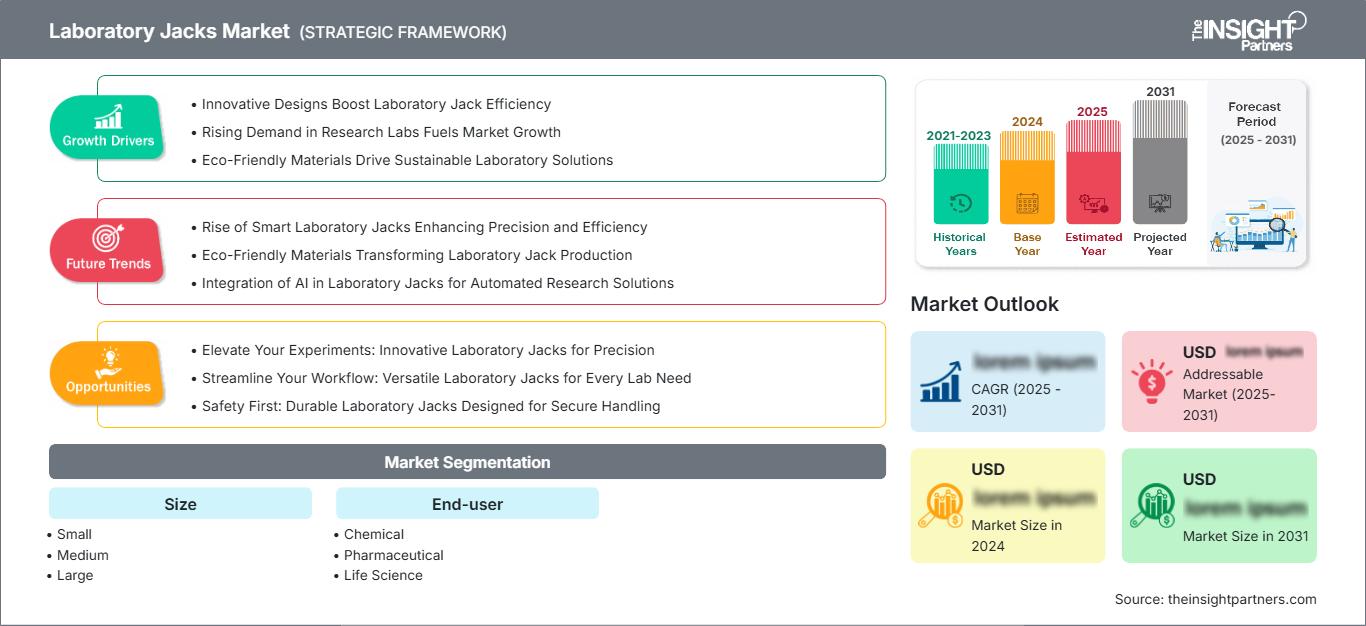
Laboratory Jacks Market: Strategic Insights
Regional Insights
North America Laboratory Jacks
North America accounted for 31% - 34% market share in 2025 and will register a CAGR of 3.30% – 3.70% during the period between 2026 and 2034. Market growth is driven by demand arising from pharmaceutical research & development facilities, universities laboratories, food & chemical testing, and regular replacement of benchtop positioning systems. USA drives the purchases, whereas Canada supports with its laboratories.
Supplier presence in the region is aided by developed distribution channels as well as requirement for specification-based solutions. Growth in the region is not purely driven by volumes; rather, it is driven by safety concerns and stability requirements for work processes involving heating, stirring, and optical alignment.
U.S. Laboratory Jacks Market
The US accounted for 76–80% of North America in 2025 and is expected to grow at a CAGR of 3.35–3.75% through 2034. Pharmaceutical quality-control laboratories, contract research sites, university chemistry departments, and photonics laboratories maintain consistent demand for medium and precision jacks. Domestic and international suppliers compete through catalog availability and distributor coverage.
The company has a wide reach, with products available from Thermo Fisher Scientific Inc., Thorlabs Inc., Boekel Scientific, LabJacks Inc., Chemglass Life Sciences LLC, and United Scientific Supplies Inc. Trends in the applications arena indicate that there is a need for small-sized equipment and heavy-duty equipment for hot plate and optical mounts.
Europe Laboratory Jacks Market
Europe represented 27–30% market share in 2025 and is expected to grow at a CAGR of 3.05–3.45%. Germany leads the country due to chemical manufacturing, precision engineering, and laboratory universities. The customers consider durability of construction, corrosion resistance, and compliance-ready purchasing documents as key requirements.
The contribution from the UK comes from pharmaceutical studies, academic chemistry, and biomedical laboratories needing reliable small and medium supports. Government research financing and university remodeling ensure continuous orders, and distributors play an essential role in bulk purchases.
The demand from France, Italy, and Spain includes life science, biology, and educational laboratories. The replacement rate is stable, although the growth is modest since there are installed bases in many laboratories and the laboratories purchase when they face safety, corrosion, or capacity issues.
APAC Laboratory Jacks Market
The Asia Pacific region held a share of 24–27% in 2025 and will exhibit a growth rate of CAGR of 3.80–4.25%. China has the dominant regional market through chemical analysis, drug production, and academic institutions.
Japan and South Korea have needs for precision and smaller systems for high-tech materials, optics, and life sciences applications. India is generating growing demand through pharmaceutical QC and academic laboratories.
Australia generates demand from university, mining, environmental, and biomedical testing labs. Government initiatives for local drug manufacturing and scientific institutions support purchases of laboratory support equipment.
Middle East & Africa Laboratory Jacks Market
Middle East & Africa is projected to grow at a CAGR of 3.00–3.40% during 2026–2034, with Saudi Arabia leading regional demand through healthcare, education, and industrial laboratory investment.
UAE uses life science centers, testing laboratories, and university research facilities for procurement. South Africa makes its contribution via mining, chemistry, university, and public health laboratories.
Rest of MEA requirements continue to be project driven, based on energy, water testing, and infrastructure laboratories. Growth is slow due to procurement cycles based on budgetary allocations and distribution channels.
Segmentation Analysis
Size
The size segment is projected to grow at a CAGR of 3.30–3.70% during 2026–2034. Selection depends on bench space, supported equipment weight, vertical travel, and required stability. Medium formats dominate because they balance price, footprint, and load capacity, while small units serve teaching and compact setups. Large units remain important for hot plates, baths, and heavier assemblies.
- Small laboratory jacks are widely used in educational, biology, and compact analytical setups where affordability, low bench footprint, and quick height adjustment matter more than heavy load capacity.
- Medium laboratory jacks serve the broadest demand base because they support common hot plates, glassware, stirrers, and small apparatus while remaining cost-effective for multi-bench procurement.
- Large laboratory jacks address heavier or taller laboratory assemblies, particularly in chemical, pharmaceutical, and materials testing workflows where stability and locking strength influence safety.
End-user
The end-user segment is projected to grow at a CAGR of 3.45–3.85% during 2026–2034. Procurement patterns vary by laboratory intensity, compliance requirements, and replacement budgets. Pharmaceutical users show the fastest growth because regulated testing and quality-control workflows require reliable support tools. Educational institutions remain volume buyers, while chemical and life science laboratories favor durable, corrosion-resistant designs.
- Chemical laboratories require stable platforms for heating, mixing, distillation, and reaction setups, making corrosion resistance, platform locking, and load stability important purchase criteria.
- Pharmaceutical laboratories prioritize reliable equipment positioning in QC, formulation, and analytical workflows, where reproducibility, safety checks, and documentation-driven procurement support premium adoption.
- Life science laboratories use laboratory jacks in sample preparation, imaging support, incubation-adjacent workflows, and flexible benchtop configurations that require frequent equipment repositioning.
- Biology laboratories prefer compact and medium units for teaching, microscopy support, specimen handling, and routine experiment setup, with affordability and simple operation influencing purchasing.
- Educational institutions generate recurring volume demand because chemistry and biology teaching labs require multiple bench units, simple operation, and durable construction for student use.
Opportunity Snapshot
| Segment Name | Revenue Contribution | Trend Tag | Adoption Stage |
| Chemical | High | Corrosion Safe | Mature |
| Pharmaceutical | High | QC Expansion | Scaling |
| Life Science | Medium | Workflow Flex | Scaling |
| Biology | Medium | Bench Compact | Mature |
| Educational Institution | Medium | Teaching Labs | Mature |
Laboratory Jacks Market Growth Drivers and Impact Analysis
Expansion of Pharmaceutical QC and R&D Laboratories
Laboratories that manufacture drugs are becoming more and more inclined to invest in quality control, formulation, and analysis processes due to growth of their pipeline of medications, biologic products, and local production facilities. With every new bench, hot plate, reactor setup, or preparation station installed, there is a need for reliable lab jacks because such equipment becomes a must-have rather than luxury in laboratories. WHO guidelines on quality assurance of pharmaceuticals and GMP inspection point out the need for reliable laboratory equipment.
Laboratory Modernization Across Academic Institutions
Universities, colleges of technology, and school labs are constantly renewing their chemistry and biology labs for the purpose of promoting practical training in science, technology, engineering, and mathematics (STEM). This means that such initiatives have a high need for small to medium lab jacks per each laboratory table, despite the relatively low price of such items. In the field of educational procurement, easy-to-use products made of reliable materials and having standard dimensions are preferred because such goods will be used by various persons.
Need for Safer Handling of Heat and Glassware Assemblies
Chemistry and biology labs require height-adjustable stands to mount hot plates, baths, condensers, flasks, and reaction vessels securely. Inadequate support can lead to spills, accidents, and injuries, thus laboratories ensure the replacement of faulty jacks even before visible malfunction. Such considerations create a market for smooth-operating screws, locking systems, non-corroding surfaces, and load-bearing stands. For commercial applications, this creates an increased propensity to pay for reliable medium-sized and large jacks in industrial laboratories, while general purpose jacks keep being used where only stable and affordable stands are required.
Laboratory Jacks Market Future Trends
Application-Specific Platform Engineering
Future Laboratory Jacks Market trends will emphasize designs tailored to defined workflows rather than generic benchtop lifting. Optical labs require excellent vertical sensitivity and stability while rotating, chemical labs require decks that are corrosion-resistant, and teaching labs require decks that are durable but affordable. Manufacturers should ensure they increase their product offerings by designing high load compact decks, better locking features, and deck designs that have patterns allowing accessories to be attached. This way, manufacturers can compete without incurring huge expenses for automation. It will be easier for laboratories to pick decks based on how well they fit the apparatus used and not the platform size alone.
Digitally Enabled Procurement and SKU Standardization
The laboratory buyers are shifting a larger volume of their transactions through the use of e-catalogues, institutional procurement websites, and distributor websites that allow for quick comparison of specifications. This will benefit vendors who have load ratings, drawings, materials, and SKUs readily available and standardized. There is an importance of standardization since laboratories with many sites will want to purchase from their list of approved equipment. The shift in buying trends does not involve smart jacks but rather digital merchandising and the ability to provide detailed product information.
Laboratory Jacks Market Opportunities
Bundled Supply Programs for Teaching Laboratories
Opportunity for incremental growth is possible from bundling lab jacks with hot plates, clamps, rods, glassware sets, and teaching material for basic chemistry education. Schools are known to purchase in bulk and tend to look for easy buying, consistent pricing, and robust equipment that would hold up to use by students. Bundling not only increases the size of orders but also assists in getting standardized equipment at each bench. It is a good opportunity especially in Asia Pacific region, the Middle East, and public universities’ refurbishment efforts, which lead to laboratory expansion projects.
Premium Corrosion-Resistant Products for Regulated Labs
Suppliers can improve profitability by developing premium laboratory jacks for regulated pharmaceutical, chemical, and life science laboratories. These users value stainless steel mechanisms, anodized or coated platforms, reliable locking, and specification documentation because equipment must perform under chemical exposure and audit scrutiny. A premium line can target replacement demand where existing jacks show corrosion, instability, or poor height control. The opportunity is action-oriented: manufacturers should pair material upgrades with test documentation and distributor education, enabling procurement teams to justify higher unit prices through safety and lifecycle value.
Recent Developments
- October 2025: Thorlabs announced the acquisition of Nu Opto, Inc., a leading designer and manufacturer of acousto-optic components. With roots tracing back to Newport Electro-Optic Systems, the Nu Opto team brings over 35 years of expertise in delivering high-quality acousto-optic solutions. Their products combine exceptional reliability and performance to meet the needs of both high-volume OEM integration and demanding stand-alone applications, including next-generation quantum technologies.
- March 2025: The Max Planck Florida Institute for Neuroscience (MPFI) is teaming up with Thorlabs to push the boundaries of brain research through a new partnership agreement. This scientific collaboration will bring Thorlabs’ cutting-edge miniaturized two-photon microscope (Mini2P) imaging system and other imaging technologies to MPFI’s facilities, helping scientists to observe real-time neuronal activity in unprecedented detail.
- March 2025: AstraZeneca announced an investment of US$2.5 billion in Beijing to establish its sixth global strategic R&D centre together with major research and manufacturing agreements that will further advance life sciences in China. This investment over the next five years is part of a strategic partnership with the Beijing Municipal Government and the Beijing Economic-Technological Development Area Administrative Office and includes agreements with three biotechs; Harbour BioMed, Syneron Bio, and BioKangtai, and follows the recent Fibrogen announcement.
Frequently Asked Questions

- Comprehensive Market Sizing and Forecast Analysis
- Detailed Segmentation Analysis
- In-Depth Market Dynamics Assessment
- Regional and Country-Level Insights
- Competitive Landscape and Company Benchmarking
- Strategic Business Intelligence
Recent Reports
Testimonials

The Insight Partners' SCADA System Market report is comprehensive, with valuable insights on current trends and future forecasts. The team was highly professional, responsive, and supportive throughout. We are very satisfied and highly recommend their services.
RAN KEDEM Partner, Reali Technologies LTDs
I requested a report on a very specific software market and the team produced the report in a few days. The information was very relevant and well presented. I then requested some changes and additions to the report. The team was again very responsive and I got the final report in less than a week.
JEAN-HERVE JENN Chairman, Future Analytica
We worked with The Insight Partners for an important market study and forecast. They gave us clear insights into opportunities and risks, which helped shape our plans. Their research was easy to use and based on solid data. It helped us make smart, confident decisions. We highly recommend them.
PIYUSH NAGPAL Sr. Vice President, High Beam Global
The Insight Partners delivered insightful, well-structured market research with strong domain expertise. Their team was professional and responsive throughout. The user-friendly website made accessing industry reports seamless. We highly recommend them for reliable, high-quality research services
YUKIHIKO ADACHI CEO, Deep Blue, LLC.
This is the first time I have purchased a market report from The Insight Partners.While I was unsure at first, I visited their web site and felt more comfortable to take the risk and purchase a market report.I am completely satisfied with the quality of the report and customer service. I had several questions and comments with the initial report, but after a couple of dialogs over email with their analyst I believe I have a report that I can use as input to our strategic planning process.Thank you so much for taking the extra time and making this a positive experience.I will definitely recommend your service to others and you will be my first call when we need further market data.
JOHN SUZUKI President and Chief Executive Officer, Board Director, BK Technologies
I wish to appreciate your support and the professionalism you displayed in the course of attending to my request for information regarding to infectious disease IVD market in Nigeria. I appreciate your patience, your guidance, and the fact that you were willing to offer a discount, which eventually made it possible for us to close a deal. I look forward to engaging The Insight Partners in the future, all thanks to the impression you have created in me as a result of this first encounter.
DR CHIJIOKE ONYIA MANAGING DIRECTOR, PineCrest Healthcare Ltd.Reason to Buy
- Informed Decision-Making
- Understanding Market Dynamics
- Competitive Analysis
- Identifying Emerging Markets
- Customer Insights
- Market Forecasts
- Risk Mitigation
- Boosting Operational Efficiency
- Strategic Planning
- Investment Justification
- Tracking Industry Innovations
- Aligning with Regulatory Trends





 Get Free Sample for