
Laser Cleaning Market Demand, Size & Forecast by 2034
Coverage: By Product Type (Handheld Laser Cleaners, Robot Laser Cleaning Machines, Conveyor Laser Cleaning Machines, and Others); Type (Multimode and Single Mode Lasers); Application (Conservation and Restoration, Cleaning Process, and Industrial Usage), and Geography
- Status : Data Released
- Report Code : TIPTE100001343
- Category : Electronics and Semiconductor
- No. of Pages : 150
- Available Report Formats :


- Last update date : September 28, 2026


2025 Market Size
US$ 713.44 Mn
Base year value
2034 Forecast
US$ 1,732.31 Mn
Projected by 2034
CAGR 2026-2034
10.36 %
Growth rate
Addressable Market
US$ 10,855.10 Mn
(2026-2034)
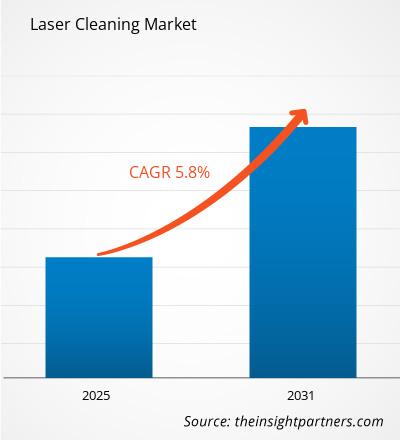
The Laser Cleaning market was valued at US$ 713.44 Million in 2025 and is projected to reach US$ 1,732.31 Million by 2034, registering a CAGR of 10.36% during 2026–2034. Laser cleaning technology is rapidly gaining popularity in manufacturing, automotive, aerospace, energy, conserving, and maintenance industries. The Market is rapidly becoming an integral part of industrial surface treatment due to the necessity for precise and non-contact cleaning of rust, coatings, oxides, contamination, and residues.
North America is anticipated to have a 9.5–11.5% CAGR over the forecast period of 2034. The growth in Laser Cleaning market size is being driven by aerospace maintenance, automotive refurbishment, nuclear asset maintenance, and environment concerns that lead to the preference of low waste surface cleaning. Industries now consider laser technologies where conventional blasting generates secondary waste, substrate damage, venting needs, or preparation/cleaning time.
Laser Cleaning Market Assessment and Insights
- North America: North America is expected to hold a 28–32% share in 2025 and grow at a CAGR of 9.5–11.5% between 2026–2034, supported by aerospace MRO, automotive manufacturing, energy infrastructure, defense maintenance, and replacement of abrasive processes.
- US: The US is estimated to represent 70–74% of North American revenue in 2025 and expand at a CAGR of 9.7–11.7% during 2026–2034, led by aerospace, defense, nuclear, and industrial applications.
- Europe: Europe is estimated to account for 25–29% share in 2025 and grow at a CAGR of 9.0–11.0% through 2034, with Germany, the UK, France, Italy, and Spain supporting demand through advanced manufacturing, automotive production, and heritage restoration.
- Asia Pacific: Asia Pacific is estimated at 34–38% share in 2025 and is projected to grow at a CAGR of 11.0–13.0%, led by China, Japan, South Korea, India, and Australia, where manufacturing automation and industrial modernization support adoption.
- Largest Segment: Industrial Usage is estimated at a 52–56% market share in 2025 and is expected to grow at a CAGR of 10.8–12.8%, supported by production and maintenance applications.
- High Growth Segment: Conservation and Restoration is estimated at a 15–19% market share in 2025 and is expected to grow at a CAGR of 12.0–14.0%, reflecting precision restoration requirements.
- Key companies analyzed in detail: HGSTAR, Pokkels, Adapt Laser Systems LLC, IPG Photonics Corporation, Laser Photonics Corporation, Coherent Corp., TRUMPF SE + Co. KG, Laserax, Clean-Lasersysteme GmbH, P-Laser.
Source: The Insight Partners' analysis based on proprietary research, government publications, company annual reports, investor presentations, industry databases, and expert interviews.
Surface preparation using laser technology has grown from restoration and laboratory applications to become an effective production process cleaner. Fiber and solid state lasers, portable scanning heads, enhanced beam delivery, and adjustable pulse settings have expanded the scope of materials and geometries that can be used. The equipment manufacturers are beginning to integrate laser sources with robotics, vision systems, extraction devices, safety enclosures, and software control so that laser cleaning is capable of being performed repeatably within manufacturing cells.
Future trends will see expansion of use in manufacturing clusters and industries with high infrastructure requirements. Expect future investment to be in portable cleaners for maintenance, robotics systems for production, and specific applications in aerospace, energy, shipbuilding, and automotive operations. Changes in environmental controls related to solvent chemistry, abrasive byproducts, operator exposure, and industrial emissions are anticipated to reinforce the economic value proposition for laser cleaning.
Laser Cleaning Market Report Scope
| Report Attribute | Details |
|---|---|
| Market size in 2025 | US$ 713.44 Million |
| Market Size by 2034 | US$ 1,732.31 Million |
| Global CAGR (2026 - 2034) | 10.36% |
| Historical Data | 2021-2024 |
| Forecast period | 2026-2034 |
Laser Cleaning Market Analysis
The demand for laser cleaning is becoming more and more dependent on the requirement of preparing surfaces before welding, painting, bonding, inspection, and repurposing without damaging substrates. Growth of Laser Cleaning Market can thus be considered related to the shift towards digitally controlled manufacturing and process engineering sustainability. This ecosystem is made up of laser source providers, optic components suppliers, scanner and motion control providers, machines manufacturers, system integrators, distribution firms, service firms, and industrial users. Pulsed or CW technologies are chosen depending on the thickness of the contaminants, the sensitivity of substrates, processing speed, and necessary cleaning depth.
The supply side is affected by availability of high-power fiber lasers, optical components performance, thermal management solutions, scanning technology, and ability of integration. High-power technologies are used for large surface processing in the industrial environment, while low-power pulsed sources are used for precise cleaning and sensitive substrates processing. Suppliers of equipment also compete in application engineering, process certification, safety features, and post-sale services.
Positioning in the market increasingly requires providing systems that go beyond just supplying a laser source alone. Analysis of the Laser Cleaning Market Report highlights a segmented structure involving major photonics companies together with specialized equipment providers. IPG Photonics Corporation, Coherent Corp. and TRUMPF SE + Co. KG feature a wide range of lasers, whereas Laser Photonics Corporation, Laserax, Clean-Lasersysteme GmbH, and P-Laser are involved in developing specialized cleaning systems.
The strategic investments in development include automation, application-oriented optics, robotics, and process control. The combination of laser sources and automated cleaning cells is provided by IPG Photonics Corporation, whereas the inclusion of cleaning as part of industrial laser processes is seen at TRUMPF SE + Co. KG. Portable and industrial systems are emphasized by Laser Photonics Corporation, while Laserax and Clean-Lasersysteme GmbH supply customized industrial applications. HGSTAR, Pokkels, Adapt Laser Systems LLC, and P-Laser add to the competition as well.
● REPORT CUSTOMIZATION
Tailor This Report To Align With Your Specific Business Requirements
This report can be customized to align precisely with your business objectives, scope, and target markets. Customization options include tailored segmentation, geography, competitive analysis, and strategic insights to support informed decision-making.
Customize This Report →WHAT YOU CAN ADJUST
- ● Segmentations
- ● Geography
- ● Competitive Analysis
- ● Language Preferences
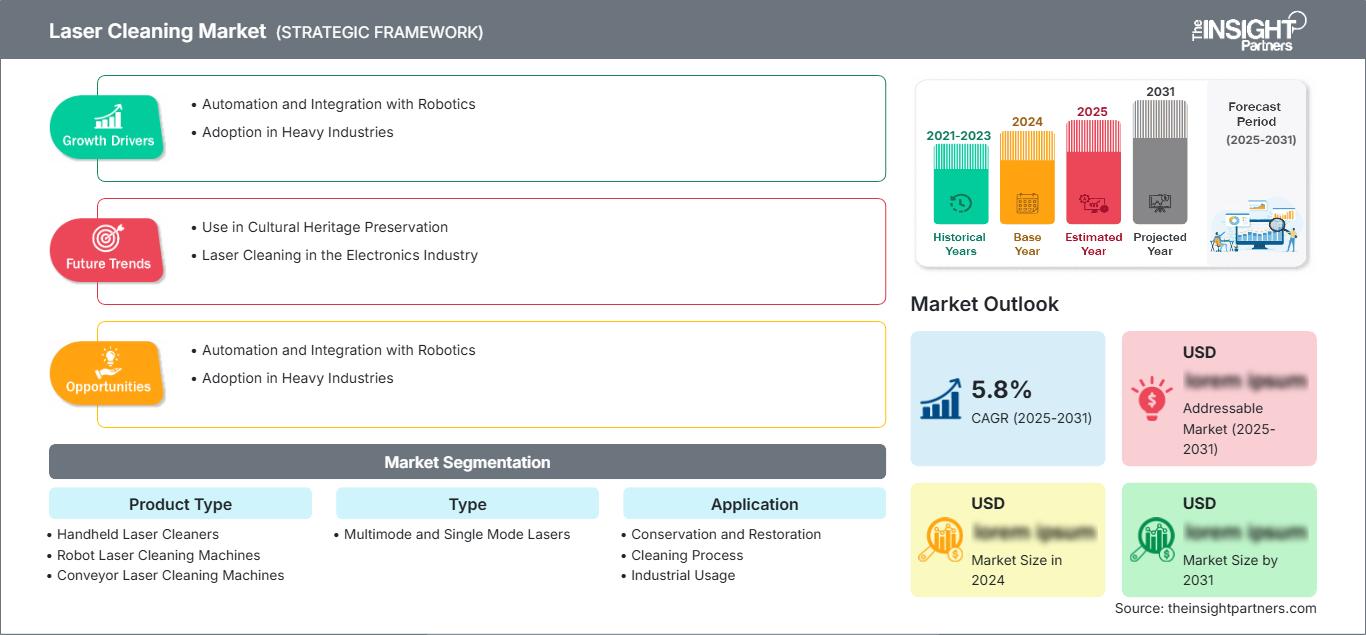
Laser Cleaning Market: Strategic Insights
Regional Insights
North America Laser Cleaning Market
North America accounts for an estimated 28% to 32% Laser Cleaning market share by 2025, along with a CAGR between 9.5% and 11.5% up to 2034. The major demand region is the US, owing to aerospace maintenance, military equipment servicing, automobile manufacturing, energy infrastructure, and industrial repairs. Contributions are expected from Canada, in areas such as nuclear, transport, mining, and heavy equipment that require control over surface preparation, waste minimization.
For industrial customers, speed of cleaning, operator safety, protection of the substrate, and reduction of the use of consumables are key criteria for the selection of the handheld and automated devices. Repetitive methods of corrosion and coating removal are preferred by the aerospace and defense sectors, whereas energy operators employ lasers for parts needing frequent maintenance.
U.S. Laser Cleaning Market
The United States is projected to account for 70-74% of revenue from North America in 2025, growing at a CAGR of 9.7-11.7%. End-users are seen in sectors like aerospace & defense, automotive, nuclear, energy, shipbuilding, and advanced manufacturing. The industrial end-users are turning towards laser cleaning due to the cost incurred in disposal, downtime, or damage to substrates with other techniques.
Participants include companies such as IPG Photonics Corporation, Laser Photonics Corporation, Coherent Corp., and Adapt Laser Systems LLC in the area of laser source, equipment, and solutions. Handheld devices cater to maintenance and servicing activities, while robotics systems cater to repetitive production activities. Aerospace and defense end-users concentrate on coating and corrosion removal, while automotive end-users prefer weld preparation and component cleaning.
Europe Laser Cleaning Market
Europe is expected to have 25%-29% of global revenue in 2025 and grow at a CAGR of 9.0-11.0%. Germany is expected to be the leader in this region, driven by auto manufacturing, industrial machines, photonic knowledge, and factory automation. The UK, France, Italy, and Spain are contributing to the region via aerospace, manufacturing, restoration, transport, and industrial maintenance services.
The UK has aerospace MRO and heritage conservation applications, which require both portable and precision solutions. Germany focuses on automated cleaning of manufacturing cells and auto manufacturing. France is driven by aerospace and industrial maintenance, whereas Italy and Spain are driven by automotive, machinery, ship building, and architectural restoration applications. Europe’s environmental and industrial efficiency needs further stimulate the interest in chemically and abrasively consumable-minimized processes.
APAC Laser Cleaning Market
In the APAC region, the market shares are estimated to be between 34-38%, with the CAGR of 11.0-13.0%. The major market here is China because of its manufacturing processes, automotive manufacturing, electronics, and automation. In addition, the precise manufacturing will be done in Japan and South Korea, and the automotive, infrastructure, mining, aerospace, and energy maintenance markets will exist in India and Australia.
The industries which upgrade their technology and implement factory automation are key drivers of the industry. The robotic implementation is provided by China, Japan, and South Korea, and there is the increase in manufacturing and infrastructure spending in India. Australia provides opportunities in the mining, heavy equipment, and maintenance sectors because of the use of portable cleaners.
Middle East & Africa Laser Cleaning Market
Middle East and Africa demand will grow at CAGR of 8.5-10.5% with Saudi Arabia as the key potential market. UAE market is driven by infrastructure, aerospace, maritime and industrial maintenance application whereas South Africa market is fueled by mining, manufacturing and energy industry applications. Other MEA region demand is focused on specialized maintenance projects.
The energy infrastructure provides potential for coatings and corrosion control, as well as cleaning of components. Saudi Arabia and UAE market are driven by industrial diversification and infrastructure development whereas South Africa market is driven by need for maintenance solutions in mining and heavy industrial facilities. Financial constraint is still an issue in some of African countries.
Segmentation Analysis
Product Type
Product Type is expected to expand at a CAGR of 10.0–12.0% between 2026–2034. Equipment selection increasingly depends on mobility, component geometry, cleaning area, automation requirements, and production volume. Portable systems address maintenance and refurbishment, while automated platforms serve repeatable factory operations. The Laser Cleaning Market scope across product configurations therefore reflects increasing segmentation between field service and production environments.
- Handheld Laser Cleaners: Handheld systems remain important for maintenance, repair, restoration, and small-batch production because operators can move the cleaning head across irregular surfaces. Their portability supports decentralized deployment.
- Robot Laser Cleaning Machines: Robotic platforms serve high-volume manufacturing where consistent motion, repeatable parameters, and operator separation are priorities. They are strategically suited to automotive, aerospace, and component-processing cells.
- Conveyor Laser Cleaning Machines: Conveyor systems support continuous production environments requiring synchronized material movement and surface treatment. Their importance increases where cleaning must operate within established automated production lines.
- Others: Other configurations address specialized geometries, customized workstations, and application-specific requirements. These systems provide flexibility when standard handheld, robotic, or conveyor architectures cannot satisfy production constraints.
Type
Type is expected to register a CAGR of 9.5–11.5% during 2026–2034. Laser selection depends on pulse behavior, power requirements, substrate characteristics, cleaning depth, and operating speed. Multimode systems can support broader industrial applications, while single mode architectures offer controlled beam characteristics for precision processing and specialized surface treatment.
- Multimode: Multimode lasers address applications requiring higher processing flexibility and broader energy distribution. They are relevant for rust, paint, oxide, and coating removal across industrial components and maintenance operations.
- Single Mode Lasers: Single mode lasers provide tighter beam characteristics for applications requiring precise energy delivery. Their strategic importance is increasing in controlled surface processing, delicate components, and specialized manufacturing environments.
Application
Application is projected to grow at a CAGR of 10.5–12.5% between 2026–2034. Demand reflects the replacement of abrasive and chemical techniques where precision, repeatability, environmental performance, and material protection are important. Industrial applications represent the largest revenue pool, while conservation and restoration provides attractive growth opportunities because laser energy can selectively remove contaminants from sensitive surfaces.
- Conservation and Restoration: Museums, heritage organizations, restoration contractors, and cultural institutions use precision laser cleaning to remove deposits while limiting mechanical contact. The approach supports controlled treatment of stone, metal, sculptures, and architectural surfaces.
- Cleaning Process: Cleaning processes include rust, paint, oxide, oil, residue, and contamination removal before or after manufacturing operations. Demand is linked to surface preparation, quality assurance, welding, coating, and refurbishment.
- Industrial Usage: Industrial users deploy laser cleaning across automotive, aerospace, energy, machinery, shipbuilding, and manufacturing applications. Repeatability, reduced consumables, and compatibility with automated workflows support its strategic importance.
Opportunity Snapshot
| Application | Revenue Contribution (High/Medium/Low) | Trend Tag | Adoption Stage |
| Conservation and Restoration | Medium | Heritage Care | Scaling |
| Cleaning Process | High | Surface Prep | Scaling |
| Industrial Usage | High | Factory Automation | Mature |
Laser Cleaning Market Growth Drivers and Impact Analysis
Replacement of Abrasive and Chemical Cleaning Methods
Industrial customers are considering alternatives to cleaning procedures involving abrasives, solvents, water, and significant waste handling processes. Lasers have the ability to strip certain layers from the surface of materials without physical contact, which eliminates the use of consumables in appropriate applications. The savings associated with such technology are most noticeable when waste handling, worker exposure, part masking, and cleaning post-processing are factors affecting expenses. For example, automotive, aircraft, energy, and heavy equipment manufacturers can benefit from this technology by making investments that are justified via process reliability and reduced consumables. Laser cleaning is not an option for everyone due to specific substrate materials, parameters, safety, and capital expenses. However, if these requirements are met, then the change of technology may result in sustained equipment sales and additional application services revenue.
Expansion of Automated Surface Preparation
The trend of automation is expanding the applicability of laser cleaning as robots can provide constant alignment and motion of the beam, scanning paths and speed. The repeatability becomes especially relevant in automotive and aerospace production, since laser cleaning will be used in conjunction with welding, bonding, coating and inspection of the parts. Automated cleaning is possible by means of incorporating into a larger cell such components as conveyors, fixtures, machine vision systems, vacuum extraction equipment and programmable controllers. The effect goes beyond simple sales of equipment, as integration, commissioning, process development, maintenance and programming services are needed. Consequently, the suppliers who are able to integrate laser sources with motion control and process engineering can extract more value out of the system.
Growing Demand for Precision and Substrate Protection
Cleaning with selective material removal using laser cleaning helps achieve cleaning that is possible to control depending on the wavelength, pulse duration, power, speed of scanning, and characteristics of the beam. This method is especially helpful when the use of aggressive methods can cause surface damage in terms of creating scratches or deformation of the substrate. The impact of the market will be the strongest when replacing or repairing components is expensive, and when the quality of the surface determines their performance. Research is important because wrong parameters of lasers can create thermal effects or poor cleaning results.
Laser Cleaning Market Future Trends
Integration of Intelligent Process Monitoring
Future systems in the Laser Cleaning market Forecast are expected to incorporate machine vision, sensors, adaptive scanning, and software-based parameter management to improve process consistency. Intelligent monitoring could detect surface condition changes and adjust laser power, pulse characteristics, or scanning patterns during processing. This development would reduce dependence on manual operator judgment and support repeatable treatment across variable component geometries. Connected equipment may also collect process data for quality documentation, maintenance planning, and production optimization. For aerospace, automotive, and energy users, traceability can become a procurement requirement rather than an optional feature. The resulting technology direction should favor suppliers that combine photonics, controls, software, and application knowledge. Over time, intelligent systems may also reduce commissioning effort by using stored process recipes and automated parameter verification.
Shift Toward Modular and Application-Specific Platforms
It will probably tend toward modular equipment design that will enable the user to configure lasers, scanning technology, optics, extraction systems, robots, and workholding based on application. It will be possible to avoid full customization of the equipment while still keeping flexibility in terms of materials and component size. Modular equipment could make it easier to maintain the equipment in the field, while standardized robotic cells would be used for repetitive tasks in the factory. Application-specific configurations are especially suitable for industries such as aerospace, shipbuilding, nuclear, automobile, and heritage restoration, since there are significant differences in the needs of cleaning in these industries. Modular design will help suppliers to reduce lead times and improve service.
Laser Cleaning Market Opportunities
Expansion of Service-Based Cleaning Models
Service-based deployment provides an opportunity to reach smaller manufacturers and maintenance organizations that may not justify immediate capital expenditure. Specialized providers can operate portable systems at customer facilities, allowing users to evaluate cleaning performance before purchasing equipment. This model can also address temporary projects involving corrosion, coating removal, restoration, or large industrial assets. Suppliers can combine equipment rental, application engineering, operator training, maintenance, and consumable-free processing into recurring service contracts. Laser Cleaning Market Forecasts therefore have relevance not only for equipment manufacturers but also for industrial service companies seeking differentiated maintenance offerings. The model may be particularly attractive in regions where financing constraints, limited technical expertise, or uncertain workload volumes make direct ownership less compelling.
Development of Regional Application and Training Centers
Regional application centers would increase adoption by providing the ability for material testing, cleaning validation, process cost comparison, and operator training without having to make any equipment investments. This type of center would allow the qualification period to be shortened, and also provide process information about challenging substrates. Centers in Asia Pacific, Europe, North America, and the Middle East could assist in addressing the local regulatory, technical, and service needs of suppliers. There is more than just the demonstration equipment in this business opportunity, as application centers could provide testing, process development, system commissioning, and education services. A supplier with well-developed local engineering resources might have an edge over equipment suppliers since customers need proof that laser cleaning is viable.
Recent Developments
- March 2026: Laser Photonics Corporation reported preliminary 2025 results showing approximately doubled revenue to about US$7.5 million and highlighted expanded industrial and defense capabilities following targeted acquisitions. The company also emphasized a larger backlog, consolidated manufacturing footprint, and plans to reinvest in core industrial and defense platforms during 2026.
- January 2026: IPG Photonics Corporation showcased new laser solutions at SPIE Photonics West 2026, including new nanosecond laser sources designed for cleaning and surface modification. The portfolio displayed a 3 kW high-power source and a 650 W air-cooled high-pulse-energy module, reinforcing the company’s focus on higher-performance cleaning applications and integrated photonics solutions.
- January 2025: Coherent Corp. introduced a high-power F-theta lens designed for remote processing applications including laser cleaning, additive manufacturing, and EV battery welding. The optical platform supports multiple wavelengths and pulse durations and is intended to improve processing speed and working-area utilization, demonstrating continued development of optical components supporting higher-throughput industrial laser applications.
Frequently Asked Questions

- Comprehensive Market Sizing and Forecast Analysis
- Detailed Segmentation Analysis
- In-Depth Market Dynamics Assessment
- Regional and Country-Level Insights
- Competitive Landscape and Company Benchmarking
- Strategic Business Intelligence
Recent Reports
Testimonials

The Insight Partners' SCADA System Market report is comprehensive, with valuable insights on current trends and future forecasts. The team was highly professional, responsive, and supportive throughout. We are very satisfied and highly recommend their services.
RAN KEDEM Partner, Reali Technologies LTDs
I requested a report on a very specific software market and the team produced the report in a few days. The information was very relevant and well presented. I then requested some changes and additions to the report. The team was again very responsive and I got the final report in less than a week.
JEAN-HERVE JENN Chairman, Future Analytica
We worked with The Insight Partners for an important market study and forecast. They gave us clear insights into opportunities and risks, which helped shape our plans. Their research was easy to use and based on solid data. It helped us make smart, confident decisions. We highly recommend them.
PIYUSH NAGPAL Sr. Vice President, High Beam Global
The Insight Partners delivered insightful, well-structured market research with strong domain expertise. Their team was professional and responsive throughout. The user-friendly website made accessing industry reports seamless. We highly recommend them for reliable, high-quality research services
YUKIHIKO ADACHI CEO, Deep Blue, LLC.
This is the first time I have purchased a market report from The Insight Partners.While I was unsure at first, I visited their web site and felt more comfortable to take the risk and purchase a market report.I am completely satisfied with the quality of the report and customer service. I had several questions and comments with the initial report, but after a couple of dialogs over email with their analyst I believe I have a report that I can use as input to our strategic planning process.Thank you so much for taking the extra time and making this a positive experience.I will definitely recommend your service to others and you will be my first call when we need further market data.
JOHN SUZUKI President and Chief Executive Officer, Board Director, BK Technologies
I wish to appreciate your support and the professionalism you displayed in the course of attending to my request for information regarding to infectious disease IVD market in Nigeria. I appreciate your patience, your guidance, and the fact that you were willing to offer a discount, which eventually made it possible for us to close a deal. I look forward to engaging The Insight Partners in the future, all thanks to the impression you have created in me as a result of this first encounter.
DR CHIJIOKE ONYIA MANAGING DIRECTOR, PineCrest Healthcare Ltd.Reason to Buy
- Informed Decision-Making
- Understanding Market Dynamics
- Competitive Analysis
- Identifying Emerging Markets
- Customer Insights
- Market Forecasts
- Risk Mitigation
- Boosting Operational Efficiency
- Strategic Planning
- Investment Justification
- Tracking Industry Innovations
- Aligning with Regulatory Trends





 Get Free Sample for