
Diode Laser Technologies Market Demand, Share & Growth by 2034
Coverage: By Product (High-Power Laser Diodes, Low-Power Laser Diodes); Application (Communications and Optical Storage, Industrial, Medical, Military and Defense, Instrumentation and Sensor) , and Geography (North America, Europe, Asia Pacific, and South and Central America)
- Status : Data Released
- Report Code : TIPRE00021265
- Category : Electronics and Semiconductor
- No. of Pages : 150
- Available Report Formats :


- Last update date : August 05, 2026


2025 Market Size
US$ 17.06 Bn
Base year value
2034 Forecast
US$ 38.22 Bn
Projected by 2034
CAGR 2026-2034
9.38 %
Growth rate
Addressable Market
US$ 246.88 Bn
(2026-2034)
The Diode Laser Technologies Market is estimated at US$ 17.06 Billion in 2025 and is expected to reach US$ 38.22 Billion by 2034 at a CAGR of 9.38% over 2026-2034. Factors fueling growth include growing use of semiconductor lasers in applications such as optical communications, medical devices, industrial processing, sensors, and defense electronics.
North America continues to be an important source of revenues for the Diode Laser Technologies Market due to advanced photonics production, modern medical devices, and optical network infrastructures. Regional growth is anticipated to register at a CAGR of 8.6-9.4%, driven by the increasing application of high power lasers for polymer joining, LiDAR units, fiber pumping, and minimally invasive procedures.
Diode Laser Technologies Market Assessment and Insights
- North America held 28–31% share in 2025 and is projected to grow at an 8.6–9.4% CAGR during 2026–2034, led by advanced photonics clusters, defense procurement, optical networking, and medical laser adoption.
- US accounted for 78–82% of North America in 2025 and is expected to grow at an 8.7–9.5% CAGR, supported by OEM integration and semiconductor laser research.
- Europe represented 22–25% share in 2025 and is projected to expand at an 8.1–8.9% CAGR, with Germany, the UK, France, Italy, and Spain leading adoption in automotive, medical, and industrial systems.
- Asia Pacific captured 34–38% share in 2025 and is forecast to grow at a 10.1–11.0% CAGR, supported by China, Japan, South Korea, India, and Australia across electronics, communications, and manufacturing automation.
- Largest Segment High-Power Laser Diodes held 57–61% market share in 2025, growing at a 9.1–9.9% CAGR as industrial processing, pumping, and defense sensing workloads expand.
- High Growth Segment Medical applications held 17–21% market share in 2025 and are expected to grow at a 10.2–11.1% CAGR, driven by surgical, dermatology, and diagnostic systems.
- Key companies analyzed in detail: ams-OSRAM AG, Panasonic Semiconductor Solutions Co., Ltd., ROHM Co., Ltd., IPG Photonics Corporation, Sharp Corporation, Coherent Corp., Hamamatsu Photonics K.K., Lumentum Holdings Inc., Jenoptik AG, and MKS Instruments, Inc.
Source: The Insight Partners' analysis based on proprietary research, government publications, company annual reports, investor presentations, industry databases, and expert interviews.
Integrated diode laser assemblies in commercial systems have evolved from using separate optical elements to an advanced modular architecture integrating diodes, optics, cooling, wavelength stabilization, and drive circuitry. Companies are expanding epitaxial, packaging, and fiber coupling technology to enhance performance. This development has made the Diode Laser Technologies Market stronger by alleviating the challenge of integration of OEMs for end-users of diode lasers in welding, communications, medical therapy, and instrumentation segments.
In the coming years, capacity build-up in Asia, defense modernization efforts in North America, and medical facility development in Europe and emerging countries will be drivers of market growth. Increased regulatory focus on energy-efficient machines and clinical safety will also aid adoption. Companies offering wide-range of wavelengths, temperature stability, and volume supply are likely to capitalize on long cycle projects.
Diode Laser Technologies Market Report Scope
| Report Attribute | Details |
|---|---|
| Market size in 2025 | US$ 17.06 Billion |
| Market Size by 2034 | US$ 38.22 Billion |
| Global CAGR (2026 - 2034) | 9.38% |
| Historical Data | 2021-2024 |
| Forecast period | 2026-2034 |
Diode Laser Technologies Market Analysis
There will be an increased demand because laser diodes have provided miniature and power-efficient lighting for high-data transmission, precision heating, bonding materials, energy delivery in medicine, and sensors. The Diode Lasers Technologies Market depends on increased bandwidth, automation of factories, autonomous sensing, and preference for minimally invasive methods in clinical practice.
The industry consists of compound semiconductor wafer makers, epitaxy services companies, chipmakers, packagers, optical assembly firms, and system integrators. The supply situation favors the suppliers with vertical integration, qualified production facilities, and regional redundancy due to the necessity for steady thermal management, proper beam shaping, and longevity of the high-powered modules.
Competition depends upon the differential of power classes, wavelength range portfolio, packaging quality, and application engineering support. According to the Diode Laser Technologies Market, it has been found that Coherent Corp., ams-OSRAM AG, ROHM Co., Ltd., Hamamatsu Photonics K.K., and IPG Photonics Corporation are targeting applications related to industrial, automotive sensor, medical, and defense purposes.
Highly-bright emitters, air-cooled industrial lasers, LiDAR lasers, quantum and fusion research instruments, and advanced medical platforms are receiving investments. Positioning of companies is becoming more dependent upon component sourcing, customer qualification process, and serving OEMS through laser modules instead of laser chips.
● REPORT CUSTOMIZATION
Tailor This Report To Align With Your Specific Business Requirements
This report can be customized to align precisely with your business objectives, scope, and target markets. Customization options include tailored segmentation, geography, competitive analysis, and strategic insights to support informed decision-making.
Customize This Report →WHAT YOU CAN ADJUST
- ● Segmentations
- ● Geography
- ● Competitive Analysis
- ● Language Preferences
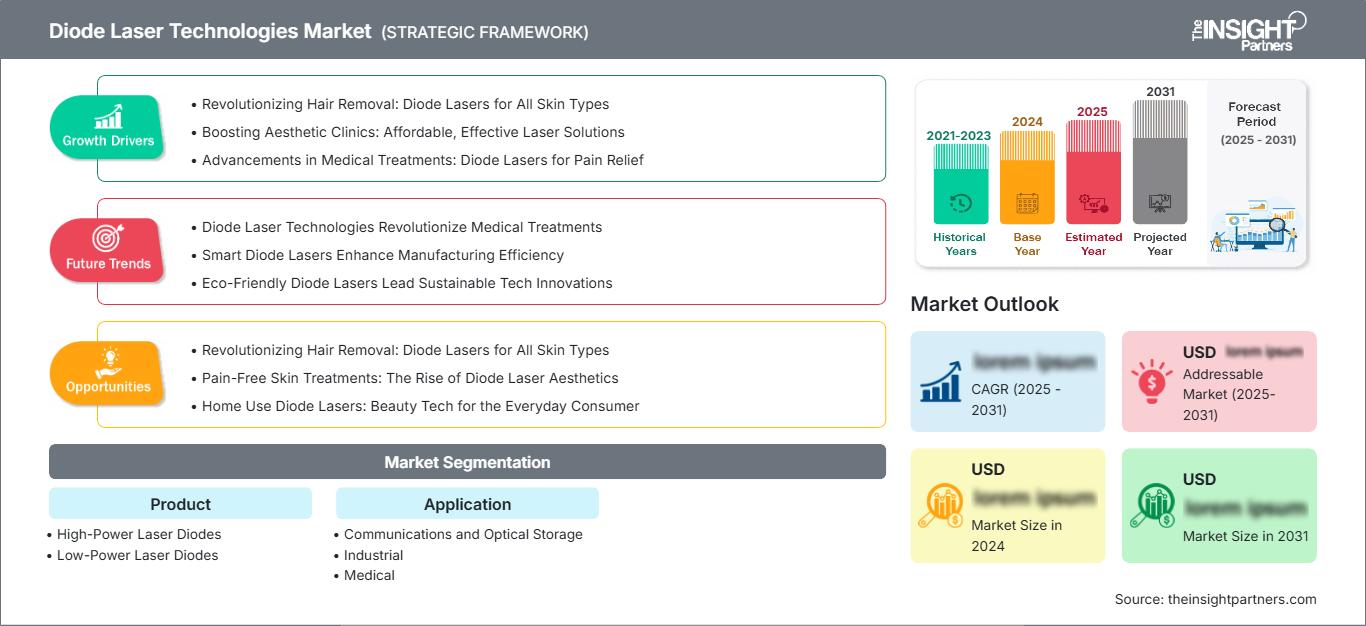
Diode Laser Technologies Market: Strategic Insights
Regional Insights
North America Diode Laser Technologies Market
North America accounted for 28–31% share in 2025 and is projected to grow at an 8.6–9.4% CAGR through 2034. The regional base benefits from strong defense electronics, medical laser systems, aerospace manufacturing, photonics research, and hyperscale data infrastructure. The Diode Laser Technologies Market share is concentrated in the US because of OEM demand and qualified component supply.
Regional buyers prioritize reliability, beam quality, and system-level integration over component price alone. Industrial polymer welding, laser-assisted bonding, LiDAR, optical storage, and clinical platforms are expanding addressable demand. Public investment in advanced manufacturing and secure communications further improves visibility for suppliers with domestic assembly, proven qualification data, and long-term service capability.
U.S. Diode Laser Technologies Market
In 2025, the US accounted for 78–82% of the continent of North America and is expected to progress at an 8.7–9.5% CAGR. Key drivers include defense sensing, medical OEM platforms, data center optical interconnects, and industrial processing machinery. Coherent Corp., IPG Photonics Corporation, and MKS Instruments, Inc. improve the local availability of components, subassemblies, and application engineering.
Trends in applications include the adoption of high-power diode lasers for pumping fiber lasers, mini-modules for plastic welding, and infrared lasers for spatial recognition. In addition, the country enjoys university and government laboratories' initiatives on photonics, which contribute to device testing, defense qualification, and rapid commercialization of more brightness-enabled designs.
Europe Diode Laser Technologies Market
In 2025, Europe’s market share was estimated at 22–25%, and the growth rate is forecasted at an 8.1–8.9% CAGR. Germany holds the leading position due to its strong automotive industry, laser processing of industry parts, and photonics engineering. In the United Kingdom, buyers use laser devices for defense, scientific instruments, and medical applications. The French market is driven by lasers used in aerospace, health care, and precise sensors.
The Italian and Spanish markets are represented by demand from machine tools, clinical instruments, packaging, and renewable energy devices production. Buyers within Europe pay special attention to compliance, safety certification, and lifecycle support. Jenoptik AG and ams-OSRAM AG leverage their engineering skills, and research programs help improve efficiency, beam shaping, and semiconductor lasers packaging.
APAC Diode Laser Technologies Market
The APAC region gained 34-38% share in 2025 and is expected to witness the highest CAGR between 10.1-11.0%. China dominates volume demand in diode lasers through electronics, fiber optics, industrial automation and applications associated with electric vehicles. Japan and South Korea provide demand for high-end components, medical equipment, and precision manufacturing applications.
Incremental demand is provided by India and Australia through communication infrastructure, healthcare reform, mining automation, and defense technology initiatives. Government initiatives towards ensuring self-reliance in semiconductors, industrial upgradation and optical communication network development positively impact the Diode Laser Technologies Market in APAC, particularly wherever low-cost manufacturing coincides with export demand.
Middle East & Africa Diode Laser Technologies Market
Projected growth for Middle East and Africa is expected to be around 7.4%–8.2% per annum, driven by the UAE and Saudi Arabia in terms of infrastructure, energy monitoring, health care, and security systems. South Africa makes contributions through mining, medical, and industrial maintenance markets, whereas demand from Rest of MEA is project-oriented.
Application of lasers in regions would be most prevalent where laser sources increase accuracy of sensors, ease maintenance, and provide clinical reach. Energy plants, airports, seaports, and industrial estates generate demand for instrumentation and safety. Nevertheless, purchasing trends are inconsistent, rendering network of distributors essential for suppliers.
Segmentation Analysis
Product
The Product segment is expected to grow at an 8.9–9.7% CAGR during 2026–2034 as the Diode Laser Technologies Market scope expands from discrete emitters to application-ready modules. Buyers increasingly evaluate power density, wavelength stability, thermal design, and coupling efficiency, creating stronger demand for suppliers able to support both high-volume and high-reliability programs.
- High-Power Laser Diodes dominate industrial, defense, pumping, and medical energy systems where brightness, thermal control, and lifetime qualification determine OEM selection and long-term service economics.
- Low-Power Laser Diodes remain strategically important in communications, sensing, optical storage, instrumentation, barcode scanning, and compact medical devices requiring efficient operation and precise wavelength control.
Application
The Application segment is projected to grow at a 9.2–10.0% CAGR, reflecting adoption across communications, industrial systems, healthcare, defense, and sensors. Application diversity reduces cyclicality because data infrastructure, medical procedures, factory automation, and military modernization each follow different procurement drivers and qualification schedules.
- Communications and Optical Storage remains a core demand pool as fiber networks, data centers, optical transceivers, and storage systems require stable, efficient semiconductor laser sources.
- Industrial demand is tied to welding, soldering, marking, additive manufacturing, heat treatment, and polymer joining, where diode lasers improve precision and energy efficiency.
- Medical applications are expanding in dermatology, ophthalmology, urology, diagnostics, and minimally invasive surgery, requiring compact sources with controlled output and strong safety profiles.
- Military and Defense uses include range finding, target designation, directed energy research, secure communications, and sensing systems where reliability and ruggedization are critical.
- Instrumentation and Sensor adoption is rising in LiDAR, spectroscopy, metrology, automation, and environmental monitoring as compact optical sources improve measurement precision and integration flexibility.
Opportunity Snapshot
| Application | Revenue Contribution | Trend Tag | Adoption Stage |
| Communications and Optical Storage | High | Fiber Links | Mature |
| Industrial | High | Polymer Welding | Scaling |
| Medical | Medium | Clinical Lasers | Scaling |
| Military and Defense | Medium | Rugged Sensing | Emerging |
| Instrumentation and Sensor | Medium | LiDAR Modules | Scaling |
Diode Laser Technologies Market Growth Drivers and Impact Analysis
Rising Need for Efficient Optical Communication Infrastructure
Fiber optics, cloud computing centers, and fast enterprise connections require lasers with stability in wavelength, low energy usage, and extended lifespans. Diode lasers are essential components of optical transceivers and signals due to their suitability for compact designs and fast data rate. With the migration towards advanced capabilities within metro, long haul, and access networks, the certified suppliers of diode lasers will have repetitive demands coming from communication modules, optical memory devices, and testing tools. This applies especially to those companies with credibility in terms of performance stability, multiple wavelengths, and massive qualification cycles.
Industrial Automation and Precision Manufacturing Expansion
Diode laser-based solutions have been increasingly used for applications such as polymer welding, soldering, marking, heat treating, and laser-enabled bonding due to their controlled energy delivery and integration with automated production lines. The use of air-cooled and fiber-based systems simplifies the installation procedure and helps the OEM deal with space limitations. This will help the Diode Laser Technologies Market as its use expands from traditional large industrial workshops to areas like electronics, automotive, packaging, and precision assembling. Companies offering application assistance and beam shaping with thermal stability will be able to extract value in this process.
Medical and Sensing Platforms Shift Toward Compact Energy Sources
Healthcare service providers and device manufacturers have been gravitating towards smaller laser sources for applications such as minimally invasive surgery, dermatology, ophthalmology, urology, diagnostics, and fluorescence detection. On the other hand, LiDAR, spectroscopy, and metrology systems require lasers with a known wavelength and stable pulsed or CW output. The above-listed demands result in overlapping markets for both small diodes and large-scale laser modules. There has been an additional market effect caused by demographic trends, efficiency, automation, and safety in sensing applications.
Diode Laser Technologies Market Future Trends
Higher Brightness and Broader Wavelength Portfolios
Diode Laser Technologies Market trends point toward higher brightness, narrower emission control, and broader wavelength availability across infrared, blue, green, and cyan devices. These improvements will help OEMs address copper processing, biological fluorescence, advanced sensing, and compact medical platforms. Future differentiation will depend less on peak output alone and more on sustained performance under thermal stress. Suppliers investing in epitaxy, packaging, and optical stabilization will be better positioned for regulated applications where qualification cycles are long and switching costs are high.
Modular Laser Subsystems for OEM Integration
OEMs are expected to shift procurement from standalone emitters toward prequalified laser subsystems that combine diode sources, cooling, optics, control electronics, and safety interfaces. This trend will reduce engineering burden for customers and shorten time to market in medical devices, instrumentation, polymer welding, and defense sensing. It also raises the competitive bar because suppliers must demonstrate system reliability, documentation, service support, and configurable architectures. Companies able to deliver modular designs at volume can improve margins and deepen customer lock-in.
Diode Laser Technologies Market Opportunities
Localized Supply for Strategic Photonics Programs
Governments and OEMs are reassessing photonics supply chains because laser diodes support defense, communications, semiconductor manufacturing, and medical technology. Diode Laser Technologies Market Forecasts indicate that suppliers with regional assembly, dual sourcing, and documented traceability can win programs where security of supply matters as much as price. Investment opportunities include wafer partnerships, packaging capacity, test automation, and local service centers. Companies that align production footprints with customer qualification needs can reduce geopolitical exposure and improve participation in publicly supported technology programs.
Medical Procedure Platforms and Diagnostic Instruments
Medical device makers can capture value by integrating diode sources into systems that improve procedural precision, reduce footprint, and support outpatient workflows. Opportunities are strongest in dermatology, ophthalmology, urology, fluorescence diagnostics, and compact laboratory instruments. Investors should prioritize platforms with recurring consumables, regulatory pathways, and differentiated beam delivery. For diode suppliers, co-development with clinical OEMs can secure long-term volume commitments while improving product designs around safety, wavelength stability, and serviceability in demanding healthcare environments.
Recent Developments
- April 2026: Nuvoton Technology announced the start of mass production of its high-power violet laser diode (402 nm, 4.5 W), expanding its light source portfolio for maskless lithography systems and advanced semiconductor packaging applications, with improved optical output and heat dissipation design.
- February 2026: Photonics Industries International Inc. introduced the DP MAX Series, a new generation of diode pulse pumped, Q-switched nanosecond lasers designed for high-energy industrial and scientific applications, featuring high pulse energy, compact integration, improved efficiency, and applications across semiconductor processing, pulsed laser deposition, laser-induced breakdown spectroscopy, and research systems.
- November 2025: Nuvoton Technology Corporation Japan announced the launch of its compact high-power violet laser diode (402nm, 1.7W), achieving high optical output power in a TO-56 CAN package through proprietary chip design and thermal management technologies, supporting space-saving and long-life optical systems for applications including laser direct imaging, resin curing, laser welding, 3D printing, biomedical, display, and mercury lamp replacement solutions.
Frequently Asked Questions

- Comprehensive Market Sizing and Forecast Analysis
- Detailed Segmentation Analysis
- In-Depth Market Dynamics Assessment
- Regional and Country-Level Insights
- Competitive Landscape and Company Benchmarking
- Strategic Business Intelligence
Recent Reports
Testimonials

The Insight Partners provided valuable market intelligence that supported our global go-to-market strategy. Their team was professional, responsive, and attentive to our feedback, providing thoughtful analysis and helpful methodological clarifications throughout the project.
Junmo Kim Chief Financial Officer (CFO), Enertech Co., Ltd.
The Insight Partners' SCADA System Market report is comprehensive, with valuable insights on current trends and future forecasts. The team was highly professional, responsive, and supportive throughout. We are very satisfied and highly recommend their services.
RAN KEDEM Partner, Reali Technologies LTDs
I requested a report on a very specific software market and the team produced the report in a few days. The information was very relevant and well presented. I then requested some changes and additions to the report. The team was again very responsive and I got the final report in less than a week.
JEAN-HERVE JENN Chairman, Future Analytica
We worked with The Insight Partners for an important market study and forecast. They gave us clear insights into opportunities and risks, which helped shape our plans. Their research was easy to use and based on solid data. It helped us make smart, confident decisions. We highly recommend them.
PIYUSH NAGPAL Sr. Vice President, High Beam Global
The Insight Partners delivered insightful, well-structured market research with strong domain expertise. Their team was professional and responsive throughout. The user-friendly website made accessing industry reports seamless. We highly recommend them for reliable, high-quality research services
YUKIHIKO ADACHI CEO, Deep Blue, LLC.
This is the first time I have purchased a market report from The Insight Partners.While I was unsure at first, I visited their web site and felt more comfortable to take the risk and purchase a market report.I am completely satisfied with the quality of the report and customer service. I had several questions and comments with the initial report, but after a couple of dialogs over email with their analyst I believe I have a report that I can use as input to our strategic planning process.Thank you so much for taking the extra time and making this a positive experience.I will definitely recommend your service to others and you will be my first call when we need further market data.
JOHN SUZUKI President and Chief Executive Officer, Board Director, BK Technologies
I wish to appreciate your support and the professionalism you displayed in the course of attending to my request for information regarding to infectious disease IVD market in Nigeria. I appreciate your patience, your guidance, and the fact that you were willing to offer a discount, which eventually made it possible for us to close a deal. I look forward to engaging The Insight Partners in the future, all thanks to the impression you have created in me as a result of this first encounter.
DR CHIJIOKE ONYIA MANAGING DIRECTOR, PineCrest Healthcare Ltd.Reason to Buy
- Informed Decision-Making
- Understanding Market Dynamics
- Competitive Analysis
- Identifying Emerging Markets
- Customer Insights
- Market Forecasts
- Risk Mitigation
- Boosting Operational Efficiency
- Strategic Planning
- Investment Justification
- Tracking Industry Innovations
- Aligning with Regulatory Trends





 Get Free Sample for