
Laser Marking Market Size, Share & Growth by 2034
Coverage: by Type (Fiber Laser, Diode Laser, Solid State Laser, CO2 Laser); Components (Hardware, Software, Services); Industry Vertical (Automotive and Transportation, Aerospace and Defense, Electrical and Electronics, Medical and Healthcare, Packaging, Others) , and Geography (North America, Europe, Asia Pacific, and South and Central America)
- Status : Data Released
- Report Code : TIPRE00005606
- Category : Electronics and Semiconductor
- No. of Pages : 150
- Available Report Formats :


- Last update date : September 28, 2026


2025 Market Size
US$ 4.01 Bn
Base year value
2034 Forecast
US$ 6.36 Bn
Projected by 2034
CAGR 2026-2034
5.26 %
Growth rate
Addressable Market
US$ 47.04 Bn
(2026-2034)
The global Laser Marking market was valued at US$ 4.01 billion in 2025 and is expected to reach US$ 6.36 billion by 2034; it is estimated to record a CAGR of 5.26% during 2026-2034.
Laser Marking Market Assessment and Insights
- North America: North America is estimated to represent a 28–32% share in 2025 and expand at a 5.5–6.3% CAGR during 2026–2034, supported by automotive production, aerospace manufacturing, electronics, medical devices, and automated traceability.
- US: The US represents 82–86% of North American demand in 2025 and is expected to grow at a 5.7–6.5% CAGR through 2034, supported by advanced manufacturing and serialization requirements.
- Europe: Europe holds a 25–29% share in 2025 and is projected to grow at a 5.3–6.1% CAGR, with Germany, the UK, France, Italy, and Spain supporting automotive, industrial, medical, and packaging applications.
- Asia Pacific: Asia Pacific accounts for a 31–35% share in 2025 and is forecast to expand at a 6.4–7.2% CAGR through 2034, led by China, Japan, South Korea, India, and Taiwan.
- Largest Segment: Fiber Laser represents an estimated 49–54% market share in 2025 and is projected to expand at a 6.1–6.9% CAGR through 2034.
- High Growth Segment: Medical and Healthcare represents an estimated 11–15% market share in 2025 and is expected to grow at a 6.8–7.7% CAGR through 2034.
- Key companies analyzed in detail: 600 Group PLC, Coherent Corp., Epilog Laser, Gravotech, Han's Laser Technology Industry Group Co., Ltd., JENOPTIK AG, LaserStar Technologies Corporation, MECCO, Novanta Inc., and TRUMPF GmbH + Co. KG.
Source: The Insight Partners' analysis based on proprietary research, government publications, company annual reports, investor presentations, industry databases, and expert interviews.
Laser marking technologies have progressed beyond basic engraving and identifying operations to incorporate digitally integrated production processes. The fiber laser continues to establish itself as an ideal choice for marking metal as a result of beam quality, compact design and low maintenance, and UV and ultra-short pulse laser systems provide more processing options for delicate material applications. Vision systems, dynamic focusing, rotary axes, automated material handling and verification continue to link marking systems to the greater manufacturing execution system environment.
Investments going forward will focus on marking cells that can handle variable data without impacting production throughput. The automotive and electronics industries will see growth in utilization in relation to serialization and component pedigrees. Medical device makers need legible marks that withstand sterilization and handling. Manufacturing clusters developing in Asia and upgrades of production facilities in the Middle East will drive new demand for digital, automated marking technologies.
Laser Marking Market Report Scope
| Report Attribute | Details |
|---|---|
| Market size in 2025 | US$ 4.01 Billion |
| Market Size by 2034 | US$ 6.36 Billion |
| Global CAGR (2026 - 2034) | 5.26% |
| Historical Data | 2021-2024 |
| Forecast period | 2026-2034 |
Laser Marking Market Analysis
The Laser Marking Market development is directly correlated with the evolution of traceability, serialization, customization, and inspection. There is an increasing need for manufacturers of durable markings that withstand mechanical action, high temperatures, exposure to chemicals, and multiple handling. Value chain includes manufacturers of laser sources, suppliers of optical equipment and beam delivery systems, scanner developers, software providers, equipment builders, integrators, distributors, and maintenance services. Economic considerations include the type of laser used, marking speed, field size, degree of automation, compatibility with materials, and the level of integration.
Supply situation favors the development of flexible platforms suitable for various materials and volumes. Fibers are widely applicable in metals; CO2 lasers stay relevant in non-metals and packaging. Diode and solid-state lasers cover niche applications with a unique set of considerations regarding wavelength, pulse duration, and cost. Vision and motion control become more and more relevant due to the growing need for precise marking, quick setup, automation, and seamless integration with production database.
Laser Marking market report is analyzed to have competitive structure with a wide range of suppliers including laser makers, photonics companies, marking machinery manufacturers, and industrial automation companies. Coherent Corp. provides lasers and integration of marking systems, whereas TRUMPF GmbH + Co. KG is a broad industrial player covering marking lasers and industrial automation. Gravotech and Epilog Laser focus on marking and engraving applications, whereas Novanta Inc. provides specialized photonics technologies that are used by marking machine manufacturers.
The strategic competition in the market will move from laser-source specifications to application-specific systems. The Asian manufacturing experience of Han's Laser Technology Industry Group Co., Ltd. makes it different from other competitors, whereas JENOPTIK AG can offer photonics and optics. Specialized technologies are provided by LaserStar Technologies Corporation, MECCO, and 600 Group PLC, and their differentiation is based on automation, service capabilities, software capabilities, and process validation.
● REPORT CUSTOMIZATION
Tailor This Report To Align With Your Specific Business Requirements
This report can be customized to align precisely with your business objectives, scope, and target markets. Customization options include tailored segmentation, geography, competitive analysis, and strategic insights to support informed decision-making.
Customize This Report →WHAT YOU CAN ADJUST
- ● Segmentations
- ● Geography
- ● Competitive Analysis
- ● Language Preferences
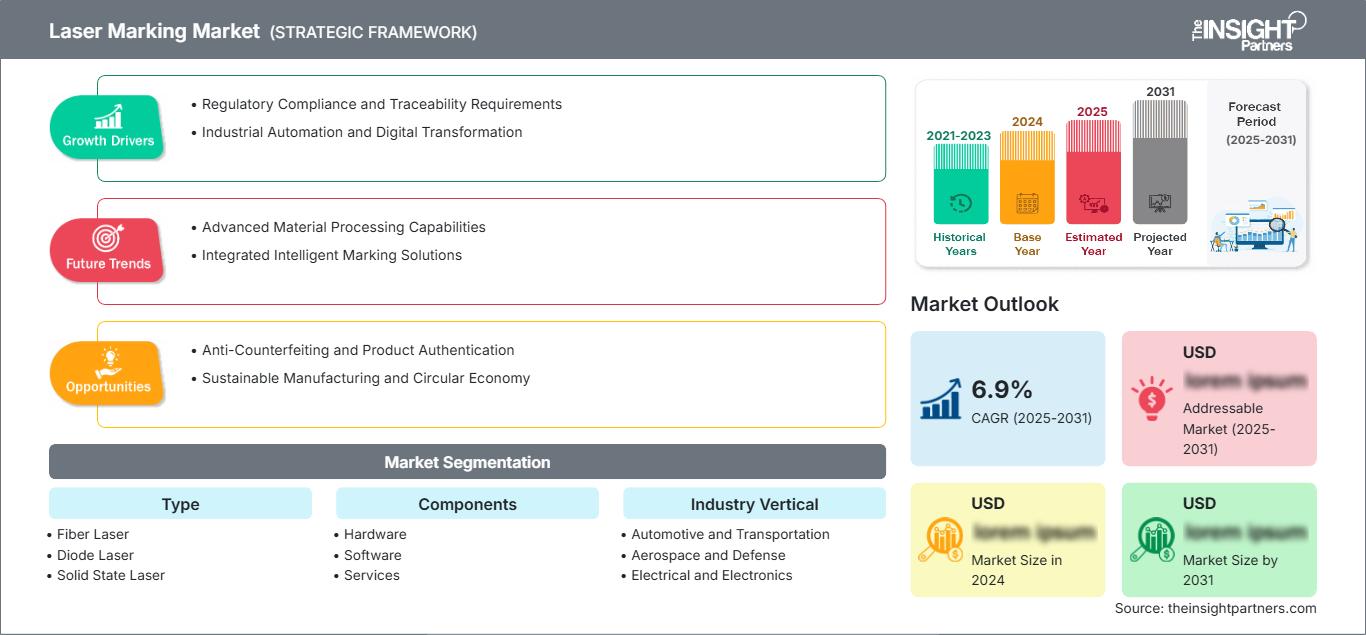
Laser Marking Market: Strategic Insights
Regional Insights
North America Laser Marking Market
The North American region accounts for a 28–32% Laser Marking Market share in 2025, and the growth is expected to be 5.5–6.3% CAGR up to 2034. The US is leading in demand; however, Canada and Mexico make an additional contribution in terms of manufacturing in the automotive industry, aerospace, electronics, medical, and industrial sectors.
Marking is becoming integrated with robotics, vision inspection, and manufacturing databases in the US manufacturers. Durable marking of components is essential in the automotive and aerospace industries, while permanent serialization is important in medical devices manufacturing. Packaging industries utilize marking of variable information at high speeds. This region possesses developed networks of system integrators, technical services, and automation solutions.
U.S. Laser Marking Market
The US is 82%-86% of the North American demand, and will grow at a 5.7%-6.5% CAGR from 2026 to 2034. The demand drivers include sophisticated manufacturing processes, aerospace manufacturing, healthcare products, electronics, automotive parts, and packaging. The increasing need for traceability drives the equipment requirements.
Relevant capabilities for Coherent Corp., TRUMPF GmbH + Co. KG, Epilog Laser, LaserStar Technologies Corporation, MECCO, and Novanta Inc. include lasers, marking equipment, motion, and photonics. Marking applications increasingly involve machine vision and automation. Customers value speed, quality, compatibility with software, service, and processing of variable data without affecting the manufacturing process.
Europe Laser Marking Market
The market share of Europe in the year 2025 is estimated between 25-29%, and its growth rate will range from 5.3-6.1% up until 2034. Germany is the leading country in Europe due to automotive industry, industrial machinery, electronics, medical equipment, and engineering segments. UK remains important in the sectors of aerospace, medical, automotive, and specialized manufacturing where traceability and documentation are significant.
Other key countries are France, Italy, and Spain, which contribute demand in the automotive, packaging, industrial equipment, food, and consumer goods markets. France gains from its aerospace and medical industry output; Italy is strong in machines, automotive parts, and packaging, while Spain features growing demand in automotive and industrial sectors. European manufacturers place growing importance on permanence of the marks, data integrity, process documentation, energy efficiency, and compatibility with automated production systems.
APAC Laser Marking Market
APAC comprises a market share of about 31–35% and will grow at a rate of 6.4–7.2% CAGR up until 2034. China dominates the market due to electronics, automotive, machinery, battery, and consumer goods manufacturing. Demand from Japan and South Korea remains strong for precision electronics and automotive production.
India and Taiwan provide opportunities for growth in electronics, semiconductor fabrication, drugs and medicine, and manufacturing industries. Lasers can be driven by automation, exports, and investment in traceability technologies. Manufacturing capabilities present in the market and development of the local machine builders ecosystem help in getting equipment and fiber laser systems have an edge in the component identification application.
Middle East & Africa Laser Marking Market
Middle East and Africa demand remains smaller but is supported by industrial diversification, automotive components, oil and gas equipment, packaging, aerospace, and infrastructure. Saudi Arabia and the UAE lead regional investment, while South Africa contributes through automotive, mining equipment, and industrial manufacturing. The region is projected to grow at a 5.8–6.8% CAGR.
The manufacturing diversification in Saudi Arabia and the logistics/industrial projects in the UAE make equipment purchases easier. South Africa has an established industrial base, whereas the rest of MEA relies to a greater extent on foreign systems and distributors in the region. Environmental conditions, technical support, operator training, and equipment reliability also play a role besides marking speed and compatibility.
Segmentation Analysis
Type
Type is projected to expand at a 5.8–6.7% CAGR during 2026–2034. Fiber Laser systems retain the strongest position because they combine compact size, high efficiency, low maintenance, and strong performance on metals. Diode, solid-state, and CO2 platforms remain relevant where wavelength and substrate characteristics require alternative processing approaches. The Laser Marking Market scope is consequently broadening as manufacturers seek application-specific laser architectures.
- Fiber Laser: Fiber Laser systems dominate industrial metal marking because they deliver high beam quality, compact system design, efficient operation, and durable results on steel, aluminum, copper, and engineered components.
- Diode Laser: Diode Laser systems address applications requiring specific wavelengths, compact architectures, or controlled thermal interaction, making them relevant for selected plastics, electronics, and specialized identification tasks.
- Solid State Laser: Solid State Laser platforms provide established precision and pulse-control characteristics for demanding marking applications, including medical devices, electronics, and components requiring controlled energy delivery.
- CO2 Laser: CO2 Laser systems remain important for non-metallic materials such as plastics, wood, glass, paper, films, and packaging substrates where longer-wavelength absorption provides effective marking performance.
Components
Components are expected to grow at a 5.4–6.3% CAGR through 2034. Hardware continues to account for the core investment, but software and services are becoming strategically important as marking cells become connected to production databases, inspection systems, robotics, and enterprise workflows. Customers increasingly evaluate total lifecycle performance rather than the laser source alone.
- Hardware: Hardware includes laser sources, scanners, optics, controllers, workstations, enclosures, motion systems, and safety components, forming the physical foundation of marking accuracy and production throughput.
- Software: Software manages designs, variable data, machine parameters, vision integration, job control, serialization, and mark verification, supporting more automated and flexible manufacturing workflows.
- Services: Services encompass installation, application engineering, calibration, maintenance, repairs, training, and lifecycle support, reducing operational risk and helping customers maintain consistent marking performance.
Industry Vertical
Industry Vertical demand is forecast to rise at a 6.0–7.0% CAGR through 2034. Automotive and transportation remain substantial users, while electronics, aerospace, medical, and packaging applications are expanding as serialization and product genealogy become more important. The strongest opportunities involve applications where permanent identification is directly connected with safety, compliance, warranty management, or manufacturing quality.
- Automotive and Transportation: Automotive manufacturers use permanent marks for component identification, traceability, safety information, serialization, and production control across engines, powertrain systems, electronics, and structural components.
- Aerospace and Defense: Aerospace and defense applications require durable, highly legible identification capable of remaining readable under demanding environmental conditions and supporting component genealogy throughout extended asset lifecycles.
- Electrical and Electronics: Electronics manufacturers use compact, high-precision marking for serial numbers, barcodes, component identifiers, circuit boards, connectors, and traceability information where available surface area can be limited.
- Medical and Healthcare: Medical-device production requires permanent identification, including unique device identifiers, batch information, and manufacturing data, while minimizing surface damage on sensitive components.
- Packaging: Packaging applications use laser marking for variable codes, dates, lot information, serialization, and branding, particularly where high-speed non-contact processes reduce consumable requirements.
- Others: Other applications include industrial machinery, tools, consumer products, jewelry, energy equipment, and specialized manufacturing where durable identification or customization provides operational value.
Opportunity Snapshot
| Industry Vertical | Revenue Contribution (High/Medium/Low) | Trend Tag | Adoption Stage |
|---|---|---|---|
| Automotive and Transportation | High | Part Traceability | Mature |
| Aerospace and Defense | Medium | Asset Identification | Scaling |
| Electrical and Electronics | High | Micro Marking | Scaling |
| Medical and Healthcare | Medium | UDI Coding | Scaling |
| Packaging | High | Variable Coding | Mature |
| Others | Medium | Custom Marking | Emerging |
Laser Marking Market Growth Drivers and Impact Analysis
Rising Requirements for Permanent Product Traceability
Identification needs have evolved to the point where there must be readable information throughout production, distribution, maintenance, and usage of the product. Laser marking allows for serial number marking, barcode coding, Data Matrix code marking, logos, and other forms of identification without the need for labels or consumables that could come loose or degrade over time. The benefit is most relevant in the automotive, aerospace, medical, and electronics production industries because genealogy of parts may be relevant in terms of quality control and warranty processing. Identification can also provide a link between the physical part and the digital manufacturing information related to it. With increasing levels of automation in manufacturing processes, identification has become an enabling step in the process, not a stand-alone finishing step.
Automation and Integration With Smart Manufacturing
Automation in manufacturing leads to more requests for marking systems which can work without constant assistance from the operator. Contemporary marking systems can accept data variations from production systems, locate the products using vision, perform coding, and even check the mark quality before releasing the products. That way there is less need for human interaction, and it improves the process for mass production. Integration also allows changing designs and serial numbers faster if there are more product variations. That has an influence on system architecture because customers more and more often ask for standardized communications protocols, safety connections, and motion synchronization. Marking systems manufacturers compete today more on their ability to integrate, develop software, and provide application engineering.
Increasing Adoption Across Electronics and Medical Manufacturing
The strong structural demand of electronics and medical devices comes from the fact that they usually need small, permanent, and high-quality readable markings. Components of electronics do not have large marking surfaces, leading to high-precision systems that would control thermal exposure and marking sizes. Medical devices need markings that are very durable and able to withstand sterilization and handling. Fiber lasers, solid-state lasers, UV lasers, and ultrashort-pulse laser systems might be used for marking different substrates based on substrate sensitivity. The market implications include higher demand for vision, validation, data management, and process documentation capabilities. Suppliers who can offer repeatable solutions and process development for particular applications will have a competitive edge over generic equipment manufacturers.
Laser Marking Market Future Trends
AI-Enabled Inspection and Adaptive Marking
Future Laser Marking Market trends are expected to incorporate artificial intelligence into mark inspection, process adjustment, and production analytics. Vision systems may increasingly classify surfaces, detect part orientation, identify defects, and automatically modify marking parameters before processing. Machine-learning models could compare finished marks against reference patterns and detect gradual deterioration associated with optics, laser power, focus, or material variation. Such capabilities can reduce scrap and improve process stability without requiring operators to inspect every component manually. Adaptive systems may also adjust parameters between batches as materials or surface finishes change. Over time, the combination of AI-based inspection and laser control could transform marking from a fixed production step into a feedback-driven manufacturing process that continuously evaluates output quality and adjusts operation.
Greater Use of Ultrafast and Specialized Laser Sources
Specialized laser architectures are expected to gain attention where conventional nanosecond marking produces excessive heat or insufficient contrast. Ultrafast lasers can reduce thermal effects, supporting applications involving delicate electronics, medical components, glass, polymers, and precision surfaces. UV systems can similarly improve interaction with selected plastics and sensitive materials. The shift will not eliminate established fiber or CO2 platforms because cost, throughput, and material requirements remain decisive. Instead, production facilities are likely to adopt a broader mix of sources according to application needs. Suppliers with flexible optical platforms and application-development capabilities may therefore address more materials without requiring entirely separate production architectures. This trend could also increase demand for advanced beam delivery, motion control, and process-monitoring technologies.
Laser Marking Market Opportunities
Integrated Traceability Cells for Automotive Production
Automotive manufacturing provides an attractive investment opportunity because each production stage increasingly depends on reliable component identification. Integrated cells can combine laser marking, robotic loading, machine vision, code verification, and database communication in a single workflow. Laser Marking Market Forecasts should therefore consider system-level opportunities rather than equipment sales alone. Investors and suppliers can target electric-vehicle components, battery assemblies, power electronics, safety components, and conventional powertrain parts where genealogy is important. Flexible systems capable of handling multiple component geometries can improve utilization as vehicle platforms diversify. Service agreements, process validation, software updates, and application engineering can provide recurring revenue. Partnerships with automation integrators and tier-one suppliers can further accelerate adoption by embedding marking into new production-line designs.
Precision Marking for Medical and Electronic Components
Medical devices and electronics offer opportunities for high-precision marking systems where compact identifiers, low thermal impact, and repeatable contrast are critical. Suppliers can target equipment configurations combining specialized lasers with vision, precision motion, and automated verification. Medical applications can benefit from integrated serialization and production-data management, while electronics manufacturers require reliable marking on increasingly small components and assemblies. Investment opportunities also exist in contract manufacturing services that provide marking as part of broader production operations. Application-specific engineering can differentiate suppliers because optimal wavelength, pulse duration, focus, and marking strategy vary considerably by material. As product variants increase, flexible software and rapid changeover capabilities can further improve equipment economics and strengthen the case for digitally integrated marking cells.
Recent Developments
- August 2026: Mondi unveiled a laser-marked flexible packaging concept that combines recyclable flexible packaging with a corrugated outer box for eCommerce and bag-in-box applications. The solution applies artwork directly during converting, eliminating printing plates and enabling faster artwork changes, greater personalisation and shorter lead times
- June 2026: Americhem launched its Laser Marking Solutions platform, a portfolio of masterbatches and engineered compounds designed to improve laser marking performance, traceability and product identification across polymer applications. The solutions enable durable, high-contrast, machine-readable markings directly within polymers, including distinctly coloured markings on dark substrates, helping manufacturers reduce reliance on labels, inks and secondary marking processes.
- April 2025: Laser Photonics and its subsidiary CMS Laser launched automated Tumbler Laser Engraving Machines designed for high-volume customization of cylindrical drinkware. The systems combine CO₂ laser marking, precision optics, intelligent robotics, machine vision and proprietary software to deliver fast, precise and repeatable personalization of tumblers, including logos, product information and full-wrap designs.
Frequently Asked Questions

- Comprehensive Market Sizing and Forecast Analysis
- Detailed Segmentation Analysis
- In-Depth Market Dynamics Assessment
- Regional and Country-Level Insights
- Competitive Landscape and Company Benchmarking
- Strategic Business Intelligence
Recent Reports
Testimonials

The Insight Partners provided valuable market intelligence that supported our global go-to-market strategy. Their team was professional, responsive, and attentive to our feedback, providing thoughtful analysis and helpful methodological clarifications throughout the project.
Junmo Kim Chief Financial Officer (CFO), Enertech Co., Ltd.
The Insight Partners' SCADA System Market report is comprehensive, with valuable insights on current trends and future forecasts. The team was highly professional, responsive, and supportive throughout. We are very satisfied and highly recommend their services.
RAN KEDEM Partner, Reali Technologies LTDs
I requested a report on a very specific software market and the team produced the report in a few days. The information was very relevant and well presented. I then requested some changes and additions to the report. The team was again very responsive and I got the final report in less than a week.
JEAN-HERVE JENN Chairman, Future Analytica
We worked with The Insight Partners for an important market study and forecast. They gave us clear insights into opportunities and risks, which helped shape our plans. Their research was easy to use and based on solid data. It helped us make smart, confident decisions. We highly recommend them.
PIYUSH NAGPAL Sr. Vice President, High Beam Global
The Insight Partners delivered insightful, well-structured market research with strong domain expertise. Their team was professional and responsive throughout. The user-friendly website made accessing industry reports seamless. We highly recommend them for reliable, high-quality research services
YUKIHIKO ADACHI CEO, Deep Blue, LLC.
This is the first time I have purchased a market report from The Insight Partners.While I was unsure at first, I visited their web site and felt more comfortable to take the risk and purchase a market report.I am completely satisfied with the quality of the report and customer service. I had several questions and comments with the initial report, but after a couple of dialogs over email with their analyst I believe I have a report that I can use as input to our strategic planning process.Thank you so much for taking the extra time and making this a positive experience.I will definitely recommend your service to others and you will be my first call when we need further market data.
JOHN SUZUKI President and Chief Executive Officer, Board Director, BK Technologies
I wish to appreciate your support and the professionalism you displayed in the course of attending to my request for information regarding to infectious disease IVD market in Nigeria. I appreciate your patience, your guidance, and the fact that you were willing to offer a discount, which eventually made it possible for us to close a deal. I look forward to engaging The Insight Partners in the future, all thanks to the impression you have created in me as a result of this first encounter.
DR CHIJIOKE ONYIA MANAGING DIRECTOR, PineCrest Healthcare Ltd.Reason to Buy
- Informed Decision-Making
- Understanding Market Dynamics
- Competitive Analysis
- Identifying Emerging Markets
- Customer Insights
- Market Forecasts
- Risk Mitigation
- Boosting Operational Efficiency
- Strategic Planning
- Investment Justification
- Tracking Industry Innovations
- Aligning with Regulatory Trends





 Get Free Sample for