
LED Dimmers Market Demand, Trends & Forecast by 2034
Coverage: By Product (Wired LED Dimmers, Wireless LED Dimmers); Application (Residential, Commercial) , and Geography (North America, Europe, Asia Pacific, and South and Central America)
- Status : Data Released
- Report Code : TIPRE00023688
- Category : Electronics and Semiconductor
- No. of Pages : 150
- Available Report Formats :


- Last update date : September 23, 2026


2025 Market Size
US$ 1.23 Bn
Base year value
2034 Forecast
US$ 2.71 Bn
Projected by 2034
CAGR 2026-2034
9.17 %
Growth rate
Addressable Market
US$ 17.61 Bn
(2026-2034)
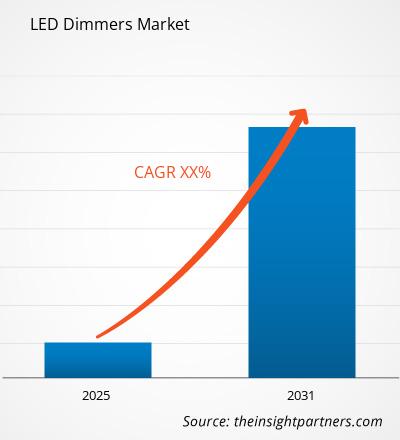
The LED Dimmers market was valued at US$ 1.23 billion in 2025 and is expected to reach US$ 2.71 billion by 2034; it is estimated to record a CAGR of 9.17% during 2026-2034.
LED Dimmers Market Assessment and Insights
- North America: North America is estimated to hold a 31–35% Led Dimmers Market share in 2025 and grow at a 9.4–10.1% CAGR between 2026–2034, supported by commercial retrofit activity, smart-building investment, connected controls, and established lighting-control infrastructure.
- US: The US is estimated to account for 84–88% of North America's 2025 demand and expand at a 9.3–10.0% CAGR during 2026–2034, supported by building modernization, residential automation, and energy-efficiency requirements.
- Europe: Europe is estimated to command a 27–31% share in 2025 and grow at a 10.0–10.7% CAGR between 2026–2034. Germany, the UK, France, Italy, and Spain are leading adoption through energy-efficiency programs and smart-building modernization.
- Asia Pacific: Asia Pacific is estimated to represent a 25–29% share in 2025 and expand at a 11.2–11.9% CAGR during 2026–2034, led by China, Japan, South Korea, India, and Australia through construction and connected-lighting investment.
- Largest Segment: Wired LED Dimmers are estimated to hold a 58–62% market share in 2025 and grow at a 9.0–9.7% CAGR between 2026–2034, supported by established installations and commercial reliability requirements.
- High Growth Segment: Wireless LED Dimmers are estimated to hold a 38–42% market share in 2025 and expand at a 12.0–12.8% CAGR during 2026–2034, driven by flexible installation and connected-building adoption.
- Key companies analyzed in detail: Acuity Brands, Inc., Hubbell Incorporated, Signify N.V., Lutron Electronics Co., Inc., Leviton Manufacturing Co., Inc., ams-OSRAM AG, Eaton Corporation plc, ABB Ltd., Cree Lighting USA LLC, and Current Lighting Solutions, LLC.
Source: The Insight Partners' analysis based on proprietary research, government publications, company annual reports, investor presentations, industry databases, and expert interviews.
Led Dimmers Market evolution has seen a transformation from independent wall-based controllers to digital-configurable dimming systems, which can be able to integrate sensors, drivers, luminaires, building control systems, and interface for users. LED technology has led to an increase in dimming capability, whereas new drivers offer compatibility with 0-10V, DALI, and network control systems. Research and development in this industry have therefore shifted its focus towards performance of the flicker, control resolution, interoperability, commissioning, and reliability at broad dimming range.
In terms of investments in the Led Dimmers Market within the forecast period, significant growth is expected in terms of wireless controllers, connected residential platform, commercial lighting control systems, and retrofit solutions. This could be achieved through construction of new buildings and urbanization in emerging economies and renovation of mature markets. Policies promoting automatic controls, occupancy, and daylight sensing controls, as well as technical system connectivity, would support this business case.
LED Dimmers Market Report Scope
| Report Attribute | Details |
|---|---|
| Market size in 2025 | US$ 1.23 Billion |
| Market Size by 2034 | US$ 2.71 Billion |
| Global CAGR (2026 - 2034) | 9.17% |
| Historical Data | 2021-2024 |
| Forecast period | 2026-2034 |
LED Dimmers Market Analysis
Demand for lighting-control will be strengthened by the wider trend towards LEDs as well since dimming permits adjustment of light intensity in relation to occupant needs, daylight, activities, and time of the day. Led Dimmers Market development will be driven by residential applications, commercial buildings, retail properties, hospitality sector, healthcare, education establishments, and other public infrastructures. Value chain actors include LED drivers, dimmer modules, switches, sensors, gateways, software, luminaires, electrical contractors, distributors, system integrators, and building automation systems vendors.
The supply trends in the Led Dimmers Market become more supportive to players which provide interoperable solutions for building control instead of standalone lighting-control solutions. Wired solutions continue to have some benefits if the reliability and ease of installation are important. In contrast, wireless solutions may help to minimize the necessity for rewiring in retrofits and allow using distributed control systems. Consequently, manufacturers will develop their product lines in terms of protocol support, commissioning software, remote configuration and energy management.
The differentiation in the Led Dimmers Market now largely revolves around systems compatibility and application-specific functionalities. Acuity Brands, Inc. integrates LED drivers, lighting controls, luminaires, and intelligent space technology, whereas Hubbell Incorporated has a wide array of offerings in electrical and lighting categories. Signify N.V. has strengths in connected lighting solutions, whereas Lutron Electronics Co., Inc. is focused on lighting and shading controls. Leviton Manufacturing Co., Inc. and Eaton Corporation plc cater to electrical-control applications.
AMS OSRAM AG specializes in LED and LED driver solutions, whereas ABB Ltd. has the strengths of building automation and electrical systems integration. Cree Lighting USA LLC operates with LED lighting and control solutions, whereas Current Lighting Solutions, LLC is focused on commercial lighting applications. Investment strategy for the players is increasingly focusing on wireless commissioning, sensor integration, digital platforms, and interoperability of control systems. This is because of changing purchasing criteria of customers from price of components to lifecycle value, installation efficiency, and performance of buildings.
● REPORT CUSTOMIZATION
Tailor This Report To Align With Your Specific Business Requirements
This report can be customized to align precisely with your business objectives, scope, and target markets. Customization options include tailored segmentation, geography, competitive analysis, and strategic insights to support informed decision-making.
Customize This Report →WHAT YOU CAN ADJUST
- ● Segmentations
- ● Geography
- ● Competitive Analysis
- ● Language Preferences
LED Dimmers Market: Strategic Insights

Regional Insights
North America Led Dimmers Market
North America is estimated to represent 31–35% of the 2025 market and expand at a 9.4–10.1% CAGR through 2034. Advantages to the region include an advanced installed base of LED, an ample supply of commercial buildings, well-established electrical distribution networks, and the wide application of lighting automation. The retrofit application is especially relevant since dimming control can be included during the replacement of luminaires or part of the overall process of building renovation.
The United States leads the Led Dimmers Market within the region, making up some 84–88% of the North American 2025 market. Canada supports the region with its commercial construction, energy efficiency, and residential automation. The demand comes from offices, retail, hospitality, healthcare, education, and luxury residential. More and more emphasis by the manufacturers is placed on wireless commissioning, network controls, occupancy sensing, daylight harvesting, and building management system integration.
U.S. Led Dimmers Market
The US is estimated to account for 84–88% of North America's 2025 Led Dimmers Market and grow at a 9.3–10.0% CAGR through 2034. Building renovation, LED replacement, smart homes, and commercial energy management projects help sustain repeatable demand. Compatibility with LED drivers, control systems, sensors, smart home technologies, and current electric installations becomes more significant in product selection.
Acuity Brands, Inc., Lutron Electronics Co., Inc., Leviton Manufacturing Co., Inc., Eaton Corporation plc, and Hubbell Incorporated possess awareness within the applicable lighting and electric control technologies. The residential segment focuses on wireless control systems and application-based controls, whereas commercial ventures emphasize scalable networked controls, zoning, occupancy and daylight control. Retrofit friendliness is a key procurement criteria since installers may enhance control capabilities without structural alterations and extended time away from the building.
Europe Led Dimmers Market
Europe is estimated to hold 27–31% Led Dimmers Market in 2025 and grow at a 10.0–10.7% CAGR through 2034, with Germany representing a leading national market. UK is aided by commercial retrofit projects and use of smart buildings, whereas France receives support from energy performance goals and modernization. In addition, Italy and Spain can be considered because of the opportunity of working on residential renovations, hotels, retail and commercial construction. European building efficiency policies are increasingly leaning toward automated light controls that can operate on the basis of occupancy, respond to daylighting, monitoring and be integrated into connected technologies. This would make it necessary to have interoperable products as opposed to manual dimming products. Germany’s industrial and commercial infrastructure enables advanced control systems installation, whereas the UK has demand for retrofit systems.
APAC Led Dimmers Market
The Led Dimmers Market report shows that APAC is estimated to represent 25–29% share in 2025 and grow at an 11.2–11.9% CAGR through 2034, with China leading regional demand. Japan and South Korea emphasize high-quality controls and automation, while India benefits from construction and urban infrastructure investment. Australia contributes through energy-efficient building upgrades.
Combination of large scale construction and development of smart buildings is witnessed in China whereas advanced adoption of connected lighting is witnessed in Japan and South Korea. Large number of commercial and residential buildings being developed in India provides opportunities for retrofitting and installation. Efficient building practices help Australia gain advantages. Demand in the region is increasingly shifting towards wireless controls, occupancy sensors, mobile commissioning, and building integration.
Middle East & Africa Led Dimmers Market
The Led Dimmers Market forecast shows that the Middle East and Africa region is expected to expand at a 10.4–11.1% CAGR through 2034, with Saudi Arabia and the UAE representing leading markets. Large hospitality, retail, commercial, infrastructure, and mixed-use developments create opportunities for sophisticated lighting controls.
The contribution from South Africa comes in the form of business premises and energy-efficient programs, while the rest of MEA presents an opportunity in the form of building construction and infrastructure upgrading. The Gulf markets become especially pertinent in view of the fact that the high-end developments are specifying integrated lighting, shades, and control systems.
Segmentation Analysis
Product
The product segment is projected to grow at a 10.0–10.6% CAGR during 2026–2034. Product selection increasingly depends on installation architecture, retrofit complexity, control reliability, connectivity, commissioning requirements, and integration with LED drivers and sensors. Wired products maintain a substantial installed base, while wireless systems are gaining importance where flexible deployment is required.
- Wired LED Dimmers: Wired systems remain important in commercial and professionally installed environments where stable communication, predictable performance, and established electrical infrastructure are priorities. They are particularly suitable for new construction and major retrofit projects.
- Wireless LED Dimmers: Wireless systems provide installation flexibility by reducing wiring requirements and supporting distributed controls. Their strategic relevance is increasing in residential automation, retrofit projects, hospitality environments, and buildings requiring adaptable zoning or reconfiguration.
Application
The application segment is expected to expand at a 10.7–11.3% CAGR during 2026–2034. Residential adoption benefits from smart-home integration and consumer convenience, while commercial demand is influenced by energy management, building automation, occupancy controls, and the need for flexible lighting environments.
- Residential: Residential applications increasingly combine dimming with smart switches, mobile applications, voice interfaces, occupancy sensing, and scene control. Premium housing and renovation projects particularly value flexible wireless installation and integration with broader home-automation ecosystems.
- Commercial: Commercial projects prioritize zoning, scheduling, daylight response, occupancy management, and centralized commissioning. Offices, retail, hospitality, healthcare, and education facilities increasingly integrate dimming with broader building systems to improve operational control and occupant experience.
Opportunity Snapshot
| Application | Revenue Contribution | Trend Tag | Adoption Stage |
| Residential | Medium | Smart Homes | Scaling |
| Commercial | High | Building Automation | Mature |
LED Dimmers Market Growth Drivers and Impact Analysis
Expansion of LED Lighting and Connected Control Architectures
The continuing replacement of conventional lamps with LED lighting is expanding the installed base that can benefit from advanced dimming. The International Energy Agency mentions efficiency of LEDs, higher lifetime, better dimming capability, and greater compatibility with lighting control systems as some key advantages of LEDs. As more and more LEDs become widespread, the role of lighting controls is becoming an integral part of the luminaire specification as opposed to being an add-on option. As a result, manufacturers have started offering dimming capability in their drivers and lighting control system platforms. There is a growing need for compatible switches, modules, sensors, gateways, and commissioning tools in such a situation. The commercial importance of the situation is huge, because each new luminaire installation can lead to the replacement of controls.
Energy Efficiency Requirements Across Buildings
Standards and regulations regarding the energy performance of buildings have made the installation of lighting controls together with energy-efficient luminaires necessary for property owners. Some of the discussions taking place in Europe regarding building energy-performance requirements include automated lighting controls that can perform occupancy sensing, daylit dimming, diagnostics and monitoring, as well as communication with building controls. Such standards and regulations encourage the adoption of lighting controls that will be able to adjust lighting based on conditions and not simply provide a fixed output. Similar considerations have started shaping standards and retrofits in other developed countries. This creates an additional business opportunity not limited to new constructions as existing buildings can be equipped with LED lamps and new controls. Commercial property owners can use dimming for greater flexibility while achieving energy efficiency goals.
Growth of Smart Homes and Intelligent Commercial Buildings
The increasing use of smart homes and intelligent buildings has expanded the application of dimming from merely adjusting the level of light to becoming a control function. Consumers demand that their lights respond not only to scenes and schedules but also to sensor inputs, mobile commands, and voice commands. Likewise, companies demand central control, occupancy sensing, daylight harvesting, and remote configuration. Together, these requirements drive the production of components capable of connecting with different automation systems. Wireless capabilities are particularly helpful when consumers wish to integrate additional control functionalities without extensive rewiring. Integration benefits are even more valuable for commercial integrators who require simplified commissioning processes and the ability to reconfigure lighting zones after installations have taken place.
LED Dimmers Market Future Trends
Wireless and Software-Defined Dimming
Wireless dimming should see a greater software-oriented approach with respect to the increasing use of more flexible communication technologies for lighting control systems. In future, more flexibility would be available whereby installers would use software to set up the zone and scene configurations, scheduling, sensor interactions, and even user permission levels. Commissioning times could be reduced, and systems modified in cases where there are changes in the building layout. The configuration of the cloud-connected systems may help in conducting remote diagnostics and software updating, yet security and interoperability issues remain important from the standpoint of procurement. The distinction between the dimmer and the lighting control node will thus become less significant. It is time for systems capable of supporting different communication protocols and interfacing with sensors, gateways, and buildings to enter the game.
Adaptive Lighting Based on Occupancy and Daylight
According to Led Dimmers Market trends, Adaptive dimming will be an essential factor in the future as it will enable buildings to match lighting to real occupancy and presence of natural light. It is possible for the future systems to integrate occupancy sensors, photosensors, time schedules, personal preferences, and environmental factors in order to adapt the lighting accordingly. Unlike manual dimming, the difference here is that the control process is responsive to changes. The commercial buildings can implement adaptive lighting in order to have more fine-tuned lighting zones, while in residential buildings, the lighting can adapt itself according to the day-to-day schedules. In some cases, it is possible to integrate lighting data into building management systems together with HVAC and space usage information.
LED Dimmers Market Opportunities
Retrofit-Friendly Wireless Control Solutions
Retrofit projects represent an attractive opportunity because many buildings have functional electrical infrastructure but require more efficient lighting and improved control. Wireless dimmers can reduce the need for extensive rewiring, helping contractors minimize disruption in occupied offices, retail stores, hotels, and residential properties. Suppliers can strengthen this opportunity through battery-efficient controls, flexible commissioning, compatibility with existing luminaires, and clear installation procedures. Products that support both standalone operation and future network integration can address customers with different levels of automation maturity. Channel partnerships with electrical distributors, lighting designers, contractors, and facility-management companies can further improve market reach. The strongest opportunities are likely to emerge where owners want measurable modernization without the capital intensity and operational disruption associated with complete electrical-system reconstruction.
Integrated Dimming and Building Intelligence
A second opportunity lies in combining dimming with broader building-intelligence platforms. Instead of operating lighting independently, future installations can connect luminaires and controls with occupancy, environmental, access, and energy-management systems. This creates opportunities for suppliers to provide gateways, software, analytics, commissioning services, and interoperability layers around core dimming hardware. Commercial property owners can gain greater visibility into space utilization and lighting operation, while integrators can simplify management through unified interfaces. Vendors should prioritize open communication protocols and flexible APIs to reduce barriers created by proprietary ecosystems. Strategic partnerships between lighting manufacturers, automation providers, sensor companies, and electrical contractors could accelerate deployment. The opportunity is especially relevant in large commercial projects where customers value centralized management and the ability to scale controls across multiple floors, buildings, or sites.
Recent Developments
- September 2025: Lutron Electronics Co., Inc. introduced its Native by Design partner program, expanding native integration between Lutron intelligent lighting and complementary luxury-home technologies. The initiative emphasizes reliable interoperability and faster commissioning for integrators. The development is relevant to advanced dimming because integrated lighting controls increasingly compete on ecosystem compatibility, installation efficiency, and coordinated control of multiple home systems rather than standalone brightness adjustment.
- August 2025: Acuity Brands, Inc. announced the nLight Animate Controller, which connects DMX lighting with the nLight networked controls platform. The solution enables color, effects, movement, and everyday lighting control through a common system while supporting energy optimization and code compliance. The development illustrates the movement toward unified control architectures in which dimming, dynamic lighting, sensors, and network management operate within a shared platform.
- April 2025: Acuity Brands, Inc. upgraded its 75LED utility floodlight with intelligent D4i driver technology and low-voltage DC control options. The product introduced multiple control configurations designed to provide flexible management while reducing operational complexity. The development demonstrates how LED luminaires and control technologies are increasingly designed together, with digital drivers serving as an interface between the light source, sensors, networks, and dimming functions.
Frequently Asked Questions

- Comprehensive Market Sizing and Forecast Analysis
- Detailed Segmentation Analysis
- In-Depth Market Dynamics Assessment
- Regional and Country-Level Insights
- Competitive Landscape and Company Benchmarking
- Strategic Business Intelligence
Recent Reports
Testimonials

The Insight Partners provided valuable market intelligence that supported our global go-to-market strategy. Their team was professional, responsive, and attentive to our feedback, providing thoughtful analysis and helpful methodological clarifications throughout the project.
Junmo Kim Chief Financial Officer (CFO), Enertech Co., Ltd.
The Insight Partners' SCADA System Market report is comprehensive, with valuable insights on current trends and future forecasts. The team was highly professional, responsive, and supportive throughout. We are very satisfied and highly recommend their services.
RAN KEDEM Partner, Reali Technologies LTDs
I requested a report on a very specific software market and the team produced the report in a few days. The information was very relevant and well presented. I then requested some changes and additions to the report. The team was again very responsive and I got the final report in less than a week.
JEAN-HERVE JENN Chairman, Future Analytica
We worked with The Insight Partners for an important market study and forecast. They gave us clear insights into opportunities and risks, which helped shape our plans. Their research was easy to use and based on solid data. It helped us make smart, confident decisions. We highly recommend them.
PIYUSH NAGPAL Sr. Vice President, High Beam Global
The Insight Partners delivered insightful, well-structured market research with strong domain expertise. Their team was professional and responsive throughout. The user-friendly website made accessing industry reports seamless. We highly recommend them for reliable, high-quality research services
YUKIHIKO ADACHI CEO, Deep Blue, LLC.
This is the first time I have purchased a market report from The Insight Partners.While I was unsure at first, I visited their web site and felt more comfortable to take the risk and purchase a market report.I am completely satisfied with the quality of the report and customer service. I had several questions and comments with the initial report, but after a couple of dialogs over email with their analyst I believe I have a report that I can use as input to our strategic planning process.Thank you so much for taking the extra time and making this a positive experience.I will definitely recommend your service to others and you will be my first call when we need further market data.
JOHN SUZUKI President and Chief Executive Officer, Board Director, BK Technologies
I wish to appreciate your support and the professionalism you displayed in the course of attending to my request for information regarding to infectious disease IVD market in Nigeria. I appreciate your patience, your guidance, and the fact that you were willing to offer a discount, which eventually made it possible for us to close a deal. I look forward to engaging The Insight Partners in the future, all thanks to the impression you have created in me as a result of this first encounter.
DR CHIJIOKE ONYIA MANAGING DIRECTOR, PineCrest Healthcare Ltd.Reason to Buy
- Informed Decision-Making
- Understanding Market Dynamics
- Competitive Analysis
- Identifying Emerging Markets
- Customer Insights
- Market Forecasts
- Risk Mitigation
- Boosting Operational Efficiency
- Strategic Planning
- Investment Justification
- Tracking Industry Innovations
- Aligning with Regulatory Trends





 Get Free Sample for