
Led Displays Lighting Fixtures Market Size, Share & Demand by 2034
Led Displays Lighting Fixtures Market Size and Forecasts (2021 - 2034), Global and Regional Share, Trends, and Growth Opportunity Analysis Report Coverage : By Product (Surface Mounted Display, Conventional LED Walls; HBLED, Color LED, Fixed And Portable Fixtures), Applications (Backlighting, Signage, General Lighting, Automotive Lighting)
- Status : Data Released
- Report Code : TIPRE00039501
- Category : Electronics and Semiconductor
- No. of Pages : 150
- Available Report Formats :


- Last update date : November 18, 2026


2025 Market Size
US$ 121.18 Bn
Base year value
2034 Forecast
US$ 250.80 Bn
Projected by 2034
CAGR 2026-2034
8.42 %
Growth rate
Addressable Market
US$ 1,669.70 Bn
(2026-2034)
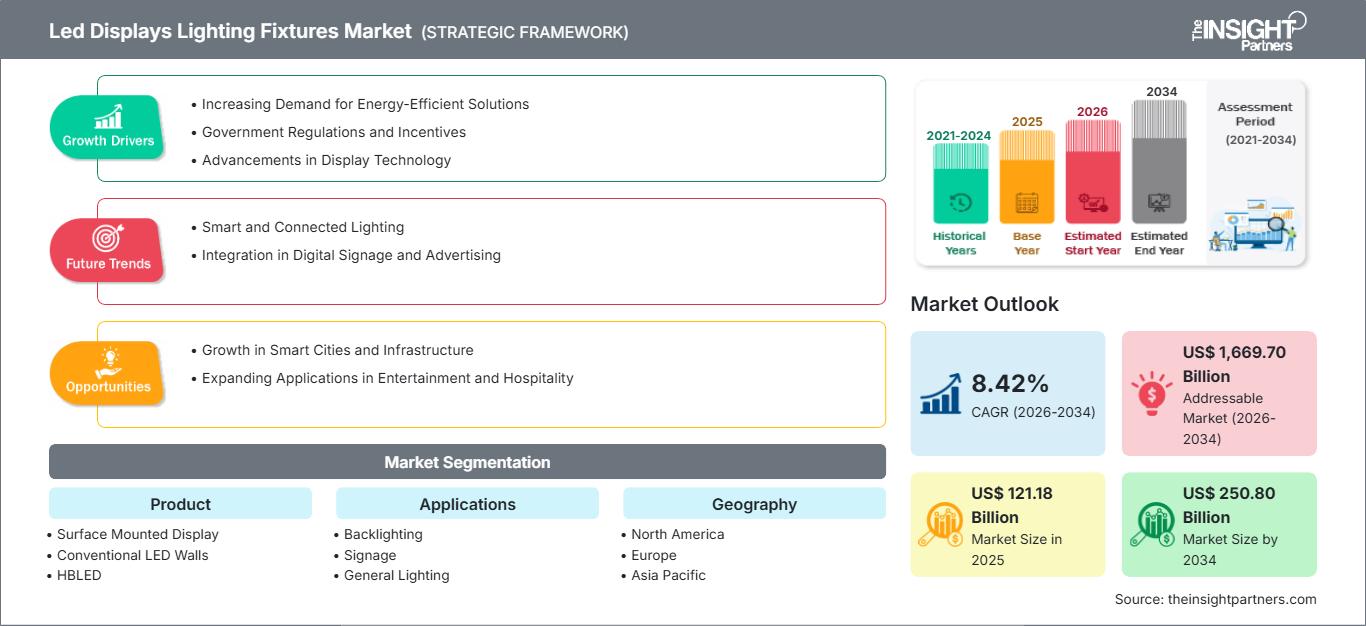
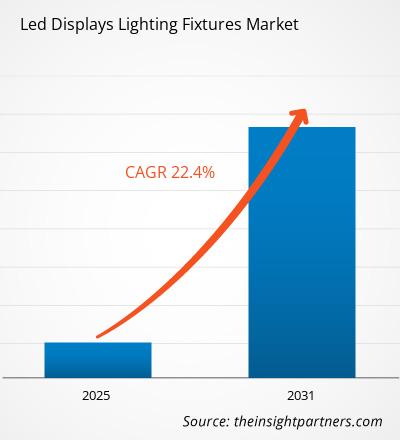
The LED Displays Lighting Fixtures Market was valued at US$ 121.18 Billion in 2025 and is projected to reach US$ 250.80 Billion by 2034, registering a CAGR of 8.42% during 2026–2034. The market covers LED-based display and lighting technologies used across signage, illumination, automotive systems, backlighting, commercial environments, and specialized visual applications. Product innovation is increasingly centered on efficiency, higher brightness, compact architectures, controllability, color performance, and application-specific integration.
North America is supported by widespread LED retrofit activity, commercial construction, digital signage deployment, and automotive lighting demand. The LED Displays Lighting Fixtures Market size in the region is expected to expand at an estimated 7.3–7.8% CAGR during 2026–2034, supported by energy-efficiency requirements, connected lighting adoption, and replacement of legacy illumination systems.
Led Displays Lighting Fixtures Market Assessment and Insights
- North America is estimated to account for 27–31% share in 2025 and is projected to expand at a 7.3–7.8% CAGR between 2026–2034, supported by LED retrofits, commercial displays, automotive applications, and demand for connected lighting systems.
- US represents approximately 72–76% of North America in 2025 and is expected to grow at a 7.4–7.9% CAGR between 2026–2034, driven by energy efficiency, signage modernization, and automotive lighting.
- Europe holds an estimated 21–25% share in 2025 and is expected to register a 7.0–7.5% CAGR between 2026–2034, with Germany, the UK, France, Italy, and Spain supporting demand through efficiency standards and commercial modernization.
- Asia Pacific represents approximately 39–43% share in 2025 and is projected to grow at a 9.0–9.6% CAGR between 2026–2034, led by China, Japan, South Korea, India, and Taiwan's semiconductor and electronics ecosystems.
- Largest Segment: Surface Mounted Display is estimated to hold a 27–31% market share in 2025 and expand at a 8.0–8.5% CAGR during 2026–2034, supported by scalable display architectures.
- High Growth Segment: Automotive Lighting is estimated at 17–21% market share in 2025 and is projected to grow at a 9.4–10.0% CAGR during 2026–2034, supported by advanced vehicle lighting.
- Key companies analyzed in detail: Philips Lumileds Lighting Co., Samsung LED Co. Ltd., Toyoda Gosei Co. Ltd., Seoul Semiconductor Co. Ltd., LG Innotek Co. Ltd., Barco NV, Brodwax Lighting, Cooper Lighting, LLC, SMART Global Holdings, Inc., and Epistar Corp.
Source: The Insight Partners' analysis based on proprietary research, government publications, company annual reports, investor presentations, industry databases, and expert interviews.
The technological developments are moving away from traditional LED packages toward dense, addressable, efficient, and specialized architectures. Micro LED, fine pitch displays, flip-chip package, chip-scale packages, and better thermal management increase performance demands. As per the IEA, currently available LEDs are rated close to 100 lumens per watt, while high-end professional ones deliver more than 200 lumens per watt.
Future trends are driven by interconnected infrastructure, digital signage, electric cars, and the renewal of old lighting systems. Europe continues its efforts towards greater efficiency policies, while Asia Pacific enjoys the benefits of localized semiconductor and electronics production. As per IEA, lighting is expected to account for 8% of the global electricity demand in 2024.
Led Displays Lighting Fixtures Market Report Scope
| Report Attribute | Details |
|---|---|
| Market size in 2025 | US$ 121.18 Billion |
| Market Size by 2034 | US$ 250.80 Billion |
| Global CAGR (2026 - 2034) | 8.42% |
| Historical Data | 2021-2024 |
| Forecast period | 2026-2034 |
Led Displays Lighting Fixtures Market Analysis
Increased demand for effective lighting, larger commercial screens, automobile customization, and digital advertising is driving growth in the LED Displays Lighting Fixtures Market. Value chain consists of LED chip vendors, epitaxy firms, packagers, display module makers, fixture providers, drivers & controllers, system integrators, distributors, and end users. Growing convergence of hardware and software has increased the scope of lighting technology from providing just illumination to facilitating communication and intelligent environment management.
The supply chain remains highly clustered in Asia Pacific semiconductor and electronics ecosystems despite the strength of North American and European players in specialty fixtures, visualization solutions, auto components and controls. Manufacturing costs are affected by yield of chips, prices of phosphors and substrates, thermal management technologies, driver electronics, packing equipment, and assembly of the display modules. According to IEA, LED efficacies have doubled from 2015 to today because of improvements in semiconductors.
Positioning within the LED Displays Lighting Fixtures Market Report becomes more specialized than having a universal product architecture in this case. Samsung LED Co. Ltd. positions itself by means of high-end displays, whereas Philips Lumileds Lighting Co. specializes mostly in LED light sources and automotive products. Barco NV provides LED video walls along with image processing capabilities, whereas Cooper Lighting, LLC serves professional fixture applications. LG Innotek Co. Ltd. enhances its position in automotive lighting with the use of surface-lighting and pixel innovations.
Increasing strategic investments are allocated to development of small pixels, better thermal performance, intelligent controls, automotive systems, and scalable manufacturing. 2026 portfolio of Samsung's displays includes Micro RGB and advanced commercial signage, whereas Barco has enhanced its LED visualization through partnerships and innovative display platforms. It becomes obvious that the market gets divided into high-volume general lighting, specialized automotive components, and premium visual-display applications.
● REPORT CUSTOMIZATION
Tailor This Report To Align With Your Specific Business Requirements
This report can be customized to align precisely with your business objectives, scope, and target markets. Customization options include tailored segmentation, geography, competitive analysis, and strategic insights to support informed decision-making.
Customize This Report →WHAT YOU CAN ADJUST
- ● Segmentations
- ● Geography
- ● Competitive Analysis
- ● Language Preferences
Led Displays Lighting Fixtures Market: Strategic Insights
Regional Insights
North America LED Displays Lighting Fixtures Market
North America is anticipated to constitute a 27–31% market share in 2025 and is forecast to register a 7.3–7.8% CAGR until 2034. The US leads demand in the region, backed by commercial LED retrofits, digital signage, automotive applications, and connected lighting. The US Department of Energy has shown significant savings of energy due to LED usage, whereas increasing efficiency further improves the economics of system replacement.
Canada also plays a role via commercial establishments, infrastructure development, automotive supply chains, and energy-efficient buildings. Increasing preference is being shown for fixtures equipped with controls, dimming, presence detectors, and networking capability instead of standalone luminaires. The regional market share for LED Displays Lighting Fixtures market is also driven by the renewal of the existing lighting systems with LEDs. Digital Signage represents another growth avenue for the market as retailers, transport facilities, sports arenas, and corporate spaces invest in visual communication systems.
U.S. LED Displays Lighting Fixtures Market
The US accounts for approximately 72–76% of North America's 2025 market and is expected to grow at a 7.4–7.9% CAGR through 2034. Commercial buildings, retail, warehouses, roads, automotive manufacturing, entertainment venues, and advertising installations create diverse demand. Federal and state efficiency initiatives continue to support replacement of inefficient lighting technologies, while connected controls improve the economics of larger installations.
Current trends in applications include intelligent luminaires, powerful sports lighting, digital signage, and pixel lighting in automobiles. Cooper Lighting, LLC has continued to launch professional LED products focusing on efficiency and adaptability of use. The visualization solution providers have been aiming at control rooms and commercial displays. Six products by Cooper Lighting Solutions were commended in the 2025 IES Progress Report.
Europe LED Displays Lighting Fixtures Market
Europe constitutes around 21-25% share in 2025 and is forecasted to grow at a 7.0-7.5% CAGR until 2034. Germany continues to be the leading country due to its industrial production and efficient energy usage. The UK, France, Italy, and Spain benefit from commercial renovations, transportation infrastructure, retail renovation, and increasingly connected lighting solutions.
The UK is benefited by commercial renovations and modernization of public infrastructure, with demand becoming more interested in controllable and efficient lighting systems. Germany industrial production and automotive industry provide a solid base for specialized LEDs and automobile lighting. France benefits from architectural, retail, and transport solutions, whereas Italy benefits from design-led lighting systems. Spain is benefited by commercial renovations, hospitality solutions, outdoor lighting, and smart cities. Favorable policies towards energy-efficient products continue to persist in Europe in terms of EU energy efficiency programs.
APAC LED Displays Lighting Fixtures Market
The region's share stands at about 39-43% in 2025, growing at 9.0-9.6% CAGR, thereby being the largest among other regions. China dominates due to having electronics manufacturing facilities, whereas Japan and South Korea help with premium display and automotive solutions. India grows thanks to infrastructure and commercial lighting applications, whereas Australia helps with efficiency of buildings and outdoor applications.
Concentrated LED chip manufacturing, LED packaging manufacturing, displays manufacturing, and electronics manufacturing contribute to regional demand. South Korea is still important in terms of advanced display technologies, whereas Taiwan has semiconductor capabilities. China combines large-scale production with widespread usage at home, India provides opportunities via urbanization and energy efficiency projects, whereas Australia has good replacement demand. Under these circumstances, APAC becomes the main manufacturer and consumer in the industry.
Middle East & Africa LED Displays Lighting Fixtures Market
MEA is forecasted to record a CAGR growth of 7.2% to 7.7% up to 2034, with the Saudi Arabia market driving demand. Hospitality, commercial property, entertainment, transport, and smart city developments in UAE drive the adoption of high-quality LED lights. South Africa drives demand through commercial lighting upgrades, retail lighting applications, industrial lighting applications, and infrastructure projects.
Saudi Arabia’s urban and entertainment developments require high output lighting systems and digital displays, while UAE’s developments focus on high-quality architectural and smart lighting applications. The South Africa and Rest of MEA markets are primarily replacement and project driven. Efficiency considerations, high cooling load needs, outdoor lighting needs, and infrastructure development are good economic drivers for LEDs in this region.
Segmentation Analysis
Product
Product configuration determines the LED Displays Lighting Fixtures Market scope across display walls, lighting systems, automotive applications, and specialized illumination. The product segment is projected to expand at a 8.3–8.8% CAGR during 2026–2034. Adoption is influenced by brightness, pixel density, thermal performance, installation flexibility, serviceability, and total operating cost.
- Surface Mounted Display systems offer scalable packaging and flexible module construction, making them important for commercial displays, signage, information boards, and high-density visual applications requiring compact assembly.
- Conventional LED Walls remain important for large-format communication in control rooms, entertainment venues, retail, transportation, and corporate environments where brightness, visibility, and modular maintenance are key requirements.
- HBLED products support high-output illumination where strong brightness, thermal stability, and reliability are required. Applications include industrial lighting, outdoor infrastructure, automotive systems, and demanding commercial environments.
- Color LED products enable dynamic visual effects, color rendering, signage, architectural applications, and entertainment installations. Their strategic importance increases where programmable color and visual differentiation influence user engagement.
- Fixed And Portable Fixtures address general, commercial, temporary, and mobile lighting requirements. Portable designs add deployment flexibility, while fixed fixtures benefit from long service life, efficiency, and integration with controls.
Applications
Application demand is diversified across illumination, visual communication, electronics, and mobility. The application segment is projected to expand at a 8.5–9.0% CAGR during 2026–2034. Buyers increasingly prioritize energy performance, controllability, optical precision, compactness, reliability, and integration with digital systems.
- Backlighting remains important for displays and electronic equipment, with demand increasingly emphasizing thin architectures, uniform illumination, color accuracy, local control, and improved optical efficiency.
- Signage benefits from the transition toward dynamic digital communication. Retailers, airports, stadiums, corporate facilities, and public authorities increasingly use programmable displays to deliver changing information and advertising content.
- General Lighting remains a large application base spanning residential, commercial, industrial, and outdoor environments. LED penetration is reinforced by efficiency improvements, long operating life, controls, and replacement economics.
- Automotive Lighting is increasingly technology-intensive as vehicles adopt adaptive headlights, pixel lighting, signature lamps, communication-oriented lighting, and highly integrated exterior and interior illumination. LG Innotek's recent automotive lighting development illustrates this transition.
Opportunity Snapshot
| Applications | Revenue Contribution | Trend Tag | Adoption Stage |
| Backlighting | Medium | Micro LED | Mature |
| Signage | High | Digital Signage | Scaling |
| General Lighting | High | Smart Controls | Mature |
| Automotive Lighting | High | Pixel Lighting | Scaling |
Led Displays Lighting Fixtures Market Growth Drivers and Impact Analysis
Accelerating Replacement of Inefficient Lighting Technologies
Replacement of fluorescent, halogen, incandescent, and other legacy technologies remains a fundamental demand driver. The IEA estimates that LEDs sold today average close to 100 lumens per watt, while premium products can exceed 200 lumens per watt. It also notes that LEDs can substantially reduce electricity consumption compared with conventional technologies. These efficiency differences improve payback economics for commercial and industrial users, especially where lighting operates for extended periods. Replacement demand also creates secondary opportunities for connected controls, sensors, drivers, emergency systems, and intelligent management platforms. Consequently, suppliers that combine efficient fixtures with controllability can address both energy savings and operational optimization.
Expansion of Digital Signage and Large-Format Visual Communication
Digital signage is expanding the addressable opportunity beyond conventional illumination by making LED systems an active communications platform. Retail stores, airports, stadiums, museums, transportation hubs, corporate environments, and entertainment venues increasingly require large, bright, high-resolution displays capable of operating under demanding ambient conditions. Samsung's 2026 introduction of a 130-inch Micro RGB commercial display and 108-inch The Wall All-in-One demonstrates continued movement toward premium, simplified large-format deployment. Barco's LED portfolio similarly targets control rooms, entertainment, retail, and professional visualization. This application expansion increases demand for display processors, installation services, content management, calibration, and lifecycle support.
Rising Automotive Demand for Advanced LED Architectures
Automotive lighting is moving beyond basic illumination toward adaptive, programmable, decorative, and communication-enabled systems. Electric vehicles and software-defined vehicle architectures create opportunities for differentiated lighting signatures, intelligent headlights, pixel modules, and thin integrated light sources. LG Innotek's Nexlide technology uses advanced optical architecture for automotive front lighting, while its Ultra Thin Pixel Lighting Module reduces module thickness and enables animated effects. This evolution increases semiconductor content and raises technical requirements for thermal management, optical uniformity, reliability, and electronic control. Suppliers able to collaborate with vehicle manufacturers on integrated designs can capture longer product-development cycles and higher-value content per vehicle.
Led Displays Lighting Fixtures Market Future Trends
Convergence of LED Lighting With Intelligent Controls
The LED Displays Lighting Fixtures Market trends are moving toward fixtures that combine illumination, sensing, communications, analytics, and automated control. Smart lighting can adjust output according to occupancy, daylight, scheduling, temperature, or user preferences, reducing unnecessary electricity consumption while improving comfort and operational visibility. The IEA identifies connected LED systems as an important next stage of efficiency improvement because LEDs are easier to integrate with controls than many conventional lighting technologies. Future commercial installations are therefore likely to specify networking, interoperability, cybersecurity, remote diagnostics, and software capabilities alongside optical performance. This shift will increasingly change purchasing criteria from fixture price toward system-level value.
Micro LED and Fine-Pitch Architectures Will Broaden Premium Display Applications
Micro LED and fine-pitch technologies are expected to move into broader professional and premium display applications as manufacturers improve manufacturing yield, thermal management, packaging precision, and system integration. Samsung's 2026 portfolio demonstrates continued expansion of Micro RGB and Micro LED formats, including ultra-large consumer and commercial displays. Barco is also expanding professional LED visualization through increasingly sophisticated processing and display architectures. As pixel density improves, applications should extend across control rooms, luxury retail, broadcast studios, museums, premium hospitality, simulation, and immersive entertainment environments.
Led Displays Lighting Fixtures Market Opportunities
Integrated Smart Lighting Platforms for Commercial Buildings
Commercial building owners in the LED Displays Lighting Fixtures Market Forecast present an opportunity for suppliers that combine LED fixtures, occupancy sensors, daylight harvesting, wireless connectivity, and centralized management. The value proposition extends beyond lower electricity consumption toward predictive maintenance, space utilization, automated scheduling, and improved occupant experience. Providers can develop retrofit packages that preserve existing electrical infrastructure while replacing legacy luminaires and adding digital controls. Partnerships with facility-management companies, electrical contractors, and building automation providers can accelerate adoption because buyers increasingly seek integrated projects rather than isolated hardware. The opportunity is strongest in offices, retail chains, warehouses, hospitals, hotels, and educational facilities where long operating hours create measurable savings from improved lighting control.
Advanced Automotive Lighting Modules and Design Partnerships
Automotive suppliers can capture additional value by developing modular LED architectures that combine optical components, electronics, thermal management, and software-controlled functionality. The opportunity extends across adaptive headlights, pixel lighting, illuminated grilles, rear lamps, interior ambient lighting, and communication-oriented exterior systems. LG Innotek's recent development of an ultra-thin pixel lighting module illustrates the direction of technology development toward thinner, more expressive automotive systems. Companies can use LED Displays Lighting Fixtures Market Forecasts to identify vehicle-platform opportunities, prioritize regional engineering resources, and establish long-term relationships with automakers. Joint development programs can also improve design-in visibility and reduce the risk of commoditization.
Recent Developments
- August 2026: 3M and BOE announced the opening of the 3M and BOE Joint Laboratory at the BOE Technology Innovation Center, expanding a more than 20-year collaboration to advance the future of display technology. The joint research and development platform brings together BOE’s display innovation and end-use application expertise with 3M’s materials science capabilities to accelerate higher-performance solutions across LCD, OLED and MLED applications, including improvements in light efficiency, foldable displays and ultra-narrow bezel processes.
- May 2026: Samsung Electronics America announced the launch of its new IBF Series, a vibrant indoor LED display to elevate brand visibility in window-facing environments. Combining high brightness, flexible installation and durable performance, the IBF Series enables businesses across retail, quick-service restaurants and live venues to create visually compelling experiences that capture attention and drive engagement.
- February 2026: Cree LED, a Penguin Solutions brand (Nasdaq: PENG), announced OptiLamp LEDs, a new display technology that integrates driver and control intelligence directly into every LED pixel. Built on patented Cree LED technology, the OptiLamp portfolio advances LED display design by delivering superior image quality with reduced power consumption and a streamlined system architecture.
Frequently Asked Questions

- Comprehensive Market Sizing and Forecast Analysis
- Detailed Segmentation Analysis
- In-Depth Market Dynamics Assessment
- Regional and Country-Level Insights
- Competitive Landscape and Company Benchmarking
- Strategic Business Intelligence
Recent Reports
Testimonials

The Insight Partners provided valuable market intelligence that supported our global go-to-market strategy. Their team was professional, responsive, and attentive to our feedback, providing thoughtful analysis and helpful methodological clarifications throughout the project.
Junmo Kim Chief Financial Officer (CFO), Enertech Co., Ltd.
The Insight Partners' SCADA System Market report is comprehensive, with valuable insights on current trends and future forecasts. The team was highly professional, responsive, and supportive throughout. We are very satisfied and highly recommend their services.
RAN KEDEM Partner, Reali Technologies LTDs
I requested a report on a very specific software market and the team produced the report in a few days. The information was very relevant and well presented. I then requested some changes and additions to the report. The team was again very responsive and I got the final report in less than a week.
JEAN-HERVE JENN Chairman, Future Analytica
We worked with The Insight Partners for an important market study and forecast. They gave us clear insights into opportunities and risks, which helped shape our plans. Their research was easy to use and based on solid data. It helped us make smart, confident decisions. We highly recommend them.
PIYUSH NAGPAL Sr. Vice President, High Beam Global
The Insight Partners delivered insightful, well-structured market research with strong domain expertise. Their team was professional and responsive throughout. The user-friendly website made accessing industry reports seamless. We highly recommend them for reliable, high-quality research services
YUKIHIKO ADACHI CEO, Deep Blue, LLC.
This is the first time I have purchased a market report from The Insight Partners.While I was unsure at first, I visited their web site and felt more comfortable to take the risk and purchase a market report.I am completely satisfied with the quality of the report and customer service. I had several questions and comments with the initial report, but after a couple of dialogs over email with their analyst I believe I have a report that I can use as input to our strategic planning process.Thank you so much for taking the extra time and making this a positive experience.I will definitely recommend your service to others and you will be my first call when we need further market data.
JOHN SUZUKI President and Chief Executive Officer, Board Director, BK Technologies
I wish to appreciate your support and the professionalism you displayed in the course of attending to my request for information regarding to infectious disease IVD market in Nigeria. I appreciate your patience, your guidance, and the fact that you were willing to offer a discount, which eventually made it possible for us to close a deal. I look forward to engaging The Insight Partners in the future, all thanks to the impression you have created in me as a result of this first encounter.
DR CHIJIOKE ONYIA MANAGING DIRECTOR, PineCrest Healthcare Ltd.Reason to Buy
- Informed Decision-Making
- Understanding Market Dynamics
- Competitive Analysis
- Identifying Emerging Markets
- Customer Insights
- Market Forecasts
- Risk Mitigation
- Boosting Operational Efficiency
- Strategic Planning
- Investment Justification
- Tracking Industry Innovations
- Aligning with Regulatory Trends





 Get Free Sample for