
LED Lighting Market Demand, Share & Growth by 2034
Coverage: By Product Type (Lamps, Luminaires); Application (Indoor Lighting, Outdoor Lighting); End-user (Industrial, Commercial, Residential, Government Bodies), and Geography
- Status : Data Released
- Report Code : TIPTE100001052
- Category : Electronics and Semiconductor
- No. of Pages : 150
- Available Report Formats :


- Last update date : October 16, 2026


2025 Market Size
US$ 95.38 Bn
Base year value
2034 Forecast
US$ 293.42 Bn
Projected by 2034
CAGR 2026-2034
13.30 %
Growth rate
Addressable Market
US$ 1,687.27 Bn
(2026-2034)
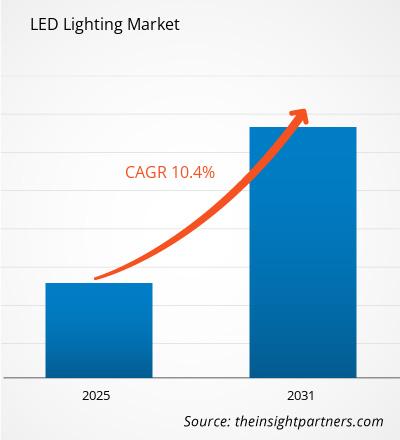
The LED Lighting Market is undergoing sustained transformation as energy-efficiency requirements, replacement of conventional light sources, connected controls, and infrastructure modernization reshape demand. The market was valued at US$ 95.38 Billion in 2025 and is projected to reach US$ 293.42 Billion by 2034, expanding at a CAGR of 13.30% during 2026–2034. Increasing adoption across commercial, industrial, residential, and public environments is broadening the addressable market for LED lamps and luminaires.
North America remains a major demand center, supported by commercial retrofits, industrial modernization, smart-building deployments, and public infrastructure upgrades. The regional market is expected to expand at a CAGR of ~10% through 2034. Building-efficiency initiatives and the replacement of aging fluorescent systems are supporting recurring demand, while connected controls increasingly influence purchasing decisions in offices, warehouses, retail facilities, and municipal applications.
LED Lighting Market Assessment and Insights
Regional Outlook
- North America: ~25% of the global market in 2025 | ~10% CAGR through 2034. Market position: North America holds a substantial mature-market position, supported by retrofit activity, commercial construction, industrial facilities, smart-building integration, and efficiency-focused procurement across offices, warehouses, municipalities, and infrastructure projects.
- US: ~80% of North American market revenue in 2025 | ~10% CAGR through 2034. Market position: The US represents the principal demand base within North America, with technology suppliers, energy-service providers, commercial property owners, and industrial operators supporting adoption across indoor, outdoor, warehouse, roadway, and high-bay applications.
- Europe: ~24% of the global market in 2025 | ~11% CAGR through 2034. Market position: Europe is a mature LED market with substantial replacement demand and regulatory support for efficient lighting. Germany leads within Europe, followed by important demand centers in the UK, France, Italy, and Spain.
- Asia Pacific: ~39% of the global market in 2025 | ~16% CAGR through 2034. Market position: Asia Pacific is the fastest-growing region, combining large manufacturing capacity, expanding construction, infrastructure investment, urbanization, and policy-driven efficiency improvements. China leads the region, with Japan, South Korea, India, and Australia contributing differentiated demand.
Segment Outlook
- Lamps: ~55% Share in 2025 | ~10% CAGR through 2034. Market position: Lamps retain the largest position because of broad household and commercial replacement demand, accessible installation, compatibility with existing fixtures, and continued conversion from incandescent, halogen, and fluorescent products.
- Luminaires: ~45% Share in 2025 | ~17% CAGR through 2034. Market position: Luminaires represent the higher-growth product category as new construction, industrial retrofits, connected controls, optical performance, and application-specific designs encourage buyers to replace complete lighting systems rather than individual light sources.
Competitive Coverage
Cree Lighting, Dialight plc, GE Lighting, Nichia Corporation, ams-OSRAM AG, Signify N.V., Samsung Electronics, Sharp Corporation, EnviroLux, Zumtobel Group AG
Methodology
The Insight Partners follows Data Collection & Secondary Research, Primary Research, Data Analysis, and Data Triangulation & Final Review to validate market estimates and insights.
Source: The Insight Partners' analysis based on proprietary research, government publications, company annual reports, investor presentations, industry databases, and expert interviews.
The transition toward solid-state illumination has moved from basic energy substitution toward higher-efficiency, application-specific, and digitally controllable systems. LED products now support indoor and outdoor environments ranging from homes and offices to factories, roads, warehouses, sports facilities, and public infrastructure. Improvements in efficacy, optical control, dimming, color quality, and product life have strengthened the value proposition of LED technology. The IEA identifies LED adoption as a major contributor to lighting-efficiency gains and notes that premium LED products can exceed 200 lumens per watt.
Looking forward, LED Lighting Market share expansion is increasingly linked with renovation programs, energy-performance standards, connected-building investment, and infrastructure modernization. Europe is incorporating lighting efficiency into broader building-renovation strategies, while developing markets continue replacing inefficient technologies. Manufacturing localization is also becoming strategically important as suppliers seek shorter supply chains and cost-efficient production. The combination of efficiency regulation, falling technology costs, and rising demand for controllable illumination creates opportunities across both replacement and new-build projects.
LED Lighting Market Report Scope
| Report Attribute | Details |
|---|---|
| Market size in 2025 | US$ 95.38 Billion |
| Market Size by 2034 | US$ 293.42 Billion |
| Global CAGR (2026 - 2034) | 13.30% |
| Historical Data | 2021-2024 |
| Forecast period | 2026-2034 |
LED Lighting Market Analysis
LED Lighting Market trends are being shaped by three overlapping requirements: lower electricity consumption, reduced maintenance frequency, and improved control over illuminated spaces. Today’s commercial and industrial users measure the cost of owning a fixture beyond its initial purchase cost, while residential users have simple replacement lamps. Public sector projects are another demand segment as they renovate and update roads, cities, and infrastructure. Therefore, the LED lighting value chain includes semiconductor producers, component suppliers, driver and control suppliers, luminaire producers, distributors, contractors, energy service providers, and consumers.
The supply side has been undergoing a shift towards technology-based as vendors distinguish themselves through efficiency, thermal performance, optics, reliability, connectivity, and application-specific products. China continues to be the main producer for the global market, while production and assembly capacity is growing in other Asian countries. Supply chains are increasingly integrating economies of scale and customization according to regional needs, regulations, product certification, and shortening delivery time. Thus, the new industry is one where component availability, electronics know-how, and application engineering become equally important alongside traditional lighting distribution.
The competitive landscape combines large international lighting companies with specialists focused on industrial, architectural, connected, or high-performance applications. Signify N.V. emphasizes connected lighting and energy-efficient solutions, while Zumtobel Group AG focuses strongly on professional lighting environments. Dialight plc serves demanding industrial and hazardous environments, and Cree Lighting concentrates on LED solutions across commercial, roadway, and other applications. Nichia Corporation and ams-OSRAM AG strengthen the technology and semiconductor side of the ecosystem.
The current investment focuses on interconnected controls, advanced optics, retrofit systems, efficient manufacturing, and application-oriented solutions. Samsung Electronics and Sharp Corporation provide LED lighting technology and display expertise, while GE Lighting and EnviroLux participate in consumer and commercial lighting sectors. The competitive positioning, in turn, is now moving away from just lumens to efficiency, reliability, control, lifecycle considerations, and platform integration.
● REPORT CUSTOMIZATION
Tailor This Report To Align With Your Specific Business Requirements
This report can be customized to align precisely with your business objectives, scope, and target markets. Customization options include tailored segmentation, geography, competitive analysis, and strategic insights to support informed decision-making.
Customize This Report →WHAT YOU CAN ADJUST
- ● Segmentations
- ● Geography
- ● Competitive Analysis
- ● Language Preferences
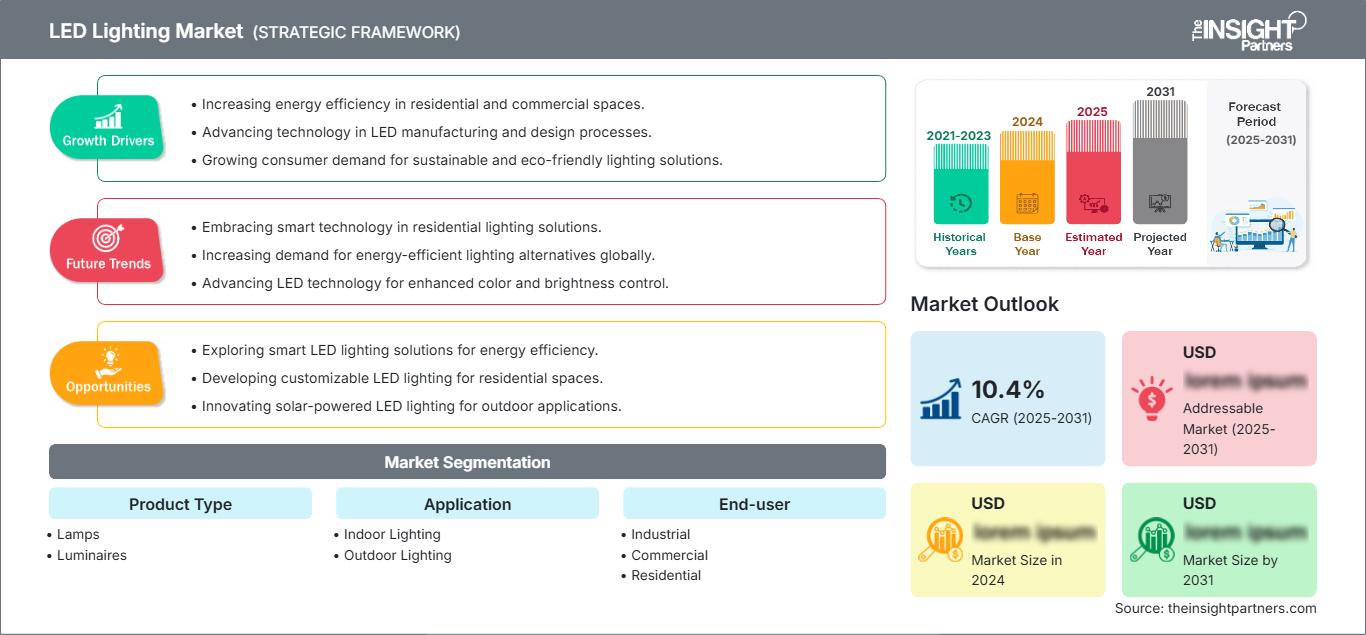
LED Lighting Market: Strategic Insights
Regional Insights
North America LED Lighting Market
North America represents ~25% of global demand in 2025 and is projected to expand at a CAGR of ~10% through 2034. A number of elements make the region well-suited to adopting LED technology, including existing lighting infrastructure, commercial floorspace, industrial facilities, warehousing, transport links, and urban assets that can be upgraded using LED retrofit technology. This would include the potential for energy savings and maintenance reduction in facilities that operate on a continuous basis.
Smart buildings are another feature of the regional market, with the increasing use of sensors and other controls in relation to occupancy and daylight harvesting, as well as connectivity in lighting technology. Owners of commercial buildings have the option of managing their electricity usage as part of their overall building management system. Durability is more important for industrial buyers, and outdoor lighting applications have moved to LED technology in roads, parking lots, and security areas.
U.S. LED Lighting Market
The U.S. accounts for ~80% of North American market revenue in 2025 and is expected to register a CAGR of ~10% through 2034. Needs exist in commercial, industrial, warehouse, retail establishments, residential replacement, roads, and outside structures. The need for retrofits is still significant as LEDs will cut down on the usage of energy and increase the interval between replacements.
There exists an extensive network of suppliers such as GE Lighting, Cree Lighting, Dialight plc, Signify N.V., and many others who specialize in providing lighting products. The needs are extremely varied depending on the use, such as smaller residential bulbs compared to high-power industrial lights. Connected lighting is becoming more relevant in commercial settings where lighting control can be combined with occupancy control, security, and energy management systems.
Europe LED Lighting Market
Europe represented ~24% of the global market in 2025 and is projected to grow at a CAGR of ~11% through 2034. High LED maturity in the region makes replacement, renovation, controls, and systems upgrades more likely to be drivers of the demand. Performance-based regulations and policies on building renovation remain an important driver for efficient lighting solutions. Germany is the leader of Europe due to its industrial activities, commercial activities, engineering expertise, and professional lighting sector development.
In the UK, commercial lighting renovation is combined with infrastructure development and energy-efficiency initiatives. In France, there is potential for commercial lighting projects, building renovation, municipal lighting renovation, and commercial activities. Germany shows robust demand for lighting in industrial buildings, offices, logistics, and professional applications, where lighting performance and control systems are directly related to buildings' performance. In Italy, there is potential in commercial buildings, manufacturing, hospitality, and infrastructure, and in Spain – in construction, tourism infrastructure, outdoor applications, and energy savings initiatives.
European competition increasingly emphasizes connected systems, circularity, repairability, and lifecycle performance. Signify N.V., ams-OSRAM AG, and Zumtobel Group AG participate in a sophisticated regional ecosystem spanning professional lighting, components, controls, and application engineering. The region's mature installed base means future value creation is increasingly associated with upgrading existing systems rather than simply increasing fixture penetration.
APAC LED Lighting Market
Asia Pacific accounts for ~39% of the global market in 2025 and is forecast to expand at a CAGR of ~16% through 2034, making it the fastest-growing region. China is the leading country in Asia Pacific, supported by extensive manufacturing, urban development, infrastructure investment, and large domestic demand. Japan and South Korea contribute advanced technology and high-quality professional applications.
Demand has been created in India due to urbanization, industrial development, building projects, and improvements in infrastructure, while Australia derives its demand from efficiency initiatives related to commercial, residential, and outdoor lighting applications. Efficient lighting policies, manufacturing expansion, and ongoing construction activity will provide demand from all regions. The region offers producers the chance to manufacture locally, cut costs in the supply chain, and produce products for varying price points.
Middle East & Africa LED Lighting Market
The demand in the Middle East and Africa is supported by infrastructure development, urban expansion, industrial projects, commercial construction, and the need to reduce electricity consumption in high-temperature environments. The region is projected to grow at a CAGR of ~12% through 2034. Saudi Arabia is the leading country in the Middle East & Africa market, where evidence supports the position, supported by large-scale urban and infrastructure development.
The UAE is an important market owing to the construction industry, hospitality, smart city developments, and requirements for outdoor lighting. South Africa, on the other hand, forms a large customer base in Africa for various uses such as commercial, industrial, municipal, and residential use. The adoption of LED technology elsewhere in the region has become increasingly linked to energy efficiency, network limitations, infrastructure expansion, and lighting inefficiency.
Segmentation Analysis
Product Type
The Product Type segment includes Lamps and Luminaires. Lamps maintain the larger revenue position because replacement remains accessible to residential and small commercial buyers, while luminaires are gaining importance in professional applications where complete fixture replacement enables better optical performance, controls, thermal management, and installation efficiency. Product selection increasingly depends on lifecycle economics and application requirements.
- Lamps: Lamps remain central to replacement-oriented demand because users can transition from conventional sources with relatively limited installation changes. Residential replacement, retail availability, and compatibility with existing fixtures sustain broad demand across developed and emerging markets.
- Luminaires: Luminaires are increasingly selected for new construction, industrial facilities, warehouses, offices, roadways, and specialized environments. Their ability to combine optics, thermal design, drivers, controls, and mechanical housing supports higher-value system applications.
Application
The Application segment comprises Indoor Lighting and Outdoor Lighting. Indoor Lighting represents a broad installed base spanning residential, commercial, and industrial buildings, whereas Outdoor Lighting benefits from municipal modernization, road infrastructure, security, parking, and architectural applications. Both applications increasingly incorporate controls and monitoring, although purchasing criteria vary by operating environment and installation requirements.
- Indoor Lighting: Indoor demand is anchored by homes, offices, retail facilities, factories, warehouses, and institutional buildings. Buyers increasingly prioritize energy consumption, visual comfort, controllability, installation flexibility, and integration with building-management systems.
- Outdoor Lighting: Outdoor applications include roads, parking areas, public spaces, security installations, sports facilities, and architectural environments. Durability, weather resistance, optical distribution, maintenance access, and energy savings are important purchasing considerations.
End-user
The End-user segment covers Industrial, Commercial, Residential, and Government Bodies. Commercial and industrial users provide significant recurring demand because high operating hours make energy savings and maintenance reductions financially material. Residential demand remains broad because lamps are readily replaceable, while government procurement can accelerate infrastructure-scale conversion through municipal and public-building programs.
- Industrial: Industrial users require durable, high-output systems for factories, warehouses, logistics facilities, mining, processing, and hazardous environments. Reliability and maintenance reduction are particularly important where lighting failures can disrupt operations or increase access costs.
- Commercial: Commercial users include offices, retail, hospitality, healthcare, and other service facilities. Demand increasingly emphasizes efficient illumination, design flexibility, occupancy controls, connected management, and improved operating economics across large building portfolios.
- Residential: Residential adoption is driven by replacement of inefficient lamps, electricity savings, long operating life, product availability, and increasingly smart-home functionality. Affordability and ease of installation remain important factors for household purchasing decisions.
- Government Bodies: Government demand encompasses public buildings, streets, transport facilities, parks, and municipal infrastructure. Procurement programs can aggregate large volumes and prioritize efficiency, durability, maintenance reduction, and compliance with public-sector performance requirements.
Opportunity Snapshot
| End Users | Revenue Contribution | Trend Tag | Adoption Stage |
|---|---|---|---|
| Industrial | High | High-Bay Retrofit | Scaling |
| Commercial | High | Smart Buildings | Scaling |
| Residential | High | Smart Homes | Mature |
| Government Bodies | Medium | Public Retrofit | Scaling |
LED Lighting Market Growth Drivers and Impact Analysis
Energy Efficiency and Total Cost of Ownership
Energy efficiency continues to be a crucial factor since lights are used in many buildings and infrastructure that have been installed. The energy efficiency of LED systems can be significantly higher than that of previous technologies, and the rate of their replacement can be lower as well. According to the IEA, the average luminous efficacy of today's commercially available LEDs is about 100 lumens per watt and more than 200 lumens per watt in the case of professional devices. This factor affects purchasing decisions in terms of focusing on life cycle costs. For businesses, savings will appear due to operating over many hours, and for cities, there will be lower energy and maintenance costs.
Replacement of Legacy Lighting Infrastructure
There are plenty of existing installations of fluorescent, halogen, incandescent and other old lighting technologies that are providing replacement possibilities. It is not only a question of replacement of the lamps; there are a lot of installations that require replacement of whole luminaires because of the necessity to increase the level of illumination, enhance the reliability, control and compliance. According to the IEA, a retrofit solution is an option to keep the existing equipment and decrease the operational expenses by using new technology in the case when direct replacement lamps exist. The replacement cycle is providing constant demand for offices, warehouses, factories, retail facilities, streets and public facilities.
Connected Lighting and Intelligent Building Integration
Combining the technologies of sensors, wireless technology, occupancy sensing, daylight sensing, and central management has increased the value of lighting products beyond mere lighting. Networked lighting helps businesses control their light outputs based on occupancy, scheduling, or environmental factors, which may not only help improve energy management but also give data about operations. In the first quarter of 2026, Signify N.V. announced its total of 171 million connected lighting points as the number of installations. Connectivity opens new avenues for suppliers of lighting products by integrating luminaires with software, analytics, and commissioning as opposed to competing on the cost of fixtures alone.
LED Lighting Market Future Trends
Lighting as a Connected and Adaptive Building Layer
Future lighting systems are expected to become more adaptive, with illumination responding dynamically to occupancy, daylight, time of day, activity, and user preferences. Rather than operating as isolated fixtures, connected luminaires can become a distributed infrastructure within intelligent buildings. This evolution may increase the value of software, sensors, commissioning, interoperability, and data services relative to conventional hardware. The direction is supported by continued investment in connected lighting portfolios and by the growing role of lighting within broader building-energy strategies. Over time, procurement decisions are likely to consider interoperability and upgradeability alongside lumen output, efficiency, and fixture life. Suppliers capable of combining dependable hardware with flexible control architectures can therefore participate in longer-term building modernization programs.
Higher-Efficacy and Human-Centric Lighting Architectures
The next phase of product development is likely to emphasize both higher efficacy and more sophisticated quality-of-light characteristics. LED efficacy has already advanced substantially, while manufacturers are developing systems that adjust color, intensity, timing, and visual characteristics according to application needs. Human-centric concepts may become increasingly relevant in offices, healthcare, hospitality, education, and residential settings where lighting is designed around user experience rather than illumination alone. Signify's 2026 Philips Skylight launch illustrates this direction by combining LED technology with dynamic daylight-inspired lighting behavior. Such developments can create differentiated product categories and encourage the replacement of basic fixtures with higher-value systems.
LED Lighting Market Opportunities
Localized Manufacturing and Regional Supply Chains
Manufacturing localization offers an opportunity for suppliers to reduce logistics exposure, improve regional responsiveness, and tailor products to local specifications. This is particularly relevant in Asia Pacific, where demand growth and manufacturing capabilities are expanding simultaneously. In March 2025, Signify N.V. announced an intended joint venture with Dixon Technologies to strengthen lighting-product and accessory manufacturing in India, covering products such as LED bulbs, downlights, spots, battens, ropes, and strips. Similar localization strategies can support competitive pricing and shorter lead times while allowing manufacturers to respond more effectively to regional construction and replacement cycles.
Professional Retrofit Platforms and Lighting-as-a-Service
Professional retrofit programs provide an opportunity to package lighting hardware with controls, installation, monitoring, maintenance, and performance management. This approach can reduce upfront barriers for commercial and industrial customers while creating recurring revenue opportunities for suppliers and service providers. The model is particularly relevant for facilities with large lighting inventories and high operating hours, where energy and maintenance savings can support investment decisions. Vendors can differentiate through project engineering, financing structures, remote monitoring, predictive maintenance, and measurable energy-performance outcomes. Such offerings may become increasingly valuable as buyers seek simplified procurement and integrated modernization rather than purchasing individual fixtures through conventional distribution channels.
Recent Developments
- September 2026: Signify launched Philips Smart Lighting Screen Sync with Strip Light, a device using a fisheye lens to capture a TV screen's full content and sync it in real time to a four-sided RGBIC strip light behind the TV, working directly with smart-TV apps, broadcast TV, or HDMI sources without needing a separate box; available in kits for 40-65" TVs starting at €89.99/£79.99.
- September 2026: Olight unveiled the ArkTac Series (flat-body tactical flashlights with up to 1,800 lumens, dual-stage switch, UV/red light, and a Green Laser on the Ultra model) plus a new Amber Orange colorway for the ArkPro Ultra EDC flashlight, alongside the PL X GL, Oclip 2 Series, and Marauder 3, at O-Fan Day 2026 in Houston.
- November 2025: Panasonic Electric Works India launched the Honeycomb LED Down Light Tri CCT (8W/12W/18W) in rose gold and silver chrome finishes, featuring a honeycomb ring design and switchable 3000K/6500K/dual-mode lighting, with 4KV surge protection and a 25,000+ hour lifespan, targeting residential and small commercial spaces.
Frequently Asked Questions

- Comprehensive Market Sizing and Forecast Analysis
- Detailed Segmentation Analysis
- In-Depth Market Dynamics Assessment
- Regional and Country-Level Insights
- Competitive Landscape and Company Benchmarking
- Strategic Business Intelligence
Recent Reports
Testimonials

The Insight Partners provided valuable market intelligence that supported our global go-to-market strategy. Their team was professional, responsive, and attentive to our feedback, providing thoughtful analysis and helpful methodological clarifications throughout the project.
Junmo Kim Chief Financial Officer (CFO), Enertech Co., Ltd.
The Insight Partners' SCADA System Market report is comprehensive, with valuable insights on current trends and future forecasts. The team was highly professional, responsive, and supportive throughout. We are very satisfied and highly recommend their services.
RAN KEDEM Partner, Reali Technologies LTDs
I requested a report on a very specific software market and the team produced the report in a few days. The information was very relevant and well presented. I then requested some changes and additions to the report. The team was again very responsive and I got the final report in less than a week.
JEAN-HERVE JENN Chairman, Future Analytica
We worked with The Insight Partners for an important market study and forecast. They gave us clear insights into opportunities and risks, which helped shape our plans. Their research was easy to use and based on solid data. It helped us make smart, confident decisions. We highly recommend them.
PIYUSH NAGPAL Sr. Vice President, High Beam Global
The Insight Partners delivered insightful, well-structured market research with strong domain expertise. Their team was professional and responsive throughout. The user-friendly website made accessing industry reports seamless. We highly recommend them for reliable, high-quality research services
YUKIHIKO ADACHI CEO, Deep Blue, LLC.
This is the first time I have purchased a market report from The Insight Partners.While I was unsure at first, I visited their web site and felt more comfortable to take the risk and purchase a market report.I am completely satisfied with the quality of the report and customer service. I had several questions and comments with the initial report, but after a couple of dialogs over email with their analyst I believe I have a report that I can use as input to our strategic planning process.Thank you so much for taking the extra time and making this a positive experience.I will definitely recommend your service to others and you will be my first call when we need further market data.
JOHN SUZUKI President and Chief Executive Officer, Board Director, BK Technologies
I wish to appreciate your support and the professionalism you displayed in the course of attending to my request for information regarding to infectious disease IVD market in Nigeria. I appreciate your patience, your guidance, and the fact that you were willing to offer a discount, which eventually made it possible for us to close a deal. I look forward to engaging The Insight Partners in the future, all thanks to the impression you have created in me as a result of this first encounter.
DR CHIJIOKE ONYIA MANAGING DIRECTOR, PineCrest Healthcare Ltd.Reason to Buy
- Informed Decision-Making
- Understanding Market Dynamics
- Competitive Analysis
- Identifying Emerging Markets
- Customer Insights
- Market Forecasts
- Risk Mitigation
- Boosting Operational Efficiency
- Strategic Planning
- Investment Justification
- Tracking Industry Innovations
- Aligning with Regulatory Trends





 Get Free Sample for