
Liquid Samplers Market Demand, Share & Growth by 2034
Coverage: By Type (Single Point, Cross Section Sampling); Application (Healthcare Industry, Food Industry, Pharmaceutical, Industrial Process, Quality Assurance, Quality Control, Sanitary Application, Environmental Liquid Sampling), and Geography (North America, Europe, Asia Pacific, and South and Central America)
- Status : Data Released
- Report Code : TIPRE00014628
- Category : Manufacturing and Construction
- No. of Pages : 150
- Available Report Formats :


- Last update date : July 16, 2026


2025 Market Size
US$ 12.86 Bn
Base year value
2034 Forecast
US$ 21.99 Bn
Projected by 2034
CAGR 2026-2034
6.14 %
Growth rate
Addressable Market
US$ 157.76 Bn
(2026-2034)
The Global Liquid Samplers Market Size is expected to reach US$ 21.99 Billion by 2034 from its value of US$ 12.86 Billion in 2025, growing at a CAGR of 6.14% during 2026-2034. The growth is attributed to increasing quality assurance standards, need for representative sampling, and use in healthcare, food, pharmaceutical, process industry, sanitary, and environmental liquid sampling operations.
North America's Liquid Samplers Market Size will see the impact of well-developed laboratory facilities, automated processes, and controlled production environment. The region will grow at a CAGR of 5.6% to 6.2% during 2026-2034 due to controls over pharmaceutical production, food safety checks, water testing, and use of closed loop samplers.
Liquid Samplers Market Assessment and Insights
- North America: The region accounted for 32–35% share in 2025 and is growing at a CAGR of 5.6–6.2% between 2026–2034, supported by analytical laboratories, biopharma plants, and water compliance spending.
- US: The US held 76–80% of North America in 2025 and is growing at a CAGR of 5.7–6.3% between 2026–2034 through regulated pharmaceutical, food, and environmental testing demand.
- Europe: Europe represented 25–28% share in 2025 and is growing at a CAGR of 5.2–5.8% between 2026–2034, with Germany, the UK, and France leading adoption in industrial and sanitary sampling.
- Asia Pacific: Asia Pacific captured 23–26% share in 2025 and is growing at a CAGR of 6.8–7.5% between 2026–2034, led by China, Japan, South Korea, and India across manufacturing and compliance-led laboratories.
- Largest Segment: Industrial Process held 28–32% market share in 2025 and is growing at a CAGR of 5.9–6.5% between 2026–2034 due to continuous production monitoring.
- High Growth Segment: Environmental Liquid Sampling held 10–13% market share in 2025 and is growing at a CAGR of 7.1–7.8% between 2026–2034 as water monitoring expands.
- Key companies analyzed in detail: Agilent Technologies, Inc.; Bürkle GmbH; Dovianus B.V.; REMBE Kersting GmbH; Sentry Equipment Corp.; Thermo Fisher Scientific Inc.; Merck KGaA; Sartorius AG; GEA Group Aktiengesellschaft; and Swagelok Company.
Source: The Insight Partners' analysis based on proprietary research, government publications, company annual reports, investor presentations, industry databases, and expert interviews.
The sampling approach has evolved from simple manual methods to closed, reproducible, and specific techniques to ensure sample integrity. The choice of stainless steel, chemical inertness, automation capabilities, and hygienic design by the producers is due to the fact that liquid sampling influences batch release, contamination prevention, and compliance with regulations. In addition, the market is driven by production conditions in which disruptions are expensive, and the ability to obtain a representative sample is key to rapid root cause identification.
The future demand will expand beyond established pharmaceutical and food plants in connection with the development of water infrastructure, specialty chemicals, biotech applications, and environmental monitoring in the new geographic regions. The regulatory tailwinds, such as GMP, food safety modernization, drinking water quality management, and industrial emissions regulation, can drive replacement cycles. Modular samplers, compatible with laboratory information systems, will be beneficial for the market.
Liquid Samplers Market Report Scope
| Report Attribute | Details |
|---|---|
| Market size in 2025 | US$ 12.86 Billion |
| Market Size by 2034 | US$ 21.99 Billion |
| Global CAGR (2026 - 2034) | 6.14% |
| Historical Data | 2021-2024 |
| Forecast period | 2026-2034 |
Liquid Samplers Market Analysis
Growth in the market is due to higher standards of sample validity required for pharmaceutical quality control, food safety tests, industrial process improvement, and environmental analysis. There is an increase in demand when there is a need for representative samples that cannot expose individuals to dangerous fluids or disrupt closed production systems. The value chain consists of liquid samplers manufacturers, automation companies, laboratory equipment providers, distributors, consultants, and users of regulated and high-throughput facilities.
Key factors influencing supply are material resistance to corrosion, sanitation certifications, low emission models, and global services network. Stainless steel, PTFE, polypropylene, and elastomer composites continue to be used materials, while automatic point samplers minimize human error. Customization and hazardous area compliance affect lead times, together with compatibility with process lines, tanks, barrels, and laboratories.
According to the Liquid Samplers Market analysis, the competitive scenario involves a fragmented market consisting of worldwide analytical technology firms along with sampling device manufacturers. The collaboration of Agilent Technologies, Inc. and Thermo Fisher Scientific Inc. ensures laboratory processes connections, whereas Bürkle GmbH, Sentry Equipment Corp., REMBE Kersting GmbH, Dovianus B.V., Swagelok Company, GEA Group Aktiengesellschaft, Sartorius AG, and Merck KGaA compete with each other using depth of applications, materials knowledge, and distribution channels.
Funding is shifting towards closed sampling loops, automation of liquid transfers, sterile connections, and documentation. Strategic positioning would involve demonstrating lower chances of contamination, cleanability, and ability to be integrated into validated production process. Vendors who are capable of supporting pharmaceuticals, food industry, chemicals, water, and environmental field operations can justify margins since consumers consider lifecycle dependability instead of mere cost.
● REPORT CUSTOMIZATION
Tailor This Report To Align With Your Specific Business Requirements
This report can be customized to align precisely with your business objectives, scope, and target markets. Customization options include tailored segmentation, geography, competitive analysis, and strategic insights to support informed decision-making.
Customize This Report →WHAT YOU CAN ADJUST
- ● Segmentations
- ● Geography
- ● Competitive Analysis
- ● Language Preferences
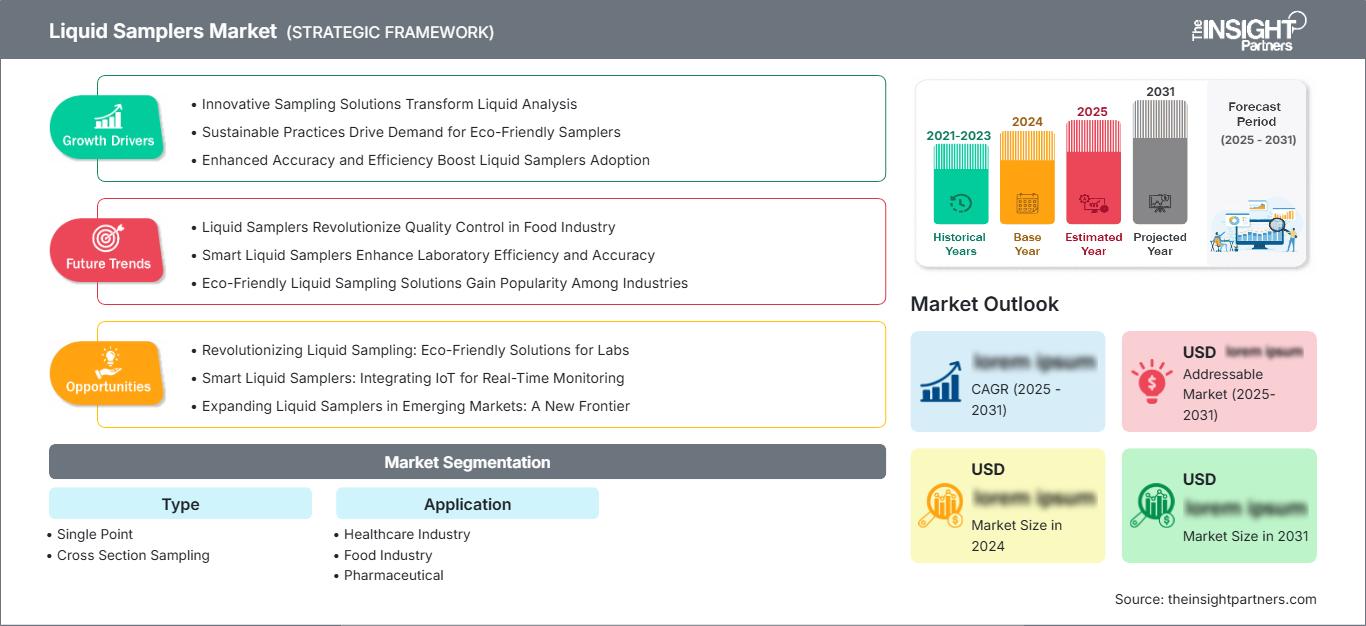
Liquid Samplers Market: Strategic Insights
Regional Insights
North America Liquid Samplers Market
North America held 32–35% of 2025 revenue and is projected to grow at a 5.6–6.2% CAGR during 2026–2034. The Liquid Samplers Market share in this region reflects high pharmaceutical validation intensity, extensive municipal water testing, and strong adoption of food safety programs. Structural demand is further strengthened by FDA-regulation-compliant manufacturing, clean utility systems, and process controls in chemicals, energy, and specialized materials. Buyers have started showing preference for closed system sampling as well as automatic samplers where exposure of operators to substances can be minimized. Sentry Equipment Corporation, Agilent Technologies, Inc., Thermo Fisher Scientific Inc., and Swagelok Company have an installed base advantage.
U.S. Liquid Samplers Market
In 2025, the US held a share of 76–80% of North America and is projected to grow at a CAGR of 5.7–6.3% from 2024 to 2034. Pharmaceutical filling & finishing, biological manufacturing, refinery sampling, and food processing facilities drive demand for consistent and repeatable sampling solutions. Market players have a wide geographical reach, with Sentry Equipment Corp. catering to liquid and slurry process systems, Swagelok Company providing fluid system integrity and analytical companies connecting samples to laboratories. Some application trends witnessed in the market include sanitary sampling in dairy and beverages, low emission sampling in chemicals, and environmental liquid sampling in utilities and industrial discharge.
Europe Liquid Samplers Market
Europe accounted for 25–28% share in 2025 and is forecast to grow at a 5.2–5.8% CAGR during 2026–2034. Germany is the leading country, supported by chemical processing, pharmaceutical engineering, environmental regulation, and strong equipment manufacturing capabilities. Investments in life sciences and water tests which are essential to provide proper integrity samples help UK. Hygiene and anti-corrosion equipment for chemicals, food, and pharmaceuticals are highlighted in Germany. Beverages and specialized products along with wastewater treatment and laboratory innovations are provided by France, Italy, and Spain. Support for competitiveness of the region is offered by Bürkle GmbH, REMBE Kersting GmbH, Sartorius AG, Merck KGaA, and GEA Group Aktiengesellschaft.
APAC Liquid Samplers Market
In 2025, APAC occupied 23%–26%, with forecasted compound annual growth rate in the range of 6.8%–7.5% from 2026 to 2034, thus becoming the region with the highest growth. China dominates the demand due to pharmaceuticals, chemicals, food processing, and water infrastructure. The key focus in Japan and South Korea is precision sampling of electronics chemicals, pharmaceuticals, and high-tech manufacturing. In India, there is development of capabilities for pharmaceutical and environmental analysis, while in Australia, there is development of mining, water, and food testing applications.
Middle East & Africa Liquid Samplers Market
MEA (Middle East & Africa) is expected to register a 5.0-5.7% CAGR from 2026 to 2034. Saudi Arabia dominates MEA regional growth in terms of demand for liquid sampling devices due to energy, petrochemicals, desalination, and industrial construction projects that need dependable sampling systems. UAE is growing in demand for liquid sampling applications in water purification, food processing, and lab testing, while South Africa provides demand from mining, municipal water supply, and industrial quality management projects. Rest of MEA will also depend on projects from the oil, gas, wastewater, and infrastructure segments.
Segmentation Analysis
Type
Type is expected to grow at a 5.8–6.4% CAGR during 2026–2034 as users balance manual flexibility with automated accuracy. The market scope across this segment includes plant floor, laboratory, field, and sanitary settings where the choice of sampler depends on tank geometry, process flow, contamination tolerance, and validation needs.
- Single Point: Single point samplers remain widely used where operators need targeted samples from tanks, drums, or specific process locations with controlled depth, clean transfer, and simple documentation.
- Cross Section Sampling: Cross section sampling is strategically important for heterogeneous liquids, slurries, and flowing streams because it improves representativeness across layers, process zones, and variable compositions.
Application
Application is expected to grow at a 6.1–6.8% CAGR during 2026–2034, supported by regulated manufacturing, contamination prevention, and environmental monitoring. Adoption is strongest where sampling errors create release delays, safety risks, or compliance exposure, making application-specific design a key purchasing criterion across the market.
- Healthcare Industry: Healthcare users require clean, documented liquid collection for diagnostics support, hospital water systems, sterilization validation, and infection-control environments where reliable samples strengthen compliance evidence.
- Food Industry: Food processors use samplers to verify consistency, detect contamination, support sanitary audits, and collect representative liquids from dairy, beverages, oils, sauces, and processing lines.
- Pharmaceutical: Pharmaceutical demand is anchored in GMP workflows, sterile manufacturing, water-for-injection systems, batch validation, and quality release processes requiring low-contamination sampling interfaces.
- Industrial Process: Industrial process applications lead adoption because chemicals, energy, refining, specialty materials, and utilities need repeatable samples to control production variability and protect assets.
- Quality Assurance: Quality assurance teams use sampling systems to generate defensible evidence, reduce retesting, maintain audit trails, and confirm that production parameters align with specifications.
- Quality Control: Quality control laboratories depend on representative liquid samples for analytical accuracy, method consistency, batch comparison, and faster investigation of out-of-specification results.
- Sanitary Application: Sanitary applications prioritize hygienic materials, cleanable surfaces, closed transfer, and food-grade seals where product safety and microbial control are central requirements.
- Environmental Liquid Sampling: Environmental sampling is expanding as water utilities, industrial sites, and regulators monitor pollutants, microcontaminants, discharge quality, and source-water risks more frequently.
Opportunity Snapshot
| Segment Name | Revenue Contribution | Trend Tag | Adoption Stage |
| Healthcare Industry | Medium | Sterile Water | Scaling |
| Food Industry | High | Sanitary Lines | Mature |
| Pharmaceutical | High | GMP Sampling | Mature |
| Industrial Process | High | Closed Loop | Mature |
| Quality Assurance | Medium | Audit Trail | Scaling |
| Quality Control | High | Lab Transfer | Mature |
| Sanitary Application | Medium | Clean Design | Scaling |
| Environmental Liquid Sampling | Medium | Water Watch | Emerging |
Liquid Samplers Market Growth Drivers and Impact Analysis
Rising need for representative and contamination-free samples
The representative sampling method has become one of the key control points since analytical findings depend on the sample taken. In pharmaceutical, food, chemical, and environmental applications, there is an increasing need for closed container systems, controlled depth sampling methods, and non-leaching and non-reactive materials in contact with liquids. This trend has created a need for purpose-designed samplers instead of using makeshift sampling devices. This has manifested through increased replacement of existing systems due to non-compliance, recalls, and high costs associated with retests. It creates value for market since failure to comply with regulations and the cost of re-testing justify expenditure on better sampling equipment.
Expansion of regulated manufacturing and quality systems
The trend towards regulated manufacturing is now widespread within biologics, specialty foodstuffs, nutriceuticals, chemicals, and clean utilities. This is leading to greater demand for documented liquid sampling processes. Requirements of GMP, HACCP, ISO quality systems, and water safety guidelines mean that procedures must be repeatable and stand up to inspection. Consequently, sampling devices are being considered as an integral component of the validation process, not a small auxiliary one. This results in such market considerations as increased demand for certified construction materials, traceability on a per-batch basis, sterile connections, and vendor documentation.
Automation and safety upgrades in process environments
Process Industries are moving away from manual handling of samples when liquids may be hot, high pressure, corrosive, toxic, or valuable. Automatic samplers and closed loop samplers provide protection for personnel and allow for accurate sampling of representative samples. This is an important issue for refinery applications, chemical plants, wastewater treatment, nuclear facilities, and food processing operations, where downtime and events are costly occurrences. This change involves the move from simple and inexpensive manual samplers to more sophisticated equipment, which include valves, purge capability, enclosures, and automation connections. It is beneficial for suppliers who have application engineering capabilities.
Liquid Samplers Market Future Trends
Digitally traceable sampling workflows
Liquid Samplers Market trends involve the use of digitized tracking systems which tie together all aspects of the process of sample taking, labeling of samples, the identification of operators and lab testing. In the coming years, the number of firms connecting their samplers to barcode systems, electronic batch records, and laboratory information management systems will increase. This will lead to fewer transcription errors, improved chain of custody and audit compliance. Firms that design sampling equipment to incorporate data capture and procedural reliability will be able to sell the value of the work flow in addition to the physical product.
Application-specific modular sampler platforms
Modular systems are anticipated to be one of the key areas of future product development because they allow configurations for use in sanitary, hazardous, high viscosity, sterile, or field environments, using universal parts. This will help to cut down on engineering time, simplify spare parts management, and help to enable distributors to sell into different industries while not having too much stock. Modular systems make it possible to customize the systems quicker for the process connection, bottle configuration, material, and clean-up process.
Liquid Samplers Market Opportunities
Environmental monitoring programs in emerging economies
The areas of water quality, wastewater discharge, and industrial pollutants testing represent a growing market for investments related to development of environmental infrastructure in the relevant countries. The forecasts provided by Liquid Samplers Market Forecasts indicate that there would be an increased demand in the situations when authorities increase the frequency of their testing and companies implement updated sampling procedures. There is an opportunity to supply devices to municipal laboratories, industrial parks, mining facilities, and organizations conducting testing on river basins with robust, portable, and contaminant-free devices.
Pharmaceutical and food facility upgrades
Upgrades to pharmaceutical and food processing facilities represent a very high value opportunity as sample ports frequently undergo redesign with expansions, line changeovers, and contamination control initiatives. Suppliers can help their customers through the use of hygienic construction, clean-in-place capability, sterile transfer capability, and documentation of validation capabilities. This opportunity is well suited for suppliers who have an early dialogue with engineering firms, quality groups, and process owners. As capacity trends favor biologics, nutritional products, and high-value beverages, there is an increased emphasis on repeatable and auditable sample ports.
Recent Developments
- May 2026: Agilent Technologies Inc. (NYSE: A) today announced the launch of the new 8890B GC and 8860B GC with GC Assist. GC Assist is the new, advanced instrument intelligence that provides system monitoring, built-in troubleshooting, and remote connectivity to analytical instrumentation within the laboratory’s secure network. These systems enable higher performance and productivity across gas chromatography analyses.
- January 2025: ABB Robotics and Agilent Technologies, a global leader in analytical and laboratory technology and software, have signed a collaboration agreement to deliver automated laboratory solutions. Working together, ABB and Agilent will combine the benefits of their technologies to enable companies across multiple sectors including pharma, biotechnology, energy and food and beverage transform their laboratory operations by making processes such as research and quality control faster and more efficient.
- 2025: Agilent Technologies, Inc. announced that they will launch their newest product, Hybrid Multisampler, along with their new LC Single Quadrupole Mass Spectrometers, at the HPLC 2025 conference scheduled to take place in Bruges, Belgium. These products will help laboratories achieve better productivity and improved results. Attendees of the exhibition will get a chance to learn about these new products.
Frequently Asked Questions

- Comprehensive Market Sizing and Forecast Analysis
- Detailed Segmentation Analysis
- In-Depth Market Dynamics Assessment
- Regional and Country-Level Insights
- Competitive Landscape and Company Benchmarking
- Strategic Business Intelligence
Recent Reports
Testimonials

The Insight Partners' SCADA System Market report is comprehensive, with valuable insights on current trends and future forecasts. The team was highly professional, responsive, and supportive throughout. We are very satisfied and highly recommend their services.
RAN KEDEM Partner, Reali Technologies LTDs
I requested a report on a very specific software market and the team produced the report in a few days. The information was very relevant and well presented. I then requested some changes and additions to the report. The team was again very responsive and I got the final report in less than a week.
JEAN-HERVE JENN Chairman, Future Analytica
We worked with The Insight Partners for an important market study and forecast. They gave us clear insights into opportunities and risks, which helped shape our plans. Their research was easy to use and based on solid data. It helped us make smart, confident decisions. We highly recommend them.
PIYUSH NAGPAL Sr. Vice President, High Beam Global
The Insight Partners delivered insightful, well-structured market research with strong domain expertise. Their team was professional and responsive throughout. The user-friendly website made accessing industry reports seamless. We highly recommend them for reliable, high-quality research services
YUKIHIKO ADACHI CEO, Deep Blue, LLC.
This is the first time I have purchased a market report from The Insight Partners.While I was unsure at first, I visited their web site and felt more comfortable to take the risk and purchase a market report.I am completely satisfied with the quality of the report and customer service. I had several questions and comments with the initial report, but after a couple of dialogs over email with their analyst I believe I have a report that I can use as input to our strategic planning process.Thank you so much for taking the extra time and making this a positive experience.I will definitely recommend your service to others and you will be my first call when we need further market data.
JOHN SUZUKI President and Chief Executive Officer, Board Director, BK Technologies
I wish to appreciate your support and the professionalism you displayed in the course of attending to my request for information regarding to infectious disease IVD market in Nigeria. I appreciate your patience, your guidance, and the fact that you were willing to offer a discount, which eventually made it possible for us to close a deal. I look forward to engaging The Insight Partners in the future, all thanks to the impression you have created in me as a result of this first encounter.
DR CHIJIOKE ONYIA MANAGING DIRECTOR, PineCrest Healthcare Ltd.Reason to Buy
- Informed Decision-Making
- Understanding Market Dynamics
- Competitive Analysis
- Identifying Emerging Markets
- Customer Insights
- Market Forecasts
- Risk Mitigation
- Boosting Operational Efficiency
- Strategic Planning
- Investment Justification
- Tracking Industry Innovations
- Aligning with Regulatory Trends





 Get Free Sample for