
Lithium Metal Market Demand, Share & Growth by 2034
Lithium Metal Market Size and Forecasts (2021 - 2034), Global and Regional Share, Trends, and Growth Opportunity Analysis Report Coverage : by Source (Salt Lake Brine and Lithium Ores); Application (Lithium-ion Anode Material, Alloy, Intermediate); End-Use Industry (Batteries, Metal Processing, Pharmaceuticals); and Geography (North America, Europe, Asia Pacific, and South and Central America)
- Status : Data Released
- Report Code : TIPRE00040592
- Category : Chemicals and Materials
- No. of Pages : 150
- Available Report Formats :


- Last update date : July 09, 2026


2025 Market Size
US$ 795.60 Mn
Base year value
2034 Forecast
US$ 1,754.20 Mn
Projected by 2034
CAGR 2026-2034
9.18 %
Growth rate
Addressable Market
US$ 11,396.23 Mn
(2026-2034)
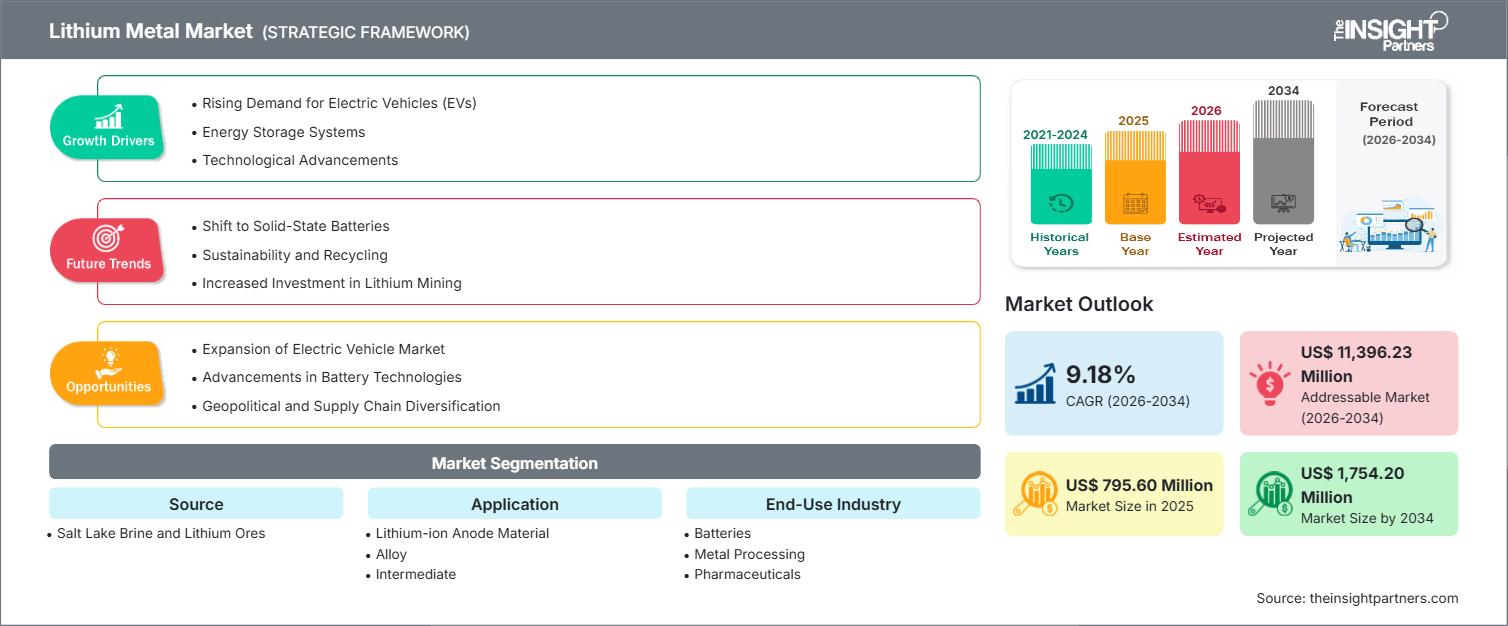
The Lithium Metal Market was valued at US$ 795.60 Million in 2025 and is projected to reach US$ 1,754.20 Million by 2034, expanding at a CAGR of 9.18% during 2026–2034. Market growth is driven by the rising use of lithium metal in new battery technologies, specialty alloys, and high-purity chemical intermediates. Ongoing investments in lithium processing, high-performance materials, and battery innovation are also boosting long-term market development across various industrial sectors.
North America is expected to have a CAGR of 8.4–9.2% from 2026 to 2034, fueled by growing investments in next-generation battery technologies and local critical mineral supply chains. Increased research into lithium metal anodes, along with more government support for advanced energy storage manufacturing and semiconductor-grade materials, should enhance regional production capabilities and industrial competitiveness.
Lithium Metal Market Assessment and Insights
- North America: North America accounted for 24–28% market share in 2025 and is projected to expand at a CAGR of 8.4%–9.2% during 2026–2034. Growth is driven by advanced battery innovation, increasing investments in domestic critical mineral supply chains, and efforts to strengthen regional manufacturing capabilities.
- U.S.: The U.S. represented 84–88% of the North American market in 2025 and is anticipated to register a CAGR of 8.6%–9.4% during 2026–2034, supported by expanding battery research and development activities, growing demand for advanced battery materials, and strategic investments in domestic production.
- Europe: Europe held 20–24% market share in 2025 and is expected to grow at a CAGR of 8.8%–9.6% during 2026–2034. Germany, France, and the United Kingdom remain the leading regional markets, supported by advanced manufacturing capabilities, strong battery research initiatives, and increasing focus on energy transition technologies.
- Asia Pacific: Asia Pacific accounted for 42–46% market share in 2025 and is forecast to expand at a CAGR of 9.8%–10.6% during 2026–2034. China, Japan, and South Korea drive regional growth through integrated lithium processing operations, large-scale battery production, and continuous investments in advanced energy storage technologies.
- Largest Segment – Batteries: The Batteries end-use industry represented the largest market segment, accounting for 61–65% market share in 2025, and is expected to grow at a CAGR of 10.0%–10.8% during 2026–2034, driven by continued advancements in high-energy-density battery technologies and increasing demand across electric mobility and energy storage applications.
- High Growth Segment – Lithium-ion Anode Material: The Lithium-ion Anode Material application is projected to register the fastest growth, accounting for 36–40% market share in 2025 and advancing at a CAGR of 10.4%–11.2% during 2026–2034, supported by the commercialization of next-generation rechargeable batteries and ongoing innovation in lithium-ion battery performance.
- Key companies analyzed in detail: Ganfeng Lithium Group Co., Ltd.; Tianqi Lithium Corporation; Chengxin Lithium Group Co., Ltd.; American Elements; Pure Lithium Corporation; Otto Chemie Pvt. Ltd.; Oxford Lab Fine Chem LLP; The Honjo Chemical Corporation; Alpha-En Corporation; Merck KGaA; Albemarle Corporation; American Lithium Energy Corporation; Materion Corporation; Stanford Advanced Materials; and Gelon LIB Group Co., Ltd.
Source: The Insight Partners' analysis based on proprietary research, government publications, company annual reports, investor presentations, industry databases, and expert interviews.
The market has evolved from serving niche metallurgical and specialty chemical applications to becoming an increasingly important component of next-generation battery development. Improvements in purification processes, handling technologies, and manufacturing precision have enabled wider commercialization, reflecting important lithium metal market trends. Simultaneously, increasing collaboration between material suppliers and battery developers has strengthened the industry's technological capabilities and expanded commercial opportunities across energy storage and advanced electronics.
Future growth is expected to be supported by continued investments in solid-state battery research, domestic processing infrastructure, and strategic critical mineral policies. Emerging manufacturing hubs across Asia Pacific and North America are expanding lithium metal production capabilities to support localized battery supply chains. Advancements in recycling technologies, improved safety standards, and increased public-private investment are expected to enhance long-term supply resilience while supporting commercialization of advanced lithium-based materials.
Lithium Metal Market Report Scope
| Report Attribute | Details |
|---|---|
| Market size in 2025 | US$ 795.60 Million |
| Market Size by 2034 | US$ 1,754.20 Million |
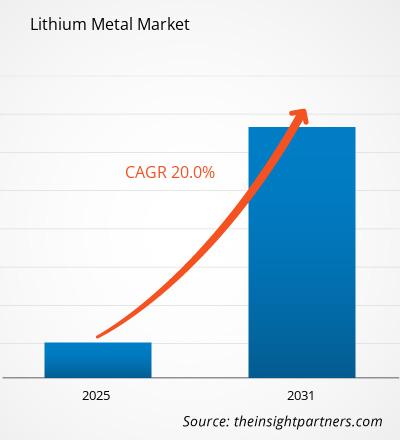
| Global CAGR (2026 - 2034) | 9.18% |
| Historical Data | 2021-2024 |
| Forecast period | 2026-2034 |
Lithium Metal Market Analysis
Demand for lithium metal continues to grow as battery manufacturers seek higher energy density, supporting steady growth in the lithium metal market size. Unlike traditional lithium compounds, lithium metal is used in specialized applications that need superior electrochemical properties, especially in new solid-state batteries and high-performance energy storage systems. The rising demand from pharmaceuticals, specialty alloys, and chemical intermediates expands the industry's end-use landscape and reduces reliance on a single application sector. The market includes lithium resource producers, purification specialists, material manufacturers, battery developers, research organizations, and industrial users. Supply dynamics increasingly focus on producing ultra-high-purity lithium metal using controlled processing technologies that meet strict quality standards for manufacturing applications.
Competition relies on technological skills, product purity, manufacturing precision, and long-term customer partnerships that help companies expand their lithium metal market share. Established companies such as Ganfeng Lithium Group Co., Ltd., Tianqi Lithium Corporation, Albemarle Corporation, and Merck KGaA are enhancing their specialty material portfolios while investing in lithium processing technologies. These organizations use integrated operations and research capabilities to meet changing customer needs in battery and industrial markets.
Specialized manufacturers like American Elements, Pure Lithium Corporation, Alpha-En Corporation, The Honjo Chemical Corporation, and American Lithium Energy Corporation are developing advanced lithium metal technologies for next-generation battery applications. At the same time, Chengxin Lithium Group Co., Ltd., Materion Corporation, Stanford Advanced Materials, Oxford Lab Fine Chem LLP, Otto Chemie Pvt. Ltd., and Gelon LIB Group Co., Ltd. strengthen market competition with specialty chemicals, engineered materials, lab-grade products, and customized lithium solutions.
● REPORT CUSTOMIZATION
Tailor This Report To Align With Your Specific Business Requirements
This report can be customized to align precisely with your business objectives, scope, and target markets. Customization options include tailored segmentation, geography, competitive analysis, and strategic insights to support informed decision-making.
Customize This Report →WHAT YOU CAN ADJUST
- ● Segmentations
- ● Geography
- ● Competitive Analysis
- ● Language Preferences
Lithium Metal Market: Strategic Insights
Regional Insights
North America Lithium Metal Market
North America accounted for 24–28% of the global market in 2025 and is projected to expand at a CAGR of 8.4–9.2% during 2026–2034. Increasing investments in battery materials and local mineral processing are supporting market growth while strengthening the regional lithium metal market share. Government funding for battery innovation, semiconductor production, and mineral security is boosting domestic production of high-purity lithium metal. Increasing research into solid-state batteries and defense applications is also driving long-term demand throughout the regional value chain.
U.S. Lithium Metal Market
The United States represented 84–88% of North American Lithium Metal Market demand in 2025 and is expected to register a CAGR of 8.6–9.4% through 2034. Federal incentives keep supporting investments in battery manufacturing and critical material supply chains. Companies like Albemarle Corporation, American Lithium Energy Corporation, American Elements, and Pure Lithium Corporation are actively researching and engaging in commercial activities to boost domestic production. The growing use of solid-state batteries, aerospace technologies, and defense systems is increasing the demand for high-purity lithium metal.
Europe Lithium Metal Market
Europe held 20–24% of the global Lithium Metal Market in 2025 and is anticipated to grow at a CAGR of 8.8–9.6% through 2034. Germany remains the leading regional market due to its strong automotive industry, battery research, and specialty chemical manufacturing. The United Kingdom is expanding research into next-generation battery technologies. This growth results from collaboration among universities, technology companies, and industrial manufacturers. Government-backed innovation programs and rising private investment are helping to commercialize lithium metal technologies for energy storage. Germany maintains a solid industrial base, a high-value manufacturing sector, and increasing investments in battery cell production.
Ongoing development of new materials and precise manufacturing strengthens the country's position in the regional market. France, Italy, and Spain are making contributions through pharmaceutical manufacturing, specialty materials production, and growing investments in battery technology. Strengthening industrial partnerships and clean energy initiatives support the wider use of lithium metal in key applications.
APAC Lithium Metal Market
Asia Pacific accounted for 42–46% of the global Lithium Metal Market in 2025 and is forecast to register the fastest regional expansion with a CAGR of 9.8–10.6% through 2034. China is the leading market in the region due to its integrated lithium processing infrastructure and large battery manufacturing ecosystem. Japan and South Korea are pushing innovation in advanced batteries, electronic materials, and high-performance industrial manufacturing. Strong investments in research and commercialization improve regional competitiveness in premium lithium metal applications. Australia helps through lithium resource development, and India is becoming a promising destination for downstream manufacturing. This growth is backed by battery production efforts and strategies for critical minerals. Regional policy support promotes greater localization of advanced material supply chains.
Middle East & Africa Lithium Metal Market
The Middle East & Africa Lithium Metal Market is expected to expand at a CAGR of 7.6–8.4% during 2026–2034. Although the regional market is still smaller, growing industrial diversity and clean energy investments are opening up new opportunities for specialty lithium materials. Saudi Arabia is expected to drive regional growth with its investments in manufacturing and mineral processing. The United Arab Emirates keeps supporting technology-driven industrial diversity with its innovation-focused economic initiatives. South Africa contributes with its mining expertise and a growing advanced materials sector. Meanwhile, the rest of the Middle East and Africa is slowly increasing investments in battery supply chains, specialty chemicals, and industrial infrastructure to meet future lithium metal demand.
Segmentation Analysis
Source
The Lithium Ores segment is expected to witness the highest growth during the forecast period, registering a CAGR of 9.8–10.6% from 2026 to 2034. Increasing development of hard-rock lithium mining projects, along with improvements in ore processing and refining technologies, is making high-purity lithium metal feedstock more available. Growing investments in integrated mining-to-metal production facilities are also supporting long-term growth.
- Salt Lake Brine: Salt lake brines remain an important source of lithium production because of their relatively lower extraction costs and established commercial operations. Continuous improvements in lithium recovery technologies and resource management practices are enhancing production efficiency while supporting sustainable supply.
- Lithium Ores: Hard-rock lithium ores are gaining prominence due to shorter project development timelines and their suitability for producing high-purity lithium chemicals required in lithium metal manufacturing. Expanding exploration activities and investments in spodumene processing continue strengthening this supply source.
Application
Lithium-ion anode material is a key area of growth. Manufacturers are focusing on creating next-generation batteries that have higher energy density and better safety. Ongoing research into lithium metal anodes is speeding up their use in electric mobility, aerospace, and improved energy storage applications.
- Lithium-ion Anode Material: Lithium metal anodes enable higher theoretical energy density compared to conventional graphite anodes, making them highly attractive for solid-state batteries and advanced rechargeable battery technologies. Continuous research and pilot-scale commercialization are strengthening long-term market prospects.
- Alloy: Lithium metal is used in specialty aluminum, magnesium, and aerospace alloys to reduce weight while improving mechanical strength and corrosion resistance. Demand continues to grow across aviation, defense, and precision engineering industries requiring high-performance lightweight materials.
- Intermediate: Lithium metal serves as an important intermediate in the production of organolithium compounds, specialty chemicals, pharmaceuticals, and advanced industrial reagents. Stable demand from fine chemical synthesis supports consistent consumption within this application segment.
End-Use Industry
The Batteries segment is expected to remain the largest end-use industry throughout the forecast period, expanding at a CAGR of 10.0–10.8% from 2026 to 2034. Increasing commercialization of lithium metal batteries, solid-state battery technologies, and high-performance rechargeable energy storage systems supports ongoing demand.
- Batteries: Battery manufacturers increasingly utilize lithium metal for advanced rechargeable battery technologies capable of delivering higher energy density, longer operating life, and improved charging performance. Growing investments in electric mobility and grid-scale energy storage continue strengthening long-term demand.
- Metal Processing: Lithium metal improves metallurgical processes by enhancing alloy performance, reducing density, and improving casting characteristics. Aerospace, automotive, and defense manufacturers continue utilizing lithium-containing alloys to meet lightweight material requirements.
- Pharmaceuticals: Pharmaceutical manufacturers use lithium metal as an intermediate for producing specialized lithium compounds utilized in research, chemical synthesis, and therapeutic formulations. Demand remains stable owing to continued pharmaceutical production and laboratory applications.
Opportunity Snapshot
| Segment Name | Revenue Contribution | Trend Tag | Adoption Stage |
| Lithium-ion Anode Material | High | Solid State | Scaling |
| Alloy | Medium | Lightweight Metals | Mature |
| Intermediate | Medium | Fine Chemicals | Mature |
Lithium Metal Market Growth Drivers and Impact Analysis
Commercialization of Solid-State Battery Technologies
The shift to solid-state batteries is driving up the demand for high-purity lithium metal. Lithium metal anodes offer much higher theoretical energy density compared to traditional graphite options. Car manufacturers, battery developers, and research groups are investing in large-scale production technologies to improve battery safety, charging speed, and driving range. As prototype technologies get closer to commercial use, suppliers of lithium metal are enhancing their purification processes and boosting manufacturing capacity. This change is likely to alter material sourcing strategies while strengthening the long-term lithium metal market forecast through continued investment across the supply chain.
Expansion of High-Purity Specialty Material Manufacturing
Demand for ultra-high-purity lithium metal keeps rising in electronics, aerospace, semiconductor, and specialty chemical industries where strict purity standards are crucial. Manufacturers are investing in better refining processes, contamination control systems, and precise manufacturing technologies to produce materials that meet tougher industrial standards. The ability to consistently provide high-purity lithium metal offers competitive advantages and supports premium product positioning. Growing production of specialized industrial materials is promoting closer collaboration between material suppliers, research institutions, and downstream manufacturers who are looking for customized solutions for advanced engineering applications.
Growing Strategic Focus on Critical Mineral Independence
Governments in major economies are recognizing lithium as a key material for energy security, technological ability, and industrial strength. Financial incentives, domestic manufacturing programs, and critical mineral strategies are driving investment in lithium extraction, refining, purification, and recycling infrastructure. These efforts reduce dependence on imported materials and enhance regional supply chain security. As manufacturing industries grow, a stronger focus on domestic lithium metal production is likely to attract new investments, boost supply reliability, and speed up the development of new processing technologies.
Lithium Metal Market Future Trends
Integration of Lithium Metal into Next-Generation Battery Platforms
Battery manufacturers are increasingly designing next-generation battery platforms with lithium metal anodes. This change aims to achieve higher energy density, lower weight, and better operational efficiency. Ongoing improvements in electrolyte chemistry, interface engineering, and dendrite suppression technologies are expected to address past commercialization issues. As technical obstacles decrease, lithium metal is likely to become a favored material for high-end electric vehicles, aerospace batteries, and high-performance portable electronics. This shift will promote long-term investments in specialized lithium metal manufacturing and product development tailored to specific applications.
Advancement of Closed-Loop Lithium Material Recovery
Circular economy initiatives are promoting the development of recycling technologies, highlighting emerging lithium metal market trends focused on sustainability. While primary production will continue to be the main source of supply, secondary recovery is likely to support the availability of raw materials in the long run. Companies that invest in better lithium purification and recycling technologies will benefit from rising sustainability requirements and will rely less on newly mined resources. A greater use of recycled lithium in manufacturing is expected to boost supply resilience and enhance environmental performance across the industry.
Lithium Metal Market Opportunities
Expansion of Domestic Lithium Metal Refining Infrastructure
There are important investment opportunities in setting up domestic lithium metal refining and purification facilities close to new battery manufacturing hubs. Many countries still depend on imported high-purity lithium materials, even as battery production capacity grows. Companies that can create integrated refining operations backed by improved purification technologies can gain from long-term supply contracts, government support, and rising domestic demand. Building stronger local manufacturing systems will also cut transportation costs while supporting long-term lithium metal market growth through stronger regional supply chains.
Development of Customized Lithium Metal Solutions for High-Value Industries
Growing demand from aerospace, defense, pharmaceuticals, semiconductors, and electronics creates opportunities for manufacturers that offer lithium metal products tailored to specific applications. Customers increasingly need specialized materials made for precise manufacturing settings and high-quality standards. Companies that focus on product customization, technical support, and research partnerships can set themselves apart from simple commodity suppliers. These enhanced solutions are likely to strengthen customer relationships, improve pricing potential, and increase involvement in high-end industrial applications beyond traditional battery markets.
Recent Developments
- June 2026: SAGA Metals Corp. merged its Legacy and Amirault Lithium projects into a single, larger Legacy Lithium Project in Quebec's Eeyou Istchee James Bay region, expanding the land package to over 72,000 hectares. Recent fieldwork confirmed key lithium-cesium-tantalum (LCT) pegmatite minerals across the area, supporting the potential for a district-scale lithium system. The company is awaiting assay results and plans further exploration, benefiting from rising lithium prices and regional consolidation trends that enhance the project's strategic value. This move positions SAGA well for future partnerships or development in a key North American lithium district.
- May 2026: Ganfeng Lithium Group Co., Ltd. announced commercial production of 10 Ah lithium metal solid-state batteries with an energy density of approximately 500 Wh/kg, marking a significant milestone in next-generation battery commercialization. The development reinforces the company's strategy of advancing lithium metal anode technologies for future electric vehicle and energy storage applications.
Frequently Asked Questions

- Comprehensive Market Sizing and Forecast Analysis
- Detailed Segmentation Analysis
- In-Depth Market Dynamics Assessment
- Regional and Country-Level Insights
- Competitive Landscape and Company Benchmarking
- Strategic Business Intelligence
Recent Reports
Testimonials

The Insight Partners' SCADA System Market report is comprehensive, with valuable insights on current trends and future forecasts. The team was highly professional, responsive, and supportive throughout. We are very satisfied and highly recommend their services.
RAN KEDEM Partner, Reali Technologies LTDs
I requested a report on a very specific software market and the team produced the report in a few days. The information was very relevant and well presented. I then requested some changes and additions to the report. The team was again very responsive and I got the final report in less than a week.
JEAN-HERVE JENN Chairman, Future Analytica
We worked with The Insight Partners for an important market study and forecast. They gave us clear insights into opportunities and risks, which helped shape our plans. Their research was easy to use and based on solid data. It helped us make smart, confident decisions. We highly recommend them.
PIYUSH NAGPAL Sr. Vice President, High Beam Global
The Insight Partners delivered insightful, well-structured market research with strong domain expertise. Their team was professional and responsive throughout. The user-friendly website made accessing industry reports seamless. We highly recommend them for reliable, high-quality research services
YUKIHIKO ADACHI CEO, Deep Blue, LLC.
This is the first time I have purchased a market report from The Insight Partners.While I was unsure at first, I visited their web site and felt more comfortable to take the risk and purchase a market report.I am completely satisfied with the quality of the report and customer service. I had several questions and comments with the initial report, but after a couple of dialogs over email with their analyst I believe I have a report that I can use as input to our strategic planning process.Thank you so much for taking the extra time and making this a positive experience.I will definitely recommend your service to others and you will be my first call when we need further market data.
JOHN SUZUKI President and Chief Executive Officer, Board Director, BK Technologies
I wish to appreciate your support and the professionalism you displayed in the course of attending to my request for information regarding to infectious disease IVD market in Nigeria. I appreciate your patience, your guidance, and the fact that you were willing to offer a discount, which eventually made it possible for us to close a deal. I look forward to engaging The Insight Partners in the future, all thanks to the impression you have created in me as a result of this first encounter.
DR CHIJIOKE ONYIA MANAGING DIRECTOR, PineCrest Healthcare Ltd.Reason to Buy
- Informed Decision-Making
- Understanding Market Dynamics
- Competitive Analysis
- Identifying Emerging Markets
- Customer Insights
- Market Forecasts
- Risk Mitigation
- Boosting Operational Efficiency
- Strategic Planning
- Investment Justification
- Tracking Industry Innovations
- Aligning with Regulatory Trends





 Get Free Sample for