Loofah Market Growth Analysis and Forecast by 2031
Historic Data: 2021-2023 | Base Year: 2024 | Forecast Period: 2025-2031Loofah Market Size and Forecast (2021 - 2031), Global and Regional Share, Trend, and Growth Opportunity Analysis Report Coverage: By Product Type (With Handle and Without Handle), Distribution Channel (Supermarkets and Hypermarkets, Specialty Stores, Online Retail, and Others), and Geography (North America, Europe, Asia Pacific, Middle East and Africa, and South and Central America)
- Report Date : Dec 2025
- Report Code : TIPRE00026473
- Category : Consumer Goods
- Status : Published
- Available Report Formats :


- No. of Pages : 149
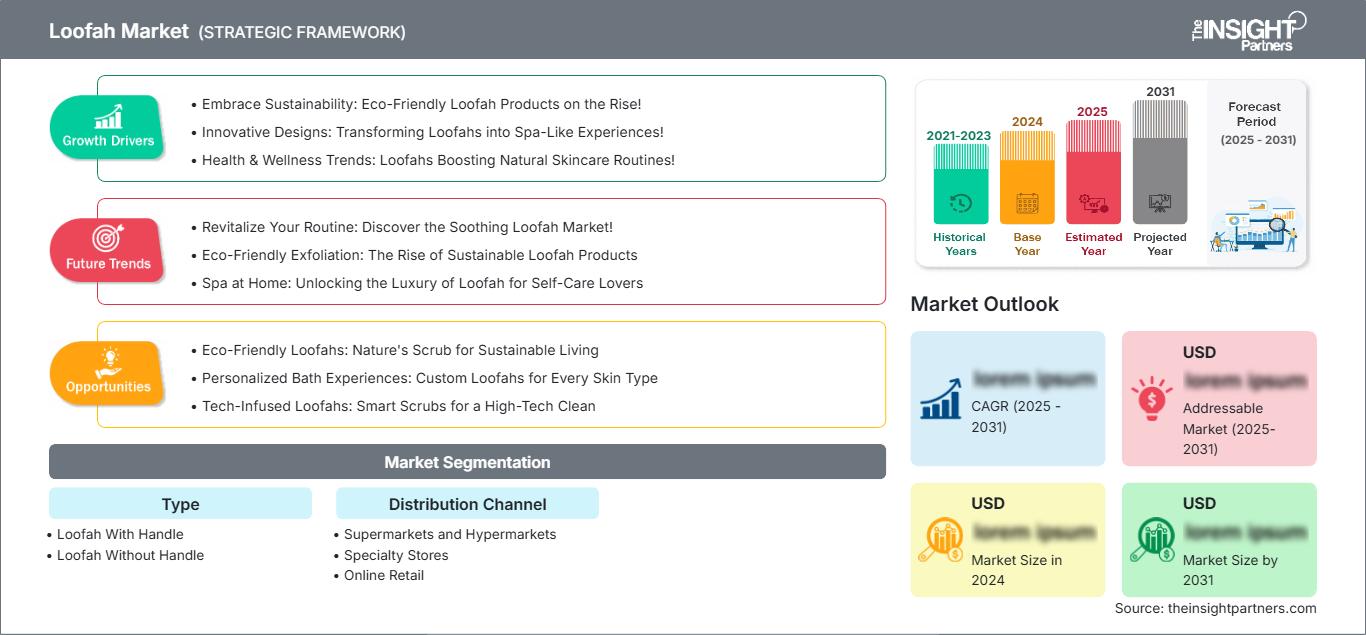
The loofah market size is projected to reach US$ 2.97 billion by 2031 from US$ 2.03 billion in 2024. The market is expected to register a CAGR of 5.6% from 2025 to 2031.
Loofah Market Analysis
The increase in consumer preference toward sustainable and environmentally-friendly personal care products and household items drives the loofah market. Synthetic sponges and plastic-based scrubbers pose environmental risks. As consumers become more aware of sustainable alternatives, demand for biodegradable and natural substitutes—such as loofah—continues to rise. Its multipurpose nature—as an exfoliating body scrub, facial pad, bath accessory, and a cleaning tool—also fosters market adoption. Moreover, the rise in the popularity of natural skincare, health-conscious lifestyles, and zero-waste is driving product development and high-end positioning. New trends include the integration of loofah in luxury spa and beauty products, the development of scented or infused variants, and multifunctional household items combining loofah with natural fibers. E-commerce platforms and social media outreach are also boosting consumer education and awareness, which is leading to demand for specialty and organic loofah products. Such factors contribute to the loofah market growth worldwide.
Loofah Market Overview
Loofah is a natural fibrous sponge made of the mature fruit of the Luffa plant, which is usually grown in the tropical and sub-tropical zones. After harvesting, the fruit is peeled, dried, and processed to eliminate the seeds, leaving behind a rough porous structure which is perfect for exfoliation and scrubbing. Loofah is traditionally a bathing and household cleaning product, but it has recently become prominent in the personal care and cosmetic markets because of its chemical-free, eco-friendly, and biodegradable characteristics. Its uses have extended to body scrubs, facial pads, bath mitts, and spa accessories, which offer a mild form of exfoliation and a stimulation of healthy circulation and skin. Moreover, the use of loofah is being incorporated into luxury and organic skincare products, which provides a multifunctional solution that combines cleansing, exfoliation, and massage. The emerging trend of consumer awareness of sustainable and natural alternatives is fueling innovation, making loofah an essential component of contemporary personal care and wellness.
Customize This Report To Suit Your Requirement
You will get customization on any report - free of charge - including parts of this report, or country-level analysis, Excel Data pack, as well as avail great offers and discounts for start-ups & universities
Loofah Market: Strategic Insights
-
Get Top Key Market Trends of this report.This FREE sample will include data analysis, ranging from market trends to estimates and forecasts.
Loofah Market: Drivers and Opportunities
Market Drivers:
- Increase in Environmental Consciousness: Growing consumer awareness of plastic pollution and synthetic sponges is leading to a rise in demand for biodegradable loofah products in personal care and household cleaning.
- Growth of the Personal Care and Wellness Industry: The use of loofah is being incorporated in exfoliating scrubs, bath mitts, and facial pads by spas, salons, and skincare brands.
- Preference for Natural and Chemical-Free Products: Health-conscious consumers prefer loofah over synthetic alternatives for gentle exfoliation and skin-friendly cleansing.
- Rising Popularity of Zero-Waste and Sustainable Lifestyles: Reduced dependence on disposable products and eco-conscious living promotes the demand for natural loofahs.
- Rising Urbanization and Disposable Incomes: Consumers in emerging markets are willing to spend more on premium personal care products.
Market Opportunities:
- Premium and Organic Loofah Products: There is high potential in luxury, organic, and natural sourced loofah products targeting spas and health-conscious consumers.
- E-Commerce and Direct-to-Consumer Development: The online retail can enable manufacturers to target niche groups of consumers and directly sell specialty loofah products.
- Innovation in Personal Care and Skincare Applications: Infused, scented, or multifunctional loofah products are also developed to improve product attractiveness in beauty and wellness segments.
- Emerging Markets Expansion: Increasing disposable income and urban populations in Asia Pacific, Africa, and South America lead to market penetration.
- Diversification Into Household and Multipurpose Products: The scope of application of Loofah can be extended into cleaning, dishwashing, and wellness packages.
Loofah Market Report Segmentation Analysis
The loofah market is divided into different segments to give a clearer view of how they work, their growth potential, and the latest trends. Below is the standard segmentation approach used in industry reports:
By Product Type
- With Handle: These loofahs are easily accessible and convenient and are frequently utilized in body scrubbing, exfoliation, and spa, where they provide superior functionality.
- Without Handle: Conventional hand-held loofahs are favored as facial washers, light exfoliators, and domestic cleaning tools; they are small, multipurpose, and can be used in daily personal care applications.
By Distribution Channel
- Supermarkets and Hypermarkets: Personal care and household cleaning products—such as loofahs—are found in large retail chains serving mainstream consumers.
- Specialty Stores: Beauty, wellness, and eco-friendly stores sell quality, organic, and specialty loofah products to niche and environmentally conscious consumers.
- Online Retail: E-commerce platforms enable direct-to-consumer sales of loofahs, including customized, infused, and bulk-pack options, expanding market reach.
- Others: This category includes convenience stores, gas stations, and mom-and-pop stores.
By Geography:
- North America
- Europe
- Asia Pacific
- South and Central America
- Middle East and Africa
The regional trends and factors influencing the Loofah Market throughout the forecast period have been thoroughly explained by the analysts at The Insight Partners. This section also discusses Loofah Market segments and geography across North America, Europe, Asia Pacific, Middle East and Africa, and South and Central America.
Loofah Market Report Scope
| Report Attribute | Details |
|---|---|
| Market size in 2024 | US$ 2.03 Billion |
| Market Size by 2031 | US$ 2.97 Billion |
| Global CAGR (2025 - 2031) | 5.6% |
| Historical Data | 2021-2023 |
| Forecast period | 2025-2031 |
| Segments Covered |
By Product Type
|
| Regions and Countries Covered |
North America
|
| Market leaders and key company profiles |
|
Loofah Market Players Density: Understanding Its Impact on Business Dynamics
The Loofah Market is growing rapidly, driven by increasing end-user demand due to factors such as evolving consumer preferences, technological advancements, and greater awareness of the product's benefits. As demand rises, businesses are expanding their offerings, innovating to meet consumer needs, and capitalizing on emerging trends, which further fuels market growth.
- Get the Loofah Market top key players overview
Loofah Market Share Analysis by Geography
North America dominates the loofah market. The growing demand for natural exfoliation scrubs across the region powers this surge. Emerging markets in South and Central America, the Middle East, and Africa have untapped opportunities for loofah providers to expand.
The growth of the loofah market varies by region. The focus on personal care and skin exfoliation continues to grow, positioning loofah in an evolving consumer landscape. Below is a summary of market share and trends by region:
1. North America
- Market Share: Dominates the market, with an annually rising market share
- Key Drivers:
- Growing consumer preference for biodegradable and eco-friendly personal care products.
- Trends: Rising adoption of loofah in spas and luxury skincare routines.
2. Europe
- Market Share: Holds a significant market share
- Key Drivers:
- Strict regulations aimed at reducing single-use plastics.
- Trends: Rising consumer focus on skincare and exfoliation.
3. Asia Pacific
- Market Share: Holds a significant market share
- Key Drivers:
- Rising disposable incomes boost demand in the personal care sector.
- Trends: Growing demand for loofah products through e-commerce platforms.
4. South and Central America
- Market Share: Small market size expanding at a rapid pace
- Key Drivers:
- Growing consumer awareness of sustainable and zero-waste lifestyles.
- Trends: Adoption of chemical-free and natural loofahs.
5. Middle East and Africa
- Market Share: A rapidly expanding market with consistent annual growth in market share. Key Drivers:
- Increased consumer spending on personal care products.
- Trends: Growing adoption of loofah in household cleaning applications.
Loofah Market Players: Density: Understanding Its Impact on Business Dynamics
High Market Density and Competition
Competition is intense due to the presence of established players such as NectarLife, Natural Bath and Body Shop, Daily Concepts, Finchberry, and others.
This high level of competition urges companies to stand out by offering:
- Diverse product offering
- Sustainable and ethical sourcing
- Competitive pricing models
- Strong customer support and easy integration
Opportunities and Strategic Moves
- Companies are focusing on research and development activities to distinguish themselves in the market.
- Leading personal care and beauty companies are expanding their global footprint and capabilities through strategic acquisitions of manufacturers in the sector.
- Key players are expanding their product portfolio with the launch of natural and biodegradable products.
Other companies analyzed during the course of research:
- Beewise
- Ibérica de Esponjas Vegetales
- Iberluffa
- Luffa Loofah
- PMD Beauty
- Earth Therapeutics
- Coty Inc.
- EcoTools Beauty
- Zephyr Companies LLC
- IMS Trading LLC
Loofah Market: News and Recent Developments
- EcoBeauty Co. – Product Launch In February 2025, EcoBeauty Co. launched a new line of organic loofahs with handles, infused with natural essential oils for aromatherapy and enhanced skin exfoliation. The products target eco-conscious consumers seeking premium, sustainable personal care solutions.
- SpongeNaturals – Expansion In May 2025, SpongeNaturals expanded its manufacturing facility in Vietnam to increase production capacity for hand-held and handled loofahs, addressing growing demand from the Asia Pacific and North American markets.
- PureSpa Essentials – Product Launch In July 2025, PureSpa Essentials introduced a luxury loofah kit combining exfoliating loofahs with natural soap bars and bath accessories. The kit is aimed at the spa and wellness industry, emphasizing sustainable and multifunctional personal care products.
- GreenHome Products – Expansion In April 2025, GreenHome Products opened a new distribution center in Brazil to enhance its supply chain for loofah-based household and personal care items, supporting growth in South and Central America's eco-friendly consumer segment.
Loofah Market Report Coverage and Deliverables
The "Loofah Market Size and Forecast (2021–2031)" report provides a detailed analysis of the market covering the following areas:
- Loofah market size and forecast at global, regional, and country levels for all the key market segments covered under the scope
- Loofah market trends, as well as market dynamics such as drivers, restraints, and key opportunities
- Detailed Porter's five forces and SWOT analysis
- Loofah market analysis covering key market trends, global and regional framework, major players, regulations, and recent market developments
- Industry landscape and competition analysis covering market concentration, heat map analysis, prominent players, and recent developments for the loofah market
- Detailed company profiles
Frequently Asked Questions
Which region dominated the loofah market in 2024?
Which are the leading players operating in the loofah market?
What is the estimated value of the loofah market by 2031?
Which driving factor drives the growth of the loofah market?
What will the future trends be in the loofah market?

- Historical Analysis (2 Years), Base Year, Forecast (7 Years) with CAGR
- PEST and SWOT Analysis
- Market Size Value / Volume - Global, Regional, Country
- Industry and Competitive Landscape
- Excel Dataset
Recent Reports
Testimonials

The Insight Partners' SCADA System Market report is comprehensive, with valuable insights on current trends and future forecasts. The team was highly professional, responsive, and supportive throughout. We are very satisfied and highly recommend their services.
RAN KEDEM Partner, Reali Technologies LTDs
I requested a report on a very specific software market and the team produced the report in a few days. The information was very relevant and well presented. I then requested some changes and additions to the report. The team was again very responsive and I got the final report in less than a week.
JEAN-HERVE JENN Chairman, Future Analytica
We worked with The Insight Partners for an important market study and forecast. They gave us clear insights into opportunities and risks, which helped shape our plans. Their research was easy to use and based on solid data. It helped us make smart, confident decisions. We highly recommend them.
PIYUSH NAGPAL Sr. Vice President, High Beam Global
The Insight Partners delivered insightful, well-structured market research with strong domain expertise. Their team was professional and responsive throughout. The user-friendly website made accessing industry reports seamless. We highly recommend them for reliable, high-quality research services
YUKIHIKO ADACHI CEO, Deep Blue, LLC.
This is the first time I have purchased a market report from The Insight Partners.While I was unsure at first, I visited their web site and felt more comfortable to take the risk and purchase a market report.I am completely satisfied with the quality of the report and customer service. I had several questions and comments with the initial report, but after a couple of dialogs over email with their analyst I believe I have a report that I can use as input to our strategic planning process.Thank you so much for taking the extra time and making this a positive experience.I will definitely recommend your service to others and you will be my first call when we need further market data.
JOHN SUZUKI President and Chief Executive Officer, Board Director, BK Technologies
I wish to appreciate your support and the professionalism you displayed in the course of attending to my request for information regarding to infectious disease IVD market in Nigeria. I appreciate your patience, your guidance, and the fact that you were willing to offer a discount, which eventually made it possible for us to close a deal. I look forward to engaging The Insight Partners in the future, all thanks to the impression you have created in me as a result of this first encounter.
DR CHIJIOKE ONYIA MANAGING DIRECTOR, PineCrest Healthcare Ltd.Reason to Buy
- Informed Decision-Making
- Understanding Market Dynamics
- Competitive Analysis
- Identifying Emerging Markets
- Customer Insights
- Market Forecasts
- Risk Mitigation
- Boosting Operational Efficiency
- Strategic Planning
- Investment Justification
- Tracking Industry Innovations
- Aligning with Regulatory Trends


















 Get Free Sample For