
Luffing Jib Tower Cranes Market Size, Trends & Growth by 2034
Coverage: By Product Type (Max. Load Capacity 30-50t, Max. Load Capacity > 50t); Application (High Rise Buildings, Bridge Building, Others) , and Geography (North America, Europe, Asia Pacific, and South and Central America)
- Status : Data Released
- Report Code : TIPRE00023693
- Category : Manufacturing and Construction
- No. of Pages : 150
- Available Report Formats :


- Last update date : July 17, 2026


2025 Market Size
US$ 3.10 Bn
Base year value
2034 Forecast
US$ 5.30 Bn
Projected by 2034
CAGR 2026-2034
6.14 %
Growth rate
Addressable Market
US$ 38.03 Bn
(2026-2034)
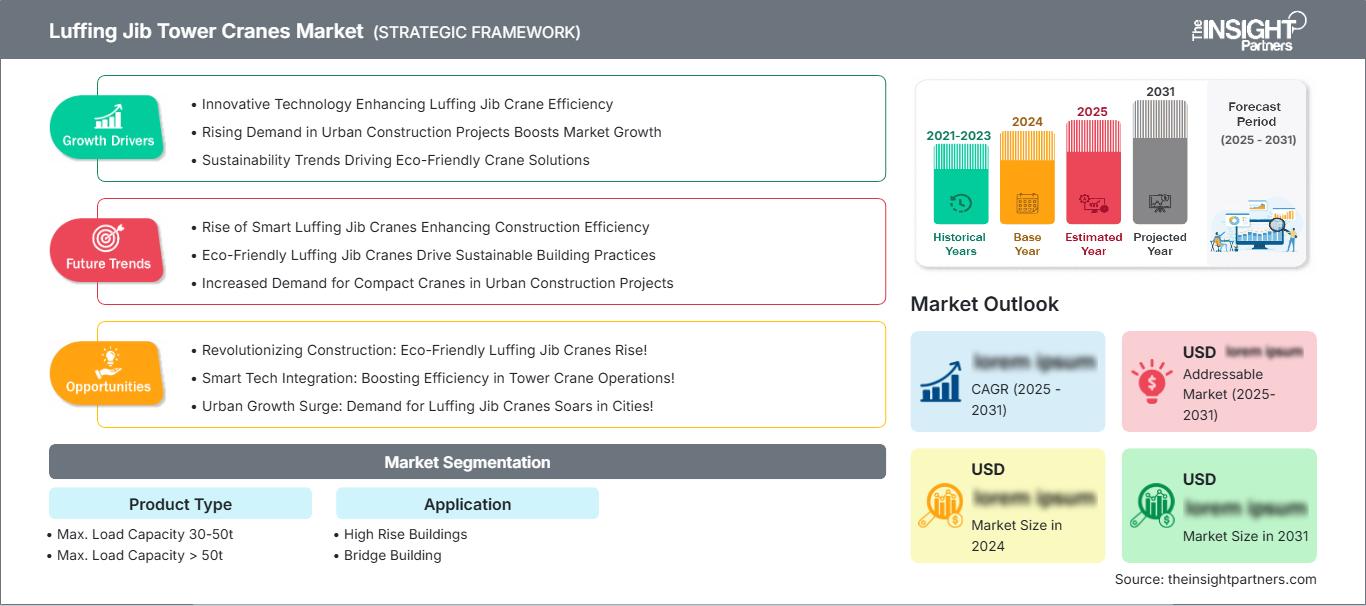
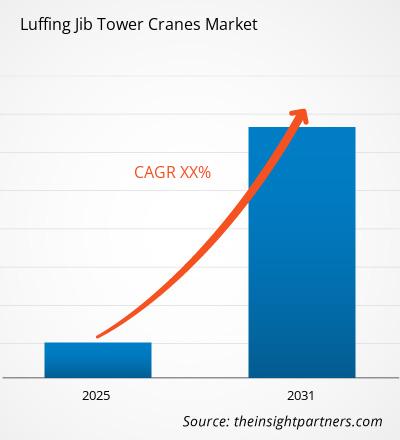
The Luffing Jib Tower Cranes Market was valued at US$ 3.10 Billion in 2025 and is projected to reach US$ 5.30 Billion by 2034; it is expected to register a CAGR of 6.14% during 2026–2034. The market reflects rising demand for compact, high-capacity lifting systems in congested urban construction, where short out-of-service radius, precise load control, and electric operation support safer high-rise and bridge building activity.
North America is expected to advance at a 5.8–6.3% CAGR during 2026–2034, supported by dense urban redevelopment, transport infrastructure renewal, and rising use of luffing cranes on constrained downtown sites. U.S. high-rise, hospital, data center, and bridge projects are strengthening rental fleet utilization, while stricter jobsite safety planning is increasing demand for anti-collision systems and remote monitoring.
Luffing Jib Tower Cranes Market Assessment and Insights
- North America held 28–32% share in 2025 and is growing at a 5.8–6.3% CAGR between 2026–2034, led by urban redevelopment, bridge rehabilitation, and high-value commercial construction.
- The U.S. represented 78–82% of North America in 2025 and is expanding at a 5.9–6.4% CAGR between 2026–2034, driven by metropolitan infill projects.
- Europe accounted for 24–28% share in 2025 and is growing at a 4.9–5.4% CAGR between 2026–2034, with Germany, the UK, France, Italy, and Spain leading adoption.
- Asia Pacific captured 30–34% share in 2025 and is advancing at a 6.8–7.4% CAGR between 2026–2034, supported by China, India, Japan, South Korea, and Australia.
- Largest Segment: High Rise Buildings held 66–70% market share in 2025 and is growing at a 5.9–6.4% CAGR between 2026–2034 due to dense urban construction.
- High Growth Segment: Bridge Building held 30–34% market share in 2025 and is growing at a 6.6–7.2% CAGR between 2026–2034 as transport infrastructure investment rises.
- Key companies analyzed in detail: Liebherr-International Deutschland GmbH, WOLFFKRAN International AG, Terex Corporation, Shandong Dahan Construction Machinery Co., Ltd., The Manitowoc Company, Inc., Linden Comansa S.L., Leavitt Cranes, Grúas Sáez, S.L., Raimondi Cranes S.p.A., Shandong Tavol Machinery Co., Ltd., Zoomlion Heavy Industry Science and Technology Co., Ltd., and XCMG Construction Machinery Co., Ltd.
Source: The Insight Partners' analysis based on proprietary research, government publications, company annual reports, investor presentations, industry databases, and expert interviews.
Market evolution has been shaped by the shift from conventional horizontal-jib configurations to compact luffing designs that reduce oversailing risk in city cores. Manufacturers are improving load charts, hoist speeds, mast compatibility, and digital diagnostics to shorten erection cycles and improve fleet productivity. The Luffing Jib Tower Cranes Market analysis also shows rising preference for electric drives, aramid-supported jib systems, and operator-assist controls that address noise, emissions, and safety compliance.
Forward demand will be strongest where urban land scarcity, rail-oriented development, and bridge renewal programs intersect. Asia Pacific offers the fastest growth base, while North America provides resilient replacement demand through rental fleets. The Luffing Jib Tower Cranes Market scope is also widening as prefabricated components, heavier façade modules, and multi-crane jobsite planning require precise lifting equipment with better telemetry, lower tail swing, and reliable service support.
Luffing Jib Tower Cranes Market Report Scope
| Report Attribute | Details |
|---|---|
| Market size in 2025 | US$ 3.10 Billion |
| Market Size by 2034 | US$ 5.30 Billion |
| Global CAGR (2026 - 2034) | 6.14% |
| Historical Data | 2021-2024 |
| Forecast period | 2026-2034 |
Luffing Jib Tower Cranes Market Analysis
Demand is anchored in high-rise buildings and bridge building, where crane radius control directly affects work sequencing, airspace safety, and project duration. Luffing jib models are favored on constrained plots because the boom can be raised to reduce conflicts with adjacent properties, live roads, rail corridors, and other cranes. This supports Luffing Jib Tower Cranes Market growth across dense commercial districts and transit-linked development zones.
The ecosystem comprises tower crane original equipment manufacturers, tower crane rentals, erection firms, component suppliers, software firms, and construction firms. Supply is affected by steel fabrication capacity, hoist motor capacity, mast sections that work together, and the availability of skilled operators. The buyer base is assessing more of the lifetime cost, transportation unit, installation time, and service response, besides just lifting capacities, since delays in vertical construction have an impact on several trades.
There is moderate consolidation at the high end and fragmentation within the value-based regional supply of the ecosystem. Liebherr-International Deutschland GmbH and WOLFFKRAN International AG compete using advanced engineering, smaller footprints, and services. At the same time, Terex Corporation, through Raimondi Cranes S.p.A., reinforces high-capacity luffer positioning for electric tower cranes. Chinese firms, including Shandong Dahan Construction Machinery Co., Ltd., Shandong Tavol Machinery Co., Ltd., Zoomlion Heavy Industry Science and Technology Co., Ltd., and XCMG Construction Machinery Co., Ltd., are key participants in cost-sensitive sourcing. These competitive developments support a positive Luffing Jib Tower Cranes Market Forecast.
Priority is being placed on investment in fleet standardization, telematics, energy-efficient cranes, and modularity in crane assembly. Crane rental companies such as Leavitt Cranes are investing in cranes that have the ability to work on various projects without incurring high costs of transportation. Linden Comansa S.L., The Manitowoc Company, Inc., Grúas Sáez, S.L., among others, have aligned their investments to focus on reliability and application-based engineering.
● REPORT CUSTOMIZATION
Tailor This Report To Align With Your Specific Business Requirements
This report can be customized to align precisely with your business objectives, scope, and target markets. Customization options include tailored segmentation, geography, competitive analysis, and strategic insights to support informed decision-making.
Customize This Report →WHAT YOU CAN ADJUST
- ● Segmentations
- ● Geography
- ● Competitive Analysis
- ● Language Preferences
Luffing Jib Tower Cranes Market: Strategic Insights
Regional Insights
North America Luffing Jib Tower Cranes Market
North America held 28–32% share in 2025 and is projected to grow at a 5.8–6.3% CAGR during 2026–2034. The region benefits from high-value construction in dense metropolitan locations, where oversailing restrictions, limited laydown space, and multi-crane coordination favor luffing jib units. Public bridge rehabilitation and rail corridor upgrades also support demand because precise load placement reduces disruption around live infrastructure. Rental penetration is structurally important in the region, as contractors often prefer project-specific crane access over ownership. The Luffing Jib Tower Cranes Market size in North America is supported by hospitals, mixed-use towers, data centers, and transport assets requiring reliable lifting under strict safety regimes. OEM service networks and operator training influence procurement decisions as much as rated capacity.
U.S. Luffing Jib Tower Cranes Market
The U.S. accounted for 78–82% of North America in 2025 and is expected to expand at a 5.9–6.4% CAGR between 2026–2034. Demand is concentrated in New York, Boston, Seattle, San Francisco, Chicago, Miami, and other cities where constrained parcels require short-radius lifting. High-rise buildings remain the primary application, while bridge building supports incremental utilization. These regional developments are highlighted in the Luffing Jib Tower Cranes Market Report. Company presence is shaped by rental fleets, dealer networks, and OEM technical support. Liebherr-International Deutschland GmbH, WOLFFKRAN International AG, Terex Corporation, Raimondi Cranes S.p.A., and The Manitowoc Company, Inc. are visible through premium supply channels. Contractors prioritize anti-collision planning, electric operation, and uptime assurance as project schedules become more trade-intensive.
Europe Luffing Jib Tower Cranes Market
Europe represented 24–28% share in 2025 and is forecast to grow at a 4.9–5.4% CAGR during 2026–2034. Germany is the leading country, supported by stable civil engineering, commercial refurbishment, and strict site-safety expectations. Mature rental markets favor cranes with lower transport requirements, fast assembly, and advanced control systems, as highlighted in the Luffing Jib Tower Cranes Market Report. The UK market is shaped by central London redevelopment, transport hubs, hospitals, and mixed-use towers where oversailing permissions and tight site boundaries influence crane choice. Contractors value compact counter-jib geometry and quiet electric operation. Germany emphasizes engineering reliability, operator safety, and productivity in urban renewal and infrastructure programs. France, Italy, and Spain contribute through metro-linked construction, tourism-related redevelopment, residential densification, and bridge modernization. Luffing Jib Tower Cranes Market share across Europe is reinforced by compliance-driven equipment replacement, particularly where contractors need precise lifting near existing buildings, public roads, and heritage-sensitive urban zones.
APAC Luffing Jib Tower Cranes Market
Asia Pacific held 30–34% share in 2025 and is projected to grow at a 6.8–7.4% CAGR during 2026–2034, making it the fastest-growing region. China remains the leading country due to scale, local manufacturing, and high-rise construction density. These factors are supporting the expansion of the Luffing Jib Tower Cranes Market across the Asia Pacific region. India, Japan, South Korea, and Australia add demand through metro systems, commercial towers, hospital projects, and waterfront redevelopment. Policy-backed infrastructure pipelines support rental fleet expansion and localized service networks. Industrial construction and prefabrication increase demand for higher lift accuracy. Regional buyers also assess price, maintenance access, and mast compatibility, creating opportunities for both global premium brands and domestic manufacturers.
Middle East & Africa Luffing Jib Tower Cranes Market
The Middle East & Africa are anticipated to witness growth at a CAGR of 5.6–6.2% between 2026 and 2034. The largest market is that of Saudi Arabia due to various mixed-use projects, transport, and energy-related infrastructure. UAE is one of the major contributors through high-rise buildings requiring cranes with small envelopes. Selective demand is seen from South Africa through urban construction, port operations, and bridge maintenance. The rest of MEA is project-driven and is affected by factors such as contractor funding, the presence of imported cranes, and maintenance capabilities. Investments in the areas of energy, airport, and logistics provide occasional but high-value lifting applications.
Segmentation Analysis
Product Type
Product Type is expected to grow at a 5.8–6.5% CAGR during 2026–2034. Demand is shaped by project load requirements, available site footprint, transport constraints, and erection time. Contractors increasingly match crane capacity to prefabricated components, steel assemblies, and façade modules, while rental firms balance utilization across mid-capacity and heavy-lift fleets.
- Max. Load Capacity 30-50t remains important for dense urban towers, hospitals, and commercial buildings, offering a balance between lifting strength, transport efficiency, and broad rental fleet applicability.
- Max. Load Capacity > 50t serves heavy infrastructure, large bridge components, and complex high-rise modules where fewer lifts, stronger load charts, and longer operating radii improve project sequencing.
Application
Application is projected to grow at a 6.0–6.7% CAGR during 2026–2034. High-rise buildings dominate demand because luffing cranes minimize interference on compact urban plots. Bridge building is gaining strategic relevance as governments prioritize transport resilience, asset replacement, and corridor upgrades requiring controlled lifting near traffic, water, utilities, and existing structures.
- High-rise buildings generate the largest revenue contribution as developers pursue vertical space efficiency, mixed-use density, and constrained-site construction requiring short-radius lifting and coordinated multi-crane operation.
- Bridge Building is strategically important where replacement spans, precast segments, and steel components require accurate placement, strong lifting control, and safe operation around live transport routes.
Opportunity Snapshot
| Application | Revenue Contribution | Trend Tag | Adoption Stage |
| High Rise Buildings | High | Urban Infill | Mature |
| Bridge Building | Medium | Span Renewal | Scaling |
Luffing Jib Tower Cranes Market Growth Drivers and Impact Analysis
Urban Densification and Restricted Site Geometry
Urban densification becomes the greatest structural driver since more and more buildings are built on small land plots bounded by other buildings, roads, utility infrastructure, and transportation resources. Luffing jib cranes minimize risks of oversailing by lifting the boom and working with a reduced radius compared to many tower cranes. Such an approach allows for keeping the work going despite poor access to the site and stringent property rights regulations of adjacent lands. The direct result is higher use of luffing jib cranes in urban skyscrapers, hospitals, educational facilities, and multi-purpose buildings. In accordance with zoning policies encouraging vertical density near transit centers, contractors will stick to such machines.
Infrastructure Renewal and Bridge Replacement Programs
Bridge construction is now emerging as an increasing demand pocket because older transportation assets need to be rehabilitated, widened, and replaced. This is achieved through the utilization of luffing jib tower cranes, which place steel segments, precast beams, formwork, and temporary works with controlled radius movements near highways, railways, rivers, and utilities. Being able to work in narrow passageways makes them less dependent on larger mobile cranes on the ground, which are not accessible to certain areas. The market implication is that the applicability of such cranes will increase beyond just the construction of tall structures, especially in North America, Europe, India, Australia, and Gulf countries.
Electrification, Safety Controls, and Fleet Productivity
Electrification and assisted operator technology are changing procurement parameters. Today's luffing jib cranes have an electric winch, an inverter-controlled swing, an anti-collision system, load-moment monitoring, remote diagnostics, and self-leveling capability. All of these help with accuracy, noise reduction, and allow compliance on busy sites with detailed safety planning. Rentals can see higher usage rates through faster setup, common parts, and maintenance prediction data. This is seen through decreased downtime possibilities and improved life-cycle economics. With a shortage of labor and time constraints, digital controls are becoming an essential part of equipment decisions.
Luffing Jib Tower Cranes Market Future Trends
Telematics-Enabled Lift Planning
Future fleet differentiation will increasingly depend on telematics-enabled lift planning. Contractors will use crane operating data, wind alerts, load histories, and maintenance signals to improve sequencing before crews arrive on site. This will support digital twins of vertical construction projects, where crane location, hook time, and material delivery windows are modeled together. The Luffing Jib Tower Cranes Market trends point toward data-sharing between OEMs, rental providers, and contractors to reduce idle time and improve safety documentation. As insurance and safety audits become more data-led, connected cranes will move from premium features to expected project controls.
Higher Capacity Cranes for Modular Construction
The development of modular and prefab construction means that there is going to be a greater need for luffing cranes capable of carrying heavier loads of room modules, façade panels, steel structures, and mechanical plant sections. There is a shift from numerous small lifts to a few but highly valued lifts that minimize schedule time and site congestion. This is a move that would benefit cranes over 50 tons in complex construction projects, including bridges, hospitals, data centers, and high-rise mixed-use buildings.
Luffing Jib Tower Cranes Market Opportunities
Rental Fleet Expansion in Fast-Growing Cities
Expansion of rental fleets appears to be an obvious business opportunity in rapidly growing cities where contractors require advanced cranes, but do not wish to make an extended investment commitment. Mid-sized capacity luffing cranes could cater to repeat high-rise, hospitals, and commercial building projects, whereas larger capacity cranes would cater to bridges and modular projects. Renters could increase the utilization through standardized mast sections, training technicians, and providing lift planning assistance. Original Equipment Manufacturers (OEMs) who provide financing facilities, availability of spares and predictive maintenance software could generate additional revenue streams beyond equipment sales. The opportunity would be available in India, Southeast Asia, the Gulf and U.S metropolitan cities.
Aftermarket Services and Lifecycle Modernization
Modernization of aftermarkets presents an enticing prospect since crane owners are looking for extended lifespans, increased safety compliance, and higher utilization rates from the fleet that they already own. Modernizations could be in the form of upgrading control systems, hoists, anti-collision mechanisms, condition monitoring, and operator cabins. Revenue generated from services is very robust, considering that cranes need to be inspected, certified, repaired and maintained during their entire lifecycle. Original equipment manufacturers as well as service organizations can build a niche through fast availability of parts, remote diagnostics, and modernization packages in compliance with local regulations.
Recent Developments
- February 2025: Liebherr announced a new generation of HC-L luffing jib cranes is coming to Bauma in Munich, including the 440 HC-L 12/24, 440 HC-L 18/36, and 620 HC-L 18/36. The models introduced improved performance, reduced out-of-service positions, aramid guying, fewer transport units, and simplified assembly for compact urban sites.
- November 2025: The Manitowoc Company, Inc. announces the launch of the MCR 505 J25, a high-performance luffing jib tower crane engineered to meet the evolving demands of modern construction sites around the world.
- April 2025: WOLFFKRAN International AG product development strategy for years and is also reflected in the exhibits at this year’s bauma. The five-member bauma pack is completed by a powerful new luffing jib crane: the WOLFF 550 B. It stands out for its high lifting capacity and flexibility.
Frequently Asked Questions

- Comprehensive Market Sizing and Forecast Analysis
- Detailed Segmentation Analysis
- In-Depth Market Dynamics Assessment
- Regional and Country-Level Insights
- Competitive Landscape and Company Benchmarking
- Strategic Business Intelligence
Recent Reports
Testimonials

The Insight Partners provided valuable market intelligence that supported our global go-to-market strategy. Their team was professional, responsive, and attentive to our feedback, providing thoughtful analysis and helpful methodological clarifications throughout the project.
Junmo Kim Chief Financial Officer (CFO), Enertech Co., Ltd.
The Insight Partners' SCADA System Market report is comprehensive, with valuable insights on current trends and future forecasts. The team was highly professional, responsive, and supportive throughout. We are very satisfied and highly recommend their services.
RAN KEDEM Partner, Reali Technologies LTDs
I requested a report on a very specific software market and the team produced the report in a few days. The information was very relevant and well presented. I then requested some changes and additions to the report. The team was again very responsive and I got the final report in less than a week.
JEAN-HERVE JENN Chairman, Future Analytica
We worked with The Insight Partners for an important market study and forecast. They gave us clear insights into opportunities and risks, which helped shape our plans. Their research was easy to use and based on solid data. It helped us make smart, confident decisions. We highly recommend them.
PIYUSH NAGPAL Sr. Vice President, High Beam Global
The Insight Partners delivered insightful, well-structured market research with strong domain expertise. Their team was professional and responsive throughout. The user-friendly website made accessing industry reports seamless. We highly recommend them for reliable, high-quality research services
YUKIHIKO ADACHI CEO, Deep Blue, LLC.
This is the first time I have purchased a market report from The Insight Partners.While I was unsure at first, I visited their web site and felt more comfortable to take the risk and purchase a market report.I am completely satisfied with the quality of the report and customer service. I had several questions and comments with the initial report, but after a couple of dialogs over email with their analyst I believe I have a report that I can use as input to our strategic planning process.Thank you so much for taking the extra time and making this a positive experience.I will definitely recommend your service to others and you will be my first call when we need further market data.
JOHN SUZUKI President and Chief Executive Officer, Board Director, BK Technologies
I wish to appreciate your support and the professionalism you displayed in the course of attending to my request for information regarding to infectious disease IVD market in Nigeria. I appreciate your patience, your guidance, and the fact that you were willing to offer a discount, which eventually made it possible for us to close a deal. I look forward to engaging The Insight Partners in the future, all thanks to the impression you have created in me as a result of this first encounter.
DR CHIJIOKE ONYIA MANAGING DIRECTOR, PineCrest Healthcare Ltd.Reason to Buy
- Informed Decision-Making
- Understanding Market Dynamics
- Competitive Analysis
- Identifying Emerging Markets
- Customer Insights
- Market Forecasts
- Risk Mitigation
- Boosting Operational Efficiency
- Strategic Planning
- Investment Justification
- Tracking Industry Innovations
- Aligning with Regulatory Trends





 Get Free Sample for