
Machine Tools Market Demand, Share & Growth by 2034
Coverage: by Product Type (Milling Machines, Grinding Machines, Drilling Machines, Turning Machines, Electrical Discharge Machines); Industry (Automotive and Transportation, Sheet Metals, Capital Goods, Energy); Automation (CNC Machine Tools, Conventional Machine Tools) , and Geography (North America, Europe, Asia Pacific, and South and Central America)
- Status : Data Released
- Report Code : TIPTE100001056
- Category : Manufacturing and Construction
- No. of Pages : 150
- Available Report Formats :


- Last update date : July 16, 2026


2025 Market Size
US$ 86.64 Bn
Base year value
2034 Forecast
US$ 119.56 Bn
Projected by 2034
CAGR 2026-2034
3.64 %
Growth rate
Addressable Market
US$ 936.37 Bn
(2026-2034)
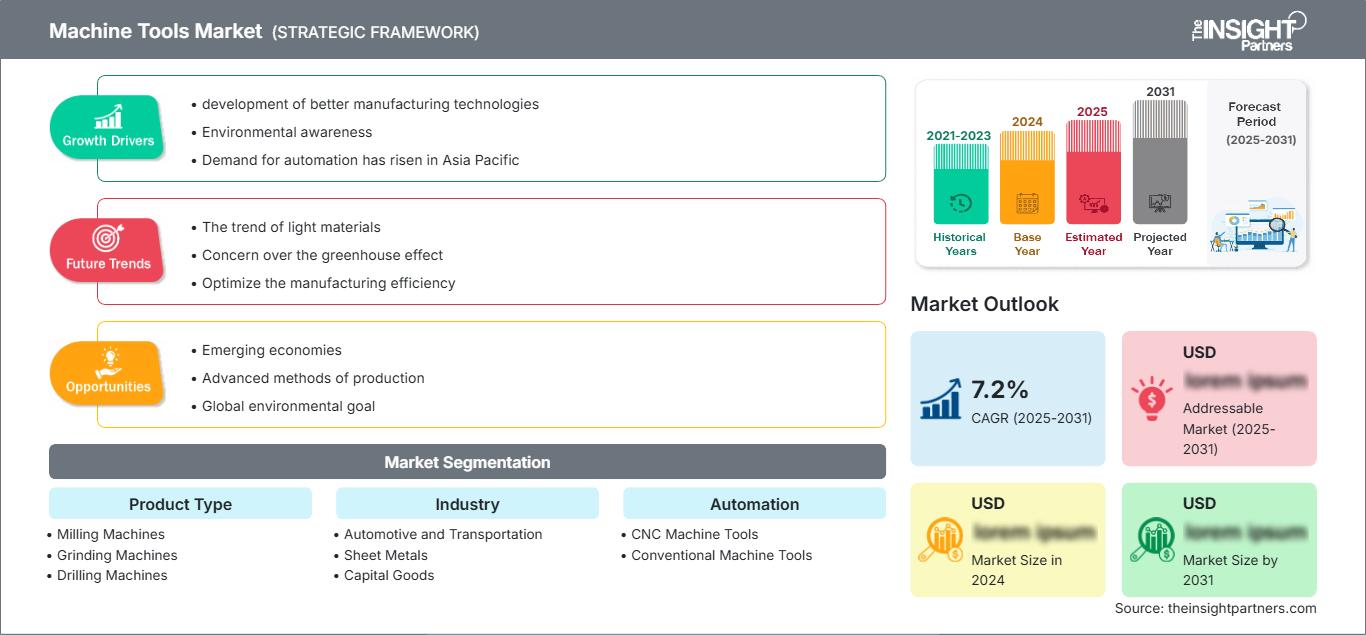
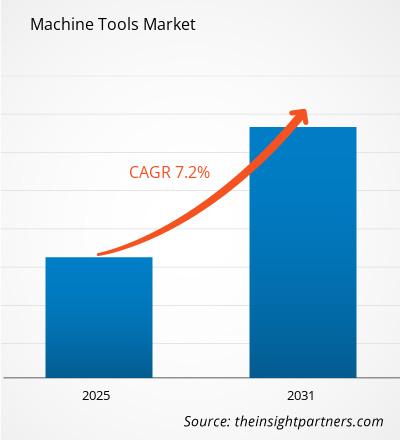
The Machine Tools Market size is anticipated to reach a value of US$ 119.56 billion by 2034 with a growth rate of 3.64% over the period of 2026–2034, starting from US$ 86.64 billion in 2025. The growth drivers are going to be precision manufacturing, automation within the factories, and investments in machining capacities used in automotive and transportation industries, sheet metals, capital goods, and energy sectors.
North America is likely to grow at a CAGR of 3.1–3.5% from 2026 to 2034 due to reshoring, aerospace machining needs, and increased capital expenditure on automatic metal working machinery. In 2025, the total orders of manufacturing technologies in the U.S. amounted to US$ 5.74 billion, growing by 22.5% year over year.
Machine Tools Market Assessment and Insights
- North America: The region is expected to account for 18–21% Machine Tools Market share in 2025 and grow at a CAGR of 3.1–3.5% during 2026–2034, led by reshoring, aerospace demand, and automation investment.
- US: The U.S. is projected to hold 78–82% of North America in 2025 and grow at a CAGR of 3.2–3.6% during 2026–2034, supported by durable goods and defense programs.
- Europe: Europe is estimated at 20–23% share in 2025 and a CAGR of 2.8–3.2% during 2026–2034, with Germany, Italy, France, Spain, and the UK leading precision equipment demand.
- Asia Pacific: Asia Pacific is expected to hold 49–53% share in 2025 and grow at a CAGR of 4.0–4.4% during 2026–2034, led by China, Japan, South Korea, and India.
- Largest Segment: CNC Machine Tools are estimated to hold 68–72% market share in 2025 and grow at a CAGR of 4.1–4.5% during 2026–2034, reflecting automation-led replacement cycles.
- High Growth Segment: Electrical Discharge Machines are expected to hold 7–10% market share in 2025 and grow at a CAGR of 4.4–4.8% during 2026–2034, supported by complex tooling and aerospace components.
- Key companies analyzed in detail: AMADA CO., LTD., CHIRON Group SE, DMG MORI CO., LTD., DN Solutions Co., Ltd., Haas Automation, Inc., Hyundai WIA Corporation, Makino Inc., Indústrias Romi S.A., SPINNER Werkzeugmaschinenfabrik GmbH, and Yamazaki Mazak Corporation.
Source: The Insight Partners' analysis based on proprietary research, government publications, company annual reports, investor presentations, industry databases, and expert interviews.
From individualized machining tools to digital connections for machining platforms offering multi-axis motion, tool inspection, robotic assistance, and predictive services, the market has evolved significantly. While automotive electrification continues to reduce demand for traditional powertrain machining, it has increased demand for machining of battery housings, cooling systems, lightweight components, and dies. Hence, suppliers are modifying their portfolios to cater to flexible CNC machines, hybrid cell technology, and application-driven automation that allows small batch size, quick set-up times, and production quality traceability.
The Machine Tools Market forecast indicates that new manufacturing hubs in India, Southeast Asia, Mexico, and Eastern Europe will create incremental opportunities for equipment demand due to supply chain diversification. The emphasis by regulatory bodies on energy savings, workplace safety, and domestic manufacturing will drive the demand for low-power-consumption machines, enclosed processing areas, and automated material handling. Growth prospects for the Machine Tools Market look stable and modest, as replacement cycles continue to favor productivity per operator over the number of installations.
Machine Tools Market Report Scope
| Report Attribute | Details |
|---|---|
| Market size in 2025 | US$ 86.64 Billion |
| Market Size by 2034 | US$ 119.56 Billion |
| Global CAGR (2026 - 2034) | 3.64% |
| Historical Data | 2021-2024 |
| Forecast period | 2026-2034 |
Machine Tools Market Analysis
The demand is due to manufacturers looking for tighter tolerances, less scrap rates, and higher efficiencies in metal-cutting and forming. The largest end user group remains automotive and transport, while the capital goods and energy sectors are buying more large machinery. According to the Machine Tools Market report, purchasers also consider machining costs, spindle usage, software, and services in addition to the machine's price.
The market consists of machine builders, control providers, tool manufacturers, metrology companies, automation providers, and maintenance partners. The supply factors continue to include castings, guides, ball screws, CNC controls, and assembler skill sets. Although lead times have improved from their pandemic-high levels, customers still favor suppliers that can provide regional services and have installation capabilities.
The competitive environment is characterized by diversified machine manufacturers that integrate machining technology with automation, software, and application engineering. AMADA CO., LTD is investing in sheet metal technologies; DMG MORI CO., LTD is focusing on machining solutions; and Yamazaki Mazak Corporation is marketing multitasking and laser-cutting machines. On the other hand, Makino Inc., Hyundai WIA Corporation, Haas Automation, Inc. and DN Solutions Co., Ltd are competing through installed base size and productive product range.
Machine Tools Market trends indicate a transition from individual machines to cell technology, mainly when labor availability is limited. CHIRON Group SE, SPINNER Werkzeugmaschinenfabrik GmbH and Indústrias Romi S.A are positioned with respect to flexible manufacturing and regional customer support. Thus, the Machine Tools Market is becoming increasingly dependent on services throughout the lifecycle, digital controls, automation readiness, and the ability to serve both high-volume and high-mix production.
● REPORT CUSTOMIZATION
Tailor This Report To Align With Your Specific Business Requirements
This report can be customized to align precisely with your business objectives, scope, and target markets. Customization options include tailored segmentation, geography, competitive analysis, and strategic insights to support informed decision-making.
Customize This Report →WHAT YOU CAN ADJUST
- ● Segmentations
- ● Geography
- ● Competitive Analysis
- ● Language Preferences
Machine Tools Market: Strategic Insights
Regional Insights
North America Machine Tools Market
The share of North America is projected to stand at 18-21% in 2025 and witness growth at a CAGR of 3.1-3.5% until 2034. The drivers include reshoring, conversion of backlog of aerospace, and defense-associated machining applications. According to AMT, there was an order of US$5.74 billion for manufacturing technologies in the USA in 2025, up 22.5%. This shows a revival in capital investment in higher-value machines. The main driving factor behind the trend toward automation is that firms are investing less in simpler units and more in advanced machines equipped with loading, inspection, and software capabilities. There has also been an increased significance of Mexico as a result of the localization of automotive and appliance production by suppliers.
U.S. Machine Tools Market
According to the forecasts, in 2025, the U.S. will have 78% – 82% of North America's market share and will experience a CAGR of 3.2% – 3.6% between 2026 and 2034. Demand is influenced by contract machining, aerospace, electrical machinery, and fabricated metal industries. According to AMT, orders in December 2025 were worth US$814.3 million, the highest monthly total ever. Companies' presence is wide-ranging, with Haas Automation, Inc. being used by high-volume domestic customers and foreign companies having their own technology centers, distributors, and service centers. The application is moving towards five-axis milling, automated bending, laser cutting of tubes, and CNC turning of complicated parts. Scope of the Machine Tools Market in the country is growing due to customers' association of buying machines with tax benefits and productivity rates.
Europe Machine Tools Market
Europe is estimated to hold 20–23% share in 2025 and grow at a CAGR of 2.8–3.2% during 2026–2034. Germany remains the leading country because of its automotive, machinery, and precision engineering base. UK demand is supported by aerospace machining, motorsport suppliers, defense modernization, and reshoring of specialized metalworking capacity. Replacement demand in Germany is driven by the need for high-end CNC machines, grinding machines, multi-tasking systems, and automated cells. Although export-oriented producers are spending carefully, they are still focused on quality, energy efficiency, and monitoring production digitally. DMG MORI CO., LTD., CHIRON Group SE, and SPINNER Werkzeugmaschinenfabrik GmbH have a great advantage of close engineering presence and installed base servicing relationships. France, Italy, and Spain add demand for the aerospace industry, metal fabrication industry, transport equipment manufacturing, and energy industry components. Italy's machine tool environment is crucial in meeting the region's needs, while France is focused on precision machining for its aerospace and nuclear industries. Spanish producers are slowly upgrading their automotive and wind energy supply chains.
APAC Machine Tools Market
APAC is expected to account for 49–53% share in 2025 and grow at a CAGR of 4.0–4.4% through 2034. China is the leading country, supported by electronics, EVs, industrial machinery, and domestic equipment upgrading. Japan and South Korea continue to be important technology providers and users in terms of high-precision machining, automotive parts, ships, and semiconductor tools. India continues to increase demand via production linked schemes, railways, defense, and capital goods localization. Australia provides lesser but consistent demand via mining equipment, repairs, and energy infrastructure projects. Manufacturing self-sufficiency policies in the region help in the adoption of CNC machines, while local vendors compete in price, and international vendors compete in precision, reliability, and service capabilities.
Middle East & Africa Machine Tools Market
Middle East & Africa is forecast to grow at a CAGR of 3.3–3.7% during 2026–2034. Saudi Arabia is the leading country, supported by industrial localization, oilfield equipment, construction metals, and defense manufacturing initiatives. The UAE is investing in advanced manufacturing, aviation services, and fabrication capacity, creating demand for CNC machining, laser cutting, and bending systems. South Africa remains important for mining equipment, automotive components, and maintenance machining. Rest of MEA demand is project-led and linked to infrastructure, power, transport, and repair workshops. The region’s opportunity is strongest where energy and industrial diversification programs justify durable equipment purchases and local service partnerships.
Segmentation Analysis
Product Type
Product Type is expected to grow at a CAGR of 3.5–3.9% during 2026–2034 as manufacturers balance standard machining needs with higher-precision, application-specific equipment. Buyers are replacing aging assets with machines that improve accuracy, reduce setup time, and support automation. Demand differs by process, with milling and turning serving broad production while grinding, drilling, and EDM address specialized tolerances and complex geometries.
- Milling Machines remain central to die, mold, aerospace, and general engineering workflows because they support versatile material removal, multi-axis machining, and high-mix production with repeatable accuracy.
- Grinding Machines serve applications requiring tight surface finish, dimensional stability, and hardened component processing, making them strategically important for automotive, bearings, tooling, and precision capital goods.
- Drilling Machines support structural fabrication, sheet metal, construction equipment, and assembly preparation, with demand strongest where productivity improvements reduce manual operations and secondary processing.
- Turning Machines remain essential for shafts, housings, fasteners, and rotating components, with CNC turning centers gaining preference for repeatability, unattended operation, and integrated milling capability.
- Electrical Discharge Machines address hard metals, molds, medical parts, aerospace components, and micro-features, making them valuable where conventional cutting faces geometry or material limitations.
Industry
Industry demand is expected to grow at a CAGR of 3.4–3.8% during 2026–2034, reflecting different capital cycles across automotive, sheet metals, capital goods, and energy. Automotive demand is shifting from engine components toward EV structures and lightweight systems. Capital goods and energy buyers emphasize durability, large work envelopes, and serviceability, while sheet metal users prioritize automation, nesting efficiency, and bending accuracy.
- Automotive and Transportation remain a core demand base as suppliers machine chassis, driveline, braking, rail, aerospace, and EV-related components under strict cost, quality, and traceability requirements.
- Sheet Metals require cutting, punching, bending, and forming systems that reduce manual handling, improve nesting yield, and support variable batch sizes in fabrication and appliance production.
- Capital Goods users invest in robust machining platforms for industrial equipment, pumps, valves, machinery frames, and tooling, where lifecycle reliability and service support influence procurement decisions.
- Energy applications require equipment for turbines, oilfield components, renewable structures, nuclear systems, and repair operations, emphasizing large-part machining, tough materials, and dimensional consistency.
Automation
Automation is expected to grow at a CAGR of 4.0–4.4% during 2026–2034 as manufacturers link equipment purchasing to labor productivity, uptime, and consistent quality. CNC Machine Tools dominate replacement spending because they enable repeatability, program storage, and integration with robotics. Conventional Machine Tools retain relevance in repair, training, and low-volume workshops where flexibility and lower upfront cost matter.
- CNC Machine Tools are the largest automation category, preferred for repeatable precision, unattended operation, data capture, and integration with pallet systems, robots, and tool monitoring.
- Conventional Machine Tools remain relevant for maintenance shops, training centers, and custom repair tasks where operator judgment, low acquisition cost, and simple servicing are priorities.
Opportunity Snapshot
| Industry | Revenue Contribution | Trend Tag | Adoption Stage |
| Automotive and Transportation | High | EV Parts | Scaling |
| Sheet Metals | Medium | Laser Cells | Scaling |
| Capital Goods | High | Heavy Machining | Mature |
| Energy | Medium | Turbine Parts | Scaling |
Machine Tools Market Growth Drivers and Impact Analysis
Automation-Led Productivity Upgrades
Manufacturers are investing in automation because skilled machinists remain limited and production schedules require higher utilization from every asset. The impact is visible in purchasing patterns where order values rise faster than unit volumes, indicating demand for machines bundled with robotic loading, pallet pools, tool monitoring, and digital controls. This shift strengthens suppliers that can deliver turnkey cells rather than standalone equipment. It also raises average selling prices and improves lifecycle service opportunities. For buyers, automation reduces idle time, stabilizes quality, and supports night-shift or lights-out production, making it a practical response to labor constraints and margin pressure.
Precision Demand from Mobility and Industrial Equipment
Automotive electrification, aerospace production, rail modernization, and industrial equipment manufacturing require components with tighter tolerances, lighter materials, and more complex geometries. Machine tools are essential for housings, molds, shafts, structural parts, battery enclosures, and turbine components. As design complexity rises, buyers move toward five-axis milling, high-precision turning, grinding, and EDM systems that reduce secondary operations. The market impact is a gradual mix shift toward higher-capability platforms, even in moderate-growth end markets. Suppliers with application engineering expertise gain an advantage because customers increasingly need process validation, fixture design, tooling recommendations, and quality assurance support before committing capital.
Regional Manufacturing Localization
Governments and manufacturers are localizing production to reduce supply-chain exposure, shorten delivery cycles, and capture strategic industrial value. This supports new machining capacity in India, Mexico, Southeast Asia, Eastern Europe, and Gulf industrial zones. Localization does not always create immediate high-volume demand, but it increases procurement of flexible CNC systems, fabrication machinery, and repair equipment for supplier ecosystems. The impact is broader geographic diversification of sales pipelines and greater importance of local service partners. Machine builders that combine global technology with regional financing, training, spare parts, and maintenance support are better positioned to convert localization policies into durable orders.
Machine Tools Market Future Trends
Connected Machining and Digital Twins
Connected machining will move from monitoring dashboards to closed-loop production support, where machine data, tool condition, inspection results, and maintenance history guide operating decisions. Digital twins will help simulate cutting paths, avoid collisions, estimate cycle times, and optimize energy use before production starts. This trend will be especially relevant for aerospace, medical, and high-value industrial parts where scrap is costly. Over time, software capability will become a stronger differentiator in the Machine Tools Market, influencing supplier selection alongside mechanical rigidity, spindle performance, and service responsiveness.
Hybrid and Process-Integrated Platforms
Future production strategies will favor platforms that combine turning, milling, grinding, laser processing, additive repair, measurement, and automated handling in fewer setups. The goal is not only speed but also reduced work-in-process, fewer fixtures, and better part traceability. Hybrid systems will gain traction in aerospace, tooling, energy, and advanced materials because they allow manufacturers to consolidate specialized operations. Suppliers able to provide integrated programming, tooling, and post-sale process support will capture premium opportunities as customers seek complete manufacturing solutions rather than isolated machines.
Machine Tools Market Opportunities
Aftermarket Services and Retrofit Programs
Installed bases across developed markets create a substantial opportunity for preventive maintenance, spindle repair, control upgrades, automation retrofits, and training services. Many manufacturers cannot replace all aging equipment at once, but they can improve uptime and data visibility through targeted modernization. Service-led offerings also stabilize revenue for machine builders during slower capital cycles. Companies that package diagnostics, remote support, spare parts, and retrofit automation can deepen customer relationships while extending machine life. This opportunity is particularly attractive for suppliers with regional technicians and digital platforms that make maintenance predictable.
Mid-Range CNC Systems for Emerging Manufacturers
Emerging manufacturers need reliable CNC capability but often face budget, financing, and skills constraints. Mid-range systems with intuitive controls, compact footprints, and optional automation can address this gap. Demand is likely to grow among suppliers serving EV components, agricultural equipment, fabricated metals, and industrial repair. Machine builders can improve conversion by offering application templates, operator training, financing, and modular automation paths. The opportunity is strongest where local production policies encourage small and medium enterprises to upgrade from conventional equipment to programmable, repeatable machining platforms.
Recent Developments
- March 2026: Haas Automation showcasing the very latest Haas CNC machines tools and manufacturing technology at NEC Birmingham, MACH 2026. The company’s advanced, highly productive, and automation systems such as multi-axis and multi-tasking machine tools allows businesses to improve their productivity and operational performance.
- September 2025: Mazak Optonics Corp. has released the latest in its tube and pipe laser-cutting line up, the FT-250. Designed for high performance processing of tube, structural, and open geometries, Mazak’s FT-250 streamlines non-cutting functions to maximize cutting uptime. The FT-250 redefines productivity by combining advanced machining capabilities, enhanced material handling, and ease of operation.
- May 2025: AMADA CO., LTD. has developed the ORSUS-3015AJe fiber laser cutting machine and the SRB-1003 press brake for sales to overseas markets. The rollout of sales in overseas markets will begin in June 2025. The machines realize high-speed, high-quality machining due to the adoption of a carriage with a low 2 center of gravity to support high acceleration and deceleration.
Frequently Asked Questions

- Comprehensive Market Sizing and Forecast Analysis
- Detailed Segmentation Analysis
- In-Depth Market Dynamics Assessment
- Regional and Country-Level Insights
- Competitive Landscape and Company Benchmarking
- Strategic Business Intelligence
Recent Reports
Testimonials

The Insight Partners' SCADA System Market report is comprehensive, with valuable insights on current trends and future forecasts. The team was highly professional, responsive, and supportive throughout. We are very satisfied and highly recommend their services.
RAN KEDEM Partner, Reali Technologies LTDs
I requested a report on a very specific software market and the team produced the report in a few days. The information was very relevant and well presented. I then requested some changes and additions to the report. The team was again very responsive and I got the final report in less than a week.
JEAN-HERVE JENN Chairman, Future Analytica
We worked with The Insight Partners for an important market study and forecast. They gave us clear insights into opportunities and risks, which helped shape our plans. Their research was easy to use and based on solid data. It helped us make smart, confident decisions. We highly recommend them.
PIYUSH NAGPAL Sr. Vice President, High Beam Global
The Insight Partners delivered insightful, well-structured market research with strong domain expertise. Their team was professional and responsive throughout. The user-friendly website made accessing industry reports seamless. We highly recommend them for reliable, high-quality research services
YUKIHIKO ADACHI CEO, Deep Blue, LLC.
This is the first time I have purchased a market report from The Insight Partners.While I was unsure at first, I visited their web site and felt more comfortable to take the risk and purchase a market report.I am completely satisfied with the quality of the report and customer service. I had several questions and comments with the initial report, but after a couple of dialogs over email with their analyst I believe I have a report that I can use as input to our strategic planning process.Thank you so much for taking the extra time and making this a positive experience.I will definitely recommend your service to others and you will be my first call when we need further market data.
JOHN SUZUKI President and Chief Executive Officer, Board Director, BK Technologies
I wish to appreciate your support and the professionalism you displayed in the course of attending to my request for information regarding to infectious disease IVD market in Nigeria. I appreciate your patience, your guidance, and the fact that you were willing to offer a discount, which eventually made it possible for us to close a deal. I look forward to engaging The Insight Partners in the future, all thanks to the impression you have created in me as a result of this first encounter.
DR CHIJIOKE ONYIA MANAGING DIRECTOR, PineCrest Healthcare Ltd.Reason to Buy
- Informed Decision-Making
- Understanding Market Dynamics
- Competitive Analysis
- Identifying Emerging Markets
- Customer Insights
- Market Forecasts
- Risk Mitigation
- Boosting Operational Efficiency
- Strategic Planning
- Investment Justification
- Tracking Industry Innovations
- Aligning with Regulatory Trends





 Get Free Sample for