
Macrofiltration Market Size, Trends & Demand by 2034
Coverage: By Product (Granular Micro Filter, Filter Press Filter, Leaf Tubular and Press Filter, Bag Filter, Belt Filter Press, Auto Backwash Filters, Others); Application (Water and Wastewater, Chemical and Pharmaceutical, Mining and Metal, Food and Beverage, Paper and Pulp, Others) , and Geography (North America, Europe, Asia Pacific, and South and Central America)
- Status : Data Released
- Report Code : TIPRE00021465
- Category : Manufacturing and Construction
- No. of Pages : 150
- Available Report Formats :


- Last update date : July 16, 2026


2025 Market Size
US$ 8.82 Bn
Base year value
2034 Forecast
US$ 15.80 Bn
Projected by 2034
CAGR 2026-2034
6.69 %
Growth rate
Addressable Market
US$ 111.27 Bn
(2026-2034)
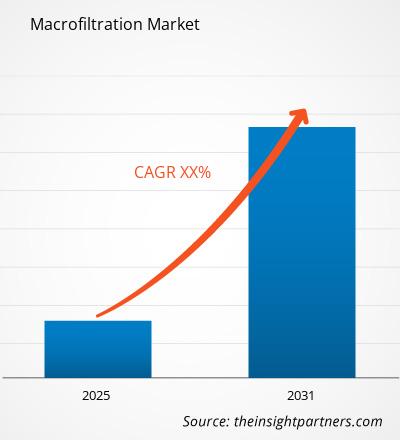
The Macrofiltration Market is forecast to increase from US$ 8.82 Billion in 2025 to US$ 15.80 Billion by 2034, at a CAGR of 6.69%. This growth will be driven by growing need for coarse to medium solid-liquid separations in municipal water applications, industrial process streams, mining slurries, and food-grade processing operations. Increased adoption is fueled by the growing need for strict discharge requirements, greater reuse, and the operational requirement to protect the subsequent downstream membrane, pump, and process equipment.
North America is estimated to grow at a CAGR of 6.2–6.6% up until 2034, driven by aging water infrastructures requiring modernization, and industrial needs for pretreatment. In North America, utilities are increasingly focusing on the separation of solids prior to biological and membrane stages of the process and downstream disinfection, while manufacturers such as those in chemical/pharmaceutical/food industries are spending on automated filters that minimize downtime.
Macrofiltration Market Assessment and Insights
- North America held 31–34% share in 2025 and is growing at a CAGR of 6.2–6.6% during 2026–2034, led by municipal renewal, process-water reuse, and compliance-driven industrial pretreatment.
- The U.S. represented 78–82% of North America in 2025 and is growing at a CAGR of 6.3–6.7%, supported by utility upgrades and industrial water recycling.
- Europe accounted for 24–27% share in 2025 and is growing at a CAGR of 5.8–6.2%, with Germany, the UK, France, Italy, and Spain leading demand.
- Asia Pacific held 28–31% share in 2025 and is growing at a CAGR of 7.2–7.6%, driven by China, India, Japan, South Korea, and Australia’s industrial-water policies.
- Largest Segment: Water and Wastewater held 38–42% market share in 2025 and is growing at a CAGR of 6.7–7.1% due to treatment expansion.
- High Growth Segment: Chemical and Pharmaceutical held 18–21% market share in 2025 and is growing at a CAGR of 7.4–7.8% amid purity and compliance needs.
- Key companies analyzed in detail: Amiad Water Systems Ltd., Ascension Industries, Inc., Danaher Corporation, Filtration Group Corporation, MANN+HUMMEL International GmbH & Co. KG, MTB Technologies Sp. z o.o., OFS Ostwald Filtration Systems GmbH, Parker-Hannifin Corporation, Pentair plc, SUEZ SA, Veolia Environnement SA, Eaton Corporation plc, Xylem Inc., Kubota Corporation, and Kovalus Separation Solutions, LLC.
Source: The Insight Partners' analysis based on proprietary research, government publications, company annual reports, investor presentations, industry databases, and expert interviews.
According to the Macrofiltration Market report, there is a shift from manual strainers and simple pressure filters to modular, automated, and sensor-based filtration equipment, which is used to stabilize flow quality before the advanced treatment phase. The manufacturers are designing new-age bag filters, auto backwash filters, and filter press systems with a focus on low total cost of ownership, fast filter media replacement, and minimal operator interference. The production process dynamics have been changing towards standardized and application-specific products that can enable suppliers to cater to the municipal, pharmaceutical, mining, and food industry sectors with general design and engineering capabilities, instead of creating custom-engineered designs.
The Macrofiltration Market forecast indicates that the emerging regions are expected to boost demand for macrofiltration equipment, given the increasing investments in wastewater reuse, desalination feedwater pretreatment, mine water recovery, and industrial effluent management applications. The favorable regulatory environment created by water quality regulations and circular water policies is expected to propel the growth of the Macrofiltration Market.
Macrofiltration Market Report Scope
| Report Attribute | Details |
|---|---|
| Market size in 2025 | US$ 8.82 Billion |
| Market Size by 2034 | US$ 15.80 Billion |
| Global CAGR (2026 - 2034) | 6.69% |
| Historical Data | 2021-2024 |
| Forecast period | 2026-2034 |
Macrofiltration Market Analysis
The demand for filters is being influenced by the availability of water resources, stringent effluent standards, and protection of more valuable downstream infrastructure. The World Health Organization lists safe water and sanitation as vital public health needs, whereas the industrial sector is implementing stricter measures for suspended solids removal to increase yield, operational efficiency, and reliability.
The supply chain comprises manufacturers of filter media, filter vessel builders, automation providers, engineering companies, utilities, and industrial end users. The supply situation for engineered solutions remains moderately consolidated, whereas for disposable filter media it is highly fragmented. End users are demanding integrated solutions, including spare parts, diagnostic services, and on-site support due to the risks of unplanned clogging.
Portfolio diversity, installed base service revenue, and application engineering expertise constitute the competitive environment. Danaher Corporation, Pentair plc, Parker-Hannifin Corporation, SUEZ SA, and Veolia Environnement SA are competing via water platform integration, whereas Amiad Water Systems Ltd. and OFS Ostwald Filtration Systems GmbH focus on unique design solutions in filtration systems for industrial and municipal uses.
Capital is flowing into automation, aftermarket exploitation, and resilient local manufacturing capabilities. Acquisition of Filtration Group Corporation by Parker-Hannifin Corporation shows the significance of proprietary media and repeatable business opportunities. According to the Macrofiltration Market analysis, future success will belong to the companies capable of integrating mechanical separation, control, and service throughout the product life cycle.
● REPORT CUSTOMIZATION
Tailor This Report To Align With Your Specific Business Requirements
This report can be customized to align precisely with your business objectives, scope, and target markets. Customization options include tailored segmentation, geography, competitive analysis, and strategic insights to support informed decision-making.
Customize This Report →WHAT YOU CAN ADJUST
- ● Segmentations
- ● Geography
- ● Competitive Analysis
- ● Language Preferences
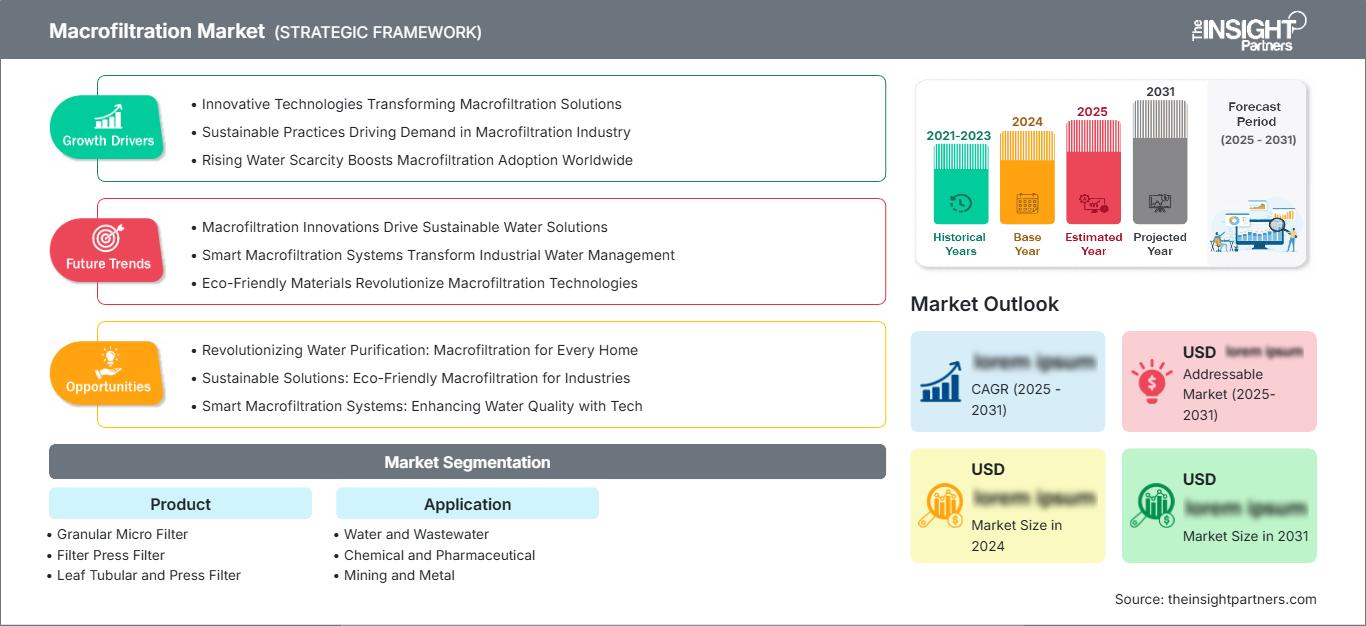
Macrofiltration Market: Strategic Insights
Regional Insights
North America Macrofiltration Market
North America’s market share in 2025 stood at 31-34%, and the market will grow with a CAGR of 6.2-6.6% during 2026-2034. The driving forces include municipal rehabilitation, industrial pretreatment, produced water management, and food-grade process filtration. Utilities are opting to replace aged clarification and screening plants with automated plants which are less labor-intensive and membrane protected. Both Canada and U.S are also stepping up their investment in reuse projects, stormwater, and PFAS pretreatments which boost solids removal requirements before polishing. North America Macrofiltration Market share includes good services penetration, well-established distribution channels, and preference for proven equipment among others.
U.S. Macrofiltration Market
The U.S. accounted for 78–82% of North America in 2025 and is expected to grow at a CAGR of 6.3–6.7%. Municipal waste water plants, semiconductors, beverages, pharmaceuticals, and mines employ macrofilters to minimize the amount of suspended solids, to safeguard further treatments, and ensure reliability in processes given stricter discharge norms. Companies have an extensive market reach with organizations like Parker-Hannifin Corporation, Pentair plc, Danaher Corporation, Eaton Corporation plc, Xylem Inc., and Filtration Group Corporation operating for both industrial and municipal customers using direct and indirect sales channels. Application areas include automated backwash filters, bag filters, and filter presses due to the requirement of regular servicing intervals.
Europe Macrofiltration Market
Europe accounted for 24%–27% in 2025 and is growing at a CAGR of 5.8%–6.2%. Germany is the market leader as there are requirements for solids separation due to chemical processing, machinery, food manufacturing, and municipal reuse projects. German end-users prioritize energy efficiency, reliability, and plant automation. The UK market receives boosts from wastewater networks modernization, storm overflows management, and industrial compliance programs. The water companies and processors are installing filter presses and automatic backwash systems to reduce maintenance costs and minimize influent fluctuations during high-solids loads on rainy days. In France, Italy, and Spain, the demand comes from beverages, food, paper, and municipal sewage treatment. SUEZ SA and Veolia Environnement SA are improving their services in the region, while equipment suppliers focus on decentralized industrial applications. The Macrofiltration Market trends in Europe include life cycle efficiency and regulatory traceability.
APAC Macrofiltration Market
The Asia Pacific has an 28-31% market share in 2025 and is expected to grow at a rate of 7.2-7.6%. China dominates demand through industrial water treatment, expansion of municipal plants, and increase in chemicals production. The re-use and cleaning projects in India are driving demand further in the region. Japan and South Korea prefer smaller and automated water filtration technology for use in electronics, food processing, and pharmaceutical industry. Australia is contributing to demand due to its contribution to mining water and desalination plant pre-treatment.
Middle East & Africa Macrofiltration Market
MEA region experiences growth rate between 6.6% and 7.0% owing to Saudi Arabia and the UAE. Pretreatment of desalination, refineries and municipal effluent recycling will sustain the need for robust macrofiltration equipment resistant to corrosion. Opportunities from mining, pulp and municipal rehabilitation exist in South Africa and in the rest of MEA region, there are opportunities from infrastructure funding and water security of urban areas. Energy related applications have high solids rejection, maintenance access and durability requirements.
Segmentation Analysis
Product
The product segment is growing at a CAGR of 6.4–6.8% during 2026–2034 as buyers shift from basic separation equipment toward automated, application-specific systems. Selection depends on particle size, solids loading, throughput, footprint, and cleaning frequency. The Macrofiltration Market size is increasingly influenced by replacement cycles, retrofit demand, and media performance improvements.
- Granular Micro Filter systems serve pretreatment and polishing needs where consistent removal of sediments, algae, and coarse biological matter supports water reuse, membrane protection, and lower downstream fouling risk.
- Filter Press Filter equipment remains strategically important in slurry dewatering, mining, chemicals, and wastewater sludge applications where cake dryness, batch reliability, and disposal-cost reduction influence procurement decisions.
- Leaf Tubular and Press Filter systems address process streams requiring enclosed operation, higher surface area, and reliable solids capture, particularly in chemical, pharmaceutical, and specialty industrial filtration duties.
- Bag Filter systems hold broad adoption because they offer flexible micron ratings, simple maintenance, and economical protection for pumps, nozzles, exchangers, and process lines across diversified industries.
- Belt Filter Press equipment is favored for continuous sludge dewatering in municipal and industrial facilities where throughput, polymer optimization, and lower hauling volumes materially affect operating economics.
- Auto Backwash Filters are gaining strategic relevance as users prioritize unattended operation, stable pressure differential, and reduced manual cleaning in cooling water, intake, irrigation, and process-water systems.
Application
The application segment is growing at a CAGR of 6.8–7.2% during 2026–2034, led by water reuse, process reliability, and compliance needs. Application intensity varies by solids profile and regulatory risk. Water and wastewater remains the largest revenue contributor, while chemical and pharmaceutical applications deliver faster growth through validation, contamination control, and higher specification requirements.
- Water and Wastewater applications dominate because municipalities and industries require dependable solids removal before biological treatment, membranes, disinfection, reuse loops, and discharge points.
- Chemical and Pharmaceutical applications require validated filtration performance, material compatibility, and contamination control, making engineered macrofiltration critical for yield protection and regulatory confidence.
- Mining and Metal applications use macrofiltration for slurry handling, tailings dewatering, process-water recovery, and equipment protection where abrasive solids create high maintenance risk.
- Food and Beverage facilities adopt macrofiltration to protect product quality, recover process water, manage organic solids, and reduce cleaning disruptions in continuous production environments.
- Paper and Pulp applications rely on robust filtration to manage fibers, fillers, and suspended solids while supporting water recirculation, effluent control, and equipment uptime.
Opportunity Snapshot
| Application | Revenue Contribution | Trend Tag | Adoption Stage |
| Water and Wastewater | High | Reuse Pretreatment | Mature |
| Chemical and Pharmaceutical | High | Validated Filtration | Scaling |
| Mining and Metal | Medium | Tailings Dewatering | Scaling |
| Food and Beverage | Medium | Process Hygiene | Mature |
| Paper and Pulp | Medium | Fiber Recovery | Mature |
Macrofiltration Market Growth Drivers and Impact Analysis
Water Reuse Mandates and Effluent Compliance
There will be greater demand for efficient control of suspended solids prior to polishing processes such as biological, membrane, UV, and chemical processes due to water reuse requirements. The effects of macrofiltration would help reduce turbidity shock and protect other downstream equipment. It also helps operators ensure constant discharge despite changes in the quality of the incoming water. The effect is most notable among municipalities, food processors, chemicals manufacturers, and refineries that might incur fines or disruptions in production from being non-compliant. Consequently, the buying behavior is now favoring automated systems that have quantifiable pressure differentials and media.
Industrial Process Reliability and Lower Downtime
Industrial operators are treating filtration as a productivity safeguard rather than a peripheral utility function. Coarse solids can damage pumps, foul heat exchangers, block nozzles, shorten membrane life, and disrupt batch quality. Macrofiltration therefore delivers measurable value by reducing unscheduled maintenance and stabilizing process conditions. In pharmaceutical and beverage plants, filtration also supports hygiene and validation expectations; in mining and pulp operations, it lowers water handling and waste-management costs. The practical market impact is higher spending on engineered equipment, spares, and service contracts, especially where downtime costs exceed filter replacement costs.
Automation and Lifecycle Cost Optimization
Automation is changing buyer evaluation from upfront equipment cost to lifecycle performance. Auto backwash filters, instrumented filter presses, and modular bag-filter housings help reduce manual cleaning, media waste, and operator exposure to difficult process streams. Digital monitoring also enables preventive maintenance by tracking pressure differential, flow variations, and cleaning intervals. This improves asset utilization for utilities and manufacturers operating with constrained labor. Suppliers that quantify water savings, sludge reduction, and maintenance time are gaining advantage because capital committees increasingly require operating-cost evidence before approving filtration upgrades.
Macrofiltration Market Future Trends
Smart Pretreatment Platforms
Future systems will increasingly combine macrofiltration hardware with sensors, controllers, and plant-level data platforms. The aim is not only to remove solids but to predict fouling, optimize backwash frequency, and coordinate with membrane or biological treatment stages. Utilities and industrial users will value systems that provide operating evidence for compliance and maintenance planning. This trend could reshape vendor differentiation, as equipment suppliers with software partnerships and analytics capability may capture more service revenue. The Macrofiltration Market trends will therefore move toward connected pretreatment rather than standalone mechanical filtration.
Compact Systems for Decentralized Treatment
Decentralized wastewater, industrial parks, remote mining sites, and modular desalination projects will require compact filtration systems that can be installed quickly and serviced locally. Space-constrained facilities prefer skid-mounted equipment, enclosed filter designs, and automated cleaning because civil works and operator availability are limited. This trend supports growth for standardized product families that can be configured by flow rate, solids loading, and materials of construction. It also creates opportunities for regional assembly and rental models, particularly in fast-growing economies where water infrastructure must scale faster than centralized networks.
Macrofiltration Market Opportunities
Aftermarket Services and Media Replacement Programs
Aftermarket programs offer an attractive opportunity because installed filtration assets require media, seals, plates, bags, screens, instrumentation calibration, and periodic refurbishment. Suppliers can improve customer retention by offering performance audits, preventive maintenance schedules, and bundled consumables tied to operating conditions. This is especially valuable in water utilities, pharmaceuticals, food production, and mining, where downtime carries operational or compliance risk. Companies that digitize service records and recommend replacement intervals based on actual pressure and solids data can expand recurring revenue while helping customers control lifecycle cost.
Localized Manufacturing for Emerging Water Projects
Localization is a practical opportunity as emerging markets expand wastewater treatment, mining water recovery, and industrial reuse. Local manufacturing or final assembly can shorten lead times, reduce import exposure, and improve responsiveness for spare parts. It also helps suppliers meet public procurement preferences in infrastructure-funded projects. Firms that combine global engineering standards with regional service teams can address cost-sensitive customers without sacrificing reliability. This opportunity is particularly relevant in India, Southeast Asia, the Gulf, and parts of Africa where water projects are moving from planning to implementation.
Recent Developments
- November 2025: Parker Hannifin Corporation announced that it has entered into a definitive agreement to acquire Filtration Group Corporation on a cash-free, debt-free basis for a cash purchase price of US$9.25 billion, which represents 19.6x Filtration Group’s calendar year 2025 estimated adjusted EBITDA, or 13.4x including expected cost synergies. The acquisition will create one of the largest global industrial filtration businesses and support Parker Hannifin Corporation to transform its filtration portfolio.
- March 2025: Alfa Laval wins significant order for advanced filtration plant used in a modern factory in Asia. The filtration plant, which is capable of both nano- and ultrafiltration, will be constructed in a new and modern factory to deliver a high level of product purity. This plant is the largest of its kind in Asia, and the order, valued at approximately EUR 8 (US$ 9.44) million.
- June 2023: Metso Corporation has signed a contract with Sinosteel Corporation for the delivery of seven Larox FFP2512 pressure filtration units to Tosyali’s iron concentrator plant expansion in Algeria. The contract value, which exceeds EUR 10 (US$ 10.94) million, is booked in Minerals’ second-quarter 2023 orders received. Metso’s filtration portfolio consists of 15 different filter types and comprehensive services for hundreds of applications.
Frequently Asked Questions

- Comprehensive Market Sizing and Forecast Analysis
- Detailed Segmentation Analysis
- In-Depth Market Dynamics Assessment
- Regional and Country-Level Insights
- Competitive Landscape and Company Benchmarking
- Strategic Business Intelligence
Recent Reports
Testimonials

The Insight Partners provided valuable market intelligence that supported our global go-to-market strategy. Their team was professional, responsive, and attentive to our feedback, providing thoughtful analysis and helpful methodological clarifications throughout the project.
Junmo Kim Chief Financial Officer (CFO), Enertech Co., Ltd.
The Insight Partners' SCADA System Market report is comprehensive, with valuable insights on current trends and future forecasts. The team was highly professional, responsive, and supportive throughout. We are very satisfied and highly recommend their services.
RAN KEDEM Partner, Reali Technologies LTDs
I requested a report on a very specific software market and the team produced the report in a few days. The information was very relevant and well presented. I then requested some changes and additions to the report. The team was again very responsive and I got the final report in less than a week.
JEAN-HERVE JENN Chairman, Future Analytica
We worked with The Insight Partners for an important market study and forecast. They gave us clear insights into opportunities and risks, which helped shape our plans. Their research was easy to use and based on solid data. It helped us make smart, confident decisions. We highly recommend them.
PIYUSH NAGPAL Sr. Vice President, High Beam Global
The Insight Partners delivered insightful, well-structured market research with strong domain expertise. Their team was professional and responsive throughout. The user-friendly website made accessing industry reports seamless. We highly recommend them for reliable, high-quality research services
YUKIHIKO ADACHI CEO, Deep Blue, LLC.
This is the first time I have purchased a market report from The Insight Partners.While I was unsure at first, I visited their web site and felt more comfortable to take the risk and purchase a market report.I am completely satisfied with the quality of the report and customer service. I had several questions and comments with the initial report, but after a couple of dialogs over email with their analyst I believe I have a report that I can use as input to our strategic planning process.Thank you so much for taking the extra time and making this a positive experience.I will definitely recommend your service to others and you will be my first call when we need further market data.
JOHN SUZUKI President and Chief Executive Officer, Board Director, BK Technologies
I wish to appreciate your support and the professionalism you displayed in the course of attending to my request for information regarding to infectious disease IVD market in Nigeria. I appreciate your patience, your guidance, and the fact that you were willing to offer a discount, which eventually made it possible for us to close a deal. I look forward to engaging The Insight Partners in the future, all thanks to the impression you have created in me as a result of this first encounter.
DR CHIJIOKE ONYIA MANAGING DIRECTOR, PineCrest Healthcare Ltd.Reason to Buy
- Informed Decision-Making
- Understanding Market Dynamics
- Competitive Analysis
- Identifying Emerging Markets
- Customer Insights
- Market Forecasts
- Risk Mitigation
- Boosting Operational Efficiency
- Strategic Planning
- Investment Justification
- Tracking Industry Innovations
- Aligning with Regulatory Trends





 Get Free Sample for