
Magnesium Trisilicate Market Growth, Trends & Forecast by 2034
Coverage: By Product Type (Pharma grade, Food grade, Cosmetic grade, Technical grade); Application (Pharmaceutical, Cosmetic, Food, Industrial), and Geography (North America, Europe, Asia Pacific, and South and Central America)
- Status : Data Released
- Report Code : TIPRE00014024
- Category : Chemicals and Materials
- No. of Pages : 150
- Available Report Formats :


- Last update date : November 02, 2026


2025 Market Size
US$ 127.51 Mn
Base year value
2034 Forecast
US$ 193.73 Mn
Projected by 2034
CAGR 2026-2034
4.76 %
Growth rate
Addressable Market
US$ 1,458.44 Mn
(2026-2034)
The Magnesium Trisilicate Market is valued at US$ 127.51 Million in 2025 and is projected to reach US$ 193.73 Million by 2034, expanding at a CAGR of 4.76% during 2026–2034. Demand is supported by pharmaceutical manufacturing, the continued use of antacid formulations, and requirements for consistent inorganic ingredients across selected food, cosmetic, and industrial applications. Market development depends on product purity, manufacturing consistency, regulatory compliance, and the ability of suppliers to maintain dependable quality and supply economics across different end-use requirements.
The North American Magnesium Trisilicate Market is expected to expand at a modeled CAGR of ~4% through 2034, supported by established pharmaceutical distribution networks and continuing demand for oral gastrointestinal preparations. Procurement decisions in the region are influenced by pharmacopoeial specifications, quality documentation, supplier qualification, and manufacturing traceability. Pharmaceutical formulators generally prioritize reproducible performance and reliable sourcing over small differences in purchase price, creating opportunities for suppliers that can demonstrate consistent batch quality. Competition will also depend on manufacturers' ability to serve established customers while responding to changing formulation requirements and procurement policies.
Magnesium Trisilicate Market Assessment and Insights
Regional Outlook
- North America: ~29% of the global market in 2025 | ~4% CAGR through 2034. Market position: North America represents a major established market, supported by pharmaceutical production, mature distribution channels, and established quality systems. Demand is comparatively stable, with growth linked to formulation continuity, supplier qualification, and recurring purchases by drug manufacturers.
- US: ~78% of North American market revenue in 2025 | ~4% CAGR through 2034. Market position: The United States is the largest national market within North America in this modeled assessment. Pharmaceutical manufacturing, established medicine distribution, and procurement requirements support demand, while quality documentation and consistent material specifications influence supplier selection.
- Europe: ~27% of the global market in 2025 | ~4% CAGR through 2034. Market position: Europe is a mature market shaped by established pharmaceutical manufacturing and structured quality requirements. Germany, the UK, France, Italy, and Spain contribute through medicine production, distribution, and industrial demand, with Germany assessed as the leading country in Europe.
- Asia Pacific: ~34% of the global market in 2025 | ~6% CAGR through 2034. Market position: Asia Pacific is the largest regional market and the fastest-growing region in this modeled assessment. Pharmaceutical manufacturing capacity, supplier concentration in India and China, and expanding regional distribution networks support demand. China is assessed as the leading country in Asia Pacific.
Segment Outlook
- Pharmaceutical application: ~61% magnesium trisilicate market share in 2025 | ~5% CAGR through 2034. Market position: Pharmaceutical use leads the application landscape because magnesium trisilicate has an established role in antacid preparations. Recurring formulation requirements and the importance of specification compliance support a comparatively resilient demand base.
- Industrial application: ~16% share in 2025 | ~6% CAGR through 2034. Market position: Industrial use offers a comparatively higher modeled growth outlook as manufacturers evaluate magnesium trisilicate for suitable functional and processing applications. Adoption depends on performance validation, application-specific specifications, and cost competitiveness against alternative materials.
Competitive Coverage
Ams Fine Chemicals, Meha Chemicals, Merck KGaA, Par Drugs and Chemicals Pvt. Ltd., PQ Corporation, Rainbow Expochem Company, Seagull Pharma Group, Tomita Pharmaceutical, Vasundhara Rasayan Limited, Mediocon Inc.
Methodology
The Insight Partners follows Data Collection & Secondary Research, Primary Research, Data Analysis, and Data Triangulation & Final Review to validate market estimates and insights.
Source: The Insight Partners' analysis based on proprietary research, government publications, company annual reports, investor presentations, industry databases, and expert interviews.
The Magnesium Trisilicate Market is rooted in existing needs for chemical process control and pharmaceutical preparation. Production typically includes precipitation using appropriate salts of magnesium and soluble silicates, with further filtering, washing, drying, grinding and quality testing. Processing control influences composition, physical properties, and applicability of the product. With the growing documentation demands in pharmaceutical procurement, suppliers find themselves under pressure to prove the repeatability of specifications and traceability of production. This makes the process control a distinctive feature of a qualified pharmaceutical supply and not just an issue of price competition.
As for future perspectives, the market development will be based on the growth of pharmaceutical production, variety of suppliers, and investments in quality control. The emergence of new centers of production and consumption in Asia Pacific could bring additional procurement activity with the desire of customers to get the supplies of the product locally and with reduced lead times. Existing markets will continue to appreciate regulation documentation, consistency of batches, and reliability of deliveries. Regulations and customer audits may present a barrier for new suppliers but at the same time offer advantages to those who are qualified enough. Growth till 2034 will probably include all these aspects.
Magnesium Trisilicate Market Report Scope
| Report Attribute | Details |
|---|---|
| Market size in 2025 | US$ 127.51 Million |
| Market Size by 2034 | US$ 193.73 Million |
| Global CAGR (2026 - 2034) | 4.76% |
| Historical Data | 2021-2024 |
| Forecast period | 2026-2034 |
Magnesium Trisilicate Market Analysis
Demand stems mainly from pharmaceutical formulation, where magnesium trisilicate acts as a component of certain antacid preparations. The demand is tied to the manufacturing schedule of the medicine and its usage and formulation inventory re-supply, not just the relatively transient buying cycle of the end user. Other markets like food, cosmetics, and industrial use also expand the customer base, though the needs vary widely. The buyer must assess whether the material is right for its use, what the specifications are, what impurities there are, and compatibility of the final formulation.
The value chain encompasses the extraction of magnesium-containing feedstock and silicate feedstock, along with chemical synthesis, purification, drying, size reduction, testing, packaging, and distribution. The manufacturer adds value via process control and adherence to customer specifications, while distributors offer local inventory, technical data, and smaller customers. Risks in the supply chain involve rising prices of the input, inconsistent feedstock quality, production disruptions, and transport problems. Switching suppliers can cost money for documentation on the part of pharmaceutical customers.
Competition in the Magnesium Trisilicate Market includes specialty chemical producers, suppliers of ingredients for the pharmaceutical industry, and diverse chemical companies. Ams Fine Chemicals, Meha Chemicals, Par Drugs and Chemicals Pvt. Ltd., Seagull Pharma Group, and Vasundhara Rasayan Limited are some of the specialties-focused suppliers in the market, and Merck KGaA and PQ Corporation have more diverse chemical product ranges. Tomita Pharmaceutical and Rainbow Expochem Company also feature among the suppliers. The mere presence of any company is not the basis of ranking by revenue from magnesium trisilicate sales; competitive analysis must separate reliable supply of the chemical from the size of the companies.
The focus of investment will most likely be on production consistency, analytical services, documentation, efficiency in manufacture, and qualification of customers. The suppliers might build their commercial advantages through distribution arrangements, export facilities, technical assistance, and consistent delivery schedules instead of large-scale expansions. Mediocon Inc is another supplier in the field of specialties. The buyer will need to compare the suppliers in terms of their manufacturing capabilities, product specifications, traceability, and supply continuity. The manufacturer will need to turn technical reliability into orders while keeping prices competitive.
● REPORT CUSTOMIZATION
Tailor This Report To Align With Your Specific Business Requirements
This report can be customized to align precisely with your business objectives, scope, and target markets. Customization options include tailored segmentation, geography, competitive analysis, and strategic insights to support informed decision-making.
Customize This Report →WHAT YOU CAN ADJUST
- ● Segmentations
- ● Geography
- ● Competitive Analysis
- ● Language Preferences
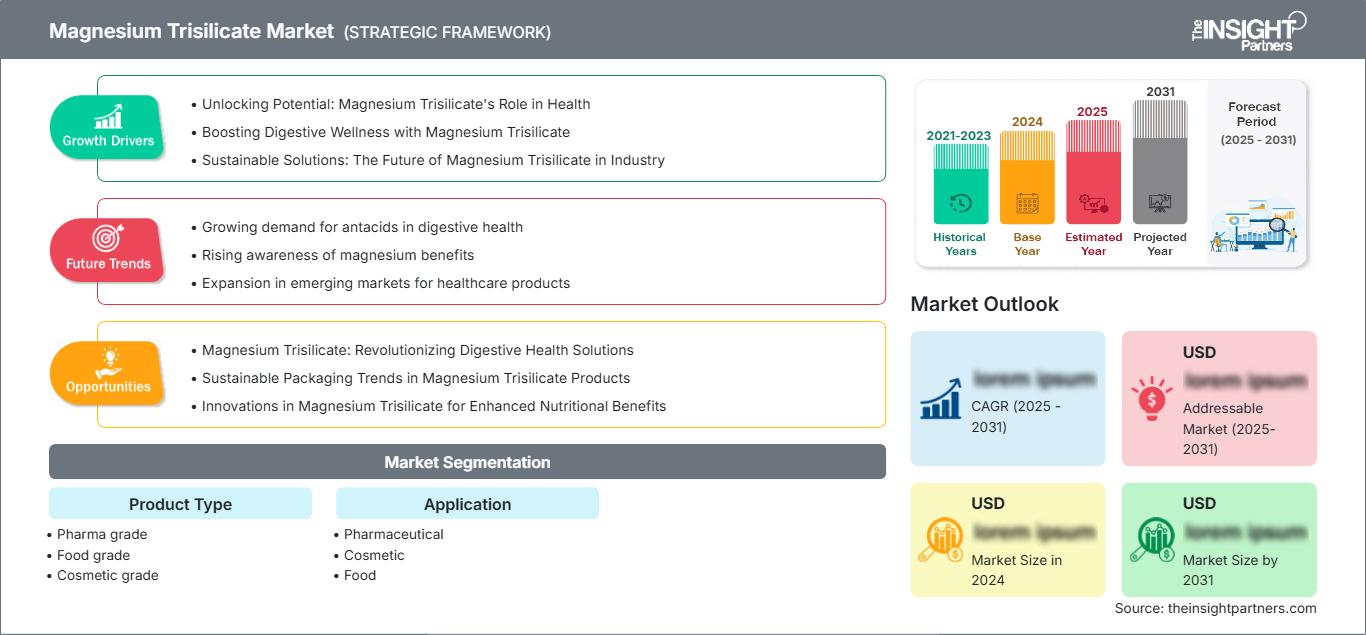
Magnesium Trisilicate Market: Strategic Insights
Regional Insights
North America magnesium trisilicate market
The Magnesium Trisilicate Market report shows that North America accounts for an estimated ~29% of global revenue in 2025 and is projected to register a CAGR of ~4% through 2034. Its location is determined by the existing pharmaceutical manufacturing, mature medicine distribution, and regular procurement of components for existing formulations. The demand is driven by the ongoing production of oral gastrointestinal products and preferences of buyers for suppliers qualified and documented. The relatively mature market structure of the region implies that the chances of dependence of growth solely on the development of applications are low.
Supplier qualification and quality control remain the core criteria in purchasing decisions. Pharmaceuticals’ clients check the compliance with specifications, batch consistency, impurities control, and documents availability. Such criteria favor qualified suppliers, although they may still allow competing for specialists who offer reliable services. The distribution channels enable the suppliers to access formulators without having to develop large direct sales force. Competition from other components and price factors still matter. In general, the North American growth depends more on the recurrence of formulation needs, continuous procurement and client expansion.
U.S. magnesium trisilicate market
The United States represents an estimated ~78% of North American magnesium trisilicate revenue in 2025 and is projected to grow at a CAGR of ~4% through 2034. This perspective fits in line with the pharmaceutical production and distribution infrastructure within the country. The demand is dependent on antacid production, existing formulations portfolio, and repeated purchases from the suppliers serving both domestic and overseas markets. Generally, procurement departments require detailed specification for the products, reliable batch history, and supplier communications prior to allowing any raw material for continuous usage.
The Magnesium Trisilicate Market forecast indicates that competitive landscape is comprised of chemical suppliers and companies targeting broader pharmaceutical ingredients market. The buyers may compare domestic supplies versus imported ones, based on overall landed costs, lead time, quality history, and continuity risk. It is anticipated that the pharmaceutical applications will represent primary source of demand, whereas cosmetic, food, and industrial applications will require additional assessment for technical feasibility and regulations. The suppliers who offer timely documentation and dependable supplies will help their customers reduce the effort. However, the demand is going to be sensitive to formulation, economic performance of existing products, and competition from other ingredients.
Europe magnesium trisilicate market
Europe represents an estimated ~27% of global revenue in 2025 and is projected to expand at a CAGR of ~4% through 2034. The market structure is characterized by pharmaceutical manufacture, chemical distribution, and purchasing procedures involving conformity and quality documentation. Germany is seen to be the leading nation in Europe owing to its strong manufacturing base for pharmaceuticals and chemicals. United Kingdom also helps through pharmaceutical formulation, medicines distribution, and procurement procedures. The advantages of such markets include suppliers who can meet the repetitive requirements of ingredients.
France provides support through manufacturing and distribution of pharmaceuticals. Italy, on the other hand, helps through manufacturing of medicines and industrial base as well. Spain contributes through pharmaceutical distribution within the country and manufacturing. The contribution of each nation is determined by the formulation portfolio, procurement process, and quality of materials rather than the size of population only. Such differences imply that country-level demands are dependent on the industrial structure as well as healthcare consumption.
Regulatory compliance and documentation are still critical competitive factors in the region. There is need for suppliers to examine the regulations concerning the product and the proposed uses, as well as any specific pharmaceutical guidelines and customer quality systems. Cross border movement could improve market penetration, but transport costs, importing processes, and stock management influence economic feasibility. Maturity in the demand side and existing supplier-customer relations might hinder quick growth in volumes, but quality assurance is one way of retaining customers. It seems to be favorable for suppliers who can manage regional distribution efficiently, have reproducible specifications, and withstand customer audits without disrupting supply.
APAC magnesium trisilicate market
Asia Pacific is estimated to account for ~34% of global revenue in 2025 and is projected to record a CAGR of ~6% through 2034, making it the fastest-growing region in this assessment. China is assessed as the leading country in Asia Pacific, supported by its chemical manufacturing base and broad industrial capacity. India is important for pharmaceutical ingredient manufacturing and export-oriented supply, while Japan and South Korea contribute through established pharmaceutical and specialty chemical industries.
Australia is a relatively small but significant market due to pharmaceuticals distribution and some industrial uses. The regional requirement depends on the placement of the plant for formulation, qualifying the supplier and the presence of reliable material at cost-effective delivery prices. Development in industry and development in the production of pharmaceuticals in the country can lead to increased purchase. But the growth will vary from country to country depending on local manufacturing, dependency on imports, client demands, and regulations.
Middle East & Africa magnesium trisilicate market
The Middle East and Africa region is expected to expand at a modeled CAGR of ~5% through 2034. Demand is supported by pharmaceutical distribution, imported medicine supply, and industrial procurement, although the region remains diverse in manufacturing capabilities and sourcing arrangements. Saudi Arabia and the United Arab Emirates provide important commercial channels through pharmaceutical distribution, healthcare-related investment, and established trading networks. South Africa is a significant market in the southern part of the region, supported by pharmaceutical distribution and a developed industrial base.
The Kingdom of Saudi Arabia is considered to be among the best-performing countries in the Middle East and Africa markets due to its localization plans for the pharma industry and existing import and distribution regulations. UAE acts as a logistics center for the region, while South Africa helps generate demand in the broader African market. Investment in infrastructure and manufacture of products locally can help overcome the problems associated with ingredient availability, yet energy prices, transportation costs, and reliance on imports affect purchase economics. The supplier has to find a compromise between product qualification, timely delivery, and the cost awareness of the regional buyer.
Segmentation Analysis
Product Type
Product Type determines the suitability of magnesium trisilicate for different manufacturing environments and customer requirements. Demand is shaped by specification consistency, processing controls, and the level of documentation required by buyers. Suppliers need to match production methods and quality systems to the intended use rather than assume that a material suitable for one application can automatically serve another. Pharma grade is expected to remain the principal product category because of its established role in medicine formulation. Within this category, pharma grade is modeled to grow at a CAGR of ~5% through 2034, reflecting recurring pharmaceutical procurement and the importance of qualified sourcing.
- Pharma grade: This category serves manufacturers that require defined specifications, consistent material characteristics, and appropriate quality documentation. Supplier approval and batch traceability influence purchasing decisions, particularly when the ingredient forms part of an established medicine formulation.
- Food grade: Food grade is intended for applications where the material must satisfy relevant food-use requirements and customer specifications. Buyers evaluate purity, permitted use, contamination controls, and suitability for the intended processing environment before introducing the ingredient into a food-related production process.
- Cosmetic grade: Cosmetic grade serves manufacturers evaluating the material for suitable personal-care formulations. Adoption depends on compatibility with the finished product, formulation stability, ingredient documentation, and the manufacturer's assessment of safety and performance requirements for the intended cosmetic use.
- Technical grade: Technical grade serves industrial buyers whose specifications are determined by process function and end-use performance. Purchasing decisions emphasize consistency, handling properties, availability, and total material cost, with requirements varying according to the manufacturing process and the role of the ingredient.
Application
Application segmentation reflects the different functions magnesium trisilicate can perform and the purchasing criteria used by downstream customers. Pharmaceutical use is the principal demand category because of established antacid formulations and repeat ingredient requirements. Other applications depend on technical suitability, formulation economics, and compliance with the rules governing each intended use. The industrial application is modeled to grow at a CAGR of ~6% through 2034, supported by potential use in suitable industrial processes and demand for functional inorganic materials. This outlook remains conditional on application-specific validation and the ability to compete with alternative materials.
- Pharmaceutical: Pharmaceutical application demand is centered on suitable antacid and gastrointestinal preparations. Manufacturers prioritize reliable specifications, batch consistency, and documented quality, while established formulations can generate recurring procurement needs that reward dependable suppliers.
- Cosmetic: Cosmetic applications depend on the material's demonstrated suitability for the intended formulation and production process. Buyers assess compatibility, finished-product performance, and applicable ingredient requirements before committing to commercial use, limiting adoption where alternative ingredients provide a better formulation fit.
- Food: Food applications require careful evaluation of permitted use, material purity, and the relevant standards for the finished product. Adoption depends on demonstrated functional value and compliance, rather than on the availability of a particular grade alone.
- Industrial: Industrial use depends on the technical role of the material within a manufacturing process. Buyers assess process compatibility, product consistency, supply reliability, and cost relative to alternatives, making application testing and reliable technical support important to wider adoption.
Opportunity Snapshot
| Application | Revenue Contribution | Trend Tag | Adoption Stage |
| Pharmaceutical | High | Antacid formulations | Mature |
| Cosmetic | Low | Formulation testing | Emerging |
| Food | Low | Ingredient qualification | Emerging |
| Industrial | Medium | Process applications | Scaling |
Magnesium Trisilicate Market Growth Drivers and Impact Analysis
Established Antacid Formulations and Recurring Pharmaceutical Procurement
Pharmaceutical demand provides a stable foundation for the Magnesium Trisilicate Market because the ingredient has an established role in selected antacid and gastrointestinal preparations. Manufacturers maintaining existing product portfolios need dependable access to qualified ingredients, creating recurring procurement requirements tied to production schedules and inventory planning. Changes in formulation, supplier approval, or product specifications can involve technical review and quality documentation, which may discourage unnecessary supplier switching. This supports suppliers that deliver consistent material characteristics and dependable lead times. The commercial impact is not unlimited, because mature formulations may experience pricing pressure and competition from alternative active ingredients. Manufacturers can strengthen retention by maintaining batch consistency, supporting customer audits, and providing clear specifications that help formulators preserve established product performance.
Quality Assurance and Specification-Based Supplier Selection
Quality assurance influences purchasing decisions throughout the Magnesium Trisilicate Market, particularly when the material is intended for pharmaceutical manufacturing. Buyers must assess the relevant specifications, impurity controls, analytical methods, traceability, and documentation needed for their intended application. Variation in composition or physical characteristics can create additional testing requirements and complicate formulation consistency. As a result, the lowest quoted price does not necessarily translate into the lowest total procurement cost. Suppliers with dependable quality systems can reduce customer qualification burdens and improve continuity. Investment in analytical laboratories, controlled processing, documented change management, and effective corrective-action procedures can therefore produce commercial benefits. Manufacturers that cannot demonstrate consistent conformity may face longer qualification cycles or restricted access to customers with demanding quality requirements.
Expansion of Chemical Processing and Diversification of End Uses
The market also benefits from opportunities to supply suitable materials beyond traditional pharmaceutical formulations. Magnesium trisilicate's physical and chemical characteristics can support selected adsorptive, processing, and formulation functions, subject to application-specific validation. Industrial customers may evaluate it where performance, availability, and delivered cost compare favorably with competing materials. Food and cosmetic buyers require a separate assessment of permitted uses, ingredient specifications, and product compatibility; suitability for one industry should not be assumed to establish suitability for another. This creates a differentiated commercial landscape in which suppliers need clear technical information and disciplined product positioning. The impact on manufacturers is a broader set of potential customers, balanced against the cost of qualification, application testing, and maintaining appropriate product documentation.
Magnesium Trisilicate Market Future Trends
Greater Emphasis on Process Consistency and Analytical Characterization
Future Magnesium Trisilicate Market trends are likely to include more systematic characterization of raw materials and finished batches. Manufacturers can improve process control by monitoring precipitation conditions, washing efficiency, drying parameters, moisture characteristics, and particle-size distribution. These controls help explain differences between batches and support more predictable performance in downstream formulations. Buyers may increasingly request specification data that addresses the actual performance requirements of their processes rather than relying exclusively on a general product description. Digital batch records and more structured analytical workflows can also improve traceability and the investigation of deviations. Such investments will not automatically create a premium for every supplier, but they can strengthen qualification prospects where consistency and documented process control are essential to customer operations.
More Application-Specific Product Positioning and Supply Strategies
Another emerging direction is a more differentiated approach to product specifications and commercial supply. Rather than treating every customer as a buyer of interchangeable bulk material, manufacturers can organize technical support around intended use, handling requirements, and the evidence needed for customer qualification. This approach may be particularly relevant where pharmaceutical buyers require rigorous documentation and industrial users prioritize process compatibility and cost efficiency. Regional inventory, export-ready packaging, and dependable delivery commitments can further distinguish suppliers serving international customers. Over time, commercial performance may depend as much on the quality of the supplier relationship as on the material itself. The strongest opportunities will be for companies that can maintain consistent production while tailoring documentation, service, and distribution to distinct customer requirements.
Magnesium Trisilicate Market Opportunities
Strengthening Qualified Supply and Export Distribution
Manufacturers can pursue opportunities by developing reliable supply arrangements with pharmaceutical ingredient distributors and finished-dose producers. An effective approach begins with confirming product specifications, preparing complete technical documentation, establishing repeatable quality checks, and mapping customer qualification requirements before expanding distribution. Export-oriented suppliers can also assess packaging, freight arrangements, delivery lead times, and local inventory options to reduce procurement uncertainty for overseas customers. These measures are particularly relevant when buyers prefer qualified suppliers capable of supporting repeat orders and resolving quality questions quickly. Investment should be directed toward identifiable customer needs rather than capacity expansion alone. A disciplined commercial strategy can improve account retention and geographic reach while limiting the risk of producing material for which demand has not been validated.
Developing Application-Led Industrial Customer Relationships
Industrial diversification offers a separate opportunity for suppliers able to demonstrate that magnesium trisilicate meets a specific process requirement. Commercial development should begin with identifying prospective applications, comparing performance against established alternatives, and conducting controlled trials with prospective customers. Manufacturers should determine whether the material provides a meaningful advantage in process consistency, handling, adsorptive performance, or overall operating economics. Technical support and transparent specifications can help customers assess suitability without assuming that a result in one application will transfer to another. Investment in application testing, customer sampling, and targeted technical sales may be more appropriate than broad promotional spending. Successful qualification could establish additional recurring accounts, although adoption will depend on demonstrated performance, customer economics, and relevant regulatory requirements.
Recent Developments
- April 2026: ExSyn published a product-focused technical overview of Magnesium Trisilicate BP, covering its precipitation-based manufacturing process, pharmaceutical applications, material identification, and specification requirements. The publication also describes the ingredient's potential industrial uses, including adsorption and purification. This provides current product-level information for formulators and procurement teams assessing material suitability and supplier documentation. The announcement concerns technical product information rather than a confirmed manufacturing-capacity expansion.
- September 2026: AMS Fine Chemicals published technical guidance explaining magnesium trisilicate's behavior in antacid formulations, including acid neutralization, adsorptive properties, and the importance of process-dependent material characteristics. The article addresses formulation and sourcing considerations and reinforces the importance of assessing product specifications when comparing suppliers. It represents a technical-information development, not a separately verified commercial launch or production expansion.
Frequently Asked Questions

- Comprehensive Market Sizing and Forecast Analysis
- Detailed Segmentation Analysis
- In-Depth Market Dynamics Assessment
- Regional and Country-Level Insights
- Competitive Landscape and Company Benchmarking
- Strategic Business Intelligence
Recent Reports
Testimonials

The Insight Partners provided valuable market intelligence that supported our global go-to-market strategy. Their team was professional, responsive, and attentive to our feedback, providing thoughtful analysis and helpful methodological clarifications throughout the project.
Junmo Kim Chief Financial Officer (CFO), Enertech Co., Ltd.
The Insight Partners' SCADA System Market report is comprehensive, with valuable insights on current trends and future forecasts. The team was highly professional, responsive, and supportive throughout. We are very satisfied and highly recommend their services.
RAN KEDEM Partner, Reali Technologies LTDs
I requested a report on a very specific software market and the team produced the report in a few days. The information was very relevant and well presented. I then requested some changes and additions to the report. The team was again very responsive and I got the final report in less than a week.
JEAN-HERVE JENN Chairman, Future Analytica
We worked with The Insight Partners for an important market study and forecast. They gave us clear insights into opportunities and risks, which helped shape our plans. Their research was easy to use and based on solid data. It helped us make smart, confident decisions. We highly recommend them.
PIYUSH NAGPAL Sr. Vice President, High Beam Global
The Insight Partners delivered insightful, well-structured market research with strong domain expertise. Their team was professional and responsive throughout. The user-friendly website made accessing industry reports seamless. We highly recommend them for reliable, high-quality research services
YUKIHIKO ADACHI CEO, Deep Blue, LLC.
This is the first time I have purchased a market report from The Insight Partners.While I was unsure at first, I visited their web site and felt more comfortable to take the risk and purchase a market report.I am completely satisfied with the quality of the report and customer service. I had several questions and comments with the initial report, but after a couple of dialogs over email with their analyst I believe I have a report that I can use as input to our strategic planning process.Thank you so much for taking the extra time and making this a positive experience.I will definitely recommend your service to others and you will be my first call when we need further market data.
JOHN SUZUKI President and Chief Executive Officer, Board Director, BK Technologies
I wish to appreciate your support and the professionalism you displayed in the course of attending to my request for information regarding to infectious disease IVD market in Nigeria. I appreciate your patience, your guidance, and the fact that you were willing to offer a discount, which eventually made it possible for us to close a deal. I look forward to engaging The Insight Partners in the future, all thanks to the impression you have created in me as a result of this first encounter.
DR CHIJIOKE ONYIA MANAGING DIRECTOR, PineCrest Healthcare Ltd.Reason to Buy
- Informed Decision-Making
- Understanding Market Dynamics
- Competitive Analysis
- Identifying Emerging Markets
- Customer Insights
- Market Forecasts
- Risk Mitigation
- Boosting Operational Efficiency
- Strategic Planning
- Investment Justification
- Tracking Industry Innovations
- Aligning with Regulatory Trends





 Get Free Sample for