
Magnetic Separator Market Share, Demand & Growth by 2034
Coverage: by Type (Magnetic Separator Equipment, Standalone Magnetic Separators); Magnet Type (Electromagnets, Permanent Magnets); Industry (Recycling, Mining, Chemical and Pharmaceutical, Food and Beverages, Others) , and Geography (North America, Europe, Asia Pacific, and South and Central America)
- Status : Data Released
- Report Code : TIPRE00005951
- Category : Manufacturing and Construction
- No. of Pages : 150
- Available Report Formats :


- Last update date : July 16, 2026


2025 Market Size
US$ 5.92 Bn
Base year value
2034 Forecast
US$ 8.36 Bn
Projected by 2034
CAGR 2026-2034
3.91 %
Growth rate
Addressable Market
US$ 64.86 Bn
(2026-2034)
The Magnetic Separator Market size is expected to grow from US$ 5.92 Billion in 2025 to US$ 8.36 Billion in 2034, at a CAGR of 3.91% between 2026 and 2034. Factors affecting the market include the adoption within the industries such as recycling, mining, chemical and pharmaceutical, and food and beverages, which depend on the precision of separators, machine reliability, and contamination avoidance for their operational efficiency, compliance, and recyclable materials’ value.
The CAGR for North America is forecasted to be 3.6-4.1% between 2026 and 2034, owing to investments in improving metals recycling processes, securing minerals, and ensuring food safety standards. Benefits offered to the region include existing processing facilities, replacement purchases, and higher contamination avoidance requirements at the plant level. In the US, investment in battery recycling, aggregates, and manufacturing ensures constant demand for high-performance separators.
Magnetic Separator Market Assessment and Insights
- North America: Share in 2025 is estimated at 27–30%, with CAGR between 2026–2034 at 3.6–4.1%, driven by recycling automation, mining modernization, and contamination-control standards.
- US: Share in 2025 is 78–82% of North America, with CAGR between 2026–2034 at 3.7–4.2%, led by scrap, food processing, and critical minerals.
- Europe: Share in 2025 is estimated at 24–27%, with CAGR between 2026–2034 at 3.2–3.7%; Germany, the UK, France, Italy, and Spain lead adoption.
- Asia Pacific: Share in 2025 is estimated at 36–39%, with CAGR between 2026–2034 at 4.2–4.7%; China, Japan, South Korea, India, and Australia anchor demand.
- Largest Segment: Magnetic Separator Equipment holds 63–67% market share in 2025 and records a 3.7–4.2% CAGR during 2026–2034, supported by plant-level integration.
- High Growth Segment: Recycling accounts for 28–32% market share in 2025 and posts a 4.5–5.1% CAGR during 2026–2034, led by e-waste and metals recovery.
- Key companies analyzed in detail: Bunting Magnetics Co.; Eriez Manufacturing Co.; Shenyang Longi Electromagnetic Technology Co., Ltd.; Metso Corporation; Mitsubishi Nagasaki Machinery Mfg. Co., Ltd.; Eclipse Magnetics Ltd.; Goudsmit Magnetics Groep B.V.; STEINERT GmbH; thyssenkrupp AG; Magnetic Products, Inc.; SLon Magnetic Separator Ltd.; and Nippon Magnetics, Inc.
Source: The Insight Partners' analysis based on proprietary research, government publications, company annual reports, investor presentations, industry databases, and expert interviews.
In recent years, magnetic separation technology has evolved from mere tramp metal removal to engineered recovery technology that utilizes rare-earth magnets, electromagnetic systems, and sensors for monitoring. Current trends show the shift to modular skids, hygienic stainless-steel assembly, and high-gradient machines that can process fine particles. According to the Magnetic Separator Market report, equipment manufacturers are emphasizing maintenance reduction, fast cleaning capability, and uptime, since processors now value their separators not only on purchase cost but also on yield protection and product purity.
The Magnetic Separator Market forecasts indicate that future demand will be driven by investments in the circular economy, processing of lower-grade ores, and strict quality requirements in packaged food and pharmaceuticals. The emerging geographies of Asia-Pacific and the Middle East are growing mineral processing capacity, while North America and Europe are retrofitting their old separators with automation systems. Favorable regulatory environment on recycling, reduction of industrial waste, and contamination prevention broadens the scope of the Magnetic Separator Market.
Magnetic Separator Market Report Scope
| Report Attribute | Details |
|---|---|
| Market size in 2025 | US$ 5.92 Billion |
| Market Size by 2034 | US$ 8.36 Billion |
| Global CAGR (2026 - 2034) | 3.91% |
| Historical Data | 2021-2024 |
| Forecast period | 2026-2034 |
Magnetic Separator Market Analysis
The demand factors are based on three practical considerations: metal recovery, machine protection, and purity considerations. The recycling facilities use overband, drum, and eddy current separators to separate ferrous and non-ferrous metals, while the mining companies use wet and dry separators to enhance ore grade and minimize tailings. Food production, chemicals, and pharmaceuticals companies use inline magnetic separators to decrease contamination risks in powders, liquids, and bulk solids
The value chain is made up of magnet manufacturers, fabricators, automation equipment manufacturers, system integrators, distributors, and operators. Permanent magnets lead in low maintenance operations, while electromagnets continue to play a key role when adjustable magnetic field, high throughput, and heavy duty tramp iron separation is necessary. Dynamics in supply are affected by rare earth availability, stainless steel manufacturing capacity, and customer desire for specialized tested equipment instead of off-the-shelf units.
There are some levels of concentration in the industry, with competition in the industry arising from differentiation based on field strengths, design of cleaners, testing and aftermarket services. Eriez Manufacturing Co., Bunting Magnetics Co., Metso Corporation, STEINERT GmbH, and Shenyang Longi Electromagnetic Technology Co., Ltd. engage in competition through depth of application in mining, recycling, and process industries. Companies like Eclipse Magnetics Ltd., Goudsmit Magnetics Groep B.V., and Magnetic Products, Inc. focus on hygienic processing and customizability.
Automated metal recovery, high-gradient separation, and condition monitoring will be key investment areas in the future. Metso Corporation and thyssenkrupp AG will enjoy advantage in mineral processing applications, while STEINERT GmbH and Bunting Magnetics Co. will be in recycling flows. Future outlook for the Magnetic Separator Market share will depend on services for installed base, regional manufacturing capabilities, and validation of separation effectiveness using customer samples prior to purchasing decisions.
● REPORT CUSTOMIZATION
Tailor This Report To Align With Your Specific Business Requirements
This report can be customized to align precisely with your business objectives, scope, and target markets. Customization options include tailored segmentation, geography, competitive analysis, and strategic insights to support informed decision-making.
Customize This Report →WHAT YOU CAN ADJUST
- ● Segmentations
- ● Geography
- ● Competitive Analysis
- ● Language Preferences
Magnetic Separator Market: Strategic Insights
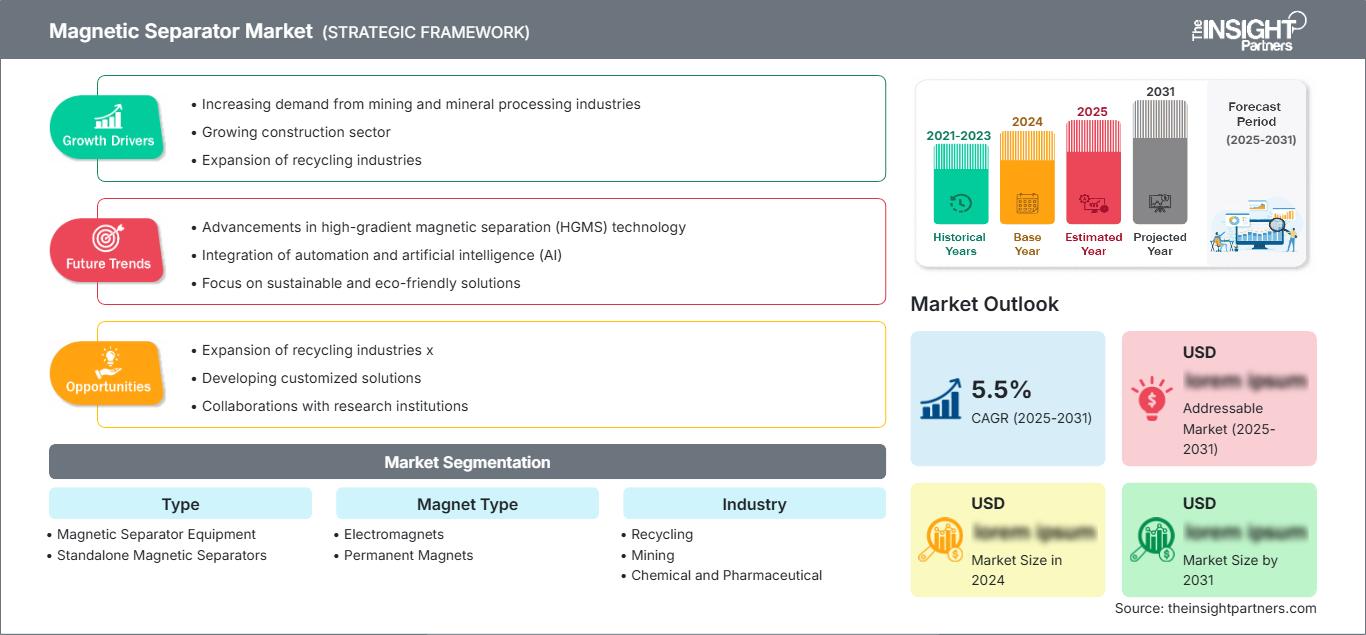
Regional Insights
North America Magnetic Separator Market
The North American market constitutes 27-30% share in 2025 and is anticipated to register 3.6-4.1% CAGR over 2026-2034. Recyclables, aggregates, food processing, and mineral security programs represent key areas of demand. Separators capable of reducing downtime, simplifying validation, and protecting crushing, milling, conveying, and packaging equipment from metal contamination are increasingly in demand among operators. The replacement demand is quite significant since there are numerous processing plants modernizing their old permanent magnets with powerful rare earth assemblies, self-cleaning features, and detection capabilities. The presence of the manufacturing base, scrap processing, and food safety tradition in the region is favorable for continuous procurement. Thus, the growth potential of the Magnetic Separator Market is mainly driven by productivity and compliance needs.
U.S. Magnetic Separator Market
The US accounts for 78–82% of North America demand by 2025 and has an expected growth rate of 3.7–4.2% CAGR during 2026–2034. The reason behind such market size is scrap processing facilities, packed food producers, aggregate facilities, battery materials recyclers, and local mineral processing plants that need magnetic drums, pulleys, grids, liquid traps, and overband separators. The presence of companies is significant due to the activities of Bunting Magnetics Co., Eriez Manufacturing Co., and Magnetic Products, Inc. that serve customers using testing labs, application engineering, and after-market services. The application developments indicate that there is a growing need for separators for e-waste, lithium-ion batteries recycling, and hygienic liquid processing.
Europe Magnetic Separator Market
In Europe, the share for the year 2025 is 24–27%, and this market is projected to grow at a CAGR of 3.2–3.7% from 2026 to 2034. Germany is a leading country in the European region in terms of demand, driven by machinery, recycling, chemical, and automotive-related metal extraction. The competitive strength of Germany lies in the equipment engineering, advanced sorting facility, and existing industrial users. Companies such as STEINERT GmbH, Goudsmit Magnetics Groep B.V., Eclipse Magnetics Ltd., and thyssenkrupp AG contribute to the growth of this region through their expertise and proximity to users. Contribution of France, Italy, and Spain is made through foods and beverages, chemicals, pharmaceuticals, quarrying, and metals recycling. Process industries play a crucial role for France while machinery and food-processing requirements make Italy’s contribution to the circular economy. Mining and aggregates are the contributions of Spain. In Europe, circular economy objectives make separators an effective investment.
APAC Magnetic Separator Market
APAC accounts for 36–39% share in 2025 and grows at a 4.2–4.7% CAGR during 2026–2034. China leads due to steel, mining, recycling, and battery-material processing. Japan and South Korea emphasize precision processing, electronics recycling, and food-grade contamination control. India adds demand from mining, cement, steel, and municipal recycling modernization. Australia remains important for mineral beneficiation and bulk-material handling. Policy support for resource efficiency, industrial waste reduction, and domestic processing capacity strengthens the Magnetic Separator Market trends outlook across the region.
Middle East & Africa Magnetic Separator Market
MEA is expected to expand at a 3.4-3.9% CAGR between 2026 and 2034. Saudi Arabia will be a key driver for the region with its mining diversification, infrastructure minerals, and industrialization. Recycling centers, construction waste processing, and food processing will drive the demand for separators in the UAE. South Africa will still have relevance in mining, mineral processing, and scrap processing. The use of separators in the MEA will be selective but will rise with increased demand for cement and aggregate recovery and metal recovery projects.
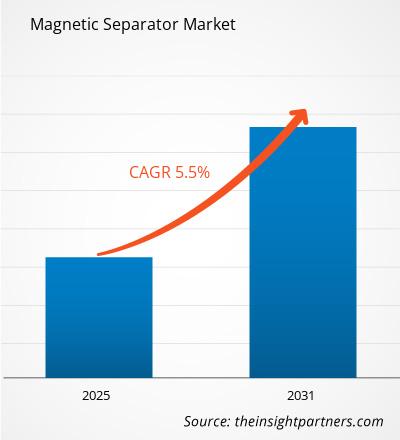
Segmentation Analysis
Type
The Type segment would be growing at a 3.6–4.2% CAGR from 2026–2034. The demand dynamics are defined by the necessity of customers’ needs for either complete machinery to ensure continuous processing or small devices for precise elimination of contaminants. The preference for complete machines is more pronounced in mining and recycling industries.
- Magnetic Separator Equipment holds the strongest position because plants require conveyors, drums, pulleys, liquid traps, and automated removal systems designed for continuous, high-volume, and validated industrial separation.
- Standalone Magnetic Separators remain strategically important for processors needing point-of-use protection, lower capital outlay, flexible installation, and targeted contamination control in powders, granules, liquids, or small-batch operations.
Magnet Type
The Magnet Type segment is projected to grow at a 3.5–4.1% CAGR during 2026–2034. Selection depends on throughput, contaminant profile, cleaning frequency, and energy considerations. Permanent magnets serve stable and low-energy operations, while electromagnets are chosen for heavy-duty recovery, adjustable fields, and larger tramp-metal burdens in mining, aggregates, and recycling lines.
- Electromagnets are favored in high-throughput and heavy-duty applications where operators need adjustable field intensity, remote activation, and reliable removal of large ferrous contaminants from moving material streams.
- Permanent Magnets are widely adopted because they reduce energy use, require limited operating controls, and provide dependable separation in food processing, recycling, chemicals, pharmaceuticals, and general bulk handling.
Industry
The Industry segment is expected to expand at a 3.8–4.4% CAGR during 2026–2034. Recycling and mining provide the largest project-based demand, while food, beverage, chemical, and pharmaceutical users create recurring replacement and validation-led purchases. Growth is tied to material recovery economics, safety standards, and the need to avoid unplanned downtime from metal contamination.
- Recycling is strategically important as operators process mixed scrap, e-waste, plastics, and battery materials, requiring magnetic and downstream separation steps to improve recovered metal value.
- Mining uses magnetic separators to upgrade ore quality, protect crushers and mills, reduce tailings, and improve downstream beneficiation economics in iron ore, industrial minerals, and base-metal projects.
- Chemical and Pharmaceutical facilities prioritize contamination control, cleanability, and validation, making inline magnetic traps and sanitary separators essential for powders, granules, liquids, and sensitive formulations.
- Food and Beverages users deploy separators to protect consumers, preserve brand integrity, and meet audit expectations across dry ingredients, slurries, liquids, grains, spices, dairy, and packaged products.
Opportunity Snapshot
| Industry | Revenue Contribution | Trend Tag | Adoption Stage |
| Recycling | High | E-waste | Scaling |
| Mining | High | Ore Upgrade | Mature |
| Chemical and Pharmaceutical | Medium | Clean Process | Scaling |
| Food and Beverages | Medium | Food Safety | Mature |
| Others | Low | Bulk Handling | Emerging |
Magnetic Separator Market Growth Drivers and Impact Analysis
Rising Recycling Throughput and Higher Recovered-Metal Value
Recycling operators are processing more complex material streams, including shredded vehicles, municipal scrap, electronics, plastics, and batteries. Magnetic separators improve plant economics by removing ferrous contamination early, protecting downstream eddy-current and sensor sorting equipment, and increasing the purity of recovered fractions. As recovered-metal spreads influence margins, buyers are investing in stronger, self-cleaning, and better-integrated systems. This driver supports repeat purchases because separator performance directly affects yield, maintenance cost, fire-risk reduction, and saleable output quality across high-volume recycling facilities.
Ore-Grade Pressure and Mineral Processing Efficiency
Mining companies face declining ore grades, higher energy costs, and pressure to reduce waste volumes. Magnetic separation helps concentrate valuable minerals before energy-intensive downstream processing, improving recovery rates and reducing material sent to tailings. High-gradient and wet drum systems are particularly relevant where fine particles or weakly magnetic minerals must be recovered. The impact is strongest in iron ore, industrial minerals, and critical-material processing, where incremental recovery gains can materially improve project economics and extend asset life.
Contamination Control in Regulated Processing Industries
Food, beverage, chemical, and pharmaceutical manufacturers use magnetic separators as preventive controls within quality and safety programs. Metal contamination can trigger recalls, equipment damage, rejected batches, and audit failures, making separator performance a risk-management issue rather than a discretionary purchase. Demand is rising for sanitary designs, documented testing, rare-earth strength, and quick-clean mechanisms. The market impact is recurring replacement and upgrade demand, especially where operators need validated separation in powders, liquids, pastes, and granular ingredients.
Magnetic Separator Market Future Trends
Smart Separators with Condition Monitoring
Future separator platforms will increasingly include sensors that track belt condition, vibration, temperature, magnet position, and cleaning cycles. These data points allow maintenance teams to identify performance drift before separation quality declines or equipment fails. Digital monitoring is especially valuable in mining and recycling plants where stoppages are costly and throughput is continuous. Suppliers able to combine magnetic expertise with practical analytics will gain differentiation because customers will evaluate lifecycle performance, uptime evidence, and service responsiveness alongside initial separation capability.
High-Gradient Separation for Fine and Complex Materials
High-gradient magnetic separation will become more important as processors handle finer particles, lower-grade ores, and mixed waste streams. Conventional separators are effective for many ferrous contaminants, but finer and weakly magnetic materials require stronger gradients and more precise process control. Demand will be reinforced by battery-material recovery, mineral beneficiation, ceramics, glass, and specialty chemical applications. This trend supports premium equipment categories because performance depends on engineering depth, feed preparation, flow control, and testing rather than magnet strength alone.
Magnetic Separator Market Opportunities
Battery Recycling and Critical-Material Recovery
Battery recycling creates an attractive opportunity because shredded cells contain metals, foils, plastics, and black mass that require staged separation. Magnetic systems can remove ferrous fractions, protect downstream equipment, and support cleaner feed for mechanical, hydrometallurgical, or pyrometallurgical steps. Suppliers can capture value by offering test-based flowsheets, modular equipment, and partnerships with recycling technology providers. The opportunity is strongest where governments encourage domestic critical-material recovery and where recyclers must improve safety, yield, and material traceability.
Hygienic Processing Upgrades in Food and Pharmaceuticals
Hygienic processing upgrades offer a resilient opportunity because contamination prevention is tied to compliance, brand protection, and batch economics. Food and pharmaceutical producers are replacing older units with sanitary, quick-clean, high-strength separators that fit validated cleaning routines. Equipment makers can differentiate through documentation, test kits, inspection services, and designs suited to powders, liquids, slurries, and viscous products. The opportunity is less cyclical than mining because upgrades are often justified by audits, customer requirements, and recall-prevention priorities.
Recent Developments
- June 2025: Bunting Magnetics completed the manufacturing of three laboratory-scale ElectroStatic Separators destined to support research bodies in the UK, Finland and Morocco. ElectroStatic Separators has the ability to produce a separation depending on a number of key material characteristics including a material’s conductivity, moisture content and particle size range.
- October 2024, Bunting Magnetics announces the launch of two upgraded products: the Liquid Magnetic Separator and the Performer Weigh checkweigher. These enhanced models will debut at Pack Expo 2024 in Chicago, offering improved performance for food, pharmaceutical, and ceramic industries.
- February 2023: Metso Corporation introduces magnetic separation plant units for high recovery and simplified operation. The magnetic separation plant units feature a flexible scope to meet the needs of the end customer or engineering, procurement and construction management (EPCM).
Frequently Asked Questions

- Comprehensive Market Sizing and Forecast Analysis
- Detailed Segmentation Analysis
- In-Depth Market Dynamics Assessment
- Regional and Country-Level Insights
- Competitive Landscape and Company Benchmarking
- Strategic Business Intelligence
Recent Reports
Testimonials

The Insight Partners provided valuable market intelligence that supported our global go-to-market strategy. Their team was professional, responsive, and attentive to our feedback, providing thoughtful analysis and helpful methodological clarifications throughout the project.
Junmo Kim Chief Financial Officer (CFO), Enertech Co., Ltd.
The Insight Partners' SCADA System Market report is comprehensive, with valuable insights on current trends and future forecasts. The team was highly professional, responsive, and supportive throughout. We are very satisfied and highly recommend their services.
RAN KEDEM Partner, Reali Technologies LTDs
I requested a report on a very specific software market and the team produced the report in a few days. The information was very relevant and well presented. I then requested some changes and additions to the report. The team was again very responsive and I got the final report in less than a week.
JEAN-HERVE JENN Chairman, Future Analytica
We worked with The Insight Partners for an important market study and forecast. They gave us clear insights into opportunities and risks, which helped shape our plans. Their research was easy to use and based on solid data. It helped us make smart, confident decisions. We highly recommend them.
PIYUSH NAGPAL Sr. Vice President, High Beam Global
The Insight Partners delivered insightful, well-structured market research with strong domain expertise. Their team was professional and responsive throughout. The user-friendly website made accessing industry reports seamless. We highly recommend them for reliable, high-quality research services
YUKIHIKO ADACHI CEO, Deep Blue, LLC.
This is the first time I have purchased a market report from The Insight Partners.While I was unsure at first, I visited their web site and felt more comfortable to take the risk and purchase a market report.I am completely satisfied with the quality of the report and customer service. I had several questions and comments with the initial report, but after a couple of dialogs over email with their analyst I believe I have a report that I can use as input to our strategic planning process.Thank you so much for taking the extra time and making this a positive experience.I will definitely recommend your service to others and you will be my first call when we need further market data.
JOHN SUZUKI President and Chief Executive Officer, Board Director, BK Technologies
I wish to appreciate your support and the professionalism you displayed in the course of attending to my request for information regarding to infectious disease IVD market in Nigeria. I appreciate your patience, your guidance, and the fact that you were willing to offer a discount, which eventually made it possible for us to close a deal. I look forward to engaging The Insight Partners in the future, all thanks to the impression you have created in me as a result of this first encounter.
DR CHIJIOKE ONYIA MANAGING DIRECTOR, PineCrest Healthcare Ltd.Reason to Buy
- Informed Decision-Making
- Understanding Market Dynamics
- Competitive Analysis
- Identifying Emerging Markets
- Customer Insights
- Market Forecasts
- Risk Mitigation
- Boosting Operational Efficiency
- Strategic Planning
- Investment Justification
- Tracking Industry Innovations
- Aligning with Regulatory Trends





 Get Free Sample for