
Marine Adhesives Market Size, Demand & Growth by 2034
Marine Adhesives Market Size and Forecasts (2021–2034), Global and Regional Share, Trends, and Growth Opportunity Analysis Report Coverage : by Resin Type (Epoxy, Acrylic, Polyurethane); Substrate (Metals, Composites, Plastics); Vessel (Cargo Ships, Passenger Ships, Boats); Application (Deck Systems, Glazing System, Panel Bonding); and Geography (North America, Europe, Asia Pacific, and South and Central America)
- Status : Data Released
- Report Code : TIPRE00040367
- Category : Chemicals and Materials
- No. of Pages : 150
- Available Report Formats :


- Last update date : July 15, 2026


2025 Market Size
US$ 570.55 Mn
Base year value
2034 Forecast
US$ 835.44 Mn
Projected by 2034
CAGR 2026-2034
4.33 %
Growth rate
Addressable Market
US$ 6,385.28 Mn
(2026-2034)
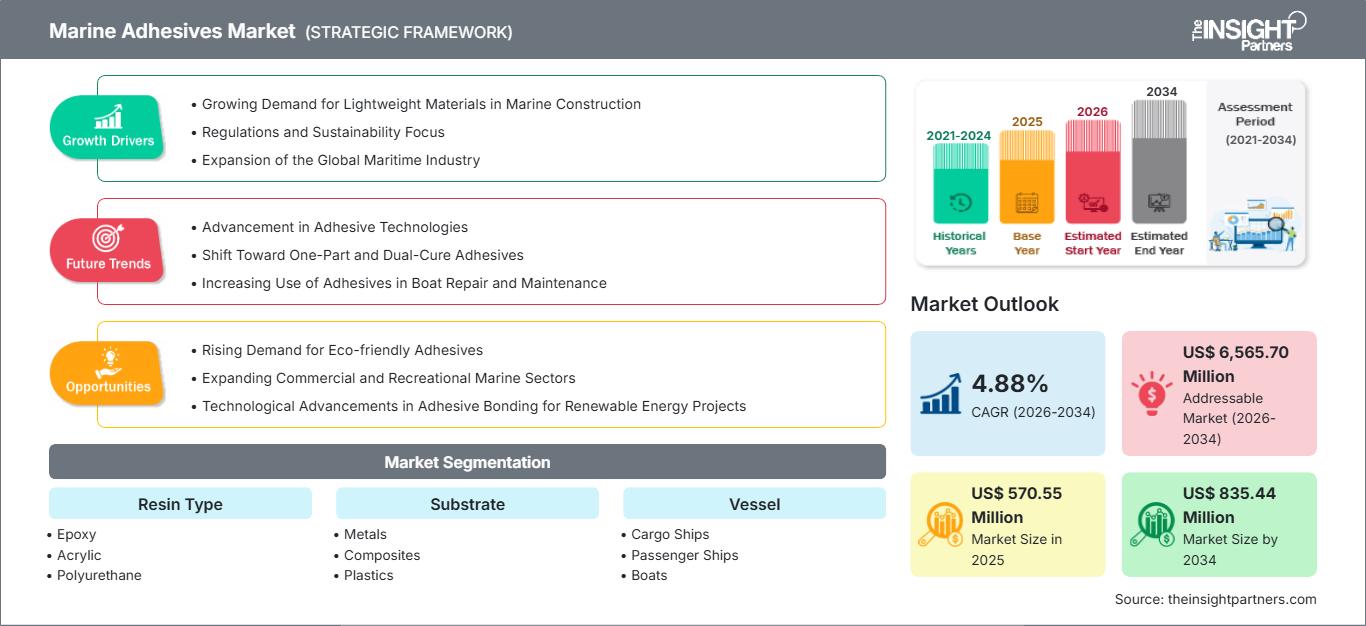
The Marine Adhesives market was valued at US$ 570.55 million in 2025 and is expected to reach US$ 835.44 million by 2034; it is estimated to record a CAGR of 4.33% during 2026-2034.
Marine Adhesives Market Assessment and Insights
- North America: Accounted for 30–34% Marine Adhesives Market share in 2025 and is projected to expand at a CAGR of 4.5–4.9% during 2026–2034. Stable ship repair activities, recreational boating demand, and offshore infrastructure investments continue to support regional consumption.
- U.S.: Represented 76–80% of the North American market in 2025 and is expected to register a CAGR of 4.6–5.0% during 2026–2034, supported by naval modernization programs and strong presence of adhesive manufacturers.
- Europe: Held 27–31% share in 2025 and is anticipated to grow at a CAGR of 4.3–4.7% during 2026–2034. Germany, Italy, Norway, France, and the UK remain major contributors owing to advanced marine engineering and shipbuilding capabilities.
- Asia Pacific: Captured 31–35% share in 2025 and is forecast to record a CAGR of 5.3–5.7% during 2026–2034. China, South Korea, Japan, and India continue expanding shipbuilding capacity while increasing composite vessel production.
- Largest Segment: Polyurethane accounted for 39–43% market share in 2025 and is expected to grow at a CAGR of 4.8–5.2% during 2026–2034, supported by excellent flexibility, weather resistance, and compatibility with multiple marine substrates.
- High Growth Segment: Panel Bonding represented 18–22% market share in 2025 and is projected to expand at a CAGR of 5.7–6.2% during 2026–2034, driven by lightweight vessel construction and increasing use of bonded composite structures.
- Key companies analyzed in detail: Exxon Mobil Corporation, 3M Company, Sika AG, Arkema SA, H.B. Fuller Company, Permabond LLC, Akfix Kimya Sanayi ve Ticaret A.Åž., Pioneer Adhesives Inc., Sealant Supplies Ltd., Principle Adhesives Pvt. Ltd.
Source: The Insight Partners' analysis based on proprietary research, government publications, company annual reports, investor presentations, industry databases, and expert interviews.
Marine construction techniques are moving towards structural bonding solutions that increase durability while minimizing assembly difficulty. With modern adhesive compositions, stronger bonds can be achieved in various materials such as metal, composite, and engineered plastic; this has made it possible to build lighter ships, thereby minimizing the need for maintenance. There has also been increased pressure by growing environmental regulations to come up with solvent-free and low-emission adhesives, and automation in shipyards has increased demand for high-performing dispensing machines and quick-curing adhesive compositions.
In the future, investment will increase in Asia Pacific, Middle East, and selected shipbuilding sites in Europe where governments continue to support local maritime industries. Advances in digital manufacturing, offshore renewable energy construction sites, and ship refurbishments are expected to drive development in new formulations. Sustainable development and circular manufacturing processes, as well as bio-resin technology, will also affect future product development.
Marine Adhesives Market Report Scope
| Report Attribute | Details |
|---|---|
| Market size in 2025 | US$ 570.55 Million |
| Market Size by 2034 | US$ 835.44 Million |
| Global CAGR (2026 - 2034) | 4.33% |
| Historical Data | 2021-2024 |
| Forecast period | 2026-2034 |
Marine Adhesives Market Analysis
Increasing demand from the commercial shipping industry, the recreational boating segment, and naval fleets, owing to their modernization, will continue to drive growth prospects for marine adhesives. Growth opportunities from marine adhesives are expected to be driven largely by the use of lightweight structures where composite materials are used instead of steel structures, which will increase the fuel economy of the vessels and help in reducing lifecycle costs.
Other than the vessel fabrication segment, the aftermarket applications also account for considerable demand for marine adhesives. Adhesives made of polyurethane, epoxy, and acrylic resins are increasingly used by shipyards, maintenance companies, and offshore service providers for applications such as glazing, paneling, deck installation, and repair. Growing investments in offshore wind support vessels, patrol boats, ferries, and luxury yachts are adding diversity to demand. Increasing demand for environmentally friendly adhesive systems will be another growth driver.
Competition is now largely driven by innovative technology, technical services, and tailor-made formulations suited to specific marine environments. Marine adhesives market analysis reveals that companies are focusing more on fast-curing technologies, improved weather resistance, and adhesives capable of bonding dissimilar surfaces without compromising durability. Digital manufacturing technologies and dispensing systems have also emerged as critical factors in competitiveness as shipbuilders look for more efficient and effective production methods.
Prominent players in the Marine Adhesives Market include 3M Company, Sika AG, Arkema SA, H.B. Fuller Company, Permabond LLC, Exxon Mobil Corporation, Akfix Kimya Sanayi ve Ticaret A.Ş., Pioneer Adhesives Inc., Sealant Supplies Ltd., and Principle Adhesives Pvt. Ltd. These companies keep improving their market standings through product innovations, expanding distribution channels, technical alliances, and regional manufacturing operations. Increasing cooperation between marine adhesive producers and yards, composite makers and marine equipment providers helps them create specialized formulations suited to tough environmental conditions and the strict criteria set by customers.
● REPORT CUSTOMIZATION
Tailor This Report To Align With Your Specific Business Requirements
This report can be customized to align precisely with your business objectives, scope, and target markets. Customization options include tailored segmentation, geography, competitive analysis, and strategic insights to support informed decision-making.
Customize This Report →WHAT YOU CAN ADJUST
- ● Segmentations
- ● Geography
- ● Competitive Analysis
- ● Language Preferences
Marine Adhesives Market: Strategic Insights
Regional Insights
North America Marine Adhesives Market
In 2025, the share of North America in the worldwide marine adhesives market was 30–34%, with an estimated CAGR of 4.5–4.9% in the period 2026–2034. The region possesses a well-established marine manufacturing sector, a substantial capacity for ship repair services, and ongoing naval modernization efforts. The other major source of demand in the region is recreational boating, especially in the USA and Canada, where vessel maintenance drives recurring consumption of adhesives for deck, glazing, and bonding applications.
With leading adhesive manufacturers, sophisticated composite producers, and marine engineering specialists in the region, innovation in the products offered remains constant. Due to environmental regulations that favor emissions reduction, solvent-free polyurethane and epoxy adhesive systems have gained widespread acceptance in recent years. Additionally, offshore energy facilities construction and port infrastructure modernization continue to present opportunities for performance bonding solutions, as well as vessel modernization efforts.
U.S. Marine Adhesives Market
In 2025, the US occupied 76–80% of the North American Marine Adhesives market share, and it is expected to register a CAGR of 4.6-5.0% up to 2034. High military spending, an established recreational marine market, and constant investments in commercial vessel maintenance all contribute to adhesive demand. Modern applications range not only from structural bonding but also to glazing systems, insulating panels, decks installation, and lightweight composite bonding to increase vessel efficiency.
US manufacturers have the potential to enable the rapid commercialization of innovative marine adhesives, thanks to 3M Company and H.B. Fuller Company. An increasing tendency toward automation within the shipbuilding and a higher preference for corrosion-resistant bonding systems instead of traditional mechanical fastening improves operational efficiency while minimizing maintenance needs in commercial ships, naval vessels, and leisure marine vehicles.
Europe Marine Adhesives Market
Europe accounted for 27–31% of the global Marine Adhesives market share in 2025 and is estimated to grow at a CAGR of 4.3–4.7% between 2026 and 2034. Germany is the major regional market because of its superior marine engineering technologies, while Italy, France, Spain, the UK, and Norway contribute through shipbuilding, luxury yacht manufacturing, and offshore marine applications.
The United Kingdom continues to see benefits from its developed ship repair sector, naval fleet upgrades, and growth in offshore marine vessels for renewable energy. The growing demand for structural polyurethane and epoxy adhesives comes from maintenance applications, passenger ferries, and specialized defense ships, where lightweight and corrosion-resistant performance is vital.
Germany dominates the European market due to its highly technological manufacturing industry and chemicals and engineering skills needed for marine equipment. France, Italy, and Spain contribute to the market through luxury yacht production, commercial vessel maintenance, and composite boat manufacturing. Sustainability regulation in the region drives demand for eco-friendly adhesives with low VOC emissions.
APAC Marine Adhesives Market
Asia Pacific captured 31–35% of the global Marine Adhesives market in 2025 and is projected to record the fastest regional expansion at a CAGR of 5.3–5.7% during 2026–2034. China leads regional demand, followed by South Korea, Japan, India, and Australia, supported by extensive commercial shipbuilding capacity and increasing production of recreational vessels.
Government initiatives promoting domestic shipbuilding, expanding export-oriented manufacturing, and investments in modern port infrastructure continue strengthening regional consumption. Growing adoption of composite materials across commercial and leisure marine applications further increases demand for high-performance structural adhesives capable of delivering durability under harsh marine operating conditions.
Middle East & Africa Marine Adhesives Market
The Marine Adhesives market in Middle East & Africa is expected to register a CAGR of 4.7–5.1% during 2026–2034, supported by expanding maritime logistics, offshore energy projects, and modernization of commercial ports. Saudi Arabia and the United Arab Emirates remain the primary demand centers, while South Africa continues serving as an important regional ship repair and maintenance hub.
Large-scale infrastructure development, offshore oil and gas operations, and growing investments in marine transportation are encouraging wider adoption of advanced adhesive technologies across vessel construction and maintenance. Increasing focus on economic diversification and regional manufacturing capabilities is also expected to support long-term demand for specialty marine bonding solutions.
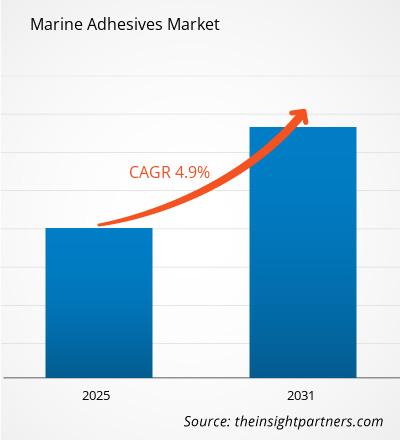
Segmentation Analysis
Resin Type
The Resin Type segment is projected to grow at a CAGR of 4.9–5.3% during 2026–2034. Material selection is largely determined by vessel operating conditions, substrate compatibility, curing requirements, and long-term durability in harsh marine environments. Manufacturers continue developing advanced resin systems that provide superior resistance to moisture, saltwater, ultraviolet exposure, vibration, and thermal cycling while supporting lightweight vessel construction. The marine adhesives market scope continues expanding as shipbuilders increasingly adopt specialized resin technologies for both original equipment manufacturing and maintenance applications.
- Epoxy: Widely used for structural bonding because of its high mechanical strength, excellent chemical resistance, and superior adhesion to metals and composites. It remains the preferred choice for load-bearing marine assemblies and repair operations.
- Acrylic: Offers rapid curing, strong impact resistance, and reliable bonding across multiple substrates. Acrylic adhesives are increasingly adopted where reduced assembly time and improved manufacturing efficiency are important operational priorities.
- Polyurethane: The largest resin category owing to its flexibility, weather resistance, vibration damping, and excellent adhesion to diverse substrates. It is extensively used for deck systems, glazing, sealing, and structural bonding applications.
Substrate
The Substrate segment is expected to register a CAGR of 4.7–5.1% during 2026–2034. Marine adhesive performance depends significantly on substrate characteristics, including surface energy, corrosion resistance, thermal expansion, and structural requirements. Increasing use of lightweight construction materials has encouraged manufacturers to develop specialized formulations capable of delivering durable adhesion across traditional and advanced marine substrates.
- Metals: Steel and aluminum remain essential materials for commercial vessels, naval platforms, and offshore structures. Adhesives reduce galvanic corrosion risks while improving fatigue resistance and minimizing dependence on mechanical fastening systems.
- Composites: Composite materials continue gaining popularity because they reduce vessel weight while improving fuel efficiency. High-performance adhesives enable reliable structural bonding without compromising mechanical integrity or long-term durability.
- Plastics: Engineering plastics are increasingly incorporated into marine interiors, equipment housings, and lightweight structural components. Specialized adhesive formulations provide dependable bonding while accommodating thermal expansion and continuous environmental exposure.
Vessel
The Vessel segment is anticipated to expand at a CAGR of 4.8–5.2% during 2026–2034. Demand varies according to vessel size, operational environment, maintenance frequency, and construction materials. Commercial fleet expansion, recreational boating, and naval modernization continue supporting steady consumption of advanced marine adhesive technologies across multiple vessel categories.
- Cargo Ships: Represent a major source of adhesive demand due to continuous construction, refurbishment, and maintenance activities involving structural panels, insulation systems, deck assemblies, and equipment installation.
- Passenger Ships: Cruise vessels, ferries, and other passenger transport platforms increasingly utilize adhesives to improve interior aesthetics, reduce structural weight, minimize vibration, and enhance passenger comfort through advanced bonding solutions.
- Boats: Recreational boats and small marine craft rely extensively on adhesives for composite hull manufacturing, glazing, deck installation, and interior component assembly, supporting lightweight and durable vessel construction.
Application
The Application segment is forecast to grow at a CAGR of 5.1–5.5% during 2026–2034. Continuous advancements in marine construction techniques have increased the importance of specialized bonding applications that improve structural performance, reduce maintenance requirements, and simplify manufacturing processes across commercial and recreational vessels.
- Deck Systems: Adhesives provide durable attachment of decking materials while enhancing moisture resistance, vibration absorption, and long-term structural stability under demanding marine operating conditions.
- Glazing System: Marine glazing applications require adhesives capable of maintaining transparency, weather resistance, and flexibility while accommodating continuous thermal movement and dynamic structural loads.
- Panel Bonding: This is the fastest-growing application because lightweight composite panels are increasingly replacing mechanically fastened assemblies. Advanced adhesive technologies improve structural integrity, manufacturing efficiency, and corrosion resistance across modern marine vessels.
Opportunity Snapshot
| Segment Name | Revenue Contribution | Trend Tag | Adoption Stage |
| Deck Systems | High | Lightweight Decking | Mature |
| Glazing System | Medium | Panoramic Glazing | Scaling |
| Panel Bonding | High | Composite Hulls | Scaling |
Marine Adhesives Market Growth Drivers and Impact Analysis
Expansion of Global Shipbuilding and Fleet Modernization
Rising investments in commercial shipping, naval vessel replacement, and recreational boating continue to strengthen demand for advanced marine bonding technologies. Countries across Asia Pacific and Europe are expanding shipbuilding capacity to support international trade, offshore energy, and maritime security requirements. Modern vessels increasingly incorporate lightweight composite structures, requiring adhesives capable of delivering high structural strength while resisting saltwater exposure, vibration, and fatigue. Fleet modernization programs also involve refurbishment of aging ships, creating additional demand for high-performance bonding systems used in deck installations, glazing, insulation panels, and interior assemblies. As shipbuilders pursue improved fuel efficiency and lower lifecycle maintenance costs, structural adhesives are becoming an integral component of next-generation vessel manufacturing and maintenance strategies.
Growing Adoption of Lightweight Composite Materials
Marine manufacturers are increasingly replacing conventional metallic assemblies with fiber-reinforced composites to improve fuel efficiency, reduce emissions, and enhance vessel performance. Adhesive bonding enables reliable joining of dissimilar materials without introducing stress concentrations associated with mechanical fasteners. Polyurethane and epoxy technologies are particularly suited for composite hulls, structural panels, and deck systems because they provide flexibility, corrosion resistance, and long-term durability under demanding marine conditions. Growing production of recreational boats, passenger ferries, offshore service vessels, and specialized naval platforms continues to accelerate demand for advanced adhesive formulations optimized for composite construction. These material innovations are expected to remain an important contributor to sustained market expansion.
Increasing Focus on Sustainable Marine Manufacturing
Environmental regulations governing volatile organic compound emissions and hazardous substances are encouraging manufacturers to develop low-emission, solvent-free, and bio-based adhesive formulations. Shipyards increasingly evaluate products based not only on bonding strength but also on environmental compliance, worker safety, and lifecycle sustainability. Manufacturers continue investing in research to improve curing efficiency, recyclability, and raw material sustainability without compromising structural performance. The transition toward greener manufacturing practices is also creating opportunities for innovative resin technologies that support international environmental standards while reducing operational emissions during vessel construction and maintenance. These developments are expected to strengthen long-term competitiveness across the marine adhesive value chain.
Marine Adhesives Market Future Trends
Increasing Integration of Smart and Automated Bonding Technologies
Digital manufacturing is becoming an important element of marine production as shipbuilders adopt automated adhesive dispensing systems, robotic assembly lines, and precision curing technologies. The marine adhesives market trends indicate that manufacturers are developing products with controlled curing profiles, higher application consistency, and compatibility with automated production environments. These innovations reduce material waste, improve bonding accuracy, and shorten assembly cycles for commercial ships, naval vessels, and recreational boats. Integration of digital quality monitoring and predictive maintenance technologies is also expected to improve production efficiency while supporting consistent structural performance throughout a vessel's operational life.
Development of Sustainable High-Performance Adhesive Chemistries
Future product development is expected to focus on bio-based raw materials, lower volatile organic compound emissions, and enhanced recyclability without compromising mechanical strength. Manufacturers are investing in advanced polyurethane, epoxy, and acrylic formulations capable of maintaining long-term adhesion under extreme marine environments while supporting increasingly stringent environmental regulations. Improved resistance to ultraviolet radiation, saltwater exposure, and temperature fluctuations will remain critical design priorities. These technological advances are expected to create competitive differentiation and support broader adoption across commercial shipping, offshore infrastructure, luxury yachts, and emerging marine mobility applications.
Marine Adhesives Market Opportunities
Expanding Investments in Offshore Renewable Energy Support Vessels
The growing offshore wind industry is creating new demand for specialized service vessels, installation ships, and maintenance fleets that require durable structural bonding solutions. Marine adhesives market Forecasts indicate that increasing investments in offshore renewable energy infrastructure will stimulate demand for advanced polyurethane and epoxy systems capable of delivering exceptional durability in harsh marine environments. Manufacturers can capitalize on this opportunity by developing application-specific products for composite components, deck installations, insulation systems, and corrosion-resistant structural assemblies. Strategic collaboration with shipbuilders, offshore engineering contractors, and renewable energy developers is expected to accelerate commercialization of next-generation marine adhesive technologies.
Rising Demand from High-Value Recreational and Luxury Marine Segments
Luxury yachts, premium recreational boats, and customized marine vessels increasingly utilize advanced adhesives to improve aesthetics, reduce structural weight, and enhance passenger comfort. Growing consumer preference for lightweight composite construction, panoramic glazing, and premium interior finishes creates opportunities for manufacturers offering high-performance adhesive formulations with superior weather resistance and long service life. Product differentiation through faster curing, improved flexibility, enhanced ultraviolet stability, and environmentally compliant chemistries can help suppliers strengthen their presence in premium marine applications. Expanding distribution partnerships and technical support capabilities will further improve competitiveness within this high-value market segment.
Recent Developments
- July 2026: Covestro has completed the acquisition of two former Vencorex production sites for HDI derivatives in Rayong, Thailand, and Freeport, Texas, USA. Additional capacities strengthen Covestro’s regional production network and improve supply resilience for coatings and adhesives customersExpanded footprint enhances reliable access to high-performance materials used in automotive, infrastructure, marine, wood furniture, electronics and other industrial applications
- June 2026: Wessex Resins & Adhesives joined MAKE UK Defence, building on three decades at the forefront of UK defence manufacturing. MAKE UK Defence membership marks a new chapter in the company’s growing commitment to the manufacturing industry in the UK.
Frequently Asked Questions

- Comprehensive Market Sizing and Forecast Analysis
- Detailed Segmentation Analysis
- In-Depth Market Dynamics Assessment
- Regional and Country-Level Insights
- Competitive Landscape and Company Benchmarking
- Strategic Business Intelligence
Recent Reports
Testimonials

The Insight Partners provided valuable market intelligence that supported our global go-to-market strategy. Their team was professional, responsive, and attentive to our feedback, providing thoughtful analysis and helpful methodological clarifications throughout the project.
Junmo Kim Chief Financial Officer (CFO), Enertech Co., Ltd.
The Insight Partners' SCADA System Market report is comprehensive, with valuable insights on current trends and future forecasts. The team was highly professional, responsive, and supportive throughout. We are very satisfied and highly recommend their services.
RAN KEDEM Partner, Reali Technologies LTDs
I requested a report on a very specific software market and the team produced the report in a few days. The information was very relevant and well presented. I then requested some changes and additions to the report. The team was again very responsive and I got the final report in less than a week.
JEAN-HERVE JENN Chairman, Future Analytica
We worked with The Insight Partners for an important market study and forecast. They gave us clear insights into opportunities and risks, which helped shape our plans. Their research was easy to use and based on solid data. It helped us make smart, confident decisions. We highly recommend them.
PIYUSH NAGPAL Sr. Vice President, High Beam Global
The Insight Partners delivered insightful, well-structured market research with strong domain expertise. Their team was professional and responsive throughout. The user-friendly website made accessing industry reports seamless. We highly recommend them for reliable, high-quality research services
YUKIHIKO ADACHI CEO, Deep Blue, LLC.
This is the first time I have purchased a market report from The Insight Partners.While I was unsure at first, I visited their web site and felt more comfortable to take the risk and purchase a market report.I am completely satisfied with the quality of the report and customer service. I had several questions and comments with the initial report, but after a couple of dialogs over email with their analyst I believe I have a report that I can use as input to our strategic planning process.Thank you so much for taking the extra time and making this a positive experience.I will definitely recommend your service to others and you will be my first call when we need further market data.
JOHN SUZUKI President and Chief Executive Officer, Board Director, BK Technologies
I wish to appreciate your support and the professionalism you displayed in the course of attending to my request for information regarding to infectious disease IVD market in Nigeria. I appreciate your patience, your guidance, and the fact that you were willing to offer a discount, which eventually made it possible for us to close a deal. I look forward to engaging The Insight Partners in the future, all thanks to the impression you have created in me as a result of this first encounter.
DR CHIJIOKE ONYIA MANAGING DIRECTOR, PineCrest Healthcare Ltd.Reason to Buy
- Informed Decision-Making
- Understanding Market Dynamics
- Competitive Analysis
- Identifying Emerging Markets
- Customer Insights
- Market Forecasts
- Risk Mitigation
- Boosting Operational Efficiency
- Strategic Planning
- Investment Justification
- Tracking Industry Innovations
- Aligning with Regulatory Trends





 Get Free Sample for